AI Recommendations Are Creating Brand Demand—But Search Still Decides Who Captures It
Similarweb data suggests brands recommended by ChatGPT are far more likely to get visited—yet most of that downstream traffic arrives through branded search. Here’s what changed, why it matters for SMEs and agencies, and the practical playbook to capture AI-created demand with the search results you actually control.

AI didn’t kill search. It changed where demand begins—and made the capture moment more competitive.
A new analysis reported by Search Engine Journal cites Similarweb research indicating that when a brand is recommended in ChatGPT, that brand is materially more likely to get a website visit in the following week—and that the majority of those downstream visits arrive via Branded Search.
That combination is the real story: AI can start interest, but search results still decide who collects the click. If your branded search results are messy, incomplete, or crowded with ads, affiliates, marketplaces, or competitors, AI-created demand won’t automatically become revenue.
I’m writing this from the perspective of building and operating at AYSA.ai: a system designed to make AI Search visibility measurable, and to close the gap between “we know what to do” and “it’s live on the website.” Monitoring without execution is a comfort blanket. In 2026, you need an operating system that monitors, prepares, requests approval, and executes accepted changes.
Concise summary

- AI recommendations can increase the probability of a site visit, but the visit often happens after the user runs a branded search.
- Your Brand SERP is now a primary conversion surface—often the first “real” interface users see after an AI suggestion.
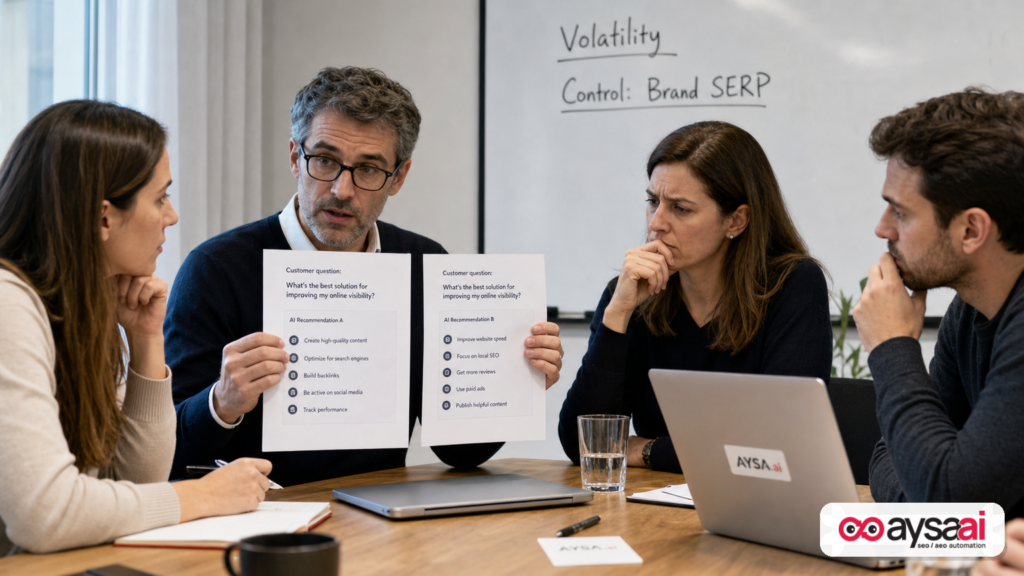
- AI visibility is volatile: the same prompt can yield different recommended brands across runs. Plan for inconsistency.
- Most businesses don’t have a capture strategy: they chase “mentions” but neglect branded search ownership, reviews, listings, schema, and conversion paths.
- Execution speed is the moat. The winners will be the teams that can ship fixes weekly, not quarterly.
Key takeaways (read this if you skim)
- AI is top-of-funnel; branded search is the handoff. Treat branded search as part of your AI strategy, not a separate channel.
- “Being recommended” isn’t the win. Capturing the click, controlling the narrative, and converting the visit is the win.
- Stop measuring only AI mentions. Measure branded search lift, brand SERP ownership, and conversion quality from branded sessions.
- Expect leak paths. If you don’t actively manage brand queries, someone else will: resellers, directories, review aggregators, competitor ads.
- Make changes fast. You need a repeatable workflow for brand SERP fixes, content updates, Structured data, and landing page improvement.
Table of contents
- What changed: AI-created demand is real, but it routes through search
- The new funnel: AI suggestion → branded search → website visit
- What Similarweb’s findings actually suggest (and what they don’t)
- Why “being mentioned by AI” isn’t a strategy
- The Brand SERP is your new homepage
- How you lose AI-created demand (common leakage paths)
- What SMEs should monitor weekly (simple, durable signals)
- What agencies need to rethink in 2026
- Concrete SME scenario: local clinic vs. marketplaces and ads
- A practical action plan to capture AI-driven branded demand
- New AI search KPIs that won’t mislead you
- Where AYSA fits: monitoring + approved execution
- What to do next
- Sources and further reading
What changed: AI-created demand is real, but it routes through search
For most of the last decade, the “search funnel” was simple:
- User searches a problem (“best CRM for plumbers”)
- Google ranks pages
- User Clicks and decides
AI assistants add a new entry point:
- User asks an AI tool for a recommendation (“What’s a good CRM for a small plumbing company?”)
- AI suggests a handful of brands
- User then verifies, compares, or navigates by searching the brand name
The Similarweb pattern reported via SEJ—that many visits happen after branded search—matches what you can observe behaviorally even without fancy tooling. When humans are unsure, they go to the interface they trust for verification: the search engine results page.
That’s why I keep repeating this to founders and marketing leads: your branded search results are no longer a hygiene item. They are now one of the most important conversion surfaces you have—often the first place a user goes after an AI recommendation.
The New Funnel: AI Suggestion → Branded Search → Website Visit
This is the practical model businesses should adopt:
- AI creates a short list (you may or may not appear)
- The user runs a branded search to validate the suggestion
- The Brand SERP determines what the user believes and where they click
- Your landing experience determines whether it becomes a lead/sale
If you focus only on step 1 (getting recommended), you’re ignoring steps 2–4 where money is actually made.
And this is where older SEO instincts still matter:
- Clear site architecture and fast pages
- Trust signals and reviews
- Accurate listings (especially local)
- Structured data to reduce ambiguity
- Brand content that answers “Is this legit?” questions
AI search changes the path, not the need for fundamentals.
What Similarweb’s findings actually suggest (and what they don’t)
Based on the SEJ coverage of Similarweb’s report, the headline claim is directional: brands recommended by ChatGPT were more likely to receive a site visit within a week than brands not recommended.
Two details matter even more than the headline:
- A large share of that downstream traffic arrived via branded searches.
- Those users showed deeper engagement on-site (more pages, more time) compared with other discovery routes (as reported by SEJ).
What you should not do with this data:
- Assume causation. Correlation is not proof that AI caused longer sessions; it may simply be that AI-primed users are higher-intent or more curious.
- Build a forecast model around a single multiplier. The “2.5x” is compelling, but it’s reported for a specific dataset and context (SEJ notes limitations like US desktop and certain industries). Treat it as a signal, not a budget spreadsheet.
- Ignore device and category differences. Mobile behavior, local intent, and ecommerce conversion cycles differ significantly. SEJ notes Similarweb intends to expand coverage.
Still, the core implication is useful and actionable: AI tools can push people toward brand queries, and that makes brand query ownership a first-class marketing priority.
Why “Being Mentioned by AI” Isn’t a Strategy
Here’s the uncomfortable truth: AI recommendations are not stable inventory.
The SEJ article references related work by SparkToro showing that AI tools can return different recommended brands across repeated versions of the same query. If the “recommendation slot” is inconsistent, then any plan that depends on consistently being listed is fragile.
That volatility changes how you should invest:
- Don’t treat AI as a channel you can fully buy or fully control. Treat it as a demand shaper.
- Invest in the surfaces you can control: your site, your listings, your brand SERP, your conversion assets, your reputation.
- Build resilience: if the AI mentions go down this month, branded search capture and conversion should keep you afloat.
If you’ve been around SEO long enough, you’ve seen this movie: businesses used to chase featured snippets and answer boxes as if they were permanent. Then layouts changed. Then features moved. Then traffic patterns shifted. The winners weren’t the ones who chased the feature; they were the ones who built a brand and a conversion engine.
AI is a bigger version of that same lesson.
The Brand SERP as Your New Homepage
Most non-SEO people think about their website homepage as the first impression. In reality, for many users, the first impression is now:
- Your brand query results on Google
- Your Google Business Profile (if local)
- Review snippets and “best of” roundups
- Ads above your organic listing
- Marketplace listings that look “official”
So what does it mean to treat the Brand SERP like a homepage?
The goals of a strong Brand SERP
- Clarity: the user immediately understands the official site and what you do.
- Trust: reviews, reputable mentions, and accurate business info support the AI suggestion.
- Control: you occupy as many top positions as possible with your own properties (site pages, social profiles, listings) rather than intermediaries.
- Conversion shortcuts: the user can call, book, buy, or contact without friction.
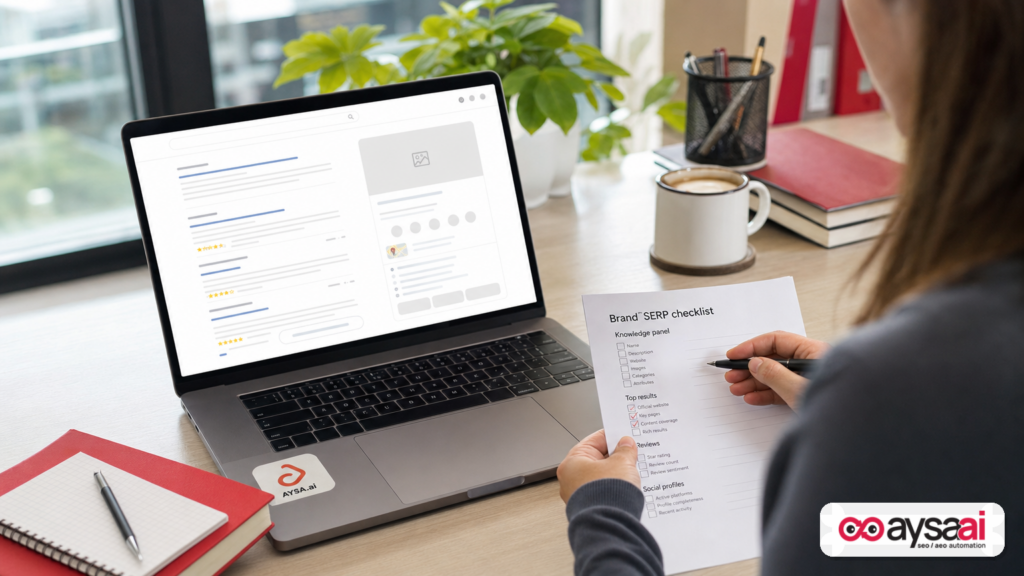
A practical Brand SERP checklist (SME-friendly)
You don’t need to be an SEO expert to run this checklist:
- Search your brand name in an incognito window. Do you see your official site first? If not, that’s urgent.
- Is your title and description clear? If someone only reads the blue link and snippet, do they understand what you sell?
- Are competitors bidding on your brand? If yes, decide whether to defend with paid search (more on that later).
- Do review sites dominate? If yes, improve your review acquisition and ensure your official pages satisfy comparison intent.
- Is your Google Business Profile correct? Hours, phone, website, categories, services, appointment links.
- Are there “parasite” pages outranking you? Coupon pages, reseller pages, thin affiliate pages—these are demand thieves.
This is not a “nice to have.” If AI sends a user to search your brand, this is where the decision happens.
How you lose AI-created demand (common leakage paths)
Let’s talk about where the money leaks out. In 2026, the most common leakage paths I see are not technical SEO bugs. They’re ecosystem problems.
1) Competitor ads on your brand name
If a competitor can show above your organic result when someone searches your brand, you’re effectively paying a “toll” on every AI-created impression you earned.
This is why paid search and SEO can’t be siloed. Even if you rank #1 organically for your brand, ads can intercept intent.
2) Affiliates, coupons, and “promo code” pages
In ecommerce and subscriptions, coupon and affiliate pages often outrank official pages for brand queries that include “discount,” “promo code,” or “coupon.”
If AI recommendations increase branded search volume, those pages scale their capture too—unless you actively manage your branded SERPs and create official alternatives.
3) Marketplaces and resellers that look like the official source
For product brands, marketplaces can take the click from users trying to verify legitimacy. For local services, lead-gen directories can do the same.
The user thinks they’re “going to your brand,” but they land on an intermediary that takes a cut, controls pricing, or sells competing options.
4) Review aggregators owning your narrative
If the first page is stacked with review pages, the user’s perception is shaped before they ever see your messaging. This is sometimes earned, sometimes not. Either way, it means you must invest in reputation management and credible third-party proof.
5) Confusing or outdated snippets, sitelinks, and knowledge information
Wrong phone numbers, old brand names, outdated “about” statements—these kill conversion and add friction. With AI-created demand, friction becomes a direct tax on growth.
What SMEs should monitor weekly (simple, durable signals)
Most businesses overcomplicate measurement. You don’t need 40 dashboards; you need a few signals you can act on.
1) Branded search demand
Watch the trend of people searching your brand name and close variants. If you see branded demand rising while non-branded traffic is flat, that can still be a win—because brand demand is often higher intent and converts better.
Practical note: many teams use Google Search Console for this, but the specific setup depends on your property structure and naming conventions. If you can’t confidently separate branded and non-branded queries, fix that first.
2) Brand SERP ownership
Track what appears on page one for your brand terms:
- Your official homepage
- Key category/service pages
- About, contact, reviews/testimonials
- Google Business Profile panel (for local)
- Social profiles
- Top third-party results (and whether they help or hurt)
If this changes week to week, you need a system to notice and respond.
3) Engagement quality on branded sessions
If Similarweb’s pattern holds directionally (AI-influenced brand visitors engage deeply), you want to confirm whether your branded sessions:
- Convert (forms, calls, purchases)
- Reach key pages (pricing, booking, product pages)
- Don’t bounce due to mismatch or slow UX
This is where GA4 can help—but only if you’ve configured conversions and key events properly. If you haven’t, you’re making decisions with blurry lenses.
What agencies need to rethink in 2026
If you run an agency (or hire one), AI search shifts the value proposition. “We’ll write blog posts and build links” is not enough on its own. The opportunity is bigger—but it requires integration and speed.
AI search is forcing cross-functional delivery
When the user path is AI → branded search → site, success depends on:
- SEO (indexation, content, technical)
- Paid search (brand defense, competitor conquesting policies)
- Reputation (reviews, listings, PR mentions)
- Conversion (landing pages, offers, UX)
Agencies that stay siloed will underperform. Agencies that orchestrate the full capture layer will win.
Shipping becomes the competitive advantage
Many agencies can diagnose problems. Fewer can ship fixes quickly because of approvals, dev queues, CMS limitations, and stakeholder chaos.
The best teams will operationalize a cadence:
- Weekly monitoring
- Bi-weekly prioritized change list
- Fast approvals
- Execution that doesn’t stall on “we’ll ask the dev team”
This is exactly where automation must be paired with governance—changes should be prepared automatically, but executed only after approval.
Concrete SME scenario: a local clinic competing with directories and ads
Let’s make this real with a scenario that mirrors what I see constantly.
The business
A two-location physical therapy clinic in a mid-sized US city. Strong word-of-mouth. Modest marketing team: the owner plus a part-time marketer.
What changes with AI recommendations
A potential patient asks an AI assistant: “What’s a good physical therapy clinic near me for a runner’s knee?”
The AI suggests a few local options (sometimes including the clinic). The patient then searches the clinic name.
Where the clinic loses the patient
- Competitors run ads on the clinic brand name.
- Two directory sites outrank the clinic’s “Appointments” page.
- The clinic’s Google Business Profile has outdated hours.
- The clinic site has no clear “Book now” path for the exact service the user wants.
The clinic was “recommended,” but it didn’t capture the demand. It paid the price in lost bookings—without ever knowing the leak happened.
What winning looks like
- Brand defense ads (if needed) that point to a high-converting booking page.
- A service page that matches intent (“Runner’s knee physical therapy”), clearly branded, fast, and conversion-focused.
- Updated GBP with correct hours, services, and appointment links.
- Reputation plan to increase review velocity and quality across trusted platforms.
- Brand SERP monitoring so directories don’t silently take over.
This is not an “SEO project.” It’s a revenue capture system.
A practical action plan to capture AI-driven branded demand
Below is a playbook you can run whether you’re an SME, an in-house team, or an agency. It’s designed for the reality that AI creates volatile exposure, but branded search capture can be engineered.
Step 1: Build a branded query map
List your brand query universe:
- Brand name
- Brand + product/service
- Brand + reviews
- Brand + pricing
- Brand + coupon/promo (if relevant)
- Brand + login/support (if SaaS)
- Brand misspellings
For each, define the ideal landing page and the risk pages (directories, affiliates, competitor ads).
Step 2: Clean up the “official” path
Make sure the user can find the official path quickly:
- Homepage and key pages have clear titles and descriptions
- Contact/booking paths are prominent
- About page establishes legitimacy
- Policies are visible (shipping/returns for ecommerce, insurance/payment for clinics)
This reduces the need for users to “keep searching,” which is when competitors and intermediaries intercept.
Step 3: Strengthen trust signals that show up in search
Trust is not just on your website; it’s in the ecosystem. Focus on:
- Consistent business info across listings
- Review acquisition processes
- Credible third-party mentions (earned, not spammy)
If AI is recommending you, the user will look for confirmation. Make confirmation easy.
Step 4: Decide on brand paid search (defense) intentionally
This is a business decision, not a moral one.
- If competitors are bidding on your brand, you may need defense.
- If your organic listing is clean and dominates, you may not.
- If intermediaries are taking the click, a paid ad pointing to the correct landing page can be a stopgap while you fix organic ownership.
The key is to evaluate this as a capture layer for AI-created branded demand.
Step 5: Create “verification pages” that match AI-driven skepticism
AI recommendations often create curiosity—users want to verify:
- “Is this legit?”
- “Is it right for my situation?”
- “How much does it cost?”
- “What’s the catch?”
Create pages that answer these directly:
- Pricing or “how pricing works”
- Comparisons (careful, factual, non-defamatory)
- Use-case pages
- Reviews/testimonials (compliant, authentic)
This is content SEO, but with conversion intent.
Step 6: Instrument the journey
You can’t manage what you can’t observe. At minimum:
- Track branded queries and clicks
- Track brand landing pages and conversion rates
- Track top referral sources and “leakage” domains if possible
If you don’t know where branded searchers land and what they do next, you’re guessing.
Step 7: Establish a weekly shipping cadence
The teams that win will not be the ones with the best strategy deck. They will be the ones that ship improvements continuously.
Set a cadence:
- Monday: review monitoring insights (SERP changes, query changes)
- Tuesday: prioritize changes
- Wednesday: prepare updates (titles, content, schema, internal links, GBP edits)
- Thursday: approval
- Friday: execute and validate
This is what turns AI volatility into a manageable operating rhythm.
New AI search KPIs that won’t mislead you
A lot of AI-search measurement is currently vanity-driven. Here are KPIs that stay useful even if AI interfaces change.
1) Branded query growth (and share of branded vs. non-branded)
If AI exposure increases brand awareness, branded demand should trend upward over time. Watch it alongside conversions so you don’t celebrate empty interest.
2) Brand SERP ownership score (internal)
Create a simple internal score for your brand SERP:
- How many of the top 10 results are yours?
- Are the “risk” domains present (directories, affiliates, competitors)?
- Is the messaging accurate?
This is not a public metric. It’s an operational metric that forces accountability.
3) Branded conversion rate and assisted conversions
Branded traffic often converts better. If it doesn’t, you may have a trust issue, UX issue, or mismatch between what people believe (from AI/search) and what they see on your site.
4) Time-to-ship for capture fixes
Measure how long it takes you to implement a change once you identify it. In AI search, speed is a strategic advantage.
Where AYSA fits: monitoring + approved execution (so you actually ship)
At AYSA.ai, our philosophy is simple: visibility is not the endpoint. Execution is the endpoint.
That’s why AYSA is built as an execution system for SEO/AEO/GEO:
- Monitor search visibility signals and surface changes that matter
- Prepare recommended website updates and fixes
- Ask for approval (because businesses need governance and brand control)
- Execute accepted changes on the website so progress compounds
If you’re trying to capture AI-created demand through branded search, you need exactly this loop—because the work isn’t one big project. It’s ongoing, iterative, and tied to how your brand appears across search surfaces.
Relevant AYSA resources
- AI search visibility: understand and improve how your brand shows up as AI changes discovery.
- Monitoring: track the signals that indicate demand, capture, and leakage.
- AI SEO tools: support SEO/AEO/GEO workflows without turning into reporting theater.
- Pricing: choose a plan aligned to your execution cadence and team structure.
- AYSA blog: ongoing playbooks and field notes for modern search.
In practical terms: AYSA helps you stop treating brand SERP capture and AI visibility as “research.” It becomes an operational loop that produces shipped improvements.
What to do next
If you want a clear next step, do this in order:
- Run a Brand SERP audit for your top 5–10 branded queries (brand, brand + reviews, brand + pricing, etc.). Note what’s missing and what’s stealing clicks.
- Identify your “official path” pages and ensure each has clear titles/snippets, strong trust signals, and a direct conversion action.
- Fix your business ecosystem data: listings, GBP (if local), and key profiles. Remove outdated info.
- Instrument conversions (forms, calls, bookings, purchases) so branded traffic is measurable.
- Establish a weekly shipping cadence so improvements don’t get stuck in backlog.
- Adopt an execution system that monitors and helps you ship—this is where AYSA can be the operating layer.
Sources and further reading
- Search Engine Journal: AI-Recommended Brands Saw 2.5x More Site Visits: Similarweb
- Search Engine Journal: Latest news (context on AI + search changes)
- Search Engine Journal: SEO coverage (brand SERP, technical, strategy)
- AYSA: AI search visibility
- AYSA: Monitoring
- AYSA: AI SEO tools
- AYSA: Pricing
- AYSA: Blog
Note on source boundaries: This editorial uses the SEJ report as research input and does not reproduce it. Where the underlying Similarweb report or SparkToro analysis is referenced in the SEJ coverage, I treat those as directional insights rather than definitive forecasts, and I avoid adding unverified figures beyond what’s stated in the supplied context.
Continue the AI search topic inside AYSA.
Use these pages to connect the article with AI SEO tools, AI visibility monitoring, AI Overviews and approved website execution.
Turn this topic into a website action plan.
Use these AYSA hubs to move from reading to technical fixes, AI visibility monitoring, research, glossary context and approval-first SEO execution.