
AI Search Broke Your Global SEO Org Chart: A Practical Ownership Playbook for Modern Brands
AI-powered search is collapsing country boundaries and amplifying inconsistencies across your sites, listings, and knowledge. Here’s a practical ownership and governance playbook—built for SMEs, agencies, and global teams—plus a step-by-step action plan and how AYSA operationalizes approved execution at scale.
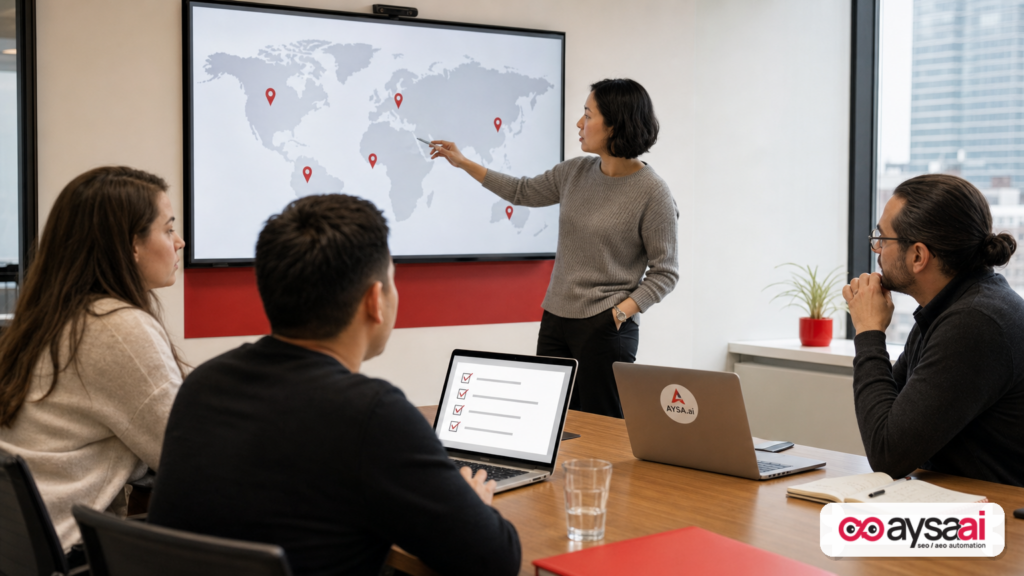
AI Search didn’t just change how people discover brands. It changed how brands need to organize to be discoverable.
If you’re responsible for growth, marketing, or web operations across multiple markets—countries, languages, regions, or even just many locations—here’s the uncomfortable truth: the old global SEO operating model was built for an era when each market could “mostly mind its own business.” That era is ending.
Large language models (LLMs) and AI-powered search experiences can translate, summarize, and fuse information from many places at once. That sounds helpful—until one small inconsistency in one country leaks into the “answer” your next customer sees in another. And when that happens, it’s rarely framed as “SEO.” It shows up as:
- Incorrect pricing, availability, or policies in AI answers
- Conflicting brand claims across markets
- Mismatched product names, model numbers, or service definitions
- Local regulation advice that’s accurate in Market A but risky in Market B
- Brand trust erosion—before traffic even drops
This article is my practical playbook for what to do about it: the ownership decisions you must make, the governance you must implement, and the operating rhythm you need so changes actually ship—without turning every page update into a global committee meeting.
I’m writing from the perspective of building execution systems at AYSA.ai: Monitoring what’s happening, preparing the right changes, requesting approval, and executing accepted updates on your site. The governance conversation is pointless if it doesn’t end in consistent execution.
Concise summary
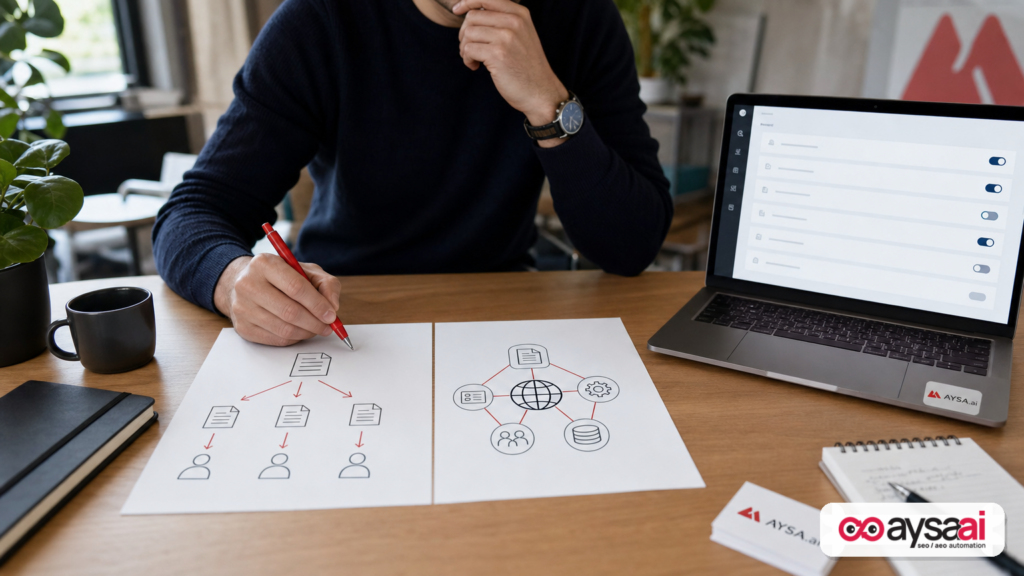
- What changed: Search is shifting from retrieving pages to synthesizing answers. That makes knowledge consistency across markets as important as rankings.
- Why it matters: AI systems amplify contradictions. “Small local differences” become global confusion, which can reduce visibility and trust.
- What to do: Make ten explicit ownership decisions (centralized, local, shared), install a lightweight governance cadence, and operationalize a monitor → prepare → approve → ship workflow.
- Where AYSA fits: AYSA helps you monitor issues, prepare updates, route approvals to the right owners, and execute accepted changes—so governance isn’t just a document.
Key takeaways (for busy operators)

- Hreflang and localization still matter—but they don’t govern what AI “believes” about your brand.
- Ownership is now an SEO ranking factor in disguise: if nobody owns definitions, policies, and entity consistency, AI answers will drift.
- Centralize what creates enterprise risk when inconsistent (technical standards, Structured data standards, entity taxonomy, bot policies, measurement).
- Localize what requires local expertise (regulatory context, terminology, customer expectations, local Authority Building).
- Share what must be both consistent and locally true (product knowledge, brand representation monitoring, escalation).
- Execution is the bottleneck. The winners will ship more correct updates, faster, with fewer mistakes.
Table of contents

- What changed: from “routing pages” to “governing knowledge”
- Why AI search exposes weak governance
- Hreflang solved routing, not understanding
- A simple ownership model: risk vs. expertise
- The 10 ownership decisions that now determine AI visibility
- What goes wrong when ownership is unclear (realistic failure modes)
- A concrete SME scenario: the multi-location clinic that lost trust (not just traffic)
- What agencies and in-house teams must rethink
- Measurement in the AI era: what to track without making up numbers
- A 90-day action plan you can actually run
- How AYSA makes governance executable: monitor → prepare → approve → ship
- What to do next
- Sources and further reading
What changed: from “routing pages” to “governing knowledge”
For most of SEO history, global teams optimized for two things:
- Discoverability (can Google crawl and index the right pages?)
- Relevance (does the local page match local queries and intent?)
International SEO mechanics—localized URLs, hreflang, Internal linking, sitemaps, region-specific content—were largely about routing users and crawlers to the right destination.
AI-powered search changes the unit of competition. It’s less “which page ranks” and more “which representation of your brand gets used in answers, comparisons, recommendations, and summaries.” That representation can be built from:
- Your own websites across countries
- Third-party sources (reviews, directories, marketplaces)
- Regulatory or industry sources
- Creator content and PR
- Structured data and entity signals
So now you’re not just managing websites by country. You’re managing an enterprise knowledge system—whether you admit it or not.
This editorial builds on the governance argument raised by Motoko Hunt in Search Engine Land: AI search is forcing global SEO teams to rethink ownership and decision rights across markets. Read the original for additional context: Why AI search is forcing global SEO teams to rethink ownership.
Why AI search exposes weak governance
AI systems are great at one thing that creates real business pain: they connect dots you didn’t realize were connected.
In the old model, a mistake on your Spanish site mostly hurt Spain. A pricing inconsistency between France and Canada might be annoying internally, but each market lived in its own search bubble.
AI collapses those bubbles by:
- Translating at scale (so “local-only” content is no longer local)
- Synthesizing across sources (so contradictions become visible)
- Preferring coherent narratives (so the market with the clearest, most consistent signals wins)
- Highlighting trust and specificity (so generic translated content can look thin)
That’s why governance becomes a growth lever. If your organization can’t answer basic questions like “who owns the definition of this product?” or “who approves regulatory language per country?” you don’t have a search strategy—you have a set of loosely related websites.
Governance isn’t bureaucracy. It’s decision speed.
The anti-governance argument is always the same: “We’ll slow down.”
The truth I’ve seen: lack of governance slows you down more. You spend cycles:
- Debating whose job it is
- Undoing conflicting changes
- Fixing avoidable errors after they spread
- Rebuilding trust with customers and partners
Good governance is fast. It sets decision rights so the right people can say “yes” without chaos—and say “no” without politics.
Hreflang solved routing, not understanding
Many global teams are still anchored to a checklist version of international SEO: “We have hreflang; we’re covered.”
Yes, hreflang remains important for search engines to understand language and regional targeting. But hreflang does not:
- Resolve contradictions between markets
- Tell AI which version is authoritative for a policy question
- Prevent a translated page from being treated as duplicative or low-value
- Guarantee local expertise signals are visible
In AI search, “routing” is only step one. The hard part is understanding and representation: what the system concludes about you when it fuses sources.
A simple ownership model: risk vs. expertise
If you take nothing else from this article, take this model. It’s how I’d explain global AI-search governance to a founder, a CMO, or a COO with no patience for SEO jargon.
Centralize decisions that create enterprise risk if inconsistent.
Localize decisions that require local expertise to be accurate and trusted.
Share decisions that must be globally consistent and locally true.
That’s it. Three buckets. Then you implement decision rights and workflows that match those buckets.
What counts as “enterprise risk” in AI search?
Enterprise risk is anything that, when implemented differently across markets, creates one of these outcomes:
- Brand misrepresentation (AI answers contradict your real offer)
- Regulatory exposure (wrong advice in a medical/financial/legal context)
- Indexation and crawl failures (bots blocked or misrouted)
- Measurement chaos (you can’t compare markets or detect issues early)
What counts as “local expertise” that AI rewards?
Local expertise is anything that only people close to the market can reliably provide:
- Terminology customers actually use
- Regulations and compliance phrasing
- Shipping/returns realities
- Local competitive landscape
- Local partnerships, citations, and authority signals
AI systems increasingly reward specificity. The local teams are the source of that specificity—if you let them publish it.
The 10 ownership decisions that now determine AI visibility
Search Engine Land’s article usefully frames this as 10 ownership decisions. I agree with the structure, and I’ll expand it into a more operational playbook: what each decision means, what can go wrong, and what “good” looks like for SMEs and global teams.
1) Technical SEO standards (typically centralized)
What it includes: crawl/index rules, canonicals, pagination patterns, internal linking standards, structured data patterns, XML sitemaps, URL conventions, performance baselines, and general technical hygiene.
Why centralize: Search engines and AI bots don’t evaluate your business “one country at a time.” They evaluate your overall footprint. If each market implements technical patterns differently, you create:
- Inconsistent parsing of structured data
- Indexation gaps you can’t diagnose quickly
- Conflicting canonicalization that causes the wrong page to be treated as primary
What good looks like: one global technical standard, with a documented exception process when a market has a legitimate constraint.
How AYSA helps: continuous monitoring and change proposals so standards don’t live in a PDF. Start with AYSA Monitoring.
2) CMS and infrastructure governance (typically centralized)
What it includes: templates, components, deployment workflow, plugins/apps, redirects, localization framework, and who can publish what.
Why centralize: Fragmented infrastructure creates inconsistent capabilities. One market can implement schema, another can’t. One market can fix hreflang, another is blocked by a legacy platform. AI-era visibility requires the ability to ship consistent improvements.
What good looks like: shared platform foundations with guardrails; local teams get flexibility inside approved components.
3) Entity definitions and taxonomies (typically centralized)
What it includes: product/service naming standards, category taxonomies, brand relationships, location entities, and the “source of truth” for what things are.
Why centralize: AI systems are entity-driven. If your “same” product is described with different names, features, and relationships across markets, the model may treat them as different items—or mash them together incorrectly.
What good looks like: a canonical taxonomy plus local mappings (synonyms, localized terms) that maintain consistency without forcing unnatural language.
Related research lead: Search Engine Land has covered entity footprint auditing: How to audit your AI entity footprint.
4) AI crawler and bot governance (typically centralized, with local exceptions)
What it includes: robots.txt and bot allow/deny, rate limiting, geo-routing behavior, server logs monitoring, and policies for AI agents and crawlers.
Why centralize: If one market blocks access, it can distort global understanding—especially when systems synthesize across markets. Also, bot policies can create legal/security implications.
What good looks like: one policy, one logging standard, one escalation path, and a controlled way for local markets to request exceptions.
Context lead: Even major AI products have had indexing mishaps when bot controls weren’t configured. Search Engine Land reported on a case where private chats were indexed because they weren’t blocked: Google indexed Claude Chats because Anthropic didn’t block your private chats from search engines. The specific incident isn’t your situation, but the governance lesson is universal: bot access is an ownership decision, not a “developer detail.”
5) Measurement and reporting frameworks (typically centralized)
What it includes: what counts as a conversion, which KPIs matter, how to segment by market, dashboards, and definitions for “visibility” in AI-driven experiences.
Why centralize: If each market reports differently, HQ can’t spot drift. AI-era issues may first appear as weird brand representation, not a clean ranking drop, so you need consistent detection.
What good looks like: comparable market reports, plus room for local add-ons that reflect local business reality.
Related reading lead: Search Engine Land’s discussion about measuring outcomes beyond simplistic attribution is relevant: Attribution vs. incrementality: Why you need both.
6) Market-specific content (typically localized)
What it includes: local landing pages, regulatory pages, market FAQs, local customer stories, local service details, pricing, availability, shipping/returns, and terminology.
Why localize: AI systems can translate content, but translation alone doesn’t produce market credibility. A local team understands the nuance of what customers ask, what they fear, what they compare, and what compliance requires.
What good looks like: global content frameworks (structure, brand tone, required claims) + local ownership of final meaning and truth.
Related reading leads:
- How semantics and topical authority improve local SEO
- The data-backed case for publishing less content (useful reminder: more pages isn’t the same as more authority)
7) Audience and search behavior research (typically localized)
What it includes: query patterns, intent differences, language nuances, local competitors, and the “jobs to be done” behind searches.
Why localize: A direct translation of HQ keywords often targets the wrong intent. The same product can be searched as “best,” “cheap,” “near me,” “official,” or “compliant” depending on market norms.
What good looks like: local teams lead research; HQ provides tools, taxonomy, and reporting standards.
8) Local authority building (typically localized)
What it includes: citations, partnerships, PR, local directories, local reviews, local creator relationships, and local community signals.
Why localize: Trust is regional. Authority isn’t a single global score; it’s earned in the market where customers live and where institutions matter.
What good looks like: local teams own relationships; HQ provides brand standards and risk guardrails.
Related reading lead: Creator content increasingly intersects with AI visibility. Search Engine Land argues for incorporating it into AI search strategy: Why creator content belongs in your AI search strategy.
9) Product and knowledge management (typically shared)
What it includes: product catalogs, service definitions, availability, warranty terms, claims substantiation, and how knowledge changes are published and propagated.
Why shared: HQ needs consistency; local needs accuracy. Product reality differs by market: different SKUs, legal disclaimers, service bundles, or timelines.
What good looks like: HQ defines the system of record; local validates and annotates; changes flow both directions with timestamps and approvals.
10) AI visibility and representation (typically shared)
What it includes: monitoring how your brand appears in AI answers, identifying misrepresentations, escalating fixes, and ensuring local correctness without fragmenting the global narrative.
Why shared: Representation problems can originate anywhere. A local market may spot a wrong policy summary; HQ may see it spreading across regions.
What good looks like: a single escalation playbook with clear owners and remediation steps—content updates, structured data adjustments, authoritative page improvements, or third-party corrections.
How AYSA helps: this is exactly what AI Search Visibility should mean operationally: detect issues, prepare changes, route approval, and ship updates.
What goes wrong when ownership is unclear (realistic failure modes)
Most global SEO failures in the AI era won’t sound like “we need more backlinks.” They’ll sound like operational pain:
Failure mode #1: “We have five versions of the truth.”
Your US site says the product is available in 48 hours. The UK site says 3–5 business days. The DE site says “depends on region.” Support docs say something else. AI compiles a single answer that is wrong for at least one market—maybe all of them.
Ownership fix: shared product knowledge management with a clear source-of-truth and local validation.
Failure mode #2: “Local teams can’t publish expertise.”
HQ provides a global template and forbids deviation. Local teams publish translated copies. AI sees duplicative content, and the market loses visibility because nothing signals local expertise.
Ownership fix: localized content ownership within global frameworks.
Failure mode #3: “Technical drift kills crawlability.”
One market deploys a new CMS plugin that breaks canonicals. Another blocks bots during a site migration and forgets to undo it. Suddenly, the global brand footprint looks inconsistent to systems evaluating it holistically.
Ownership fix: centralized technical standards + centralized bot governance + a reliable execution workflow.
Failure mode #4: “Nobody owns third-party truth.”
Reviews, directory listings, and marketplace descriptions become the easiest source for AI to cite—especially if your own pages are thin or inconsistent. But nobody is accountable for correcting them.
Ownership fix: local authority building ownership, with central guardrails and monitoring.
Context lead: as AI systems integrate third-party review ecosystems, governance matters. Search Engine Land reported on ChatGPT gaining access to Yelp reviews, ratings, and photos: ChatGPT gains access to Yelp reviews, ratings, and photos.
Failure mode #5: “We can’t tell if we’re winning.”
Traffic patterns change, SERP layouts shift, AI answers reduce clicks, and your reporting can’t distinguish between a visibility issue, a measurement issue, and a conversion issue.
Ownership fix: centralized measurement definitions, plus a blended CAC view (where SEO influences paid efficiency and downstream conversions).
Related reading lead: How SEO reduces blended customer acquisition costs.
A concrete SME scenario: the multi-location clinic that lost trust (not just traffic)
Let’s make this real with a scenario I see constantly in the SME world—because you don’t need to be a multinational enterprise to have “global” governance problems.
Business: a regional medical clinic group with 12 locations across two states, plus telehealth.
What they did historically:
- Each location had its own page.
- Front desk managers updated hours “when needed.”
- Marketing owned the main site copy.
- Operations owned policies (insurance, cancellations).
- No single owner reconciled conflicts.
What changed with AI search: Patients started asking AI-driven tools questions like:
- “Does this clinic accept my insurance?”
- “What’s the cancellation policy?”
- “Can I do telehealth for this issue?”
The AI answer blended sources:
- An outdated location page (old hours)
- A third-party directory listing (old phone number)
- A generic policy page (not updated after a change)
The outcome: fewer appointments weren’t the first symptom. The first symptom was increased friction—more calls, more confusion, more no-shows, and more reputation damage.
The ownership problem: nobody “owned” the knowledge layer. Everyone owned a piece, but no one owned consistency.
The fix (practical):
- Centralize templates, structured data, and measurement.
- Localize location page details and local FAQs (owned by location manager, reviewed monthly).
- Share policy content ownership between operations (truth) and marketing (clarity), with legal review when needed.
This is AI-era SEO in plain English: not rankings. Operations.
What agencies and in-house teams must rethink
AI search pressures the traditional SEO org structure in two ways:
- It expands the surface area of “SEO work” into product, legal, customer support, listings, PR, and analytics.
- It shortens the time between inconsistency and impact, because synthesis spreads errors faster.
Agencies: move from deliverables to decision systems
If you’re an agency, clients will still ask for audits, content plans, and technical fixes. But what they increasingly need is:
- Help defining ownership and approval workflows
- A cadence that prevents drift (not a one-time cleanup)
- Evidence that updates were executed correctly
This is where an approved-execution model matters. A recommendation that isn’t implemented is not strategy—it’s theater.
If you’re building a scalable service, pair your strategic work with a system that executes. AYSA is built for that kind of operational reliability: you can explore the toolset at AYSA AI SEO Tools and the workflow at Monitoring.
In-house teams: SEO becomes a cross-functional PM function
In-house SEO leadership increasingly looks like product management:
- Defining standards
- Managing stakeholders
- Prioritizing changes
- Coordinating releases
- Owning measurement
That may sound like “more meetings.” The better interpretation is: SEO is finally being treated like a business system, not a marketing channel.
Measurement in the AI era: what to track without making up numbers
Because I’m not going to invent statistics, here’s what I recommend tracking as a practical baseline—especially for SMEs and mid-market teams that can’t build a data science stack.
1) Technical health and indexation consistency
- Indexation coverage by market and template type
- Canonical consistency checks
- Structured data validity (and consistency across markets)
- Server log signals for major bots and crawlers (where available)
2) Content differentiation (local uniqueness with global consistency)
- Which pages are near-duplicates across markets?
- Where do local pages add real expertise (regulations, terminology, FAQs)?
- Which pages are the “authoritative truth” for policies and products?
3) Representation issues and “knowledge drift”
- Recurring customer questions that trigger wrong answers
- Support tickets or call center patterns indicating confusion
- Brand misinformation that appears in third-party sources
4) Business outcomes, not just clicks
- Lead quality by market
- Conversion rate and assisted conversion paths (use what you have—GA4, CRM notes)
- Paid efficiency changes when organic content improves (blended view)
Again, the point isn’t perfect attribution. It’s detecting drift early and proving that consistency improvements reduce friction.
A 90-day action plan you can actually run
Governance projects die when they become “global transformation initiatives.” You don’t need that. You need momentum and decision clarity.
Days 1–15: Define the ownership map (one page)
- Create a three-column list: Central / Shared / Local.
- Place the 10 decisions into those columns for your business.
- Name an owner and a backup for each decision.
- Define an escalation path: what happens when markets disagree?
Output: a one-page “decision rights” doc you can share.
Days 16–30: Identify the top 20 knowledge assets AI relies on
These typically include:
- Top product/service pages per market
- Pricing, availability, shipping, returns, warranty pages
- Location pages
- High-intent FAQs
- Policy pages
Then ask: do these assets tell one coherent story globally, while remaining locally accurate?
Days 31–60: Standardize technical and entity foundations
- Align structured data patterns across templates and markets.
- Confirm canonical and hreflang patterns are consistent and correct.
- Review bot and crawler policies, especially if you use geo-routing.
- Establish an exception process (don’t pretend exceptions won’t happen).
Days 61–90: Build local expertise signals that don’t break brand consistency
- Add local regulatory context where needed (reviewed by the right owner).
- Create market-specific FAQs addressing actual local objections.
- Strengthen local authority signals (citations, partners, reviews, creators).
- Reduce duplicate “translated-only” content where it adds no unique value.
Install a recurring cadence (the “governance without pain” rhythm)
- Weekly (30 minutes): review representation issues and high-risk inconsistencies.
- Monthly (60 minutes): review technical drift, top asset changes, and market exceptions.
- Quarterly (half-day): taxonomy and product knowledge alignment; update standards.
This cadence is intentionally lightweight. The work should happen in execution systems, not meeting notes.
How AYSA makes governance executable: monitor → prepare → approve → ship
Most teams don’t fail because they don’t know what to do. They fail because execution is fragmented:
- SEO tool finds issue
- Ticket is created
- Developer backlog delays it
- Content team updates the wrong page
- Local market pushes an inconsistent edit
- No one verifies the fix actually shipped correctly
AYSA’s perspective is simple: governance must be operationalized as a closed loop.
1) Monitor (continuous visibility)
You need consistent monitoring across markets so drift is detected early. That’s the foundation: AYSA Monitoring.
2) Prepare (turn issues into proposed changes)
Monitoring without preparation becomes noise. The system should convert findings into specific proposed edits: content updates, internal linking improvements, structured data adjustments, template changes, and technical fixes.
3) Ask for approval (route to the right owner)
This is where governance lives. The right stakeholder approves the right change:
- Legal approves regulated claims
- Product approves specifications
- Local managers approve location details
- Central digital team approves template standards
Approval is not red tape; it’s controlled risk.
4) Execute accepted changes (reliably, with logs)
Finally: ship the change. Not a recommendation. Not a ticket. A real update on the site.
If you want to evaluate whether AYSA fits your team’s needs, start with AI Search Visibility, then review pricing to understand how it aligns with your execution volume and governance complexity.
What to do next
- Make the ownership map: Put the 10 decisions into Central / Shared / Local, name owners, and define escalation.
- Pick your “truth pages”: Identify the top policy/product/location pages AI is most likely to rely on, and make them consistent.
- Fix technical drift: Standardize structured data and crawl/index rules across markets.
- Give local teams room to publish expertise: Add market-specific regulatory and terminology signals—without breaking brand standards.
- Operationalize execution: Use a monitor → prepare → approve → execute loop so governance turns into shipped improvements.
- Explore AYSA: Start here: AI SEO Tools and Monitoring. For ongoing insight, follow the AYSA blog.
Sources and further reading
- Search Engine Land: Why AI search is forcing global SEO teams to rethink ownership
- Search Engine Land: How semantics and topical authority improve local SEO
- Search Engine Land: ChatGPT gains access to Yelp reviews, ratings, and photos
- Search Engine Land: Google indexed Claude Chats because Anthropic didn’t block your private chats from search engines
- Search Engine Land: How to audit your AI entity footprint
- Search Engine Land: How SEO reduces blended customer acquisition costs
- Search Engine Land: Attribution vs. incrementality: Why you need both
Note: This editorial uses the Search Engine Land article and related links as research leads. Where official primary sources (e.g., search engine documentation) are not included in the provided research context, I’ve avoided making claims that would require external verification.
Continue the AI search topic inside AYSA.
Use these pages to connect the article with AI SEO tools, AI visibility monitoring, AI Overviews and approved website execution.
Turn this topic into a website action plan.
Use these AYSA hubs to move from reading to technical fixes, AI visibility monitoring, research, glossary context and approval-first SEO execution.

