High CTR Isn’t a Win Anymore: The 2026 Playbook for Measuring Paid Search That Actually Pays Back
In 2026, automated bidding and AI-shaped SERPs can inflate CTR without improving revenue. Here’s how to measure what matters post-click, redesign campaigns for reality, and use approved execution to turn signals into outcomes.

By Marius Dosinescu (AYSA.ai)
Click-through rate (CTR) used to be a reliable gut-check: if people clicked, the ad was relevant. In 2026, that mental model is outdated.
Automated bidding and AI-driven optimization have changed what CTR represents. Add Generative search experiences (like AI summaries on results pages) and you have a messy reality: your CTR can look phenomenal while your pipeline, bookings, or profit quietly underperform.
This editorial is a practical playbook for business owners, in-house marketers, and agencies: what changed, why it matters, what can go wrong, what to monitor now, and how to build a measurement stack that ties paid Clicks to real business outcomes—not vanity metrics.
Primary research lead: Search Engine Journal’s analysis of why a sky-high CTR in 2026 doesn’t necessarily mean your ads are working (and how automated bidding warps interpretation). Source.
Concise summary
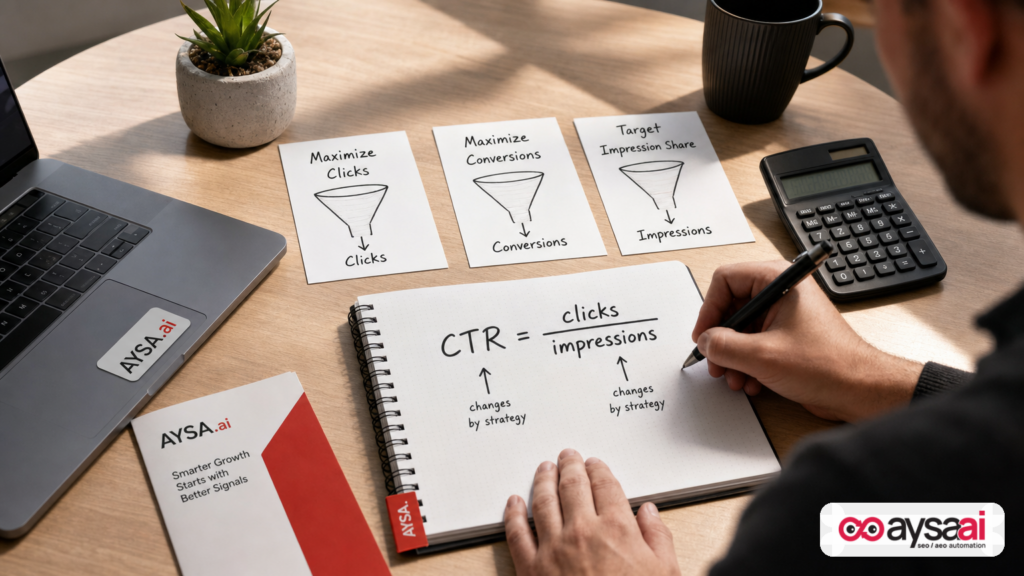
- CTR is no longer a clean measure of “ad resonance.” Bid strategies can restrict or expand Impressions, making CTR rise or fall as a byproduct of the algorithm’s traffic selection.
- Success must be judged post-click. If Conversion rate, lead quality, and cost-per-acquisition (CPA) aren’t improving, a high CTR is noise.
- Campaign architecture changes CTR expectations. Search, Display, YouTube, Demand Gen, and Performance Max each produce different CTR “shapes.” Comparing them directly is misleading.
- AI-shaped search increases “zero-click” outcomes. Some queries resolve without a site visit; ad platforms may count impressions/clicks differently in new layouts, making dashboards harder to interpret cleanly.
- The winning teams operationalize measurement + execution. Monitoring needs to translate into approved, shipped changes—on-site and in campaigns—fast.
Table of contents

- The CTR era: why it mattered and why we’re letting it go
- What changed: CTR used to measure people. Now it often measures machines.
- Redefining the CTR equation in an AI bidding world
- Campaign architecture: why “good CTR” depends on format
- Does a healthy CTR equal success? A blunt framework
- Moving beyond the click: post-click quality and business outcomes
- The new KPI stack: what to watch instead of (or beside) CTR
- AI-shaped SERPs and measurement ambiguity: what we can and can’t know
- A concrete SME scenario: the “sky-high CTR, low profit” ecommerce trap
- What agencies should rethink (and what clients should demand)
- A 2026 action plan: how to rebuild your measurement and optimization loop
- Where AYSA fits: from monitoring → recommendations → approved execution
- What to do next
- Sources and further reading
The CTR era: why it mattered and why we’re letting it go

CTR became popular because it was simple, comparable, and tied to a real human behavior: clicking. For years, you could take CTR as a proxy for three things:
- Relevance: Did the ad align with the query?
- Offer clarity: Did the ad communicate value?
- Auction competitiveness: Did you earn enough visibility to attract clicks?
But simplicity is also what makes CTR dangerous in 2026. When you put a single number on a dashboard, teams optimize for it—sometimes explicitly (“raise CTR”), sometimes implicitly (“we’re doing well because CTR is up”).
The reality now is that CTR often measures the platform’s ability to find clickers, not your business’s ability to create customers.
This isn’t an anti-CTR rant. CTR still has value. It’s just no longer a north-star performance metric. It’s a diagnostic signal that needs context.
What Changed: CTR Used To Measure People. Now It Often Measures Machines.
The most important shift is who is doing the selecting.
In older PPC workflows, you (or your agency) did the selection:
- You chose keywords and match types.
- You structured ad groups tightly.
- You wrote a smaller set of ads.
- You bid manually or with simple rules.
In that world, CTR was heavily influenced by your decisions. If CTR went up, it often meant your choices aligned better with what people wanted.
In 2026, automation chooses more than you think:
- Automated bidding decides which auctions to enter and how aggressively.
- “Broad” targeting (in multiple formats) expands where ads can show.
- Creative systems assemble variations and test quickly.
- Multi-channel campaign types blend Search intent with discovery placements.
That means CTR often becomes the output of algorithmic traffic shaping. If the system is optimized for clicks or is learning aggressively, it can find clickers. Your CTR can rise while your business results remain unchanged—or worse.
This is the core argument explored in the Search Engine Journal piece: high CTRs don’t guarantee success because modern bid strategies and AI Optimization change what CTR actually indicates. Read the original analysis.
Redefining the CTR equation in an AI bidding world
Mathematically, CTR is still:
CTR = Clicks / Impressions
But interpreting that fraction depends on what is controlling impressions and what is controlling clicks.
The denominator problem: impressions aren’t “neutral” anymore
When automated strategies restrict impressions to a subset of users the system believes are likely to take a desired action, the denominator can shrink. A smaller denominator makes CTR look better even if total opportunity hasn’t improved.
Other strategies prioritize visibility (and therefore pull in more impressions), which can lower CTR without meaning performance is worse—just broader.
So a CTR increase can mean:
- Your messaging improved or
- The platform showed your ads to people more likely to click or
- The platform withheld impressions from people less likely to click or
- Search layouts shifted, changing how impressions are counted and where clicks go
Only one of those is “your ads are resonating.” The others are system behavior.
The numerator problem: “clicks” are not equal
Even when clicks are real, clicks are not uniform. A click can represent:
- High-intent: “book emergency plumber now”
- Research: “best plumber reviews”
- Curiosity: “how much does plumbing cost”
- Bounce behavior: accidental taps, mismatched landing pages, weak mobile experience
CTR merges all of this into one number, which is why it’s easy to celebrate and easy to mislead.
Campaign architecture: why “good CTR” depends on format
One of the most common mistakes I see in small and mid-sized businesses is comparing CTR across fundamentally different campaign types—and drawing conclusions that send optimization in the wrong direction.
In modern ad platforms, formats behave differently by design:
- Search: Often higher CTR because the user has expressed explicit intent via query.
- Display: Lower CTR is normal; the job is often awareness or retargeting.
- Video/YouTube: Clicks may be secondary to view-based outcomes; lower CTR doesn’t automatically mean failure.
- Multi-channel “all-in-one” types: Mixed inventory produces mixed CTR distributions.
This aligns with the source’s warning that campaign subtype heavily impacts CTR expectations; formats like Display, Demand Gen, and YouTube naturally yield lower CTR, and multi-channel formats introduce variability. Source.
Rule: compare CTR only within comparable contexts
CTR is most useful when comparing:
- The same campaign type over time
- Similar intent clusters (brand vs non-brand vs competitor)
- Similar device mix (mobile vs desktop)
- Similar geography and schedule
When you compare apples to oranges, you end up “fixing” the wrong thing.
Does a healthy CTR equal success? A blunt framework
A CTR can be healthy and still be unprofitable. That’s the uncomfortable truth.
Here’s the framework I use to keep teams grounded:
CTR is a sign of life
A campaign with zero engagement is usually broken: wrong targeting, poor creative, low visibility, or a measurement issue. CTR tells you the ad is at least earning attention in the auction.
CTR is not proof of business impact
Business impact is measured by what happens after the click:
- Do visitors take meaningful actions?
- Are those actions valuable?
- Can you repeat them at a cost that sustains the business?
The source frames this shift well: CTR has moved from a primary success metric to a diagnostic indicator—often reflecting the algorithm testing audiences, placements, and creative iterations. Source.
Two questions that beat “Is CTR good?”
- What are we buying with these clicks? (Leads, calls, bookings, purchases, subscriptions?)
- Are we buying the right kind of customer? (Qualified, profitable, retained?)
If your team can’t answer those clearly, CTR discussions are mostly theater.
Moving beyond the click: post-click quality and business outcomes
In 2026, the competitive edge is often built after the click.
Paid search teams obsess over:
- Ad text variations
- Audience expansion
- Bid strategy toggles
Meanwhile, the actual revenue difference frequently comes from:
- Landing page clarity (what do you do, who is it for, what happens next?)
- Speed and mobile usability
- Form friction (too many fields, confusing errors, no trust signals)
- Offer alignment (ad promise vs on-page reality)
- Follow-up speed (especially for lead gen)
A click is not a conversion. It’s an invitation to compete.
Build a “quality loop,” not a “click loop”
If you optimize mainly for CTR, you’ll often attract:
- Curiosity traffic
- Deal seekers who churn or refund
- Low-intent browsers who never convert
If you optimize for outcomes (and measure them correctly), you start to attract intent that matches your business model.
The new KPI stack: what to watch instead of (or beside) CTR
If you’re a founder or operator, you don’t need 40 KPIs. You need a KPI stack that connects spend to outcomes with minimal ambiguity.
Here’s a practical hierarchy I recommend for SMEs:
Tier 1: Business outcome metrics (executive level)
- Revenue (or pipeline created): tied as directly as possible to paid traffic.
- Gross margin (or contribution margin): revenue minus cost of goods/service delivery.
- Customer acquisition cost (CAC) vs payback: how long until the customer becomes profitable.
Not every SME has clean margin reporting or a mature CRM. If that’s you, treat this tier as a direction, then implement a minimum viable version (see the action plan).
Tier 2: Conversion and lead quality metrics (marketing-ops level)
- Conversion rate (CVR): not just “did someone click,” but “did they do the thing?”
- Cost per acquisition (CPA): cost per qualified conversion.
- Lead quality rate: % of leads that match your target profile (where you can measure it).
Tier 3: Experience and intent indicators (diagnostic level)
- Engaged sessions / on-site engagement: evidence the landing experience is working.
- Drop-off points: where users abandon (forms, carts, booking steps).
- Search term intent review: are you attracting the right questions?
Where CTR belongs in this stack
CTR sits in Tier 3. It’s a symptom and a clue—not the outcome.
Use CTR to diagnose:
- Creative mismatch
- Query/intent mismatch
- Auction visibility shifts
- Potential tracking anomalies
But judge success by Tier 1 and Tier 2.
AI-shaped SERPs and measurement ambiguity: what we can and can’t know
Another 2026 reality: search engines increasingly try to satisfy intent directly on the results page.
The Search Engine Journal source highlights how generative AI features (for example, AI-generated result experiences) contribute to “zero-click” behaviors and add ambiguity to how impressions and clicks are counted inside these blocks in standard reporting. Source.
I want to be careful here: I’m not going to claim specific counting methodologies or reporting definitions that we can’t verify from official documentation in the provided research context. But we can say something actionable:
- Layouts change behavior. When the page answers more questions directly, fewer users need to click through.
- That shifts what “good” looks like. Your job isn’t simply to force clicks; it’s to win the customer journey—sometimes before the click, sometimes after it.
- It also increases the need for clean measurement. When the environment is shifting, you need stable first-party tracking and consistent conversion definitions.
This is where AI Search and AEO/GEO strategies matter alongside paid media. AYSA’s perspective: paid search performance is increasingly coupled to how your brand appears across AI-influenced discovery, not just classic “10 blue links.” If you’re thinking about that shift, start with AI search visibility and the tooling behind it at AYSA’s AI SEO tools.
A concrete SME scenario: the “sky-high CTR, low profit” ecommerce trap
Let’s make this real with an example you can recognize. (No invented stats—just the pattern.)
Business: a small ecommerce brand selling premium consumables (think skincare, supplements, specialty food, or home goods).
What the team sees:
- CTR climbs month over month.
- Clicks are abundant.
- Traffic charts look “healthy.”
What the owner feels:
- Profit isn’t improving.
- Support tickets increase.
- Returns/refunds creep up.
- Repeat purchase rate is flat.
What’s happening:
- Automated systems find people likely to click on compelling offers.
- The landing page experience doesn’t qualify buyers well (unclear shipping timelines, weak sizing/fit guidance, unclear subscription terms, etc.).
- The campaign drifts into top-of-funnel curiosity queries that click—but don’t buy.
The fix isn’t “get CTR even higher.” The fix is to:
- Define “success” as profitable purchases (or high-quality leads), not clicks.
- Measure quality outcomes (refund-adjusted revenue, margin where possible).
- Adjust targeting and creative to match intent.
- Improve on-site qualification and conversion flow.
This is why I agree with the source’s final verdict: CTR is a sign of life, not a guarantee of performance. Source.
What agencies should rethink (and what clients should demand)
Agencies and consultants are under pressure in 2026. Automation reduces the perceived value of “button pushing,” and clients still demand clarity. The easiest path is to cling to familiar metrics (CTR, CPC, impressions). That’s also the path to churn.
Stop selling CTR as performance
CTR is not a business outcome. If your monthly report leads with CTR wins, you’re teaching clients the wrong scoreboard.
Sell post-click improvements as part of paid performance
Paid media results are constrained by on-site reality. Agencies should build a workflow that includes:
- Landing page testing and iteration
- Conversion tracking hygiene
- Offer and funnel alignment
- Speed and usability fixes
Not as “extra projects,” but as core performance work.
Clients should demand approved execution—not just recommendations
One of the most expensive failure modes in marketing is the “recommendation backlog.” The audit is done. The deck is delivered. Nothing ships.
That’s why AYSA’s operational model matters in 2026: monitor what’s changing, prepare specific improvements, ask for approval, and execute accepted changes. You can explore the monitoring layer here: AYSA Monitoring.
A 2026 action plan: how to rebuild your measurement and optimization loop
Here’s a practical plan you can implement without needing an enterprise analytics team.
1) Reframe the goal in one sentence
Write a single sentence that defines success without using CTR, clicks, or impressions.
- Ecommerce: “Profitably acquire repeat buyers for Product X.”
- Clinic: “Book qualified appointments for Service Y with minimal no-shows.”
- SaaS: “Generate demos that convert to paid plans within Z days.”
Now every metric is either a driver or a distraction relative to that sentence.
2) Define conversions that reflect value (not convenience)
Many teams track the easiest actions, not the most meaningful ones.
Examples of “convenient but weak” conversions:
- Any form submission (including spam or unqualified inquiries)
- Page views
- Time on site
Examples of “value-aligned” conversions:
- Booked appointment (not just “contact us”)
- Qualified lead (meets criteria)
- Purchase with minimum margin threshold
If you can’t fully implement value-based conversions yet, start with a two-tier system: primary (high value) and secondary (assist signals). Make reporting reflect that.
3) Separate brand, non-brand, and competitor intent
This is old advice, but it matters more now because automation can blur intent boundaries. Keep reporting segmented so CTR doesn’t hide what’s happening.
At minimum, ensure you can answer:
- Is CTR rising because brand demand is up?
- Is non-brand CTR rising because we’re buying broader, cheaper curiosity clicks?
- Are competitor clicks actually producing customers or just expensive window shoppers?
4) Inspect search terms and landing page alignment weekly
If you want to protect profit, build the habit of reviewing:
- What people actually searched (intent reality)
- What page they landed on (experience reality)
- What they did next (outcome reality)
CTR alone cannot show you mismatch. Search term-to-landing alignment can.
5) Create a post-click quality dashboard for leadership
Your founder or GM does not need a platform screenshot. They need answers:
- What did we spend?
- What did we get?
- Was it profitable (or moving toward profitability)?
- What are we changing next?
CTR can be included—but only as a supporting metric, not the headline.
6) Ship improvements on a predictable cadence
Most marketing underperformance is an execution problem. The businesses that win are not those with the best ideas—they’re the ones that ship improvements consistently.
This is where an approved-execution system pays off: it shortens the time between “we noticed something” and “the site/campaign is better now.” Learn how AYSA approaches this end-to-end at AI SEO Tools and see ongoing insights on the AYSA blog.
Where AYSA fits: from Monitoring → Recommendations → Approved Execution
AYSA isn’t “another dashboard.” It’s an execution engine designed for the reality that modern marketing is a moving target.
When CTR can rise while outcomes stagnate, you need a system that does four things well:
1) Monitor what matters
Monitor shifts that affect real business outcomes: visibility, content/landing readiness, and the signals that correlate with post-click quality—not only top-line traffic changes. Start here: AYSA Monitoring.
2) Prepare concrete changes
Recommendations should translate into implementable tasks: landing page improvements, content alignment, technical fixes, and visibility actions that support both paid and organic discovery.
3) Ask for approval (so you stay in control)
Businesses need governance. AYSA is built around approved execution—changes are prepared, reviewed, and only implemented once accepted. This reduces risk and builds trust across stakeholders.
4) Execute accepted changes
The biggest gap in marketing is the gap between insight and implementation. AYSA closes that loop.
If you’re evaluating operational fit, pricing and packaging are here: AYSA Pricing. If you’re trying to understand the broader AI search shift (which increasingly intersects with paid), start with AI Search Visibility.
What to do next
- Stop reporting CTR as the headline KPI. Move it into a diagnostic section.
- Rewrite your paid success definition. One sentence, outcome-based (revenue, pipeline, bookings, margin).
- Audit conversions. Ensure you track a value-aligned primary conversion (not just any click or form).
- Segment reporting by intent. At least brand vs non-brand vs competitor.
- Review search term → landing page alignment weekly. Fix mismatches before the algorithm scales them.
- Build a post-click quality dashboard. Include lead quality, CPA, conversion rate, and where possible, margin.
- Implement an execution cadence. Decide what ships weekly or biweekly—and who approves it.
- Operationalize monitoring + execution. Use a system that can monitor, prepare changes, request approval, and execute accepted updates—like AYSA.
Sources and further reading
- Search Engine Journal: CTR Is Sky High In 2026 That Doesn’t Mean Your Ads Are Working
- Search Engine Journal: PPC News (context for ongoing platform shifts)
- Search Engine Journal: SEO News (context for AI-shaped SERPs and visibility changes)
- Search Engine Journal: SEO category (broader visibility and measurement topics)
- Search Engine Journal: Webinars (additional learning paths referenced in the source context)
Related AYSA resources:
Continue the AI search topic inside AYSA.
Use these pages to connect the article with AI SEO tools, AI visibility monitoring, AI Overviews and approved website execution.
Turn this topic into a website action plan.
Use these AYSA hubs to move from reading to technical fixes, AI visibility monitoring, research, glossary context and approval-first SEO execution.