
Multi-Location Search Visibility In 2026: How To Win Across Google, Maps, AI Assistants, And “Recommendation” Search
Search visibility for multi-location brands has fractured across Google, Maps, AI assistants, social platforms, and navigation apps. This editorial lays out a practical operating system—data accuracy, location page quality, ecosystem validation, and reputation signals—plus the KPIs and execution workflow teams need to earn recommendations (not just rankings) at scale.
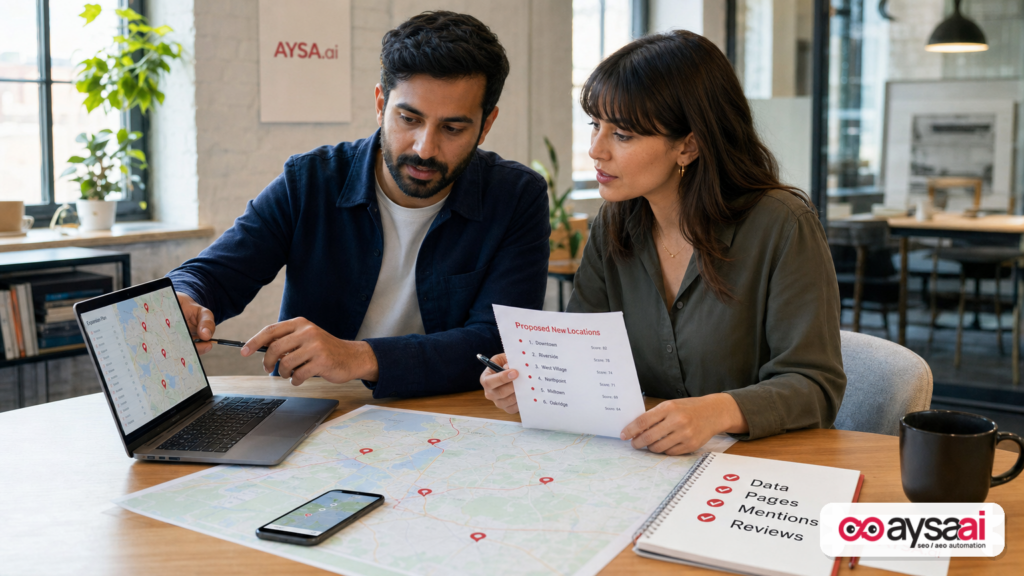
By Marius Dosinescu (AYSA.ai)
Multi-location marketing used to be a scale game: publish more location pages, keep Google Business Profiles clean, build citations, and watch rankings roll in city by city.
That playbook still matters—but it no longer explains what’s happening in 2026.
Today, search visibility is fragmented across a local discovery ecosystem: traditional Google search, Google Maps features, AI-assisted experiences (including AI-powered summaries and chat-style interfaces), social platforms, and navigation apps. The new question isn’t “How do we rank #1?” It’s “How do we become the business that gets recommended—with confidence—across systems we don’t control?”
This editorial is my practical, operator-focused guide for multi-location brands (and the agencies supporting them) to win local visibility in a world where classic rankings are only one output. It’s based on field patterns we see across brands using AYSA.ai, plus research and frameworks discussed in a Search Engine Journal piece on multi-location search visibility across Google and AI destinations.
Primary research lead: Search Engine Journal — Multi-Location SEO: How To Win Google & AI Search Visibility At Scale.
Concise summary (for busy operators)
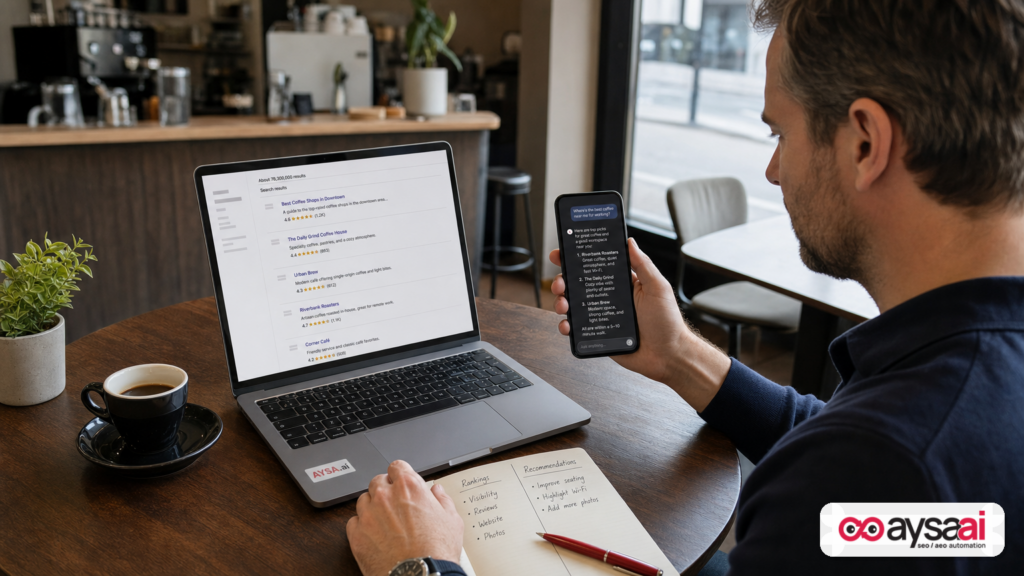
- Visibility has moved from rankings to recommendations. AI and maps experiences synthesize signals from many sources before they “suggest” a business.
- Multi-location brands win by building confidence at scale. That requires consistency, local relevance, third-party validation, and reputation—not just on-site SEO.
- The operational problem is execution, not ideas. The bottleneck is governance: who updates data, pages, and reputation signals—and how fast.
- The four-pillar system works across platforms: (1) Business data accuracy, (2) Location page quality, (3) ecosystem visibility & validation, (4) reputation & trust.
- AYSA fits as an execution system: monitor → prepare changes → ask for approval → execute accepted updates on your website, continuously.
Table of contents
- What changed: local search is now a distributed ecosystem
- The big shift: from rankings to recommendations
- Why multi-location brands are a different sport
- The four pillars of multi-location search visibility (2026)
- Pillar 1 — Business data accuracy & consistency
- Pillar 2 — Location pages that deserve to be cited
- Pillar 3 — Ecosystem visibility & third-party validation
- Pillar 4 — Reputation & trust signals beyond Google reviews
- What to measure now: modern KPIs for local + AI discovery
- Concrete SME scenario: a 12-location clinic network
- Agency reset: what service packages must become
- Where AYSA.ai fits: approved execution at scale
- What can go wrong (and how to prevent it)
- What to do next: a 30/60/90-day action plan
- Sources and further reading
What changed: local search is now a distributed ecosystem

For years, “Local SEO” could be explained as a two-lane highway:
- Google Search (the blue links and local packs)
- Google Maps (the listing experience)
In 2026, that model is incomplete. Discovery happens everywhere people make decisions:
- Search engines (Google, Bing)
- Maps and navigation experiences (including Apple Maps and navigation data providers)
- AI assistants and chat-style interfaces that summarize options
- Social platforms where users search inside the app (and where creators influence decisions)
- Vertical directories (healthcare, legal, home services, dining, travel)
The Search Engine Journal research framing calls this a “modern local discover ecosystem” and describes a local “supply chain” of brand data, listings, aggregators, directories, reviews, and user-generated content. I agree with that framing—because it matches what we see in execution: when a brand’s “truth” about each location is inconsistent, every downstream platform inherits confusion.
What this means: You’re not optimizing for one algorithm. You’re building confidence across a network of systems that each ingest different sources of truth. If you’re multi-location, the combinatorial chaos is the real enemy.
The big shift: from rankings to recommendations
Traditional search is a results list. AI-powered discovery is closer to a decision engine.
In classic local SEO, the user might type “tacos near me” and the engine returns a ranked list based on proximity, relevance, and authority signals.
In AI-style discovery, the prompt becomes more specific and human:
- “Find a family-friendly taco place nearby that’s open late.”
- “Which clinic near me has same-day appointments and great bedside manner?”
- “Best florist in town for last-minute delivery and modern arrangements.”
Then the system aggregates evidence from many sources and returns a recommendation (often with an explanation). And that changes everything—because:
- Authority alone isn’t enough. Evidence matters: accurate business data, location-specific relevance, reviews, third-party validation, and consistent entity relationships.
- Being “good” isn’t enough. You must be legible to machines and credible to humans across platforms.
- Your website becomes one node, not the destination. Many journeys start and end inside apps—maps, assistants, vertical directories—without a website visit.
This is not a reason to panic. It’s a reason to finally treat local visibility like an operating system, not a one-time campaign.
Why multi-location brands are a different sport
A single-location business can “fix local SEO” with a couple weekends of effort and a motivated owner. Multi-location brands can’t. The challenges are structural:
1) Complexity scales faster than opportunity
Every location adds:
- its own address, hours, phone, categories, attributes
- its own reviews and reputation profile
- its own local competitors
- its own demand patterns and seasonal behavior
- its own content and compliance constraints
Ten locations isn’t 10x the effort. It’s often 30–50x the points of failure because inconsistencies multiply and spread across ecosystems.
2) Governance and approvals are the real bottleneck
Most brands can identify what they should do. The failure is in execution:
- Legal blocks local copy (“we can’t mention landmarks”)
- Brand blocks unique photos (“only approved lifestyle imagery”)
- Dev teams can’t prioritize location templates
- Franchisees edit listings inconsistently
- Operations change hours without marketing knowing
That’s why a system like AYSA matters: visibility is now a continuous maintenance job, and maintenance needs an execution loop—Monitoring + proposed changes + approvals + publishing.
3) Platform fragmentation is permanent
You can’t “pick one platform” anymore. Even within one company, different user segments behave differently:
- Tourists use maps and travel directories.
- Locals use social platforms and word-of-mouth cues.
- Busy parents ask assistants for a short list.
- Older consumers still use classic search and call buttons.
Your job is to show up wherever decisions are made.
The four pillars of multi-location search visibility (2026)
The most useful framework from the Search Engine Journal piece is the four pillars model. I’m adopting it here, but with an execution-first lens—what you actually need to do, who owns it, and how to scale it without creating an internal war.
- Pillar 1: Business data accuracy & consistency
- Pillar 2: Location page quality & relevance
- Pillar 3: Ecosystem visibility & third-party validation
- Pillar 4: Reputation & trust signals
If you do these four well, you win both the old game (rankings) and the new game (recommendations). If you miss any one pillar, AI-style discovery systems have less confidence—and confidence is the currency now.
Pillar 1 — Business data accuracy & consistency (your trust foundation)
If your business information is wrong in one place, it’s wrong everywhere—eventually.
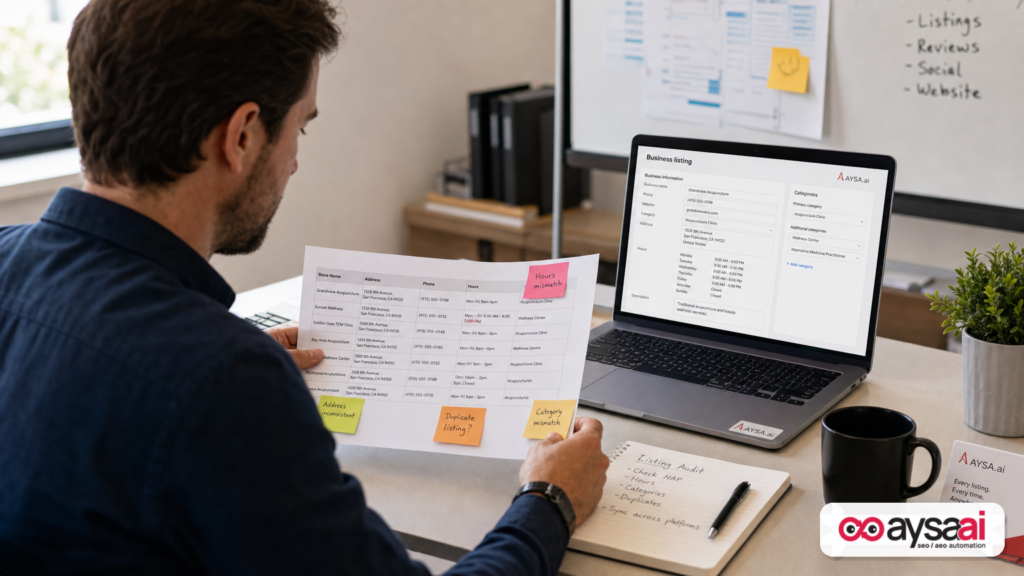
At minimum, multi-location brands must treat the following as governed, audited assets:
- Name, address, phone (NAP)
- Hours (including holiday exceptions)
- Categories (and subcategories where relevant)
- Attributes (parking, accessibility, reservations, delivery, etc.)
- Products/services (what you actually sell at that location)
Why data accuracy matters more now than “classic local SEO”
In a recommendation world, inconsistent data doesn’t just hurt rankings—it creates uncertainty. AI systems and mapping experiences don’t like uncertainty. When confidence drops, they hedge by recommending a competitor with clearer corroboration.
And the definition of “data consistency” is expanding. It’s no longer just the usual directory roster. The SEJ research notes that AI platforms can cite sources beyond what most teams monitor, and that emerging “AI ranking” tools are beginning to surface those citations.
Practical reality: If your location hours differ across platforms, your assistant-style recommendation can fail on the simplest prompt: “open now.”
Who should own Pillar 1?
- Operations owns the truth (hours, phone routing, services available).
- Marketing owns distribution (listings, profiles, and on-site accuracy).
- IT / web owns structured representation (schema, templates, feeds).
If one team owns everything, you will either ship slowly (too many approvals) or ship inaccurately (too much decentralization). The answer is not more meetings; it’s a controlled workflow and clear permissions.
Pillar 1 action items (operator-grade)
- Create a single source of truth file for all locations (even if you also use a platform). Include fields for hours exceptions, services, appointment URLs, and messaging phone numbers.
- Run a consistency audit on a schedule (monthly for fast-changing businesses; quarterly for stable ones).
- Define a change-control process: who submits updates, who approves, and how quickly must updates publish?
- Make “hours accuracy” a KPI. Not a vanity metric—an operational metric.
How AYSA helps: AYSA can continuously monitor website location pages and key local templates, prepare recommended updates, and route them for approval before publishing. That reduces the “we meant to update it” drift that destroys trust.
Pillar 2 — Location pages that deserve to be cited
Your location page is one of the few assets you fully control. That’s why it’s also one of the highest-leverage assets you can invest in.
The SEJ research emphasizes that strong location pages help with both classic search and LLM-style discoverability, and highlights how multi-location brands scale intent and specialty pages (examples include pages for delivery, careers, late-night, specials, and specific menu/service categories).
I’ll add a blunt operator’s perspective:
If your location page is a template with a swapped address, you’ve built a liability—not an asset.
What a great location page does in 2026
- Proves the location is real (photos, staff, storefront, local cues)
- Proves relevance (services available here, not “somewhere in the brand”)
- Answers intent-driven questions (“open late,” “same-day,” “delivery,” “wheelchair accessible”)
- Connects entity relationships (the brand/location ↔ services/products ↔ place terms)
- Reduces friction (call, directions, booking, ordering)
Location page elements to prioritize (practical, non-hype)
Based on the SEJ discussion of location page attributes and LLM discoverability, here’s a prioritization that works for most multi-location brands:
- Hyperlocal content: a paragraph that references the service area, neighborhoods, landmarks, and who you serve (without being spammy). Make it specific enough that it couldn’t be copied to another city without sounding wrong.
- Original location images: not stock lifestyle. Real storefront/entrance, parking cues, interior, team (if appropriate).
- Services/products available at this location: including variations (e.g., “walk-ins accepted,” “pediatric appointments,” “commercial-only”).
- FAQs tied to Local intent: “Where do I park?” “Do you accept same-day appointments?” “Do you serve [neighborhood]?”
- Directions and map links: reduce navigation ambiguity.
- Fast performance and clean rendering: slow pages don’t just hurt UX—users bounce, and you lose the chance to build trust.
- Location-specific social links where appropriate, especially if a location has its own profile and community engagement.
The underused lever: intent/specialty pages per location
Many teams stop at the main location page. But intent pages are how you align to the way people actually ask questions.
Examples (adapt to your vertical):
- Restaurant: delivery, late-night, catering, specials
- Clinic: same-day visits, insurance, telehealth, pediatrics
- Home services: emergency service, financing, service area, maintenance plans
- Hotel: parking, pet-friendly, near airport, late check-in
These pages also help establish clearer “entity relationships” (the SEJ article references the idea of semantic triples—brand → offers → product/service). Whether you call it semantic triples or simply “being explicit,” the principle is the same: don’t assume machines infer what you never clearly state.
Pillar 2 action items
- Audit location pages for uniqueness and completeness: if 80% of text is identical across locations, you’re underperforming.
- Create an “original media” requirement: each location must provide a minimum set of photos updated at least annually.
- Publish 2–5 intent pages per location tied to revenue (not SEO fantasies).
- Ship in batches with testing: don’t redesign 800 pages at once; roll out to 20–50 locations, measure, then expand.
How AYSA helps: AYSA can support an “Approved Execution” workflow for content and technical changes—monitor pages, propose improvements, route for stakeholder approval, and publish accepted updates. See AI Search Visibility and AI SEO tools for how we think about this as a system, not a one-time audit.
Pillar 3 — Ecosystem visibility & third-party validation
Local visibility is no longer “your website + your Google profile.” It’s your presence across a network of sources that act like corroborating witnesses.
The SEJ research calls this pillar “ecosystem visibility & third-party validation,” and it’s the pillar most brands neglect until they realize AI experiences are citing sources they never invested in.
Citations evolved: from NAP listings to brand mentions with meaning
Classic citation building focused on consistent NAP in directories. That still matters. But now there’s a second layer: mentions that carry context and sentiment.
In other words, not just:
- “Brand Name, 123 Main St.”
But also statements that explain why a location is chosen:
- “Brand X is great for same-day appointments.”
- “Brand Y has the best smash burgers in town.”
- “Brand Z is the quiet hotel near the convention center.”
These are the kinds of phrases recommendation engines can use as “reasons” in their output.
Where to build ecosystem visibility (without boiling the ocean)
The SEJ article lists categories that matter for multi-location brands:
- Aggregators (data distribution)
- Search engines and maps
- Navigation ecosystems
- Local social platforms
- Industry directories (vertical validation)
- Local directories (chambers, city/tourism guides)
- LLM citation sources (the places assistants tend to reference)
Two practical rules for prioritization:
- Start with overlaps. If a directory covers multiple cities where you operate, it’s higher leverage than a directory that only matters in one micro-area.
- Start with “decision-stage” platforms. If customers book, order, or choose inside the platform, it has outsized value.
Note on tooling: The SEJ research references citation-finding tools (e.g., Whitespark and GeoRanker) as helpful for identifying directory overlaps when managing many locations. If you use these or alternatives, treat the output as a roadmap—not a checklist to blindly spam.
Pillar 3 action items
- Build a “platform coverage map”: for each location, which directories/review sites matter in that vertical?
- Ensure core listings are complete (all fields) before chasing new platforms.
- Identify potential “citation sources” used in AI answers by researching what gets referenced for local queries in your vertical. If you can’t verify, treat it as hypothesis and test.
- Create lightweight UGC prompts that encourage customers to describe what you’re known for (ethically, without scripting fake reviews).
How AYSA helps: While AYSA is not a listings management vendor, it supports the part many teams forget: making sure your website—the canonical owned node—contains the explicit information that third parties and AI systems can corroborate. That includes service statements, FAQs, policies, and locally specific details that reduce ambiguity.
Pillar 4 — Reputation & trust signals beyond Google reviews
If you take one lesson from this editorial, make it this:
Reputation is now multi-platform by default.
Many brands still behave as if “reputation” equals “Google reviews.” That’s legacy thinking. The SEJ research explicitly argues for expanding beyond that bubble, noting that some ecosystems surface reviews from other providers and that new maps features can look beyond a single platform’s review corpus.
Even if Google remains a primary source of local demand, your customers—and the systems summarizing your business—do not operate in a single-platform world.
In many industries, the real trust lives in vertical review sites
The SEJ research lists examples of niche platforms across home services, legal, healthcare, and dining (for example: Thumbtack, Avvo, Healthgrades, OpenTable, Angi, Zocdoc, and others). The specific winners vary by vertical and region, so don’t copy a list—build your own based on where customers in your market actually decide.
Practical approach:
- If a platform drives bookings/leads, it deserves reputation investment.
- If a platform ranks well for “best [service] in [city],” it deserves monitoring.
- If a platform is consistently cited or referenced in your category, it deserves optimization.
Turn review sentiment into better content and better operations
One of the strongest ideas in the SEJ piece is using AI to summarize review themes into:
- business improvement insights (operations, staff, product/service quality)
- content opportunities (FAQs, service claims, clarifications)
- natural-language prompts aligned to how people search
This matters because it connects marketing to reality. Your customers already tell you what they value. Most brands just don’t operationalize it.
Important guardrails:
- Don’t fabricate testimonials or reviews.
- Don’t cherry-pick only praise; use criticism to fix the business.
- Don’t publish claims you can’t support (compliance matters in healthcare, finance, legal, etc.).
Pillar 4 action items
- Build a multi-platform review acquisition plan by vertical and by location.
- Centralize monitoring so you can respond and spot systemic issues.
- Run quarterly sentiment summaries and feed the insights into: training, operations, and location page FAQs.
- Measure response speed and “issue closure,” not just star rating averages.
How AYSA helps: When sentiment reveals repetitive questions (“Do you take walk-ins?”, “Is there parking?”), AYSA can propose website updates to address them on location pages and service pages—then route changes for approval and publish them. That’s how reputation becomes a growth loop instead of a defensive chore.
What to measure now: modern KPIs for local + AI discovery
The worst thing a brand can do right now is panic over a single metric—usually clicks—without updating the measurement model.
Yes, many teams are seeing year-over-year changes in Search Console patterns and attributing it to “AI results.” But regardless of the cause, the response should be mature: update KPIs to reflect the full ecosystem.
Four KPI categories that actually help operators
Instead of trying to measure “AI visibility” with speculative dashboards, I recommend focusing on signals you can control and validate:
1) Location data integrity KPIs
- % locations with verified hours (including holiday exceptions)
- % locations with complete attributes/services fields in your source-of-truth file
- Number of detected data conflicts per month (trend should go down)
2) Location page quality KPIs
- % locations with original photo set (and last updated date)
- % locations with FAQs (and top questions covered)
- Core Web Vitals / performance benchmarks for location templates (site-level view)
- Indexed coverage and crawl health of location and intent pages
3) Ecosystem coverage KPIs
- # of priority directories/vertical platforms fully optimized per location
- Consistency score across top platforms (however you measure it)
- Brand mention velocity on priority platforms (directionally)
4) Reputation and trust KPIs
- Review volume and rating distribution by platform (not just one)
- Response rate and response time
- Theme trends (e.g., “wait time” complaints rising = operational fire)
Analytics reality: you may get fewer clicks and still win
In a recommendation world, some interactions shift upstream. Users may call directly from a maps interface or book inside a directory. Your website can lose clicks while revenue holds steady—or grows.
That’s why measurement must include:
- calls
- direction requests
- bookings
- orders
- lead submissions
Search Console remains valuable, but it’s no longer the whole story.
Concrete SME scenario: a 12-location clinic network
Let’s make this tangible with a realistic example.
Business: a 12-location urgent care / family clinic network across two metro areas.
Problem: organic clicks are down, but call volume is inconsistent by location. Leadership suspects “AI search stole our traffic.” Marketing suspects “our location pages are thin.” Operations suspects “franchise managers keep changing hours.” Everyone is partially right.
How the four pillars diagnose the real issue
- Pillar 1 (Data): Three locations have mismatched holiday hours across platforms. Patients show up to closed doors. Reviews mention it. Trust drops.
- Pillar 2 (Pages): Location pages don’t clearly state which services are available at each clinic (pediatrics, imaging, occupational medicine). AI-style prompts like “kids clinic open now” get answered with competitors that explicitly state it.
- Pillar 3 (Ecosystem): The network is missing/unfinished on one key healthcare directory used in that state. The competitor is complete with consistent NAP and updated photos.
- Pillar 4 (Reputation): Reviews are strong on Google but weak on a vertical platform patients actually consult. The brand’s “proof” is uneven across ecosystems.
What the clinic does next (in plain English)
- Creates a governed hours-update process with a 24-hour SLA.
- Updates location pages with explicit services available and common FAQs (“walk-ins,” “insurance,” “wait times,” “parking”).
- Optimizes priority healthcare directory profiles across all 12 locations.
- Expands review acquisition to the vertical platform, not just Google.
Where AYSA fits in this scenario
AYSA becomes the execution loop for the website portion of the program:
- Monitor location pages and service templates for drift and missing elements
- Prepare proposed page updates aligned to what patients ask
- Route to compliance/leadership approval
- Publish accepted updates quickly and consistently
This is the difference between knowing what to do and actually doing it across 12 locations, every month.
Agency reset: what service packages must become
If you’re an agency (or an in-house team that works like one), the market is shifting under your feet.
The old packages
- “Local SEO setup”
- “Citation buildout”
- “Monthly blog posts”
- “GBP optimization”
These can still be components, but they’re insufficient as the primary offering because they don’t address distributed discovery and recommendation-style outputs.
The new packages (what clients will pay for)
- Location data governance: processes, audits, and SLAs
- Location page systems: templates, intent pages, QA, performance
- Ecosystem coverage strategy: vertical directories + local validations
- Reputation operations: multi-platform review acquisition and sentiment insights
- Execution velocity: shipping improvements every week, not every quarter
The agencies that win will stop selling “SEO tasks” and start selling “visibility operations.”
Where AYSA.ai fits: approved execution at scale
At AYSA, we’re opinionated about one thing: execution is the moat.
Most teams don’t fail because they lack ideas. They fail because they can’t ship improvements reliably across dozens or hundreds of pages—while juggling approvals from brand, legal, operations, and dev.
AYSA is designed to function as an approved SEO/AEO/GEO execution system:
- Monitor your site and templates for issues and opportunities (Monitoring).
- Prepare recommended changes (content improvements, structured clarity, internal linking, page completeness).
- Ask for approval (you stay in control; no risky auto-publishing).
- Execute accepted changes consistently—so improvements actually go live.
This model is how multi-location brands avoid the two classic traps:
- Trap #1: “We have a strategy deck, but nothing ships.”
- Trap #2: “We shipped fast, and compliance/brand had a meltdown.”
If you want the product overview, start here:
What can go wrong (and how to prevent it)
Multi-location visibility programs often fail in predictable ways. Here are the big ones—and what to do about them.
Failure mode 1: treating AI discovery as a “new channel” instead of a new standard
If you create a separate “AI optimization project” without fixing core local fundamentals, you’ll just generate more inconsistent outputs.
Fix: use the four pillars as your foundation; treat AI as an amplifier of strengths or weaknesses.
Failure mode 2: templated location pages with no proof
Thin pages can still rank sometimes, but they rarely earn recommendation-style confidence for nuanced prompts.
Fix: original photos, hyperlocal content, explicit services, FAQs.
Failure mode 3: “Google-only” reputation strategy
Even if Google remains huge, your category may depend on vertical review ecosystems.
Fix: map your decision platforms by industry and region; diversify review acquisition.
Failure mode 4: no governance = endless drift
Hours change. Phone systems change. Services change. If updates don’t propagate, trust collapses.
Fix: change-control process + monitoring + SLAs + ownership.
Failure mode 5: measuring only clicks
Recommendations and “zero-click” experiences can reduce website traffic without reducing business outcomes.
Fix: measure conversions across calls, bookings, directions, and platform-native actions where possible.
What to do next: a 30/60/90-day action plan
If you’re a busy operator, you don’t need another theory. You need a plan that ships.
Days 1–30: stabilize trust
- Build/update your single source of truth for location data (hours, services, phone, booking URLs).
- Audit a sample of locations for data conflicts across major surfaces.
- Pick your top 10 “money prompts” per vertical (the ways customers ask for what you sell).
- Choose 10–20 pilot locations for faster iteration.
Days 31–60: make location pages reference-worthy
- Upgrade the location page template: explicit services, FAQs, directions, performance, and unique local proof.
- Collect original photos for pilot locations and publish them.
- Launch 2 intent pages per pilot location tied to revenue (not vanity keywords).
Days 61–90: expand ecosystem validation + reputation ops
- Identify top 5–10 vertical and local directories that matter for your category; complete profiles for pilot locations.
- Implement a multi-platform review acquisition flow (ethical and compliant).
- Run your first sentiment theme summary and update site FAQs based on repeated customer language.
- Roll out location page improvements to the next batch of locations.
Ongoing: make it a system, not a project
- Monthly data integrity checks
- Quarterly location page refresh cycles (photos, FAQs, services)
- Weekly reputation monitoring and response workflows
- Continuous execution loop (monitor → propose → approve → publish)
What to do next (quick checklist)
- Pick your pillar owner(s). Assign accountable owners for Data, Pages, Ecosystem, and Reputation.
- Start with a pilot. Prove impact in 10–20 locations, then scale.
- Upgrade location pages before chasing hype. Owned assets first.
- Diversify reputation. Identify where trust lives in your vertical.
- Adopt an execution system. If your team can’t ship weekly, you’re losing by default.
Sources and further reading
- Search Engine Journal: Multi-Location SEO — How To Win Google & AI Search Visibility At Scale
- Search Engine Journal: Local Search category
- Search Engine Journal: Enterprise SEO category
- Search Engine Journal: SEO category
- AYSA.ai: AI Search Visibility
- AYSA.ai: AI SEO Tools
- AYSA.ai: Monitoring
- AYSA.ai: Pricing
- AYSA.ai: Blog
Disclosure note: This editorial references concepts and examples discussed in the Search Engine Journal article linked above as research input. The guidance and framing here are original and written for AYSA.ai’s audience, with an execution-first point of view.
Continue the AI search topic inside AYSA.
Use these pages to connect the article with AI SEO tools, AI visibility monitoring, AI Overviews and approved website execution.
Turn this topic into a website action plan.
Use these AYSA hubs to move from reading to technical fixes, AI visibility monitoring, research, glossary context and approval-first SEO execution.

