Personalization In AI Search: What Google’s “Preferred Sources” Really Means For Small Publishers (And Every SME That Wants To Be Found)
Google says personalization and “preferred sources” can help small publishers show up in AI-driven search. That might be true—but it’s not a strategy by itself. Here’s what actually changes for SMEs and publishers, what to measure, where personalization helps (and doesn’t), and how to build durable visibility when AI answers replace clicks.

Search is changing in a way that most small businesses and publishers haven’t fully internalized yet: your next competitor isn’t just the site ranking above you—it’s the AI answer that never sends the click, plus the user’s growing habit of trusting “their” sources.
In a recent conversation covered by Search Engine Journal, Google’s VP and Head of Search, Liz Reid, argued that personalization and preferred sources can help small publishers get discovered in AI-driven search experiences. The core idea: when Google has more signals about what a person likes, niche creators can surface more often—pushing visibility “into the tail” instead of everyone seeing the same generic winners.
As an operator, I want that to be true. As a business owner, I can’t build a plan on an unmeasured promise.
This editorial is my practical take on what’s actually changing, how personalization can help (and where it can hurt), why “preferred sources” is not the discovery engine small publishers need, and what SMEs should do now to win visibility in AI Search—without waiting for Google to ship better reporting.
Concise summary
- Personalization can be a discovery path—but it primarily benefits brands that already have some user-level affinity signals (repeat visits, brand searches, subscriptions, saved preferences).
- “Preferred sources” rewards known trust, not unknown quality. It may lift a publisher after they’ve earned loyalty, not while they’re still trying to break through.
- The biggest problem is measurement: if you can’t see how AI results are assembled or how “preferred” impacts visibility, you need your own testing framework and proxy KPIs.
- SMEs should shift from “ranking pages” to “earning selection”: build topical authority, unique experience-based content, strong brand demand, and technical clarity that makes your site easy to cite.
- Execution matters more than strategy decks. This is where AYSA fits: monitor changes, prepare improvements, ask for approval, and ship accepted changes continuously.
Table of contents

- What changed: AI answers + personalization move discovery upstream
- The real shift: from “ranking for everyone” to “being chosen for someone”
- How personalization can help small publishers (in theory and in practice)
- “Preferred sources” sounds like a win—until you ask: preferred by whom?
- Subscriptions, paywalls, and the user experience problem
- The measurement gap: if Google won’t prove it, you’ll need to test it
- What SMEs should monitor now (AI visibility KPIs that don’t require guesswork)
- A practical playbook for SMEs & small publishers (that doesn’t rely on hope)
- Concrete SME scenario: local clinic vs aggregator sites in AI search
- What agencies must rethink: deliverables, reporting, and incentives
- Where AYSA fits: monitoring + approved execution for AI search readiness
- What to do next (action list)
- Sources and further reading
What changed: AI answers + personalization move discovery upstream
Classic SEO was built for a world where discovery happened on a results page. You typed a query, you got ten blue links, and if you ranked well you earned a click. Personalization existed, but in many markets it didn’t radically reshape the whole page every time.
AI search changes the economics and the psychology:
- The answer is increasingly “assembled,” not “retrieved.” A model can summarize, compare, recommend, and synthesize before the user ever reaches your site.
- Clicks become optional. If the user’s intent is satisfied in the interface, your content may still be used—but not visited.
- Attribution can be diffuse. A user might remember the recommendation but not the source, especially when the interface emphasizes the summary over the publisher.
- Personalization becomes a ranking layer. If the system can infer preference, it can bias which sources are shown, cited, or even used to ground answers.
Google’s Liz Reid is effectively arguing that this personalization layer can be a counterweight: when a user has specific interests, niche publishers can show up more often than they would in a generic, one-size-fits-all SERP. That’s plausible. It’s also incomplete.
The question SMEs must ask is not “Is personalization good?” The question is: What inputs does personalization reward, and can I realistically generate them?
The Real Shift: From “Ranking For Everyone” To “Being Chosen For Someone”
Let’s translate personalization into business language.
In the old model, you built pages to rank for queries. The user’s identity barely mattered; the query mattered.
In the emerging model, you build a brand and a content system that can be selected for a person. That selection can be driven by:
- Explicit preferences (a user chooses preferred sources, follows your newsletter, subscribes, saves your site).
- Implicit behavior signals (repeat visits, long reads, branded searches, engagement, location context).
- Topical fit (your site is clearly “about” the topic the user seems to care about).
- Trust alignment (the system believes your site is reliable for that topic).
This is a more human model of discovery. But it changes how you win:
- If your strategy is “publish a lot of broad content,” personalization may not rescue you—because you’re not distinct.
- If your strategy is “be the best at a narrow slice,” personalization may amplify you—because you’re a better match for a specific person.
That’s why Reid’s phrase (as reported) about pushing “more into the tail” resonates. The tail is where specialists live. The catch is: the tail also has the hardest measurement and the weakest discovery loops.
How personalization can help small publishers (in theory and in practice)
Here are the credible ways personalization can support niche publishers and SMEs—without assuming magic.
1) Personalization can surface “latent intent” content
In the SEJ write-up, Reid described a user who cares about eco-friendly brands but doesn’t necessarily type “eco-friendly” in every query. If the system knows that preference, it can surface reviews or merchants aligned with it.
For SMEs, this is meaningful because customers often don’t search the way they talk. A person might want “low sugar,” “hypoallergenic,” “quiet,” “senior-friendly,” or “locally made,” but search in shorthand.
If you are the business that truly aligns with a preference, personalization can reduce the burden of perfect Keyword matching—if the system has those preference signals and if your site is legible about those attributes.
2) Personalization can reduce head-term monopoly effects
Generic SERPs are often dominated by the biggest brands because:
- They have broader authority signals.
- They attract more links and mentions.
- They are “safe defaults.”
Personalization can override safe defaults for certain users. That’s the best-case scenario for small publishers: you don’t need to beat everyone; you need to be the best fit for someone.
3) Personalization can reward specialists with consistent topical focus
Reid’s point (as reported) that personalization favors creators and journalists who focus on specific subjects is strategically important. Many SMEs and small publishers have a built-in advantage: they actually live the niche.
A local dental clinic is not trying to be WebMD. A boutique hotel is not trying to be Booking.com. A regional publication can be the best source for a city’s planning policy or school board decisions. That specificity can become a personalization match.
4) Personalization can strengthen “repeat exposure” loops
In classic SEO, you could win by being the best one-time answer. In AI search, you increasingly win by being the best ongoing source—because preference systems (explicit or implicit) are path dependent.
That means:
- Your newsletter matters again.
- Your returning user experience matters again.
- Your brand name matters more than your page titles.
Personalization doesn’t just rank pages. It can rank relationships.
“Preferred Sources” Sounds Like A Win—Until You Ask: Preferred By Whom?
“Preferred sources” is the part of Reid’s argument that sounds most actionable: users can tell Google which publishers they prefer, and then those sources can appear more prominently than others with similar information.
Conceptually, this is appealing. If I’m an SME publisher with strong reporting in a narrow domain, I want loyal readers to be able to “pull me up” in their experience.
But from a growth and discovery perspective, there’s a structural limitation:
Preferred sources mainly helps you after you’ve already been preferred.
That’s not a small nuance—that’s the whole problem for small publishers. The hardest phase is the cold start:
- No one knows you.
- No one is searching your brand name.
- No one is adding you to a preferred list.
So “preferred sources” can be a retention and loyalty tool, not necessarily a discovery tool.
What this means for SMEs
If you’re a small publisher, local business, or niche ecommerce brand, you should treat preference systems like compounding advantages. Once you earn loyalty, you can deepen it. But you still need your own acquisition loops:
- Email list growth
- Community distribution (events, partnerships)
- Social visibility in places where your audience actually spends time
- PR and mentions
- Brand search demand
In other words: you can’t “SEO” your way into being preferred. You have to build preference.
Subscriptions, paywalls, and the user experience problem
Reid (per SEJ) also addressed paywalls: surfacing gated content doesn’t help most users if they can’t read it, and paywalls often reduce traffic. That’s not controversial—paywalls trade reach for revenue.
But the underlying AI-search issue is deeper:
- AI answers can reduce the value of casual visits, pushing publishers toward subscriptions.
- Subscriptions reduce the value of being “surfaced”, because non-subscribers bounce.
Reid’s proposed direction—routing subscribers to what they already pay for—sounds logical, but again we’re back to measurement and control. Publishers need to know:
- Are subscribed users actually being routed differently?
- Is gated content being used to ground AI answers while the publisher loses the visit?
- How should publishers structure free vs paid content so they can be cited and still monetize?
Without reliable reporting, SMEs should assume a conservative reality: your paywall strategy must be compatible with discovery and citations. That usually means:
- Keeping some “public, citable” content accessible.
- Putting the unique value behind the paywall (tools, deep research, archives, community).
- Ensuring the public content clearly signals expertise and topical ownership.
The measurement gap: if Google won’t prove it, you’ll need to test it
The SEJ piece calls out the obvious gap: Reid did not provide data in that interview to prove that personalization and preferred sources measurably improve visibility for small publishers.
I’m not saying her claim is false. I’m saying it’s not operational until you can measure it.
Why this is uniquely difficult in AI search
- Impressions don’t equal influence. Your page might be used to ground an answer without an impression you can see.
- Visibility is user-specific. A personalized system can show different citations to different people, making “Average position” less meaningful.
- Queries fragment into conversations. Many AI experiences are multi-turn; attribution might change across turns.
A practical way to think about it
When platform reporting is weak, operators switch to controlled experimentation and proxy metrics.
That means you stop asking: “Did Google help small publishers?”
And you start asking: “When I change X on my site and distribution, do I see more signs that AI systems and users are choosing me?”
This is also where an execution system matters. Strategy without shipping becomes coping.
What SMEs should monitor now (AI visibility KPIs that don’t require guesswork)
When clicks decline, many teams panic—or they chase vanity metrics (“mentions”) with no link to revenue. You need a small set of signals that map to outcomes.
Here are measurable indicators most SMEs can track without pretending to have perfect AI attribution:
1) Brand search demand
Are more people searching your brand name (or branded products/services)? Brand demand is the closest thing to a “preferred source” signal you can influence directly.
2) Returning users and direct traffic quality
Personalization rewards relationships. Returning visitors, email-driven sessions, and repeat conversions show you’re earning preference outside the SERP.
3) Non-branded long-tail performance (not just head terms)
If personalization “pushes into the tail,” you should see growth in niche queries where your specificity matters. Even if volume is lower, conversion intent is often higher.
4) Lead quality and conversion rate by landing page type
AI can send fewer clicks but better clicks. Track whether informational content is assisting conversions (assisted conversions, form fills, calls, bookings).
5) Indexation and crawl health for your “core knowledge” pages
AI systems can’t cite what search engines can’t reliably access and interpret. Technical hygiene is table stakes.
6) Mentions and citations you can verify
In some AI experiences, sources are shown. Track when and where you’re cited, but treat it as directional—not definitive.
If you want a place to start building monitoring discipline, AYSA’s monitoring suite is designed for exactly this kind of continuous, change-driven environment: AYSA Monitoring.
A practical playbook for SMEs & small publishers (that doesn’t rely on hope)
Let’s make this real. Here is the playbook I’d run in 2026 if I were a small publisher—or any SME—trying to win in AI search with personalization dynamics.
Step 1: Define your “preference wedge” (the thing certain people will prefer you for)
Personalization can’t amplify generic. You need a wedge that’s both:
- Specific (a narrow domain or audience)
- Defensible (you have experience, data, local presence, or original research)
Examples:
- A local news site becomes the definitive source on city zoning and permits.
- An ecommerce brand becomes the definitive guide for allergy-safe products for toddlers.
- A B2B SaaS becomes the most practical implementation guide for one workflow in one vertical.
Step 2: Build a “citable” content architecture (clarity beats volume)
AI systems and search engines need structure: clear topics, clear entities, clear page purposes.
Focus on:
- Topic hubs with obvious internal linking.
- Pages that answer one question extremely well.
- Original experience: photos, test methods, benchmarks, field notes (without inventing numbers).
- Clean titles and headings that reflect what the page actually solves.
If you want an overview of the toolset and workflow AYSA uses to translate strategy into execution, start here: AI SEO Tools.
Step 3: Make “proof of expertise” unavoidable
Personalization may help discovery, but trust still gates inclusion. SMEs often undersell their real-world expertise.
Strengthen:
- Author and business identity pages (who you are, why you’re credible).
- About and editorial standards (for publishers).
- Transparent sourcing when you cite claims.
- Visible experience signals: location, team, process, photos, policies.
Step 4: Create a loyalty loop that turns first-time readers into “preferred” users
If preferred sources becomes meaningful, your job is to earn preference—then capture it.
Practical moves:
- Newsletter with a clear promise (“weekly city permit alerts,” “monthly allergy-safe product updates”).
- Simple membership tiers (even free membership) to build identity and repeat visits.
- On-site prompts that ask users to bookmark, subscribe, or return (without being spammy).
Step 5: Run controlled tests, not opinions
Since Google hasn’t shipped a clean “personalization impact” report, you test with what you control:
- Choose 10–20 pages in your wedge.
- Improve them meaningfully (depth, clarity, internal links, freshness, technical fixes).
- Log the changes.
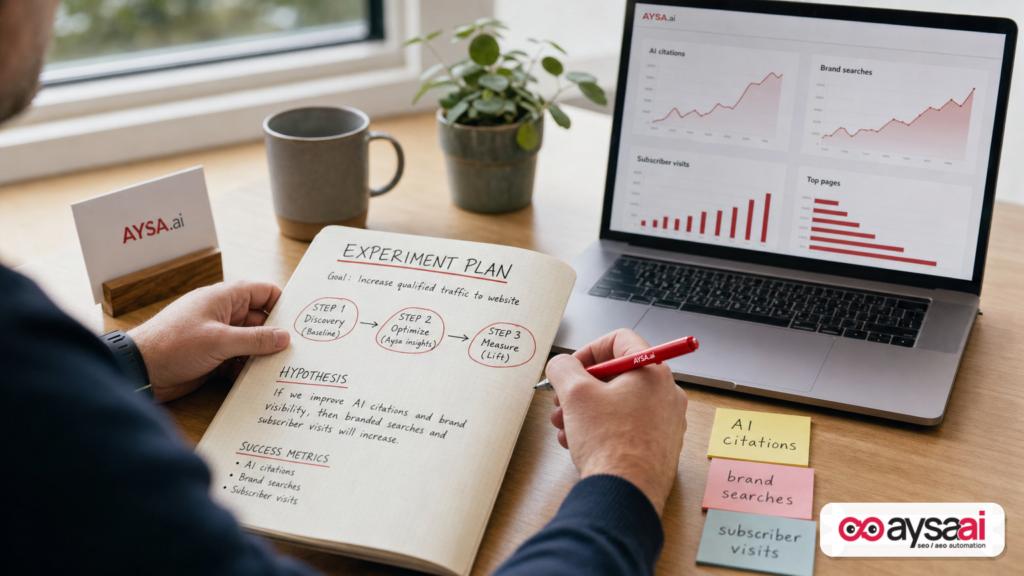
- Track proxy KPIs for 4–8 weeks (brand searches, returning users, long-tail impressions, conversions).
AYSA is built for this: it monitors, prepares recommended changes, asks for approval, and then executes accepted updates—so you can run iterative experiments without turning your site into a science project. Learn more here: AI Search Visibility.
Step 6: Upgrade technical fundamentals so you’re easy to parse and cite
AI visibility still depends on search accessibility. If you’re not technically sound, personalization won’t save you.
Basics that matter:
- Indexation: important pages are indexed, thin pages are controlled.
- Canonicalization: avoid duplicates that dilute signals.
- Internal linking: make your wedge unmistakable.
- Page performance: don’t punish mobile users.
Step 7: Don’t outsource discovery to Google—diversify your demand
If AI answers reduce clicks, then organic search becomes less like “traffic” and more like “influence.” You still need distribution engines you own:
- Partnerships
- Events / webinars
- Community participation
- PR (earned mentions)
Personalization can amplify an existing relationship. It cannot create one from nothing.
Concrete SME scenario: local clinic vs aggregator sites in AI search
Imagine a mid-sized local dermatology clinic in a competitive metro area.
The old SEO plan was straightforward:
- Create service pages (“acne treatment,” “eczema care,” “mole screening”).
- Optimize for location modifiers.
- Get reviews and local citations.
The new AI search reality adds friction:
- The user asks an AI experience: “What should I do about recurring adult acne?”
- The AI summarizes causes, OTC options, and when to see a doctor.
- The user may never click—until they decide to book.
Where personalization could help:
- If the user has shown a preference for local providers, evidence-based content, or specific care values (e.g., sensitive skin, pregnancy-safe treatments), the system might surface the clinic’s content or listing more readily.
- If the clinic has strong returning-user behavior (patients revisiting after appointments, reading aftercare instructions), the brand relationship strengthens.
What the clinic should do (practically):
- Publish a small set of aftercare and decision-support pages that are genuinely useful (what to expect, when to escalate, safety notes).
- Make those pages clearly authored/reviewed by clinicians with update dates and policies.
- Use content to drive brand recall: patients remember the clinic name, not just “a website.”
- Measure success by bookings and branded search, not by raw blog traffic alone.
This scenario demonstrates the core point: personalization can be a tailwind, but the clinic must first become the kind of source a person prefers—by being distinct, useful, and trustworthy.
What agencies must rethink: deliverables, reporting, and incentives
If you run an agency, AI search and personalization change your business model more than your keyword list.
Stop selling “rankings” as the product
Rankings are increasingly personalized, interface-dependent, and less correlated with clicks. You need to sell outcomes: qualified demand, leads, subscriptions, and measurable visibility signals.
Upgrade reporting beyond “sessions”
Traffic alone is not a business metric. Agencies should report:
- Brand demand
- Conversion rates by landing page group
- Returning users
- Content that assists conversions
- Indexation/crawl health
Move to an execution system, not a monthly checklist
AI search changes fast. You can’t wait for quarterly overhauls. You need:
- Monitoring that detects changes early
- Continuous improvements shipped safely
- Approval workflows to manage risk on client sites
This is exactly why we’ve built AYSA around approved execution: recommendations are prepared, humans approve, then changes are implemented. It’s not “set and forget.” It’s operational SEO for the AI era.
Where AYSA fits: monitoring + approved execution for AI search readiness
At AYSA, we treat AI search visibility as an execution discipline.
The core problem most SMEs face isn’t a lack of ideas. It’s a lack of bandwidth and safe implementation:
- They know their site needs content improvements, internal linking fixes, technical cleanup, or clearer topical structure.
- They don’t have time to brief writers, manage dev tickets, QA changes, and measure results.
AYSA is designed to close that gap:
- Monitor what matters as search evolves: AYSA Monitoring
- Prepare specific, prioritized website changes tied to visibility and performance goals
- Ask for approval so you stay in control (no risky autopilot)
- Execute accepted changes so improvements actually ship
If you’re evaluating whether a system like this fits your team and budget, start with pricing and packaging here: AYSA Pricing.
And if you want more operational writing from our team, browse the AYSA blog: AYSA Blog.
What to do next (action list)
- Pick your wedge. Write down the narrow topic/audience you can be the best source for.
- Audit for distinctness. Identify 10 pages that are “same as everyone else” and 10 that are uniquely yours.
- Fix citable pages first. Improve the pages most likely to be referenced in AI answers (guides, comparisons, how-tos, definitions, local specifics).
- Build loyalty capture. Add newsletter/membership prompts that match the wedge promise.
- Shift KPIs. Add brand demand, returning users, and conversion-assist reporting to your weekly dashboard.
- Run one controlled test. Change a small set of pages, log the updates, measure for 4–8 weeks.
- Operationalize execution. If changes don’t ship, nothing improves—use a system and workflow that makes shipping safe and repeatable.
Sources and further reading
- Search Engine Journal: Google’s Liz Reid: Personalization Can Help Small Publishers
- Search Engine Journal: Latest News (context on ongoing search changes)
- Search Engine Journal: SEO section (additional background and reporting)
Note on sources: The primary research input provided for this editorial was the SEJ report linked above. Where the industry needs platform confirmation (e.g., the measurable impact of preferred sources on visibility), we’ve treated those points as analysis and operational guidance rather than as proven fact.
Continue the AI search topic inside AYSA.
Use these pages to connect the article with AI SEO tools, AI visibility monitoring, AI Overviews and approved website execution.
Turn this topic into a website action plan.
Use these AYSA hubs to move from reading to technical fixes, AI visibility monitoring, research, glossary context and approval-first SEO execution.