Reddit Citations Are the New Link Farm: How to Earn AI Visibility Without Getting Filtered
Buying Reddit mentions to “win” AI citations works—until it doesn’t. The same pattern that killed paid links will catch manufactured Reddit threads. Here’s the practical, durable playbook for SMEs and agencies to earn citations the hard way (the only way that compounds), with an execution plan built for the agentic web.

Search has done this to us before: it promotes a new signal, the market rushes to manufacture it, and then the filter arrives. Today’s version is “AI citations,” and one of the hottest surfaces is Reddit.
Because AI assistants and AI-powered search experiences often cite Reddit discussions, a cottage industry has emerged to seed threads, buy aged accounts, coordinate upvotes, and slip Brand Mentions into “organic-looking” conversations. It works right now. It is also the clearest modern parallel to the era of bought links and link farms—an approach that eventually turned into a ranking liability when Google enforced quality at scale.
This editorial is a practical guide for SMEs and agencies: what changed, why it matters, what can go wrong, what to measure, and how to build AI visibility that compounds instead of depreciating. I’ll also explain where AYSA fits in a world where the “agentic web” doesn’t reward promises—it rewards executed, verified reality across your website and your reputation surfaces.
Concise summary
- AI citations are becoming a visibility currency across AI answers and AI-driven search experiences.
- Buying Reddit mentions is the new Link Farm: scalable, tempting, and likely to be filtered as platforms protect trust signals.
- The durable strategy is being real: genuine community participation plus citation-ready owned assets (your website) that models can understand and trust.
- Execution matters more than ideas: you need Monitoring, a prioritization system, and a safe way to ship improvements consistently.
- AYSA’s role: monitor AI Search visibility and site signals, prepare prioritized changes, ask for approval, and execute accepted updates on your site—so you move from “plans” to compounding improvements.
Table of contents

- What changed: AI answers elevated “citable” community content into a ranking surface
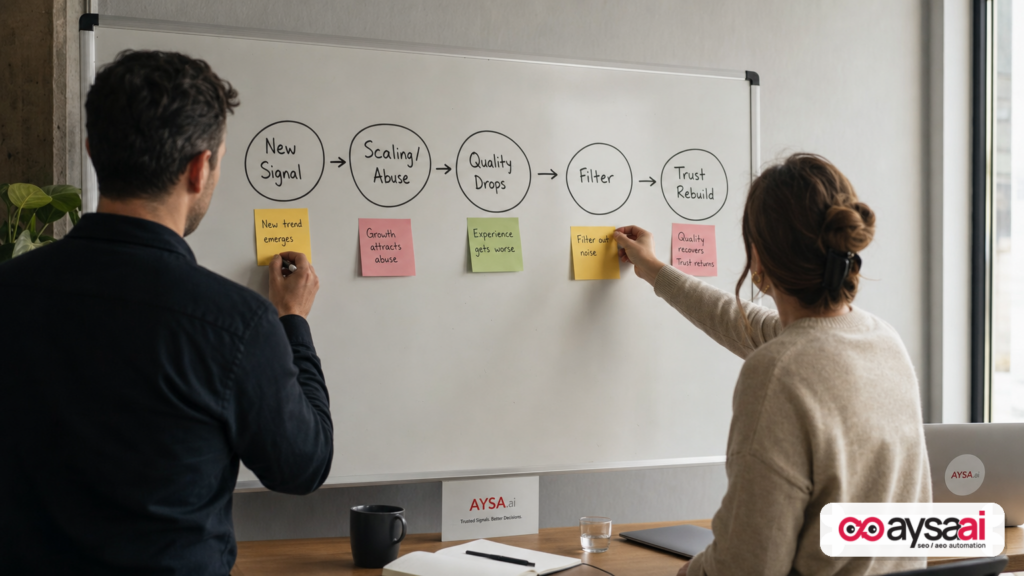
- The pattern repeats: a new signal emerges, a market forms to fake it, then the filter lands
- Why Reddit is overrepresented in AI citations (and why that invites manipulation)
- Why buying Reddit seeding is an asset engineered to depreciate
- The Penguin parallel: what history tells us about how this ends
- The real risk for SMEs: not just “penalties,” but trust collapse
- A durable alternative: build citations you don’t have to hide
- The community playbook: how to participate without being “that brand”
- Your owned-asset playbook: build pages AI can cite with confidence
- What to measure now: moving from vanity mentions to decision-grade signals
- Concrete SME scenario: a clinic tempted to buy citations
- Agency reset: what to sell when “manufactured citations” get filtered
- Where AYSA fits: monitor, prepare, approve, execute
- What to do next (action list)
- Sources and further reading
What changed: AI answers elevated “citable” community content into a ranking surface

For most of the modern web, visibility has been interpreted through a few familiar channels: organic rankings, ads, email, social reach. The last two years have added another layer: answer experiences that summarize and cite sources instead of sending every user to ten blue links.
Whether the interface is an AI-powered search feature, a chatbot, or an “AI overview”-style summary, the mechanism is similar:
- The system tries to understand the user’s intent.
- It pulls information from multiple sources.
- It synthesizes an answer.
- It cites sources to justify the answer and to give the user a path to verify.
When citations become the path to visibility, the game changes. You’re no longer only competing for rank. You’re competing to be trusted enough to be referenced. That’s a higher bar, and it’s also more fragile: once a source pool is polluted, platforms have incentives to clean it up.
This is the context behind the Search Engine Journal piece, “Buying Reddit To Win AI Citations Is The New Link Farm,” which argues that bought Reddit citations will be filtered the way bought links were filtered—because the moment a citation surface becomes purchasable, it becomes unreliable, and unreliable surfaces are eventually devalued. (Source)
The pattern repeats: a new signal emerges, a market forms to fake it, then the filter lands
If you’ve been in business long enough, you’ve seen the cycle:
- Discovery: A platform introduces or starts emphasizing a signal that correlates with quality (links, reviews, engagement, authorship, community references).
- Arbitrage: Marketers notice the signal works and create “services” to mass-produce it.
- Abuse: The signal gets noisy; quality drops; real users complain; the platform’s product degrades.
- Enforcement: The platform builds detection and applies a filter (sometimes retroactively).
- Fallout: The businesses who rented the shortcut lose visibility. The businesses who built real assets keep compounding.
Reddit citation buying sits squarely in stage two and stage three today. That’s not a moral judgment—it’s a predictable market response to incentives. If a marketer can point to a screenshot of a brand being cited in an AI answer and say “we can do that for you,” someone will pay. The problem is the same as it was in the link-farm era: you’re buying something precisely because it’s easy to fake. And anything easy to fake becomes the first thing platforms try to discount.
Why Reddit is overrepresented in AI citations (and why that invites manipulation)
Why does Reddit show up so often in AI citations and AI-influenced search results?
We should be careful not to over-claim specifics without platform documentation, but the directional reasons are clear:
- First-person experience at scale. Threads contain lived experience: “I tried X,” “here’s what broke,” “here’s what worked.” That’s gold for answer synthesis.
- Natural language Q&A. Threads resemble the way people ask questions and the way people answer them.
- Long-tail coverage. Reddit contains niche, specific, messy questions that formal editorial sites don’t always publish.
- Cross-examination. Bad answers often get challenged, corrected, or downvoted by other users.
That last point is the key: Reddit is valuable because it contains friction. It’s not just a publishing platform—it’s a debate platform. The minute marketers convert it into a “citation inventory system,” they remove the friction and replace it with stagecraft.
That’s why the SEJ piece highlights a reported trend of companies manufacturing threads to get scraped and cited by AI, and why communities respond by restricting posts—protecting their usefulness for humans first. (SEJ article)
If your business depends on this surface, your question shouldn’t be “how do we buy it faster?” It should be: how do we build durable trust signals that survive a cleanup?
Why buying Reddit seeding is an asset engineered to depreciate
If someone offers you “Reddit seeding for AI citations,” the pitch usually sounds like this:
- We have aged accounts with history.
- We can create threads that look organic.
- We can coordinate engagement to make them visible.
- We can insert brand mentions where AI systems will pull them.
Even if you set aside community rules and ethics, treat this as an investment question. You’re buying an asset whose value depends on two fragile assumptions:
- The platform can’t detect manipulation reliably.
- The AI systems will continue to trust that surface at the same level.
Both assumptions get weaker as the tactic becomes popular. In other words, the more people do it, the faster it stops working. That’s the definition of a depreciating asset.
There’s also a second-order effect the SEJ author points out: as manipulation increases, the surface becomes less trustworthy overall, which can lead to broader devaluation. If you’re paying to exploit the surface, you may be paying to destroy the very thing you’re renting.
For SMEs, this is the part that matters most: shortcuts don’t just fail—they create cleanup costs. When the music stops, you’re left with suspicious threads, reputational risk, and a visibility strategy that has to be rebuilt under pressure.
The Penguin parallel: what history tells us about how this ends
The SEJ piece draws a direct comparison to Google’s link-spam era and the eventual filtering that followed. That’s the right frame.
In the 2000s and early 2010s, links were a dominant signal. Predictably, the market created ways to manufacture links at scale: link farms, paid networks, comment spam, private blog networks. For a time, it worked—until it didn’t. Then quality systems and spam updates reduced the value of manufactured links and increased the risk of relying on them.
I’m intentionally not re-litigating the entire history of algorithm updates here; what matters is the strategic lesson:
- If a signal is both valuable and purchasable, it will be abused.
- If abuse becomes widespread, the platform will protect itself.
- When protection arrives, it’s rarely gentle.
The modern twist is that AI systems don’t just “rank.” They assemble answers from multiple surfaces and cross-check consistency. That can make manufactured consensus easier to detect over time, because the system can compare your brand’s footprint across sources.
Also, unlike a single Backlink that might be quietly removed, a manipulated public thread can become a PR story. That’s a risk profile many SMEs underestimate.
The real risk for SMEs: not just “penalties,” but trust collapse
When business owners hear “filter,” they often translate it into “Google penalty.” That’s not always the right mental model for AI citations.
The more realistic business risk is trust collapse across three layers:
1) Community trust
If your brand is perceived as astroturfing, you may not just lose visibility—you may lose the ability to participate. Moderators can remove posts, ban accounts, or restrict topics, and your legitimate support or education efforts get harder.
2) Platform trust
Once a surface is widely gamed, AI systems and search platforms may reduce its weight, shift citation preferences, or strengthen criteria for citing it. If you bought your way into that surface, your “asset” can vanish overnight.
3) Customer trust
Even if you never get “caught” by a platform, customers are increasingly good at pattern recognition. Weirdly similar posts, repeated talking points, unnatural phrasing, and brand mentions that don’t match the tone of a community—all of this reads as manipulation.
For SMEs, brand trust is often your biggest moat. Trading it for a short-lived citation spike is a bad deal.
A durable alternative: build citations you don’t have to hide
Here’s the strategy that compounds on the agentic web: be real in the places that matter and make your owned assets citation-ready.
In practice, that means you stop thinking of citations as something you “win” and start thinking of citations as something you earn as a byproduct of being consistently useful.
There are three pillars:
Pillar A: Genuine participation where your customers already gather
Not paid seeding. Not fake consensus. Real participation under your real identity (or clearly disclosed company representation), adding value.
Pillar B: Owned content that is easy to cite and verify
Your website should contain the kind of pages AI systems can confidently reference: clear definitions, policies, comparisons, troubleshooting steps, and “what to expect” explanations.
Pillar C: Proof and consistency across surfaces
AI systems can compare claims across sources. The more your messaging and facts are consistent—site, profiles, documentation, community answers—the safer you are.
This is also where many businesses get stuck: they agree with the strategy, but they lack the operational system to execute it consistently. That’s the execution gap AYSA is designed to close.
The community playbook: how to participate without being “that brand”
“Just be real on Reddit” sounds simple until you try it. Communities have norms, and brands often violate them accidentally.
Here’s a practical playbook that works across Reddit-like communities, niche forums, and professional groups.
1) Pick fewer communities—and go deeper
Most SMEs don’t need 30 subreddits or 15 forums. They need 1–3 places where:
- Customers ask questions that lead to purchase decisions.
- Practitioners debate tradeoffs (which is where expertise shows).
- Moderation is active enough to keep quality high.
2) Lead with problems, not products
If every answer you write ends with your brand name, you’ll be ignored. Instead:
- Explain the decision criteria.
- Share what typically goes wrong.
- Offer a checklist.
- Clarify expectations and timelines.
When it’s appropriate to mention your company, do it in a way that’s clearly contextual: “We do this type of work, here’s how we approach it,” rather than “Buy our thing.”
3) Build “reference answers” you can reuse ethically
Teams struggle because they reinvent the wheel. Create internal drafts for common questions, then adapt them to the thread. The goal is consistency of helpfulness, not copy-paste spam.
4) Don’t fake engagement—invite it
Instead of buying upvotes, ask better questions:
- “What context would change the answer?”
- “What constraints are you working with?”
- “If you tried X, what happened?”
Real engagement is messy. That’s a feature, not a bug. It’s the exact messiness manipulative vendors try to imitate—and the exact messiness that survives filters.
5) Treat communities as intelligence, not just distribution
The best reason to participate isn’t to be cited—it’s to learn:
- What customers are confused about.
- Which tradeoffs matter most.
- Which myths keep circulating.
- Which competitors are positioned as “trusted.”
Then take that intelligence back to your website and product messaging, where you control the asset.
Your owned-asset playbook: build pages AI can cite with confidence
Most “AEO talk” stays abstract. Let’s make it concrete. If you want AI systems to cite your site, you need content that is:
- Specific (clear answers, not vague marketing language)
- Verifiable (policies, steps, constraints, definitions)
- Structured (so machines and humans can extract it)
- Consistent with other sources (so cross-checking doesn’t flag you)
Here are page types that tend to be “citation-friendly” for SMEs without requiring you to publish research studies or pretend to be a media company.
1) “What to expect” pages
Great for clinics, home services, agencies, and any business with a process.
- Steps and timeline
- Who it’s for / who it’s not for
- Preparation checklist
- Risks and alternatives (yes, include them)
2) Pricing, packaging, and decision criteria pages
Transparent pricing is hard, but even ranges and “what affects cost” sections help. AI systems like concrete constraints.
3) Troubleshooting and edge-case guidance
These pages earn trust because they acknowledge reality. For ecommerce, that might be fit guidance or compatibility; for SaaS, common implementation failures.
4) Definitions and plain-English explainers
If your category is jargon-heavy, own the glossary. “Explain it like I’m busy” wins citations.
5) Comparison pages (ethical, factual)
Not “Competitor X is terrible.” Instead:
- Use-case comparisons
- Feature tradeoffs
- Implementation differences
- Who should choose which option
6) Policies that reduce uncertainty
Shipping, returns, warranties, privacy, cancellations, SLAs—these are highly citable because they answer “Can I trust you?” questions.
Important: Don’t create pages purely for AI. Create them because they reduce customer friction. The AI visibility is the byproduct.
If you need a starting point for AI-oriented SEO tooling and workflows, AYSA maintains resources for teams trying to adapt to AI-driven discovery: AI search visibility and AI SEO tools.
What to measure now: moving from vanity mentions to decision-grade signals
The biggest operational mistake I see is businesses chasing screenshots: “Look, we were cited in an AI answer once.” That’s not a KPI. That’s a moment.
You need measurements that help you decide what to do next. Here’s a practical measurement stack for SMEs and agencies that doesn’t require inventing new analytics systems.
1) Track demand: are people searching for you by name?
Branded search demand isn’t perfect, but it’s a durable proxy for awareness. If your AI visibility efforts are working, more people will look you up directly.
2) Track owned-asset performance: which pages earn engagement and conversions?
If you publish “citation-ready” content but it doesn’t help users, it won’t compound. Track:
- Organic entrances to those pages
- Assisted conversions
- Lead quality (qualitative if needed)
3) Track consistency: is your brand information aligned across surfaces?
This is unglamorous and critical: NAP and profiles for local businesses, policies and pricing explanations for ecommerce, implementation docs for SaaS. AI systems cross-check.
4) Track AI visibility as “weather,” not a single lever
The SEJ piece makes a great conceptual point: treat Reddit and other citation surfaces as weather. Watch what shows up, learn, adapt—but don’t bet your business on a hack.
AYSA’s monitoring layer is designed for exactly this kind of “weather tracking” plus actionable site work: Monitoring.
Concrete SME scenario: a clinic tempted to buy citations
Let’s make this real.
Scenario: A multi-location wellness clinic (think: physical therapy, dermatology, or hormone health) notices that AI answers frequently cite community posts when users ask, “Is treatment X worth it?” or “What should I expect after procedure Y?”
An “AEO agency” pitches them:
- 10 seeded threads per month
- aged accounts
- guaranteed upvotes
- “we’ll get you cited by AI”
The temptation: The clinic is fighting rising ad costs and wants visibility in AI answers quickly.
What goes wrong:
- The threads attract real patients asking follow-ups. The seeded account can’t respond credibly without exposing the script.
- Moderators restrict the topic or remove the posts.
- If the posts remain, they become a reputational liability. Patients don’t just want optimism—they want balanced expectations and risks.
The durable alternative for the same clinic:
- Create two “what to expect” hubs on the clinic site: preparation, aftercare, timelines, contraindications, and “when to call a professional.”
- Publish clinician-written FAQs that answer the exact messy questions patients ask in communities.
- Participate transparently in one or two communities: disclose affiliation, answer without pushing, invite second opinions.
- Use monitoring to see which questions are trending and which pages need improvement.
This approach is slower than buying threads. It also builds assets the clinic owns, trains the market, reduces support burden, and remains valuable even if Reddit citations get deweighted.
Agency reset: what to sell when “manufactured citations” get filtered
If you run an agency, this moment is a test of what business you’re actually in.
Are you in the business of shipping outcomes—or selling whatever shortcut is currently working?
When citations are the KPI, some agencies will be tempted to productize “citation placement.” That is dangerously close to selling links in 2010. It’s also hard to defend ethically and operationally because the buyer can’t easily audit whether the “citations” are durable or manipulated.
Here’s what to sell instead—services that remain valuable even when filters tighten:
1) Citation-ready information architecture
Build a site structure where key answers are findable, coherent, and internally consistent.
2) Editorial systems, not content volume
Most clients don’t need 50 posts. They need 10 pages that remove uncertainty from buying decisions.
3) Community intelligence + feedback loops
Use communities as listening posts, then translate insights into owned assets and product messaging.
4) Technical cleanliness that reduces ambiguity
Fast pages, clear templates, consistent metadata, and structured data where appropriate. Not because “schema hacks AI,” but because clarity reduces misinterpretation.
5) Execution discipline
This is where most agencies fail: great decks, slow shipping. The agentic web rewards consistent execution over quarterly strategy refreshes.
AYSA can complement agencies here by turning strategy into a controlled execution pipeline—monitoring, preparing changes, requesting approval, then executing updates safely. If you’re curious how that operational model works, start with AI search visibility and the AYSA blog.
Where AYSA fits: monitor, prepare, approve, execute
AI search is forcing a shift that I think most SMEs will underestimate: visibility is becoming a byproduct of operational truth. That means your website, your policies, your community presence, and your support documentation all need to align.
The hard part isn’t knowing what to do. The hard part is shipping the work, consistently, without breaking your site or creating chaos inside the business.
AYSA is built as an execution system for modern SEO/AEO/GEO:
- Monitors the signals that matter for AI search visibility and site health: AYSA Monitoring
- Prepares prioritized, actionable website improvements (content structure, internal linking, technical hygiene, clarity upgrades) so you’re not guessing.
- Asks for approval before changes go live—critical for SMEs that need control and compliance.
- Executes accepted changes on your site so improvements actually ship, compounding week after week.
In other words: instead of buying questionable “visibility placements,” you invest in making your business easier to understand and trust—by humans and machines.
If you want to evaluate whether this model fits your team, review pricing and compare it against the real cost of manual execution (and the hidden cost of cleaning up short-lived hacks).
What to do next (action list)
- Audit your current “citation surfaces.” Where are customers discussing your category (Reddit, forums, industry groups)? Pick 1–3.
- Ban the purchase of manufactured community signals. No paid upvotes, no aged account bundles, no ghostwritten “organic” threads.
- Build 5–10 citation-ready owned pages that answer real buyer questions: what to expect, pricing drivers, comparisons, troubleshooting, policies.
- Create a participation SOP (who replies, response standards, disclosure rules, escalation paths).
- Set up monitoring for your site’s visibility and health, and create a weekly improvement cadence.
- Use an approval-based execution workflow so changes ship safely instead of dying in a backlog.
If you want a structured starting point for adapting to AI search, explore:
Sources and further reading
- Search Engine Journal: Buying Reddit To Win AI Citations Is The New Link Farm
- Search Engine Journal: Latest news (context on ongoing search/AI shifts)
- Search Engine Journal: SEO coverage (broader context)
- Search Engine Journal: Google algorithm updates history (historical framing for spam enforcement cycles)
- AYSA: AI search visibility
- AYSA: AI SEO tools
- AYSA: Monitoring
- AYSA: Pricing
- AYSA: Blog
Note: This editorial intentionally avoids claiming specific platform metrics or internal AI citation weighting. Where platforms have not published primary documentation in the provided research context, I’ve framed insights as strategic analysis rather than as verified fact.
Continue the AI search topic inside AYSA.
Use these pages to connect the article with AI SEO tools, AI visibility monitoring, AI Overviews and approved website execution.
Turn this topic into a website action plan.
Use these AYSA hubs to move from reading to technical fixes, AI visibility monitoring, research, glossary context and approval-first SEO execution.