AI Search Impressions Aren’t “Visibility”: What Google’s New Counting Rules Mean For Your SEO, Reporting, And Revenue
Google is counting AI search impressions based on links—not brand presence—and “expand to reveal” links don’t count until a user activates them. Here’s what that changes in measurement, how SMEs should adjust SEO and reporting, and how AYSA helps monitor, prepare, and execute approved fixes.

AI Search is changing what “visibility” even means. And now Google is also changing (or at least clarifying) how it counts that visibility inside Search Console’s generative AI reporting.
The big takeaway from John Mueller’s explanation: Impressions in the AI report are tied to links to your pages being shown in AI Overviews / AI Mode—not simply your brand being present, and not necessarily when a link is hidden behind an “expand” or “activation” step. If the user has to reveal the sources first, the impression only counts after they do.
That sounds like a detail. It isn’t. This one counting rule changes how SMEs should interpret performance, how agencies should report progress, and how you should prioritize on-site execution if you want to be a reliable cited source in AI answers.
Key takeaways
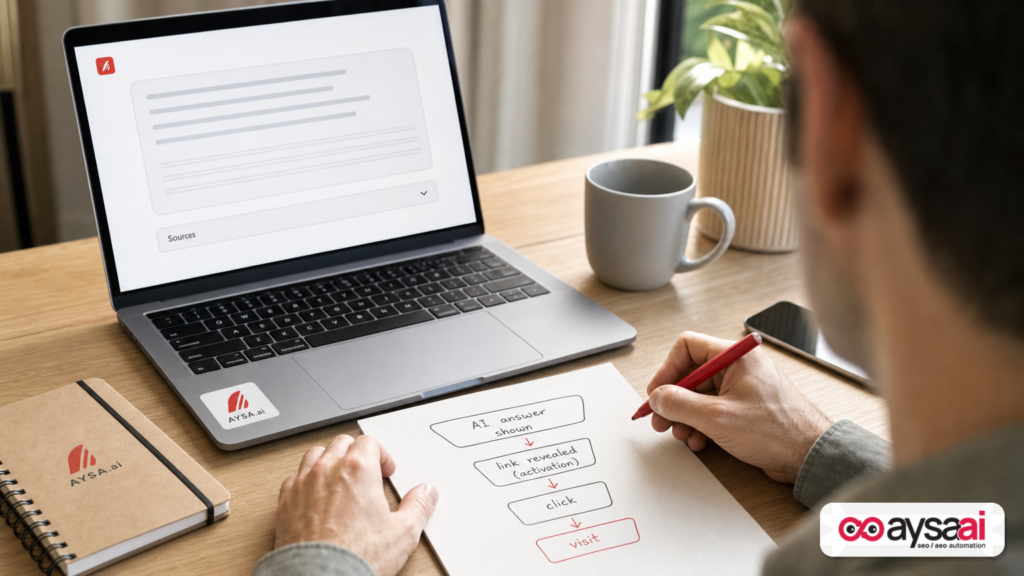
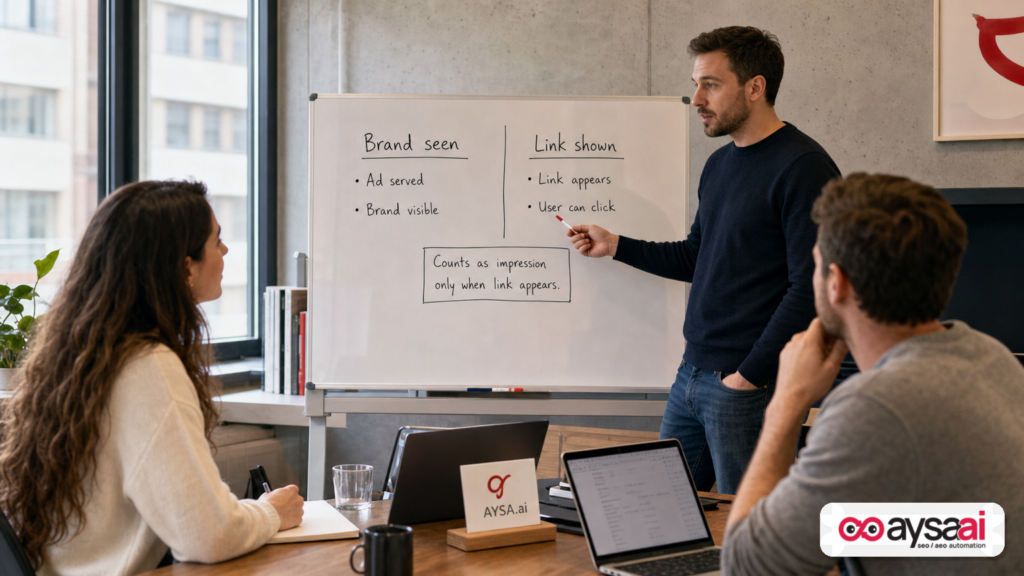
- AI impressions are link-based, not “brand presence” based. If your logo or brand appears but your page link isn’t shown, you may not get an impression.
- “Activation” matters. If a link is behind an expansion (sources drawer, cluster, combined card behavior), it may not count until the user reveals it.
- Expect mismatches between what you see in live AI answers and what Search Console records—especially early in rollout/testing.
- This will pressure teams to improve fundamentals: clear entity/topic coverage, structured content, technical accessibility, and “citation-ready” pages that AI systems can confidently reference.
- Measurement must evolve: stop treating AI impressions like traditional rankings; build a stack that separates exposure from outcomes (leads/revenue).
- Execution speed becomes a competitive advantage. Monitoring and recommendations help—but only if changes actually ship.
Table of contents
- The short version (concise summary)
- What actually changed: Google’s link-based impression definition in AI results
- Why “how impressions are counted” is a business problem, not an SEO trivia question
- The activation problem: hidden links, combined cards, clusters, and why your counts look low
- Documentation vs reality: what Google says, what’s still unclear, and how to stay sane
- AI search behavior is different: fewer clicks, more scanning, more “good enough” answers
- The new measurement stack: from rankings to exposure to outcomes
- A practical SME scenario: why your “AI mentions” don’t match Search Console
- What SMEs should monitor weekly (without drowning in dashboards)
- What agencies should change in reporting and strategy
- Where AI search optimization goes wrong: great strategy, zero execution
- How AYSA fits: monitor, prepare, approve, execute—without chaos
- What to do next: a practical action plan
- Sources and further reading
The Short Version (Concise Summary)

Google’s new Search Console AI reporting is not counting “impressions” the way many marketers assumed it would.
Per John Mueller’s explanation, impressions in AI Overviews / AI Mode are based on links to your site being shown. If users must activate a UI element (expand, reveal sources, open a cluster) to make your link visible, the impression may only count when that activation occurs.
In plain English: you can “show up” in AI answers in ways that feel like visibility, while Search Console records fewer impressions—because your actual link wasn’t displayed yet.
This matters because businesses are already making budget decisions (content, PR, Technical SEO, reporting) based on early AI Search Metrics. If you don’t understand how the metric is counted, you’ll misread performance and optimize the wrong things.
What Actually Changed: Google’s Link-Based Impression Definition In AI Results
This editorial is based on reporting from Search Engine Journal about John Mueller’s comments clarifying impression counting in Google Search Console’s AI reporting: Search Engine Journal: Google’s Mueller Explains How AI Search Impressions Get Counted.
The core idea is deceptively simple:
- An impression is tied to a link to your page being shown in AI Overviews or AI Mode.
- If a user needs to do something to make that link appear—Mueller called it “activated”—then the impression may only be counted after that activation.
Two implications immediately follow:
- Brand visibility ≠ measurable visibility. A brand icon, a favicon, or a mention in a combined card might not count if it doesn’t surface a link to a page on your site.
- Interface design affects analytics. Whether sources are collapsed by default, grouped into clusters, or shown only when expanded can determine whether your “appearance” becomes an impression.
That second point is where teams get blindsided. In traditional search results, a listing is a listing. In AI results, there are layers: answer, citations, sources drawer, expanded sources, and then Clicks. If Search Console is counting only when a particular layer is revealed, you should expect systematically lower impressions than your “I saw us in AI” observations.
Why “How Impressions Are Counted” Is A Business Problem, Not An SEO Trivia Question
Most SMEs don’t wake up thinking about impression methodology. They care about:
- Is search driving revenue this month?
- Are we losing traffic to AI answers?
- Should we invest in content, PR, or ads?
- Is our agency doing the job?
When a platform introduces a new report, teams naturally try to map it onto old mental models:
- Impressions → “How many people saw us.”
- Clicks → “How many visitors we got.”
- CTR → “How compelling we are.”
But AI search compresses the journey. A user can get what they need without visiting a site. That means impressions—especially link-based impressions—don’t represent the same opportunity they used to.
And yet, impressions are often what stakeholders use to judge whether investment is “working.” If impression counting is stricter (or gated by activation), your stakeholders may incorrectly conclude:
- “We’re not showing up in AI answers.”
- “SEO is declining.”
- “Content isn’t working.”
Sometimes, the truth is simpler: you’re present in AI answers, but your link is not displayed unless a user expands something. That’s not a win—but it’s also not the same as being absent.
The Activation Problem: Hidden Links, Combined Cards, Clusters, And Why Your Counts Look Low
Mueller’s explanation specifically called out a pattern that’s common in generative interfaces: the system can show an answer first, and reveal sources only when the user asks.
From a measurement perspective, that introduces a new “gate”:
- Gate 1: Answer exposure (user sees an AI answer)
- Gate 2: Citation exposure (user sees a source link)
- Gate 3: Click (user visits the source)
Search Console’s AI impressions appear to align with Gate 2. That means Gate 1 can be large while Gate 2 stays modest—especially if users trust the answer and don’t expand sources.
Combined cards and clustered sources: what marketers are worried about
The question that prompted Mueller’s response was essentially: what if Google shows a combined card where your brand icon appears, but your specific article isn’t visible unless expanded? Do you get an impression?
The broader principle from Mueller’s response is: the link is the unit.
- If your brand “shows” but no link to a page on your site is shown, you may not get an impression.
- If your link exists but is hidden until activation, it may only count after activation.
This is uncomfortable, because marketers can’t directly control whether Google chooses to collapse or expand sources in the UI. But you can influence whether your site is a source worth surfacing prominently.
Why UI decisions now shape SEO reporting
In classic search, the interface is stable: 10 blue links (plus SERP features). In AI search, the interface is dynamic: a model-generated answer that may summarize, cite, cluster, and reveal.
That means visibility is increasingly mediated by:
- User intent (are they researching or just checking?)
- Confidence (does the model feel it can answer without showing many sources?)
- Interface patterns (collapsed sources, expandable drawers, “chips,” cards, and clusters)
- Query complexity and risk (medical, finance, safety topics may show different source behavior)
Your reporting has to adapt to the fact that the “surface area” where a link can appear is variable.
Documentation vs Reality: What Google Says, What’s Still Unclear, And How To Stay Sane
The SEJ piece notes that Google’s help documentation defines an impression in the AI report as the number of times a link to your site appears in a generative AI feature on Google Search—but it may not clarify edge cases like icons, combined cards, clusters, or activation requirements.
When documentation lags product behavior, two things happen:
- Teams over-interpret early data.
- Teams fight over attribution and “what counts.”
Your job as a business leader (or agency) is to create rules of engagement:
- Use Search Console AI impressions as directional. Treat them like “reported link exposures,” not like total AI answer visibility.
- Separate measurement from strategy. Even if the metric is imperfect, the underlying reality stands: AI answers are capturing attention that used to become clicks.
- Document your assumptions. If leadership meetings rely on AI impressions, define what it represents and what it misses.
One more caution: the SEJ piece notes the report launched without click data (at least initially) and that there are still open questions. That means you should not expect a clean, GA4-style funnel yet. You’ll need to blend multiple signals.
AI Search Behavior Is Different: Fewer Clicks, More Scanning, More “Good Enough” Answers
Even without inventing numbers, we can state the direction: AI answers change the click economy.
Historically, a user searched, scanned results, clicked, and then the site did the persuading. In AI search:
- Google (or the model) does more of the persuading upfront.
- The user often reaches “good enough” without leaving the SERP.
- Clicks become more selective and may skew toward deeper evaluation (pricing, booking, product detail, credentials, local proof).
So the strategic question becomes: what does your site offer that an AI answer can’t fully replace?
Good answers:
- Trust signals (certifications, credentials, professional bios, editorial standards)
- Original data or proprietary insight
- Product depth (inventory, options, compatibility, availability)
- Local relevance (service area nuance, on-the-ground proof)
- Transactional capability (book, buy, quote, schedule)
When you build for those outcomes, you’re not just chasing impressions—you’re building reasons to be cited and reasons to be clicked.
The New Measurement Stack: From Rankings To Exposure To Outcomes
If you’re an SME or agency trying to adapt, here’s the cleanest way I’ve found to avoid confusion: build a layered measurement stack.
Layer 1: Presence and eligibility (are we even in the conversation?)
- Index coverage and crawlability (Search Console)
- Structured data validity (where relevant)
- Content coverage for the topics that generate AI answers
- Authority/credibility signals (site-wide and page-level)
Layer 2: AI exposure (what Search Console is beginning to report)
- AI impressions (link-based exposures)
- Query categories driving AI impressions (if available to you)
- Page types being cited (guides, product pages, local pages, FAQ, editorial)
This is where Mueller’s clarification matters: treat AI impressions as “links shown,” not “mentions,” and not “answers generated.”
Layer 3: Engagement and business outcomes
- Organic sessions and landing page mix (GA4)
- Lead submissions, phone calls, bookings, purchases
- Assisted conversions and returning visitors
- Sales team feedback: lead quality changes
The mistake is collapsing all of this into one KPI and arguing over it. The win is agreeing on what each layer is for, and then optimizing systematically.
A Practical SME Scenario: Why Your “AI Mentions” Don’t Match Search Console
Let’s make this real with a scenario that mirrors what I’m hearing from founders and marketing managers.
Scenario: a regional clinic investing in SEO content
You run a regional clinic. Your marketing manager searches “how long does it take to recover from X procedure” and sees an AI answer that appears to pull language consistent with your blog post. Your brand icon might even appear in a grouped set of sources.
But in Search Console’s AI report, impressions barely move.
What likely happened (without guessing at Google’s internals)
- The AI answer was shown to users (Gate 1).
- Your source link may have been collapsed behind an expansion (Gate 2 not reached for many users).
- Only a subset of users expanded sources, causing impressions to be counted only then.
Why it matters
- If leadership thinks “we’re not showing up,” they might cut content investment at the exact moment your material is influencing the market.
- If leadership thinks “impressions are the goal,” they might push for tactics that increase link exposure but don’t increase appointments.
What to do instead
- Keep AI impressions as a directional indicator, but judge success by booked appointments, qualified calls, and downstream revenue.
- Improve pages to be the best citation: clear definitions, updated content, medical review notes (where appropriate), structured headings, and strong internal linking.
- Strengthen conversion surfaces so that when AI does send a click, it becomes a lead.
What SMEs Should Monitor Weekly (Without Drowning In Dashboards)
Most small businesses don’t need an enterprise BI stack to handle this. They need a weekly routine that catches change early.
1) AI impressions trend (direction, not perfection)
- Watch for trend breaks, not day-to-day noise.
- Segment by page type: informational vs transactional vs local.
2) Landing page mix shifts in GA4
- Are fewer top-of-funnel pages receiving traffic?
- Are more visitors landing deeper (pricing, product, booking, location)?
3) Branded vs non-branded search health
- If AI answers reduce discovery clicks, branded demand becomes more important as a “return path.”
4) Content decay and freshness signals
- Prioritize refreshing pages that are already eligible to be cited.
- Update dates only when you genuinely improve content—don’t play games.
5) Technical consistency: indexing, canonicals, and duplication
- If you have duplicate versions of the same answer, you’re diluting citation clarity.
- Make it easy for systems to choose the canonical source.
AYSA’s monitoring is designed for exactly this type of operating cadence—track what changed, surface what matters, and turn it into executable work: AYSA Monitoring.
What Agencies Should Change In Reporting And Strategy
If you’re an agency, the biggest risk is letting AI impressions become a new “rankings report” that replaces thinking.
Reporting: update the narrative
Clients are going to ask: “Why am I seeing us in AI results but Search Console says otherwise?” Your answer should be:
- AI impressions are based on links shown, and some AI UI patterns hide links until expanded.
- Therefore, impressions undercount total AI answer exposure.
- We measure success with a stack: exposure + engagement + outcomes.
Strategy: move from “rank” to “be cited” (and then convert)
In practice, that means:
- Build “citation-ready” pages (clear structure, scannable sections, definitional clarity, strong topical coverage).
- Strengthen internal linking so models and crawlers can understand relationships between concepts and commercial pages.
- Make sure transactional pages answer pre-purchase questions, not just list features.
AYSA’s positioning is straightforward here: an execution system that helps you monitor, prepare changes, request approval, and ship updates without turning SEO into a never-ending ticket backlog. Explore the tooling and workflows here: AI SEO Tools.
Where AI Search Optimization Goes Wrong: Great Strategy, Zero Execution
The AI era amplifies a problem that already existed in SEO: the gap between knowing and doing.
Most teams can generate a list of “AI SEO best practices.” But the businesses that win are the ones that:
- Ship improvements consistently (weekly, not quarterly)
- Protect quality (no rushed, generic content refreshes)
- Keep technical foundations stable (no indexation chaos)
- Measure outcomes, not just exposure
This is where the operational model matters. AYSA is built around approved execution: the system identifies and prepares changes, you approve what should go live, and then accepted changes are executed. That’s how you keep control without stalling progress.
Relevant starting points:
- AI search visibility overview: AI Search Visibility
- Monitoring and change detection: AYSA Monitoring
- Pricing and packaging (for SMEs and teams): AYSA Pricing
- More implementation guidance: AYSA Blog
How AYSA Fits: Monitor, Prepare, Approve, Execute—Without Chaos
Here’s the practical AYSA lens on Mueller’s clarification: if impressions in AI reports are link-based and activation-gated, then the game becomes earning prominent, visible citations—not just being “kind of present” somewhere in a collapsed list.
To do that, you need three capabilities working together:
1) Monitor the right signals
- Track AI search visibility and organic changes as leading indicators.
- Detect when key pages lose visibility (and why).
Start here: AI Search Visibility
2) Prepare changes that are actually shippable
- Content structure improvements (headings, sections, FAQs where appropriate)
- Internal linking updates (make the best page the most obvious page)
- Technical fixes that reduce ambiguity (canonicals, indexability, duplication)
Explore tools: AI SEO Tools
3) Keep humans in control with approval workflows
In regulated industries, or simply in brands that care about voice and accuracy, you can’t let changes auto-publish unchecked. “Approved execution” means you move fast without losing governance.
4) Execute accepted website changes
AI search doesn’t reward the team with the best slide deck. It rewards the team that ships improvements relentlessly. That’s the gap AYSA is designed to close.
What To Do Next: A Practical Action Plan
If you want a clear next step list you can implement immediately, use this.
In the next 7 days
- Align stakeholders on definitions. Document what AI impressions represent (links shown) and what they miss (unexpanded exposure).
- Pick 10 “citation candidate” pages. Choose pages most likely to be referenced: how-to guides, definitions, comparisons, location pages, top products.
- Improve structure, not volume. Add clear H2/H3 sections that match the questions people ask; tighten introductions; remove fluff.
- Fix internal linking. Link from high-authority pages to the candidate pages using descriptive anchors.
In the next 30 days
- Create a measurement stack. Exposure (AI impressions) + engagement (sessions/landing pages) + outcomes (leads/sales).
- Refresh content with real updates. Add new details, updated steps, clearer definitions, stronger sourcing.
- Audit duplication and canonicals. Reduce ambiguity so Google can confidently select the best source.
In the next 90 days
- Build a “citation moat.” Publish a small set of pages that are the best on the internet for your niche—original frameworks, checklists, comparisons, and proof assets.
- Operationalize execution. Decide who ships changes weekly; adopt a system that turns findings into deployed updates.
Sources And Further Reading
- Search Engine Journal — Google’s Mueller Explains How AI Search Impressions Get Counted
- AYSA — AI Search Visibility
- AYSA — Monitoring
- AYSA — AI SEO Tools
- AYSA — Pricing
- AYSA — Blog
Closing perspective
My view: the market is over-fixating on the new AI report as if it’s the next rankings dashboard. It’s not. It’s an early, imperfect window into a new interface where links can be hidden, clustered, and revealed only when the user asks.
Mueller’s clarification is valuable because it forces us to be honest about what we’re measuring: not “mindshare,” not “influence,” but visible links in AI features—sometimes only after activation.
Businesses that win will do two things at once: (1) make their sites the most credible sources to cite, and (2) build execution muscle so improvements ship continuously. That’s exactly the operating model AYSA is built to support.
Continue the AI search topic inside AYSA.
Use these pages to connect the article with AI SEO tools, AI visibility monitoring, AI Overviews and approved website execution.
Turn this topic into a website action plan.
Use these AYSA hubs to move from reading to technical fixes, AI visibility monitoring, research, glossary context and approval-first SEO execution.