
AI Search Measurement Beyond Clicks: How to Prove Visibility, Influence, and Revenue in a Zero-Click World
AI answers can recommend your brand without sending a click—so measuring “traffic” alone is now an incomplete story. Here’s a practical measurement framework for AI search: track entity mentions vs. citations, build prompt samples that reflect real buyers, investigate sources that shape answers, and connect visibility to revenue using better attribution evidence.
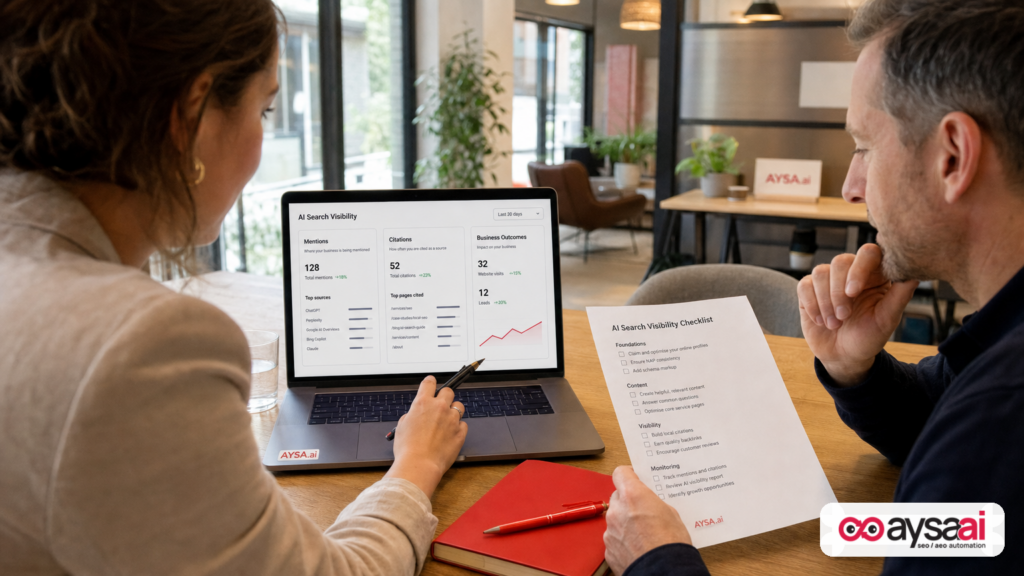
AI Search is forcing a measurement reset. The uncomfortable truth is that an AI answer can recommend your product, service, or brand without linking to your website—so the customer still discovers you, still buys, and your analytics still tells you “direct,” “none,” or worse: nothing at all.
That means the classic SEO report—rankings, Clicks, sessions, conversions—has become a partial truth. Not useless, but incomplete. If you want to manage growth in 2026 and beyond, you need a measurement model that can explain influence when traffic doesn’t show up in a clean referrer string.
This editorial is my practical take (Marius Dosinescu, AYSA.ai) on how to build that model. It’s inspired by the measurement challenges discussed by Tom Capper (STAT) in a session recapped by Search Engine Journal, but it’s written as a complete, standalone framework you can implement—whether you’re a local business, ecommerce brand, SaaS company, or agency.
Primary source: Search Engine Journal recap of “Tactical Solutions For The Biggest AI Search Measurement Challenges” (STAT’s Tom Capper): searchenginejournal.com: 593023
Concise summary (for busy operators)

- AI discovery is often zero-click: you can be recommended without being visited. That turns measurement into an Attribution challenge, not just a traffic problem.
- Track mentions (entities) separately from citations (URLs): a brand can be recommended even when competitors “own” the cited links.
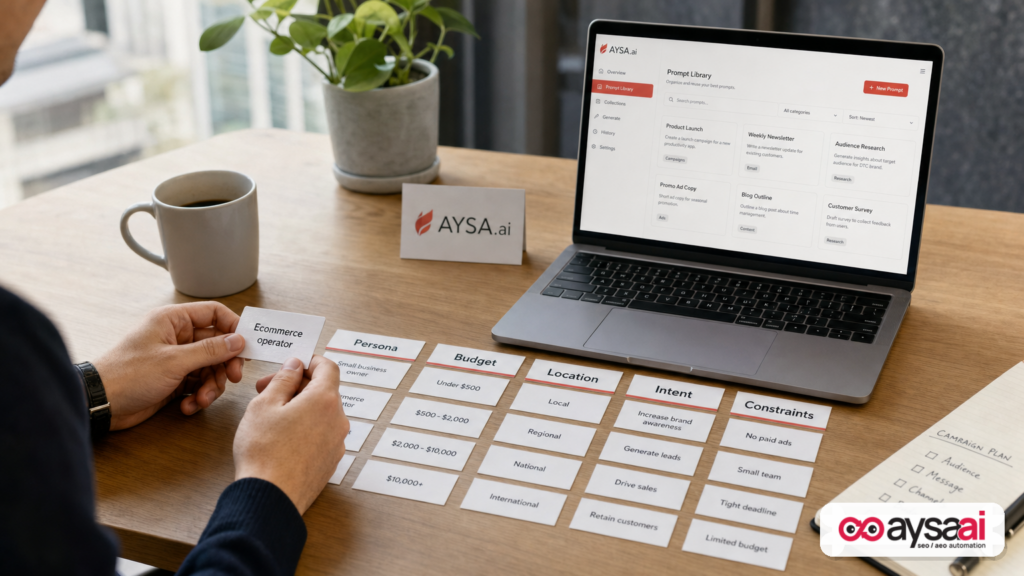
- Prompt variability is a sampling problem: build a representative prompt set (personas, budgets, locations, intents), not a tiny hand-picked list that produces noise.
- Use citations as investigative leads: they help you understand what sources shape answers and what changed after your campaigns.
- Add visibility metrics alongside business outcomes: presence, recommendation context, and surface prominence are leading indicators; revenue is the lagging indicator.
- Use surveys to strengthen the attribution story: combine self-reported “AI helped me choose” with visibility trends and your first-party data.
- Execution is now the bottleneck: teams who can monitor, propose improvements, get approvals, and ship changes consistently will outperform teams who only “report.”
Table of contents
- What changed in search (and why measurement broke)
- The measurement reset: AI can recommend you without linking to you
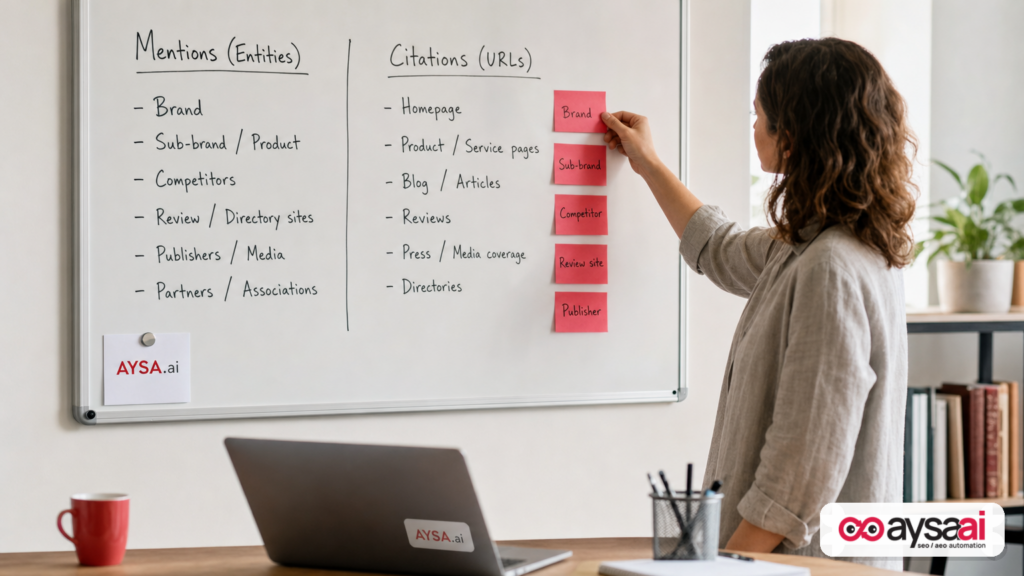
- Mentions vs. citations: the most important distinction in AI search reporting
- From search to discovery: the new funnel you should measure
- Build a representative prompt sample (without boiling the ocean)
- How to use citations to investigate what changed
- A practical AI search measurement framework (KPIs you can actually defend)
- Instrumentation basics: what to fix first in GA4, GSC, and your site
- Surveys + first-party data: your best attribution upgrade
- Dashboards that executives trust (and what to stop reporting)
- Concrete SME scenario: a local clinic competing in AI answers
- What agencies must rethink: deliver measurement + execution, not PDFs
- Where AYSA fits: monitored, approved execution for AI search visibility
- What to do next (action list)
- Sources and further reading
What changed in search (and why measurement broke)
For two decades, SEO measurement mostly assumed a simple chain:
- User searches.
- Search engine shows links.
- User clicks a link.
- Analytics records the visit with a referrer.
- Business measures conversions and assigns credit.
That chain is now optional.
AI-driven search experiences (across search engines and chat-style assistants) often answer questions directly, summarize options, and recommend brands. Even when links are present, the user may not click. And even when the user acts, they may take a path that’s invisible to the original AI exposure: Branded Search later, a direct visit, a store visit, a phone call, or a purchase through a marketplace.
This is why “zero-click” is the wrong phrase if it makes you think the outcome is “zero value.” The value can still be there. What’s missing is the measurement trail.
In other words: AI search didn’t just change traffic. It changed observability. Your business can be influenced upstream by an AI recommendation while your analytics only sees downstream behavior.
To navigate this, you need two shifts:
- Shift #1: from measuring visits to measuring visibility and influence.
- Shift #2: from expecting a single attribution model to explain reality to building an evidence portfolio (multiple signals that support a decision).
The Measurement Reset: AI Can Recommend You Without Linking to You
The core measurement problem, highlighted in the SEJ recap of Tom Capper’s webinar, is simple and brutal: an AI answer can recommend your product without linking to your site. That means:
- You may gain customers without seeing Referral traffic.
- Your team may incorrectly conclude “SEO isn’t working” because clicks plateaued.
- Executives may cut investment in content, Technical SEO, or Digital PR—just as AI surfaces increasingly depend on those inputs.
This is the same strategic risk we saw with featured snippets years ago, but amplified. Featured snippets still lived on a classic search results page with recognizable ranking logic and abundant links. AI answers can be more conversational, more personalized, and more likely to resolve intent without a click.
So the question becomes: How do you measure the things that happen before the click?
At AYSA, we frame this as measuring two layers at once:
- Visibility layer: Do you show up? How? In what context?
- Business layer: Did it help revenue, leads, calls, bookings, pipeline, retention?
If you only measure the business layer, you’ll miss early signals and you won’t know what to fix. If you only measure the visibility layer, you’ll build pretty charts that don’t earn budget. You need both.
Mentions vs. Citations: The Most Important Distinction in AI Search Reporting
One of the most practical ideas from the SEJ recap is separating brand mentions from source citations.
- Mentions (entities): The AI answer names or recommends a brand, product line, or company.
- Citations (URLs): The AI answer references sources via links to web pages—often third-party publishers, review sites, forums, or aggregators.
Why this matters: your domain being cited is not the same as your brand being recommended. And in AI answers, it’s common for the AI to recommend a brand while citing other sites as “evidence.”
If your KPI is “citations to our domain,” you can be losing while actually winning, or winning while actually losing:
- False negative: Your brand is recommended, but citations point elsewhere. Your report says “0” and your team panics.
- False positive: Your blog is cited, but the AI recommendation favors a competitor. Your report says “up,” and your team celebrates the wrong thing.
Operationally, the best practice is to define what you are tracking as entities:
- Your primary brand name.
- Sub-brands or product lines (the names customers actually use).
- Key competitors (so comparisons are meaningful).
Then track citations separately as a diagnostic layer: “What sources might be shaping the answer?” That’s where citations shine.
AYSA supports this mindset through AI visibility monitoring and workflow-driven execution: AI Search Visibility
From Search to Discovery: The New Funnel You Should Measure
Many SMEs still think in a linear funnel: impressions → clicks → conversions. AI search behaves more like a discovery system:
- Exposure: AI answer mentions you (or doesn’t).
- Framing: AI associates you with a category (“best for,” “good if,” “avoid if”).
- Validation: User cross-checks (reviews, Reddit, YouTube, local listings, friends).
- Action: User searches your brand, visits directly, calls, books, or buys elsewhere.
This is why measuring only referrals is strategically dangerous. It’s like measuring billboard effectiveness by counting how many people touched the billboard.
Instead, you want to measure:
- Presence: Did you appear?
- Recommendation status: Were you recommended, merely listed, or excluded?
- Context: What reasons were given (price, quality, location, durability, warranty, availability, expertise)?
- Next-step behavior: branded search lift, direct traffic lift, calls, store visits, form fills, demo requests.
This isn’t theoretical. It’s what executives actually need to know: “Are we in the conversation? And is it moving the business?”
Build a Representative Prompt Sample (Without Boiling the Ocean)
AI answers vary. That variability makes people throw their hands up and say: “Measurement is impossible.”
It’s not impossible. It’s sampling.
We’ve dealt with this problem forever in SEO:
- Search results differ by location.
- They differ by device.
- They differ by personalization and history.
- They change over time, even hour-to-hour.
AI adds more variability, but the solution is similar: you do not measure one query once and call it reality. You measure patterns across a representative set.
Principles for building a prompt set that behaves like your market
A good prompt sample mirrors the situations your customers are in. That means prompts should encode:
- Persona: first-time buyer vs. expert buyer; DIY vs. “done for me.”
- Constraints: budget, delivery speed, compliance requirements, allergies, device limits.
- Location: city, neighborhood, service area, language nuances.
- Intent type: informational (“how”), commercial (“best”), transactional (“buy”), navigational (“near me”).
- Evaluation criteria: “quiet,” “durable,” “HIPAA compliant,” “pet safe,” “good for acne,” “enterprise-ready.”
The SEJ recap mentions using “People Also Ask” as a realistic starting point for questions. That’s directionally smart because PAA questions reflect real search behavior. If you’re operating primarily in Google search today, you can use your existing keyword research and question mining as inputs, but you must translate them into natural prompts instead of dumping a keyword list into a tracker.
Also important: document the collection context. Even in the SEJ recap, Capper notes that the environment used to collect answers matters (for example, web interfaces vs. APIs can differ). You don’t have to obsess over this—just don’t pretend you’re tracking “the one truth” if your collection method changed mid-quarter.
How big should the sample be?
There is no universal number. The right answer depends on:
- How many products/services you sell.
- How many locations you serve.
- How diverse the intents and personas are.
- How high the stakes are (regulated industries need more rigor).
But here’s the practical guideline: your sample should be large enough to produce stable directional trends week-to-week, not dramatic swings that are really just noise. If your report flips from “positive” to “negative” based on one or two prompts, your sample is too small—or too narrow.
This is where monitoring matters. AYSA’s monitoring layer is designed to reduce the operational load of tracking and comparing changes over time: AYSA Monitoring
How to Use Citations to Investigate What Changed
If mentions are the KPI layer, citations are the investigation layer.
When a competitor is consistently recommended, citations can reveal the sources the model appears to rely on for that topic. Those sources are often:
- Review sites and comparison pages
- Industry publications
- Forums and community Q&A
- Retailer or marketplace pages
- Local business directories
The tactical workflow looks like this:
- Find prompts where competitors win.
- Extract cited URLs.
- Classify sources (review, editorial, forum, directory, vendor docs).
- Identify gaps: Are you missing from “best of” lists? Do you have weaker review coverage? Is your product spec language misaligned with shopper language?
- Launch actions: PR pitches, review program improvements, content upgrades, product page rewrites, schema enhancements.
- Monitor over time: Do the citations shift? Do mentions/recommendations shift? Do outcomes shift?
This is vastly more actionable than reporting “citation count up 12%.” Counts don’t tell you what to do. Source analysis does.
A Practical AI Search Measurement Framework (KPIs You Can Actually Defend)
Let’s turn the strategy into a framework you can run in a real business.
Three KPI groups: Leading, diagnostic, lagging
1) Leading indicators (visibility metrics)
- Presence rate: % of tracked prompts where your brand is mentioned.
- Recommendation rate: % where your brand is explicitly recommended vs. passively listed.
- Context themes: the recurring reasons you’re included/excluded (price, quality, service area, “good for X”).
- Surface prominence (where applicable): not just “position,” but how visible you are (above/below fold, how much space a surface occupies). This is analogous to how SEOs learned that “rank #3” can outperform “rank #2” depending on SERP layout.
2) Diagnostic indicators (explainers)
- Citation share: what domains/pages are cited when you appear vs. when competitors appear.
- Source category mix: how much influence appears to come from editorial vs. reviews vs. forums.
- Content alignment signals: do your pages clearly answer the criteria your market asks about?
3) Lagging indicators (business outcomes)
- Revenue, leads, bookings, calls, pipeline influenced
- Brand search demand trends (branded queries and impressions)
- Assisted conversions (where available)
- Retention/renewal effects (for subscription businesses)
The insight from the SEJ recap that I strongly agree with: visibility metrics should support—not replace—business outcomes. You need both in one narrative.
Why “sentiment” is often a trap
Many vendors will try to sell you sentiment scoring for AI answers. Use caution.
In practice, AI outputs are often neutral in tone, and small differences in phrasing can cause big swings in a sentiment classifier. You end up with charts that look dramatic but are basically measuring noise.
Instead of sentiment as a single number, measure themes and framing:
- Are you framed as “budget” or “premium”?
- Are you framed as “beginner-friendly” or “expert-only”?
- Are you framed as “fast” or “high quality”?
- Are you associated with a problem (“complaints about X”) that you need to fix operationally?
How to report it (cadence)
- Weekly: presence/recommendation rate trends; major citation shifts; notable framing changes.
- Monthly: connect visibility trends to outcomes; review prompt sample quality; update competitor set.
- Quarterly: refine measurement design; reassess which intents matter; align budget with demonstrated influence.
Instrumentation Basics: What to Fix First in GA4, GSC, and Your Site
You can’t “dashboard your way” out of broken measurement. You need basic instrumentation that captures the downstream signals AI-driven discovery often creates.
Here’s the priority order I recommend for most SMEs.
1) Treat Google Search Console as your demand barometer, not just an SEO tool
If you’re not already using it, start here: Google Search Console.
Even if AI answers reduce clicks, Search Console can still help you observe:
- Changes in impressions for branded and non-branded queries
- Changes in query mix (what people ask before they contact you)
- Country/device patterns that hint at where AI exposure might be changing behavior
Practical move: create separate views (or exports) for branded queries vs. non-branded queries. If AI is increasing awareness, you may see brand queries rise even if non-branded clicks don’t.
2) Make GA4 useful (events, channels, call tracking, lead quality)
GA4 is not perfect, but it’s the system most SMEs have. Use it intentionally: Google Analytics 4 (GA4).
Minimum viable setup:
- Clean conversion events (forms, purchases, calls where possible)
- Clear distinction between leads vs. qualified leads (where your CRM allows it)
- UTM discipline for campaigns you control (email, paid social, affiliates)
And most importantly: stop assuming “Direct” means “typed the URL.” Direct is often “unknown,” which can include AI-driven discovery that later becomes a direct visit.
3) Fix technical hygiene that affects discoverability and interpretation
This is not about chasing a “perfect” Lighthouse score. It’s about clarity and accessibility for both users and machines:
- Indexation sanity: important pages should be indexable and canonicalized correctly
- Clear on-page structure: headings, summaries, comparison tables where relevant
- Readable product/service copy in customer language (not just internal spec sheets)
- Basic structured data where appropriate (avoid spam; implement what accurately reflects the page)
This is exactly where an execution system matters, because the hardest part isn’t knowing what to do—it’s shipping it consistently. AYSA is built to monitor, prepare site changes, request approval, and then execute the accepted updates: AI SEO Tools
Surveys + First-Party Data: Your Best Attribution Upgrade
When analytics can’t observe upstream AI influence, you need additional evidence.
The SEJ recap highlights a smart, underused tool: post-purchase surveys. They won’t produce perfect truth, but they will produce signal—especially when you treat them as one piece of a portfolio.
Survey questions that actually help (and won’t annoy customers)
Keep it short. One or two questions is enough for most businesses:
- “How did you first hear about us?” (include “AI assistant / AI answer” as an option)
- “What helped you decide?” (AI recommendation, reviews, price, friend, social, search, etc.)
A key tactical note (also echoed in the SEJ recap): randomize the order of answer choices so you don’t bias toward the first option.
Connecting surveys to analytics without pretending it’s perfect
The goal is not to “reconstruct every journey.” The goal is to improve decision-making.
Ways to do that:
- Pass survey response as a dimension into your analytics/warehouse/CRM (implementation depends on your stack).
- Compare self-reported discovery vs. the channel analytics credited (e.g., “Direct,” “Organic,” “Paid”).
- Watch trends over time: if AI discovery rises while AI visibility rises, that’s corroboration.
For many SMEs, that corroboration is enough to protect budget and prioritize the right work.
Dashboards That Executives Trust (and What to Stop Reporting)
Most dashboards fail for one of two reasons:
- They are too SEO-native (rankings, crawl stats) and not tied to business outcomes.
- They are too business-native (revenue only) and provide no levers to pull.
Your AI search measurement dashboard should be a bridge.
The executive view (one page)
- Visibility: presence rate, recommendation rate (trend lines, not one-off numbers)
- Top framing themes: 3–5 bullet points (what AI says you’re good for)
- Source shifts: notable citation/source category changes
- Outcomes: revenue/leads/bookings, brand search demand trend
- Decisions: what we’re changing next and why
What to stop over-indexing on
- Raw citation counts without context
- Single prompt screenshots as “proof” (they’re anecdotes)
- Average position alone without surface prominence considerations
- Sentiment scores as a primary KPI
The point is not to remove detail. It’s to make the detail serve decisions.
Concrete SME Scenario: A Local Clinic Competing in AI Answers
Let’s make this real with a scenario that looks like thousands of businesses.
Business: A dermatology clinic with two locations in a metro area.
Problem: New patient appointments are flat. Organic traffic is flat. But competitors seem to be “everywhere,” and patients increasingly arrive saying, “I saw you recommended.” The clinic’s leadership thinks SEO has peaked.
What AI search is doing to the clinic’s funnel
A prospective patient asks an AI assistant:
- “Best dermatologist for acne scars near me”
- “Is microneedling worth it for melasma?”
- “Dermatologist who takes anxiety seriously”
The AI answer might:
- Explain treatment options (no click required)
- List 2–4 clinics with short reasons
- Cite third-party medical directories and local news
Even if the clinic is recommended, the patient may not click the clinic’s site from the AI answer. They may search the clinic name later, look at reviews, then call. In analytics, that looks like “Direct” or “Organic brand.” Leadership says: “Nothing changed.” But reality changed.
A measurement plan the clinic can run
Step 1: Define entities
- Clinic brand name
- Doctor names (often searched as entities)
- Service lines (acne scar treatment, microneedling, etc.)
- Top competitors
Step 2: Build a prompt set
- Include “near me” variants by neighborhood
- Include budget constraints (“affordable,” “financing”)
- Include concerns (downtime, skin tone, sensitivity)
Step 3: Track mentions vs. citations
- Mentions: is the clinic recommended?
- Citations: which directories/publishers are cited?
Step 4: Execute improvements
- Rewrite service pages in patient language (FAQs, contraindications, realistic expectations)
- Clarify location/service area signals
- Improve presence in sources that appear in citations (profiles, editorial mentions where appropriate)
Step 5: Strengthen attribution evidence
- Add a post-appointment survey question: “Did an AI assistant influence your choice?”
- Compare trend vs. AI visibility changes and branded search trends (GSC)
This is not about “gaming AI.” It’s about making your real-world strengths legible in the places customers and models look for evidence.
What Agencies Must Rethink: Deliver Measurement + Execution, Not PDFs
AI search is pressuring agencies in a specific way: it increases complexity while compressing patience.
Clients will ask:
- “Why are clicks down?”
- “Are we showing up in AI?”
- “How do we prove ROI if there are no clicks?”
If an agency answers with a PDF of rankings and generic commentary, churn will increase. The winning agencies will:
- Implement a defensible sampling approach for AI visibility.
- Separate mentions from citations and use citations for investigative work.
- Connect visibility trends to business outcomes using multiple evidence sources.
- Actually ship changes: content updates, technical fixes, authority-building actions—fast.
Execution speed is the new moat. That’s why we built AYSA around monitored, approved execution rather than “recommendations that die in a backlog.” See platform overview: AI SEO Tools
Where AYSA Fits: Monitored, Approved Execution for AI Search Visibility
Most businesses don’t fail because they lack ideas. They fail because they can’t operationalize the loop:
- Monitor what’s happening
- Decide what it means
- Prepare changes
- Get stakeholder approval
- Ship changes safely
- Measure impact and repeat
AYSA is built as an execution system for SEO/AEO/GEO workflows:
- Monitor: track AI search visibility patterns and website signals over time (monitoring).
- Prepare: generate site-ready improvements (content structure, on-page clarity, internal linking opportunities, technical tasks) aligned to what visibility data suggests.
- Ask for approval: you control what ships; stakeholders review and approve.
- Execute accepted changes: reduce the lag between insight and impact.
This matters even more in AI search because the feedback loop can feel fuzzy. When measurement is probabilistic (sampling-based), you win by consistently improving the inputs that models and users rely on: clear entity signals, high-quality explanatory content, credible third-party references, and strong on-site user experience.
If you want to explore how we think about AI visibility measurement specifically, start here: AI Search Visibility
If you want a practical sense of what’s included and how teams adopt it, see: AYSA Pricing
More practical editorials and implementation notes live on our blog: AYSA Blog
What to do next (Action list)
Use this as a 30-day operating plan. Don’t overcomplicate it.
Week 1: Fix definitions and reporting scope
- Write down your entities: brand, sub-brands, product lines, locations, key people, competitors.
- Decide what “winning” means for AI answers: mention, recommendation, top 3 inclusion, “best for” framing, etc.
- Audit your current dashboard: where does it measure only visits/clicks but not mentions?
Week 2: Build a representative prompt set
- Start from real customer language (support tickets, sales calls, reviews, “People Also Ask”).
- Build prompts across personas, budgets, locations, and intents.
- Document your collection approach so you can compare month-to-month.
Week 3: Add diagnostic source investigation
- For prompts where competitors win, record cited sources.
- Classify the source types and identify the top recurring domains.
- Create a short plan: which sources can you influence ethically through better representation, PR, partnerships, or improved listings?
Week 4: Connect visibility to outcomes with better evidence
- In GSC, track branded vs. non-branded query trends separately.
- In GA4, validate conversions and reduce “unknown” where feasible (UTM discipline, event cleanliness).
- Add a post-purchase / post-lead survey question that includes AI discovery as an option.
- Roll it into a one-page executive view: visibility + outcomes + next actions.
If you want help operationalizing this loop with monitored, approved execution, start with AYSA’s monitoring and AI visibility capabilities:
Sources and further reading
- Search Engine Journal: “Tactical Solutions For The Biggest AI Search Measurement Challenges” (recap, STAT / Tom Capper): searchenginejournal.com: 593023
- Google Search Console (official): search.google.com: About
- Google Analytics 4 (official help center): developers.google.com: Analytics
- Search Engine Journal — AI Search category (context lead): searchenginejournal.com: Generative Ai
- Search Engine Journal — SEO category (context lead): Search Engine Journal SEO
Note: This editorial focuses on measurement design and operational execution. AI search interfaces and features change quickly, and not every platform exposes the same data. Where a claim cannot be verified from the supplied source context or official documentation, I’ve treated it as analysis rather than fact.
Continue the AI search topic inside AYSA.
Use these pages to connect the article with AI SEO tools, AI visibility monitoring, AI Overviews and approved website execution.
Turn this topic into a website action plan.
Use these AYSA hubs to move from reading to technical fixes, AI visibility monitoring, research, glossary context and approval-first SEO execution.