
When Google “Poisons” SERPs: How to Trust Rank Tracking Again (and What to Do Instead of Panic-Reporting)
Rank trackers and SERP APIs are increasingly seeing “suspect” Google result sets—partial, abnormal, or inconsistent SERPs that can trigger false ranking drops. Here’s what’s changing, why it matters for SMEs and agencies, and a practical workflow for validating visibility before you change strategy or send client reports—plus where AYSA fits as an approved execution system.

Author: Marius Dosinescu (AYSA.ai)
Rank tracking is supposed to be the “truth layer” of SEO reporting: did we go up, did we go down, did the work matter?
But in late September and October 2026, a growing number of SEO tool vendors described a different reality: Google sometimes returns suspect result sets to certain automated collectors—pages that look incomplete, abnormal, or inconsistent with a Keyword’s historical SERP makeup. If your reporting stack ingests those SERPs as if they were real, you can end up with false ranking drops, phantom volatility, and a lot of unnecessary panic.
This editorial is not a recap. It’s a practical playbook for SMEs and agencies to:
- Understand what “suspect” SERPs are and why they’re happening
- Know how rank trackers say they handle them (and why methods differ)
- Stop overreacting to noisy signals
- Build a validation workflow that survives the next incident
- Use AYSA as an Approved Execution system that monitors, prepares, asks for approval, and executes site changes when the evidence is real
Primary source for background: Search Engine Journal coverage of vendor statements and handling approaches: How Rank Trackers Say They Handle Suspect Google Results.
Concise summary
- Some Google SERP fetches (especially via large-scale automated systems) can return incomplete or abnormal result sets, which vendors have described as “poisoned” or “incorrect.”
- Rank trackers use different safeguards: history-based comparisons, re-fetching with new sessions, anomaly filters, “sandwich” checks, and sometimes holding previous values temporarily.
- Because each vendor’s rules differ, two tools can show different “truth” for the same keyword on the same day.
- Businesses should validate suspected drops using Google Search Console as a primary reference for their own site, plus careful manual spot checks and/or re-crawls.
- During noisy measurement periods, the best strategy is not “do nothing,” but “do only what you can justify.” AYSA helps by linking Monitoring to approved execution—proposed changes, review, and controlled rollout.
Table of contents

- The New Problem: “Suspect” Google SERPs That Look Like Real Drops
- What Changed (and Why Google Might Be Doing It)
- Why This Matters: The Real Business Cost of Bad SERPs
- How Tools Try To Detect Bad SERPs (and Why Their Methods Differ)
- What You (the Customer) Might See in Dashboards
- The Hardest Part: What Happens to Past Data and Exports
- If You Use SERP APIs: Your Pipeline Can Multiply the Problem
- Use Search Console as Your “Ground Truth” (With Caveats)
- A Practical Validation Workflow Before You Report a “Drop”
- SME Scenario: The “Rank Drop” That Wasn’t (and the One That Was)
- What to Measure Instead of Obsessing Over Daily Rank
- Where AYSA Fits: Monitoring + Approved Execution (Not Blind Automation)
- What to do next (action list)
- Sources and further reading
The New Problem: “Suspect” Google SERPs That Look Like Real Drops

Let’s define the issue in plain language:
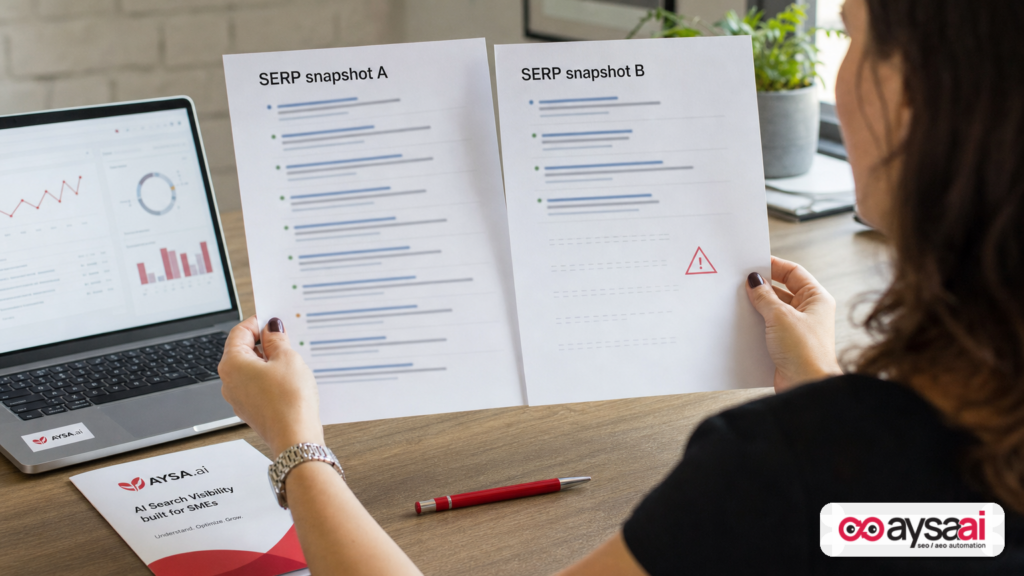
A “suspect” SERP is a results page that doesn’t resemble the normal, expected competitive landscape for a query. Not “the results changed because Google updated something.” More like: the page is missing many of the usual ranking sites, sometimes replaced with odd selections, sometimes truncated, sometimes inconsistent across fetches.
When a rank tracker records that SERP, your dashboard can show:
- Massive keyword drops across many clients at once
- Sudden volatility that resolves the next day
- “Everyone disappeared” patterns (brand sites, directories, major publishers vanish)
- Device discrepancies that feel too extreme to be real (desktop looks normal, mobile looks broken, or vice versa)
Search Engine Journal’s reporting summarizes how multiple vendors described their detection and mitigation approaches during this period, including how they check for abnormal SERPs, what customers see while checks are running, and whether or how they reprocess results historically (SEJ article).
One thing to internalize: even if two tools are doing their best, their definitions of “bad SERP” can differ. That’s why you can’t treat rank as a singular, objective metric. It’s a measurement of a moving system through a specific lens.
What Changed (and Why Google Might Be Doing It)
In the vendor statements and SEJ’s synthesis, a central theory emerges: Google may be responding to large-scale automated scraping of SERPs, and some rank tracking workflows get caught in that response.
We do not have a public statement from Google in the provided source context confirming intent or mechanism. SEJ notes that, as of the time described, vendors themselves also pointed out the lack of an official Google statement.
So we should treat the “why” as analysis, not fact. But from a systems perspective, several forces can be true at once:
- Google wants to protect infrastructure: SERPs are expensive to compute and serve. Automated fetching at scale can be abusive.
- Google wants to protect product integrity: If external systems extract SERPs for resale or training at scale, Google may throttle, degrade, or vary responses to protect business and quality.
- Google results are increasingly personalized and contextual: Device type, location, timing, and other factors already shape SERPs. Google’s own documentation emphasizes variability, which means a “single true SERP” is already slippery.
If you want a reminder straight from Google that results vary, see Google Search Console documentation around performance and how position is calculated and influenced by context (Google Search Console Performance report help). (Note: this link is included as an official, primary source reference; the SEJ text references Google’s performance reporting help page.)
The takeaway is not to argue about motive. The takeaway is operational: your measurement layer can fail in ways that look like performance changes.
Why This Matters: The Real Business Cost of Bad SERPs
Bad SERP data isn’t an “SEO nerd problem.” It’s a business governance problem.
Here’s what actually breaks when suspect SERPs leak into reporting:
1) Decision-making turns reactive
Leadership sees a visibility chart fall off a cliff and demands immediate action. The SEO team changes page titles, deletes content, rewrites Internal linking, or pauses initiatives—without evidence the drop is real.
2) Agency trust gets damaged
If you’re an agency, nothing erodes trust like sending a “we dropped” report and then walking it back a week later. Even when the root cause is tooling, the client experience is: “You didn’t know.”
3) Time gets burned on the wrong investigation
Engineers get pulled into log analysis for a phantom issue. Writers get pulled into rewriting pages that weren’t actually impacted. Paid teams get asked to cover for organic losses that may not exist.
4) Historical reporting becomes inconsistent
If a vendor reprocesses data later, exports taken earlier may not match the platform’s current view. That can create messy client disputes: “Why doesn’t the report match what your tool says now?” SEJ explicitly points out this risk and advises comparing older exports to updated platform values when reprocessing occurs (SEJ article).
How Tools Try To Detect Bad SERPs (and Why Their Methods Differ)
One of the most useful parts of SEJ’s coverage is the side-by-side view of how different vendors described their safeguards. We’re not going to restate every implementation detail—because you shouldn’t treat any as a guarantee anyway—but we will translate the approaches into evaluation criteria you can use.
Based on the source, vendors discussed tactics like:
- Rejecting “shortened” or incomplete SERPs before storing rank
- Re-fetching with a second session to see if results normalize
- History checks: comparing current SERP makeup to recent days for that keyword
- Threshold rules (e.g., if fewer than half of “typical” page-one sites appear, treat as suspect)
- Holding/lagging display: temporarily showing previous values while validating big drops
- Reprocessing affected periods after new checks are deployed
- Supplier redundancy (especially mentioned in a local SEO tooling context)
The key point: these are not all the same kind of defense.
Defense type A: “Real-time validation before storage”
This tries to stop bad data from ever landing in your historical record. Strength: cleaner history. Weakness: can increase delays, and can still fail if the suspect SERP looks “plausible” by the tool’s definition.
Defense type B: “Display safeguards”
This focuses on what you see in the UI (e.g., show prior rank for a short period while verifying a sharp drop). Strength: reduces panic. Weakness: can mask real drops temporarily and confuse users if not explained clearly.
Defense type C: “After-the-fact reprocessing”
This acknowledges bad data landed and attempts to clean or rerun it later. Strength: can correct history. Weakness: you may already have exported, reported, or made decisions based on the old data.
How to evaluate your vendor (even if they say “we handle it”)
Ask your provider questions that map to operational truth:
- What qualifies as a suspect SERP? Is it content-based, history-based, or both?
- Do you re-fetch? If yes, how many times and with what session strategy?
- Do you store a confidence flag per datapoint?
- What happens in the UI during validation—do you show last known rank, show “pending,” or show the suspect rank with a warning?
- If you reprocess, do you notify customers, list affected dates, and version exports?
Those questions matter more than a blog post reassurance.
What You (the Customer) Might See in Dashboards
SEJ highlighted something many teams overlook: what users see in a dashboard depends on the tool’s validation and display rules, not only what Google returned.
In practice, that means:
- Two users in two tools can see different ranks for the same keyword-day.
- Even within one tool, you might see a rank “stick” for a day or two while the platform verifies a large drop.
- “Refresh” features can produce different results because they trigger new sessions and new fetches.
This is why I advise SMEs and agencies to stop treating daily rank deltas as absolute truth. Treat them like an early-warning sensor: useful for detection, not sufficient for diagnosis.
The Hardest Part: What Happens to Past Data and Exports
If you’ve ever had a CFO ask “why last month’s report changed,” you already know why this section matters.
When a vendor reprocesses affected keywords or cleans past results, the platform’s historical charts can shift. SEJ notes that teams who resend data from affected periods should ask the vendor whether stored dates were updated—and that older exports may not reflect the current tool state. That is not a small footnote; it’s the difference between a stable reporting system and a credibility incident.
Operational advice for agencies and in-house teams:
- Version your exports. Include export date, tool version (if available), and notes about known incidents.
- Store raw exports. If your “source of truth” is a dashboard that can change retroactively, you need snapshots.
- Add an “incident disclosure” block in client reports during volatile periods: one paragraph that explains measurement noise risk and how you validated.
If You Use SERP APIs: Your Pipeline Can Multiply the Problem
A lot of modern SEO and growth teams don’t “use a rank tracker.” They use a data warehouse plus a SERP API plus internal logic that creates rankings, opportunity lists, alerts, and forecasts.
SEJ’s source context mentions SERP API handling discussions, including customer requests for fields to flag searches without relevant results, and notes that downstream services may need to review each response (SEJ article).
This is the scary part: internal pipelines can make suspect SERPs worse, because they often:
- Assume all responses are valid
- Aggregate noisy points into “insights”
- Trigger automated alerts or tickets
- Feed content generation or optimization queues
If your org runs SEO like a product—automated prioritization, automated task creation—then a measurement incident can cascade into dozens of unnecessary actions.
Recommendation: Add a SERP confidence layer before your warehouse writes “rank.” If you can’t get a confidence flag from the API provider, build your own: detect incomplete result sets, extreme SERP makeup changes, and conflicts across multiple fetches.
Use Search Console as Your “Ground Truth” (With Caveats)
When ranking data is suspect, the next question is: what do we trust?
For your own site’s performance in Google Search, Google Search Console is usually the best primary reference you have because it’s based on Google’s own logged impressions and clicks for your property. It won’t tell you everything (it’s not a full SERP scraper), but it’s a dependable anchor for answering: “Did our visibility actually change?”
Google’s documentation explains that average position is based on the highest-ranking result from your site for a query and that results can vary by device, location, time, and other factors (Search Console Performance report help).
How to use GSC during a suspected incident:
- Check clicks and impressions for the affected query set over the same dates the rank tool shows the drop.
- Segment by device and (if relevant) country.
- Look for corroboration: if the rank tool shows a 30-position drop but impressions and clicks are flat, you likely have a measurement issue (or a SERP layout change where position isn’t translating the same way).
Important caveat: GSC is not immune to reporting lag, aggregation, or sampling constraints. But it’s still your best “first check” because it reflects actual searcher exposure to your pages.
A Practical Validation Workflow Before You Report a “Drop”
Here’s the workflow I recommend for SMEs and agencies. It’s intentionally designed to be usable without a data science team.
Step 1: Classify the event (single keyword vs. systemic)
- Single keyword drop: likely normal SERP movement, competitor change, or query intent shift.
- Category-wide drop (many related keywords): could be algorithmic, technical, or measurement.
- Account-wide drop (hundreds/thousands of keywords across unrelated clusters): suspect measurement first.
Step 2: Check Search Console before you change anything
Validate with GSC trends: impressions, clicks, and query/page combinations. If business impact isn’t showing, pause.
Step 3: Perform 5–10 manual spot checks—carefully
Do not screenshot and “trust your browser” as a full answer. But manual checks can catch obvious nonsense, like a SERP missing all usual brands or major sites.
- Use a consistent method (incognito helps reduce personalization, but doesn’t eliminate variability).
- Check on both mobile and desktop if the tool shows device discrepancies.
- Check from the relevant location context for the business (especially local SEO).
Step 4: Trigger re-crawls/refresh inside your tool (if available)
Many platforms offer keyword refreshes or recrawls. A second pull with a new session can distinguish a transient bad SERP from a real shift.
Step 5: Look for “SERP makeup” anomalies, not just rank deltas
Ask: “Did the set of ranking domains change drastically in a way that seems implausible?” Vendors described using history-based checks and thresholds for this exact reason (see SEJ synthesis: source).
Step 6: Decide your response track
- If validated as measurement noise: document it, adjust reporting language, and avoid major site changes.
- If validated as real loss: run your normal SEO incident response (technical checks, content intent review, competitive analysis).
Step 7: Communicate like an operator, not a pundit
Clients and stakeholders don’t need a theory war about Google. They need: what happened, what we checked, what we know, what we don’t know, and what we’ll do next.
SME Scenario: The “Rank Drop” That Wasn’t (and the One That Was)
Let’s make this real with a scenario that’s common in the SMB world.
Business: a local clinic with multiple locations
The clinic invests steadily in content: service pages, FAQs, and physician bios. They also monitor local pack visibility and organic rankings for “urgent care near me,” “sports physical,” “flu shot,” and brand terms.
Week 1: The false alarm
On Monday, the rank tracker shows:
- 50–70% of keywords down 10–40 positions
- Local pack tracking looks chaotic
- Competitors “disappear” from top results
If you react immediately, you might:
- Rewrite titles across the site
- Change internal linking structure
- Blame the dev team for “indexing issues”
- Send an urgent note to leadership
But you run the validation workflow:
- Search Console: impressions and clicks are flat week-over-week.
- Manual spot checks: SERPs look normal; the clinic still appears where expected.
- Tool refresh: many keywords return to prior positions.
Conclusion: measurement noise. Action: document, annotate reporting, continue planned work.
Week 2: The real issue
Now, a different signal appears:
- Search Console impressions drop significantly for “sports physical” queries.
- Clicks drop.
- Manual spot checks show competitor pages outranking the clinic for the service page queries.
- The SERP makeup looks plausible and stable across days.
Conclusion: real loss. Action: review intent alignment, page quality, internal linking to service pages, and location relevance. This is when execution matters—fast, controlled, and measurable.
What to Measure Instead of Obsessing Over Daily Rank
I’m not saying “stop tracking rankings.” I’m saying: treat rank as one of several inputs, not the scoreboard.
During periods where SERP collection is unstable, businesses should emphasize metrics that are harder to fake by measurement artifacts:
1) Search Console query impressions and clicks (by topic cluster)
Build clusters (e.g., “sports physical” set, “flu shot” set) and watch the aggregate.
2) Revenue or leads attributed to organic landing pages
Even if your analytics isn’t perfect, directional conversion trends matter more than “we’re #3 today.”
3) Share of demand for branded queries
If brand demand holds while non-brand declines, the problem (if real) is often content/competition, not reputation.
4) Indexation and technical health indicators
When you see real traffic loss, verify the basics: crawlability, canonical consistency, redirects, template changes, etc. (This is where a system like AYSA can continuously monitor and surface actionable issues.)
Where AYSA Fits: Monitoring + Approved Execution (Not Blind Automation)
This is where I want to be very direct about philosophy.
When measurement is noisy, the worst thing you can do is pair it with uncontrolled execution. If your stack auto-generates tasks, auto-changes titles, or auto-publishes content because “rank dropped,” you risk making real damage in response to an unreal signal.
AYSA is built for the opposite posture: monitor → prepare → approve → execute, with traceability.
Here’s how that maps to this moment:
1) Monitoring that’s designed for uncertainty
AYSA’s monitoring layer is meant to surface what changed, but also to support verification. When rank data is questionable, you shift weight toward first-party evidence and site-level signals. Learn more about AYSA monitoring here: AYSA Monitoring.
2) AI-assisted preparation, not AI-driven panic
AYSA can prepare proposed on-site actions—like clarifying a service page, improving internal linking, or aligning content to intent—without pushing changes live until a human approves. That matters when you’re not 100% sure the “problem” is real.
See how we frame AI SEO tooling: AI SEO Tools.
3) Approval gates for governance
In agencies, approvals protect clients. In-house, approvals protect the brand. Either way, you need an audit trail: what changed, who approved it, and why.
4) Execution that connects to visibility outcomes
The point isn’t to “do SEO tasks.” It’s to improve search visibility in a world where search is changing (AI answers, variable SERPs, shifting layouts). That’s the lens we use in our AI search visibility work: AI Search Visibility.
5) Practical rollout discipline
When in doubt, implement changes in controlled batches. Validate impact. Then expand. That’s how you avoid compounding uncertainty with irreversible site edits.
If you want to explore whether AYSA fits your org size and workflow, pricing and packaging are here: AYSA Pricing.
And for additional editorial guidance and updates, you can always check our latest posts: AYSA Blog.
What to do next (action list)
- Stop treating daily rank changes as “facts.” Treat them as alerts that require validation.
- Ask your rank tracking vendor for their suspect-SERP policy. Specifically: validation rules, re-fetch strategy, UI behavior during validation, and reprocessing disclosures.
- Anchor investigations in Search Console. Check impressions/clicks for the affected timeframe and device context.
- Build a lightweight SERP incident SOP. Include: classification, GSC check, spot checks, refresh/re-crawl, documentation, reporting language.
- Version your reports and exports. Add export dates and incident notes to prevent future disputes.
- De-risk execution with approval gates. Don’t let suspect data trigger uncontrolled site changes.
- If you rely on SERP APIs, add a confidence layer. Validate responses before they become “rank” in your warehouse.
- Adopt an execution system that pairs monitoring with controlled implementation. If you need this operationally, evaluate AYSA’s monitoring and approved execution flow.
Sources and further reading
- Search Engine Journal (primary source context): How Rank Trackers Say They Handle Suspect Google Results
- Google Search Console documentation (official reference on performance reporting and position variability): Performance report in Search Console
- SEJ topical hub (research lead): SEJ SEO category
- SEJ topical hub (research lead): Google algorithm update history
- AYSA: AI SEO tools overview: AI SEO Tools
- AYSA: AI search visibility (AEO/GEO lens): AI Search Visibility
- AYSA: Monitoring: AYSA Monitoring
- AYSA: Pricing: AYSA Pricing
- AYSA: Blog: AYSA Blog
Continue the AI search topic inside AYSA.
Use these pages to connect the article with AI SEO tools, AI visibility monitoring, AI Overviews and approved website execution.
Turn this topic into a website action plan.
Use these AYSA hubs to move from reading to technical fixes, AI visibility monitoring, research, glossary context and approval-first SEO execution.