AI Search for SaaS Isn’t About Ranking Pages Anymore: It’s About Owning Evidence, Destinations, and the Next Action
AI search visibility for SaaS isn’t won by “writing more content.” It’s won by controlling the evidence AI systems cite, aligning that evidence to the pages (and product flows) users actually go to next, and measuring citations and referrals as two different layers. Here’s how to build an AI search program you can execute—reliably—without guessing.

AI Search is forcing SaaS companies to confront a hard truth: you can’t “SEO your way” into AI answers with on-site content alone. You can influence the answer, yet never get the visit. Or you can get the visit to a page that was never cited, and still miss the conversion because the next step is actually a login, an OAuth authorization, or a calculator—not your homepage.
This editorial is my practical operating guide for SaaS teams navigating AI search across ChatGPT and Google’s AI experiences. It’s informed by Aleyda Solis’ benchmark research on SaaS AI Search Behavior and measurement across multiple sub-verticals (CRM/Sales, Collaboration, Accounting/Finance) and by what we see at AYSA: execution—not ideas—is the bottleneck.
Primary source: Aleyda Solis, What It Takes for SaaS Brands to Win in AI Search: 5 Data-Backed Findings and Actions.
Concise summary
- Most AI citation influence comes from outside your website. Treat third-party ecosystems as a first-class channel.
- ChatGPT and Google AI Mode don’t use the same evidence. You need two distribution programs, not one.
- They also cite different parts of your own site. ChatGPT leans on canonical surfaces; AI Mode tends to pull deeper, task-specific pages.
- Citations and referrals are different. The pages that get cited are often not where users (or agents) go next.
- Category context matters more than generic “AI SEO tips.” CRM, collaboration, and finance SaaS win in different ways because the user’s job is different.
Table of contents

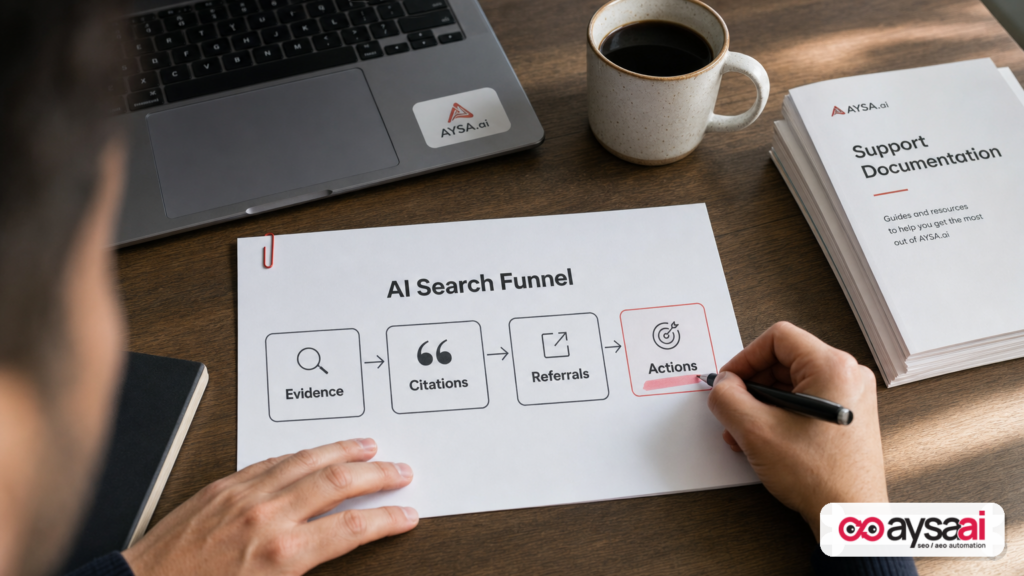
- The new AI search funnel: evidence → citation → referral → action
- What changed: AI platforms cite differently than search engines rank
- Why “SEO on your site” is no longer enough
- ChatGPT vs Google AI Mode: two evidence ecosystems
- Your website still matters—just not the way your org chart thinks
- Citations are not clicks: how the measurement breaks
- No universal playbook: optimize for your category’s primary job
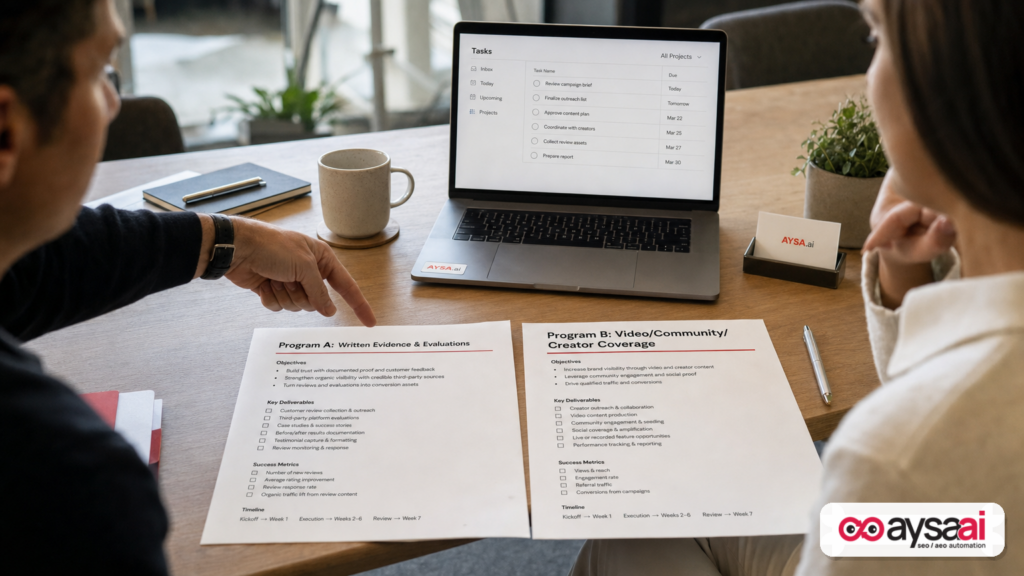
- A practical operating model: two programs, one measurement system
- SME scenario: a SaaS company that’s “cited everywhere” but sees no pipeline
- What SMEs and agencies should monitor weekly (without drowning in noise)
- Where AYSA fits: turning AI search strategy into approved execution
- What to do next: a 30/60/90-day action list
- Sources and further reading
The new AI search funnel: evidence → citation → referral → action
In classic SEO, the mental model was relatively clean: create content, earn links, improve rankings, capture Clicks, convert. AI search breaks that model into four distinct layers that behave differently and require different owners:
- Evidence: the documents, pages, videos, forums, review profiles, and datasets AI systems treat as “support.”
- Citations: where the AI assistant explicitly references sources (or implicitly relies on them).
- Referrals: where the user (or AI agent) goes after reading the answer—if they go anywhere.
- Actions: the measurable outcomes (demo, signup, install, workspace activation, filing, support completion, etc.).
What Aleyda’s analysis makes painfully clear is that these layers don’t align by default. A page can be excellent evidence and earn citations yet be a dead-end for conversions. Conversely, the highest-value destination can be a login or authorization flow that never gets cited—but still receives AI-referred traffic.
This is why I’m skeptical whenever I see a company report “AI visibility” as a single KPI. It’s like tracking “fitness” with one number without separating calories, strength, cardio, and sleep. You’ll optimize the wrong thing and still feel confused.
What changed: AI platforms cite differently than search engines rank
AI assistants don’t just retrieve “the best page.” They synthesize answers, which means they assemble justification. That justification is drawn from sources that feel credible for the task—often sources you don’t control.
In the research, SaaS answers are frequently shaped by external ecosystems: peer vendor pages, forums, reviews, publishers, creators, and video. This should change how SaaS teams think about “SEO ownership.” In AI search, your brand’s marketing site is only one node in a broader information graph.
Another shift: the answer is often the product. If the assistant can complete the task without sending a click—explaining pricing tiers, summarizing integration options, comparing competitors—then the assistant can satisfy intent without you ever seeing a session. This is already familiar in featured snippets and zero-click SERPs, but AI deepens it because it can handle multi-step reasoning and personalized context.
So the question becomes: what must your brand “own” so the answer is accurate, favorable, and leads to the next step you actually want?
If you want the disciplined version of this: you’re not optimizing for rankings; you’re optimizing for inclusion in the evidence set and frictionless next actions.
Why “SEO on your site” is no longer enough
Aleyda’s benchmark highlights that the majority of citation weight comes from third-party sources, not brand-owned pages. The exact breakdown varies by SaaS category and by AI platform, but the strategic implication is stable:
Publishing more on your own site is necessary, but rarely sufficient.
Here’s how that changes execution for SaaS teams (and why many will resist it):
1) You must map your evidence ecosystem like you map your sales funnel
In most SaaS companies, “off-site” work is split across PR, partnerships, influencer programs, community, and affiliate. Each team optimizes for their own goals. AI search rewards the opposite: a coordinated ecosystem strategy where you identify the specific domains and page types that repeatedly show up in AI answers for your high-value prompts.
That means you don’t start with “let’s be on 50 websites.” You start with: Which sources does the AI assistant actually reuse when answering the questions that matter to my pipeline?
Practical tip: build a prompt library before you build content. Aleyda has also written about prompt libraries for measurement on her site; use that idea as a discipline, not a one-time spreadsheet.
2) Page-level accuracy beats broad coverage
AI systems can repeatedly reuse the same third-party “comparison” or “best tools” page across many prompts. So one wrong description of your product in one high-leverage comparison can damage your outcomes more than a dozen low-impact mentions.
Classic Link Building incentives (more links, more mentions) can lead teams to ignore this. AI search flips it: the accuracy of a small set of pages matters disproportionately.
3) Become a category source, not only a brand source
If your brand only publishes self-referential content, you’ll be limited to brand navigational prompts. AI assistants also answer category prompts (“best CRM for X,” “how to automate invoice approvals,” “how to set up a project handoff workflow”). If you want share of that answer space, you need assets that are legitimately useful beyond your product pitch.
In practice, that means original research, benchmarks, calculators, templates, integration explainers, and documentation that other people cite because it’s the best artifact—not because you paid for placement.
4) Build the video layer (especially for Google AI Mode)
One of the sharpest platform differences in the benchmark is the role of video. Even if you’re allergic to “YouTube strategy,” AI Mode’s evidence ecosystem can make video a primary citation asset—tutorials, demos, walkthroughs, integration setup videos.
For many SaaS teams, video has lived under “brand” or “paid acquisition.” AI search pushes it into “search visibility” and “product education.” That requires a different production cadence: fewer glossy campaigns, more practical demonstrations that match user tasks.
For context on Google’s broader direction with AI in Search, keep an eye on official Google Search communications. While we can’t infer all mechanics, Google’s public guidance is consistently centered on helpful content and satisfying users (see Google Search Central: Search documentation).
ChatGPT vs Google AI Mode: two evidence ecosystems
The operational mistake I see most often is teams trying to run one “AI Optimization” program. The benchmark suggests that’s structurally flawed because the platforms rely on different types of evidence.
Translate that into business terms: you are distributing your credibility into two different media markets.
ChatGPT: written, structured, evaluative sources
ChatGPT tends to rely more on structured written sources: documentation, editorial comparisons, review platforms, statistics/research, and vendor/peer content. This leans into:
- Digital PR and editorial placements
- Keeping review profiles accurate (categories, features, pricing representation)
- Publishing research artifacts that others reference
Two research tools are mentioned in the source context as part of the analysis workflow: Semrush (citation data) and Similarweb digital intelligence (referral data). The point isn’t that every SaaS must use these exact tools; the point is to measure citations and referrals separately with dependable datasets.
Google AI Mode: video, creators, social, and participatory media
AI Mode (as represented in the benchmark) gives much greater prominence to video and a wider spread of creator/community/social evidence. That requires capabilities many SEO teams don’t have:
- Video production tied to user tasks
- Community participation (not drive-by promotions)
- Creator relations and technical advocates
Important nuance: this is not “brand awareness.” In AI search, a tutorial can function as evidence the AI system uses to justify an answer.
Communities are the shared foundation
Across both platforms, communities and forums can be foundational evidence. That means your community strategy is no longer optional, and it’s not just a support function. It’s an AI visibility moat because it compounds and can’t be replicated overnight.
If you’re a founder reading this: the fastest way to lose in communities is to treat them as a distribution channel. The only durable way to win is to show up with real help: troubleshooting, examples, best practices, and honest trade-offs.
Your website still matters—just not the way your org chart thinks
AI search doesn’t reduce the importance of your website. It changes which parts of your site become “evidence.”
The benchmark indicates different citation patterns for owned content depending on platform. The takeaway isn’t to rebuild your IA for a robot. The takeaway is to:
- Keep canonical brand surfaces unambiguous and current (because they get reused as evidence).
- Invest in documentation and help as a marketing-grade asset.
- Build deep, task-specific guides that match what users actually do.
- Create utility formats (templates, tools, calculators, comparisons) that act as “proof.”
Homepage and product hubs: not just branding
Many SaaS teams treat the homepage as sacred and static. But in AI search, it can become source material. If your homepage copy is vague (“all-in-one platform,” “seamless workflows”), the AI answer can inherit that vagueness. If your positioning is outdated, the AI answer can be outdated.
Action: treat your homepage and core product pages like living documentation. Update naming, capabilities, and “who it’s for” with the same rigor you apply to release notes.
Help and documentation: your most underrated growth asset
Docs are consistently cited because they contain the details AI systems need: steps, definitions, permissions, limitations, and edge cases. For many categories, that’s exactly what users ask about.
If your docs are thin, stale, or hard to navigate, you lose twice:
- You lose evidence quality (fewer citations, or incorrect synthesis).
- You lose conversion quality (users land on docs and can’t progress).
Docs need an owner, an update cadence, internal linking, and quality control. In other words: docs need to be part of your growth system, not a support afterthought.
Deep guides: AI Mode’s growth engine (for many SaaS types)
AI Mode tends to pick deeper, task-specific content: workflow guides, integration steps, templates, comparisons. If your blog is mostly thought leadership essays, you may be investing in content that’s socially shareable but not structurally useful as evidence.
A strong AI-search guide has:
- A specific job to be done (“set up lead routing rules in X scenario”)
- Concrete steps and screenshots (where appropriate)
- Clear prerequisites and definitions
- Links to the next action (trial, template, integration, login)
Comparisons and “alternatives” pages: controversial but necessary
Most SaaS teams avoid honest comparison pages because they feel risky. In AI search, avoiding comparisons can be riskier, because the evaluation happens anyway—on third-party pages you don’t control.
Done correctly, comparisons are not trashy “us vs them” takedowns. They’re structured decision support: which tool fits which use case, with transparent constraints. This aligns with how AI assistants are used: to reduce decision effort.
Citations are not clicks: how the measurement breaks
Aleyda’s benchmark emphasizes that citations and referrals are two different stages. This seems obvious, but most dashboards still conflate them.
Why the gap exists
AI systems cite the best evidence to justify the answer. Users click (or continue) based on what they need to do next.
Those are not the same. In collaboration SaaS, the “next action” might be opening a workspace, authorizing an integration, or installing an app. In finance SaaS, it might be using a calculator or completing a filing step. In CRM, it might be pricing, demo, or implementation guidance.
If your team reports “top cited URLs” and assumes those are “top AI landing pages,” you will:
- Over-invest in evidence pages that don’t convert
- Under-invest in destinations that do convert
- Misdiagnose performance when pipeline doesn’t move
How to report AI search like an adult
You need a layered report with explicit denominators:
- Citations: share of citations for your prompt set (by platform)
- External authority coverage: presence and accuracy in high-leverage third-party sources
- Referrals: measurable AI traffic (by platform where possible)
- Actions: conversions tied to your category’s job (not just form fills)
- Alignment rate: what portion of AI-referred traffic lands on cited pages (as a diagnostic, not a goal)
This is also where data quality can sabotage you: suites vs sub-brands, customer login traffic mixed with acquisition, and irrelevant sections (careers, status pages) muddying results. If you’re using GA4, you’ll want disciplined event design and filtering (see Google’s GA4 documentation: Google Analytics 4).
Track trends, not snapshots
AI search changes constantly. One measurement run can mislead you. What you need is a repeatable measurement cadence—same prompt library, same categorization rules, same time windows—so you can see directionality.
If your leadership wants a weekly “AI score,” push back. Offer a weekly trend brief and a monthly deep dive with actions tied to evidence, destination, and conversion layers.
No universal playbook: optimize for your category’s primary job
The most important strategic idea in the benchmark is also the simplest: AI systems reward the content that helps users complete the primary job of the category.
That means copying another SaaS content strategy can be actively harmful. You’ll build the wrong assets, in the wrong formats, for the wrong “next step.”
CRM/Sales SaaS: “Understand, compare, adopt”
In CRM, buyers often need:
- Clarity on capabilities and fit
- Implementation guidance and onboarding confidence
- Comparisons and alternatives
Owned assets that tend to matter: product pages, pricing signals, support, academy/training, implementation guides, comparisons. External priorities: reviews, directories, peer vendors, communities.
Destinations that matter: demos, pricing, signup, support, and sometimes app/account access.
Project/Collaboration SaaS: “Complete workflows and integrate”
Collaboration products are operational. The job is not “learn what it is,” it’s “make it work in my stack.” So the high-value assets are:
- Documentation and integration instructions
- Templates and workflow guides
- Utilities and reference content
External priorities: YouTube, creators, technical communities, Reddit-style forums, peer tools. Destinations that matter: OAuth/authorization flows, installations, workspace URLs, logins.
This is where classic marketing dashboards often fail: the “conversion” is not a lead. It’s activation.
Accounting/Finance SaaS: “Reduce risk and decide”
Finance buyers want fewer surprises. They want decision support: compliance explainers, calculators, comparisons, and authoritative help content.
External priorities: specialist publishers, peer vendors, reviews, communities. Destinations that matter: calculators, support flows, pricing, account access, filing workflows.
If you publish vague trend content (“Top finance trends 2026”), you may get attention. But attention isn’t the job. Decision support is the job.
A practical operating model: two programs, one measurement system
Let’s turn this into an operating model you can actually run inside a SaaS business without reorganizing the company.
Program 1: Evidence & evaluations (ChatGPT-leaning)
Goal: be accurately represented in the written evaluative sources AI assistants reuse.
Workstreams:
- Audit top third-party comparison/review pages for accuracy
- Fix mismatches: categories, features, pricing, integrations
- Publish category-level assets (benchmarks, calculators, datasets) others can cite
- Update canonical on-site pages so AI doesn’t repeat stale messaging
Success metrics: citation share for priority prompts, representation accuracy, growth in high-leverage evidence placements, referral quality to commercial pages.
Program 2: Demonstration & community coverage (AI Mode-leaning)
Goal: dominate task-based evidence—tutorials, walkthroughs, community answers—that supports workflows.
Workstreams:
- Produce task-focused videos (setup, integrations, troubleshooting)
- Invest in community participation (engineers + advocates + power users)
- Creator partnerships focused on education, not promotion
Success metrics: inclusion in AI Mode evidence surfaces, AI referrals to docs/utilities, activation events tied to those referrals.
One measurement system that doesn’t lie
Both programs require the same measurement discipline:
- A representative prompt library per product line
- Separate reporting per platform (do not blend)
- Layered KPIs (citations, referrals, actions)
- Filters for irrelevant traffic (careers, status, unrelated subdomains)
- Trend tracking over time
This is where execution systems matter, because measurement produces tasks. Tasks produce changes. And changes need governance.
SME scenario: a SaaS company that’s “cited everywhere” but sees no pipeline
Let’s make this real with a scenario I see often.
Company: a 45-person SaaS in the CRM/automation space.
What they notice: marketing keeps seeing the brand mentioned in AI answers and social screenshots. The CEO hears “we’re showing up in ChatGPT.” But demo requests aren’t growing.
They do a quick internal audit and find:
- The brand is cited primarily via third-party comparisons and forum threads (evidence layer is strong).
- AI referrals land mostly on help docs and a few generic blog posts (referral layer is misaligned).
- Those docs have no strong “next step” to pricing/demo, and internal linking is weak (action layer is broken).
- Tracking is messy: AI traffic is lumped into “referral,” and product login traffic is mixed with acquisition (analytics layer is unreliable).
What fixes it:
- Bridge cited pages to next actions. Add context-appropriate CTAs: “See pricing,” “Start a trial,” “View integration directory,” “Book onboarding call.” Not everywhere—strategically where the intent signals it.
- Refresh canonical product messaging. Make feature definitions and ICP explicit; remove vague claims the AI can’t operationalize.
- Repair high-leverage third-party pages. Correct feature mismatches and ensure category placement is accurate.
- Measure actions that match CRM’s job. Demos, trials, and implementation starts—not vanity sessions.
The lesson: being cited can be real progress. But without destination design and measurement integrity, it won’t show up in the numbers your CFO cares about.
What SMEs and agencies should monitor weekly (without drowning in noise)
AI search can turn into chaos quickly because it feels infinite: infinite prompts, infinite answers, infinite sources. You need a tight monitoring loop.
Weekly: indicators and hygiene
- Prompt-set spot checks: Are you present for your 20–50 highest-value prompts per product line?
- Representation accuracy: Are you described correctly (features, pricing model, integrations, limitations)?
- Destination health: Are the top AI landing pages fast, clear, and conversion-capable?
- Community pulse: Are there new threads you should respond to with real help?
Monthly: analysis that informs budget
- Citation share by platform (ChatGPT vs AI Mode)
- Top external evidence sources (by reusability and leverage)
- AI referrals by page type (docs, guides, product, utilities, login flows)
- Actions: demos, installs, authorizations, activations, calculator completions—whatever matches your category job
Quarterly: rebuild the prompt library and strategy
Prompts change as your category changes. Competitors ship features, pricing models shift, and AI assistants evolve. Quarterly, revalidate:
- Which prompts drive business value now
- Which external sources dominate those prompts
- Which on-site assets are being used as evidence and which are decaying
If you run an agency: this is your opportunity. Many clients will ask for “AI SEO.” The best agencies will productize monitoring + evidence strategy + destination optimization + measurement, not just content production.
Where AYSA fits: turning AI search strategy into approved execution
Most companies don’t fail because they lack ideas. They fail because execution is slow, risky, or politically blocked. AI search increases the volume of required changes: docs updates, internal linking improvements, CTA fixes, template pages, comparison page refreshes, structured data updates, analytics cleanup. That’s a lot of surface area.
AYSA is designed for this reality: monitor, prepare, ask for approval, then execute accepted changes. That governance loop matters when you’re editing high-impact pages or regulated content.
Here’s how we typically map AYSA into an AI search program:
1) Monitoring that matches AI search, not 2018 SEO
Start with a monitoring layer that tracks what matters: visibility signals, content freshness, and destination performance. See: AYSA Monitoring.
2) AI search visibility as a system, not a screenshot
AI visibility needs repeatable checks, not anecdotal “we saw ourselves in ChatGPT.” AYSA’s approach to AI search visibility supports the discipline you need to separate evidence and destination layers. See: AYSA AI Search Visibility.
3) Tools to operationalize AEO/GEO work
You need tooling that translates insights into tasks: what to update, where to link, what to improve, what to publish next. See: AYSA AI SEO Tools.
4) Approved execution to reduce brand and compliance risk
AI search will push you to edit docs, pricing language, integrations, and comparison claims. That’s exactly where approvals matter. AYSA’s execution model is built to propose changes, collect approvals, and then implement accepted updates safely—without turning every edit into a multi-week ticket queue.
5) Make it budgetable
AI search can feel like an endless project. It needs to be a budget line item with a defined cadence. See: AYSA Pricing.
If you want more on how we think about building an execution engine for SEO and AI search, the AYSA blog is where we publish frameworks and playbooks: AYSA Blog.
What to do next: a 30/60/90-day action list
You don’t need a massive replatform to get traction. You need sequencing.
Days 0–30: build the foundation (so your measurement isn’t fiction)
- Define your category’s primary job. Write it in one sentence. If you can’t, you can’t prioritize.
- Build a representative prompt library. Start with 30–100 prompts per product line.
- Separate KPIs: citations vs referrals vs actions. Decide what “action” means in your category (demo, install, activation, calculator completion).
- Inventory your owned assets by job: docs, guides, templates/tools, comparisons, product pages, academy.
- Identify your top external evidence sources for your prompt set (not generic “best sites”).
Days 31–60: fix high-leverage evidence and destinations
- Refresh canonical pages (homepage/product hubs) so they’re unambiguous and current.
- Upgrade docs as evidence: add missing steps, clarify definitions, improve internal linking.
- Bridge cited pages to next actions: add intent-matched CTAs and navigation paths.
- Correct key third-party pages where you’re misrepresented (comparisons, reviews, directories).
Days 61–90: launch the two-program distribution model
- ChatGPT program: publish one category-level “source asset” (benchmark, calculator, integration matrix) and secure accurate inclusion in a small set of high-reuse evaluative pages.
- AI Mode program: ship a task-based video series (5–10 videos) + a community participation plan.
- Measurement cadence: weekly checks, monthly report, quarterly strategy refresh.
What can go wrong (so you can avoid it)
- Over-optimizing for citations and neglecting conversion paths
- Blending platform metrics and drawing the wrong conclusion
- Publishing content in the wrong format for the evidence role (e.g., blog post instead of template or video tutorial)
- Ignoring product destinations (login/OAuth/workspace) because “marketing doesn’t own them”
- Letting data quality rot until reporting becomes a debate instead of a decision tool
Sources and further reading
- Aleyda Solis (primary research source): What It Takes for SaaS Brands to Win in AI Search: 5 Data-Backed Findings and Actions
- Semrush (tool referenced in the research context): Semrush
- Similarweb (tool referenced in the research context): Similarweb digital intelligence
- Google Search Central documentation (general guidance context): Google Search documentation
- Google Analytics 4 documentation (measurement context): Google Analytics 4
AYSA resources referenced:
The bottom line
AI search is not “SEO with new keywords.” It’s a shift from ranking pages to managing evidence and orchestrating the next action. SaaS brands that win will do three things consistently:
- Own the evidence ecosystem (on-site and off-site) that AI systems reuse.
- Design destinations for the next step—including operational product flows, not just marketing pages.
- Measure in layers so the program can improve instead of arguing over one misleading number.
And then they’ll execute—fast, safely, and continuously. That’s the difference between being “mentioned in AI” and turning AI search into durable growth.
Continue the AI search topic inside AYSA.
Use these pages to connect the article with AI SEO tools, AI visibility monitoring, AI Overviews and approved website execution.
Turn this topic into a website action plan.
Use these AYSA hubs to move from reading to technical fixes, AI visibility monitoring, research, glossary context and approval-first SEO execution.