AI Search Has Two Memories: How to Win in Retrieval and “Model Memory” (Without Wasting a Quarter)
AI answers come from two different memory systems: what models already “know” and what they retrieve live. Most businesses optimize one and ignore the other—then wonder why their brand looks fresh on one engine and outdated on another. Here’s how to audit both layers and build an execution plan that actually sticks.

AI Search didn’t “replace” SEO. It split it.
When a customer asks an AI engine a question about your product, your locations, or your pricing, the answer usually comes from one of two places:
- What the model already believes (trained, embedded, and hard to change quickly), and/or
- What the engine retrieves live (fetched from the web at the moment of the question).
Most teams treat AI visibility like one problem with one playbook. That’s why you see the weirdest real-world outcome: your brand looks fresh on one platform and stale on another, even when you’re asking the same question.
This editorial is built from the research framing in Search Engine Journal’s piece on how AI search runs on two memory systems and how platforms use them differently, and what that means for marketing and SEO teams (source).
From my perspective (Marius Dosinescu, AYSA.ai), the practical implication is straightforward: you can’t manage what you don’t separate. If you don’t explicitly diagnose whether your AI problem is “retrieval” or “model memory,” you’ll waste quarters producing content that never gets fetched—or doing technical cleanups that don’t fix what the model already thinks it knows.
Concise summary
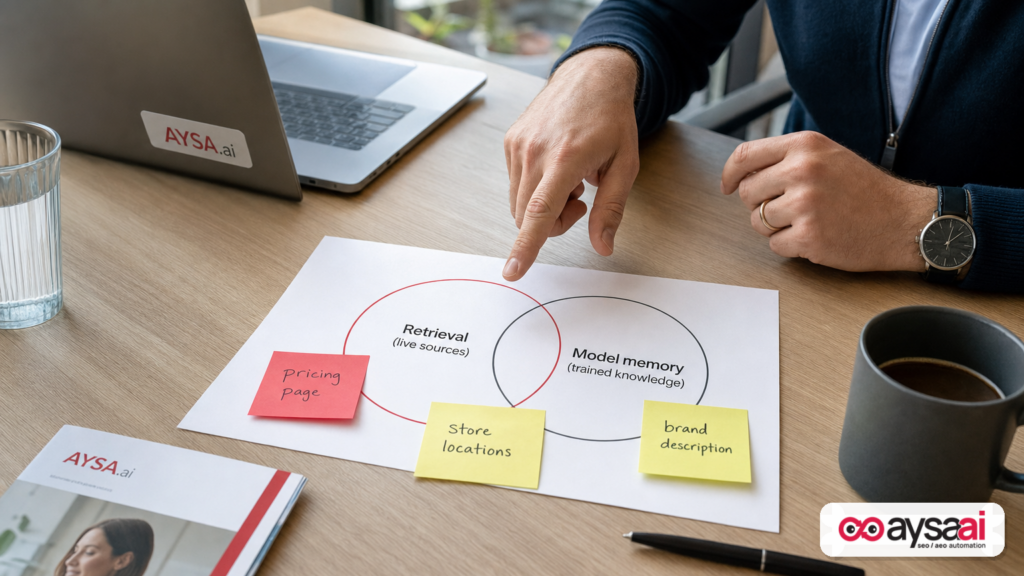
- AI answers run on two memory systems: (1) model memory (sometimes called parametric memory) and (2) retrieval (fresh sources pulled at query-time).
- Platforms have different default behaviors (“memory postures”). Some retrieve almost every time; others decide per query (and can change over time).
- The same symptom can have two different causes: “AI gets our brand wrong” might be a model-memory problem or a retrieval-selection problem. The fixes are not interchangeable.
- Timing is now a lever: model memory updates on retraining cycles; retrieval can reflect changes as soon as pages are crawled/accessible.
- Execution matters more than strategy: teams need a Monitoring-to-approved-change workflow, not just a list of recommendations.
Key takeaways (what changed, why it matters)

- Search behavior changed: users increasingly ask full questions and accept synthesized answers, not ten blue links.
- SEO split into AEO/GEO + classic SEO: you’re optimizing for inclusion, extraction, and representation—not just rankings.
- Visibility isn’t one score anymore: you can have strong retrieval visibility and weak model-memory accuracy (or the reverse). Averaging them hides risk.
- Your brand is “assembled”: engines may pull your pages, third-party coverage, and reviews—then summarize imperfectly.
Table of contents

- The new mental model: AI answers run on two memory systems
- Why platforms disagree about your brand (and why it’s structural)
- Memory posture: the single concept most teams are missing
- Retrieval isn’t one step anymore: from “top 3 pages” to agentic fan-out
- The hidden failure: being retrieved vs being represented accurately
- Timing became a competitive lever (and most teams aren’t using it)
- A “memory posture” audit you can run in 60 minutes
- How to fix retrieval problems (what actually moves the needle)
- How to influence model memory (without pretending you can “update the model”)
- The SME scenario: a local clinic that looks “wrong” in AI answers
- What agencies should rethink: deliverables, reporting, and responsibility
- Where AYSA fits: monitoring + approved execution across both layers
- What to do next (action list)
- Sources and further reading
The new mental model: AI answers run on two memory systems
If you want to make AI search operational for your business, you need a mental model that a non-SEO stakeholder can understand in one sentence:
AI answers come from either “what the model already knows” or “what it retrieves right now.”
In the Search Engine Journal analysis, this is described as:
- Model/parametric memory: knowledge learned during training and “baked into” the model until a future training run.
- Retrieval: fresh sources pulled from the web (or an index) at query-time, often presented as citations or source links.
Think of it like two employees answering a customer:
- Employee A answers from memory. Fast, confident, sometimes outdated.
- Employee B checks the latest docs. Slower, but can cite the current policy.
Your “AI visibility” is not one thing. It is the combination of:
- Whether you get retrieved,
- Whether you get extracted cleanly, and
- Whether you are represented accurately after the system synthesizes multiple sources.
This is why we built AYSA’s approach as a loop: monitor what AI surfaces say, prepare fixes, ask for approval, and execute accepted website changes—because visibility without remediation is just anxiety. (More on this later.)
Why platforms disagree about your brand (and why it’s structural)
Business owners often describe the problem like this:
- “ChatGPT says we’re a budget brand.”
- “Google shows us as premium.”
- “Another engine cites our competitor’s comparison page instead of our own.”
- “One answer references our old pricing model from last year.”
It’s tempting to dismiss these as model quirks. But the SEJ piece argues the gaps are structural: platforms don’t use the two memory systems the same way.
Once you accept that, the work becomes less mystical:
- If the platform is answering from retrieval, you need to win the retrieval race (Indexing, relevance, extractability, corroboration).
- If the platform is answering from model memory, you need to win the training-data narrative over time (consistency across the web, stable facts, repeated corroboration).
Same question, different memory posture → different answer. Not random. Not personal. Fixable—if you diagnose correctly.
Memory posture: the single concept most teams are missing
The SEJ article gives a name to the behavior that matters most for planning: memory posture.
Memory posture is an engine’s default “lean” when asked a question:
- Does it retrieve live sources by default?
- Or does it answer from model memory unless it decides retrieval is necessary?
Why this matters operationally: the posture determines your levers.
Two broad camps (and why you should care)
In the SEJ framing:
- Always/mostly retrieve: engines that run retrieval on nearly every query (Perplexity is cited as a clear example in the source; some Google experiences lean heavily on retrieval from the Search index).
- Model-decided retrieval: engines that choose per query whether to retrieve (ChatGPT, Claude, Copilot, and app experiences are discussed in the source text).
The key operational difference:
- On retrieve-first systems, your AI visibility is primarily a retrieval problem.
- On model-decided systems, your AI visibility can be a settings-and-context problem as much as a content problem. Retrieval may not even fire for a given query.
Posture is not stable
Another important point from the source: posture can change as models and product experiences are updated. If your team ran an AI audit six months ago and hasn’t repeated it, you might be managing last season’s system behavior.
That’s why we treat AI visibility as monitoring, not a one-time “project.” (See AYSA Monitoring.)
Retrieval isn’t one step anymore: from “top 3 pages” to agentic fan-out
Traditional SEO trained us to think of retrieval like this:
- User enters query
- Search engine fetches top results
- User Clicks a result
AI retrieval changes the middle. It may still fetch documents, but the system can also:
- Break the question into sub-questions,
- Run multiple retrievals,
- Compare sources,
- Assemble a synthesized answer.
The SEJ article describes this shift as retrieval becoming more “agentic” (planning and executing multiple sub-queries) rather than a single pass.
Practical implication for content and SEO:
- You’re not only optimizing for the exact question the user typed.
- You’re optimizing for the invisible sub-questions the system generates to answer it.
Example: how one buyer question turns into many machine questions
User asks: “Is Acme Accounting good for restaurants?”
The AI system may fan out into questions like:
- “Acme Accounting restaurant features”
- “Acme Accounting integrations with POS systems”
- “Acme Accounting pricing for multi-location”
- “Acme Accounting reviews restaurant owners”
- “Alternatives to Acme Accounting for restaurants”
If your site has one generic product page and your competitor has a detailed “For Restaurants” hub plus comparison content, you’ve probably already lost retrieval selection—even if your product is better.
The hidden failure: being retrieved vs being represented accurately
Here’s the trap: teams celebrate “we got cited” and ignore whether the citation was used correctly.
The SEJ article points out a real limitation: even when models can locate facts in long context, they may still struggle to integrate multiple scattered signals into a coherent brand picture.
For businesses, this creates a new quality bar:
- Inclusion: Are you retrieved and included in context?
- Extraction: Are your facts easy to extract (clear, structured, consistent)?
- Representation: Is the final summary accurate and aligned with your positioning?
Why representation fails in practice
In SME terms, representation errors often come from:
- Ambiguity (you describe your offer three different ways across pages)
- Conflicts (your site says one thing; third-party sources say another)
- Thin primary-source coverage (your own site lacks the detail, so the AI leans on a review site or competitor comparison)
- Unclear location/entity boundaries (brand vs franchise vs location pages vs practitioner pages)
Classic SEO mostly cared whether you ranked. AI search cares whether you can be assembled correctly.
Timing became a competitive lever (and most teams aren’t using it)
In classic SEO, when you updated a page, you expected that update to propagate once crawled and indexed. AI search introduced a second timeline: the training window.
Model memory doesn’t update just because you published a correction. If the engine answers from model memory, it may repeat an old story until the model is retrained and that new story is learned.
The SEJ piece argues this changes the key question from:
- “How do we fix what the model believes today?”
to:
- “What will the model learn about us next time it trains?”
What timing means for a business leader
You now manage two “freshness clocks”:
- Retrieval freshness clock: how quickly engines can discover and fetch your updated pages (crawl/index/availability).
- Model-memory freshness clock: how quickly the next model generation “absorbs” the updated narrative (training cadence, dataset inclusion, redundancy across sources).
If you only work on one clock, you’ll keep experiencing brand drift.
A “memory posture” audit you can run in 60 minutes
You don’t need special tooling to start. You need discipline: ask the right questions, across the right surfaces, and label what you see.
Step 1: Pick revenue-tied queries (not vanity queries)
Skip “What is {Brand}?” unless you’re doing crisis comms. Pick questions that actually precede a purchase:
- “Best {category} for {use case}”
- “{Brand} vs {competitor}”
- “{Category} pricing for {segment}”
- “Does {brand} support {integration}?”
- “{Service} near me” + qualifiers (for local)
Choose 5–10.
Step 2: Test across a deliberate engine spread
Use at least:
- One retrieve-first engine (to observe retrieval behavior clearly), and
- Two model-decided engines (to see when retrieval is invoked vs skipped).
Use identical wording. The variable you’re testing is the platform, not your prompt creativity.
Step 3: Read the posture, not just the answer
You’re looking for tells:
- Are there citations/source links? Strong signal retrieval occurred.
- Is the answer confident but uncited? Likely model memory.
(Not every product shows citations the same way, so treat this as a heuristic, not a law.)
Step 4: Force a recency cue
Ask the same question twice:
- Evergreen version: “Is Acme good for restaurants?”
- Recency version: “Is Acme good for restaurants in 2026?” or “What’s the latest on Acme for restaurants?”
In the SEJ framing, this can flip some engines into retrieval. When you see a flip, you just learned something important: that engine is posture-flexible, and your strategy must account for both layers.
Step 5: Classify problems by memory layer
This is the moment most teams skip, and it’s the moment that saves money.
- Stale facts with no citations → model-memory problem (you can’t “edit” it directly; you influence future training inputs).
- No mention / competitor cited / wrong page cited on a retrieval answer → retrieval-selection problem (findability, relevance, corroboration, structure).
- You’re cited but summarized wrong → representation problem (ambiguity/conflicts across sources; unclear extraction; scattered facts).
Step 6: Repeat on a cadence
The SEJ piece emphasizes posture changes. Treat your audit as a recurring check. For most SMEs: quarterly is a good starting cadence; for volatile or regulated categories, consider monthly.
AYSA is built to support that ongoing reality: AI Search Visibility plus Monitoring and controlled execution.
How to fix retrieval problems (what actually moves the needle)
When retrieval is the dominant layer, you’re back in a world that feels like SEO—but with new requirements: you’re not just ranking, you’re getting selected and extracted as evidence for an answer.
1) Build primary-source pages that answer the fan-out sub-questions
If your buyer asks comparisons, integration questions, “best for” questions, and “how does it work” questions, you should have your own pages answering them, not just a generic homepage and a blog.
Examples of retrieval-friendly primary-source assets:
- “{Product} for {industry}” pages (restaurants, clinics, contractors)
- Integration pages (what connects to what, limits, setup steps)
- Comparison pages that are fair and specific (not smear pages)
- Pricing explanation pages that resolve common confusion
- Policy pages that are readable (returns, shipping, cancellations)
In other words: publish what the agent would search for.
2) Make extraction easy: structure beats cleverness
AI retrieval systems don’t “appreciate” your brand voice. They appreciate clarity.
Practical content structure patterns that help:
- Clear headings that match buyer questions
- Short definitions near the top (“Acme is a…”)
- Tables for feature comparisons (when accurate and maintained)
- Bulleted lists for requirements, compatibility, exclusions
- Canonical, consistent naming for your products/services
This is squarely in the “Content SEO meets Technical SEO” zone. You can do it manually, but it’s easy to miss across dozens or hundreds of pages—especially for ecommerce and multi-location.
That’s where systems matter. AYSA’s positioning is not “generate more content.” It’s monitor → prepare changes → ask for approval → execute accepted changes across your real pages. See: AYSA AI SEO Tools.
3) Strengthen corroboration across third-party sources
The SEJ piece highlights that models learn (and retrieval systems trust) what is consistent and corroborated across sources.
In retrieval mode, the engine may still use third-party pages to validate claims or fill gaps. If every reputable source describes you one way and your site claims another, your site won’t win the “assembly.”
What you can do without inventing PR stunts:
- Ensure core facts are consistent everywhere you control them (site, docs, profiles).
- Publish clear, citable primary-source pages so third parties reference you.
- Reduce ambiguity (one brand name, one product naming convention, one pricing narrative).
4) Treat “competitor comparison capture” as a retrieval problem
When AI routes a buyer through a competitor’s “Acme vs Competitor” page, that’s often not because the AI hates you. It’s because your competitor created the most retrieval-ready document for that sub-question.
Your response is not outrage. It’s an asset:
- Create your own comparison page that is factual, specific, and kept up to date.
- Address switching costs, who you’re best for, and who you’re not best for.
- Link it from relevant product and “solutions” pages so crawlers see it as important.
How to influence model memory (without pretending you can “update the model”)
If your audit suggests the answer is coming from model memory, you’re dealing with a slower system. That doesn’t mean you’re powerless. It means your levers are different.
What you cannot do
- You cannot “submit an update” to a model’s parameters the way you submit a sitemap.
- You cannot reliably erase a widely repeated misconception overnight.
So don’t build a strategy on fantasies.
What you can do (the long-game playbook)
Model memory tends to reflect what is:
- Repeated across sources,
- Stable over time,
- Corroborated,
- Easy to crawl and parse.
That points to a pragmatic set of actions:
1) Make the accurate story the redundant story
If your positioning changed (e.g., you moved upmarket, you dropped a feature, you changed your shipping policy), ensure that:
- Your website reflects the change across all relevant pages (not just one announcement post).
- Your documentation and FAQs match the new truth.
- Your partner pages, profiles, and owned listings match.
The goal isn’t to publish one “correction.” It’s to make the new narrative hard to miss.
2) Reduce contradictions that confuse future training
Contradictions are model-memory poison. Common sources:
- Old blog posts that still rank and describe deprecated offers
- Stale PDFs
- Copied product descriptions on reseller pages that you never updated
- Multiple “about” pages with different language
Cleaning this up is unglamorous and extremely valuable.
3) Assume training is periodic—and plan for it
The SEJ article notes training refreshes happen in steps (new releases, new cutoffs). You can’t control the calendar, but you can control whether your “true” version is prominent and repeated before the next training window.
This is why “approved execution” matters: when teams identify contradictions, they need a safe way to fix them quickly without a six-week dev queue. That’s the gap AYSA targets.
The SME scenario: a local clinic that looks “wrong” in AI answers
Let’s make this concrete with an example I see constantly in the wild: a local clinic (or a multi-location health practice) where AI answers are confident and wrong.
Scenario:
- You operate a clinic with two locations.
- You added a new service line (e.g., sports physicals) and stopped offering another (e.g., pediatric urgent care).
- You updated your website months ago, but AI answers still mention the old service and omit the new one.
Diagnosis via memory posture
- If the AI answer has no citations and repeats old facts, that smells like model memory.
- If the answer cites a third-party directory with stale data, that’s a retrieval problem (your primary source is losing to a secondary source).
- If it cites your site but still summarizes incorrectly, that’s a representation problem (often ambiguity: the service is mentioned but not clearly described, or details are scattered).
Fix plan (layered)
Retrieval layer fixes:
- Create or improve service pages with clear headings, eligibility, and location availability.
- Ensure location pages explicitly list services offered at that location.
- Improve internal linking so crawlers understand service-to-location relationships.
Model-memory influence:
- Remove or update old pages/PDFs that still describe deprecated services.
- Make the new service description consistent across site sections and any owned profiles.
Representation fixes:
- Use consistent terminology for the service (don’t alternate between three names).
- Add a plain-English “What it is / Who it’s for / What’s included” section near the top.
The key is you don’t do “content” as a vague task. You do the layer that’s broken.
What agencies should rethink: deliverables, reporting, and responsibility
AI search changes what clients actually buy from agencies.
Historically, many retainers delivered:
- Rank tracking
- Monthly reports
- Content calendars
- Technical audits
Those still matter. But they’re incomplete because AI outcomes are often:
- Cross-engine (different postures)
- Cross-source (your site + third parties)
- Cross-format (answers, citations, summaries, comparison routes)
Reporting needs to split by memory layer
A single “AI visibility score” is seductive and often misleading. If you average retrieval visibility and model-memory accuracy into one number, you hide risk.
Instead, agencies should report separately:
- Retrieval presence: do we get cited/pulled into context?
- Retrieval quality: are the right pages being cited?
- Representation accuracy: is the summary aligned?
- Model-memory drift: do uncited answers repeat old facts?
Deliverables must include execution—or the retainer becomes theater
AI search makes “recommendations only” less defensible. Because when an AI engine misrepresents a brand, the client doesn’t care that you wrote a PDF. They care that it’s fixed.
This is why we believe the future is approved execution—a workflow that gets changes live safely and quickly, with client control.
If you’re an agency, the operational question becomes: how do you ship changes without turning every edit into a dev ticket?
That’s one of the reasons AYSA exists: prepare changes, request approval, execute accepted updates—so agencies and SMEs can move at the speed AI surfaces change.
Where AYSA fits: monitoring + approved execution across both layers
AYSA.ai is built around a reality I think the industry is still avoiding:
AI search is now a living system. You can’t “set and forget” your brand narrative.
So we focus on three things that match how AI search actually behaves:
1) Monitor what AI engines say (and how they say it)
You need ongoing monitoring because memory posture changes and retrieval can shift with indexing and competition.
Start here: AYSA Monitoring
2) Prepare fixes mapped to the broken layer
Not “make more content.” Specific, page-level changes tied to:
- retrieval selection (coverage, relevance, structure)
- representation accuracy (clarity, consistency)
- model-memory influence (removing contradictions; repeating the accurate story)
Learn more: AI SEO Tools
3) Ask for approval, then execute accepted website changes
AI optimization can’t be a free-for-all. Brands need control. Regulated industries need governance. SMEs need safety.
That’s why we emphasize approved execution: changes are proposed, reviewed, and only then implemented.
If you’re exploring operational fit and cost: AYSA Pricing
Bonus: learn and adapt
We also publish ongoing thinking and playbooks here: AYSA Blog
What to do next (action list)
- Run a memory posture audit on 5–10 revenue queries across at least three AI surfaces.
- Label each failure: retrieval, model memory, or representation.
- Fix retrieval first when citations show the system is pulling sources but picking the wrong ones.
- Fix contradictions across your site and owned assets to influence future model memory.
- Clarify extraction: restructure key pages so your answers are easy to lift (headings, tables, definitions).
- Set a cadence (quarterly minimum) to re-run the audit because posture shifts over time.
- Operationalize execution: choose a workflow/tooling approach that can ship approved updates quickly.
If you want to build this into a repeatable system, start with AYSA’s AI visibility and monitoring resources:
Sources and further reading
- Search Engine Journal: AI Search Runs On Two Memory Systems. The Platforms Don’t Use Them The Same Way
- Search Engine Journal SEO section (context and related coverage)
- Search Engine Journal SEO News (platform changes that can affect posture)
- AYSA: AI Search Visibility
- AYSA: Monitoring
- AYSA: AI SEO Tools
- AYSA Blog
- AYSA Pricing
Note: This editorial deliberately avoids claiming specific platform percentages or feature behaviors beyond what’s described in the supplied research context. Where platform settings, retrieval triggers, or product behaviors vary, treat them as variables to measure with your own audits, not assumptions to bake into strategy.
Continue the AI search topic inside AYSA.
Use these pages to connect the article with AI SEO tools, AI visibility monitoring, AI Overviews and approved website execution.
Turn this topic into a website action plan.
Use these AYSA hubs to move from reading to technical fixes, AI visibility monitoring, research, glossary context and approval-first SEO execution.