The AI Recommendation Gap: Why Being Understood Isn’t Enough (and How to Earn “In-the-List” Visibility)
AI systems can accurately describe your business and still never recommend you. The difference often isn’t your schema or About page—it’s whether trusted third-party content consistently mentions you alongside the category leaders. Here’s how to close the recognition-to-recommendation gap with co-mentions, category positioning, and an execution plan SMEs can actually run.

Search used to be a simple bargain: publish good pages, earn a few links, rank for keywords, get Clicks. Now the bargain is changing. More buyers are asking AI tools to recommend “the best” options, and those answers don’t always look like a list of blue links.
Here’s the hard part: many businesses are doing the “AI SEO” basics—clean About page, correct schema, clear positioning—and they’re still not showing up when customers ask AI: “What’s the best [category]?”
New research shared in Search Engine Land helps explain why: being understood by AI isn’t the same as being recommended by AI. The practical lesson isn’t about one more schema type. It’s about how often your brand appears in the same conversations—in third-party editorial, comparisons, “best of” lists, retailer category pages, and industry reports—alongside the brands that already define the category.
I’m Marius Dosinescu, and at AYSA.ai we build systems that help teams monitor, prepare, and execute SEO/AEO/GEO changes with an approval-first workflow. This editorial is a standalone playbook for closing what I’ll call the AI recommendation gap: the space between “AI can describe you” and “AI will put you in the shortlist.”
Concise summary
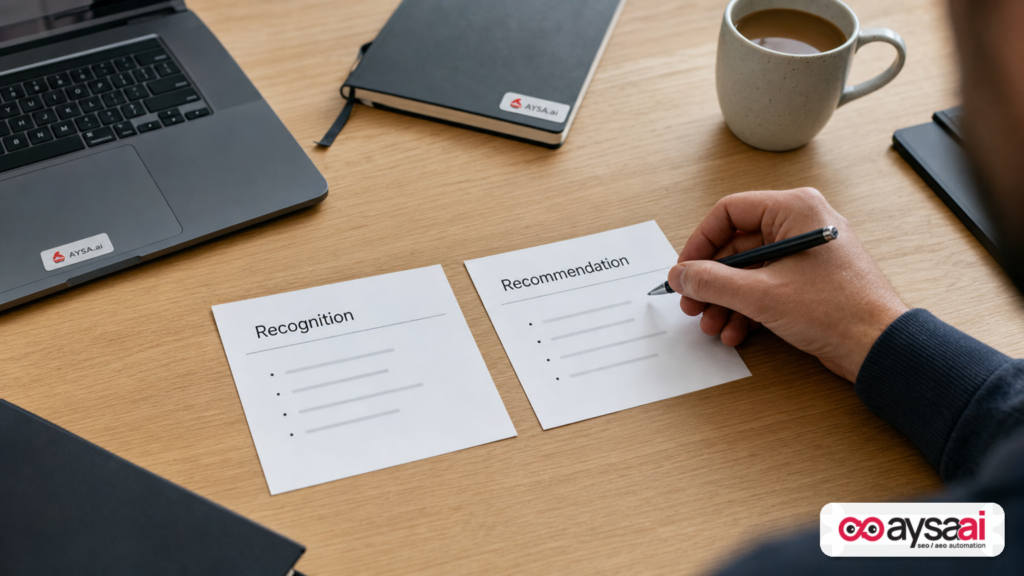
AI tools often recommend brands based on category clusters learned from (and reinforced by) third-party content. If you’re not consistently co-mentioned next to the category leaders in credible sources, you may be recognized but not recommended. To close the gap:
- Keep Entity Clarity strong (site + Structured data) so AI can identify you correctly.
- Earn external credibility signals (independent coverage, reviews, authoritative citations).
- Deliberately build category positioning by getting mentioned with the right peer set in comparisons, roundups, and taxonomies.
- Measure recommendation visibility separately from Organic traffic and brand queries.
Key takeaways

- Recognition ≠ recommendation. Your brand can be accurately described and still never appear in “best X” answers.
- Third-party content dominates recommendations. When users don’t name your brand, AI systems lean heavily on external sources (not your site).
- Co-mentions create category membership. AI learns “what belongs together” by seeing brands appear together in lists and comparisons.
- Adjacency doesn’t happen automatically. Even if you logically fit a related category, AI may not bridge that gap unless the ecosystem has already built the bridge.
- Your plan needs execution, not theory. Monitoring + content improvements + PR/partnership work must run as an operating system.
Table of contents
- The new reality: AI can recognize your brand and still never recommend it
- Why this matters now: AI answers are becoming the first stop
- Co-mentions: the hidden mechanism behind “in-the-list” visibility
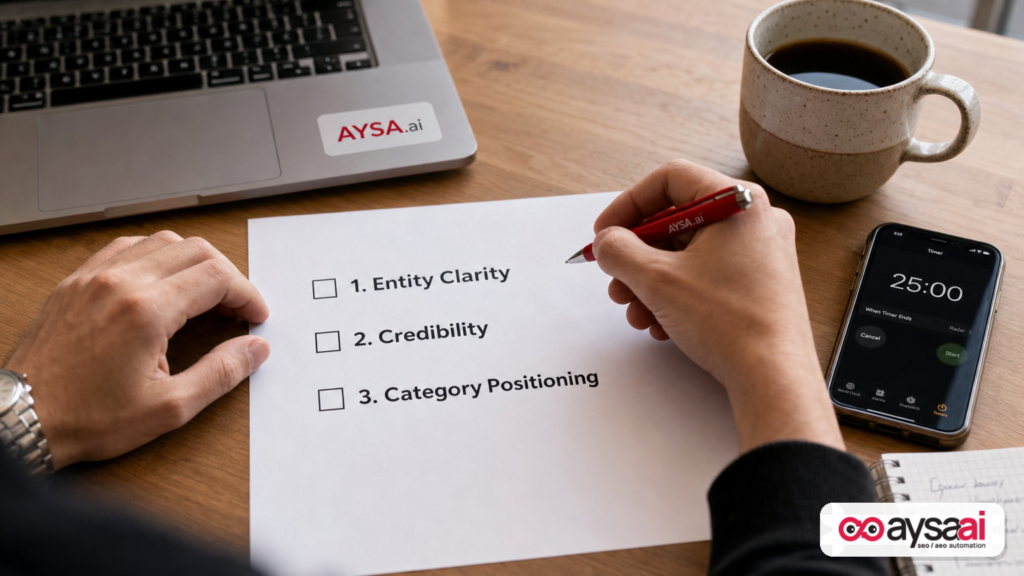
- A practical framework: from Entity Clarity → Credibility → Category Positioning
- How to measure the recommendation gap (without guessing)
- The SME scenario: a great brand that never gets recommended
- What to change on your site (still necessary, just not sufficient)
- What to change off-site: PR, comparisons, partnerships, and taxonomy
- What agencies should rethink: deliverables, reporting, and incentives
- What can go wrong: cheap co-mentions, mismatched categories, and brand risk
- Where AYSA fits: monitoring + approved execution for AI search visibility
- What to do next
- Sources and further reading
The new reality: AI can recognize your brand and still never recommend it
If you’ve been working on “AI visibility,” you’ve probably done the right first steps:
- Clarify what you do in plain English.
- Improve your About page and brand story.
- Add organization schema and entity references.
- Create pages that answer common questions directly.
All of that helps an AI system recognize you: “This is who they are.” But recommendation is a different game: “These are the top choices.” And “top choices” are rarely chosen by reading a single company’s About page.
The Search Engine Land research summary highlights the core issue: in tests across multiple AI systems, brands could be accurately recognized while still being absent from recommendation prompts. The strongest insight is not that AI is “wrong.” It’s that AI is often doing what it was trained (and tuned) to do: pattern-match to known category sets that repeatedly appear in third-party content.
In business terms, think of it like this:
- Recognition is your legal name and your elevator pitch.
- Recommendation is whether you’re invited into the industry’s “top vendors” slide.
Those two things are related—but they’re not the same.
Why this matters now: AI answers are becoming the first stop
It’s tempting to treat AI answers as a novelty. But buyer behavior is changing in a predictable way: when people want a short list, they ask an assistant instead of reading 12 tabs.
Search Engine Land has been tracking multiple shifts in AI-driven discovery and visibility, including how AI surfaces results and how platforms change recommendation behaviors. Their broader coverage on AI search shifts reinforces that this isn’t a one-off tweak; it’s a structural change in how information is retrieved, summarized, and recommended (see: 7 AI search shifts you can’t afford to ignore).
What’s new is not that brands need authority. What’s new is:
- The interface is consolidating choices. Buyers are satisfied with fewer results when the output feels confident.
- The retrieval layer is selective. AI often cites and recombines a narrower set of sources than the open web.
- Category membership matters more. Being “adjacent” may not count unless the ecosystem already talks about you as part of that set.
This is why we advise teams to track AI search visibility as its own KPI, not as a side note to rankings. (More on measurement later—and yes, AYSA supports this kind of monitoring: AI Search Visibility.)
Co-mentions: the hidden mechanism behind “in-the-list” visibility
Let’s define co-mentions in plain English.
A co-mention happens when your brand and another brand appear together in the same third-party piece of content. That content might be:
- a “best of” list,
- a comparison article,
- a retailer category page,
- an analyst report,
- a review roundup,
- a forum thread that gets indexed and cited (when reputable),
- or an editorial guide where multiple brands are named together.
Why does that matter? Because category understanding—especially in recommendation contexts—is often learned through association:
- “If Brand A and Brand B appear together in many ‘best X’ lists, they likely belong to the same cluster.”
- “If Brand C appears mostly with a different set, it likely belongs to another cluster.”
The Search Engine Land piece describes a study design that separated recognition prompts (brand named) from recommendation prompts (brand not named) across multiple AI systems. The insight worth carrying forward is conceptual: recommendation outputs leaned heavily on third-party sources, and category cluster association (inferred via co-mentions) helped explain why some brands appeared and others didn’t.
From my perspective, this is one of the most useful “translation layers” for SMEs. Many owners hear “GEO” or “AEO” and think it’s mysterious. Co-mentions make it concrete: you’re not just trying to be crawled—you’re trying to be included in the same lists that define the category.
Co-mentions aren’t the same as links (and that’s the point)
Classic SEO taught us to value links. Links still matter. But co-mentions introduce a different emphasis: context.
- A link can be isolated (“Here’s Brand X”).
- A co-mention is inherently comparative (“Brand X alongside Brand Y and Z”).
Recommendation prompts are comparative by nature. So the content that best trains and supports recommendations is also comparative by nature.
AI doesn’t always assume adjacency
Humans make leaps: “This running shoe brand probably also works for athleisure.” AI systems often can make leaps, but they don’t reliably do so in recommendation settings when they’re anchored to a retrieved corpus of “what people say belongs in this category.”
This is why a business can be accurately categorized but still not recommended for a neighbor category unless there’s a strong external narrative connecting the two.
A practical framework: from Entity Clarity → Credibility → Category Positioning
Most teams mix these into one bucket and call it “AI SEO.” That’s a mistake. You should treat them as three separate problems with three different solution paths.
1) Entity Clarity (Being understood)
This is the work you control on your own site. The goal is to reduce ambiguity for both search engines and AI systems:
- Who are you?
- What do you sell?
- Where do you operate?
- What category do you belong to?
- What are your differentiators (without marketing fog)?
This includes clear “about” information, consistent NAP (if local), explicit category language, and structured data where appropriate. It’s also where you ensure your content is formatted for direct answers.
2) External Credibility (Being trusted)
This is where independent sources corroborate your claims. AI systems, like humans, are skeptical of self-praise.
Credibility can come from:
- independent editorial coverage,
- credible reviews,
- industry associations,
- expert citations,
- case studies hosted on reputable third-party sites,
- and consistent brand presence across recognized directories (where relevant).
Important nuance: credibility alone does not guarantee recommendations in a specific category prompt. It may make you “safe,” but not necessarily “top of mind.”
3) Category Positioning (Being recommended)
This is the heart of the recommendation gap. Positioning is not your tagline. It’s how the market places you in relation to others.
Category positioning is built when third-party content repeatedly includes you alongside the brands that define the category. Co-mentions become a proxy for “membership.”
In practical terms, you want to answer:
- When an editor writes “Best [category] tools/brands/services,” are you in that article?
- If you are included, are you listed alongside the same competitors AI tools consistently mention?
- If you’re absent, which sources are shaping the category set without you?
This is why GEO budgets that focus only on “fix the website” tend to stall. The website work qualifies you. The ecosystem work places you.
How to measure the recommendation gap (without guessing)
Most teams measure the wrong thing because it’s comfortable. They track:
- rankings,
- clicks,
- impressions,
- and brand search volume.
Those are still useful. But they don’t directly answer: “Are AI systems recommending us when the user doesn’t know we exist?”
Measure recognition and recommendation separately
Set up two different query sets:
- Recognition queries: “What is [Brand]?”, “Is [Brand] legit?”, “Where is [Brand] located?”, “Does [Brand] offer [service]?”
- Recommendation queries: “Best [category] near me,” “Top [category] for [use case],” “What [product] should I buy for [problem],” “Alternatives to [leader]”
Track appearance rate, position (if the AI outputs a ranked list), and which sources are being cited.
AYSA’s approach is to turn this into an ongoing monitoring workflow rather than a one-time audit: AYSA Monitoring. Monitoring matters because AI outputs can change as models update, retrieval sources shift, and the web evolves.
Watch the citation mix
The Search Engine Land research summary highlights a crucial distinction: for brand-named prompts, AI systems often cite a brand’s own site more. For category recommendation prompts, AI leans far more on third-party sources.
You don’t need exact percentages to act on this. You need the principle:
- If you’re optimizing for recognition, your site is often your primary lever.
- If you’re optimizing for recommendation, the web’s discussion of your category is your primary lever.
Measure co-mention coverage in your category
For SMEs, you can start with a simple, manual version:
- List the 10 brands that AI tools commonly recommend in your category.
- Search for “best [category]” and identify the 20–50 pages that rank and/or get cited.
- Count how often you appear on those pages, and how often you appear next to the leaders.
Then graduate to automation: crawl and monitor category content, track co-occurrence patterns, and measure whether new placements change AI visibility. The mechanics can be sophisticated, but the goal is simple: be in the room, in the right company.
The SME scenario: a great brand that never gets recommended
Let’s make this concrete with a realistic example.
Scenario: You run a 12-person ecommerce brand selling premium sleep products—pillows, weighted blankets, and cooling sheets. Your product quality is excellent, you have strong reviews, and your website is clean. You even invested in schema and wrote detailed guides like “How to choose a pillow for neck pain.”
You test AI tools with two prompts:
- “What is [YourBrand]?” → The AI describes you accurately.
- “Best cooling sheets in 2026” → You never show up. It lists the same 8 brands every time.
Most owners respond by writing more blog content. But the actual blocker is often category positioning:
- The AI’s “cooling sheets” cluster is built from a set of roundups and reviews where your brand is absent.
- Even if you have great on-site content, that content is not what the AI uses to build a top-10 list when the user didn’t name you.
What fixes it (usually): Not another article on your site. Instead, you need a deliberate plan to earn placements in reputable comparisons and retailer/editorial categories that already mention the leaders—so you are repeatedly co-mentioned with them.
This is uncomfortable for SEO-only teams because it looks like PR and partnerships. But it’s also practical: it gives you a clear “next best action” rather than endlessly polishing metadata.
What to change on your site (still necessary, just not sufficient)
Let’s be clear: site fundamentals still matter. If AI can’t confidently understand who you are, you won’t get to the recommendation layer at all.
Here’s the on-site checklist I’d treat as non-negotiable for recognition and qualification:
Use explicit category language (not just brand language)
SMEs often avoid category terms because they want to sound unique. That backfires in AI search.
- Say what you are in the first screen of your homepage.
- Use the exact terms customers use (e.g., “accounting software for contractors,” “cosmetic dentist,” “fleet tracking platform”).
- State your primary and secondary categories clearly.
Treat your About page like an entity hub
Your About page should help systems reconcile identity and credibility:
- legal entity name and brand name relationship,
- location, founding, leadership,
- what you sell and who you serve,
- press mentions or awards (with careful linking),
- and consistent external profiles.
Implement structured data carefully (and consistently)
Schema is not a magic wand, but it reduces ambiguity. Implement what’s appropriate for your business type and keep it consistent with on-page copy. Avoid spammy markup.
Format content for answer extraction
Use:
- clear headings,
- definitions,
- lists with criteria,
- FAQs (where helpful),
- and “best for” statements backed by specifics.
Then treat this as a living system: monitor for drift (broken schema, outdated pages, conflicting claims) and prepare updates continuously. This is where AYSA’s “prepare → approve → execute” model fits operationally: AI SEO Tools.
What to change off-site: PR, comparisons, partnerships, and taxonomy
If recommendations rely heavily on third-party sources, then “off-site” stops being optional. But it needs structure, otherwise it becomes random outreach.
Prioritize content types that create co-mentions
Not all coverage is equal for recommendation visibility. If you want to be listed, you need content that lists.
- Editorial roundups & comparisons: “Best X,” “X vs Y,” “Top tools for…”
- Retailer category pages (where relevant): being grouped with leaders reinforces category membership.
- Industry reports: sector overviews that group vendors/brands.
- Podcasts and interviews: useful when hosts explicitly position you relative to known players (and the show pages are indexable).
Notice what’s missing: generic press releases. They might create a mention, but they rarely create the co-mention context that builds a cluster.
Build adjacency on purpose (but responsibly)
Adjacency means: being discussed in the same breath as the brands you want to be compared with.
Responsible ways to do this:
- Pitch editors with clear comparison angles (“We’re a lightweight alternative to X for teams under 50 employees”).
- Publish data that editors can cite, making it natural to include you in roundups.
- Create partner integrations that earn you placement on “integrations” and “ecosystem” pages (common in SaaS).
- Participate in reputable “best of” evaluations where methodology is transparent.
Irresponsible ways (don’t): paying for fake lists, link farms disguised as “awards,” or stuffing mentions into low-quality content that hurts trust.
Fix the category you’re currently in before chasing new ones
A common trap is chasing a more lucrative adjacent category before you’ve secured your home category.
Ask:
- Do we show up for “best [our actual category]” today?
- Are we co-mentioned with the leaders who dominate AI answers?
- If not, why would AI promote us to a harder adjacent category?
Aim for sources that are likely to be retrieved and cited
We can’t reliably know each AI system’s retrieval set without direct tooling and experimentation. But we can apply common sense:
- well-edited publications,
- recognized industry sites,
- credible retailer ecosystems,
- and established comparison outlets
As Search Engine Land’s broader AI coverage suggests, outputs can change depending on whether web search/retrieval is enabled and what sources are available (see: 80% of ChatGPT product recommendations change when search is enabled: Study). That reinforces the need for monitoring and for diversified, reputable coverage.
What agencies should rethink: deliverables, reporting, and incentives
If you run an agency, the recommendation gap is both a threat and an opportunity.
Deliverables are shifting from pages to presence
Clients still need content and technical fixes. But a “recommendation-ready” strategy also needs:
- digital PR systems,
- partner marketing,
- review and reputation programs,
- and category placement campaigns.
These are harder to productize, which is exactly why they’re becoming differentiators.
Reporting must include AI visibility (not just rankings)
Agencies that only report keyword positions will miss the buyer journey shift. The new reporting stack should include:
- recognition prompt performance,
- recommendation prompt performance,
- citation sources and changes over time,
- and co-mention coverage with category leaders.
This doesn’t mean abandoning SEO reporting. It means adding the layer that reflects how customers are discovering vendors now.
Execution is the bottleneck (and where most teams fail)
The brutal truth: most strategies die in implementation.
AI search visibility introduces more moving parts—monitoring prompts, updating content, coordinating PR placements, fixing site structure, and tracking outcomes. That’s why I believe “approved execution” becomes a core capability: systems should prepare changes, humans should approve, and execution should be reliable and auditable.
This is exactly the model we’re building at AYSA: monitor → prepare → ask for approval → execute accepted website changes. If you’re curious how that’s packaged, start with the platform overview and tooling pages: AI SEO Tools and AYSA Pricing.
What can go wrong: cheap co-mentions, mismatched categories, and brand risk
Whenever a new ranking signal becomes popular, the market tries to game it. Co-mentions will be no different. Here are the mistakes to avoid.
Mistake #1: Buying fake “best of” lists
Low-quality listicles and pay-to-play awards can create mentions, but they can also:
- damage brand trust,
- associate you with spammy neighborhoods,
- and fail to influence the sources that actually matter.
If you can’t explain why a source is reputable to a skeptical customer, don’t invest in it.
Mistake #2: Getting in the room with the wrong company
Co-mentions work because they shape category membership. But that cuts both ways.
If you repeatedly appear alongside:
- cheap competitors when you’re premium,
- enterprise vendors when you’re SMB-only,
- or adjacent categories that confuse your main offer,
you can train the ecosystem to misplace you. The goal isn’t “more mentions.” It’s “the right mentions, in the right sets.”
Mistake #3: Ignoring entity clarity because “PR will fix it”
PR can’t compensate for a confusing website. If your business name conflicts across directories, if your category language is vague, if your site contradicts itself—AI systems may still hesitate to recommend you even with external mentions.
Mistake #4: Forgetting geography and intent
Recommendation prompts often contain implicit intent:
- local intent (“near me”)
- budget intent (“affordable”)
- use-case intent (“for runners with knee pain”)
Make sure your third-party footprint and your on-site content support the intent you actually want. If you’re a local clinic, national “best of” mentions may help credibility, but local directories, local press, and local comparison pages may matter more for local recommendation prompts.
Where AYSA fits: monitoring + approved execution for AI search visibility
At AYSA.ai, our stance is simple: strategy is only valuable when it turns into consistent execution. The recommendation gap is a perfect example—because it requires ongoing iteration across your site and your ecosystem.
1) Monitor what AI systems say (and when it changes)
You should be monitoring:
- brand recognition prompts,
- category recommendation prompts,
- citations/sources that appear,
- and the competitors who repeatedly show up.
That’s the baseline to know whether you’re improving. Start here: AYSA Monitoring and AI Search Visibility.
2) Prepare changes automatically (without pushing them live)
Most teams waste weeks debating what to change. A better workflow is:
- the system identifies gaps (missing category language, weak internal structure, outdated FAQs),
- prepares drafts or recommendations,
- and packages them for approval.
This reduces friction and keeps your site aligned with how customers search and how AI systems interpret your content. AYSA’s tool set is designed for this kind of operational consistency: AI SEO Tools.
3) Ask for approval, then execute accepted website changes
In SEO, “execution debt” is real. Someone still has to implement fixes: content updates, structured changes, internal linking improvements, and technical cleanups.
AYSA’s approved execution model is designed to keep humans in control while removing the busywork. You approve what matters, and accepted changes get executed reliably.
4) Keep learning and iterating
AI search is moving fast, and teams need an internal knowledge loop. We publish ongoing playbooks and perspectives here: AYSA Blog.
Important note: AYSA can help with on-site clarity, monitoring, and execution. Co-mentions and third-party positioning also require PR, partnerships, and relationship-driven work. A realistic strategy acknowledges both sides and assigns owners to each.
What to do next
Here’s a practical action list you can run in the next 30 days—whether you’re an SME owner, an in-house marketer, or an agency lead.
In the next 7 days
- Write down your money categories (no more than 3). Use the same words customers use.
- Test recognition vs recommendation manually: ask 5–10 prompts in at least two AI systems. Record whether you appear and what gets cited.
- List the “always-mentioned” competitors that show up repeatedly in recommendations.
In the next 14 days
- Run an entity clarity sweep: homepage first screen, About page, contact info, and category pages. Make sure you clearly state what you are and who you’re for.
- Create a category positioning target list: 25 publications/retailers/industry pages that already mention your category leaders.
- Audit your existing mentions: are you mentioned alone, or alongside the leaders?
In the next 30 days
- Pitch 5–10 comparison-worthy angles to credible editors/partners (your goal is co-mention context).
- Ship 3 on-site improvements that support recommendation prompts (criteria pages, “best for” sections, comparison landing pages—done responsibly).
- Set up monitoring for recommendation prompts and citations so you can see movement over time (not just traffic). Explore: AI Search Visibility.
If you want a system to keep this operational—monitoring and preparing changes with an approval-first workflow—start with AYSA’s monitoring and tools pages: AYSA Monitoring and AI SEO Tools.
Sources and further reading
- Search Engine Land: What co-mentions reveal about the AI recommendation gap
- Search Engine Land: 7 AI search shifts you can’t afford to ignore
- Search Engine Land: 80% of ChatGPT product recommendations change when search is enabled: Study
- Search Engine Land: AI referrals to travel sites surge 194% as engagement rises: Adobe
- Search Engine Land: Why next-question intent matters for AI search visibility
AYSA resources:
Continue the AI search topic inside AYSA.
Use these pages to connect the article with AI SEO tools, AI visibility monitoring, AI Overviews and approved website execution.
Turn this topic into a website action plan.
Use these AYSA hubs to move from reading to technical fixes, AI visibility monitoring, research, glossary context and approval-first SEO execution.