AI Search Users Don’t Search Keywords Anymore: How to Rebuild Content for Google AI Mode (Without Burning Your SEO)
Google’s own AI Mode data confirms a shift: queries are longer, more conversational, and increasingly multimodal. Here’s how SMEs and agencies should redesign content, information architecture, and execution workflows to win visibility in AI-driven search—without gambling on unapproved site changes.

Keyword SEO didn’t die. But the keyword-first content model is collapsing under a measurable behavioral shift: people are asking longer, more personal questions, staying in follow-up loops, and increasingly using images and voice instead of typing fragments.
Google has now published AI Mode usage data that puts numbers behind what many of us have been sensing in client work: AI Search users are moving past keywords. The problem is that most websites—especially SMEs—are still written as if the user is searching like it’s 2023.
This editorial is my practical field guide for rebuilding content for AI search (AEO/GEO), without “burning” your existing SEO equity or shipping risky changes you can’t control. I’ll explain what changed, why it matters, what breaks first, and an action plan you can run in 30–90 days. I’ll also show where AYSA fits as an execution system: we monitor, prepare changes, ask for approval, and then implement what you accept—so you can move fast and stay safe.
Concise summary
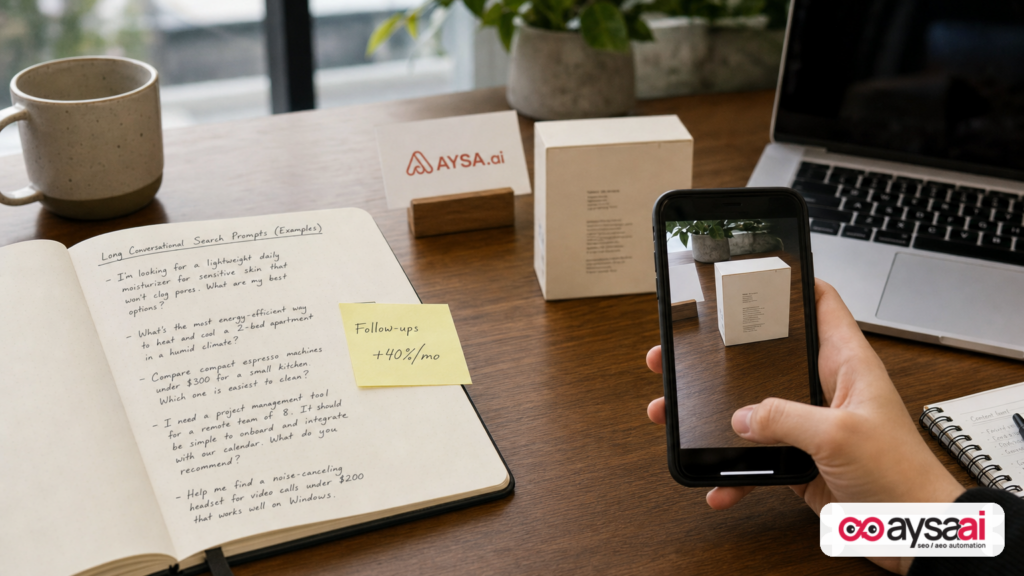
- AI Mode queries are longer and more conversational, which means old “one keyword → one page” strategies miss the real question.
- Follow-up questions are exploding, so the winning content is designed for conversation depth, not a single-shot answer.
- Multimodal search is growing (image/voice), so your visual assets and surrounding context now affect discovery.
- Your job isn’t to abandon SEO. It’s to redesign content as an “answer system” that supports Explore → Decide → Learn → Create → Do behaviors.
- Execution becomes the bottleneck: teams that can safely ship structured improvements across templates, pages, and media will win disproportionate visibility.
Key takeaways (for busy operators)
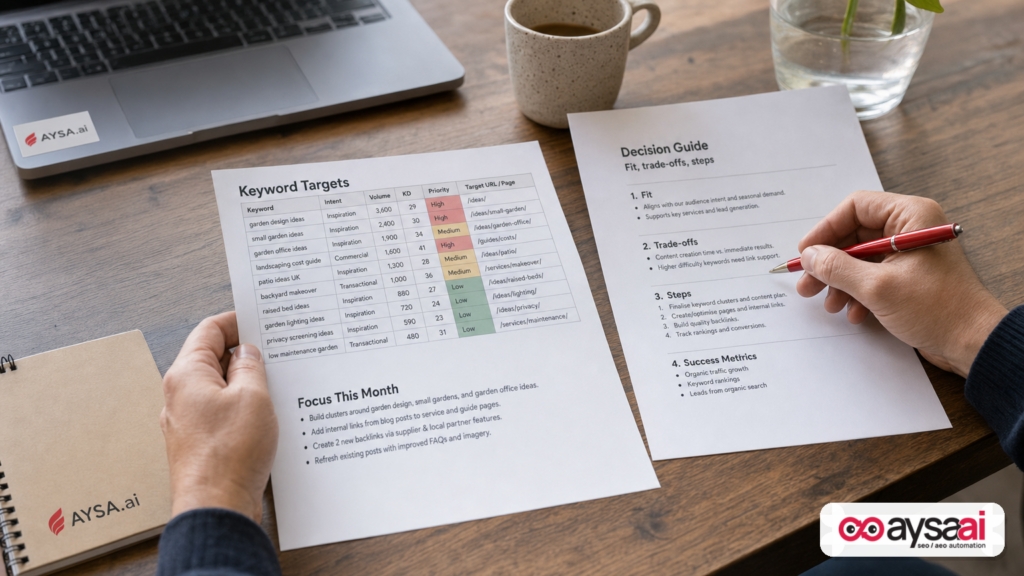
- Stop treating keywords as the user’s language. Use them as a classification system, but write for natural questions and constraints.
- Rebuild your top pages around decisions. Trade-offs, steps, fit checks, and “if this, then that” logic beat generic lists.
- Create a follow-up inventory. For every entry topic, define the 5–15 follow-up questions the user asks next.
- Make images searchable by intent. Not just accessibility alt text—context that helps AI understand what the image represents and why it matters.
- Move from page optimization to system optimization. Internal linking, Structured data, content templates, and modular sections matter more than perfect metadata.
Table of contents

- The shift Google just quantified: AI Mode users moved past keywords
- Why this matters now (and why 2025 playbooks break)
- Explore, Decide, Learn, Create, Do: the new intent map
- What the “content gap” looks like in 2026
- A practical content redesign framework: from keyword pages to “answer systems”
- Follow-up queries: the most underbuilt asset in content marketing
- Multimodal search: images and voice aren’t side quests anymore
- Structure wins: internal linking, modular sections, and schema as “citation rails”
- A concrete SME scenario: local clinic + ecommerce add-on
- Measurement: what to track when traffic becomes harder to interpret
- What can go wrong (and how to avoid breaking what already works)
- Where AYSA fits: turning strategy into approved, measurable execution
- What to do next: a 30–90 day action list
- Sources and further reading
The shift Google just quantified: AI Mode users moved past keywords
Search behavior has been drifting toward natural language for years, but Google’s AI Mode data puts hard edges around what that drift now looks like in practice.
According to a Search Engine Journal analysis of Google’s AI Mode usage report, average AI Mode queries are around three times longer than traditional searches, follow-up queries are growing quickly, and multimodal queries (voice/image/video) account for a meaningful share of usage.
Here’s the non-SEO translation: the “query” is no longer a couple of words. It’s the user’s situation.
- Not: best running shoes flat feet
- But: I have flat feet and knee pain; what running shoes should I start with for a first 5K and how do I check fit?
In the keyword era, the dominant model was:
- Target a phrase.
- Write a page that “covers” the phrase.
- Win rankings.
- Capture click.
In AI search, the model is becoming:
- User describes context and constraints.
- AI synthesizes from sources and asks clarifying questions.
- User follows up and narrows.
- AI recommends steps or options (sometimes with citations, sometimes with brand mentions).
This doesn’t eliminate SEO; it changes what “optimization” means. You’re optimizing for being usable as an answer in a multi-step decision flow—not just being discoverable for a fragment.
Primary source context: Search Engine Journal’s coverage references Google’s AI Mode usage report published on Google’s “The Keyword” blog. If you want the starting point that triggered this editorial, read the SEJ piece here: Google Data Shows AI Search Users Moved Past Keywords, Your Content Hasn’t (Search Engine Journal).
Why this matters now (and why 2025 playbooks break)
Most businesses didn’t “fail SEO” in 2025. They followed the incentives they could see:
- Rank tracking and keyword tools pushed teams toward head terms and neat clusters.
- Content calendars prioritized volume and coverage (“we need a post for every keyword”).
- Templates were built to scale: intro, H2s, FAQ, conclusion.
That approach becomes fragile under AI search for three reasons:
1) The user’s real question is no longer a neat keyword
AI search encourages full thoughts. People type (or speak) like they’re talking to a helpful specialist. That means the query contains:
- Personal constraints (budget, health, experience level, time)
- Context (location, existing tools, preferences)
- Desired outcome (what “success” means to them)
If your content doesn’t reflect those constraints, it may still rank for the fragment, but it will be less useful as a source for AI-generated answers—and less convincing when users land.
2) The interaction is iterative (follow-ups)
In classic SERP behavior, the “second query” existed, but it was often a new search. In AI Mode, follow-ups are part of the same session: the user stays in the conversation and keeps narrowing. That changes what it means to “answer the query.” Your content must support the second and third question, not just the first.
3) Inputs aren’t only text
Users can point their camera at something and ask what it is, how to use it, whether it’s compatible, where to buy it, and what to avoid. If your images and surrounding context aren’t built for understanding, you lose visibility in a channel that’s growing.
Bottom line: “keyword optimization” still matters, but it’s no longer the strategy. It’s hygiene.
Explore, Decide, Learn, Create, Do: the new intent map
The most useful way to interpret AI search behavior is not by keyword type but by task type.
Google’s AI Mode report (as summarized in the SEJ coverage) organizes behavior into five buckets:
- Explore: discover ideas, options, directions
- Decide: compare, choose, validate a purchase/plan
- Learn: understand concepts, get explanations
- Create: draft, generate, assemble something (plans, messages, content)
- Do: execute steps, troubleshooting, workflows
Most SME content libraries are over-invested in Learn and underbuilt for Decide and Do.
Why that mismatch is expensive
- Learn content drives awareness but often fails to convert.
- Decide content is where revenue is influenced.
- Do content is where trust is earned and retention happens.
AI search amplifies this: decision and execution queries are the ones users bring the most context to—and where AI assistance is most valuable.
What the “content gap” looks like in 2026
When I audit sites for AI search readiness, I’m not looking for “AI content.” I’m looking for whether the site can carry a conversation.
Here’s what the gap looks like on real websites:
Gap #1: Pages answer the headline, not the situation
Example: a page titled “Best Email Marketing Software” that lists tools but doesn’t address:
- “I’m a solo founder; I need something I can set up in a weekend.”
- “I already use Shopify; what integrates cleanly?”
- “I have 1,200 customers but low repeat purchase; what automations matter first?”
In AI search, those constraints are the query. If your content doesn’t speak that language, you’re not the best source to cite.
Gap #2: Content is shallow where the decision gets made
Many pages include “pros/cons,” but they’re generic. AI Mode users ask for trade-offs that reflect their reality:
- time vs cost
- durability vs comfort
- risk vs speed
- compliance vs convenience
If your content doesn’t include decision logic, you force AI to synthesize from someone else.
Gap #3: FAQs exist, but they aren’t built from follow-up behavior
Lots of sites have FAQs because it’s “good SEO.” But the questions are often:
- too broad (“What is X?”)
- too self-serving (“Why choose us?”)
- not sequential (they don’t mirror a real decision process)
In AI search, the order matters. Follow-ups are the funnel.
Gap #4: Images exist, but they’re not meaningfully indexable
You might have beautiful product photos—yet no contextual signals that help an AI system understand:
- what variant is shown
- what the product solves
- what it’s compatible with
- how to identify it from a photo
Gap #5: Teams can’t ship improvements fast enough
Even when everyone agrees on the changes, execution collapses into a backlog:
- no clear template ownership
- legal/compliance review delays
- engineering queues
- fear of breaking pages that still convert
This is where strategy-only SEO loses. AI-era search rewards teams that can iterate quickly and safely.
A practical content redesign framework: from keyword pages to “answer systems”
Here’s the framework I recommend to SMEs and agencies that want a durable approach—one that still respects classic SEO fundamentals but matches AI search behavior.
Step 1: Reframe “keyword research” as “question + constraints research”
Keep your keyword list, but treat it as a taxonomy—not a writing prompt.
For each priority topic, define:
- Entry question: the first thing someone asks (broad)
- Constraints: budget, timeline, location, experience, health, size, platform
- Decision criteria: what matters most and what trade-offs exist
- Follow-up set: the next 5–15 questions after the first answer
This is your AI search spec. Without it, content writers default to generic coverage.
Step 2: Build “hub → decision guides → supporting nodes”
Instead of one blog post per keyword, design a system:
- Hub page (category/overview): defines the space, user types, and paths
- Decision guide: comparisons, fit checks, calculators, checklists, workflows
- Supporting nodes: “Do” pages (how-to), troubleshooting, compatibility, safety, glossary
Why this wins in AI search: it gives the system multiple structured places to source specific answers, rather than one page trying to be everything.
Step 3: Write “modules” that can be cited
AI answers tend to pull discrete chunks of information. Help the model by writing in modules:
- Definition module: short, plain-English, precise
- When it’s a good fit: conditions and examples
- When it’s not: warnings and alternatives
- Step-by-step: numbered, verifiable, not fluff
- Decision table: criteria and trade-offs (even without exact numbers)
Do not hide the best information behind a long intro. Put the answer early, then expand.
Step 4: Make the page “conversation-complete”
A page is AI-ready when it answers:
- the entry question
- the most common clarifying questions
- the decision criteria
- the next action (“Do”)
Think of it like a great salesperson or clinician: they don’t just answer what you asked. They anticipate what you’ll ask next and guide you through it.
Step 5: Update templates, not just pages
If you have 200 product pages or 1,000 location pages, you do not have a “writing” problem. You have a template architecture problem.
AI search rewards systematic improvements:
- consistent section structure
- strong internal linking to decision guides
- clean media context and alt text
- structured data where appropriate
This is one reason AYSA focuses on scalable preparation + approved execution, not just recommendations. More on that later.
Follow-up queries: the most underbuilt asset in content marketing
Follow-up behavior is the hidden map of your customer journey.
In AI Mode, follow-ups are a first-class interaction pattern. That means if you only optimize for entry keywords, you’re optimizing for the beginning of the conversation—and letting competitors win the middle and end.
How to build a follow-up inventory (without guessing)
I can’t claim you’ll see perfect AI Mode follow-up data in your standard reports (and I won’t invent a method that depends on access you may not have). But you can still build a defensible inventory using what most businesses already have:
- Sales calls and support tickets: the best follow-up questions are already in your inbox.
- On-site search: what people search after landing.
- Chat transcripts: what people ask once they think you’re relevant.
- Product reviews: what people wish they had known.
Turn follow-ups into content structure, not just FAQs
Don’t dump these questions into an FAQ block. Use them to create:
- dedicated “Do” pages (how to choose, how to measure, how to install)
- comparison modules (“X vs Y if you care about Z”)
- decision checklists and fit tests
If you want one heuristic: if a follow-up question changes the recommendation, it deserves a strong, structured answer on your site.
Multimodal search: images and voice aren’t side quests anymore
The SEJ coverage highlights that a meaningful share of AI Mode searches are multimodal, with image-based querying growing quickly. That fits what we see operationally: it’s easier to show a camera what you mean than to describe it.
What multimodal means for SMEs
Consider how customers actually shop and troubleshoot:
- A homeowner photographs a pipe fitting and asks what part it is.
- A shopper photographs a skincare ingredient list and asks if it’s safe for sensitive skin.
- A traveler screenshots an itinerary and asks for a better plan.
Your website becomes a candidate source when it has:
- clear images of the product/issue from multiple angles
- captions and nearby text that name what’s shown and why
- alt text that identifies the object and intent (not keyword stuffing)
- supporting pages that answer “identify / explain / find” style prompts
Alt text: accessibility first, but intent-aware
Accessibility remains non-negotiable. But in practice, many teams wrote alt text as either (1) empty, or (2) keyword-loaded. Neither helps users who are searching with images.
A better approach:
- Describe what is visually present.
- Add distinguishing attributes (size, material, model, variant) where relevant.
- Connect it to the task (“replacement filter for…”, “how to measure…”, “compatible with…”).
This isn’t about gaming. It’s about being understandable.
Structure wins: internal linking, modular sections, and schema as “citation rails”
AI answers rely on source material that is easier to parse, chunk, and trust. You don’t need to “write for robots,” but you do need to structure information cleanly.
Internal linking as a conversation path
In a conversational search journey, internal linking is not just SEO glue—it’s a way to model the next best question.
Example: If someone lands on “How to choose a water filter,” your internal links should offer the next steps:
- “How to test your water”
- “Filter types compared”
- “Installation steps and common mistakes”
- “Maintenance schedule”
This helps users and creates a coherent topic graph that AI systems can use when synthesizing answers.
Modular section design
Make the key sections obvious:
- Short “answer first” paragraph
- Bulleted criteria
- Steps with numbered lists
- Clear headings that match natural questions (“How do I know if…?”)
Many “SEO-optimized” pages hide the answer under a long preamble. In AI search, that’s self-sabotage.
Schema: helpful when accurate, harmful when sloppy
Structured data can clarify meaning and relationships. But schema is not a magic “AI citation” switch. The risk in 2026 is that teams deploy aggressive or incorrect markup at scale.
Use schema where it is truthful and supported by the visible page content. If you’re unsure, treat it as a controlled experiment with monitoring and rollback.
If you need a starting point on schema foundations, Google’s own documentation is the safest reference (note: not provided in the source context here, so I’m not linking it as a “discovered source”). The key point is operational: schema must be governed like code, not like copy.
A concrete SME scenario: local clinic + ecommerce add-on
Let’s make this real with a scenario that looks like hundreds of SMEs in the market.
The business
- A local physical therapy clinic with two locations
- They also sell a small ecommerce catalog: braces, foam rollers, resistance bands
- They rely on a mix of local search, referrals, and a blog that historically targeted keywords like “knee pain exercises”
What changes in AI search
Before, a user might search: “knee pain exercises.”
Now, the query looks like:
- “I get knee pain when I run downhill, but I can still squat. What could be causing it, what exercises should I start with, and when should I see a PT?”
Then follow-ups:
- “What if it hurts only after?”
- “How do I know if I’m doing the exercise right?”
- “What brace helps and when does it make things worse?”
The old content fails because it’s not “decision-complete”
A generic list of exercises isn’t enough. The user needs:
- red flags (when to stop / seek care)
- progressions and regressions
- fit checks (what pain is acceptable vs not)
- how to select a brace or tape method (and when not to)
The AI-ready content system
Instead of 40 separate posts chasing fragments, the clinic builds:
- Hub: “Knee pain when running: causes, self-checks, and next steps”
- Decision guide: “When to self-treat vs see a PT (symptom-based guide)”
- Do pages: “How to do step-downs correctly,” “How to test hip strength at home,” “How to size a knee sleeve”
- Product support nodes: “Knee sleeve vs hinged brace: which is better for stability vs swelling?”
The goal is not to diagnose people over the internet. The goal is to provide safe, structured education that matches how people ask questions now—and guide them toward appropriate care or products.
What this accomplishes
- More opportunities to be cited because answers are modular and specific
- Better conversion because decision support is stronger
- Lower content churn because pages are built as durable resources
Measurement: what to track when traffic becomes harder to interpret
AI search creates a measurement problem: visibility and influence can increase while clicks behave unpredictably. You may get cited without a click, or the user may get the answer and still visit later via branded search.
Given the constraints in the supplied research context, I’ll avoid pretending there’s a perfect “AI Mode report” inside your analytics. Instead, here’s a pragmatic measurement stack most SMEs can run.
1) Track branded search resilience
If your content is becoming a trusted source in AI answers, brand demand often rises over time. Watch for increases in:
- branded impressions and clicks in Search Console
- direct traffic and returning users (imperfect but directional)
2) Watch query length and question patterns in Search Console
Even if you can’t isolate AI Mode, query patterns tend to drift:
- more “how do I…” and “which…” phrasing
- longer, more specific queries
- more problem statements (“I have…”, “my…”, “can I…”)
3) Measure depth, not just entry sessions
If you’re building an answer system, you want to see:
- higher internal click-through to “Do” pages
- more assisted conversions (content → product/service)
- improved engagement on decision guides
4) Operational metrics: velocity and quality
The new competitive edge is execution. Track:
- time from insight → deployed change
- number of pages improved via templates/modules
- error rate (broken markup, incorrect canonicals, thin duplicates)
This is where an execution system (not just advice) becomes a growth lever.
What can go wrong (and how to avoid breaking what already works)
When the market shifts, two failure modes show up immediately:
Failure mode #1: Overreacting and nuking proven pages
Teams panic, rewrite everything, change URLs, remove internal links, and “AI-ify” copy. The result is often:
- rank loss from structural changes
- conversion loss from diluted intent
- brand risk (overconfident claims, compliance issues)
Safer approach: start with the top 10–20 pages that drive outcomes and expand them using modules and follow-up coverage—without changing what already converts.
Failure mode #2: Shipping ungoverned automation
AI tools can generate content and deploy changes quickly, but speed without governance is a liability. Especially for:
- medical, legal, financial content
- regulated claims (supplements, skincare)
- location-based services with strict NAP consistency
Safer approach: require approvals, maintain change logs, and deploy in controlled batches with monitoring and rollback capability.
Failure mode #3: Confusing “AI citations” with business results
Even if you win citations, the business still needs:
- qualified leads
- sales
- retention
AI visibility is a means, not the end. Design content to move users to the next action: book, buy, call, compare, or subscribe.
Where AYSA fits: turning strategy into approved, measurable execution
Most businesses don’t lose in AI search because they lack ideas. They lose because they can’t operationalize change safely across a real website.
AYSA is built for that reality: we combine monitoring, preparation, approvals, and execution—so your team stays in control while still moving at AI-era speed.
How AYSA supports AI search visibility (practically)
- Monitoring: Track visibility signals and site health so you know what changed and where risk is accumulating. Start here: AYSA Monitoring.
- Preparation: Identify pages/templates that need conversational expansion, decision modules, better internal links, and media context.
- Approval workflow: AYSA prepares recommended changes and asks for your approval—so nothing ships silently or recklessly.
- Execution: Once approved, AYSA implements changes consistently (especially valuable for template-based sites and ecommerce catalogs).
Where to explore AYSA for AI search work
- AI SEO capabilities: AI SEO Tools
- AI search visibility (AEO/GEO focus): AI Search Visibility
- Pricing and fit: AYSA Pricing
- More playbooks and editorials: AYSA Blog
Why “approved execution” matters more in the AI era
AI search will keep evolving. That implies more iterations, more experiments, and more frequent content updates. If every change requires a multi-week cycle—or worse, if changes ship without oversight—you’ll either move too slowly or create risk.
The approved-execution model is the middle path:
- Fast enough to iterate
- Controlled enough to protect revenue pages
- Auditable enough for teams and regulators
What to do next: a 30–90 day action list
If you’re an SME operator, a marketer, or an agency lead, here’s a realistic plan you can run without rewriting your entire site.
Days 1–7: Diagnose the gap
- Pick your top 10 pages (traffic, leads, or revenue).
- Rewrite each target keyword as a natural AI Mode prompt (include constraints).
- List 10 follow-up questions a customer would ask after reading the first answer.
- Mark what’s missing: trade-offs, steps, fit checks, examples, visuals.
Days 8–30: Build your first “answer system”
- Create or upgrade one hub page that routes users by situation.
- Build one decision guide that helps people choose (not just learn).
- Add 3–5 “Do” pages for the highest-impact follow-ups.
- Strengthen internal links so each page suggests the next question.
- Improve image context: add captions, intent-aware alt text, and clear variant labeling.
Days 31–90: Scale safely
- Convert winning sections into templates/modules you can reuse across similar pages.
- Roll out in batches (don’t change 500 pages at once).
- Monitor outcomes: branded demand, long-tail question impressions, assisted conversions, engagement on decision guides.
- Institutionalize follow-up inventory as a monthly workflow with sales/support input.
If you want AYSA’s help operationalizing this (monitoring + prepared changes + approvals + execution), start with: AI Search Visibility and Monitoring.
Sources and further reading
- Search Engine Journal: Google Data Shows AI Search Users Moved Past Keywords, Your Content Hasn’t (research input for this editorial)
- Search Engine Journal: SEO section (ongoing context and reporting)
- Search Engine Journal: SEO news (updates that often impact AI search behavior)
- Search Engine Journal: Local SEO (relevant for multi-location and local intent shifts)
- Search Engine Journal: On-page SEO (foundational tactics that still matter)
Note on primary sources: The SEJ article references Google’s AI Mode usage report on Google’s “The Keyword” blog. That direct URL is not included in the supplied research context, so I’m not linking it here as a discovered source. If you provide that link, I can add it as a primary citation in an update.
AYSA internal resources:
Continue the AI search topic inside AYSA.
Use these pages to connect the article with AI SEO tools, AI visibility monitoring, AI Overviews and approved website execution.
Turn this topic into a website action plan.
Use these AYSA hubs to move from reading to technical fixes, AI visibility monitoring, research, glossary context and approval-first SEO execution.