
Block AI Crawlers or Measure Their Value First? A Practical Playbook for SMEs (and the Teams Who Serve Them)
AI crawlers can inflate bandwidth costs and scrape valuable content—yet blocking them can also make your brand invisible in LLM answers. Here’s a decision framework, measurement plan, and execution checklist (with an AYSA-approved workflow) to manage AI bots without guessing.

AI crawlers are showing up in more server logs than many business owners expected—and they’re not behaving like traditional search engine bots. They can consume real infrastructure resources, scrape valuable content, and sometimes ignore the old “Robots.txt solves it” assumption. At the same time, blocking them blindly can reduce your visibility in the answers customers increasingly trust from tools like ChatGPT, Perplexity, and Gemini.
This editorial is a practical playbook for small and mid-sized businesses (SMEs) and the agencies that support them. We’ll cover what changed, why it matters, how to measure value versus cost, and how to implement a sensible “allow, limit, or block” policy without breaking your marketing pipeline.
Primary research inspiration: Search Engine Journal’s Ask An SEO column on this exact dilemma: Should I Block AI Crawlers Or Measure Their Value First? (Helen Pollitt, SEJ).
Concise summary
- Not all AI bots are equal. Training crawlers, search/Indexing crawlers, and user-triggered fetches behave differently and create different risks.
- Robots.txt is no longer a complete control layer. Some user-triggered fetchers may not reliably honor robots.txt, forcing WAF/server-level controls.
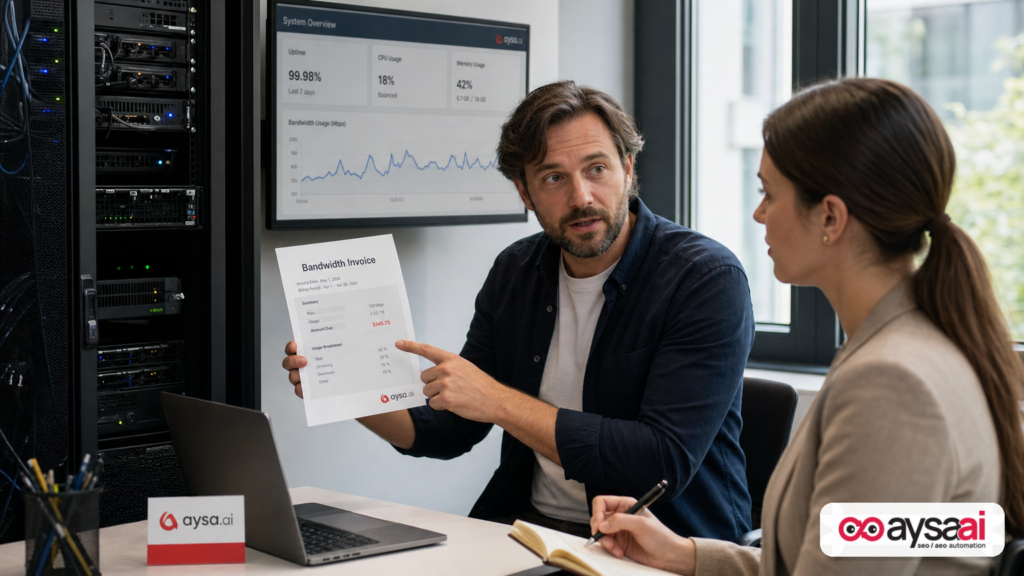
- Measure value before you swing the hammer. Use log files to quantify crawl cost; use analytics (including GA4’s “AI Assistant” channel) to estimate business value.
- Blocking everything is a bet against the future. You may reduce costs now but become invisible in LLM answers later.
- Allowing everything is also a bet—on your budget and your IP. You may subsidize model training while paying the hosting bill.
- Best practice for most SMEs: create a tiered policy (allowlist/ratelimit/deny) and review it monthly as the ecosystem changes.
Table of contents

- The new reality: AI bots are not “just another crawler”
- What changed (and why the old rules fail)
- Three types of AI crawling you must separate
- A decision framework: when blocking is smart, and when it’s risky
- The real risks of blocking all AI bots
- The real risks of allowing all AI bots
- How to measure AI bot value (without fooling yourself)
- How to identify AI bots: logs first, analytics second
- Control options: robots.txt, server rules, and WAF-level blocking
- A practical AI bot access policy for SMEs
- The SME scenario: an ecommerce brand with rising hosting bills
- What agencies should rethink now
- Where AYSA.ai fits: monitoring + approved execution
- What to do next (action list)
- Sources and further reading
The new reality: AI bots are not “just another crawler”
For years, most businesses treated bots as a simple split:
- Good bots (Googlebot, Bingbot) that help you earn traffic and revenue.
- Bad bots that scrape pricing, spam forms, brute-force logins, or drain resources.
AI crawlers don’t fit neatly into that model. They can behave like scrapers in terms of volume and intent (collecting your content), while also behaving like search bots in terms of potential upside (helping your brand get cited in AI answers).
That gray zone is what makes this decision hard—especially for SMEs. A large enterprise might tolerate Crawling load as a cost of doing business. A small ecommerce store on a tight hosting plan can’t. A publisher with proprietary images or data may have more to lose than a local plumber with service pages.
So the right question isn’t “Should we block AI bots?” It’s:
- Which AI bots are hitting us?
- What do they cost us—in dollars and risk?
- What do they return—traffic, conversions, citations, and brand lift?
- What policy gives us optionality as AI Search evolves?
What changed (and why the old rules fail)
The biggest mental model shift: robots.txt is no longer a reliable single control plane for AI access decisions.
In the SEJ piece, Helen Pollitt notes that some AI user-triggered fetchers may not commit to honoring robots.txt in the same way SEOs have come to expect from major search crawlers. That forces a more “security and infrastructure” style approach: server rules or WAF-level blocking.
This matters because many business owners still believe they have only two options:
- Let everyone in and accept the cost.
- Block in robots.txt and assume the problem is solved.
But if your goal is to manage AI bots responsibly, you may need a multi-layer system:
- Robots.txt to signal preferences to compliant crawlers.
- Server/WAF controls for non-compliant crawlers, rate limits, and abuse patterns.
- Measurement to confirm outcomes: costs down, user experience stable, visibility preserved where it matters.
And you need a review cadence—because “best practices” are moving fast. This isn’t a set-it-and-forget-it Technical SEO task anymore.
Three types of AI crawling you must separate
The SEJ analysis usefully separates AI crawlers into categories. I’ll keep that framing because it’s the clearest way to avoid bad decisions.
1) AI training bots
These crawlers collect web content to help train or improve models. The business tension is straightforward:
- Cost: crawl load + potential extraction of IP.
- Benefit: indirect; may improve a model’s ability to speak about your topic or brand, but not necessarily link to you.
For some businesses—especially those with proprietary information, premium content, unique images, or paywalled research—this can feel like subsidizing someone else’s product.
2) Search/indexing bots used by LLM “search” experiences
These behave closer to traditional search indexing: they crawl pages to decide what to surface and cite in AI-generated answers.
Even when LLM referral traffic is small, citations can influence buyer perception. If your brand isn’t present, a competitor’s will be.
3) User-triggered fetches
These happen when a user asks an AI assistant about a specific URL, brand, or document and the system fetches your content on demand.
From a marketing standpoint, this is the most “bottom-of-funnel” signal of the three: someone is already interested enough to request more detail about you specifically. From an infrastructure standpoint, it can still be noisy—but it is at least tied to real user intent.
A decision framework: when blocking is smart, and when it’s risky
Here’s the framework I recommend for SMEs and agencies: decide by (1) cost to serve, (2) IP sensitivity, and (3) visibility upside—then implement controls by crawler type.
Step 1: quantify “cost to serve”
- Are AI bots causing measurable performance degradation (CPU, memory, origin requests, cache misses)?
- Are bandwidth/hosting/CDN bills rising?
- Is your infrastructure team already rate-limiting traffic?
If you can’t answer these with data, the default should not be “block everything.” The default should be: measure for 30 days and implement conservative rate limits while you learn.
Step 2: classify IP sensitivity by site section
Not all pages deserve the same exposure.
- Low sensitivity: About page, store locations, public FAQs, basic service pages.
- Medium sensitivity: product pages with unique descriptions, original blog content.
- High sensitivity: premium research, proprietary datasets, high-value images, paywalled content, content that is effectively the product.
Many businesses overreact because they think the choice is binary. In practice, you can restrict crawling of the high-sensitivity sections while keeping the low-sensitivity sections open for discoverability and brand presence.
Step 3: estimate visibility upside by funnel impact
- Do you sell something where buyers research heavily (healthcare services, B2B SaaS, high-ticket home services)?
- Are you in a category where AI answers are already replacing “ten blue links” behavior?
- Do you need brand trust more than raw clicks?
If the answer is yes, blocking everything is a risky bet.
The real risks of blocking all AI bots
Blocking all AI crawlers can feel satisfying: fewer requests, lower cost, less scraping anxiety.
But it has strategic consequences.
1) You can become invisible where customers are increasingly getting answers
Even if LLMs send less referral traffic today than Google, they influence buyer awareness. If your competitor is consistently cited and you’re not, you don’t just lose clicks—you lose mindshare.
2) You lose the ability to learn which platforms matter for your business
When you block everything, you stop generating evidence. You can’t tell:
- Which assistants cite you accurately
- Which categories you show up for
- Whether LLM-referred visitors convert better than other channels
For most SMEs, learning is a competitive advantage. Blocking everything removes your learning loop.
3) You may be making a permanent decision in a temporary environment
AI discovery is evolving quickly. If AI becomes a dominant discovery layer in your vertical, being absent is expensive—even if it was cheap today.
The real risks of allowing all AI bots
On the other side, “allow everything” has clear failure modes.
1) You subsidize aggressive crawling behavior
The SEJ article cites Cloudflare’s discussion of extreme crawl-to-referral ratios (i.e., many requests for each visit). Even without relying on any single number, the business principle is obvious: some bots can request far more than they return.
If you’re paying for bandwidth, origin compute, or CDN egress, you can end up funding someone else’s product development.
2) Intellectual property extraction risk
If your competitive advantage is a unique dataset, original photography, premium editorial content, or product information that took years to build, unrestricted crawling can be a direct threat.
This is where “SEO thinking” needs to meet “product thinking.” If your content is the product, you cannot treat AI crawling as a free marketing channel.
3) Brand safety: misrepresentation at scale
Even if an assistant cites you, it can summarize incorrectly. That can become a customer support burden and a trust liability. It’s not enough to be mentioned—you need to be described accurately.
How to measure AI bot value (without fooling yourself)
The biggest mistake I see is using one metric to justify a policy decision.
For example:
- “LLMs don’t send traffic, so block them.”
- “We got a few AI referrals, so allow everything.”
Instead, measure value across four buckets and compare it to cost.
Bucket 1: referral traffic quality (not just quantity)
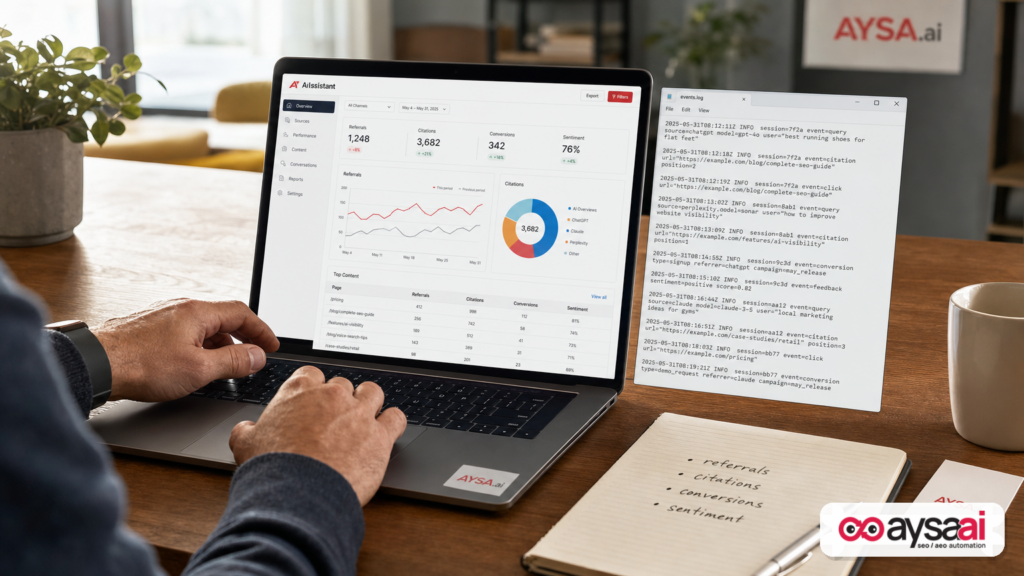
In Google Analytics (or your analytics platform), isolate referrals from AI assistants and evaluate:
- Engagement: time on site, pages per session, scroll depth (if you track it).
- Intent signals: product views, pricing page visits, add-to-cart, demo requests.
- Conversion rate: compared to organic search, paid search, and direct.
The SEJ piece notes GA4’s newer “AI Assistant” channel classification (with limitations). Treat this as a directional signal, not perfect truth. Use it to start the conversation and decide what deeper instrumentation you need.
Bucket 2: citations and mentions (visibility without clicks)
Traffic is not the only value. You should also track how often your brand or pages are cited in AI answers for relevant topics.
This is the new “impression layer.” You may not get the click, but you may win the association.
AYSA’s approach here is to treat AI visibility like a monitored surface, not a guessing game. We built workflows for monitoring and improving AI search visibility across assistants and topics: AI Search Visibility.
Bucket 3: accuracy and sentiment
Set up a lightweight review process for high-stakes queries:
- How does the assistant describe your product or service?
- Does it recommend you appropriately—or confuse you with a competitor?
- Does it make claims you can’t support?
If the model is repeatedly wrong, that’s a business issue. It can drive the wrong customers, trigger refunds, or create regulatory risk in sensitive industries.
Bucket 4: query/topic coverage (where you show up and where you don’t)
Map your priority topics to AI surfaces:
- Commercial queries (buy/compare/best)
- Problem/solution queries (how to fix/choose)
- Local intent queries (near me/service area)
This is also where agencies should stop treating AI as “just content.” Coverage is influenced by technical accessibility, structured data, and clarity of entities and relationships—not just word count.
How to identify AI bots: logs first, analytics second
Measurement starts with visibility into what’s happening on your infrastructure.
1) Log files (most reliable)
As SEJ highlights, server log files are the most complete record of bot activity. A 30-day slice is usually enough to answer:
- Which user agents are hitting you
- How frequently
- Which sections they target
- Whether crawling patterns look “reasonable” or abusive
If you’re an SME without access, ask your hosting provider, dev partner, or IT team for help. This is one of the rare times where SEO needs to sit next to infrastructure and finance and do a shared review.
2) Analytics referrals (helpful but incomplete)
Referral traffic shows which platforms are sending visits. It does not show all crawling.
Still, it’s useful for answering:
- Which AI tools send any traffic at all
- What landing pages they send users to
- How those users behave compared to other channels
If GA4 is your system of record, use it as your starting dashboard for “is this working?”—but don’t confuse it with a full crawler audit.
Control options: robots.txt, server rules, and WAF-level blocking
Once you can see the bots and estimate their value, you can control them. SEJ lays out the reality: some crawlers may not reliably honor robots.txt, which pushes you toward infrastructure controls.
1) Robots.txt (baseline signaling)
Robots.txt is still useful for compliant crawlers. It’s fast, clear, and standardized—just not sufficient alone anymore.
If you need a refresher on best practices and pitfalls, SEJ references robots.txt usage guidance in their ecosystem (helpful as a conceptual lead): Search Engine Journal often publishes updated technical SEO guidance, including robots controls.
2) Server rules (more control, more responsibility)
Server-level rules can detect suspicious patterns and block or throttle traffic. This is powerful but requires discipline:
- Don’t accidentally block legitimate users.
- Don’t break your own monitoring tools.
- Document every rule and why it exists.
3) WAF-level blocking (enterprise-grade, increasingly SME-relevant)
A Web Application Firewall (WAF) can enforce allow/deny and rate limiting before traffic hits your origin. SEJ mentions common WAF providers such as Cloudflare and AWS. Even if you’re a small business, you may already be behind a managed WAF via your host or CDN.
This is often the cleanest place to implement:
- Allowlists for known compliant crawlers
- Rate limits for high-volume user agents
- Geo/IP reputation rules for abuse patterns
Important: SEO should not implement WAF policy in isolation. This is a shared responsibility with whoever owns uptime, security, and cost.
A practical AI bot access policy for SMEs
Most SMEs need a policy that is:
- Simple enough to maintain
- Flexible enough to evolve
- Defensible enough to explain to leadership
Here’s a pragmatic policy template (conceptual, not legal advice):
Policy layer 1: define goals
- Primary goal: maintain AI discoverability for priority topics without harming site performance.
- Secondary goal: protect high-sensitivity IP and reduce abusive crawling costs.
Policy layer 2: categorize your site content
- Public discovery content: services, locations, FAQs, brand story
- Commercial content: product pages, pricing, comparison pages
- High-value IP: original research, premium tools, unique images, gated resources
Policy layer 3: implement per-bot rules
- Allow indexing/search bots where the visibility upside is clear.
- Rate limit high-volume crawlers, especially on expensive endpoints.
- Block clearly abusive bots and patterns, and restrict sensitive sections.
Policy layer 4: review monthly
Set a recurring review using:
- Log file summaries (crawl volume, endpoints targeted, trends)
- GA4 outcomes (AI referrals, assisted conversions, engagement)
- AI visibility checks (citations, accuracy, sentiment)
This is a living document, not a one-time technical tweak.
The SME scenario: an ecommerce brand with rising hosting bills
Let’s make this real.
Scenario: A 12-person ecommerce brand sells specialty home goods. They run on a common ecommerce platform with a CDN in front. Over two months, their hosting provider warns them about origin load spikes and higher bandwidth usage. No marketing campaign is running. Conversion rate is flat. The founder asks: “Are we being attacked?”
What’s actually happening: An increasing share of requests are bots—some classic scrapers, some AI crawlers. Many requests hit product detail pages and image URLs.
Bad response: Block everything in robots.txt and hope it stops (it won’t, for non-compliant fetchers) and accept being absent from AI answers.
Better response (30-day plan):
- Pull 30 days of logs and group requests by user agent, endpoint type, and request frequency.
- Quantify cost impact with the hosting/CDN provider: which traffic is driving egress and origin load.
- Identify high-sensitivity assets (unique product photography, premium buying guides) and decide what must be protected.
- Implement WAF rate limits for high-volume user agents and protect expensive endpoints first (search, filters, images).
- Keep public discovery pages accessible so the brand can still be cited for category-level queries.
- Measure outcomes: site speed and uptime improve; costs stabilize; AI referrals and citations are tracked as a learning loop.
Result: The brand reduces costs and risk without betting against AI discovery.
What agencies should rethink now
If you’re an agency, this shift changes your operating model.
1) Technical SEO now includes bot governance
This is no longer “just robots.txt.” Your deliverables should include:
- Bot audit (logs + analytics)
- Policy proposal (by bot type and site section)
- Infrastructure collaboration plan (who owns WAF, who approves)
2) Reporting must expand beyond clicks
AI search visibility introduces a bigger brand layer: citations, mentions, and accuracy. Agencies that only report rankings and traffic will miss the impact—and clients will feel it in pipeline shifts they can’t explain.
3) Execution speed matters more than ever
The ecosystem changes quickly. If your agency’s workflow requires six weeks to ship a simple policy change, you’ll lose to teams that can ship safely in days.
This is exactly the gap AYSA is designed to close: monitoring, recommendations, and approved execution so changes don’t sit in a backlog forever. See how we approach monitoring and action loops: AYSA Monitoring.
Where AYSA.ai fits: monitoring + approved execution
At AYSA.ai, our perspective is simple: AI search is an execution problem disguised as a strategy problem.
Most businesses can agree on the high-level goal (“don’t waste money, don’t get scraped, don’t disappear from AI answers”). The hard part is turning that into a repeatable system:
- Monitor AI visibility and site performance signals
- Detect issues and opportunities early
- Prepare the right changes (technical + content + structured signals)
- Get stakeholder approval (marketing, IT, security, leadership)
- Execute accepted changes safely and track impact
That’s the model behind AYSA’s tooling and workflows:
- AI SEO tools to support modern SEO/AEO/GEO workflows
- AI search visibility monitoring and improvement loops
- Monitoring as the backbone of governance and iteration
- Pricing to evaluate fit for your team size and execution needs
- Blog for ongoing playbooks as the market changes
In plain language: AYSA helps you run this like a business system, not an emotional debate about whether AI is “good” or “bad.”
What to do next (action list)
- Pull a 30-day log sample (or ask for it) and identify top AI-related user agents and endpoints hit.
- Estimate cost to serve: bandwidth/egress, origin load, and any performance impact on real users.
- Check GA4 for AI referrals and compare conversion quality to other channels. Don’t stop at sessions.
- Run a citation/accuracy spot check for your top 10 money topics: are you cited, and are you described correctly?
- Draft a tiered policy: allow low-risk discovery content, restrict high-sensitivity IP, rate-limit aggressive patterns.
- Implement controls at the right layer: robots.txt for compliant crawlers; WAF/server rules for enforcement.
- Set a monthly review and adjust as AI platforms evolve.
If you want this as an ongoing system rather than a one-off project, start with AYSA’s monitoring-first approach: AYSA Monitoring.
Sources and further reading
- Search Engine Journal (Ask An SEO): Should I Block AI Crawlers Or Measure Their Value First?
- Search Engine Journal (site hub for ongoing SEO and technical guidance): SEO on Search Engine Journal
- Search Engine Journal (news and updates context): Latest marketing and search news
- AYSA.ai: AI Search Visibility
- AYSA.ai: AI SEO Tools
- AYSA.ai: Monitoring
- AYSA.ai: Pricing
- AYSA.ai: Blog
Note on external sourcing: The supplied research context references WAF providers and Cloudflare commentary on crawl-to-referral ratios. This editorial avoids adding new numerical claims without primary citations included in the provided context. If you’d like, we can add more primary documentation links (e.g., official crawler user-agent docs) once they are provided in your editorial research bundle.
Continue the AI search topic inside AYSA.
Use these pages to connect the article with AI SEO tools, AI visibility monitoring, AI Overviews and approved website execution.
Turn this topic into a website action plan.
Use these AYSA hubs to move from reading to technical fixes, AI visibility monitoring, research, glossary context and approval-first SEO execution.

