
Google AI Overviews Aren’t “Filtering Low-Quality Clicks.” Here’s What That Means For Your SEO, Content, And Revenue
A randomized field experiment suggests the clicks Google’s AI Overviews take away aren’t lower quality. If that holds, the problem isn’t “better traffic” — it’s less traffic, period. Here’s how SMEs and agencies should adapt: shift from rankings-only thinking to AI visibility, citation readiness, and execution that ships changes fast (with approval).

Google’s AI Overviews have been framed as a trade-off: fewer Clicks, but “better clicks.” That story matters because it determines whether businesses should accept traffic declines as a healthy filter… or treat them as a real demand shock that forces a new strategy.
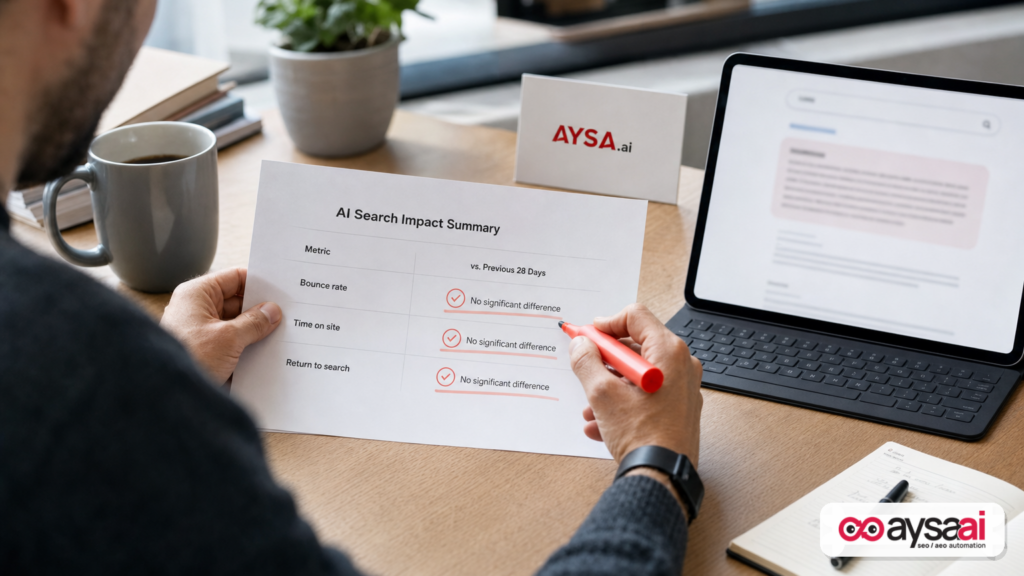
A recent update to a randomized field experiment, covered by Search Engine Journal, adds an important data point: when AI Overviews were removed, the extra clicks websites received did not appear to be lower quality. No measurable differences showed up in bounce behavior, very short visits, or time on site. That directly challenges the most comforting explanation for publishers, brands, and local businesses seeing fewer organic visits.
As Marius Dosinescu at AYSA.ai, my take is straightforward: if click quality doesn’t measurably improve, then the practical business impact of AI Overviews is not “less junk traffic.” It’s fewer chances to earn a customer — especially at the top of the funnel. That forces a shift in how we build content, how we measure SEO, and how we operate execution.
Concise Summary
The updated experiment suggests AI Overviews reduce outbound clicks substantially on affected queries, without producing a clear improvement in click quality. Losses appear concentrated in informational searches (the questions that historically fueled awareness and discovery). Businesses should adapt by: (1) optimizing for AI citation and visibility (AEO/GEO), (2) strengthening conversion paths and brand recall, (3) rebuilding measurement beyond rankings, and (4) improving execution speed through a monitor → recommend → approved change workflow.
Key Takeaways (For Busy Operators)

- The “lost clicks were low quality” explanation is not supported by the experiment’s click-quality comparisons (bounce behavior, short visits, and time on site looked similar).
- Informational queries are the flashpoint: these are the queries where AI Overviews are most likely to show, and where many SMEs built traffic via helpful content.
- SEO isn’t dead; the unit of value changed. Rankings still matter, but “influence inside the answer” (citations/mentions) increasingly decides outcomes.
- Measurement needs a reset: you can’t manage what you can’t see. Move from “rankings and sessions” toward a KPI stack that includes query mix, SERP Features, conversions, and brand demand.
- Execution is the differentiator. Teams that can ship improvements weekly — without breaking the site — will pull away.
Table of Contents
- What Changed In The Study (And Why It’s A Big Deal)
- How We Got Here: From 10 Blue Links To Answer Engines
- Why “Click Quality” Is A Loaded Argument
- Why Informational Queries Take The Biggest Hit
- The New SERP Economics: Scarcity Above The Fold
- Business Impacts By Company Type (SMEs, Ecommerce, Local, SaaS, Publishers)
- A Concrete SME Scenario: The Local Clinic That Built Growth On FAQs
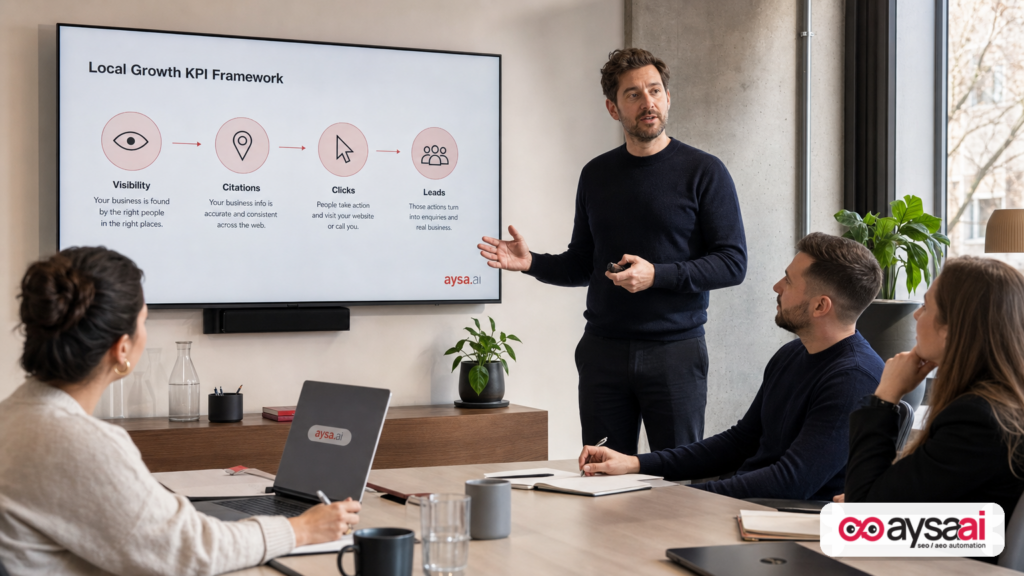
- The New KPI Stack: From “Rankings” To “Visibility, Citations, And Conversions”
- Content Strategy In An AI Overview World: What To Build Now
- Technical And Structured Data: The Boring Work That Now Pays
- Authority Signals And Brand: How To Be The Cited Source
- What Agencies Must Rethink (Packaging, Reporting, And Retainers)
- Where AYSA Fits: Monitoring → Recommendations → Approved Execution
- What To Do Next (30/60/90-Day Plan)
- Sources And Further Reading
What Changed In The Study (And Why It’s A Big Deal)
The headline finding that grabbed attention earlier this year was click loss: when AI Overviews appear, outbound organic clicks fall on affected queries. In the updated version covered by SEJ, the researchers added something the industry has been arguing about nonstop: are the clicks that disappear mostly “bad clicks” that would have bounced anyway?
They looked at several behavioral proxies for click quality:
- Returning to search (e.g., back button behavior on same-tab clicks)
- Very short visits (e.g., sessions ending quickly without interaction)
- Time on site
According to SEJ’s summary of the revised paper, there was no statistically meaningful difference in these measures between users who saw AI Overviews and those who didn’t. In other words: the “extra clicks” that happen when Overviews are removed don’t look measurably worse.
Why this matters: Google leadership has publicly suggested AI-generated summaries can reduce “bounce clicks.” The experiment doesn’t prove intent, and it doesn’t resolve every measurement nuance, but it does challenge the idea that traffic declines are simply a cleanup of low-engagement visits. If the quality of the marginal clicks is roughly the same, then the traffic reduction is more likely to translate into fewer leads, fewer signups, fewer orders, and fewer ad impressions—unless businesses adapt their funnel and content strategy.
How We Got Here: From 10 Blue Links To Answer Engines
To make good decisions, it helps to name the shift correctly. We’re not just dealing with “a new feature.” We’re dealing with a structural change in how search products allocate attention.
A Quick SERP Timeline (The Non-Technical Version)
- Classic web search: You asked a question, got a list of links. Websites competed for clicks.
- Featured snippets & knowledge panels: Google increasingly answered some questions directly on the results page, reducing clicks for certain queries.
- Rich results & SERP features: Local packs, product carousels, “People also ask,” and other blocks changed what “ranking #1” even meant.
- AI Overviews: The search engine becomes a summarizer. Many queries now start with an answer, and citations/links become supporting material, not the main product.
This is why I keep telling founders: the “SEO game” didn’t end; the incentive structure changed. The SERP is evolving from a referral engine into a decision engine.
Why This Is Accelerating Now
Two forces are pushing in the same direction:
- User expectations: People want faster answers. Summaries feel convenient for informational searches.
- Platform incentives: Keeping users on the platform increases control, measurement, and monetization options.
None of this is new in spirit (think: instant answers), but AI makes it scalable across far more topics. SEJ notes the researchers expect AI Overviews to appear on more queries over time, which would expand the overall impact.
Why “Click Quality” Is A Loaded Argument
“Click quality” sounds objective, but it’s often used as a rhetorical shield. Let’s unpack it in business terms.
Quality For Whom?
When a platform says, “We reduced low-quality clicks,” it might mean:
- Users are less likely to pogo-stick back to results
- Users spend more time on the destination site
- Users convert more often
- Users are happier (survey-based)
But your business doesn’t get paid in “time on site.” You get paid in:
- Booked appointments
- Orders
- Qualified leads
- Email subscribers and returning customers
A visit can be short and still be high value (think: a phone call click, directions click, or “buy now”). And a long visit can still be low value (someone reading a long article and leaving). That’s why the SEJ-covered experiment is helpful but incomplete: it tests certain behavioral proxies, not business outcomes. Still, the direction matters: if the additional clicks in the “no overview” condition aren’t worse on those proxies, the “we only removed junk” narrative becomes harder to defend.
The Real Question: What Is The Marginal Click Worth?
From an operator perspective, the only question that matters is the value of the marginal click you lost. If AI Overviews remove 20%–40% of your clicks on certain query types, you have to assume some meaningful portion of those clicks would have converted—especially if click quality looks similar.
This is why I tell SMEs to stop debating philosophy and start building a mitigation plan: improve conversion rates, increase brand demand, and position your content to be the cited source in AI answers.
Why Informational Queries Take The Biggest Hit
The SEJ article notes the losses were concentrated in informational searches, while navigational and transactional queries didn’t show measurable change (with smaller samples). That pattern makes intuitive sense.
Three Query Types, Plain English
- Informational: “How do I remove coffee stains from a sofa?” “Is Invisalign worth it?”
- Navigational: “Costco return policy” “AYSA monitoring”
- Transactional: “buy running shoes size 11” “book dentist appointment near me”
AI Overviews are most useful where users want synthesis: the informational bucket. That’s also where many businesses built low-cost customer acquisition through content marketing, guides, FAQs, and blog posts.
Top-Of-Funnel Was The Bargain. Now It’s The Battlefield.
For years, “answer content” worked like this:
- Write a helpful article answering a question
- Rank for long-tail searches
- Earn traffic cheaply
- Retarget, email-capture, nurture, convert
AI Overviews compress step 2 and weaken step 3. The user may get enough of the answer without clicking. If they do click, they may only click one source — and that source is often pulled into the AI Overview citations.
So the new play isn’t just “rank the page.” It’s “become the referenced source inside the answer and be the best click when a click happens.” That is the combined discipline of SEO + AEO (Answer Engine Optimization) + GEO (Generative Engine Optimization).
If you want a framework for this shift, start with AYSA’s AI search visibility view of the world: track how AI surfaces your brand, then close the gaps with structured improvements you can actually ship.
The New SERP Economics: Scarcity Above The Fold
In classic SEO, the SERP was a list. In AI search, the SERP is a composition: a summary, sometimes expanded, with citations, and then the rest of the results below. That changes the economics of attention in three ways.
1) Link Scarcity
Even when AI Overviews include sources, they typically feature fewer links than a traditional SERP view encourages users to explore. Fewer “consideration clicks” means fewer chances for mid-market brands to compete on story, trust, and UX.
2) Winner-Takes-More Dynamics
SEJ notes that when AI Overviews were removed, the top-ranked results gained the most clicks, with position one benefiting substantially. That implies a concentration effect: if AI Overviews compress exploration, the best-positioned and best-recognized sources get disproportionate benefit, while the long tail gets squeezed.
3) Brand Becomes A Conversion Factor Earlier
When users see an AI answer first, they may only click when they trust the source, recognize the brand, or need deeper detail. This raises the value of:
- Clear brand cues in titles and snippets
- Demonstrated expertise and authorship
- Real-world proof (reviews, case studies, credentials)
Even if you’re an SME, you can compete here—if you operationalize it. The hard part isn’t knowing what to do; it’s doing it consistently across dozens or hundreds of pages.
Business Impacts By Company Type (SMEs, Ecommerce, Local, SaaS, Publishers)
AI Overviews don’t hit everyone the same way. Here’s what I’m seeing in how the risk shows up, and what “winning” likely looks like for different business models.
Local Businesses (Clinics, Home Services, Hospitality)
Risk: Many local businesses invested in educational content to build trust (“symptoms,” “cost,” “what to expect”) and feed calls/appointments. AI answers can satisfy early questions without a click, pushing discovery later in the journey—sometimes to directories or aggregators.
What to prioritize:
- Service pages and location pages that clearly communicate offerings, pricing ranges (where appropriate), policies, and next steps
- FAQ sections that are structured and citation-ready (not fluffy)
- Trust assets: credentials, author bios, review signals, and clear contact actions
Ecommerce Brands
Risk: “Best X for Y” and “how to choose” content has historically driven cheap discovery. AI summaries reduce clicks and may keep users in comparison mode longer before they ever hit a product page.
What to prioritize:
- Category pages that answer selection questions (not just product grids)
- Buying guides with clear comparison tables and decision rules
- Product pages with strong specs, FAQs, shipping/returns clarity, and unique differentiators
SaaS (B2B And B2C)
Risk: High-intent keywords remain valuable, but top-of-funnel queries that fed the pipeline (templates, definitions, best practices) can be summarized away.
What to prioritize:
- Use-case pages and integration pages that match “how do I…” workflows
- Glossary and documentation that’s structured, interlinked, and authoritative
- Content designed to earn citations and drive branded searches later
Publishers & Content-Heavy Sites
Risk: Direct traffic loss with no replacement channel can damage revenue quickly. If AI Overviews reduce pageviews, ad revenue and affiliate clicks follow.
What to prioritize:
- Exclusive reporting, original data, and firsthand experience (harder to summarize safely)
- Strong internal linking to deepen sessions when clicks happen
- Newsletter and membership capture to reduce platform dependency
A Concrete SME Scenario: The Local Clinic That Built Growth On FAQs
Let’s make this real with a scenario that mirrors what I see constantly.
Scenario
A mid-sized local dental clinic invests in content because paid ads are expensive. Over two years, they publish:
- “How much does Invisalign cost?”
- “Invisalign vs braces”
- “Does Invisalign hurt?”
- “How long does teeth whitening last?”
These articles drive a steady stream of new visitors. Some convert immediately; many return later and book.
What Changes With AI Overviews
When AI Overviews become common for those informational questions, a portion of users get enough of the answer directly on Google. The clinic sees:
- Fewer organic sessions to blog posts
- Fewer first-touch conversions attributed to organic
- More “dark funnel” behavior (people show up branded later, or call without a trackable click)
If leadership believes “those were low-quality clicks anyway,” they may reduce content investment right when they should be doubling down on the parts that create defensible differentiation.
How The Clinic Wins Anyway
The winning adjustment isn’t “write more content.” It’s “make content perform a new job.”
- Make pages citation-ready: clear definitions, concise answer blocks, structured headings, medically appropriate disclaimers, strong author credibility.
- Move conversion opportunities up: make it easy to book, call, or get a pricing range without scrolling forever.
- Strengthen local authority: location pages that clearly communicate services, unique capabilities, financing, and reviews.
- Measure assisted conversions: don’t judge content only by last-click attribution.
This is exactly where a system like AYSA helps: it’s not a one-time audit. It’s ongoing monitoring and an execution loop that proposes specific site changes, asks for approval, and then implements them reliably.
The New KPI Stack: From “Rankings” To “Visibility, Citations, And Conversions”
AI Overviews make one thing painfully clear: you can no longer treat rankings as the score, because rankings are not the full user interface.
What To Measure Instead (Practical, Not Theoretical)
Here’s a KPI stack that’s realistic for SMEs and still meaningful for agencies:
- Query mix and intent mix: what percent of your organic value comes from informational vs transactional queries?
- Search Console trends: impressions, clicks, CTR changes on top queries/pages (especially informational content).
- Conversion rate on organic landing pages: if clicks drop, conversion rate has to rise to hold revenue.
- Branded search demand (directional): if AI reduces discovery clicks, you need more people searching your brand later.
- Lead quality / pipeline impact: for service businesses and SaaS, track outcomes in CRM, not just sessions.
If you’re already using GA4 or another analytics platform, the point isn’t to chase perfect attribution; it’s to detect directional changes fast enough to respond.
Monitoring And Alerts Are Now A Core SEO Capability
In the old world, quarterly SEO was survivable. In the AI Overview world, SERP layouts and triggers can change quickly. If your team finds out six weeks later, you’re not “behind.” You’re invisible.
This is why AYSA is built around continuous monitoring and controlled execution. Start with Monitoring, then move into action through AI SEO tools that turn insights into implementable changes.
Content Strategy In An AI Overview World: What To Build Now
If informational queries are where AI Overviews concentrate, you have two options: abandon that territory, or evolve your content so it survives and still produces revenue.
Build Two Layers: “Answer Layer” And “Decision Layer”
Think of every core topic as having two layers:
- Answer layer: concise, structured, factual, easy to cite. This is what AI Overviews like to summarize.
- Decision layer: the part AI cannot safely commoditize: your process, your pricing logic, your constraints, your experience, your before/after proof, your inventory reality, your local availability.
Your content must do both. If you only do the answer layer, AI will eat it. If you only do the decision layer, you’ll fail to match how people search.
Formats That Tend To Hold Value Better
Without claiming universal rules, these formats often remain click-worthy because they promise specificity and accountability:
- Original research and benchmarks: data you collected, not rephrased consensus.
- Tools, calculators, and templates: interactive value.
- Local and operational specifics: “cost in Austin,” “availability this week,” “what we do differently.”
- Comparisons with real constraints: “Best option if you need X,” “avoid this if Y.”
- Case studies and stories: hard to summarize without losing credibility and nuance.
On-Page Adjustments That Improve Citation Readiness
- Put a direct answer near the top (2–4 sentences) before the long explanation.
- Use question-based H2/H3 headings that match real queries.
- Define terms clearly, and stay consistent with entities (products, services, locations).
- Add “next step” modules: booking, quote, email capture, product finder.
- Refresh pages more often; stale content is easy to outrank and less trusted.
Execution matters here because doing it once on one page won’t move a business. You need a workflow that applies improvements across many pages safely.
Technical And Structured Data: The Boring Work That Now Pays
When the interface becomes a summary, the machine needs clarity. Technical SEO and structured data are not optional “nice-to-haves” anymore—they are how you communicate meaning reliably.
Structured Data As A Translation Layer
We can’t claim exactly how Google uses every piece of schema for AI Overviews based on the SEJ article alone. But we can say this safely: structured data helps search engines understand your content and entities. That matters more when the engine is generating answers rather than simply matching keywords.
Practical schema hygiene that helps many sites:
- Organization / LocalBusiness
- Product and Offer (for ecommerce)
- FAQPage (used carefully and honestly)
- HowTo (where appropriate)
- Article / BlogPosting with author information
Quality Signals That Reduce Ambiguity
- Fast, stable pages (core UX still matters)
- Clear canonicalization and indexation control
- Clean internal linking that reinforces topical clusters
- Consistent NAP (name/address/phone) for local businesses
AYSA’s approach is practical: identify issues, prepare changes, and ship them only after approval—so teams don’t have to choose between speed and safety. Learn more at AYSA AI SEO tools.
Authority Signals And Brand: How To Be The Cited Source
If AI Overviews reduce clicks and compress exploration, your brand and authority are what make the remaining clicks count—and what can earn you citations inside the answer.
What “Citable” Usually Looks Like
- Specificity: concrete steps, conditions, limitations, and clear definitions.
- Transparency: who wrote it, when it was updated, what sources informed it.
- Consistency: your site repeatedly covers a topic with depth, not one-off posts.
- Corroboration: other reputable sites reference you (earned links and mentions still matter).
One reason I’m bullish on “execution systems” over “content volume” is that authority is built through compounding improvements: structure, updates, internal links, entity clarity, and a steady cadence of shipping enhancements.
Why Brand Demand Becomes A Defensive Moat
If users don’t click as often, you need more users who search for you by name later. That’s not just a marketing slogan; it’s a risk hedge. Invest in:
- Memorable positioning and category clarity
- Consistent messaging across web, socials, and listings
- Email capture and owned audiences
- PR and partnerships that create real-world mentions
AYSA can’t “buy” you brand, but it can protect and amplify the brand signals you already have by keeping your website consistent, accurate, and optimized for how AI systems interpret content.
What Agencies Must Rethink (Packaging, Reporting, And Retainers)
Agencies face a specific risk: clients still pay for outcomes, but the familiar levers (rankings up, traffic up) are less stable when a summary sits between the user and the click.
Old Deliverables vs New Deliverables
Old deliverables: keyword ranking reports, blog calendars, technical audits that sit in a PDF.
New deliverables:
- AI visibility monitoring and gap analysis
- Content restructuring for citation readiness
- Conversion improvements on organic landing pages
- Weekly shipping cadence: small, safe improvements continuously
- Stakeholder-friendly reporting that explains SERP changes
Your Real Competitor Is The Client’s Backlog
Most SEO programs fail in execution, not strategy. Recommendations pile up because:
- Dev teams are busy
- Approvals take weeks
- No one owns QA
- Stakeholders fear breaking the site
That’s why an approved-execution model matters. AYSA is designed to monitor, prepare changes, request approval, and then implement accepted updates—so the work actually ships. Agencies can use this to increase throughput without increasing risk.
For pricing and operational fit, see AYSA pricing.
Where AYSA Fits: Monitoring → Recommendations → Approved Execution
AI Overviews push search into a new phase: visibility isn’t just a ranking; it’s whether your brand is present in the answer ecosystem and whether your site earns the click when it’s offered.
AYSA’s role is to turn that reality into an operational advantage:
1) Monitor What Matters
With AYSA Monitoring, the goal is early detection: changes in performance, content drift, technical issues, and visibility signals that indicate where AI is reshaping demand.
2) Prepare Changes That Are Actually Implementable
Insights are cheap. Implementation is expensive. AYSA focuses on preparing concrete website changes: content structure improvements, internal linking updates, schema hygiene, and on-page clarity work—tailored to the pages that matter.
3) Ask For Approval (So You Stay In Control)
SMEs and agencies need guardrails. AYSA proposes changes and requests approval before pushing updates. This makes execution safe enough to do continuously, not just in quarterly bursts.
4) Execute Accepted Changes
This is the difference-maker: accepted changes are implemented so your site evolves at the speed of the SERP, not the speed of internal politics.
If you want more perspective on how we think about these shifts, visit the AYSA blog and AI search visibility.
What To Do Next (30/60/90-Day Plan)
Here’s a plan you can implement without pretending you control Google’s product roadmap.
Next 30 Days: Stabilize And Diagnose
- Segment your organic landing pages into informational vs transactional intent (roughly is fine).
- Identify your top 20 pages at risk: pages that historically drove discovery (guides, FAQs) and are seeing CTR/click declines.
- Audit conversion paths on those pages: can a user book/buy/contact in under 15 seconds?
- Set up monitoring for key performance changes and technical drift.
Next 60 Days: Rebuild Pages For Citations + Decisions
- Rewrite the top section of priority pages with a clear answer block and a clear next step.
- Add structured headings that mirror real questions and reduce ambiguity.
- Strengthen internal linking to connect informational pages to money pages (service/product/category pages).
- Implement appropriate schema and clean up inconsistent entity signals.
Next 90 Days: Expand Authority And Reduce Dependency
- Create 2–3 defensible assets (tools, calculators, templates, benchmarks, original research).
- Build brand capture: newsletter, lead magnet, follow-up sequence, retargeting audiences.
- Align reporting to outcomes: assisted conversions, branded demand direction, lead quality.
- Operationalize shipping: weekly cadence of improvements and updates.
What To Do Next (Action List)
- Pick 10 informational pages that used to drive discovery and check whether clicks/CTR are declining.
- Add an “answer-first” block plus a “decision” section that explains your unique approach or constraints.
- Strengthen the path from informational page → service/product page → conversion.
- Refresh and date-stamp content updates where appropriate; remove fluff.
- Implement basic schema and entity consistency (especially for local and ecommerce).
- Set monitoring so you find out about shifts in days, not months.
- Adopt an approved-execution workflow so improvements actually ship.
Sources And Further Reading
- Search Engine Journal: Google AI Overviews Study Finds Lost Clicks Weren’t Lower Quality (primary source for the study summary referenced in this editorial)
- Search Engine Journal: Latest News (ongoing coverage context)
- Search Engine Journal: SEO (broader SEO strategy context)
- Search Engine Journal: Local SEO (local business implications)
- Search Engine Journal: Link Building (authority-building context)
- SEJ: Google Algorithm Updates (history and change awareness)
Note: The SEJ article references a working paper hosted on SSRN that had not completed peer review at the time of coverage. This editorial treats the findings as directional evidence, not final truth, and focuses on actionable strategy that remains valuable even if effect sizes change.
If you want help operationalizing this shift—monitoring what’s changing, preparing the right updates, and shipping improvements with approvals—start with AI search visibility and Monitoring, then explore AYSA’s AI SEO tools and pricing.
Continue the AI search topic inside AYSA.
Use these pages to connect the article with AI SEO tools, AI visibility monitoring, AI Overviews and approved website execution.
Turn this topic into a website action plan.
Use these AYSA hubs to move from reading to technical fixes, AI visibility monitoring, research, glossary context and approval-first SEO execution.

