ChatGPT Ads Are Growing Up: What Image, Video & Conversational Placements Mean For Your SEO (And Your Budget)
OpenAI’s hiring signals bigger ad formats are coming to ChatGPT—image, video, native, and conversational. That changes the visibility math for brands: more paid real estate around answers, higher stakes for organic mentions, and a new need for “AI search readiness” that blends SEO, AEO/GEO, and performance measurement. Here’s what to monitor, how to prepare, and how AYSA can execute the changes safely.
By Marius Dosinescu (AYSA.ai)
Search is changing again—this time inside the chat interface itself.
According to Search Engine Journal, OpenAI job listings point toward new ad formats in ChatGPT that go beyond the small sponsored unit tested so far, including image, video, native, and conversational experiences. Whether you’re a founder, a marketer, or an agency lead, you should read that as a signal: the amount of paid “surface area” inside AI answers is likely to expand, and that changes how brand visibility will be won (and lost).
This isn’t just a “paid media” story. It’s an SEO/AEO/GEO story, a measurement story, and an operations story. Because if the screen fills up with richer ads, the organic mentions you’ve been relying on—“the AI said our brand”—can become less visible even if they’re still present.
In this editorial, I’ll break down what’s changing, why it matters, and what businesses should do in the next 90 days to protect demand and grow in a chat-first world—without turning your website into a constant experiment. I’ll also explain where AYSA fits: Monitoring what AI surfaces say, preparing the right site changes, asking for your approval, and executing accepted updates safely.
Concise summary
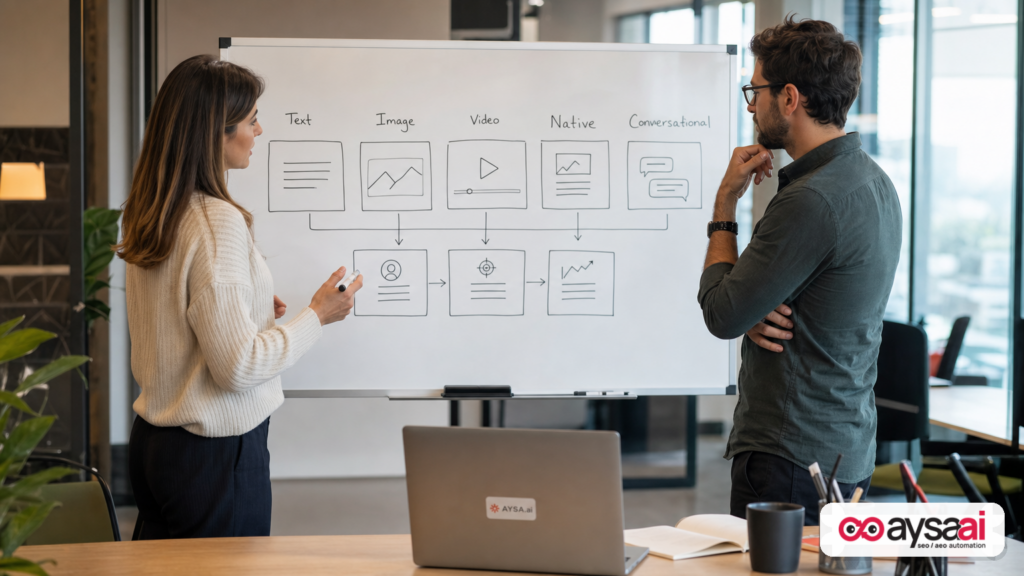
- OpenAI is hiring engineers for ad formats that include image, video, native, conversational, and interactive placements—suggesting ChatGPT ads won’t stay a small text box forever.
- More ad formats typically means more attention captured by paid units, even if the “answer text” remains unchanged.
- For SMEs, the risk is simple: your organic mention can be “true” but still not seen. The opportunity is also simple: if you become the source AI relies on, you can win mindshare and conversions even as ads expand.
- Winning in AI Search will increasingly require tight execution: structured content, clear product/service facts, policies, comparisons, local proof, and continuous monitoring of AI visibility.
- AYSA’s value: monitor AI visibility, prepare prioritized fixes, request approval, then execute changes—so you move fast without breaking trust or the site.
Key takeaways (for busy operators)
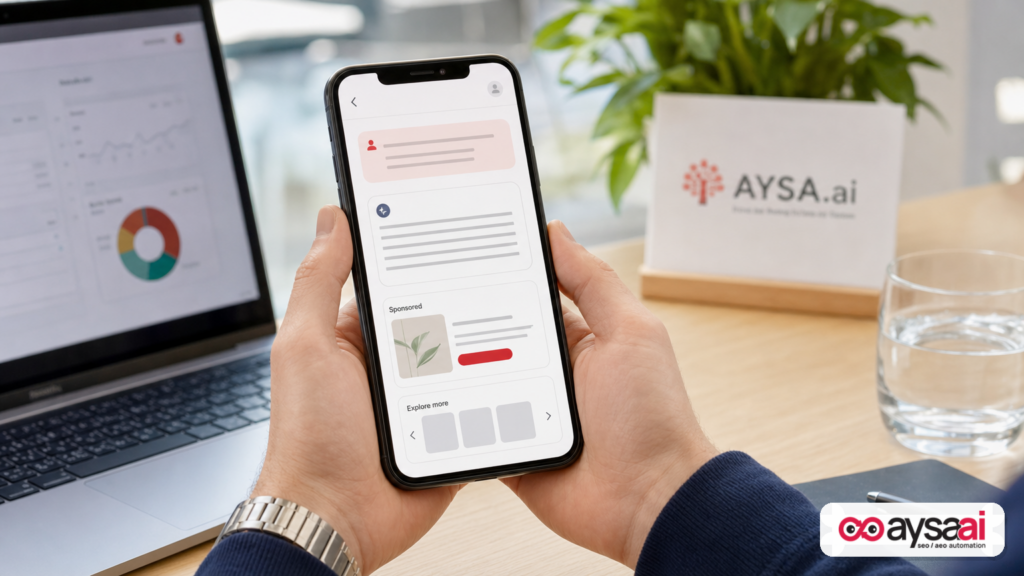
- Expect richer ads in ChatGPT. Hiring for iOS/Android ad rendering + monetization infrastructure implies expansion beyond today’s unit.
- Attention is the new ranking. The “best answer” matters, but so does what’s placed around it: ads, cards, carousels, and interactive flows.
- Organic visibility shifts from “ranking” to “being cited, selected, or recommended.” That depends heavily on your on-site clarity.
- Measurement will get messier. You’ll need a blend of brand search demand, referral patterns, assisted conversions, and AI visibility monitoring.
- Operations beats brainstorming. The winners will be the teams that can ship improvements weekly with controlled approvals.
Table of contents

- What Changed: OpenAI’s Hiring Signals Bigger Ad Formats In ChatGPT
- Context: From Search Ads To AI “Answer Pages”
- The New Visibility Reality: AI Answers Are Becoming Multi-Surface Experiences
- What “Image, Video, Native, Conversational” Ads Could Look Like (And Why It Matters)
- Trust, Privacy & Safety: The Constraint That Will Shape Everything
- How This Changes Organic Visibility (AEO/GEO) For Brands
- Measurement: What To Track When The Click Isn’t The Only Outcome
- SME Scenario: A Local Clinic Competing In A Chat-First World
- Agency Implications: New Deliverables, New Reporting, New Risks
- Site Readiness Checklist: What Your Website Must Do Well For AI Discovery
- The Practical Action Plan (90 Days): Monitor, Fix, Publish, Earn, Iterate
- Where AYSA Fits: Monitoring + Approved Execution For AI Search
- What Can Go Wrong (And How To Avoid It)
- What to do next
- Sources and further reading
What Changed: OpenAI’s Hiring Signals Bigger Ad Formats In ChatGPT
The most useful detail in the Search Engine Journal coverage isn’t speculation—it’s the nature of the roles. SEJ reports that OpenAI is hiring engineers for an “Ad Formats” team (including mobile-specific iOS and Android roles) and a senior monetization/ads role spanning infrastructure, APIs, and user-facing experiences. That implies serious work on rendering, presentation layers, and platform-level plumbing—not a temporary experiment.
SEJ also notes that OpenAI has already tested a standard ad unit (headline, short description, image, link) and that the company has publicly indicated it will evolve ads over time to support additional formats and buying models. The job listings discussed by SEJ specifically reference building across text, image, video, native, conversational, and interactive surfaces.
It’s important to be precise: hiring doesn’t confirm a launch date, and none of us should pretend to know the exact UI that will ship. But in product reality, companies don’t staff “rendering and presentation” teams unless they expect placements to scale across devices and contexts.
That’s the business takeaway: ChatGPT is likely moving from “a small ad unit” to an ad platform with multiple surfaces.
Context: From Search Ads To AI “Answer Pages”
For two decades, Google trained businesses to think in a familiar model:
- You have an intent (a query).
- You get a list of results.
- You compete for top spots organically and via ads.
AI search flips the interface. The “results page” becomes a conversation and an answer, with supporting elements around it. That matters because the user is no longer forced to scan 10 blue links and decide where to click. Often, they will accept the first coherent answer, then ask a follow-up question, then decide.
Historically, ads were “separate” from the answer: top-of-page, side rail, shopping carousel. In an AI chat interface, that separation becomes harder. Even if an AI system claims ads won’t change the answer text (SEJ notes OpenAI says ads won’t alter answers), ads can still shape outcomes by shaping attention—what the user notices, remembers, and acts on.
This is why an “ads expansion” story is also an “organic visibility” story. The organic mention may still exist, but its prominence can decline if richer ad units occupy more screen space.
The New Visibility Reality: AI Answers Are Becoming Multi-Surface Experiences
When businesses ask me, “Will SEO still matter?” my answer is: yes, but you need to stop thinking about SEO as only “rankings.” In AI search, visibility is fragmented across multiple surfaces:
- The answer itself (the narrative response)
- Mentions/citations (explicit links or implied sources)
- Cards and widgets (products, local packs, comparisons)
- Interactive flows (follow-ups, refinements)
- Paid units (sponsored cards, carousels, conversational ads)
In classic search, you could fight for position #1 and call it a day. In AI search, the user might never “see” position #1 because the interface isn’t a list—it’s a composite experience.
So your job becomes:
- Make your brand eligible to be selected as a source
- Make your content extractable (clear facts, definitions, comparisons)
- Make your offer convertible (pricing, policies, availability, trust)
- Make your presence measurable (monitor AI visibility and downstream demand)
This is exactly why we built AYSA as an execution system—not a “tool that gives suggestions.” In this environment, suggestions are cheap. Shipping changes safely is the bottleneck.
What “Image, Video, Native, Conversational” Ads Could Look Like (And Why It Matters)
SEJ’s reporting, based on job listings and earlier ad tests, suggests a broad range of ad formats. Let’s translate those words into practical implications—without pretending we know OpenAI’s final designs.
1) Image ads: more persuasion per pixel
Even modest image expansion changes outcomes. A small image already communicates brand, category, and vibe faster than text. A larger image or a carousel can dominate a mobile screen and reduce attention on organic mentions.
What it means for SMEs: Visual differentiation and offer clarity matter more. If a user sees an image ad for a competitor with “same-day delivery” while your brand is merely mentioned in the answer text, you may lose the click—even if the AI “recommended” you.
2) Video ads: attention capture plus explanation
Video is the highest attention format on most platforms. In a chat interface, video could serve as an explainer, demo, or testimonial—especially powerful for categories where trust and understanding drive purchase (health, home services, SaaS, education).
What it means: If video ads arrive, conversion might shift earlier into the chat experience. Your website must be ready to close the loop when that traffic arrives: clear landing pages, transparent pricing, strong policies, and “next step” UX.
3) Native ads: blending into “helpful” UI
“Native” usually means an ad that looks like part of the product experience. In chat, that could be a card that resembles a recommended resource, a product panel, or a “best option” suggestion—appropriately labeled, but still integrated.
What it means: The line between “content” and “placement” gets thinner in the user’s mind. Your brand needs to be consistently credible across the web so that when users see you (paid or organic), they trust you.
4) Conversational ads: the ad becomes a mini-sales rep
SEJ notes OpenAI has described a conversational unit where users can ask the ad questions before buying. That’s a major shift: it’s not just “click to site,” it’s “resolve objections inside the interface.”
What it means: Brands will need clean, consistent answers to common questions—features, compatibility, shipping, returns, guarantees, contraindications, licensing, geographic availability, and more.
And here’s the catch: if your website is vague or inconsistent, you’re not just hurting SEO—you’re feeding ambiguity into any system trying to represent you accurately. The best “conversational ad” in the world can still lead to disappointed customers if the underlying facts don’t match reality.
5) Interactive surfaces: configuration, qualification, and lead capture
Interactive can mean many things: quizzes, calculators, “choose your plan,” eligibility checks, appointment prompts. In a chat context, interactive ads can do what landing pages do—without the landing page.
What it means: Your differentiation must be machine-readable: service areas, appointment types, inventory constraints, pricing tiers, and eligibility rules.
Trust, Privacy & Safety: The Constraint That Will Shape Everything
SEJ mentions that privacy and safety language runs through the listings, emphasizing trust, fairness, privacy, and policy compliance. That’s not fluff—it’s the reality of advertising inside an assistant people use for sensitive topics.
For businesses, this has two implications:
- Ad targeting and measurement may be constrained compared to what some marketers are used to on other platforms.
- Brand compliance will matter more. If your category requires disclaimers (health, finance, legal, supplements), get your house in order now: transparent claims, accurate language, and clear policies.
If you’re an SME thinking, “We’ll just buy our way into visibility,” pause. Platforms that prioritize trust tend to be careful about what they allow, how they label it, and how they measure it. Paid will matter—but it likely won’t be a free-for-all.
How This Changes Organic Visibility (AEO/GEO) For Brands
Let’s talk about what most businesses actually want when they say “SEO” today:
- “When people ask AI for the best option, I want to show up.”
- “When people compare vendors, I want to be included.”
- “When people ask if we serve their area, I want the right answer.”
That’s AEO (Answer Engine Optimization) and GEO (Generative Engine Optimization) in practical terms—earning inclusion in AI-generated answers and recommendations.
If richer ads expand inside ChatGPT, two things happen simultaneously:
- Organic inclusion becomes more valuable because it’s a trust signal (“the assistant said it”).
- Organic inclusion becomes more fragile because it can be visually de-emphasized by paid formats and interactive units.
So your strategy needs to do two jobs at once:
- Make inclusion more likely (improve the content and structure AI systems can rely on)
- Make conversion resilient (so that when users do reach you, they quickly understand and act)
At AYSA, we frame this as AI search visibility plus approved execution. Monitoring alone is not enough; publishing without control is risky. You need both.
Explore the concept here: AI Search Visibility.
Measurement: What To Track When The Click Isn’t The Only Outcome
When ads and answers share a screen, “traffic” becomes a lagging indicator. You might win visibility without a click (the user remembers you), or you might lose a click to an ad even though you were mentioned.
So what should SMEs track?
1) Brand demand signals
- Branded search volume trends (directional)
- Direct traffic trends (directional)
- Increase in “brand + product/service” queries in Search Console (if applicable)
2) Conversion quality and assisted conversions
- Lead-to-close rate and time-to-close
- First-touch vs. assisted channel mixes (GA4 can help, but don’t over-trust attribution)
- Contact reasons: “I heard about you from…” (sales intake fields matter again)
3) AI visibility monitoring (mentions, citations, inclusion)
You need to know:
- When you’re mentioned (and for what)
- When you’re not mentioned (and who is)
- Whether key facts are accurate (pricing, location, service scope)
This is where AYSA’s monitoring is designed to fit: AYSA Monitoring.
4) Landing page readiness metrics
- Speed and usability (especially mobile)
- Clarity: does the page answer the top 5 questions in 30 seconds?
- Trust elements: reviews, guarantees, policies, credentials
AI surfaces can drive higher-intent visitors—if you don’t waste that moment.
SME Scenario: A Local Clinic Competing In A Chat-First World
Let’s make this real.
Business: A local dermatology clinic with two locations.
Today’s acquisition mix: Google Search, Google Maps, some paid search, word-of-mouth.
Now imagine a patient asks an AI assistant:
- “What’s the best clinic for adult acne treatment near me?”
- “Do I need a referral? What’s the typical cost?”
- “Can I get an appointment next week?”
In a future where ChatGPT has larger image/video/native placements, a competing clinic (or a skincare telehealth brand) could run a conversational ad that answers those objections inside the chat: pricing ranges, financing, appointment availability, a short explainer video, and a one-tap booking CTA.
Meanwhile, your clinic might still be “mentioned” organically in the AI answer—but below a richer paid unit.
What should the clinic do?
- Clarify service scope: adult acne, hormonal acne, isotretinoin support, etc.
- Publish transparent policies: referral requirements, insurance guidance, cancellation policies.
- Improve local signals: location pages with consistent NAP, service areas, parking info, accessibility, hours.
- Create “objection content”: what to expect, typical visit flow, safety disclaimers.
- Monitor AI answers: where are we mentioned, what’s wrong, what’s missing?
This is not theoretical work. It’s revenue protection. And it’s exactly the kind of work that’s easy to plan and hard to execute consistently—unless you have a system.
Agency Implications: New Deliverables, New Reporting, New Risks
If you run an agency, ChatGPT ad expansion is a warning and an opportunity.
Deliverables will shift from “rankings” to “readiness + visibility”
Clients will ask: “Are we showing up in AI answers?” not “Did we move from #5 to #3?” You’ll need deliverables like:
- AI visibility audits (what the assistants say today)
- Entity and brand fact cleanup (site + listings + profiles)
- Content structured for extraction (FAQs, comparisons, definitions)
- Conversion readiness improvements (policies, pricing clarity, trust)
Reporting will need humility and triangulation
Attribution is already messy. AI interfaces add another layer. Agencies should shift toward triangulating:
- Brand demand (directional)
- Pipeline quality
- AI visibility monitoring
- On-site conversion improvements
Risk will rise if you “ship changes” without governance
When the environment is volatile, some teams will panic and publish lots of content fast. That’s how websites get bloated, inconsistent, and untrustworthy.
This is where an approved execution model matters. AYSA is built to prepare changes, ask for approval, and then execute—so you can move quickly without turning the site into a patchwork.
See the tools we align to that workflow: AI SEO Tools.
Site Readiness Checklist: What Your Website Must Do Well For AI Discovery
If ChatGPT ads become richer, some brands will respond by spending more. That’s not wrong. But you’ll waste money if your website isn’t “AI-and-human ready.”
Here’s a practical readiness checklist—written for SMEs.
1) Clarity: your offer must be immediately understandable
- What do you sell?
- Who is it for?
- Where do you serve?
- What makes you different?
2) Facts: publish the details customers ask about
- Pricing ranges or how pricing works
- Shipping times / service availability
- Returns/refunds / guarantees
- Eligibility requirements
- Safety disclaimers where needed
3) Comparison content: help the customer choose
- “X vs Y” (your category comparisons)
- “Best for…” pages (use-case-driven)
- “Alternatives to…” (honest, balanced)
4) Local proof: make location and legitimacy obvious
- Location pages with consistent contact info
- Service area definitions
- Reviews/testimonials (embedded responsibly)
- Licenses, certifications, memberships (where relevant)
5) Structure: make your content easy to extract
- Descriptive headings
- FAQ sections that answer real objections
- Internal linking that maps “questions” to “answers”
- Schema where it accurately applies (avoid spammy markup)
6) Freshness and governance: update without chaos
- Content owners
- Review cadence (quarterly for policies, monthly for offers)
- Change logs (what changed, why)
This is the boring work that wins. And it’s exactly what gets skipped when teams chase shiny tactics.
The Practical Action Plan (90 Days): Monitor, Fix, Publish, Earn, Iterate
If you do nothing else after reading this, do this 90-day plan. It’s realistic for SMEs and disciplined enough for agencies.
Days 1–15: Establish your baseline
- Document the top 20 customer questions (sales calls, emails, chat logs)
- Audit your top 10 revenue pages: clarity, policies, proof, internal links
- Set up AI visibility monitoring (mentions + accuracy + competitors)
- List “facts that must be correct” (pricing model, service areas, availability)
If you’re using AYSA, this is where monitoring becomes your operating system: AYSA Monitoring.
Days 16–45: Fix the conversion blockers
- Rewrite the top pages for clarity (above-the-fold)
- Add/clean up FAQ sections (real objections, concise answers)
- Create or improve pricing/policy pages
- Strengthen internal linking (question → answer → conversion page)
Key principle: don’t create 100 new pages. Make your money pages undeniable.
Days 46–75: Publish “AI-first” content assets
- 2–4 comparison pages that reflect real buying decisions
- 1–2 “best for…” pages driven by use cases
- Local expansions: service-area/location pages where justified
This is where many teams get stuck: what to publish, how to structure it, and how to ensure it’s consistent with the rest of the site. AYSA’s model is: prepare → approve → execute.
Days 76–90: Earn credibility and iterate
- Find 5–10 partnership/link opportunities that are legitimate (associations, local orgs, suppliers)
- Update content based on what AI surfaces get wrong or omit
- Run small paid tests (if relevant) only after landing readiness is solid
And if you need a place to keep learning as this evolves: AYSA Blog.
Where AYSA Fits: Monitoring + Approved Execution For AI Search
Most “AI SEO” advice stops at audits and recommendations. That’s not enough anymore.
AI search is moving fast, and ad formats expanding inside ChatGPT will likely compress the time you have to react. But moving fast can’t mean pushing unreviewed changes live—especially for SMEs where the website is the product brochure, the sales rep, and the trust anchor all at once.
AYSA is designed as an execution system:
- Monitors AI search visibility and brand mentions (so you know what’s happening)
- Prepares prioritized website changes (so you know what to do)
- Asks for approval before anything goes live (so you stay in control)
- Executes accepted changes (so progress isn’t blocked by bandwidth)
If you want the big picture on AI visibility: AI Search Visibility.
If you want to understand the tooling approach: AI SEO Tools.
And if you’re evaluating the business case: AYSA Pricing.
What Can Go Wrong (And How To Avoid It)
Whenever a platform adds ad formats, a predictable set of mistakes follows. Here are the ones I see coming in AI search.
Mistake #1: Treating ChatGPT ads like “just another channel”
If conversational/native units become common, the ad experience may happen inside the purchase decision, not just before it. That changes creative, compliance, and landing expectations.
Avoid it: Build a unified “source of truth” on your site (facts, policies, pricing logic) so both organic and paid experiences stay consistent.
Mistake #2: Publishing thin “AI SEO” pages at scale
Flooding your site with shallow FAQs and generic listicles usually backfires: it dilutes authority and confuses users.
Avoid it: Start with your top revenue pages and your top objections. Depth beats volume.
Mistake #3: Ignoring local and “real world” proof
As interfaces get crowded, trust shortcuts matter more. For local and service businesses, legitimacy and location clarity are conversion multipliers.
Avoid it: Invest in location pages, reviews, credentials, and clear service area statements.
Mistake #4: Over-believing attribution
When AI answers shape decisions without clicks, attribution models will undercount the channel’s influence.
Avoid it: Triangulate: demand signals + pipeline quality + AI visibility monitoring.
Mistake #5: Moving fast without approvals
AI-era SEO requires speed—but brand, legal, and operational accuracy still matter. One wrong policy statement can become a customer support nightmare.
Avoid it: Use an approval-based execution workflow (this is core to AYSA’s model).
What to do next
- List your top 20 customer questions (sales, support, and “pre-sale objections”).
- Audit your top 10 pages for clarity, pricing/policy transparency, and trust proof.
- Start AI visibility monitoring so you know where you’re mentioned and what’s inaccurate: AYSA Monitoring.
- Publish 2–4 comparison/use-case assets that match how people choose in your category.
- Fix internal linking so every question has a clear path to the best answer page.
- Decide your execution cadence: weekly shipping beats quarterly “SEO projects.”
- If you need controlled speed, use an approve-then-execute model (what AYSA is built for): AI SEO Tools.
Sources and further reading
- Search Engine Journal — OpenAI Hiring Points To Image & Video Ads Coming To ChatGPT
- Search Engine Journal — Latest News (context on ongoing AI/search changes)
- Search Engine Journal — PPC News (broader paid media implications)
- Search Engine Journal — SEO (ongoing SEO context as interfaces evolve)
- AYSA.ai — AI Search Visibility
- AYSA.ai — Monitoring
- AYSA.ai — AI SEO Tools
- AYSA.ai — Pricing
- AYSA.ai — Blog
Note: The SEJ source references additional reporting (e.g., Digiday, Marketing Dive) and OpenAI’s advertising page, but those primary links were not included in the supplied research context. Where specifics depend on those sources, I’ve treated them as directional context rather than verified product details.
Continue the AI search topic inside AYSA.
Use these pages to connect the article with AI SEO tools, AI visibility monitoring, AI Overviews and approved website execution.
Turn this topic into a website action plan.
Use these AYSA hubs to move from reading to technical fixes, AI visibility monitoring, research, glossary context and approval-first SEO execution.