
Google’s June 2026 AI Updates Signal a New Search Reality: What SMEs Must Do Next (and How to Execute Without Chaos)
Google’s June 2026 AI rollout isn’t just “more AI.” It’s a shift toward always-on, multimodal assistants that translate, act on desktops, and synthesize research—changing how customers discover, evaluate, and choose businesses. Here’s what changed, why it matters for search visibility, and a practical execution plan SMEs can run with AYSA’s approved-change workflow.

June 2026 quietly marked a turning point: Google’s AI updates weren’t just new models and shiny features—they were infrastructure for a world where assistance becomes ambient, multimodal, and increasingly action-oriented. When AI can translate live conversations, operate across desktop workflows, summarize research into charts and slide decks, and sit inside your home and phone as a default interface, the definition of “being discoverable” changes.
As a business, you don’t get to opt out of that shift. Your customers’ expectations will change even if you never open an AI app. They’ll ask questions differently, compare providers differently, and accept answers from synthesized interfaces that may or may not send you a click.
This editorial breaks down what Google announced in June 2026, the pattern behind it, and the practical implications for SMEs and agencies. Most importantly: it outlines an Execution Plan you can run without turning your site into an endless experiment. That’s where AYSA fits best—Monitoring what’s happening, preparing specific website changes, requesting approval, and then executing only what you accept.
Concise summary
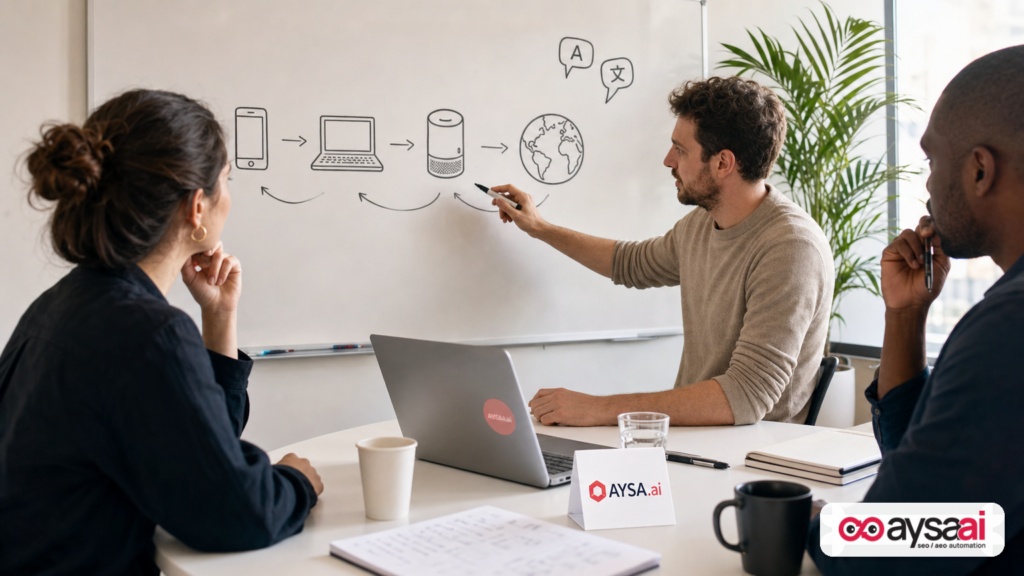
Google’s June 2026 AI updates (including local models, “computer use” agents, live speech translation, research synthesis tools, and AI embedded across Android/Pixel/Home) point to a unified assistant layer across devices. For search and customer acquisition, this increases the value of “answer-ready” content and verifiable business facts (pricing, policies, inventory/service details, reviews, location signals) while raising the bar for operational execution (keeping information consistent, structured, and current). SMEs should focus on building an AI-readable visibility stack—then use a safe, approval-based workflow to implement changes continuously.
Key takeaways (for busy operators)
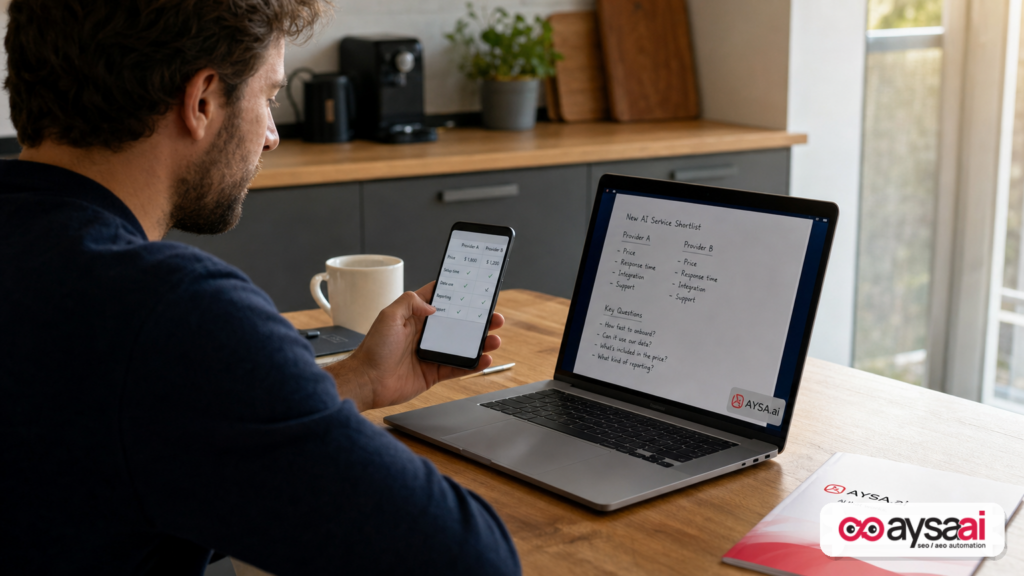
- Google is pushing toward an always-on assistant layer across phone, desktop, and home—not just a search box.
- AI translation and multimodal inputs expand your market, but only if your site communicates the basics clearly (services, pricing, policies, availability, proof).
- “Being the answer” increasingly competes with “getting the click.” That shifts SEO from ranking tactics to credibility, structure, and freshness.
- Execution is now the bottleneck. You need a system to monitor, propose, approve, and ship changes without breaking the site or your brand voice.
- AYSA’s role: continuously monitor your search visibility, generate specific improvements, ask for approval, and implement the accepted changes—so strategy becomes shipped outcomes.
Table of contents
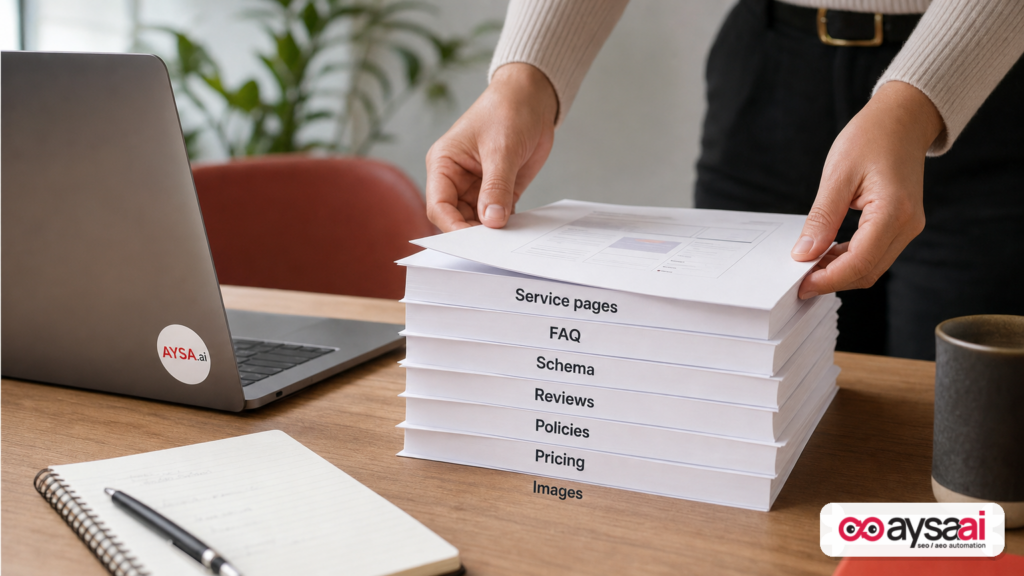
- What Google Actually Announced in June 2026 (and the Pattern Behind It)
- The Real Story: A Unified Assistant Layer Across Devices
- Why These Updates Change Search Behavior (Even If You Don’t “Use AI Search”)
- The New Visibility Stack: From Rankings to Being the Answer
- Live Translation and the Global SME Opportunity (and Risk)
- Computer-Using Agents: Automation Raises the Stakes for Site Clarity
- Education Features Are a Search Signal in Disguise
- Safety, Scams, and Why Trust Signals Matter More Than Ever
- A Concrete SME Scenario: Local Clinic + Multilingual Demand
- What to Monitor Weekly (Not Annually)
- A Practical 30-Day Action Plan for SMEs
- Where AYSA Fits: Approved Execution for AI-Driven Search
- What to do next
- Sources and further reading
What Google Actually Announced in June 2026 (and the Pattern Behind It)
Google’s June 2026 recap is broad by design. It’s not a single product launch; it’s a coordinated push that makes AI more present in everyday workflows across devices and contexts—work, school, finance, home, travel, and safety. In Google’s own roundup, several themes stand out:
- Local AI on consumer hardware (e.g., an open model positioned to run on a laptop with typical memory constraints).
- Action-taking agent capabilities (computer use integrated into a model variant, aimed at building agents that can see and act across environments).
- Multimodality everywhere (image generation updates, video workflows, voice translation, and voice-first assistants).
- AI embedded into operating systems and devices (Android updates, Pixel features, and a new smart speaker built around Gemini).
- AI-powered research and learning tools (NotebookLM upgrades, study notebooks, education workflows).
- Security and public-good posture (anti-scam actions, climate alerts, public service modernization prototypes).
If you want the raw list, read Google’s post directly: The latest AI news we announced in June 2026. That post also points readers to Google’s primary channels—useful for staying grounded in official updates rather than second-hand summaries, including the Google DeepMind blog, the Google Research blog, the Google Developers blog, and the Google Cloud blog.
The pattern behind the list: Google is building an ecosystem where AI doesn’t merely answer questions—it translates, summarizes, generates, and increasingly does things on your behalf. That reality is bigger than SEO, but it will rewrite the economics of organic acquisition.
The Real Story: A Unified Assistant Layer Across Devices
For years, “search” was the center of gravity. Then came mobile, then voice, then apps, then recommendation feeds. June 2026’s updates reinforce a new center: an AI assistant layer that rides on top of everything else.
Consider what happens when these pieces converge:
- Your phone becomes an always-available translator and concierge.
- Your laptop can run certain AI workflows locally (privacy + speed benefits), or use cloud models for heavier tasks.
- Your home assistant becomes more conversational and context-aware (multiple requests, follow-ups, memory of the thread).
- Your research workflows (personal or business) compress into summarized “key moments,” charts, slide decks, and structured notes.
From an SME perspective, the question is not “How do I rank #1 for [Keyword]?” It becomes: How do I become the trusted entity that an assistant can confidently recommend, quote, or use to complete an action?
This is where the conversation shifts from SEO tactics to operational visibility. Your facts, policies, availability, and proof must be easy for machines to extract and safe to present to users.
Why These Updates Change Search Behavior (Even If You Don’t “Use AI Search”)
A common misconception in small business: “Our customers aren’t using AI; they just Google us.” In 2026, that distinction is increasingly meaningless because AI is being embedded into the default interfaces people already use—phones, browsers, system features, and productivity tools.
Here are three behavior shifts I see as inevitable given Google’s June 2026 direction:
1) More decisions will be made before the click
If an interface can summarize options, translate a call, or generate a shortlist based on constraints (“near me,” “open now,” “accepts insurance,” “under $200,” “can do it this week”), users will spend less time browsing ten websites. The evaluation happens in the assistant layer.
That means your website’s job becomes less about persuading a deep visitor and more about feeding accurate, persuasive, verifiable signals into systems that summarize you.
2) The customer journey becomes multimodal by default
Google’s updates emphasize voice, vision, and video workflows—not just text. Customers will ask: “Is this product compatible with this?” while showing a picture, or “Can you translate what this contractor said?” while listening to audio. The assistant becomes the mediator across media types.
For businesses, that raises the value of:
- Clear product images with descriptive context
- Concise explanations (compatibility, sizing, before/after, warranty)
- Service pages that answer “can you do X?” in plain language
3) “Trust friction” becomes a competitive moat
As AI helps people move faster, scams and low-quality providers will also try to move faster. Google’s June recap explicitly includes scam enforcement and policy efforts. When trust becomes a top-tier product concern, legitimate businesses with strong proof signals gain an advantage—if they package that proof properly.
The New Visibility Stack: From Rankings to Being the Answer
Traditional SEO often collapses into one question: “What keyword should I target?” AI-driven discovery forces a more structural question: “What information does an assistant need to answer on my behalf?”
I think of this as the AI visibility stack. You don’t need all of it perfectly, but you need enough layers that you’re consistently “safe to cite.”
Layer 1: Business truth (the non-negotiables)
- What you do (precise services/products, not vague positioning)
- Where you do it (service area, locations, shipping coverage)
- When you do it (hours, lead times, appointment availability)
- How pricing works (ranges, minimums, what’s included, financing)
- Policies (returns, cancellations, warranties, insurance)
Businesses routinely hide this because they’re afraid it will reduce leads. In reality, hiding it filters in low-intent prospects and filters out the high-intent buyers who want certainty. AI systems also struggle to recommend ambiguous options.
Layer 2: Structured clarity (make it machine-extractable)
When your site is organized clearly, assistants and search systems can map answers reliably. That doesn’t mean “add random schema.” It means you should be able to point to a URL and say: “That page defines this service and answers the top questions.”
In practice, this often means:
- Dedicated service pages (not a single catch-all page)
- FAQ sections written like real customer questions
- Internal links that reflect how people decide
- Consistent naming (service names, product variants, plan tiers)
AYSA helps operationalize this with monitoring and change preparation: AYSA Monitoring.
Layer 3: Proof (be credible under synthesis)
AI summaries collapse nuance. That makes proof signals even more important because they survive Compression. “Trusted by 10,000 customers” is a claim; “4.8-star reviews across multiple platforms with recent detailed feedback” is evidence.
Proof isn’t only reviews. It includes:
- Before/after galleries with context
- Certifications and licenses (with identifiers where appropriate)
- Case studies with constraints and outcomes (no fluff)
- Clear author/company identity and contactability
Layer 4: Freshness and consistency (the operational layer)
In an assistant-driven world, stale details are dangerous. Wrong hours, outdated pricing, or discontinued products aren’t “minor.” They create user harm—and systems will learn to distrust you.
This is why SEO is becoming closer to operations. If your team can’t ship updates weekly, you’ll lose to businesses that can.
Layer 5: Execution (the part most teams can’t scale)
Most SMEs are stuck here:
- The marketing person knows what to fix.
- The founder is busy and can’t review details.
- The developer is backlogged (or you don’t have one).
- The site stays unchanged for months.
AYSA is designed to close that gap: it monitors, prepares website changes, asks for your approval, then executes only what you accept—turning strategy into shipped improvements. Explore the execution approach here: AI SEO Tools and AI Search Visibility.
Live Translation and the Global SME Opportunity (and Risk)
One of the most business-relevant announcements in Google’s June recap is live speech-to-speech translation, positioned to preserve intonation and reduce awkward pauses across many languages. Google framed it as reducing language barriers during calls, meetings, and travel, rolling out via Gemini Live API, Google AI Studio, and the Google Translate app (per the recap post: source).
From an SME standpoint, live translation changes two things at once:
1) Your addressable market expands overnight
If a customer can call your hotel, clinic, or service business and communicate comfortably through translation, they’re more likely to choose you—even if your site is only in English today.
But there’s a catch: translation doesn’t fix ambiguity. If your service page is vague, translating it into 70 languages simply spreads the confusion.
2) Your liabilities expand if your info is inconsistent
Translation makes it easier for people to act on your information quickly. If your policies are unclear (“same-day cancellation fee may apply”) or your pricing has hidden constraints, you’ll face more disputes—not fewer. Clear policies are now a growth strategy.
Practical move: add a “How pricing works” and “Policies” section to your key money pages. Make them simple enough to translate cleanly.
Computer-Using Agents: Automation Raises the Stakes for Site Clarity
Google highlighted “computer use” integrated into a Gemini model variant, enabling builders to create agents that can see, reason, and take action across desktop/mobile/browser contexts (again, per the June recap: source).
For businesses, this has a non-obvious consequence: more customers will delegate browsing, comparing, and form-filling to agents. You should assume that some portion of your “users” will be software acting on behalf of humans.
That pushes your site toward being:
- Readable (clean headings, clear page purpose)
- Extractable (prices, plans, features stated plainly)
- Actionable (contact paths, booking flows, forms that work)
- Stable (avoid broken flows, pop-ups that block steps, inconsistent navigation)
It also raises the importance of monitoring. If an agent fails on your booking form due to an error, that’s not just a UX bug—it’s lost revenue from delegated journeys you’ll never see.
Education Features Are a Search Signal in Disguise
Google’s recap included NotebookLM upgrades (reasoning, cloud computer to run code, chart/spreadsheet/slide generation), study notebooks in the Gemini app, and connected tools for classrooms. On the surface, that’s “education.” In practice, it’s “how people learn what to buy.”
Why it matters for search and acquisition:
- People increasingly use AI tools to learn before purchasing—especially for high-consideration services (healthcare, legal, B2B SaaS, home improvement).
- If your content can be pulled into research workflows cleanly, you become part of the user’s knowledge base, not just a search result.
- AI-generated notes, comparisons, and slides tend to reward sources that are structured and explicit.
Translation: “educational content” is no longer top-of-funnel fluff. It’s a format that assistants can ingest and reuse. If you publish one definitive guide that answers real customer questions with clear constraints, it can outperform ten shallow blog posts.
If you’re building that kind of asset, keep it updated and internally linked from your money pages. That’s a classic execution problem, and it’s exactly the kind of recurring work AYSA is built to systematize: AYSA Blog.
Safety, Scams, and Why Trust Signals Matter More Than Ever
Google’s June recap also touched on combating AI-powered scams, including legal actions and support for legislative efforts (per the recap: source). You don’t need to be a security expert to understand the downstream effect: platforms will keep tightening trust requirements.
In practical terms, legitimate businesses should assume:
- It will become harder for low-trust brands to maintain visibility.
- Signals of identity and accountability will matter more.
- Inconsistent facts across the web will be punished—sometimes algorithmically, sometimes by user skepticism.
Trust signals SMEs can control (and often ignore)
- Identity: clear company name, address (if relevant), phone, email, leadership/team info.
- Policies: transparent refund/return/cancellation terms.
- Proof: reviews, certifications, professional associations, case studies.
- Security basics: HTTPS, no broken pages, no deceptive UX.
You don’t need to “look big.” You need to look real.
A Concrete SME Scenario: Local Clinic + Multilingual Demand
Let’s make this tangible.
Scenario: You run a mid-sized local clinic in a U.S. metro area. Your neighborhood has high multilingual demand. Historically, you’ve relied on referrals and local search. Your site has a homepage, a generic “Services” page, and a contact form. Pricing is “call for details.” Policies are not clearly described.
Now add June 2026’s reality:
- A patient uses live translation to call multiple clinics quickly.
- An assistant summarizes options: “Clinic A: likely accepts your insurance, appointment within 72 hours, transparent cancellation policy. Clinic B: unclear pricing, unclear appointment lead time.”
- The patient chooses the clinic with less ambiguity—even if it’s slightly farther away.
What changed? Not your clinical quality. The interface changed, and it rewarded the clinic that was easiest to evaluate and safest to recommend.
What you should do (clinic version):
- Create one page per major service with: who it’s for, how it works, typical timelines, what to bring, common questions.
- Add “Insurance & Billing” clarity (even if it’s ranges and a verification process).
- Publish cancellation/no-show policies clearly.
- Add trust signals: clinician bios, credentials, and contact pathways.
- Monitor the top questions people ask (Search Console + on-site behavior) and keep FAQ sections current.
Where AYSA fits: You don’t want a clinic staff member pushing random edits live. You want a workflow: monitor → propose changes → approval by the clinic manager/owner → execute safely. That’s the operating model.
What to Monitor Weekly (Not Annually)
AI-driven search rewards businesses that respond to reality fast. That means monitoring isn’t a “quarterly report.” It’s an operating cadence.
Here’s what I would treat as weekly hygiene for most SMEs (and daily for competitive niches):
1) Demand signals
- Which queries are rising (new services, new product variants, new pain points)?
- Which pages are gaining impressions but losing clicks (possible “answer without click” effect)?
2) Trust and conversion signals
- Are people bouncing because pricing/policies are unclear?
- Are leads mentioning “I saw…” (implying summary-driven discovery)?
3) Content and site integrity
- Broken pages, outdated information, inconsistent service naming.
- Pages that should be updated because the business changed (hours, availability, product discontinuations).
4) SERP and answer visibility
Even without naming specific search features, you can track whether your brand is being represented consistently across search surfaces and whether your content is being used as a reference. AYSA’s core monitoring capability is built for that operational rhythm: AYSA Monitoring.
A Practical 30-Day Action Plan for SMEs
Most advice fails because it’s either too technical or too vague. Here’s a plan built for execution with limited time and no appetite for risk.
Week 1: Build your “answer-ready” baseline
- List your top 10 money questions: pricing, timelines, “does it include X,” “who is it for,” “what happens if…”
- Audit your top 10 revenue pages: do they answer those questions clearly?
- Decide what you can publish: ranges are fine; “call us” isn’t.
Week 2: Fix ambiguity and add proof
- Add “How it works” sections to key pages.
- Add policies that reduce disputes (returns/cancellations/warranties).
- Add proof blocks: reviews, case studies, credentials, guarantees (only if true).
Week 3: Improve structure so assistants can extract answers
- Create dedicated pages for your core services/products if you don’t have them.
- Add a clean FAQ section per service/product.
- Strengthen internal linking: service → pricing → FAQs → contact/booking.
Week 4: Operationalize monitoring and approvals
- Set a weekly review: “What changed in demand? What changed in the business?”
- Queue site updates as change requests, not ad-hoc edits.
- Ship improvements weekly.
If you want this to run without creating work for your developer (or risking “someone broke the site”), this is where an approved-execution system matters. See AYSA’s tooling overview: AI SEO Tools. If you’re evaluating fit and cost, start here: AYSA Pricing.
Where AYSA Fits: Approved Execution for AI-Driven Search
Many AI-search conversations drift into theory: prompts, models, “the future.” SMEs don’t need more theory. They need a reliable system that turns visibility requirements into shipped website improvements.
AYSA is built around a simple loop:
- Monitor visibility and site signals continuously (not just rankings).
- Prepare concrete, page-specific improvements—titles, FAQs, internal links, content clarifications, structural updates.
- Ask for approval so the business stays in control of claims, pricing language, compliance, and brand tone.
- Execute the approved changes safely and consistently.
This matters more in an AI-forward ecosystem because the risk profile is higher:
- If your site is unclear, assistants will summarize you poorly.
- If your info is stale, assistants may mislead users.
- If your updates are inconsistent, trust signals degrade.
AYSA’s positioning is not “AI writes your content.” It’s “AI helps you operate SEO as a disciplined execution practice.” If you want to explore that approach, start with: AI Search Visibility.
What to do next
- Pick one revenue-critical page and add: pricing approach, lead time, policies, and top FAQs.
- Pick one trust asset (reviews, credentials, case study) and make it visible on that page.
- Standardize your service/product naming across the site to reduce ambiguity.
- Set a weekly cadence to ship at least one approved improvement.
- Implement a monitor → approve → execute workflow so changes happen without chaos—review AYSA’s monitoring and tools: AYSA Monitoring and AI SEO Tools.
Sources and further reading
- Google Search Blog (The Keyword): The latest AI news we announced in June 2026
- Google DeepMind blog
- Google Research blog
- Google Developers blog
- Google Cloud blog
AYSA internal links referenced: AI SEO tools, AI search visibility, Monitoring, Pricing, Blog.
Continue the AI search topic inside AYSA.
Use these pages to connect the article with AI SEO tools, AI visibility monitoring, AI Overviews and approved website execution.
Turn this topic into a website action plan.
Use these AYSA hubs to move from reading to technical fixes, AI visibility monitoring, research, glossary context and approval-first SEO execution.

