
AI Search Winning Brands: The 10 Characteristics That Make a Brand Easy to Recommend
A practical AYSA guide to the characteristics of brands that win in AI search: accessibility, usefulness, entity clarity, credibility, differentiation, freshness and execution.
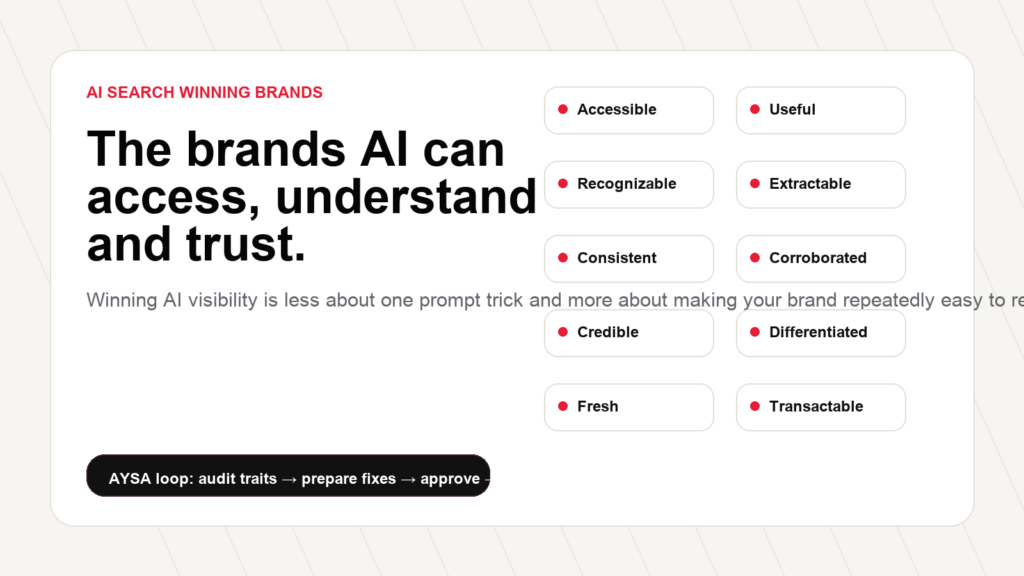
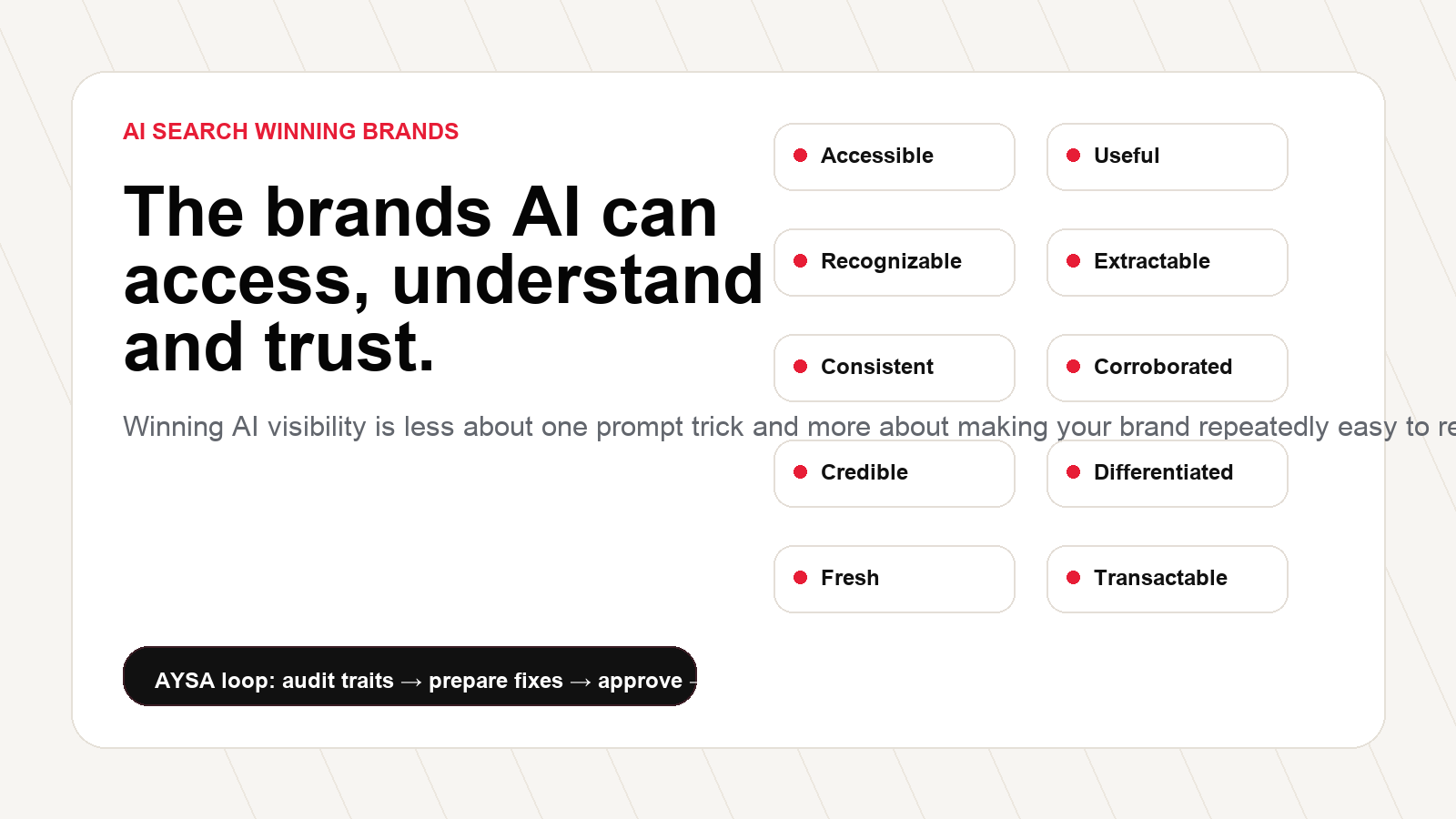
Executive summary: Brands that win in AI Search are not only the biggest brands. They are the brands that AI systems can access, understand, verify, differentiate and safely recommend. Aleyda Solis describes 10 characteristics of AI search winning brands: accessible, useful, recognizable, extractable, consistent, corroborated, credible, differentiated, fresh and transactable. The AYSA view is simple: these are not static content qualities. They are operational requirements that must be monitored and improved continuously.
This article explains what those characteristics mean in practice for SMEs, ecommerce, local businesses, clinics, hotels, agencies and SaaS companies. It also connects the topic to our earlier articles on global AI search strategy, AI search measurement and the March 2026 core update: visibility is no longer just about rankings. It is about whether the brand is a reliable source and a useful answer.
Why some brands win in AI search
AI search changes the meaning of visibility. In classic SEO, a brand could win by ranking a page for a Keyword. In AI-assisted search, the brand may need to be retrieved, summarized, compared, cited, recommended and connected to an action. That is a higher bar.
When a user asks an AI system “What should I compare before choosing a pediatric clinic in Bucharest?” or “Which Ecommerce SEO platform is useful for a small business?” or “What hotel should I choose near the airport with parking and late check-in?”, the answer system needs more than a Title tag. It needs accessible pages, clear facts, trustworthy proof, current information, differentiated value and enough context to explain why one brand belongs in the answer.
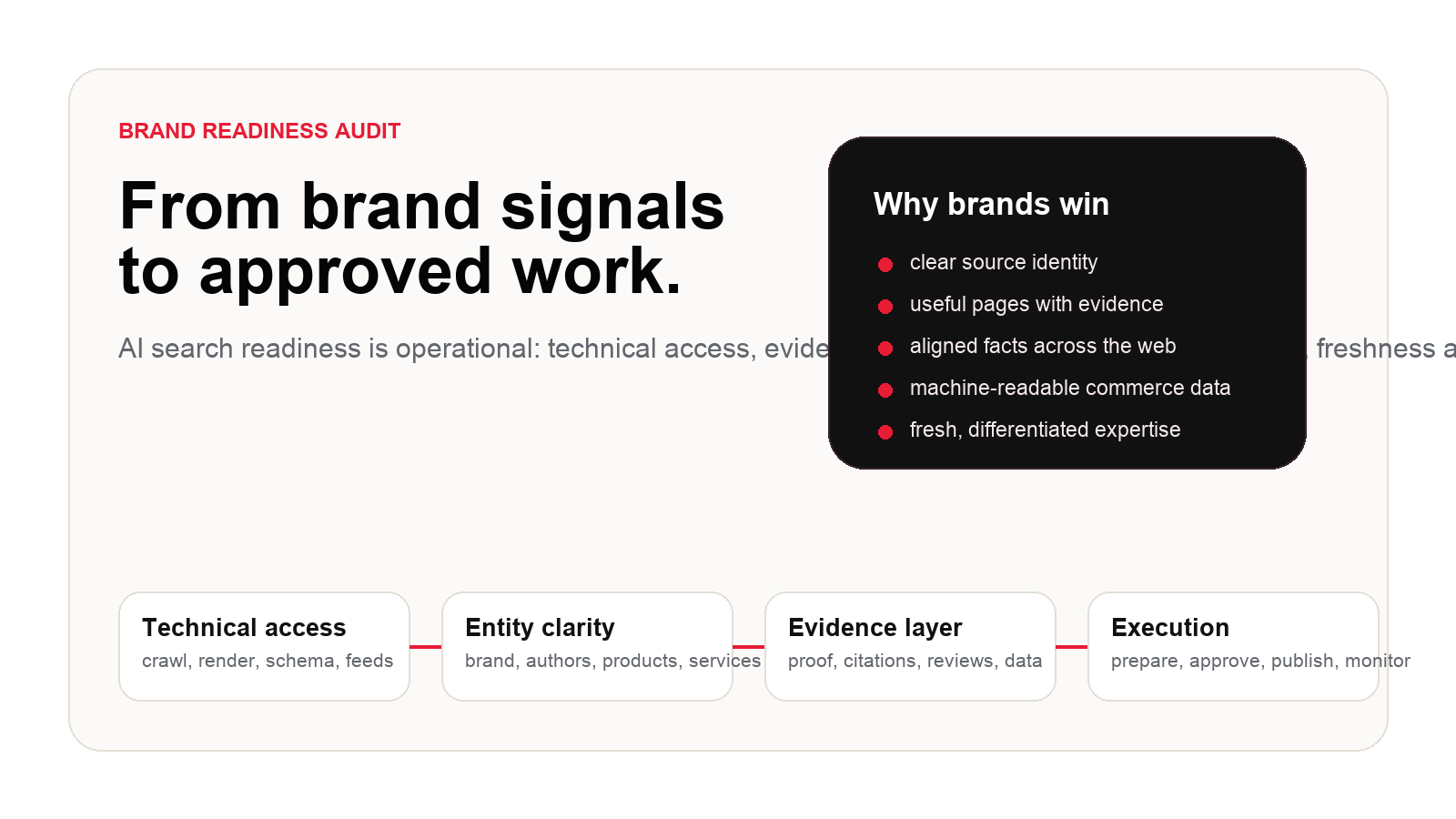
This is why Aleyda Solis’ framework is useful. Her list of winning brand characteristics is not about gaming a prompt. It is about making the brand easier for AI systems to understand and use. The winning brand is not always the largest. It is often the brand with the clearest, most useful, most verifiable evidence for a specific task.
For SMEs, this is encouraging. A small business may not have the Domain authority of a global publisher, but it can often become the best direct source for its own products, services, locations, policies, expertise and customer proof. The work is not glamorous. It is operational: fix access, clarify entities, improve useful pages, strengthen evidence, keep information fresh and make actions easy.
The 10 characteristics of AI search winning brands
Aleyda’s 10 characteristics can be grouped into five operational pairs. The first pair is accessible and extractable. AI systems cannot use what they cannot crawl, render, parse or extract. The second pair is useful and differentiated. Generic pages are harder to justify in a synthesized answer. The third pair is recognizable and consistent. The system must understand who the brand is and see the same facts across the web. The fourth pair is corroborated and credible. External proof, reviews, citations, expert authorship and trustworthy references matter. The fifth pair is fresh and transactable. Information must be current, and the user must be able to take the next step.
This is where many companies get AI search wrong. They treat it as a content problem only. It is not. It is a technical, semantic, editorial, commercial and operational problem. A brand can have good content but poor Crawlability. It can have a strong product but weak Entity Clarity. It can have excellent service but no visible proof. It can have reviews but no structured local pages. It can have useful pages but stale prices, policies or availability.
That means the work cannot live only in a blog calendar. It must involve technical SEO, content, product data, local profiles, reviews, PR, authority building, internal links, structured data and conversion paths.
Accessible and extractable
Accessibility in AI search starts with classic technical SEO. Pages must be crawlable, indexable, fast enough, mobile-friendly and not hidden behind broken JavaScript, bad canonicals, blocked resources or messy redirects. Google’s AI features guidance does not introduce a secret AI-only optimization layer. It points back to useful content and accessible pages that Google can crawl and understand.
Extractability goes one step further. The answer system should be able to pull the useful parts of the page. Clear headings, concise definitions, structured lists, visible FAQs, product data, service details, tables, author information and internal links all make extraction easier. If important facts are buried in vague marketing copy, the brand becomes harder to cite.
For example, a parking company near an airport should not only say “secure parking near the airport.” It should clearly expose distance, shuttle process, booking process, opening hours, pricing model, security features, cancellation rules and reviews. A clinic should expose specialties, doctors, appointment process, location, emergency limits and trust signals. An ecommerce store should expose product attributes, availability, returns, shipping, comparisons and reviews.
Extractable does not mean robotic. It means useful information is visible, structured and connected to user intent.
Useful and differentiated
Usefulness is the heart of AI search visibility. A page should answer the user’s real decision, not only repeat a keyword. This is especially important because AI systems synthesize. If five pages say the same thing, the system has little reason to prefer one unless there is stronger authority, clearer evidence or better fit.
Differentiation is therefore practical. What does the brand know, offer, prove or explain better than alternatives? A florist can show delivery reliability, occasion expertise, fresh product handling and local service coverage. A clinic can show doctor expertise, patient process, specialization and location-specific help. A SaaS company can show workflow, integrations, examples, documentation and pricing clarity. A hotel can show amenities, local context, transportation, policies and guest experience.
As we wrote in our March 2026 core update analysis, the search landscape increasingly rewards source fit. A generic page is fragile. A page that is clearly the best direct source for a specific user task is much stronger.
For SMEs, this means the website should not imitate large publishers. It should use its real business knowledge. What questions do customers ask before buying? What objections stop them? What details do they need to decide? What proof would make the choice easier? Those answers create useful, differentiated content.
Recognizable and consistent
AI systems need to understand the entity. Who is the brand? What does it do? Where does it operate? Which products or services does it offer? Who founded it? What is it known for? Which websites, social profiles, business listings and publisher mentions belong to the same entity?
Recognizability is not only a logo problem. It is a data consistency problem. The brand name, address, phone number, website, social profiles, author information, product names, service descriptions and business categories should be consistent across the web. If one source says the company is an agency, another says it is a SaaS platform, another says it is a marketplace and the website is unclear, the entity becomes harder to interpret.
Consistency is especially important for international and local brands. As we explained in our global AI search strategy article, a brand can be clear in one market and fuzzy in another. Local language pages, business profiles, reviews, publisher mentions and social profiles should reinforce the same core identity while adapting to local user needs.
For AYSA, this matters because the product sits at the intersection of SEO automation, AEO, GEO, AI search visibility and approved website execution. That positioning has to be repeated clearly across product pages, blog posts, glossary terms, help content and external mentions.
Corroborated and credible
AI search winning brands are not only self-described. They are corroborated. Corroboration can come from reviews, publisher mentions, authoritative directories, case studies, customer proof, expert authorship, documentation, product data, awards, interviews, social proof and third-party citations.
Credibility depends on the vertical. In healthcare, qualifications, responsible language and patient trust matter. In finance or legal topics, compliance and expertise matter. In ecommerce, product data, reviews, returns and delivery reliability matter. In SaaS, documentation, use cases, security and customer proof matter. In local services, reviews, location proof and process clarity matter.
This is why authority building should not be treated as “buy links.” The modern version is controlled authority building: identify relevant publisher or ecosystem opportunities, understand the context, approve the spend or action, and track delivery. AYSA’s integration with Adverlink belongs here: authority opportunities should be surfaced, explained, approved and tracked, not handled through messy outreach and spreadsheets.
Corroboration also protects against hallucinated or outdated brand descriptions. If the web consistently explains the brand correctly, AI systems have a stronger basis for accurate answers.
Fresh and transactable
Freshness matters because outdated information creates bad answers. Prices change, opening hours change, product availability changes, policies change, services change, doctors change, features change and markets change. A brand that does not maintain its information becomes less reliable.
Transactable means the user can act. For ecommerce, that may mean product availability, price, shipping, returns and checkout clarity. For local services, it may mean booking, phone, address, opening hours and service area. For SaaS, it may mean pricing, signup, demo, documentation and integration details. For publishers, it may mean clear authorship, dates, sources and next steps.
AI systems increasingly sit closer to action. As we discussed in our article on agent-ready websites, the web is moving toward interfaces where agents can compare, decide and sometimes act. Brands that are hard to transact with may lose even if they are mentioned.
Fresh and transactable is not a content slogan. It is a maintenance requirement. Someone or something must keep the website updated.
What this means for SMEs
For SMEs, the message is not “become a global brand.” The message is “become the clearest and most useful source for the market you actually serve.” A local clinic does not need to win every medical query. It needs to be understandable, credible and useful for the patients it can serve. A florist does not need to be a global flower encyclopedia. It needs to answer local delivery and occasion questions better than competitors. A hotel does not need to compete with every travel publisher. It needs to make the stay decision easier.
This is good news because SMEs often have real expertise close to the customer. The problem is that this expertise is not always visible on the website. It lives in phone calls, WhatsApp messages, reception conversations, sales meetings, customer reviews and the owner’s head. AI search cannot use what is not published, structured or corroborated.
The practical SME playbook is simple: make key pages useful, expose decision criteria, show proof, keep details fresh, build internal links, fix technical access, strengthen local profiles, collect and structure reviews, and make next actions clear. Then repeat.
The hard part is consistency. That is where manual SEO breaks down. A business owner can fix one page once. But AI search readiness requires continuous monitoring and execution.
A brand readiness workflow for AI search
Start by auditing your brand presence. Search and prompt the questions your customers actually ask. Does the brand appear? Is it described correctly? Which competitors appear? Which sources are cited? What facts are missing or wrong?
Then audit readiness. Can crawlers access the pages? Are important pages indexable? Do pages answer the query clearly? Is structured data valid? Are internal links strong? Are service details visible? Are reviews and proof easy to find? Are profiles consistent? Are policies current?
Next, identify execution gaps. These may include rewriting service pages, adding FAQs, fixing schema, creating comparison pages, improving local pages, updating Google Business Profile, adding product data, building authority mentions, improving internal links or consolidating weak pages.
Finally, prioritize by business value. Not every AI search gap deserves immediate work. Focus on prompts and pages connected to leads, sales, bookings, revenue and strategic positioning.
Static checklist
Read a list of AI search factors, make a few edits, then hope the brand starts appearing in answers.
Operating workflow
Where AYSA fits
AYSA is built for the operational reality behind these characteristics. A brand cannot become accessible, useful, recognizable, extractable, consistent, corroborated, credible, differentiated, fresh and transactable through one report. It needs repeated work across technical SEO, content, local profiles, internal links, schema, reviews, authority and AI visibility monitoring.
AYSA monitors website and search signals, prepares SEO, AEO and AI visibility actions, explains why they matter, asks for approval and executes accepted changes inside the website workflow. For SMEs and non-specialists, that is the difference between “we know what we should do” and “the work is actually getting done.”
If you are tired of AI search advice that sounds smart but turns into another manual checklist, AYSA is designed for the next phase: agentic SEO execution. The goal is not to make the owner an AI search expert. The goal is to keep the owner in control while the agent prepares and executes the work that makes the brand easier to access, understand and recommend.
Agentic SEO for brands that need execution
Tired of knowing what AI search wants, but not having time to fix it?
Try AYSA: an AI SEO agent that monitors brand readiness, prepares SEO, AEO and AI visibility actions, asks for approval and executes accepted changes inside your website workflow.
Sources and further reading
This article cites and builds on Aleyda Solis’ analysis of AI search winning brand characteristics, Google Search Central’s AI features optimization guide, Google’s structured data documentation and our own AYSA articles on global AI search strategy, AI search measurement and the March 2026 core update. The AYSA sections are our author and product perspective. We do not claim guaranteed rankings, guaranteed AI citations or guaranteed AI Overview inclusion.
Continue the AI search topic inside AYSA.
Use these pages to connect the article with AI SEO tools, AI visibility monitoring, AI Overviews and approved website execution.
Turn this topic into a website action plan.
Use these AYSA hubs to move from reading to technical fixes, AI visibility monitoring, research, glossary context and approval-first SEO execution.

