
AI SEO Statistics: What the Numbers Really Mean for Search, AEO and SMEs
AI SEO statistics are useful only when they change how a business acts. This guide explains what recent AI search data means for rankings, AI Overviews, clicks, content, technical SEO and approved execution.
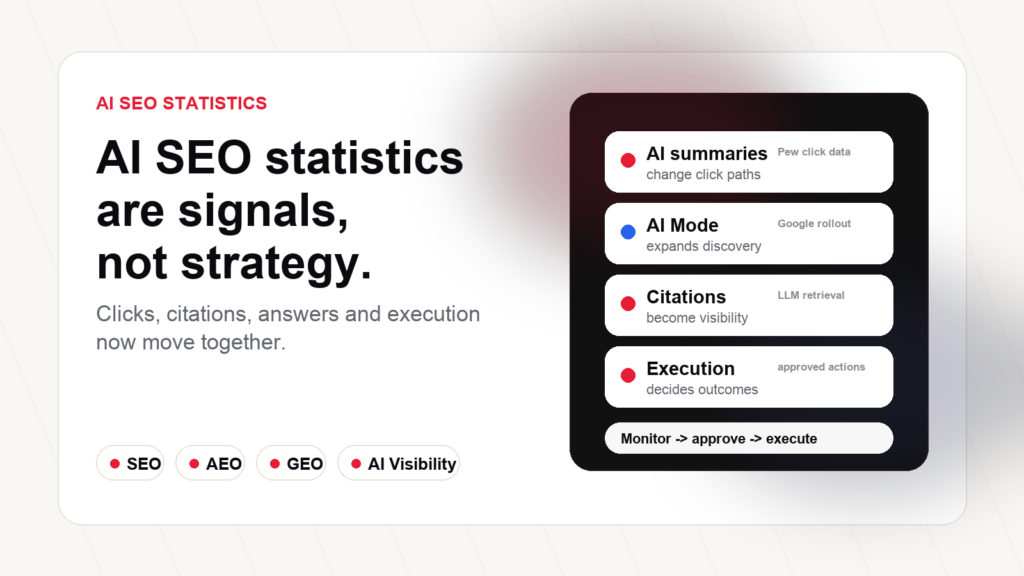
Executive summary: AI SEO statistics are becoming easy to collect and hard to interpret. ChatGPT has reached mainstream scale, Google is expanding AI Overviews and AI Mode, zero-click behavior is rising, AI referrals are growing from a small base, and AI crawlers are already visiting millions of websites. But the important lesson is not “stop doing SEO.” The lesson is: search visibility is moving from ranking-only thinking to a broader operating model built around Crawlability, useful content, Entity Clarity, authority, measurement and execution.
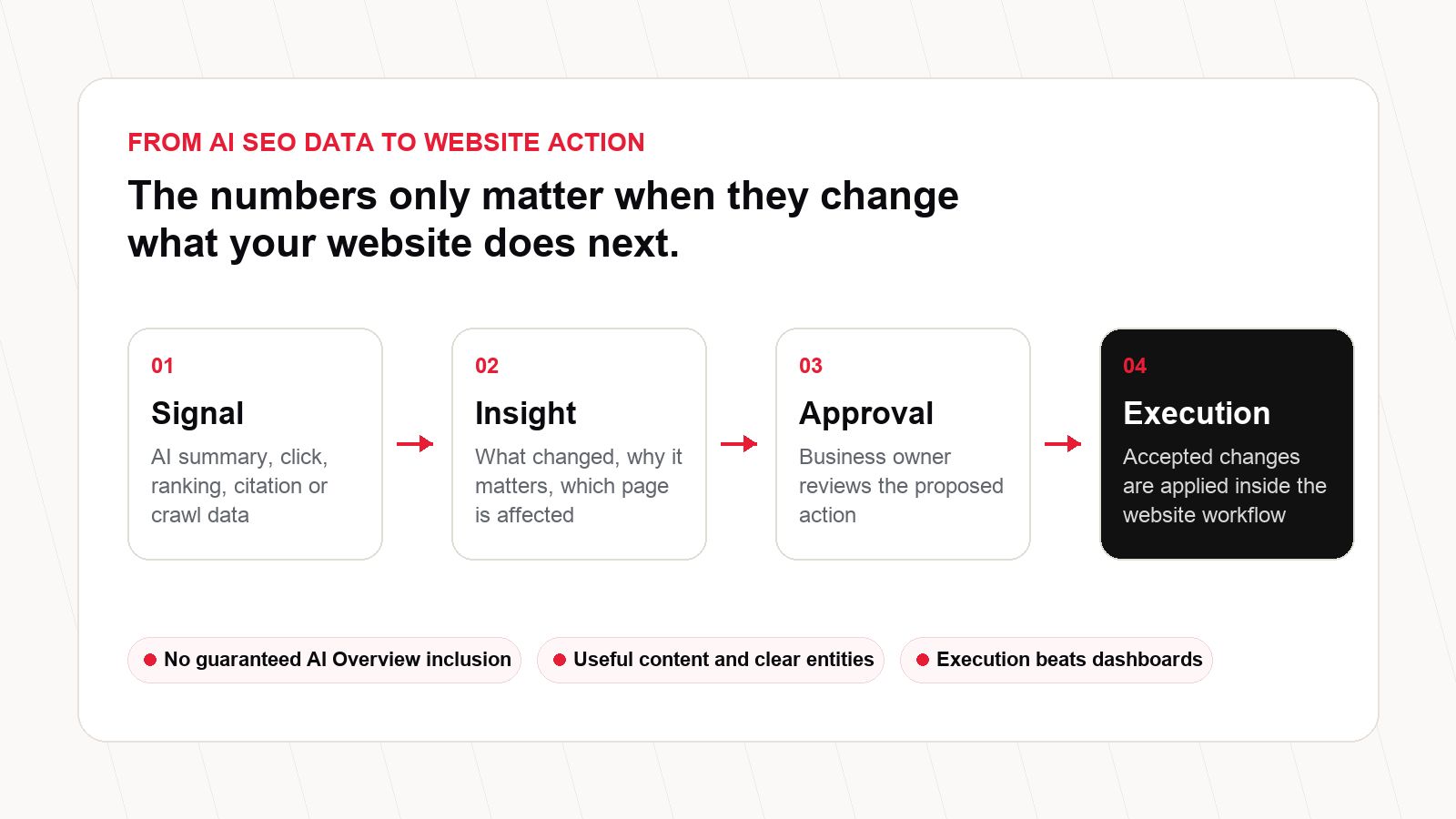
In my opinion, most small and medium-sized businesses do not need another dashboard showing that AI Search is important. They need a system that turns these signals into approved work: monitor what changed, identify the opportunity, prepare the content or technical fix, ask for approval and execute accepted changes inside the website workflow. That is where AYSA fits.
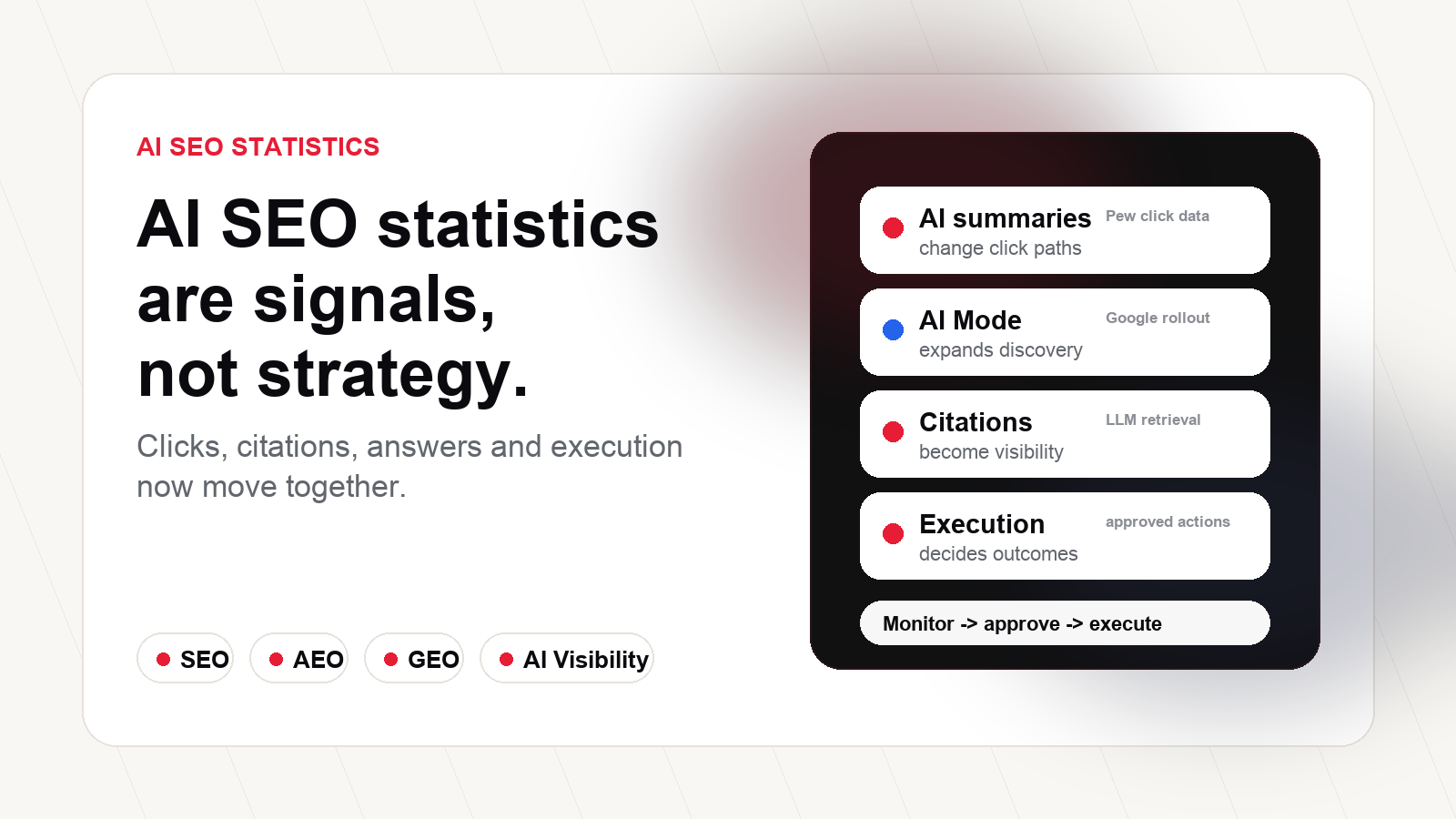
Why AI SEO statistics matter, and why they are easy to misuse
AI search is no longer a niche experiment. It is now part of how people ask questions, compare options, research purchases and decide whom to trust. The numbers are moving quickly: AI-assisted search features are appearing inside Google, ChatGPT has become a mainstream consumer product, AI referrals are showing up in analytics, and AI crawlers are fetching content in ways that look different from traditional search Crawling.
That creates a temptation: build a slide full of statistics, declare that “SEO is dead,” and tell every business to chase a new acronym. I do not think that is useful. The data tells a more practical story. Search is changing, but the work that makes a website visible is still grounded in fundamentals: crawlable pages, useful content, clear entities, structured business information, internal links, authority, page experience and trust.
The difference is speed. In classic SEO, a small business could survive with a slow cycle: audit once, write a few articles, wait, maybe fix technical issues later. In the AI search era, weak information architecture, thin content, messy product data, inconsistent business details and slow implementation become more expensive. AI systems do not reward websites because they use AI buzzwords. They need retrievable, reliable, current and useful information.
So this article is not just a list of AI SEO statistics. It is an interpretation of what those numbers mean for business owners, ecommerce teams, agencies, publishers and non-specialists. The point is to separate signal from noise and turn the data into an execution model.
The AI SEO numbers that matter most in 2026
The most important AI SEO statistics fall into five groups: user adoption, search interface changes, click behavior, AI referral quality and crawl/retrieval behavior. Each group says something different.
User adoption tells us whether AI Search Behavior is large enough to matter. OpenAI’s 2025 research says ChatGPT had 700 million weekly active users at the time of the study, and that many conversations focused on practical guidance, seeking information and writing. That matters because those are search-adjacent behaviors. People are not only asking AI systems to write poems or code. They are asking for help making decisions.
Search interface changes tell us how Google itself is evolving. Google’s AI Mode announcement explains that AI Mode can break a question into subtopics through query fan-out and issue multiple searches on behalf of the user. This changes the shape of optimization. A business may be discovered through a subtopic inside a larger task, not only through a single keyword.
Click behavior tells us whether visibility and traffic are decoupling. Pew Research Center found that, in its March 2025 Google search dataset, users clicked traditional result links less often when an AI summary appeared. This does not mean clicks disappear. It means ranking position alone is no longer the whole visibility story.
AI referral quality tells us whether the traffic that does arrive from AI systems is valuable. Adobe’s 2026 retail data shows that AI traffic to U.S. retail sites grew sharply and converted better than non-AI traffic in March 2026, with higher engagement and longer time on site. That is important for ecommerce and for any SME that treats AI referrals as “small but potentially high-intent.”
Crawl and retrieval behavior tells us how AI systems interact with websites. Search Engine Journal reported on a Duda analysis of 68.9 million AI crawler visits in February 2026. The study found that AI crawling is already happening at scale and is associated with structured business data, content depth and crawl accessibility. The key point is not to chase bots blindly; it is to make the website easier to understand and verify.
Weak reaction
Read AI SEO statistics, panic, publish generic AI content, add a few schema snippets and wait for a ranking miracle.
Useful reaction
Clicks are changing: zero-click search is not a theory anymore
The most uncomfortable part of AI search is the click problem. For years, SEO reporting was built around rankings, impressions, clicks, sessions and conversions. Those metrics still matter. But AI summaries, featured snippets, local packs, shopping units, knowledge panels and answer-style results mean users can receive more information before visiting a website.
Bain’s 2025 research argues that about 60% of searches on traditional search engines now end without the user progressing to another destination site, and that 80% of consumers rely on AI-written results for at least 40% of their searches. These are broad consumer-survey findings, so they should not be treated as exact numbers for every industry. But they clearly indicate a direction: discovery is increasingly mediated by answer surfaces.
Pew’s analysis gives a more specific Google behavior snapshot. In March 2025, Pew analyzed 68,879 unique Google searches from 900 U.S. adults who agreed to share browsing activity. Pew found that about 18% of searches generated an AI summary, and that when an AI summary appeared, users clicked a traditional result link in 8% of visits. When no AI summary appeared, users clicked a search result in 15% of visits. Pew also found that users clicked links inside AI summaries in only about 1% of visits.
This is not a reason to abandon SEO. It is a reason to stop treating clicks as the only proof of visibility. If your brand is mentioned, cited or used as a source in a decision moment, value can be created before the click. The user may come back later through branded search, direct traffic, a referral, a call, a map action, a marketplace, a form or a sales conversation.
For SMEs, the practical implication is simple: keep optimizing for qualified visits, but also measure visibility, brand recall and action. A clinic, florist, parking operator, ecommerce store or SaaS business should care whether AI systems can correctly understand services, location, pricing logic, reviews, availability, product categories and proof. If AI search produces fewer clicks but better-qualified visits, weak analytics will miss the value.
AI Overviews and AI Mode: Google is moving from answers to tasks
Google’s AI Overviews already changed the appearance of many informational results. AI Mode goes further because it is designed as a more conversational and exploratory search experience. Google describes AI Mode as using advanced reasoning and multimodality, and says it uses query fan-out: the system breaks down a question into subtopics and issues multiple queries simultaneously.
This is a major shift for SEO strategy. A user might not search for “best pediatric clinic Bucharest” anymore. They might ask: “I need a private pediatric clinic in Bucharest for a toddler with recurring fever, good reviews, easy parking and online booking. What should I compare?” That query contains location, urgency, service type, trust criteria, logistics and decision support. A single keyword page is rarely enough to satisfy that task.
For AI Mode, the website has to support multiple retrieval paths. A medical clinic needs service pages, doctor pages, location details, appointment information, insurance/payment context, FAQs, review signals, accessibility information and clear medical disclaimers. An ecommerce store needs category depth, product data, shipping, returns, sizing, stock, comparisons and useful guides. A local service provider needs service areas, pricing ranges, proof, process and contact details.
Google’s generative AI optimization guide is careful and useful here. Google says SEO remains relevant because generative AI features are rooted in core Search ranking and quality systems. It also says technical clarity remains central: pages must be crawlable, indexable and eligible to be shown in Search with a snippet. Google also warns against overdoing it by creating excessive pages just to capture every possible fan-out query.
That warning matters. The response to AI Mode should not be mass content spam. It should be better coverage of real customer needs. The goal is not “one page for every possible AI query.” The goal is a website that answers real questions well enough to be useful, cited, recommended or selected.
ChatGPT and answer engines: AI discovery is broader than Google
Google remains central to search, but it is no longer the only place where discovery happens. ChatGPT, Perplexity, Copilot, Claude, Gemini and other AI interfaces have become research assistants, comparison engines and decision-support tools. Users ask them questions that previously belonged to search engines.
OpenAI’s research on how people use ChatGPT is important because it shows the product’s role in everyday decision-making. The study describes three broad usage patterns: Asking, Doing and Expressing. “Asking” represented about half of messages in the study and includes information-seeking and advice. “Doing” represented 40% and includes task-oriented work such as drafting and planning. That mix is directly relevant to SEO because many commercial journeys begin with advice and planning.
For businesses, the question is not only “Do we rank on Google?” It is also: “Can AI systems understand who we are, what we do, why we are trustworthy and when we are relevant?” If a user asks an AI system for SEO automation tools for a WordPress business, pediatric clinics in Bucharest, a florist that delivers in Bragadiru, airport parking near Otopeni or linkbuilding platforms in Romania, the answer engine needs structured, reliable and current information.
Semrush’s article points to another important idea: cited links and business/service websites can matter in AI responses. I would treat that as a direction rather than a guarantee. A company site can be a useful source if it contains clear, credible, non-generic content. But a company site full of thin marketing copy has less value than a well-structured page with actual services, examples, pricing context, FAQs, proof and external validation.
This is where E-E-A-T becomes practical. Experience is not a badge. It is visible evidence: founder story, client examples, original observations, screenshots where appropriate, real use cases, product documentation, transparent limitations and content that explains trade-offs. Expertise is not jargon. It is the ability to explain complex decisions in a way a non-specialist can act on.
AI referral traffic may be small, but it can be high-intent
One of the most interesting patterns in AI SEO statistics is that AI referral traffic can be small in volume but strong in quality. Adobe’s 2026 retail report says AI traffic to U.S. retail sites grew 393% year over year in Q1 2026. Adobe also reported that, in March 2026, AI traffic converted 42% better than non-AI traffic, reversing a previous gap where AI traffic converted worse in March 2025. Adobe’s data also showed higher engagement, longer time on site and more pages per visit for AI-referred shoppers.
This does not mean every business should expect AI referrals to become its main traffic source tomorrow. Adobe’s data is U.S. retail-specific and based on large-scale ecommerce behavior. But it gives us a useful strategic signal: when AI users do click, they may arrive with more context. They may have compared options, clarified intent and narrowed the decision before the visit.
For ecommerce businesses, this changes content requirements. Product pages need to be machine-readable and human-useful. Category pages need context, not only product grids. Return policies, shipping information, sizing, compatibility, reviews and product attributes need to be easy to find. If AI systems cannot read key product or service details, the business may lose visibility before the user ever lands on the website.
For local SMEs, the same logic applies. AI assistants may recommend businesses only when the public information is coherent. Opening hours, service areas, reviews, booking options, price context, parking, location and contact information should be consistent across the website, Google Business Profile, directories and relevant publisher mentions.
Technical SEO is becoming AI visibility infrastructure
Technical SEO is not becoming less important. It is becoming harder to ignore. AI systems still need to discover, crawl, process, interpret and trust content. Google’s guidance states that the way Search finds and processes pages remains the core of how AI systems access data. That is a very important sentence for businesses that think AI visibility is only about writing new content.
AI crawlers add another layer. Search Engine Journal’s reporting on Duda’s dataset described 68.9 million AI crawler visits across 858,457 sites in February 2026. More than half of sites in the dataset received at least one AI crawler visit. The report also noted patterns around structured business data, integrations, Google Business Profile sync, local schema and content depth.
The practical lesson is not “open every bot and hope.” The lesson is: make the website technically clear. Use clean HTML. Avoid blocking important resources. Keep canonical signals consistent. Remove crawl waste. Fix redirects and 404s. Maintain sitemaps. Keep important pages indexable. Use structured data where it matches visible content. Make product, local and service information easy to parse.
Many WordPress websites fail here for boring reasons: plugin bloat, slow themes, duplicate tag archives, broken internal links, image weight, JavaScript-heavy builders, incorrect noindex settings, bad canonical tags, orphan pages and sitemaps full of low-value URLs. These problems hurt classic SEO and AI visibility at the same time.
AYSA’s view is that technical SEO should not stop at an audit. A technical audit is useful only if it becomes prioritized action. If a site has duplicate meta, redirect chains, weak internal links, schema gaps, slow pages or crawl traps, those issues should be converted into approval-ready fixes. The business owner should not need to interpret a 50-page technical report and then chase a developer for three weeks.
Content quality, E-E-A-T and the end of generic AI pages
AI SEO statistics can be dangerous if they push teams into mass publishing. Google’s own guidance warns against creating many pages primarily to manipulate rankings or generative AI responses. This is the right warning. AI search does not make low-quality content safer. It makes it easier to produce, and therefore easier for the web to become flooded with commodity pages.
Quality content starts with a harder question: what would make this page the most useful result for a specific user, at a specific stage of the journey, in a specific market? A page about “best pediatric clinic in Bucharest” should not look like a generic medical directory. It should help a parent compare options, understand when emergency care is appropriate, evaluate trust signals, see logistics such as parking and booking, and decide what to do next. A page about “technical SEO audit” should not only define the term. It should explain checks, risks, examples, prioritization and what happens after issues are found.
This is where E-E-A-T should be made visible. A strong AI-era article should include direct experience, expert interpretation, credible sources, clear limitations, examples and a useful structure. It should not pretend uncertainty does not exist. It should distinguish between data, interpretation and opinion.
For AYSA, E-E-A-T also means showing the operational layer behind the content. We are not writing about AI SEO statistics as abstract observers. AYSA is built to help websites monitor search signals, prepare SEO and AI visibility work, ask for approval and execute accepted changes. That gives us a practical point of view: the winners in AI search will not be the companies that read the most statistics. They will be the companies that execute the right changes consistently.
What should businesses measure now?
The measurement layer has to evolve. If a business still measures only keyword rankings and last-click organic sessions, it will miss part of the AI search story. But it would also be a mistake to invent vanity metrics that sound futuristic and cannot be tied to business decisions.
Start with classic search health: Google Search Console impressions, clicks, click-through rate, average position, indexed pages, crawling issues, query groups and landing pages. These remain essential. Then add AI-era visibility layers: AI Overview presence where measurable, AI referral traffic in analytics, branded search growth, direct traffic, referral quality, assisted conversions, AI crawler activity where server logs allow it, and recurring brand/entity checks in answer engines.
For ecommerce, measure product/category pages that receive impressions but do not convert, product feed completeness, structured data coverage, category content usefulness and AI referral quality. For local businesses, measure Google Business Profile actions, local landing pages, service pages, review growth, local schema completeness, phone/click actions and mentions in relevant sources. For content publishers, measure which informational pages lose clicks but continue to generate impressions, citations, subscriptions or assisted conversions.
Most importantly, measure action history. If you do not know what changed on the website, when it changed and why it changed, you cannot learn from performance. AI search increases volatility. Action history becomes part of SEO intelligence.
Where AYSA fits: from AI SEO statistics to approved execution
AYSA exists because SEO has a practical implementation gap. Traditional tools show reports, scores and dashboards. Agencies can help, but for many SMEs the model is too slow, too expensive or too dependent on manual communication. ChatGPT and Claude can help with ideas, but they are not inherently connected to the website, Search Console, Analytics, Business Profile, action history and approval workflow.
AYSA’s role is different. AYSA learns the business, monitors SEO, AEO, GEO and AI visibility signals, identifies opportunities, prepares work, explains the reason, asks for approval and executes accepted changes inside the website workflow. That is the bridge between statistics and growth.
In practical terms, AYSA can help with the exact themes this article covers: pages that receive impressions but do not answer the query well, missing topics, weak internal links, title and meta improvements, schema opportunities, technical SEO issues, crawl and indexation problems, authority-building opportunities, content plans, local/business profile gaps and AI visibility monitoring.
The important safety principle is approval. AYSA should not blindly publish or buy authority placements without user control. The point is approved automation: the system does the heavy work, but the business remains in control of important actions. That is especially important for SMEs and non-SEO users who want results without becoming SEO specialists.
My opinion is simple: AI search will punish slow execution more than lack of knowledge. Most businesses can already find advice. The hard part is turning advice into consistent action. If AI SEO statistics show anything, they show that search is moving faster than manual workflows can comfortably handle.
Final take: AI SEO is not a new trick. It is a new operating rhythm.
The best interpretation of AI SEO statistics is not fear. It is discipline. AI search adoption is real. Zero-click behavior is real. AI Mode and query fan-out are real. AI referral traffic is becoming measurable. AI crawlers are already interacting with the web at scale. But none of this means fundamentals are obsolete.
The right response is to make the website easier to understand, easier to crawl, easier to cite, easier to compare, easier to trust and easier to update. That means better content, stronger structure, cleaner technical SEO, more complete business data, real authority and faster execution.
For SMEs, the opportunity is large because many competitors will react in the wrong way. They will publish generic AI content, chase hacks, ignore technical debt and measure the wrong things. A business that builds a clear SEO operating system can win attention even in a zero-click and AI-assisted search world.
Less SEO work does not mean less SEO. It means less manual SEO busywork and more approved execution. That is the real opportunity behind the numbers.
Less SEO work. More organic growth.
Turn AI SEO statistics into approved website action.
AYSA monitors your website, prepares SEO, AEO and AI visibility work, asks for approval and executes accepted changes inside your website workflow.
Sources and further reading
This article uses Semrush’s AI SEO statistics roundup as a starting point and cross-checks key themes against source material and industry research: Semrush AI SEO statistics, OpenAI: ChatGPT overview, Google’s guide to optimizing for generative AI experiences, Google’s AI Mode update, Pew Research Center’s study of AI summaries and clicks, Bain’s zero-click search analysis, Adobe’s 2026 AI traffic and retail visibility report, and Search Engine Journal’s coverage of AI crawler visit data. The AYSA sections are our product interpretation and do not claim guaranteed rankings, AI Overview inclusion or answer-engine citation.
Continue the AI search topic inside AYSA.
Use these pages to connect the article with AI SEO tools, AI visibility monitoring, AI Overviews and approved website execution.
Turn this topic into a website action plan.
Use these AYSA hubs to move from reading to technical fixes, AI visibility monitoring, research, glossary context and approval-first SEO execution.

