
Ask Maps Can Now Find Appointments And Call Businesses: The New Local SEO Playbook For “AI Bookings”
Google’s Ask Maps is starting to find appointment availability and even call local businesses on a customer’s behalf. This changes how demand shows up—and how fast you must operationalize listings, booking data, and phone readiness to win AI-driven local conversions.
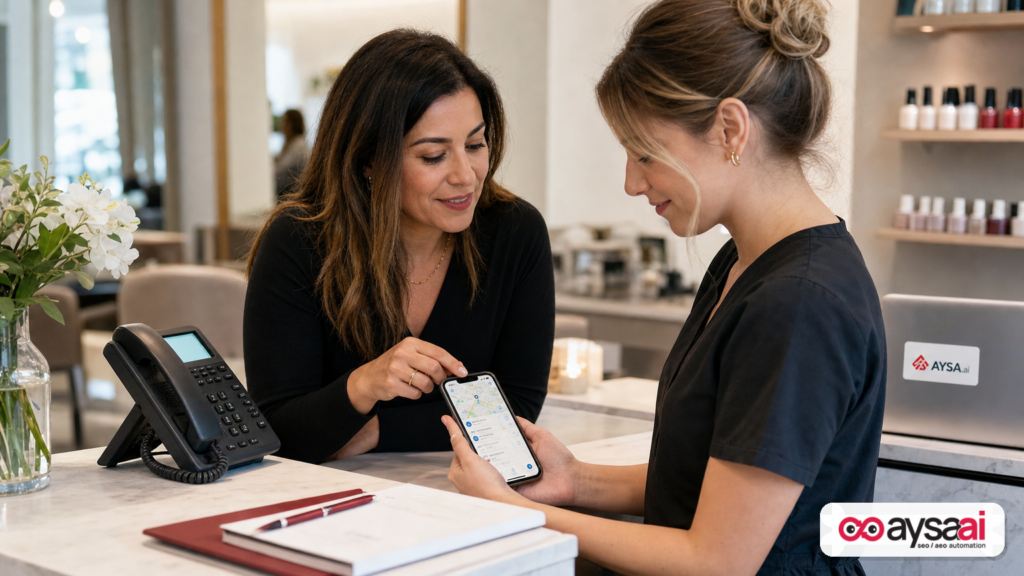
Google is quietly turning Maps into something much bigger than a place to “look up a business.” With new capabilities in Ask Maps (Google Maps’ AI chat experience), Google says it can now find appointment openings online for certain local services—and call businesses on a customer’s behalf to check availability or book.
That’s not a minor UI tweak. It’s a directional change: local search is shifting from recommendations to outcomes. When Google can surface open slots and place calls, the “winner” isn’t only the business with the best photos or the most reviews. It’s the business that can be understood by an AI agent, confirmed quickly by staff, and booked without friction.
I’m Marius Dosinescu, and at AYSA.ai we build systems for SEO/AEO/GEO execution that actually gets done—Monitoring issues, preparing fixes, asking for approval, and then shipping the accepted changes. This update is exactly the kind of moment where execution beats strategy decks. The businesses that operationalize their listings, scheduling, and phone workflows will compound wins. Everyone else will wonder why “traffic is fine” but revenue stalls.
Concise Summary
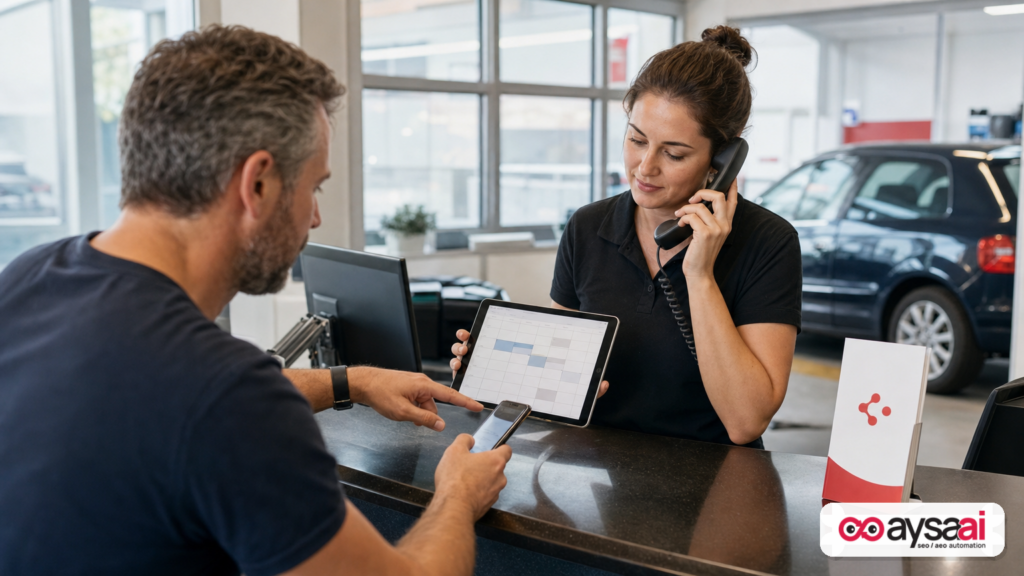
- What changed: Ask Maps is beginning to show appointment openings for select categories and can call businesses for customers to check openings/book.
- Why it matters: The “conversion” may happen inside the AI chat flow, not on your website—and not after a human Clicks “Call.”
- Who’s impacted first: Beauty, pet care, auto, and home repair categories in the U.S. (per Google’s rollout described by Search Engine Journal).
- Big risk: Your marketing can succeed (you get chosen) while operations fail (missed AI call, outdated availability, no booking path).
- What to do: Audit Business Profile settings, booking integrations, Structured data, phone workflows, and measurement—then execute fixes continuously.
Key Takeaways (Read This If You’re Busy)

- Ask Maps is becoming an agent, not a search box. It can take intent (“4 p.m. nail appointment near me”) and do the work of checking availability.
- Local SEO KPIs must expand. Rankings and impressions matter less if you can’t convert AI-driven calls into booked slots.
- Your Business Profile settings are now revenue settings. If Google’s automated calls are off (or mishandled), you may be invisible to AI-led booking workflows.
- Operational readiness is the new moat. The fastest, most reliable booking experience will win—especially when an agent is picking who to contact.
- Execution velocity wins. These systems evolve weekly. If you don’t have a loop to monitor → fix → approve → deploy, you’ll fall behind.
Table of Contents

- What Changed: Ask Maps Becomes An “Appointment Agent”
- How This Likely Works (And What We Can & Can’t Confirm)
- Business Profile Automated Calls: The Setting You Must Review
- This Isn’t Google’s First AI Calling Wave—It’s The Next One
- The Behavior Shift: From “Search Then Choose” To “Ask Then Book”
- The Real Impact: Local Search Isn’t Just Visibility—It’s Operational Readiness
- What Can Go Wrong (And Will)
- The New Local KPIs For AI-Driven Appointments
- A Practical Action Plan For SMEs (With Checklists)
- A Practical SME Scenario: How A Pet Groomer Wins (Or Loses) AI-Driven Bookings
- What Agencies Need To Rethink
- Where AYSA Fits: Always-On Monitoring + Approved Execution For Local Businesses
- What To Do Next
- Sources & Further Reading
What Changed: Ask Maps Becomes An “Appointment Agent”
According to reporting from Search Engine Journal, Google is rolling out new Ask Maps capabilities where the AI chat can:
- Find appointment availability online for select local business categories (beauty, pet care, auto, home repair).
- Call local businesses on a customer’s behalf to check openings and help complete the request.
- Show open slots nearby so the customer can decide what to book—inside the conversation.
This matters because it pushes local search down-funnel. Instead of:
- search → compare → click site → navigate booking → call if needed
…the flow becomes:
- ask → confirm preferences → AI checks availability → choose slot/provider → booking happens (online or by call)
From a business owner’s perspective, you’re now competing inside an AI decision loop, not only on a map grid.
Primary research lead: The feature and rollout details referenced above were covered by Search Engine Journal.
How This Likely Works (And What We Can & Can’t Confirm)
We need to be careful not to invent specifics Google hasn’t published in the provided context. But we can still reason about the moving parts based on what’s described:
1) Inputs: What Ask Maps needs to confidently show availability
To show “open slots,” an agent generally needs at least one of these:
- Direct online booking integration (availability data accessible to Google).
- Third-party booking provider data (a partner feed or integration).
- A phone call outcome (AI calls business, asks for openings, confirms times).
The SEJ source indicates Ask Maps can both look online and call businesses. That suggests a hybrid approach: use online sources when possible, call when needed, and then present options.
2) Selection: How does Ask Maps choose which businesses to call?
The supplied source context notes that when AI calling launched in Google Search, a Google spokesperson said it selected businesses based on “traditional local search rankings” (as described by SEJ). The Ask Maps post doesn’t specify selection logic.
So here’s the practical takeaway: whether it’s “rank-based,” “availability-based,” or “user-preference-based,” the selection will still heavily depend on the signals you already know:
- Business Profile completeness
- Category relevance
- Proximity
- Prominence (reviews, citations, brand demand)
- On-site/local landing page quality
In other words: if you’ve neglected Local SEO fundamentals because you were chasing broader AI search visibility, this update is your reminder that the plumbing still matters.
3) The new “surface area” is the chat itself
Historically, your “surface area” was:
- Your Business Profile panel
- The local pack
- Your website landing page
- Review platforms
Now add:
- The conversational thread where options are proposed
- The agent’s decision about who to call
- The agent’s representation of your availability
That’s why “AEO/GEO for local” isn’t theoretical anymore. You’re optimizing to be chosen and transacted with by an agent.
Business Profile Automated Calls: The Setting You Must Review
SEJ’s write-up points to an important operational control: Google Business Profile includes a setting related to automated calls and text messages for bookings and inquiries. The help documentation (as referenced by SEJ) indicates Google may call a business on a customer’s behalf to complete requests such as booking appointments and confirming service availability.
Even if you don’t remember enabling anything, you should treat this like a critical revenue toggle—because it increasingly is.
What to check immediately
- Is “Bookings and inquiries from customers” enabled? If it’s off, you may be opting out of a growing conversion path.
- Who answers the phone? Many businesses outsource phones, rotate staff, or miss calls during peak hours.
- Do you have a script? Staff should recognize these calls are from Google on a customer’s behalf (SEJ recommended notifying phone staff).
Watch-outs: regional availability and exclusions
The SEJ source indicates the Business Profile help page mentions automated calls availability across most U.S. states with a short list of exceptions. This is exactly the kind of detail that can confuse multi-location brands and franchises.
Practical approach: Don’t rely on assumptions. Confirm what’s enabled per location and document it. If you operate across states, treat each location as its own operational unit.
Note: The supplied context doesn’t include a direct link to Google’s Business Profile help page. Because I can’t cite it as a primary source from the research pack, treat the above as “per SEJ’s reporting” rather than a direct quote from Google documentation.
This Isn’t Google’s First AI Calling Wave—It’s The Next One
If this feels familiar, it should. Google has explored “call businesses for me” for years in different forms. The SEJ source specifically references a 2025 rollout where Google Search let users tap an option like “Have AI check pricing,” triggering calls to local providers and returning quotes by email (again, per SEJ’s reporting).
The key evolution is where the behavior is happening:
- Search: user expresses intent, AI checks, results delivered later (email/quotes workflow).
- Ask Maps: user expresses intent, AI checks, results shown immediately as open slots nearby (a more direct booking loop).
Maps is the natural home for this. People open Maps when they’re ready to go somewhere—or ready to pay.
The Behavior Shift: From “Search Then Choose” To “Ask Then Book”
Local search used to be a two-stage process:
- Discovery: “Find a nail salon near me.”
- Conversion: choose one, then navigate the booking/phone process yourself.
Ask Maps compresses this into one conversational flow where the customer can:
- clarify constraints (time, location, service type)
- see which businesses have openings
- decide faster
That changes consumer expectations. If customers get used to “AI shows open slots,” they’ll become less patient with:
- “Call us to check availability”
- slow callbacks
- vague appointment windows
- booking links that don’t work on mobile
This is the real competitive shift: you’re not only competing with businesses in your category—you’re competing with the best booking experience in your customer’s entire phone.
The Real Impact: Local Search Isn’t Just Visibility—It’s Operational Readiness
Local SEO has always been partly operational: accurate hours, correct phone number, consistent NAP, fast response to reviews. But appointment agents raise the stakes because they make operations a first-class ranking/conversion factor—even if indirectly.
Consider the chain reaction:
- Ask Maps needs businesses it can confidently recommend for a time-based request.
- If one business has reliable, machine-readable availability (or picks up AI calls consistently), it becomes a safer choice.
- That business gets more bookings.
- More bookings often leads to more reviews and brand searches.
- Those signals can further improve prominence.
This is how small operational advantages become durable market advantages.
What local businesses must own now
- Availability truth: whichever calendar is “source of truth” must match what customers can book.
- Phone truth: missed calls are no longer just missed calls—they’re potentially “missed AI conversions.”
- Service truth: services, pricing ranges, and categories must be unambiguous.
- Location truth: service areas, addresses, and hours must be accurate across platforms.
What Can Go Wrong (And Will)
Any time an intermediary agent gets between customers and businesses, new failure modes appear. Here are the ones I’d plan for right now.
1) Missed or mishandled AI calls
If Ask Maps calls your business and no one answers (or staff hangs up because it “sounds automated”), you may lose a booking in seconds.
Mitigation: Train staff. Create a script. Decide who owns appointment confirmations. Set call routing during peak hours.
2) Wrong availability data (and the trust penalty)
If your online booking shows openings that aren’t real—or your staff contradicts what the agent thinks is available—you create a bad customer experience. Even if there’s no explicit “penalty,” customers will blame you, not the model.
Mitigation: One calendar source of truth. Regular audits. Remove dead booking links. Confirm provider integrations.
3) Category and service mismatch
Ask Maps is rolling out by category. If your Business Profile categories are sloppy (or you’re missing primary/secondary categories), you might not be eligible for the appointment flow—or you might get the wrong requests.
Mitigation: Audit categories, services, attributes, and descriptions. Keep it accurate, not aspirational.
4) The measurement gap (you can’t manage what you can’t attribute)
AI-led calls and bookings can create attribution problems:
- the customer didn’t click your website
- the customer didn’t fill a form
- the customer may never see your brand until the last second
Mitigation: Set up call tracking carefully (without breaking NAP consistency), use booking analytics where available, and monitor changes in call volume, direction requests, and booked appointments.
5) Compliance and customer expectations
Some businesses operate in regulated environments (medical, legal). Appointment setting and information exchange may have constraints. Even non-regulated businesses may have policies about recording calls or collecting details.
Mitigation: Define what staff can confirm on a call. Keep scripts compliant. If needed, restrict what gets booked automatically and route to human follow-up.
The New Local KPIs For AI-Driven Appointments
If you still report local success as “we rank #3 for ‘dentist near me’,” you’re going to have awkward QBRs in 2027.
Ask Maps appointment finding pushes us toward conversion-first KPIs that connect marketing to operations.
Must-have KPIs
- Answered call rate (during business hours and peak intent windows)
- Appointment conversion rate (calls → booked slots; chats → booked slots where measurable)
- Time-to-confirm (how fast a slot is confirmed when asked)
- Booking friction rate (drop-offs from booking page; failed booking attempts)
- Availability accuracy (audit samples: shown openings vs. actual)
Leading indicators (early warnings)
- changes in Business Profile actions (calls, website clicks, direction requests)
- review velocity and review sentiment about scheduling (“couldn’t book,” “no one answered”)
- increase in “wrong category” inquiries
Important: The SEJ source links this expansion to AI-driven local discovery and calling. It does not provide measurement guidelines. The KPI framework above is operational analysis meant to help SMEs manage real outcomes.
A Practical Action Plan For SMEs (With Checklists)
Here’s a grounded plan you can run in a week, then maintain monthly. No hype—just execution.
Phase 1 (This week): Protect your ability to receive and convert AI calls
- Audit Business Profile contact info
- primary phone is correct and routed
- hours are accurate (including holidays)
- address/service area is correct
- Check automated call settings
- review any settings related to Google automated calls / bookings & inquiries (per SEJ’s description)
- document current state per location
- Train whoever answers the phone
- they should expect calls from Google on behalf of customers
- they should have a consistent way to provide availability
- Create a minimum call script
- confirm service type
- confirm desired time window
- offer the next 2–3 openings
- confirm booking and next steps
Phase 2 (Next 30 days): Make availability machine-readable and consistent
- Decide your source of truth calendar (one system wins; everything else syncs).
- Fix booking link integrity
- booking link works on mobile
- no dead ends, no forced app installs unless necessary
- service menu matches what you actually offer
- Align services across properties
- Business Profile services
- website service pages
- pricing pages (if you show pricing)
- third-party booking provider categories
- Improve local landing pages
- clear service area and address
- clear “book” CTA
- FAQ content for appointment constraints (duration, prep, policies)
Phase 3 (Ongoing): Monitor, test, and iterate like a revenue system
- weekly: check missed calls, booking failures, and review feedback
- monthly: audit Business Profile fields and booking links
- quarterly: refresh service content and FAQs based on real inquiries
This is where most businesses fail: they do a one-time cleanup and then drift for 12 months. AI-driven local surfaces won’t wait for annual audits.
A Practical SME Scenario: How A Pet Groomer Wins (Or Loses) AI-Driven Bookings
Let’s make this real with a scenario I see constantly.
The business
A single-location pet grooming shop in a mid-size U.S. city. They’re great at grooming. Marketing is “good enough.” They rely on:
- Google Business Profile
- reviews
- a basic website
- calls and texts for bookings
What Ask Maps changes
A customer asks: “Find me a grooming appointment tomorrow after 3 near me.”
Ask Maps can now attempt to find openings online and/or call businesses (per SEJ’s reporting). The groomer is either:
- Option A (wins): set up so availability is consistent, calls are answered, and staff can quickly confirm open slots.
- Option B (loses): misses calls, has no standardized appointment intake, and gives vague answers (“Maybe around 4?”).
The win path looks like this
- Business Profile is complete with correct categories (pet care, grooming) and updated hours.
- Their booking method is consistent (online booking or fast phone booking).
- When called, staff recognizes it’s a Google/customer booking inquiry, confirms service duration, and offers exact times.
- The customer sees a clear opening and books.
The loss path is painfully common
- Call goes to voicemail because it’s peak service time.
- Voicemail doesn’t get checked for hours.
- Customer books elsewhere from the same Ask Maps thread.
The point: you can “do SEO” and still lose because you didn’t do operations. AI agents will expose this gap faster.
What Agencies Need To Rethink
If you serve local clients—especially multi-location—this update forces uncomfortable changes in how you scope and report.
1) Stop selling local SEO as a checklist
Many agency packages are still:
- optimize Business Profile once
- build citations once
- post weekly updates
- send rank reports
That’s not enough when the conversion is mediated by an AI agent that depends on operational signals and real-time availability. The deliverable must be a maintained system, not a one-off service.
2) Agencies must partner with operations
You can’t improve “AI bookings” without:
- front desk training
- call routing
- booking platform decisions
- service catalog accuracy
Agencies that refuse to touch operations will be stuck defending results they can’t control.
3) Reporting must connect marketing to booked appointments
“Impressions up” won’t cut it. You need to report:
- calls answered
- appointments requested
- appointments booked
- quality issues (wrong requests, scheduling complaints)
Even if you can’t attribute every booking perfectly, you can build a directional system that ties local visibility to operational outcomes.
Where AYSA Fits: Always-On Monitoring + Approved Execution For Local Businesses
This is exactly the category of change AYSA.ai is built for: the environment shifts, the details are messy, and the only advantage is consistent execution.
AYSA’s model is simple and practical:
- Monitor what’s changing across your site and visibility signals.
- Prepare the highest-impact fixes (technical, content, local landing pages, structured data, internal links).
- Ask for approval so your team stays in control.
- Execute the accepted changes so improvements actually go live.
When Ask Maps introduces appointment availability and calling, the work isn’t “one magic optimization.” It’s a pipeline of small, compounding fixes:
- updating service pages and FAQs to match real appointment constraints
- fixing broken booking links and CTAs
- improving local landing pages for each location/service
- keeping structured data clean and consistent (where applicable)
- monitoring content drift and outdated business details
If you want the practical overview of how we approach modern AI search visibility, start here: AI Search Visibility.
Then explore our tool approach: AI SEO Tools.
And the core system—continuous oversight and alerts—lives here: AYSA Monitoring.
If you’re evaluating whether this kind of execution loop is worth it versus adding another dashboard, pricing is transparent: AYSA Pricing.
For more editorials like this as AI changes search behavior, see our blog: AYSA Blog.
What To Do Next (Action List)
- Open your Google Business Profile settings and review anything related to automated calls, bookings, and inquiries (as referenced by SEJ).
- Run a “mystery shop” internally: call your business during peak hours and measure time-to-answer and booking success.
- Standardize a call script and train staff to handle Google/customer booking calls quickly and consistently.
- Audit your booking experience on mobile (from Business Profile to booked slot). Fix dead ends immediately.
- Align services and categories across Business Profile, your website, and any booking providers.
- Upgrade your KPI dashboard from “rankings” to “appointments booked, calls answered, time-to-confirm.”
- Implement continuous monitoring + execution so you’re not reacting months late. If you want an approved-execution system, evaluate AYSA’s approach at AYSA Monitoring.
Looking Ahead: Why This Is Bigger Than Appointments
In the SEJ source, Ask Maps appointment finding starts in the U.S. and Ask Maps expands across parts of Europe. Google also suggested more regions are coming soon (with no dates named in the provided context). That pattern matters: once Google proves the workflow for a few categories, expansion tends to follow.
Here’s the strategic bet I’d make as an operator:
- Today it’s beauty/pets/auto/home repair.
- Tomorrow it’s more service categories.
- Then it’s inventory checks, reservations, quotes, and “hold this slot.”
If you run a local business, you should assume AI agents will increasingly mediate your demand. The only sane response is to build a system where your business data, availability, and customer intake are consistently understandable and actionable.
Sources & Further Reading
- Search Engine Journal: Google’s Ask Maps Starts Finding Appointments & Calling Businesses
- Search Engine Journal: Local SEO coverage (research lead)
- Search Engine Journal: AI Search coverage (research lead)
- AYSA.ai: AI Search Visibility
- AYSA.ai: AI SEO Tools
- AYSA.ai: Monitoring
- AYSA.ai: Pricing
- AYSA.ai: Blog
Note on sourcing: The supplied research context summarizes Google’s announcements and Business Profile call settings via Search Engine Journal. The context does not provide direct links to Google’s official posts or help documentation pages. Where details depend on those pages, I’ve treated them as “per SEJ reporting” rather than presenting them as primary-source citations.
Continue the AI search topic inside AYSA.
Use these pages to connect the article with AI SEO tools, AI visibility monitoring, AI Overviews and approved website execution.
Turn this topic into a website action plan.
Use these AYSA hubs to move from reading to technical fixes, AI visibility monitoring, research, glossary context and approval-first SEO execution.