
People Use AI, But Don’t Trust It: The Content & SEO Playbook For Winning In The Credibility Gap
Your customers are using AI assistants weekly—even when they’re worried about privacy, accuracy, and over-reliance. Here’s how to build content that earns trust, shows up in AI-powered discovery, and converts skeptics with transparent sourcing, clear product limits, and execution you can actually ship.

AI is now a default layer between your customer and your website. But here’s the part most businesses still miss: AI adoption doesn’t equal AI trust. People will use chatbots, AI Search, and AI shopping assistants while simultaneously worrying about privacy, accuracy, and over-reliance.
That contradiction is not a temporary phase—it’s the new baseline. And it changes what “good SEO” means. Not because keywords stopped mattering, but because credibility, verifiability, and clear limits now determine whether AI-mediated discovery turns into revenue.
In this editorial, I’ll lay out a practical playbook for building content that performs inside AI answers and reassures skeptical buyers. I’m writing from the perspective of building systems that execute—not just advise—because in 2026, the biggest risk isn’t “not knowing,” it’s “not shipping.” AYSA is designed to close that gap: it monitors your search presence, prepares recommended updates, asks for approval, and executes accepted changes on your website.
Concise summary
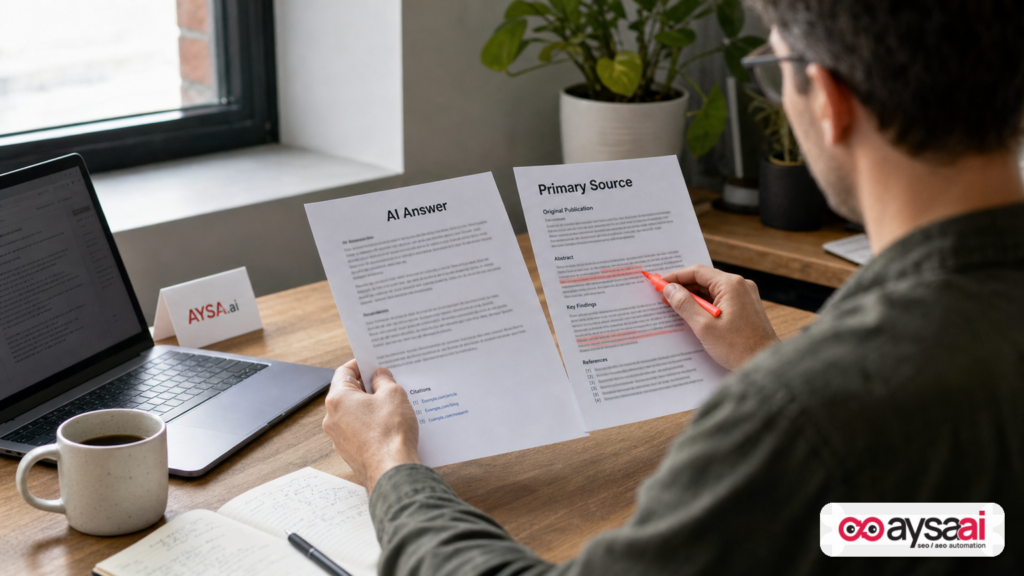
Your audience may use AI weekly while still distrusting it. The opportunity is to build content for the gap: segment by AI usage frequency, publish content with easy-to-check sourcing, add trust modules (policies, limitations, methodology), and measure outcomes that prove trust (qualified leads, sales conversations, refunds, support load). AI-era SEO is less about “writing for bots” and more about making truth easy to verify for humans—and easy to cite for machines.
Key takeaways

- Don’t treat AI usage as a vote of confidence. Many users rely on AI tools while remaining wary of outputs.
- Segment your content strategy by AI usage frequency. Daily/weekly AI users need fast verification; non-users need education and reassurance.
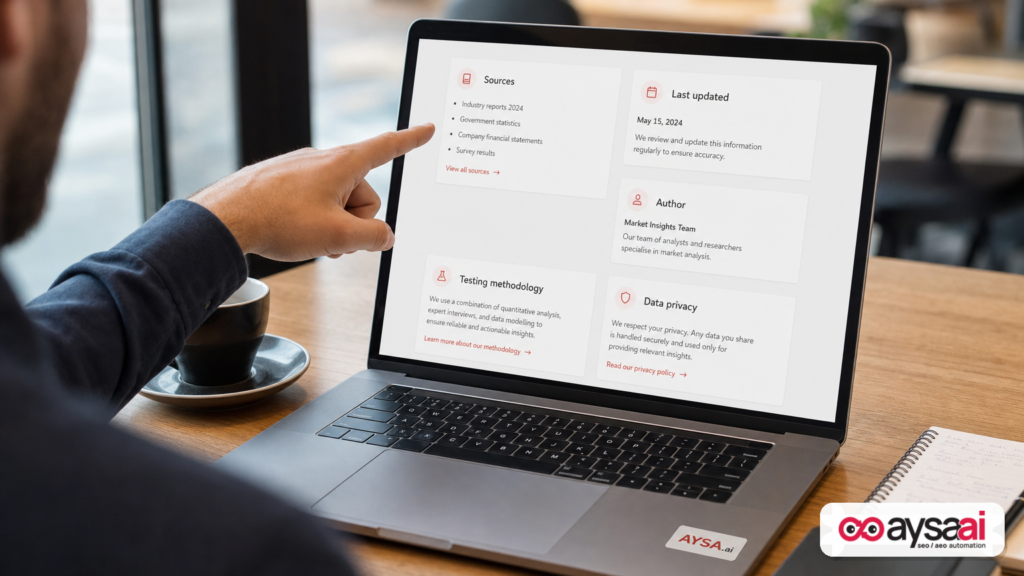
- Make “checking” frictionless: primary-source links, author names, dates, update logs, and clear definitions.
- Say what your product can’t do. Clear limits can increase qualified conversions in a skeptical market.
- Optimize for AI citation and human trust at the same time. That’s AEO/GEO in practice, not theory.
- Execution is the moat. If you can’t reliably ship improvements, you’ll lose to businesses that can.
Table of contents
- The New Reality: AI Adoption Is Not The Same As AI Trust
- What Changed In Search (And Why This Hits SMEs Hard)
- Segment Your Audience By AI Usage Frequency (Before You Write A Single Page)
- Trust Signals That Work In AI-Mediated Discovery
- Content Architecture For The Trust Gap: Pages, Modules, And Proof
- The Underrated Conversion Lever: Stating Product Limits
- AEO/GEO Without The Hype: How To Be Citable
- Measurement: How To Prove You’re Earning Trust (Not Just Clicks)
- A Practical SME Scenario: Ecommerce Brand Competing In AI Shopping Answers
- What Agencies Must Rethink: From Deliverables To Outcomes To Execution
- Where AYSA Fits: Monitoring → Recommendations → Approval → Execution
- What to do next (action list)
- Sources and further reading
The New Reality: AI Adoption Is Not The Same As AI Trust
A useful way to describe today’s market is: people use AI because it’s convenient, not because it’s credible. AI is embedded into tools they already use, which means AI-mediated discovery happens even when the user didn’t explicitly choose “AI.” That’s a major shift from the older search model where the user intentionally went to a search engine, typed a query, and evaluated a list of links.
This editorial is inspired by reporting and commentary published by Search Engine Journal on the “use vs. trust” gap, referencing analysis of YouGov and Pew Research data and broader cultural coverage (MIT Technology Review) on the public’s ambivalent relationship with AI. See: Search Engine Journal: “Your Audience Uses AI But Doesn’t Trust It – Build Content For The Gap”.
What matters for business owners isn’t the sociology of AI. It’s this operational truth:
- Your prospects will encounter summaries about your brand, your product category, and your competitors that you did not write.
- Some of those summaries will be wrong, incomplete, or missing key context.
- Even when they’re accurate, many users will still doubt them. That doubt delays purchase decisions and increases the burden of proof on your website.
So the job of content isn’t simply “rank.” It’s to shorten the distance from AI exposure to confident action. Confidence comes from evidence, clarity, and consistency—not from louder marketing language.
What Changed In Search (And Why This Hits SMEs Hard)
Search didn’t suddenly become “AI search.” It became AI-mediated discovery: AI layers that summarize, recommend, compare, and answer—often before the click.
For years, SEO advice focused on two challenges:
- How to get discovered (rankings, visibility, distribution)
- How to convert (copy, UX, offers, trust, pricing, friction)
AI compresses the journey and blurs the boundary between those two. Now, your “discovery” happens via an AI summary—and the credibility test begins immediately because users know (or suspect) AI can hallucinate or omit. This creates a paradox: AI increases speed, while skepticism increases the need to verify. Users want fast answers and strong proof at the same time.
SMEs feel this more than enterprise brands for three reasons:
- Less brand inertia. Big brands can survive ambiguity because they already have trust equity. SMEs must earn it page by page.
- Less content redundancy. Enterprises often have multiple assets that AI can pull from (press, Wikipedia pages, third-party reviews, documentation). SMEs may only have a few thin pages.
- Execution constraints. SMEs know what they should fix—but lack time, staff, or a reliable system to ship changes consistently.
This is why I believe “AI-era SEO” isn’t a creative writing challenge. It’s a systems challenge.
Segment Your Audience By AI Usage Frequency (Before You Write A Single Page)
One of the most actionable ideas from the SEJ piece is simple: usage frequency splits your audience into camps. If you average them together, you get a misleading “meh” signal—when the reality is polarization.
Even without adding new statistics here, you can apply the principle immediately:
- Daily/weekly AI users tend to want fast validation: “Show me proof. Give me the source. Make it easy to confirm.”
- Monthly/rare AI users often need reassurance and education: “Explain this clearly. What does it mean? Is this safe?”
- Non-users/skeptics may be sensitive to manipulation: “Don’t oversell. Don’t hide the downsides. Tell me what’s real.”
How to segment in practice (SME-friendly)
You don’t need a PhD study. Add one question to your lead form, onboarding flow, post-purchase survey, or customer interview script:
- “How often do you use AI tools (ChatGPT, Gemini, Copilot, Perplexity, etc.) for research or work?” (Daily / Weekly / Monthly / Rarely / Never)
Then do one thing most teams skip: cut every result by frequency.
- What objections show up in each camp?
- Which words do they use?
- What proof do they ask for?
- How long is their decision cycle?
What you build from the segmentation
Segmentation isn’t just “different ads.” It should change your site structure:
- AI-native landing page paths for fast evaluators: comparisons, methodology, citations, “why trust this,” pricing, policies.
- AI-skeptic landing page paths that start with basics: definitions, use cases, human support, safety, guarantees, non-AI alternatives.
If you try to make one page do both jobs, you’ll likely fail both audiences: too slow for power users, too abstract for skeptics.
Trust Signals That Work In AI-Mediated Discovery
In the pre-AI era, “trust signals” often meant logos, testimonials, star ratings, and polished design. Those still help. But the trust gap introduced by AI has a different texture: it’s about verifiability.
When your audience worries about accuracy, data privacy, and corporate motives (themes highlighted in the SEJ article’s discussion of survey findings), your content needs to answer: “How do I check this?” and “What happens if I rely on this?”
The cheapest trust signals you can add this week
- Primary-source links for factual claims. If you cite a statistic, link to the original publisher, not a chain of blogs.
- Named author + credentials. Not “Admin.” A real person with accountability.
- Publish dates and “last updated” dates. With meaningful updates, not fake refreshes.
- Clear definitions. If your industry uses jargon, define it inline.
- Privacy and data handling explanation where relevant (especially if you use any AI features).
These elements help humans trust you, and they also make your content more “citeable” for systems that look for grounded statements.
When you can’t link a primary source
Sometimes you can’t. Maybe the data is proprietary. Maybe the claim is experiential. In that case, don’t bluff. Use language like:
- “Based on our internal support tickets…”
- “In our experience across client sites…”
- “We can’t publicly share the dataset, but here is the method we used…”
That honesty is a trust signal by itself. The goal isn’t to look omniscient. The goal is to be auditable.
Content Architecture For The Trust Gap: Pages, Modules, And Proof
“Write better content” is not a strategy. Structure is a strategy. If you want to win in AI-mediated discovery, your site needs repeatable content modules that answer the same trust questions across pages.
The core modules I recommend for most SMEs
Think of these as reusable blocks:
- What this is / who it’s for (plain English)
- What it is not (limits; avoids overpromising)
- How it works (high-level process; no secrets required)
- Proof (case studies if you have them; otherwise methods, examples, credentials)
- Sources / methodology (especially for guides and comparisons)
- Pricing / ranges (or a clear “how pricing works” explanation)
- Policies (returns, cancellations, SLAs, support hours)
- FAQs that reflect real objections (not fluffy questions)
For AI visibility, FAQs are especially useful—not because “FAQ schema is magic,” but because FAQs force you to write in natural language questions that resemble what users ask AI tools.
Avoid the thin-content trap
When teams chase AI visibility, they often crank out dozens of shallow pages. That usually backfires because:
- Users don’t trust thin pages.
- AI systems prefer grounded, specific sources to cite.
- Maintenance becomes impossible (stale content destroys trust).
A better model: publish fewer pages, but make them deeply complete and modular so you can maintain them.
The Underrated Conversion Lever: Stating Product Limits
Most marketing teams are trained to avoid talking about limitations. In a high-trust environment, that might work. In a low-trust, AI-mediated environment, it often fails.
Why? Because skeptical buyers already assume you’re overselling. If you never acknowledge trade-offs, you confirm their suspicion.
The SEJ piece suggests testing landing pages that clearly state what an AI-powered product can’t do versus pages that promise everything. That’s the right instinct. Here’s how to operationalize it without self-sabotage.
How to state limits without killing conversions
- Put limits in a “fit” section, not as a disclaimer at the bottom.
- Frame limits as selection guidance: “This is a fit if… / not a fit if…”
- Offer a path forward: alternative plan, consultation, or workaround.
Examples (copy patterns you can adapt)
- SaaS: “Our AI suggestions speed up drafts, but you still approve every change before it goes live.”
- Clinic: “This guide is educational, not medical advice; we encourage you to discuss symptoms with a licensed clinician.”
- Agency: “We don’t guarantee #1 rankings; we guarantee a clear plan, measurement, and consistent execution.”
Notice the theme: accountability. Limits paired with accountability build trust.
AEO/GEO Without The Hype: How To Be Citable
AEO (Answer Engine Optimization) and GEO (Generative Engine Optimization) are trendy terms, but the practical goal is timeless: be the source that gets cited.
To do that, your content needs:
- Clear claims (not vague adjectives)
- Supporting evidence (sources, methodology, examples)
- Unambiguous entities (product names, locations, services, people)
- Consistent definitions across pages
Write in citable formats
AI systems and humans both prefer content that’s easy to extract and verify. Formats that work:
- Step-by-step processes with clear headings
- Comparison tables (with explicit criteria)
- Checklists (what to verify, what to ask)
- Short definitions (one-sentence explanations at the top)
- Q&A blocks based on real customer questions
AI-agnostic optimization still matters
One of the most stable strategies in a shifting landscape is topical authority: build a coherent cluster of content that demonstrates real expertise, not isolated posts that chase keywords.
This is “AI-agnostic” because it helps regardless of interface changes. Whether the user gets ten blue links, an AI overview, or an agentic shopping assistant, strong topical coverage increases the chance you’re included, cited, or clicked.
If you want more on AI-era visibility at the system level, see AYSA’s overview: AI search visibility.
Measurement: How To Prove You’re Earning Trust (Not Just Clicks)
When skepticism rises, vanity metrics get more dangerous. Traffic can go up while revenue stays flat—especially if AI answers satisfy curiosity without driving intent.
So what should you measure?
Outcomes that indicate trust (and business health)
- Qualified leads (not just form fills—leads that match your ICP and budget)
- Sales conversations booked and show-up rates
- Checkout conversion rate for ecommerce
- Refunds/returns (overpromising often increases returns)
- Support ticket volume and themes (unclear content creates tickets)
- Branded search trends (a proxy for real-world interest)
Content tests worth running
- Limits vs. hype copy test: Does a transparent “not a fit if” section increase qualified conversions?
- Sources module test: Does adding primary-source citations increase time-on-page and lead quality?
- FAQ objection test: Does adding “hard questions” reduce support tickets and increase conversions?
- Author credibility test: Does a real author bio improve conversion on informational pages that feed bottom-funnel behavior?
The theme: you’re not testing “AI.” You’re testing confidence.
To keep this sustainable, you need monitoring that tells you when performance shifts and what changed. AYSA’s monitoring layer is built for that: Monitoring.
A Practical SME Scenario: Ecommerce Brand Competing In AI Shopping Answers
Let’s make this concrete with a realistic SME example.
Scenario: You run a small ecommerce brand selling premium ergonomic office chairs. You’re not a household name. Your customers research intensely because the purchase is expensive and comfort is subjective.
The old path: User searches “best ergonomic chair for back pain,” reads articles, clicks product pages, compares specs, then buys.
The new path: User asks an AI assistant, “Which ergonomic chair is best for tall people with lower back pain under $600?” The assistant summarizes a few brands, maybe mentions yours, and the user arrives on your site already skeptical: “Is this recommendation real? Is this brand legit? Will it fit me? What’s the return policy?”
What breaks on most SME product pages
- Specs are copied from a manufacturer sheet, not written in shopper language.
- Fit guidance is missing (height ranges, desk setups, body types).
- Returns and warranties are hidden in the footer.
- Claims are unverified (“best,” “top,” “#1”) without sources or context.
- No comparison help (users bounce back to AI or competitors).
What to build instead (a trust-first product page system)
- “Best for” section: tall users, long workdays, petite frames, etc.
- “Not ideal for” section: be honest (e.g., “If you need a headrest, choose another model”).
- Measurement guide: how to measure inseam/seat height, desk height, etc.
- Policies up front: shipping timelines, returns, warranty—no hunting.
- Comparison table: your models vs. each other, with criteria that match real questions.
- FAQ based on objections: “Is assembly difficult?”, “What if it hurts after a week?”, “Do you share data if I use your sizing quiz?”
This isn’t “SEO fluff.” It’s conversion infrastructure for a skeptical buyer journey that starts inside AI.
What Agencies Must Rethink: From Deliverables To Outcomes To Execution
If you’re an agency (or a consultant), the AI trust gap changes the client relationship. Clients will ask:
- “Why did traffic go down if rankings look okay?”
- “Why are we not mentioned in AI answers?”
- “Why do we get more leads but worse quality?”
The answer is often that the journey is fragmented across AI layers, and trust is being evaluated earlier. Which means agencies must shift from:
- Deliverables (X blog posts per month)
- to systems (monitor → identify gaps → ship improvements → measure trust outcomes)
Execution becomes the differentiator. Strategy decks don’t update websites. And in the AI era, stale content is a trust liability.
Where AYSA Fits: Monitoring → Recommendations → Approval → Execution
Most businesses don’t fail because they lack ideas. They fail because they can’t consistently execute improvements across dozens (or hundreds) of pages while keeping stakeholders aligned and risk controlled.
That’s the niche AYSA is built for: approved execution.
The AYSA workflow in the context of the trust gap
- Monitor what matters: visibility in AI-influenced search, content performance shifts, and page-level opportunities. (See Monitoring.)
- Prepare recommended changes: add missing FAQ blocks, strengthen sourcing modules, clarify product limits, improve internal linking, clean up thin sections.
- Ask for approval: humans stay accountable. Nothing risky “auto-ships” without signoff.
- Execute accepted website changes reliably—so the strategy actually becomes reality.
If you want to see the tooling side, start here: AI SEO tools. If you want to understand how this connects to modern discovery, explore: AI search visibility.
What AYSA is not (and why that matters)
AYSA is not “push-button content spam.” The AI era punishes that approach because distrust is already high. Instead, AYSA supports a practical operating model: monitor reality, propose improvements, get approval, then ship—and repeat.
For teams evaluating whether this is a fit, pricing is transparent: AYSA pricing. For ongoing education, visit the AYSA blog.
What to do next (action list)
- Add one segmentation question (AI usage frequency) to a survey, form, or onboarding flow.
- Audit your top 10 revenue-driving pages for verifiability: sources, dates, author, definitions, policies, limits.
- Ship a “What we don’t do / not a fit if” module on one landing page and A/B test it against your current version.
- Build one comparison asset (table + criteria) that matches how customers ask questions.
- Upgrade FAQs from fluffy to objection-driven; use support tickets and sales calls as inputs.
- Set measurement beyond traffic: qualified leads, conversion rate, returns, support tickets, sales cycle length.
- Implement a repeatable execution cadence—weekly or biweekly—so improvements don’t stall.
Sources and further reading
- Search Engine Journal – Your Audience Uses AI But Doesn’t Trust It – Build Content For The Gap
- Search Engine Journal – AI Search category
- Search Engine Journal – SEO category
- Search Engine Journal – Technical SEO category
- Search Engine Journal – Local SEO category
- Search Engine Journal – Links & PR category
- Search Engine Journal – Google Updates timeline
- SEJ webinar landing page – How AI Shopping Agents Choose Products
Note on primary sources: The SEJ article references YouGov, Pew Research Center, and MIT Technology Review, but those direct URLs were not included in the supplied research context here. Where you rely on those datasets for business decisions, I recommend linking directly to the original publishers in your own content once you’ve located the primary pages.
Continue the AI search topic inside AYSA.
Use these pages to connect the article with AI SEO tools, AI visibility monitoring, AI Overviews and approved website execution.
Turn this topic into a website action plan.
Use these AYSA hubs to move from reading to technical fixes, AI visibility monitoring, research, glossary context and approval-first SEO execution.