
ChatGPT Search + Cloudflare Signals: What “Discovery” Means For Your SEO, Your Crawl Budget, And Your Revenue
Cloudflare says network-level signals helped OpenAI discover and index hundreds of millions of new pages for ChatGPT search. That’s not just a crawler story—it’s a distribution story. Here’s what changed, why it matters for SMEs and agencies, and what to do now to be discoverable, citable, and measurable in AI search.

Cloudflare says a research pilot using network-level signals helped OpenAI discover and index hundreds of millions of new pages for ChatGPT search. That single line—discover and index—is the headline, but it’s not the real story.
The real story is this: AI Search engines are shifting from “crawl what we already know exists” to “use signals closer to real user traffic and real web change” to decide what to go find. And if your business relies on search—local leads, ecommerce revenue, B2B pipeline, publisher traffic—this changes what “SEO” means in practice.
I’m Marius Dosinescu, and at AYSA.ai we build systems that don’t just recommend SEO/AEO/GEO improvements—they monitor, prepare the work, ask for approval, and execute accepted changes. This Cloudflare + OpenAI development is exactly the kind of change that turns SEO from a quarterly project into an always-on operations function.
Concise summary
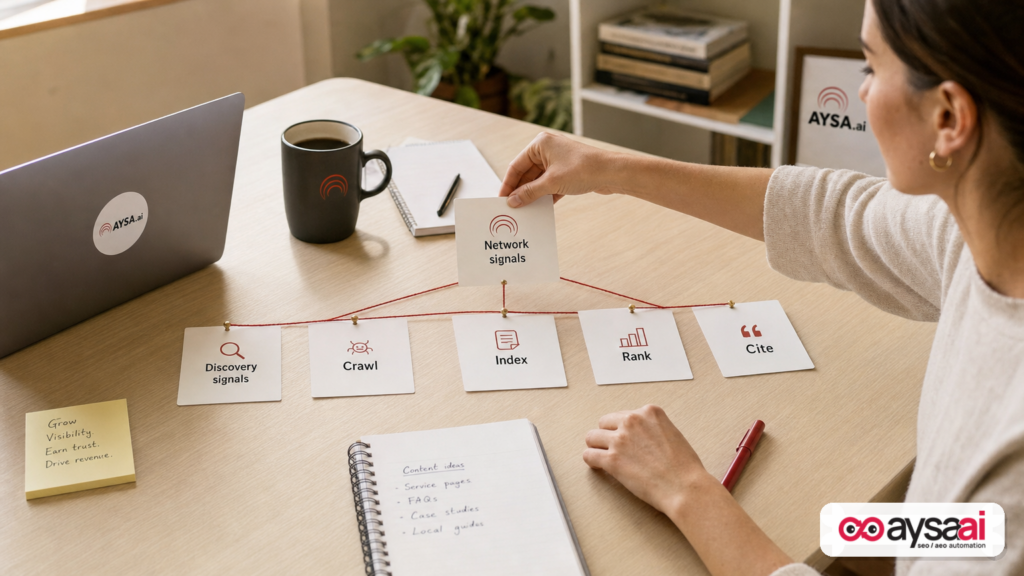
- What changed: Cloudflare reports that network signals from a pilot cohort helped OpenAI discover and index many new pages for ChatGPT search, and helped avoid wasteful Crawling (dead URLs, duplicates, pages that haven’t changed). Source: Search Engine Journal coverage.
- Why it matters: AI search visibility begins at discovery, not ranking. Pages with few links (manuals, menus, fees, policies, product support) can be valuable if they’re fresh, accessible, and clearly structured.
- What doesn’t change: Permissions still apply. A signal doesn’t override
Robots.txtor your crawler-blocking settings; access is still controlled by site owners. - What to do: Fix crawl traps and dead ends, build “AI-citable” page formats, separate your stance on “search crawling” vs “training crawling,” and measure AI referrals with disciplined analytics.
- Where AYSA fits: Continuous Monitoring + Approved Execution: detect issues and opportunities, propose fixes, get stakeholder approval, ship changes, and track AI search visibility outcomes. See: AI Search Visibility and Monitoring.
Key takeaways for operators

- Discovery is now a competitive layer. If AI systems learn “this page exists and changes,” you get a seat at the table earlier.
- Indexing is not citation. Getting crawled and indexed doesn’t guarantee you’ll be referenced in ChatGPT answers.
- Crawl efficiency becomes a business KPI. Dead URLs, redirect-everything patterns, and duplicate parameter pages aren’t just “technical SEO sins.” They’re AI visibility taxes.
- Permissions are strategy. You can allow AI search access while restricting training access—depending on your risk tolerance and business model.
- Measurement needs discipline. If AI referrals arrive inconsistently labeled, you need a monitoring system that doesn’t depend on “perfect referrers.”
Table of contents
- Context: why Cloudflare is now part of the search conversation
- What changed: from “crawl the web” to “discover through network signals”
- What network signals likely do (and don’t do)
- Crawl efficiency: dead URLs, redirect patterns, duplicates, and change detection
- Robots.txt, permissions, and the misunderstood split between search and training
- The new reality: “Being indexed” and “being cited” are not the same job
- Business implications: what SMEs should care about (not just SEOs)
- The SME scenario: a local clinic, an unlinked policy page, and a missed citation
- Agency reset: what to change in deliverables, reporting, and contracts
- Monitoring and measurement: proving outcomes in AI search
- Action plan: a practical 30/60/90-day execution roadmap
- Where AYSA.ai fits: monitoring + approved execution for AI search
- What to do next (checklist)
- Sources and further reading
Context: why Cloudflare is now part of the search conversation
For most business owners, “search” has meant one company for the last decade: Google. You optimize pages, earn links, keep your site fast, and hope you show up. Even if you’ve paid attention to Bing, you’ve mostly treated it as a secondary channel.
AI search breaks that single-lane model. Now, discovery and citation can happen inside products that feel less like a search engine and more like a conversation—ChatGPT being the obvious example.
Cloudflare enters the conversation because it sits on a large portion of the web’s delivery infrastructure—CDN, security, bot management, edge caching, and performance. When an infrastructure provider can surface “this page changed” or “this path returns 404 repeatedly” signals, it can help crawlers decide:
- What new URLs are likely worth testing
- Which URLs are dead ends and can be ignored
- Which pages changed recently (and should be re-fetched)
- Which patterns look suspicious or harmful
According to Search Engine Journal’s reporting on the pilot, Cloudflare and OpenAI described early results: OpenAI discovered and indexed hundreds of millions of new pages, and the signals helped reduce unnecessary crawling while still expanding coverage. Read the coverage here: ChatGPT Search Can Draw On More Pages After A Cloudflare Pilot.
There are two important operator caveats from the same reporting:
- A signal doesn’t grant permission. Your access controls still win.
- OpenAI ranks pages independently. Discovery is not favoritism; it’s a broader input set.
What changed: from “crawl the web” to “discover through network signals”
Traditional crawling is expensive. Crawlers maintain URL queues, revisit known pages, try sitemaps, follow links, and attempt to infer what’s new. It’s a constant tradeoff between coverage and cost.
What the Cloudflare pilot implies is a step-change in the first phase: discovery. Not “how do we rank what we already crawled,” but “how do we find pages worth crawling in the first place?”
In the SEJ summary of Cloudflare’s post, network signals helped OpenAI find pages that are useful even if few other sites link to them—examples included product user guides, passport requirements and fees, and restaurant menus and hours.
That detail matters because it calls out a long-standing SEO gap: many of the pages that customers need most are not the pages that get links.
- Support docs rarely attract links.
- Fee schedules don’t go viral.
- Hours, menus, and policies are utilitarian.
Yet those pages are precisely what AI assistants want to quote because they answer questions directly. If discovery improves, more of those pages enter the candidate set.
The implication for your business: you’re no longer competing only on “rank for a keyword.” You’re competing to be included in the assistant’s world model of what exists and what’s current.
What network signals likely do (and don’t do)
Let’s be precise: neither SEJ’s coverage nor the excerpted material gives a full spec of the signals, who opted in, or exactly how the data is transmitted. We should not pretend we have that detail.
But we can still reason operationally from what’s described.
Probable “discovery” and “refresh” signal categories
SEJ’s recap references signals related to:
- How recently a page has been updated
- The quality of traffic to a website
- What updates have actually been made to a page (at least in concept)
- Change signals that indicate whether revisiting is worthwhile
- Potentially harmful page flags (example: a malicious login form on one URL)
From an operator viewpoint, these signals don’t need to be “ranking factors” to matter. They influence allocation:
- Which sites/pages get crawled sooner
- How frequently content is refreshed
- How much crawl waste is avoided
What these signals are not
- Not permission. If your crawler settings block access, signals won’t override that.
- Not a guarantee of citations. Discovery expands the pool; selection is still competitive.
- Not an excuse to ignore fundamentals. You still need clean status codes, canonicalization, indexable content, and trustworthy information architecture.
Crawl efficiency: dead URLs, redirect patterns, duplicates, and change detection
If you want a practical takeaway from this entire development, it’s this: AI search will punish crawl chaos more quickly than classic SEO did.
Why? Because many AI answer systems depend on a relatively fresh understanding of the web for certain query classes (hours, fees, policies, availability). If your site is hard to crawl efficiently, your “freshness” becomes unreliable—even if your content team updates the page.
SEJ’s reporting highlights a few crawl-waste patterns Cloudflare/OpenAI called out:
- Bots repeatedly requesting files that aren’t available
- Sites that redirect nearly any address to the homepage
- Addresses that lead to duplicate copies of the same content
Let’s translate those into business problems you can actually fix.
1) Dead URLs that never die
Dead URLs come from:
- Old campaigns
- Deleted products
- Migrated blog posts
- Auto-generated internal search URLs getting indexed
Every dead URL is a request that burns crawl capacity and introduces uncertainty. At best it’s noise. At worst, it teaches crawlers your site is sloppy.
Operator move: audit your server logs and identify high-frequency 404/410 paths. Either restore, redirect precisely (not to the homepage), or return a clear 410 for permanently removed pages.
2) “Redirect everything to the homepage” is toxic
This is common with naive edge rules or misconfigured CMS routing. If every unknown path 301s to /, you create a trap: crawlers keep discovering garbage URLs and think they’re real because they return 200 after redirects.
Operator move: ensure unknown paths return a 404/410, not a soft-redirect to home.
3) Duplicate URLs and parameter explosions
Ecommerce filters, tracking parameters, and faceted navigation can create millions of URL variants. Even local service sites can generate duplicates via:
- Case variations
- Trailing slashes
- HTTP/HTTPS inconsistencies
- Multiple category paths to the same product
Operator move: canonicalization, parameter handling rules, and internal linking discipline. If the site presents 10 versions of the same page, discovery systems will still “find” them—but you’ll dilute attention and refresh capacity.
4) Change detection: update signals must match real updates
If your system updates timestamps without meaningful content changes, you train discovery systems to waste refresh cycles. If your system meaningfully changes content but doesn’t expose it (e.g., content is loaded only via scripts that bots don’t execute well), you reduce the chance the “change” is understood.
Operator move: ensure important content is server-rendered or otherwise reliably accessible to crawlers; ensure update patterns reflect meaningful changes.
5) “Harmful page” detection: the hidden brand risk
The pilot also mentioned testing signals that can flag potentially harmful pages (the example described a fake login page planted on a legitimate site). That matters beyond SEO: it’s brand trust and customer safety.
Even if the detection isn’t perfect, the operational insight is: site integrity is increasingly tied to visibility. If a portion of your domain looks compromised, you don’t just have a security incident—you may have a distribution incident.
Robots.txt, permissions, and the misunderstood split between search and training
This topic gets emotional fast, so let’s stick to what’s supported by the supplied context.
SEJ’s article notes:
- The Oct. 15 post included: “A signal about a page doesn’t grant permission to access it.”
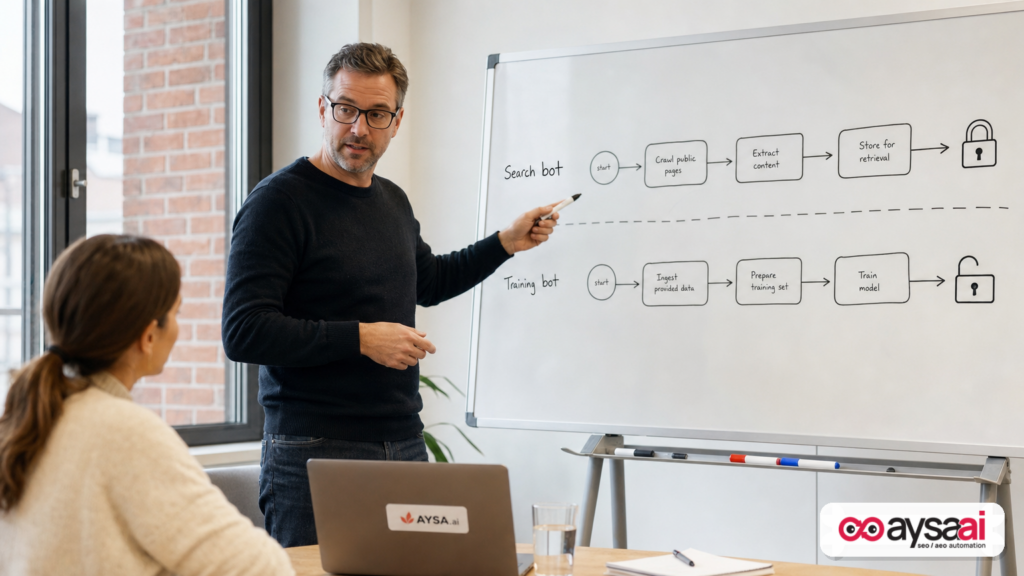
- OpenAI’s crawler documentation divides search and training into separate
robots.txtdirectives. - If a site blocks the search crawler, it won’t be included in ChatGPT’s search results; if it allows both search and training crawlers, data collected in one crawl may be used for both purposes.
- Cloudflare offers “AI Crawl Control” allowing customers to see and allow/block specific AI crawlers (as described by SEJ).
We can’t responsibly add more implementation details than that without primary documentation in the provided research context. But we can still give decision guidance.
Permission is now a strategy question, not a checkbox
Historically, most businesses treated bots as either “good (Googlebot)” or “bad.” AI introduces a third category: “useful but sensitive.”
From an operator standpoint, there are three broad stances:
- Max visibility: allow search crawling, and allow training crawling.
- Visibility without training: allow search crawling, restrict training crawling.
- Lockdown: restrict both.
Which stance is best depends on your business model, regulatory environment, and content uniqueness. A local clinic might want maximum discoverability for hours, insurance, and forms—but have strict rules around patient content. A niche publisher may view training access as a competitive threat.
The key: don’t let this be an IT-only decision. It’s a distribution decision with revenue consequences.
The new reality: “Being indexed” and “being cited” are not the same job
One of the most expensive mistakes I see businesses make is assuming that if a page is indexable, the job is done.
AI search introduces a new funnel:
- Discovery: the system learns the page exists
- Access: it’s allowed to fetch it
- Understanding: it can parse what the page says reliably
- Selection: it chooses your page as a candidate source
- Citation: it references your page in an answer
- Click/visit: a user actually visits
- Conversion: the user takes action
Cloudflare helping OpenAI discover more pages impacts step 1 and 3–4 indirectly. But step 5 (citation) is where businesses win or lose.
What makes a page “AI-citable” in practice
Without inventing proprietary ranking factors, we can still describe the pattern AI systems prefer—because it’s the same pattern humans prefer when they need a precise answer:
- Specificity: the page answers a narrow question clearly
- Structure: headings, lists, tables (where appropriate), scannable formatting
- Freshness signals: clearly updated information where time matters (hours, fees, requirements)
- Authority cues: who wrote it, how to contact you, policy context, location and legal details when relevant
- Consistency: the same facts appear across your site (and ideally across your public profiles)
This is where AEO (Answer Engine Optimization) and GEO (Generative Engine Optimization) stop being buzzwords and start being an editorial operations discipline.
AYSA’s perspective: if your content can’t be turned into a clean answer snippet, you’ll be “indexed” but not “selected.” Start here: AYSA AI SEO tools.
Business implications: what SMEs should care about (not just SEOs)
Most SMEs don’t have time to care about crawling theory. They care about phones ringing, appointments booked, carts checked out, and demos requested.
So here are the SME-level implications of the Cloudflare/OpenAI direction, stated plainly.
1) More “long-tail reality” queries get answered from the open web
When discovery expands, more niche pages become findable: model-specific instructions, “how much is X fee,” “do you accept Y insurance,” “what’s the menu today,” “return policy for sale items,” etc.
If your site is the primary source of truth for those answers, this is good news—if your pages exist, are accessible, and are updated.
2) Operational content beats marketing copy
AI answer systems have little patience for fluffy pages that say “we offer world-class service.” They need operational facts: steps, requirements, constraints, pricing ranges, compatibility, hours.
That means your “boring” pages may become your top customer acquisition assets. Treat them like product pages.
3) Technical hygiene becomes a growth lever
Fixing redirect traps or duplicate URL structures used to be “SEO housekeeping.” In AI search, it’s closer to “making your inventory visible.”
4) Attribution will be messy unless you build for it
SEJ notes that tracking ChatGPT visits depends on UTM tags or referrers, and some links lacked both earlier in the month referenced in the coverage. The meta-point: AI traffic is still an evolving analytics surface.
If you wait for perfect labeling, you’ll wait too long. You need:
- Landing page monitoring
- Event-based conversion tracking
- Trend detection (not only last-click attribution)
The SME scenario: a local clinic, an unlinked policy page, and a missed citation
Let’s make this real with a scenario I see constantly.
Business: a local clinic (physical therapy, dermatology, dental—pick your flavor). They have a modern website, a few service pages, and a blog. Their marketing team focuses on “best clinic in [city]” pages and Google Business Profile optimization.
The reality: patients increasingly ask assistants questions like:
- “Do they accept my insurance?”
- “What’s the new patient fee?”
- “What forms do I need?”
- “Are they open on Saturday?”
On the clinic’s site, the answers exist—but scattered:
- Hours are on the contact page only
- Insurance list is an old PDF linked from a footer
- New patient instructions are a blog post from two years ago
- Fees are not published; there’s a generic “call us” line
What happens in AI search: If discovery expands, the assistant may find the PDF, the contact page, and the blog post. But selection/citation will be inconsistent because the information is not presented as a single, authoritative “patient info” hub with clear, current details.
What the clinic should do:
- Create a “Patient Information” section with dedicated pages: hours, insurance, forms, pricing guidance, cancellations, parking.
- Make those pages indexable, internally linked from primary navigation, and updated with visible “last updated” where appropriate.
- Ensure PDFs have HTML equivalents for key facts.
- Monitor for changes: if hours change, update the site, local listings, and schema consistently.
This is not “blogging more.” It’s building a reliable, citable source of truth.
Agency reset: what to change in deliverables, reporting, and contracts
If you run an agency (or you’re an in-house marketer managing one), this shift will break your current reporting if you let it.
Why? Because AI search visibility doesn’t always show up as neat keyword ranking lines. And even when it does, it may show up as citations or mentions that drive fewer clicks but higher intent.
Deliverables that need to evolve
- From “keyword pages” to “answer inventory.” Build and maintain pages that answer customer questions operationally.
- From “content calendar” to “content maintenance plan.” Updates, change logs, and freshness workflows.
- From “technical audit PDF” to “execution pipeline.” Find issues, fix them, verify results, repeat.
Reporting that doesn’t collapse under AI
AI visibility reporting should blend:
- Index coverage (are key pages accessible?)
- Content completeness (do key answers exist?)
- Citation monitoring (where possible)
- Landing page trend monitoring from AI sources
- Conversion outcomes
This is exactly why AYSA is built as a system, not a checklist: you need monitoring plus execution. See AYSA Monitoring and AI search visibility.
Contract language: define “visibility,” not just “rankings”
Agencies should explicitly define what success means in an AI search world. If you sell “top 3 rankings,” you’ll end up arguing about a metric that’s losing monopoly power.
Instead, define outcomes like:
- Increase coverage of citable pages for priority questions
- Reduce crawl waste and duplicate URL footprint
- Improve conversion rate on AI-driven landing pages
Those are business metrics, not vanity metrics.
Monitoring and measurement: proving outcomes in AI search
SEJ’s reporting mentions a very real analytics pain: AI referrals may not consistently show UTMs or referrers, and fixes can roll out over time.
So how do you operate without perfect attribution?
Measure what you control
- Landing page readiness: do you have dedicated pages for top questions?
- Indexability checks: are key pages blocked, noindexed, canonicalized away, or trapped behind scripts?
- Change tracking: do critical pages update when the business updates (hours, fees, availability)?
- Conversion instrumentation: are calls, forms, bookings, purchases tracked reliably?
Monitor trends, not only sources
If you suspect AI search is influencing demand, watch for:
- Growth in direct traffic to informational pages
- Higher-intent queries in form submissions (“I saw on ChatGPT…”)—qualitative feedback counts
- Shifts in assisted conversions (if you have multi-touch tracking)
You don’t need to pretend the data is perfect. You need to be consistent and honest about confidence levels.
How AYSA approaches monitoring in practice
At AYSA, we focus on building an “always-on” loop:
- Monitor your site for technical and content changes that affect AI search visibility
- Prepare recommended fixes and content improvements
- Request approval from stakeholders (so nothing ships unexpectedly)
- Execute the accepted changes
- Validate outcomes and keep iterating
That’s the difference between “SEO recommendations” and operational SEO. Learn more: AI SEO Tools.
Action plan: a practical 30/60/90-day execution roadmap
If you’re an SME or an agency and you want to respond to this shift without boiling the ocean, here’s a pragmatic plan.
Days 0–30: Get your “discovery” foundation clean
- Audit crawl traps: identify redirect-everything behavior, parameter explosions, internal search pages being indexed.
- Fix dead URL hotspots: top 404/soft-404 paths; use precise redirects or 410s.
- Confirm indexability of critical pages: hours, pricing/fees guidance, shipping/returns, contact, location, top product categories.
- Decide bot permissions intentionally: define your stance on search crawling vs training crawling (in collaboration with legal/compliance when needed).
Operational note: if you’re on Cloudflare, review bot controls and make sure you’re not accidentally blocking legitimate search crawling while allowing spam bots. SEJ notes Cloudflare’s AI Crawl Control is available across plans (per their reporting).
Days 31–60: Build an “answer inventory” that can be cited
- Create or refactor pages that answer real questions: not marketing pages—operational pages.
- Standardize page templates: consistent headings, short summaries, FAQs where appropriate, clear contact/next step.
- Replace PDF-only answers with HTML: keep PDFs for printing if needed, but publish key facts in HTML.
- Strengthen internal linking: make sure these pages are reachable from main navigation or relevant hub pages.
Days 61–90: Instrument measurement and establish maintenance
- Set up monitoring: alerts for critical page changes, availability issues, accidental noindex, broken navigation.
- Create a refresh cadence: monthly review for pages where freshness matters.
- Track outcomes: conversions, assisted conversions, lead quality, and landing page performance.
- Operationalize approvals: make it easy for stakeholders to approve changes quickly.
This is where execution systems matter. If every fix requires a ticket that waits three weeks, you lose the advantage of faster discovery and refresh cycles.
Where AYSA.ai fits: monitoring + approved execution for AI search
Most SEO tools stop at “here’s a problem.” That’s not enough anymore.
As AI search expands discovery, the winners will be the teams who can:
- Detect changes and issues early
- Translate them into precise fixes
- Ship improvements without organizational friction
- Prove business impact over time
That’s the thesis behind AYSA:
- AI Search Visibility: understand and improve how you show up in AI-driven discovery and answers.
- Monitoring: detect technical/content shifts that affect crawlability, freshness, and answer readiness.
- AI SEO Tools: build an execution pipeline for SEO/AEO/GEO improvements.
- Pricing: evaluate the right level of automation and support for your team.
- Blog: ongoing playbooks and operator-focused guidance.
Importantly, AYSA is built for how real businesses operate: stakeholders need control. That’s why we prepare changes, ask for approval, and only then execute what’s accepted. In an AI search landscape where freshness and technical cleanliness matter, that approval loop is the difference between “we meant to fix it” and “we fixed it.”
What to do next (action list)
- Pick 20 “must-be-right” pages (hours, fees, policies, shipping/returns, top product/service pages) and verify they are indexable, fast, and updated.
- Stop homepage-redirect traps: unknown paths should not resolve to the homepage.
- Kill dead URL loops: resolve high-frequency 404s with precise redirects or 410s.
- Build an answer inventory: create dedicated pages for the top 25 customer questions.
- Decide permissions intentionally: document your stance on AI search crawling vs training crawling and implement it consistently.
- Instrument conversions: ensure calls/forms/bookings/purchases are tracked so you can measure outcomes even when referrers are imperfect.
- Set monitoring alerts: for accidental noindex, critical page downtime, content regressions, and template changes.
- Adopt an execution loop: recommendations → approval → shipping → validation. (This is where AYSA helps.)
Sources and further reading
- Search Engine Journal: ChatGPT Search Can Draw On More Pages After A Cloudflare Pilot (primary source for this editorial’s reported claims)
- Search Engine Journal: AI Search coverage (context and ongoing reporting)
- Search Engine Journal: Technical SEO (background on crawling/indexing concepts)
- AYSA.ai: AI Search Visibility
- AYSA.ai: AI SEO Tools
- AYSA.ai: Monitoring
- AYSA.ai: Pricing
- AYSA.ai Blog
Continue the AI search topic inside AYSA.
Use these pages to connect the article with AI SEO tools, AI visibility monitoring, AI Overviews and approved website execution.
Turn this topic into a website action plan.
Use these AYSA hubs to move from reading to technical fixes, AI visibility monitoring, research, glossary context and approval-first SEO execution.