What Award-Winning Search Work Looks Like in 2026: Story, Proof, and Execution (Not “Best Practices”)
In 2026, the best SEO and paid search work isn’t just about results—it’s about explaining the why, proving the impact, and operationalizing change. Here’s the practical playbook for building award-worthy search programs (and why execution systems like AYSA matter more than ever).

Search marketing has always had a paradox: the work is technical and measurable, but the decisions that unlock budgets, trust, and career growth are emotional. In 2026, that paradox got sharper. AI accelerated the pace of change, “best practices” became even less differentiated, and more teams started producing “good” results that look identical on paper.
So what actually separates the work that gets remembered—from the work that gets lost in the spreadsheet?
One helpful lens comes from the people who review hundreds of submissions across SEO and paid search: awards judges. Not because trophies are the point (they aren’t), but because judging forces a strict definition of excellence: clarity, evidence, and impact—with enough detail that someone smart can follow the logic and verify the outcome.
This editorial is inspired by insights shared by Search Engine Land Awards judges in their 2026 guidance for applicants. I’m not rewriting that article. I’m using it as a springboard to answer the more useful question for most businesses and agencies:
What does award-worthy search work look like as an operating system—and how do you build it consistently?
Because here’s my opinion (and I’ll stand behind it): the search teams that win in 2026 don’t just have better tactics. They have better process. They can explain the “why,” prove the “what,” and execute the “next.” And execution—shipping improvements reliably—is where most organizations still fall apart.
This is where AYSA.ai fits: an AI-driven SEO/AEO/GEO execution system that monitors, prepares, asks for approval, and executes accepted website changes. That sounds simple until you try to do it across dozens or thousands of pages with real constraints.
Concise summary
- Award-worthy search work is story + proof. Judges repeatedly ask for context, tactics, and evidence—not vague “best practices.”
- Innovation must connect to business outcomes. Clever ideas without measurable impact don’t hold up.
- Human impact matters more in an AI era. Some judges explicitly value trust, empathy, and qualitative signals alongside metrics.
- Execution is the real moat. Many teams can identify what to do; fewer can ship changes safely, quickly, and repeatedly.
- SMEs and agencies should run search like a product. Use hypotheses, baselines, experiments, governance, and post-launch learning loops.
Table of contents

- Why “award-worthy” is a useful standard—even if you never enter
- The new baseline: “Tell the story, show the receipts”
- What changed in 2026: AI reshaped search, but judging got more human
- The mistakes that quietly kill strong work
- The 10-point checklist for an award-worthy (and board-worthy) entry
- What “bring receipts” really means (and what to redact)
- Innovation that matters: break norms, not measurement
- The human layer: trust, intent, and qualitative outcomes
- A concrete SME scenario: local clinic + AI search changes
- What agencies should rethink: systems beat heroics
- Why execution is now the differentiator (and where most teams lose)
- Where AYSA fits: approved execution for SEO/AEO/GEO
- What to do next (action list)
- Sources and further reading
Why “award-worthy” is a useful standard—even if you never enter

Awards can be polarizing. Some people see them as pure marketing. Others see them as validation. I see them as a forcing function. When you try to explain your best work to a skeptical audience with limited time, you learn quickly whether your program is actually disciplined.
That’s why the Search Engine Land Awards judging guidance is more valuable than the trophy: it’s an external checklist for what great looks like in search right now.
And in 2026, “great” isn’t defined by one channel (SEO vs PPC) or one platform. It’s defined by whether you can:
- Diagnose a real business problem (not just a ranking problem)
- Choose a strategy that matches constraints
- Explain tactics with enough specificity to be credible
- Measure outcomes in a way that withstands scrutiny
- Show learning and iteration (not just a lucky spike)
That’s the standard you want for internal reviews, client retention, and board conversations—whether or not you ever submit an entry.
Source inspiration: Search Engine Land’s article featuring judges’ advice for award-worthy applications (external link).
The new baseline: “Tell the story, show the receipts”
The judges’ comments converge on two themes:
- Structure your work as a story (goal → actions → outcome)
- Prove what you claim (data, charts, screenshots, evidence)
That may sound obvious, but most teams still write like this:
- “We used best practices.”
- “We optimized campaigns.”
- “We improved content.”
That language is the enemy. Not because it’s wrong, but because it’s non-falsifiable. It hides the thinking. And it makes your work indistinguishable from everyone else’s.
The most useful judge frameworks from the Search Engine Land piece include:
- Goal → action → measurable outcome (a simple narrative arc)
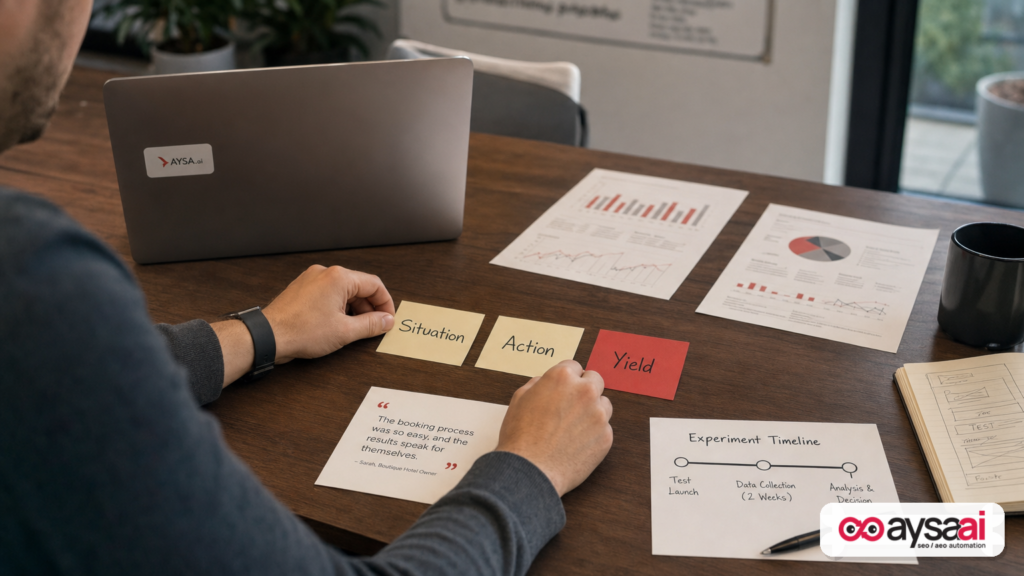
- Situation → action → yield (SAY)
- Explain the tactics and the reasoning, not just outcomes
- Evidence (charts, analytics, screenshots) to support claims
From an operator’s standpoint, this translates to a discipline I want every team to adopt:
Run every initiative like a mini case study
If you can’t write a clean one-page case study after the fact, it’s a sign you didn’t fully understand what you were doing during the work. That doesn’t mean you’re bad at search. It means your process isn’t tight enough to scale.
Here’s a practical one-page template (use it internally even if you never submit for an award):
- Business objective: what the company needed (revenue, bookings, pipeline, CAC)
- Search objective: what you aimed to change (visibility, qualified traffic, Conversion rate)
- Baseline: before-state with dates and segments
- Constraints: budget, brand rules, dev capacity, legal limits, seasonality
- Hypothesis: what you believed would work and why
- Actions: specific changes made (not “best practices”)
- Measurement approach: Attribution, incrementality, holdouts, leading indicators
- Results: impact with time window + confidence limits where possible
- Learnings: what failed, what surprised you, what you changed next
That’s not awards advice. That’s how you build a search program that survives staff turnover and platform volatility.
What changed in 2026: AI reshaped search, but judging got more human
One of the strongest signals in the judges’ comments is a shift in what “great” looks like in the AI era. Yes, AI is moving fast. But the standout entries don’t just celebrate AI-driven efficiency. They connect search outcomes to trust and human experience.
This matters because AI Search surfaces—whatever name you use internally (AEO/GEO/LLM visibility)—tend to reward brands that are clear, consistent, and credible. That’s partly technical (entities, Structured data, topical coverage), and partly experiential (does your content actually help, do users bounce, do they convert, do they complain, do they come back?).
When a judge says “show me the humans behind the metrics,” they’re pointing to something many teams still ignore: if your program only optimizes for visibility, you might win impressions and lose trust.
AI doesn’t remove accountability—it increases it
AI makes it easier to produce output: more ads, more landing pages, more content updates, more experiments. That abundance raises the bar for:
- Editorial judgment: what not to publish
- Measurement discipline: what actually caused the lift
- Governance: who approves changes and why
- Risk management: preventing brand damage and wasted spend
In practice, AI pushes teams toward two operating models:
- Content factory: produce more, hope some sticks (high risk, low differentiation)
- Execution system: monitor → identify opportunities → prepare changes → approve → deploy → measure → iterate (lower risk, compounding gains)
My view: the second model is the only sustainable one for SMEs and agencies in 2026.
The mistakes that quietly kill strong work
Based on the judges’ themes (and what I see in real operations), these are the recurring mistakes that keep good teams from being great:
1) Vague language that hides the work
“We used best practices” is a confession that you didn’t define what you did. Two teams can both claim “best practices” while doing opposite things.
Replace it with specifics:
- “We split non-brand campaigns by intent tier and rewrote ads to match each tier.”
- “We consolidated 120 near-duplicate pages into 14 canonical guides and redirected the rest.”
- “We rebuilt internal linking using a topical hub model and measured crawl + ranking changes.”
2) No baseline or unclear time window
If you show a lift but don’t show the before-state and dates, a reviewer can’t tell whether you improved performance or rode seasonality.
3) No “why” behind the “how”
Judges explicitly want the reasoning. Your internal stakeholders do too. The “why” is what makes a tactic portable to other campaigns, markets, and future algorithm shifts.
4) Pretending the work was clean
Real work is messy. The best entries explain what failed, what you tried, and what changed. That’s not weakness; it’s credibility.
5) Over-indexing on soft metrics without business impact
Traffic and impressions are not meaningless, but they’re not enough. Tie metrics to the business model: leads, bookings, revenue, margin, retention, qualified pipeline, or at least conversion proxies that the business agrees matter.
6) The execution gap: insight without deployment
Many teams can diagnose problems and propose improvements. Far fewer can ship them consistently because:
- Approvals are slow or unclear
- Dev resources are limited
- Content updates bottleneck in review
- QA is inconsistent
- No one owns the post-deploy measurement
If you want compounding gains, your execution throughput is a core KPI.
The 10-point checklist for an award-worthy (and board-worthy) entry
Whether you’re an SME writing an internal performance memo or an agency preparing a case study, use this checklist as a quality gate.
1) State the business problem in plain English
Not “rankings dropped.” Try: “Bookings slowed while paid CAC rose, and we needed organic to offset acquisition costs without harming brand trust.”
2) Define the objective and success metrics
Be explicit about what “winning” meant and what you measured. If the metric is imperfect, say so and explain why you chose it.
3) Show the baseline with dates and segments
Before vs after. Include the window and the segment (brand vs non-brand, new vs returning, mobile vs desktop, by location, by product line).
4) Explain constraints
Constraints are often what make work impressive: limited budget, legal review, site limitations, a platform migration, seasonality, a small team.
5) Share the insight and hypothesis
What did you notice that others missed? What did you believe would work? This is where strategy lives.
6) Detail the tactics (enough that an expert can evaluate them)
List the specific changes. Avoid jargon where possible, but don’t hide behind vagueness.
7) Prove the work happened
Use evidence: charts, analytics exports, screenshots, change logs, ad history, landing page diffs. (If you must redact, redact.)
8) Connect outcomes to the objective
Don’t just report metrics—interpret them. What did the lift mean for the business? What tradeoffs existed?
9) Show iteration and learning
What did you try first? What didn’t work? What did you change? This is often where the “unfair advantage” is hiding.
10) Document what you changed next
Great teams don’t stop at results; they update the system: new guardrails, new templates, new bidding rules, new content governance, new monitoring.
What “bring receipts” really means (and what to redact)
One judge quote (in the Search Engine Land piece) is blunt: if you can’t share data, you’re at a disadvantage. That’s true in awards, and it’s true with clients and CFOs.
But many SMEs and agencies have legitimate confidentiality constraints. Here’s the practical approach:
Show the shape, not the secrets
You often don’t need to reveal exact revenue or ad spend to be credible. You can provide:
- Percent change (e.g., +18% leads) with baseline and time window
- Indexed charts (100 = baseline) showing trend direction
- Segmented results (brand vs non-brand, location A vs location B)
- Counts without dollars (appointments, form fills, calls)
However, be careful: percent-only results can still be misleading without context. If you can, include absolute numbers for at least one metric (even if it’s not revenue) to show scale.
Evidence types that build trust fast
- Change logs: what changed, when, and who approved it
- Before/after landing pages: diffs of headings, FAQ, internal links, schema
- Ad variation history: what was tested
- Analytics screenshots: annotated with date ranges
- Search Console exports: query/page performance over time
Note: I’m not linking to specific Google documentation here because it isn’t included in the provided research context. If you want a sources expansion with official Google docs, we can add them once you provide the preferred official links for citation.
A word on attribution vs incrementality
The Search Engine Land page we were given includes a related link about “Attribution vs. incrementality” (external link). That’s not just analytics theory. It’s a credibility filter.
In 2026, sophisticated reviewers expect you to acknowledge that attribution models can over-credit the last touch and under-credit brand effects or upper funnel. You don’t need perfect incrementality testing for every initiative—but you should show that you’ve thought about causality and confounders (seasonality, promotions, PR spikes, inventory changes, algorithm volatility).
Innovation that matters: break norms, not measurement
Several judges emphasize innovation: doing something unexpected, challenging SEM norms, breaking new ground in SEO, anticipating where the channel is going.
Here’s the trap: teams chase novelty for novelty’s sake. They do something “cool,” but they can’t explain why it should work, or whether it truly drove outcomes.
My practical definition of valuable innovation in search:
- It’s rooted in a constraint. You had a problem traditional tactics couldn’t solve efficiently.
- It’s testable. You structured it so someone can evaluate it fairly.
- It’s transferable. You can apply the logic elsewhere, not just once.
- It changed the operating system. Not only results, but how you work.
Examples that tend to be “award-worthy” when done well
These are generic examples (not claims about specific winners):
- Cross-channel intent mapping: using PPC query intelligence to restructure SEO content priorities and internal links.
- Programmatic QA with governance: scaling content updates while maintaining editorial standards and compliance.
- Audience-first campaign architecture: restructuring paid search around customer segments and lifecycle stages, then proving impact.
- Local semantic strategy: building topical authority around services and locations rather than keyword stuffing (the provided research context includes a related SEL link on semantics/topical authority in local SEO: external link).
The common thread: not the tool, not the trend—the system design.
The human layer: trust, intent, and qualitative outcomes
One judge in the Search Engine Land article explicitly calls for empathy and wellness-based craft—work that builds genuine trust with real people, not just visibility. Even if you don’t share that exact framing, the underlying point is critical for 2026:
Search is increasingly mediating relationships, not just clicks.
When AI answers become a first touchpoint, your brand is represented by:
- Your clarity (do you define terms plainly?)
- Your credibility (do you show real expertise and evidence?)
- Your consistency (do your pages agree with each other?)
- Your intent alignment (do you actually answer what people mean?)
How to include “human proof” without being fluffy
Judges don’t want poetry; they want truth. Add one or two qualitative signals that connect directly to outcomes:
- A short customer quote from a survey about clarity or trust
- Sales team feedback: “leads are more qualified” plus supporting conversion-rate data
- Support ticket reduction after improved documentation
- Call transcripts summarized into recurring objections you addressed on pages
Important: don’t fabricate. Use what you already have: reviews, support logs, onboarding notes, call recordings (where compliant), customer emails.
A concrete SME scenario: local clinic + AI search changes
Let’s make this real with a scenario I see constantly: a local healthcare clinic (or dental practice, physical therapy, dermatology) that depends on a mix of local SEO and paid search.
Situation
- Appointments are steady but not growing.
- Paid search costs rise; lead quality is inconsistent.
- The website has thin service pages, outdated FAQs, and inconsistent messaging across locations.
- The team is small: an owner, office manager, and a part-time marketer.
Action (what “award-worthy” work would include)
A disciplined approach might look like this:
- Define the objective: increase booked appointments for two high-margin services without increasing no-show rates.
- Baseline: last 90 days by service, by location, by channel; identify booking conversion rates and call volume.
- Insight: top queries show confusion about eligibility, pricing expectations, and recovery time—content doesn’t address those questions clearly.
- Website changes: rewrite service pages to answer “am I a candidate?”, “what does it cost?”, “what’s recovery like?”, add doctor-reviewed FAQs, improve internal links between symptoms and services.
- Local enhancements: align location pages with consistent NAP, service definitions, and structured FAQs; ensure each location has unique context.
- Paid search restructure: separate brand vs non-brand; create intent-tier ad groups; add negatives for irrelevant informational queries; align landing pages to match ad promise.
- Measurement: track booked appointment rate (not just form fills), call quality tags, and downstream show rates.
- Iteration: review weekly; update FAQs based on call objections; pause ads that drive low-quality calls.
Yield
A credible “yield” section would include:
- Before/after booked appointment rate by service line
- Call-to-appointment conversion change
- Paid CPA trend with segmentation
- Organic qualified lead trend (not just sessions)
If you can’t share the clinic’s revenue, you can still share appointment counts and conversion rates. That’s “receipts.”
Where teams usually fail
Not in identifying improvements. They fail in execution:
- Pages take weeks to update because approvals are unclear.
- Changes go live without QA, breaking tracking.
- No one monitors after deployment, so issues linger.
- Insights are repeated monthly but never implemented systematically.
That is an operations problem, not an SEO problem.
What agencies should rethink: systems beat heroics
Agencies are under pressure in 2026. Clients expect faster iteration, clearer attribution, and “AI-powered” efficiency. Meanwhile, differentiation based on tactics is collapsing because everyone can access similar tools and playbooks.
The judges’ advice—explain tactics, show evidence, make it readable—sounds like writing advice, but it’s also a clue about agency positioning:
Productize your operating system, not your deliverables
Most agencies still sell deliverables:
- X blog posts
- X landing pages
- X campaigns
- X audits
But buyers increasingly want outcomes and control. The winning agency offer in 2026 is closer to:
- A monitoring layer (catch volatility early)
- A prioritization layer (what matters next)
- An approval layer (governance and brand safety)
- An execution layer (ship changes)
- A measurement layer (prove impact)
If you can’t execute, you become a recommendation engine—and recommendation engines are being commoditized by AI.
Readability is a competitive advantage
One judge says they’re more likely to vote for an entry they enjoyed reading. That’s not superficial; it’s operational. Clear writing reflects clear thinking. Clear thinking reduces waste.
Agencies should treat clarity as a deliverable:
- One-page strategy briefs
- Change logs with rationale
- Monthly narrative reports (not dashboards-only)
- Explicit “what changed next” sections
This is how you retain clients when results get noisy.
Why execution is now the differentiator (and where most teams lose)
I’ll say it plainly: in 2026, execution throughput is a bigger differentiator than insight.
Many teams can find opportunities with audits, competitive tools, and AI. But the value only materializes when changes are deployed safely and measured properly.
The four bottlenecks that block compounding gains
- Decision bottleneck: too many stakeholders, no tie-breaker, unclear priorities
- Approval bottleneck: legal/brand review is slow and inconsistent
- Implementation bottleneck: dev queue is overloaded; CMS access is restricted
- Verification bottleneck: no monitoring, no QA, no post-launch learning loop
When these bottlenecks exist, you get a predictable pattern:
- Audits pile up
- Backlogs grow
- Teams argue about priorities
- Executives lose patience
- Search becomes “random” again
Execution is also risk management
Shipping changes faster doesn’t mean shipping recklessly. In fact, the better your system, the safer you become:
- You document what changed.
- You reduce one-off manual edits.
- You standardize QA.
- You can roll back mistakes.
- You monitor continuously.
That’s not just good SEO. That’s good governance.
Where AYSA fits: approved execution for SEO/AEO/GEO
At AYSA.ai, we’re biased toward a simple belief: recommendations are cheap; execution is value.
That’s why AYSA is built as an execution system for SEO/AEO/GEO:
- Monitors performance and site signals so you can spot issues and opportunities early (AYSA Monitoring).
- Prepares website changes so they’re reviewable (not just ideas in a doc).
- Asks for approval before changes go live—critical for SMEs with brand, legal, and quality concerns.
- Executes accepted changes to remove the “handoff gap” where most programs stall.
In practice, this supports the exact judge criteria we saw in the Search Engine Land guidance:
- Explain tactics: a systemized change log makes tactics explicit.
- Bring receipts: monitoring plus change history builds evidence trails.
- Tell a story: you can narrate improvements as a sequence of decisions and outcomes.
If you’re new to the idea of AI search visibility and how brands show up in AI-driven discovery, start here: AYSA AI Search Visibility.
If you want to see how AYSA approaches AI-driven SEO tooling more broadly, explore: AYSA AI SEO Tools.
For teams evaluating whether an execution system fits their stage and resources, pricing is here: AYSA Pricing.
And for more operational editorials like this one, visit: AYSA Blog.
Why “approved execution” matters for SMEs
SMEs don’t fail because they don’t care. They fail because they’re busy, risk-averse, and resource-constrained. They need:
- Changes presented clearly
- Confidence the change won’t break the site
- A quick approval step
- Proof the change improved outcomes
Approved execution respects that reality. It’s the difference between “we should update those pages” and “those pages are updated, measured, and iterated.”
What to do next (action list)
If you want your search program to be “award-worthy” in the only way that matters—repeatable impact—do the following over the next 30 days.
1) Turn your next initiative into a one-page case study
- Write the baseline, constraints, hypothesis, actions, and measurement plan before you start.
- After launch, write the results and learning.
2) Replace “best practices” language with tactical truth
- Audit your reports and case studies for vague phrases.
- Rewrite them as concrete actions with dates.
3) Build a receipts folder
- Create a shared folder with exports/screenshots for every major change.
- Include a simple changelog: what, when, why, expected impact.
4) Install an execution workflow
- Define who can propose changes, who approves, who deploys, who verifies.
- Set a weekly cadence for approvals and post-launch checks.
5) Add one qualitative signal to every monthly review
- One customer quote, one sales insight, or one support pattern.
- Connect it to a page update or campaign test.
6) If you’re stuck on execution, use a system
- If your backlog is growing, your execution layer is the problem.
- Consider an approved execution model like AYSA to monitor and ship improvements reliably.
Sources and further reading
- Search Engine Land (source inspiration): Straight from the source: 2026 Search Engine Land Awards judges reveal what makes an application award-worthy
- Search Engine Land (related link in provided context): Attribution vs. incrementality: Why you need both
- Search Engine Land (related link in provided context): How semantics and topical authority improve local SEO
- Search Engine Land (related link in provided context): How to scale SEO content updates with Claude Code
- Search Engine Land (related link in provided context): Why creator content belongs in your AI search strategy
- AYSA.ai: AI Search Visibility
- AYSA.ai: Monitoring
- AYSA.ai: AI SEO Tools
- AYSA.ai: Pricing
- AYSA.ai: Blog
Disclosure note: This article references judge themes quoted by Search Engine Land as research inspiration. It does not copy their article. It expands those themes into an operational playbook for SMEs and agencies and explains how AYSA supports an approved execution model.
Continue the AI search topic inside AYSA.
Use these pages to connect the article with AI SEO tools, AI visibility monitoring, AI Overviews and approved website execution.
Turn this topic into a website action plan.
Use these AYSA hubs to move from reading to technical fixes, AI visibility monitoring, research, glossary context and approval-first SEO execution.