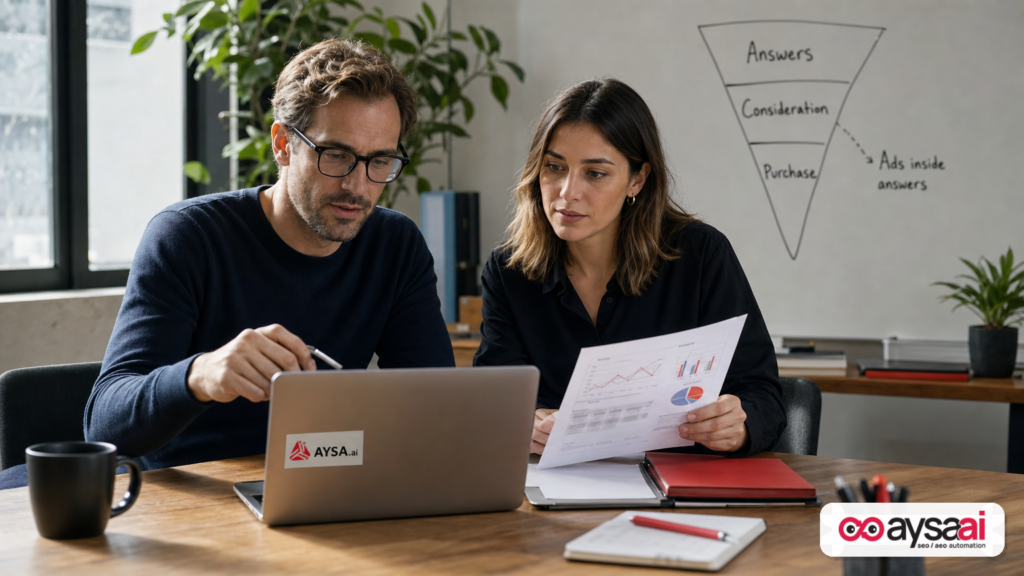
Brave’s Search Index Is Fueling AI Answers: What It Means For Your Website (And What To Do About It)
Brave is selling access to its search index to AI companies. That changes the implicit bargain of “crawl → rank → click.” Here’s what likely happened, why it matters to SMEs and agencies, the real control points you still have (and don’t), and an operational playbook to protect traffic while growing AI visibility.
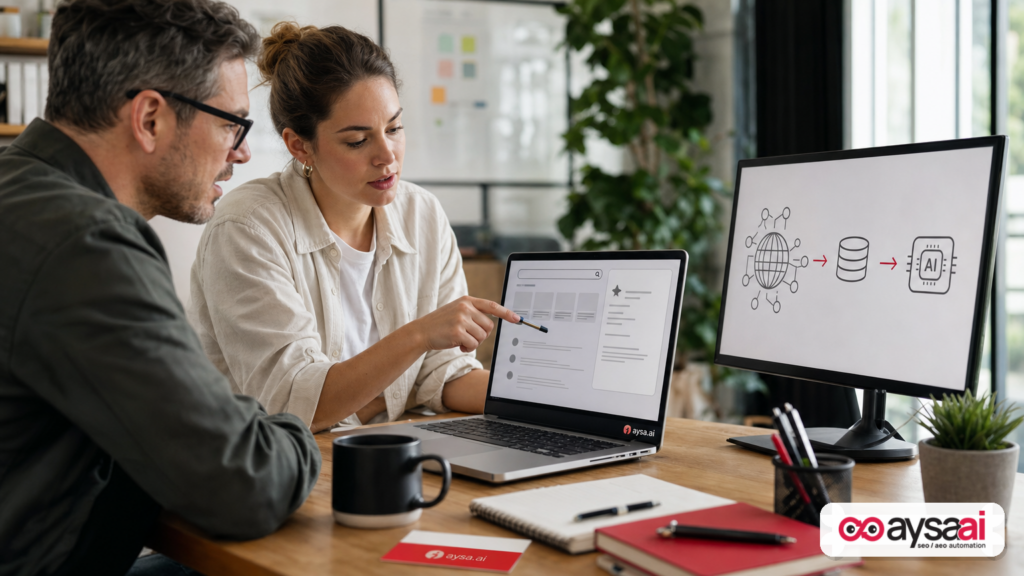
Search is no longer a single, simple bargain: you let a crawler in, you earn rankings, and you get Clicks. In 2026, that bargain is being renegotiated in public—and not by Google.
A recent report highlighted a major shift: Brave (the company behind the Brave browser and Brave Search) sells access to its search index to AI companies through an API product, and your website is likely included in that index. The same report notes an uncomfortable operational detail: Brave’s crawler is described as not advertising a unique identity, which makes it hard to block “Brave-only” access without also blocking Google.
This isn’t just a media/publisher story. It’s an SME and agency story, because the value of your web content is increasingly extracted upstream—before a visitor ever reaches your site. Whether you love or hate AI answers, the business risk is the same: you can lose distribution while still “being visible.”
In this editorial, I’ll lay out what changed, why it matters, what control you realistically have, and how to build an AI-search operating system that doesn’t depend on lawsuits, wishful thinking, or one-off technical hacks.
Primary source used for this editorial: Search Engine Journal coverage of Brave selling its index to AI companies: Brave Sells Its Search Index To AI, And Your Website Is Probably In It.
Concise summary (for busy operators)
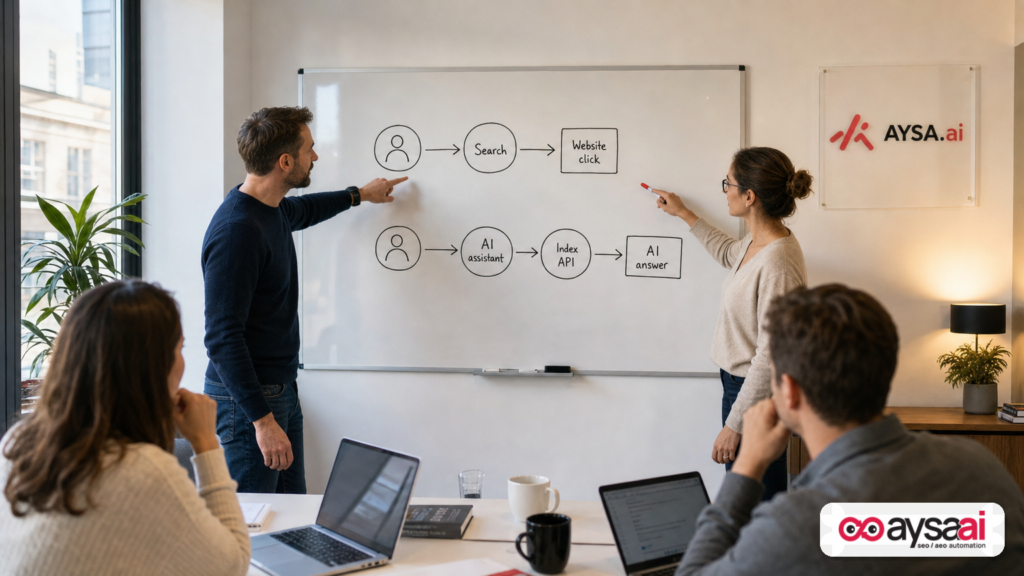
- What changed: Brave monetizes its web index via an API used by AI companies. That turns “search index” into “AI answer supply chain.”
- Why it matters: An index sold to AI doesn’t have to send you traffic. Your content can power answers while your pipeline (leads, sales, subscriptions) stagnates.
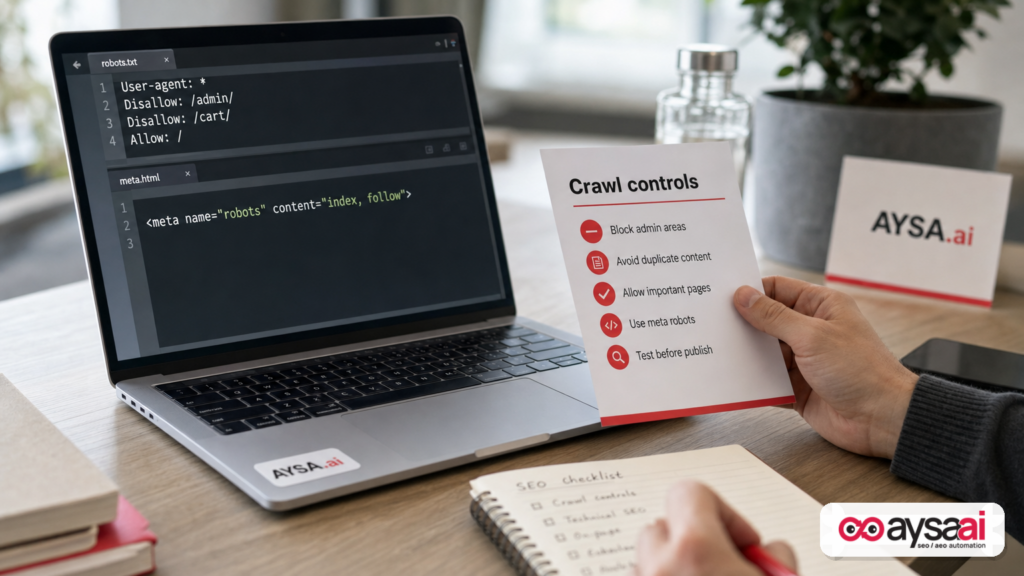
- The control gap: Robots.txt depends on crawler identity. If a crawler doesn’t present a differentiated user agent (as described in Brave’s help documentation referenced in the source), you can’t selectively block it without collateral damage.
- What to do: Build an AI visibility plan that includes Monitoring, technical hygiene, content designed for citation, and a workflow that can execute site changes safely and consistently.
- Where AYSA fits: AYSA is an execution system for SEO/AEO/GEO: it monitors, prepares recommended changes, requests approval, and executes accepted changes—so you can move at AI speed without breaking the site.
Table of contents
- What actually changed: from “search engine” to “index-as-a-service”
- Why this is happening now (and why it won’t be the last case)
- The control problem: robots.txt works by identity—and Brave reportedly doesn’t present one
- Search engines send people back. AI answers don’t have to.
- Who “owns” the bargain: publishers, SMEs, and the new AI supply chain
- Business risks for SMEs (beyond “copyright drama”)
- A concrete SME scenario: the local clinic that keeps losing appointment leads
- What agencies should rethink: deliverables, measurement, and responsibility
- Technical basics you must get right (even if you never touch robots.txt)
- Content that gets cited (and still converts)
- What to monitor now: from rankings to “AI visibility” signals
- An action plan that doesn’t depend on lawsuits
- The AYSA perspective: approved execution for AI search
- What to do next (checklist)
- Sources and further reading
What actually changed: from “search engine” to “index-as-a-service”
Historically, “search” meant a loop you could understand:
- A crawler indexes your page.
- A user searches.
- You compete for a click.
- If you earn it, you can convert that visitor.
Brave’s business model adds a second loop—one that can bypass your site entirely.
According to Brave’s own positioning quoted in the Search Engine Journal piece, Brave sells access to its index through the Brave Search API, marketed as a way for AI systems to fetch “fresh” web information without Crawling everything themselves. The SEJ source notes Brave says its API is used by AI companies such as Cohere, Mistral, and Perplexity, and that Brave’s index includes tens of billions of pages (these are product claims referenced in the source; we’re not independently verifying the exact counts here).
That shift matters because an index is no longer just a “catalog that helps people find you.” It becomes a raw material warehouse for AI answers. If AI companies can purchase chunks of your pages (plus metadata) through an index API, they can generate responses users accept—without requiring a click.
This is the central strategic change: distribution is decoupling from traffic.
If you’re an ecommerce brand, that can mean fewer category page sessions. If you’re a clinic, fewer “call now” visits. If you’re a SaaS company, fewer trial sign-ups from top-of-funnel queries. If you’re a publisher, fewer ad impressions and subscriptions. Same mechanism, different pain.
Why this is happening now (and why it won’t be the last case)
Three forces are colliding:
1) AI products need freshness, not just training data
Many AI assistants can’t rely only on model training; they need current information. One way to get that is to crawl the web directly. Another way is to pay for access to someone else’s index—exactly the “index-as-a-service” model described in the SEJ coverage.
2) Crawling the entire web is expensive and politically messy
Operating a high-quality crawl-and-index pipeline is costly and triggers conflict with publishers. An API purchase shifts cost and conflict to the index provider.
3) The legal environment is unresolved
The SEJ article reports on litigation claims involving The New York Times and also notes other publishers filed separate cases the same day, and that Brave had not yet responded at the time of writing. We should treat the allegations as allegations until courts decide. But the operational lesson for businesses is immediate: your content may be used in AI experiences even if you never opted in.
This won’t be the last time you see a search index become an AI infrastructure asset. If you run marketing, you should assume more “middle layers” will appear between your website and the end user.
The control problem: robots.txt works by identity—and Brave reportedly doesn’t present one
Non-SEO version: websites typically publish a file called robots.txt to communicate crawl permissions. But robots.txt only works because crawlers identify themselves with a user agent name.
In the SEJ source, Brave’s help documentation is described as stating its crawler “does not advertise a differentiated user agent,” and that Brave follows Google’s rules—meaning what Googlebot can’t crawl, Brave won’t crawl. If that’s accurate, the impact is straightforward:
- You can’t write a robots.txt rule that says “Allow Google, block Brave” if Brave presents as Googlebot (or otherwise doesn’t differentiate).
- The “escape hatch” suggested in the source context is often noindex—but noindex removes you from search results broadly, including (often) the very traffic you need.
This is where many businesses get trapped in false choices:
- Option A: Block broadly and lose legitimate discovery, leads, and revenue.
- Option B: Allow broadly and accept that your content may be repackaged into AI answers.
Even if you disagree with Brave’s approach, the bigger lesson is that technical controls are imperfect and unevenly enforced. You need a strategy that assumes some extraction will happen and still protects outcomes.
A note on verification
We’re relying on the SEJ article’s reporting and its references to Brave documentation for the crawler identity point. We are not independently validating Brave’s user agent behavior here. If you want to treat this as a risk assessment exercise, that’s the right posture: the risk exists whenever a crawler cannot be uniquely identified and controlled.
Search engines send people back. AI answers don’t have to.
This is the crux for SMEs.
Search engines, at least in their classic form, are structured to refer traffic outward. Their product is “help you find the best page.” Even when search engines answer directly (snippets, instant answers, AI results), the default mechanic still includes citations and links.
But when an index is sold to an AI system, the AI system’s product is “give you the best answer,” not “send you to the best site.” That means:
- The AI can quote or paraphrase you without sending a visit.
- The AI can mix your content with competitors’ content and produce a blended recommendation.
- The AI can omit your brand entirely while still using your facts.
The SEJ source highlights Brave’s positioning around “LLM Context” that delivers extracted page chunks and metadata in a format that satisfies LLM needs without further scraping. If that’s the product design, then the buyer (the AI company) is explicitly paying to reduce the need to fetch content from origin sites—meaning fewer reasons to click through.
For operators, this creates a new scoreboard:
- Old scoreboard: rankings → clicks → conversions
- New scoreboard: visibility in AI answers → citations/mentions → assisted conversions (plus whatever direct traffic remains)
This is exactly why we built an entire practice around AI search visibility rather than treating “SEO” as a single-channel game.
Who “owns” the bargain: publishers, SMEs, and the new AI supply chain
One reason this Brave story is resonating is that it exposes the invisible supply chain behind AI answers:
- Your site publishes content.
- A crawler copies it into an index.
- An API packages and resells it.
- An AI assistant uses it to answer.
- The user feels satisfied and may never visit your site.
In the “classic web,” this supply chain ended at step 2 (index) and step 3 was “the user clicks.” Now, step 3 can be a private commercial relationship between an index provider and an AI company.
There are two uncomfortable truths for business owners:
- Truth #1: Even if courts eventually limit some practices, the market incentive to turn web content into AI product inputs will remain.
- Truth #2: You can’t negotiate with every crawler, index, and model provider. You need leverage through strategy and execution.
Business risks for SMEs (beyond “copyright drama”)
If you’re not a publisher, it’s tempting to shrug and think, “That’s The New York Times’ problem.” It’s not.
Risk 1: Demand capture without attribution
If an AI answer uses your expertise but doesn’t cite your brand, your authority is subsidizing someone else’s product. That can show up as declining branded search growth, fewer direct visits, and weaker recall.
Risk 2: “Good enough” answers reduce high-intent clicks
Even a cited answer can reduce clicks. If the AI summarizes shipping costs, refund terms, or appointment prep instructions, many users won’t need to visit.
Risk 3: Stale or partial snapshots become your “truth”
The SEJ source points out Brave results appeared to reflect stored copies rather than a live fetch. That matters because if AI systems rely on index snapshots, your updated pricing, policies, or inventory may not propagate instantly—yet users will treat the AI answer as current.
Risk 4: Compliance and liability exposure
In regulated sectors (health, finance, legal), an AI answer generated from outdated or decontextualized content can create real compliance risk. Even if the AI company is responsible, your brand may get blamed.
Risk 5: Measurement blindness
If you only watch Google rankings and GA4 sessions, you’ll miss the shift. You might “hold position” while conversions slide because the clickstream is being intercepted upstream.
That’s why monitoring needs to evolve from “Where do we rank?” to “Where do we show up in AI answers, and what is that doing to outcomes?” AYSA’s approach starts with monitoring and then moves into controlled execution.
A concrete SME scenario: the local clinic that keeps losing appointment leads
Let’s make this painfully real with a scenario I’ve seen repeatedly (not specifically tied to Brave, but absolutely tied to AI answer behavior).
Business: A local dermatology clinic with two locations.
Old funnel:
- User searches: “eczema treatment near me,” “does cortisone help eczema,” “how much is a skin check.”
- User clicks clinic blog or service page.
- User sees trust signals, doctor bios, insurance info, books appointment.
New funnel:
- User asks an AI assistant the same questions.
- AI answers with a neat summary: symptoms, OTC advice, when to see a doctor, typical pricing ranges, and “book with a dermatologist.”
- User never lands on the clinic site—then calls a larger competitor or uses a marketplace that is “one tap away.”
What goes wrong: The clinic “still ranks” for some queries, but the number of visits that reach the booking experience declines. The clinic team blames seasonality, ads, or reputation.
What we do instead (the operator’s play):
- Rebuild pages for citation + conversion: clear definitions, medically reviewed statements, author credentials, last-updated dates, and tight internal links from informational answers to booking-ready pages.
- Create “AI-friendly” structured sections: eligibility, prep steps, pricing components, insurance notes, what to expect—written in crisp blocks that are hard to misinterpret.
- Monitor AI answer drift: if AI answers start recommending competitor brands more often, we treat that like a rank drop and respond operationally.
This is exactly where execution matters. Knowing what to do is not enough; someone must ship the changes safely. AYSA is designed to do that: it prepares changes, asks for approval, and executes accepted updates—so the clinic isn’t stuck in a six-week dev backlog.
What agencies should rethink: deliverables, measurement, and responsibility
If you run an agency, Brave’s index licensing story is a warning flare: clients will soon ask why “SEO” isn’t producing the same traffic lift even when technical work is solid.
1) Deliverables must move from “rank report” to “visibility coverage”
Rankings still matter, but they’re no longer the whole surface area. Agencies need deliverables that include AI answer presence, citations, brand mentions, and “share of voice” inside AI experiences.
This is the difference between doing SEO as a checklist and doing it as an operating system. If you want a starting point, see AYSA’s framing on AI search visibility.
2) The new contract: outcomes require execution speed
Clients don’t lose to smarter agencies; they lose to faster execution. AI search changes quickly: your site structure, internal linking, schema, and page intent alignment must be iterated continuously.
That’s why “approved execution” is becoming a competitive advantage. Agencies can’t spend two weeks writing a ticket to change a title tag.
3) Responsibility expands into “AI answer correctness”
When AI assistants summarize your client’s content, errors can happen—even if the site is correct. Agencies will need policies for:
- What content is safe to publish
- How to phrase statements so they are hard to misquote
- How often to update pages that AI frequently cites
Execution systems (like AYSA) help here because they enforce a workflow: monitor → prepare → approve → execute. That reduces the risk of reckless automation while still keeping pace.
Technical basics you must get right (even if you never touch robots.txt)
The Brave crawler identity debate can distract from a more important truth: most SMEs are leaking AI visibility (and classic SEO performance) through basics they control fully.
1) Indexation clarity
Make sure the pages that should represent you are indexable—and the pages that shouldn’t are clearly excluded. This is not about hiding from AI; it’s about preventing low-value pages from becoming your brand’s “source material.”
2) Canonical hygiene
AI systems and indexes are more likely to mis-handle duplicate or near-duplicate content. Strong canonical signals reduce the chance that the “wrong version” gets used.
3) Content freshness signals
If your pricing, policies, inventory, or availability changes, your pages should communicate recency clearly (e.g., last updated). This doesn’t guarantee instant propagation into every index, but it improves your odds that the latest version is selected and trusted.
4) Entity clarity (who you are)
AI answers tend to favor clarity: exact business name, address, service areas, product lines, ownership/leadership, author credentials. Don’t bury identity information in PDFs or images.
5) Server reliability and performance
If your site is slow or unstable, you increase the chance that crawlers and indexers snapshot partial content or deprioritize recrawl. Performance remains foundational—especially when the ecosystem is pulling content into secondary layers.
AYSA can help operationalize these fundamentals through its AI SEO tools and ongoing monitoring, then push changes through an approval gate.
Content that gets cited (and still converts)
AI visibility is not only technical. It’s editorial and structural.
Here’s the mental model: if your content is easy for an AI to chunk, interpret, and attribute, you’re more likely to be cited accurately. If it’s vague, overly clever, or purely promotional, it’s more likely to be ignored or misrepresented.
Write for “extractability” without becoming bland
- Use clear headings that match real questions customers ask.
- Answer in the first 2–3 sentences, then add detail.
- Use lists, tables (where relevant), and definitions.
- Separate opinions from facts.
Build “citation hooks”
Citation hooks are sections that make attribution natural:
- “What we recommend” (clearly labeled)
- “Pricing components” (not just a price range)
- “Process steps” (what happens first, second, third)
- “Limitations / when this doesn’t apply” (adds trust)
Protect the conversion path
Even if AI answers reduce clicks, the clicks you do get must convert. That means:
- Every informational page should have a clear next step.
- Internal links should guide users to transactional pages.
- Trust signals should be visible without scrolling through fluff.
If you want a place to explore these practices in a systemized way, AYSA’s blog is where we publish operational playbooks as the ecosystem changes.
What to monitor now: from rankings to “AI visibility” signals
To operate in AI search, you need monitoring that answers different questions than traditional SEO dashboards.
What SMEs should monitor (practical list)
- Brand presence in AI answers: Are you mentioned by name for your core topics?
- Citation quality: If cited, is the link correct, current, and pointing to the best page?
- Topic coverage: Are your priority services/products being accurately summarized?
- Snapshot drift: Do AI answers reflect outdated pricing/policies?
- Conversion integrity: Are your key pages converting the traffic you still receive?
These are the signals that matter whether the source index is Brave, another search engine, or a proprietary dataset. They’re also the signals a business can act on without waiting for court outcomes.
AYSA’s role is to make monitoring actionable: detect changes, prepare fixes, ask for approval, and execute. Learn how that workflow is structured here: AYSA Monitoring.
An action plan that doesn’t depend on lawsuits
The SEJ source frames an important legal question: whether Brave can sell its index to AI companies under the claims made. Courts will decide that. But operators can’t wait.
Here’s a pragmatic plan you can execute in parallel—starting this week.
Step 1: Confirm whether Brave indexes your domain
The SEJ piece suggests a quick test: use Brave Search and run a site:yourdomain.com query to see indexed pages. Treat this as a directional signal, not perfect measurement, but it’s a fast audit that most SMEs can do in under a minute.
Step 2: Inventory your “source pages”
List the pages you most want AI systems to cite:
- Core service/product pages
- Pricing/policy pages
- High-performing guides that influence buying decisions
- Location pages (if local)
Step 3: Reduce ambiguity in those pages
Update structure so an AI can extract correctly:
- Clear H2/H3s that map to questions
- Direct answers early
- Definitions and “what it includes” lists
- Last-updated signals
Step 4: Tighten internal linking to the pages that convert
Assume fewer clicks. Make each click count by routing informational visits toward action pages.
Step 5: Build an AI visibility measurement baseline
Before you change everything, capture a baseline:
- Top 20–50 queries that generate business value
- Where your brand appears in AI experiences you care about (manually at first if needed)
- Which pages are most often cited (when citations are visible)
Step 6: Put execution on rails
This is the step most teams skip. Without a system, you end up with:
- Great strategy decks
- Backlogged tickets
- Stale content
AYSA is built for this gap: it monitors opportunities, prepares changes, asks for approval, and executes accepted improvements. If you want to evaluate fit, start here:
The AYSA perspective: approved execution for AI search
Most AI search commentary gets stuck in one of two modes:
- Mode 1: Panic (block everything, the web is doomed)
- Mode 2: Hype (publish more content, AI will reward you)
Operators need Mode 3: execution with control.
At AYSA, we treat AI search visibility as an operational discipline:
- Monitor what AI experiences are doing to your topics and brand.
- Prepare specific, testable website changes (technical + content + internal linking).
- Ask for approval before deploying changes—because automated edits without governance are how brands create legal and compliance problems.
- Execute quickly once approved—because speed is now a ranking factor in practice, even if not in the algorithm.
This is why we talk about AEO and GEO as execution problems, not just strategy keywords. If you want the overview, start with:
What to do next (action list)
- Run the Brave “site:” check for your domain and note what pages appear.
- Pick 10 “source pages” you want AI to represent you with (services, categories, key guides).
- Update those pages for extractability: clear headings, direct answers, lists, last-updated.
- Add internal links from those pages to your highest-converting pages.
- Set a baseline for AI visibility on your top money queries.
- Implement a weekly operating rhythm: monitor → prepare → approve → execute.
- Decide on governance: who approves changes, especially in regulated or high-liability niches.
If you’re trying to do this without adding headcount, look at AYSA’s model: AYSA Pricing.
Sources and further reading
- Search Engine Journal (primary research input): Brave Sells Its Search Index To AI, And Your Website Is Probably In It
- Search Engine Journal category hub (context on AI search coverage): AI Search
- Search Engine Journal category hub (broader SEO context): SEO
- AYSA: AI SEO tools overview: AI SEO Tools
- AYSA: AI search visibility framework: AI Search Visibility
- AYSA: monitoring workflow: AYSA Monitoring
- AYSA: pricing: AYSA Pricing
- AYSA blog: AYSA Blog
Continue the AI search topic inside AYSA.
Use these pages to connect the article with AI SEO tools, AI visibility monitoring, AI Overviews and approved website execution.
Turn this topic into a website action plan.
Use these AYSA hubs to move from reading to technical fixes, AI visibility monitoring, research, glossary context and approval-first SEO execution.