
Queries Are Up. Revenue Isn’t. Welcome To The “Answer-First” Ad Era (And What SMEs Must Do Next)
Alphabet says Google query growth hit a five-year high, yet Search revenue growth slowed. The structural gap is AI Mode monetization—and Google’s fix is predictable: more ads inside AI answers. Here’s what changed, why it matters for SMEs and agencies, and how to build a measurement + execution system for AI Search visibility before paid placements squeeze you out.

Google just gave the market an unusually candid signal: people are searching more, but Search revenue isn’t keeping pace. The structural reason named on the earnings call—lower monetization in AI Mode—is the part that should change how you plan SEO, content, and paid search for 2027.
I’m writing this as Marius Dosinescu at AYSA.ai, and I’ll be direct: the shift from “ten blue links” to “one answer” is no longer an abstract UX debate. It’s a monetization problem for Google, which means it becomes a product roadmap priority. When Google’s incentive is to increase ad yield inside AI answers, every business relying on organic Clicks needs a new operating model: measure visibility inside answers, protect and expand your citation footprint, and execute site changes faster—without breaking things.
This editorial is based on reporting and analysis published by Search Engine Journal (source) and the context it references from Alphabet’s Q3 earnings discussion. I won’t copy the original article; instead, I’ll extend it into a practical playbook for SMEs and agencies.
Concise summary
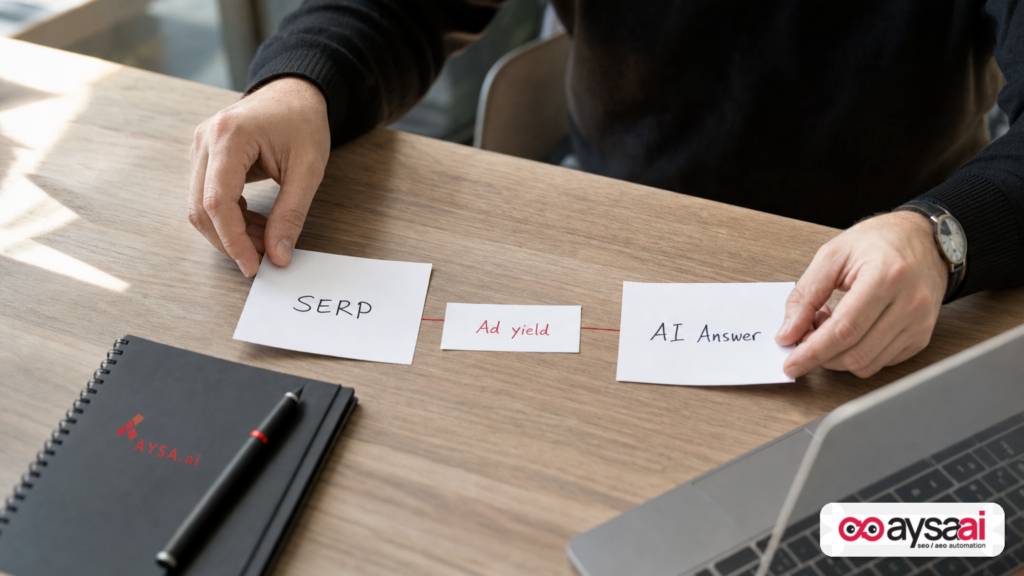
- Query growth can rise while revenue lags when more searches happen in AI Mode/AI answers that monetize less than classic results pages.
- Google’s logical fix is to move more ads into the answer (AI Overviews and AI Mode), including formats designed for multi-turn conversations.
- Organic visibility doesn’t disappear—but the inventory shrinks: fewer slots exist inside an answer than on a full SERP, and paid + organic compete more directly.
- SMEs should stop treating “rankings and sessions” as the only scoreboard and start tracking: presence in AI answers, citation share vs competitors, and revenue-quality outcomes.
- Execution speed becomes a moat: the winners will monitor changes, prepare fixes, get approvals, and ship improvements continuously—exactly the kind of workflow AYSA supports.
Key takeaways (for busy operators)

- Assume AI answers will get more commercial. Google has a structural incentive to increase ad load and performance inside answers.
- Expect reporting confusion. “Queries” and “clicks” become noisier metrics as multi-turn interactions grow and fewer users click out.
- Defend your brand’s inclusion in answers. If you’re not cited, you’re not in the shortlist. If you’re cited inconsistently, you’re a replaceable source.
- Rebuild your SEO ops around Monitoring + iteration. Annual SEO roadmaps will underperform monthly (or weekly) execution loops.
Table of contents
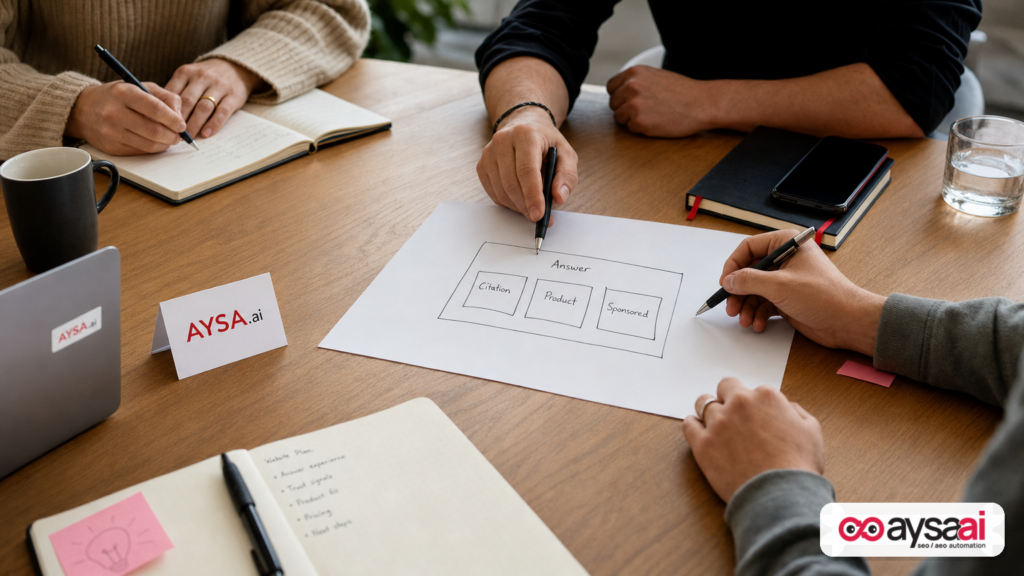
- Queries up, revenue down: why this gap matters
- The most important line: “lower monetization in AI Mode”
- Temporary vs structural causes (and why only one keeps growing)
- What a “query” means in AI Mode (and why counting changes the story)
- Why the ads move into the answer
- Inside the answer, paid and organic collide
- What changes for users (and what doesn’t)
- The SME reality check: a scenario you can recognize
- What to measure now: the AI visibility scorecard
- What to fix on your site: the “answer-ready” checklist
- What agencies must rethink (pricing, reporting, and deliverables)
- Where AYSA fits: monitoring → preparation → approval → execution
- What to do next (30/60/90 days)
- Sources and further reading
Queries up, revenue down: why this gap matters
For most of Google’s history, “more searches” and “more search revenue” moved together. Not perfectly, but close enough that marketers didn’t have to think about the plumbing. If volume grew, the ads had more auctions, the SERP had more commercial opportunities, and budgets found their way into the channel.
What Search Engine Journal highlighted in this quarter’s narrative is that the linkage is loosening: Search query growth hit a multi-year high, while Search revenue growth slowed relative to earlier quarters in 2026 (Search Engine Journal analysis).
That divergence is not just an investor story. It’s a “how buyers discover you” story.
- If AI Mode sessions are growing and monetizing less, Google will change the ad product until it monetizes more.
- If AI answers reduce outbound clicks, your old SEO KPI stack (rankings → clicks → leads) becomes less predictive.
- If the answer becomes the primary interface, then being included in the answer is the new top-of-funnel.
In other words: the surface area where you used to compete (the SERP) is being compressed into a smaller space (the answer). When space gets smaller and more commercial, competition increases. That’s the core business logic.
The most important line in the earnings call: “lower monetization in AI Mode”
The biggest shift in this quarter’s discussion is not the existence of AI answers—it’s Google acknowledging the money gap in a way practitioners can’t ignore.
Per Search Engine Journal’s write-up, Google’s leadership pointed to strong growth in AI Mode queries having an impact “because of the lower monetization we were seeing in AI Mode” (SEJ source).
Why this matters:
- It turns inference into acknowledgment. For two years, the industry argued about AI answers with click studies and partial data. This is closer to a first-party confirmation that the mix shift changes revenue dynamics.
- It clarifies incentives. Google will not voluntarily scale a product that reduces per-query earnings without redesigning monetization.
- It predicts product behavior. The path to parity is to make AI answers carry more commercial units—ads, sponsored product lists, and likely more ad formats tuned for conversational sessions.
If you run an SME, the practical translation is simple: your prospects may interact with Google more than ever while clicking your website less. Your job is to stay visible in the places where decisions are formed.
Temporary vs structural causes (and why only one keeps growing)
The SEJ analysis separates “explanations that fade” from “explanations that compound.” That’s the right mental model for planning.
Google cited several contributors to slower Search revenue growth—things like currency effects, specific retail pullbacks, and comps that change year-over-year comparisons (SEJ source).
You don’t need to be an economist to see the planning implication:
- FX headwinds are cyclical. They move, then they move back.
- Event-driven ad spikes normalize. Sports, entertainment cycles, and short-term spend anomalies come and go.
- Policy and trade changes get priced in. Advertisers adapt budgets and logistics.
- AI Mode adoption compounds. If Google is actively pushing users into AI experiences, that share grows quarter over quarter.
The only durable driver in that list is the one tied to product direction: AI Mode query share increases, and monetization needs to catch up.
That’s why “ads inside answers” isn’t a tactic—it’s a strategic inevitability.
What a “query” means in AI Mode (and why counting changes the story)
One of the quietest risks in AI Search reporting is definitional. In the traditional SERP model, a query is usually a single input that triggers a results page. In Conversational search, a “search” can be:
- an initial prompt
- a follow-up refinement
- a request for options
- a request to compare
- a constraint change (budget, location, timing)
- a final “which should I choose?”
Search Engine Journal’s source notes that AI Mode queries average longer and support multi-turn conversations, with ads designed for those sessions (SEJ source).
Here’s the practical point: query growth can accelerate mechanically if each turn is counted as a query. That doesn’t mean the claim is wrong. It means that, as operators, you should treat “record query growth” as less actionable than “revenue per query is under pressure.”
For SMEs and agencies, this shows up as confusion in reporting:
- Your brand is mentioned in AI answers, but clicks decline—your team panics.
- Your impressions rise, but conversion rate changes because traffic mix changes.
- Your “top keywords” list becomes less stable as language expands into multi-sentence prompts.
This is why we need a new scorecard (we’ll cover it below) that includes visibility inside the answer, not only what happens after the click.
Why the ads move into the answer
In classic search, Google monetized the page. In AI search, Google has to monetize the experience—because many sessions can end without a click.
SEJ’s analysis makes the next move explicit: Google will close the yield gap by scaling advertising within AI Overviews and AI Mode, expanding internationally, and introducing multi-turn ad experiences (SEJ source).
If you’ve run paid search before, you already know the playbook:
- Start with limited inventory and conservative formats.
- Test performance and user tolerance.
- Increase coverage: more queries, more users, more regions.
- Increase density: more placements per interaction.
- Improve targeting and measurement so advertisers can justify spend.
AI answers provide a tempting advantage for ad systems: the user’s intent is often expressed more richly (longer prompts, clarifying questions, constraints). That can make ad matching easier—if Google can do it without damaging trust.
And that’s the balancing act businesses must anticipate: as answers become more commercial, user trust becomes the limiting factor. Google will push until it sees friction, then tune. Your job is to not be the brand that disappears during the tuning cycle.
Inside the answer, paid and organic collide
The SERP used to be a wide playing field:
- ads at the top and bottom
- organic results
- maps
- shopping units
- featured snippets
- people-also-ask
AI Mode collapses that complexity into a smaller surface. That’s good for users—until it isn’t. But it’s unquestionably harder for brands: fewer slots to occupy, fewer ways to “win” visibility through diversified SERP features.
SEJ highlighted a particularly important detail for marketers: click-through rates can be similar between sponsored and organic product list items within AI Mode (SEJ source).
Think about what that implies operationally:
- If paid and organic perform similarly inside the answer, brands with budget will buy the slots.
- If Google needs to increase ad yield, it will allocate more slots to paid units.
- If the answer only shows a handful of products or sources, losing one slot is a major share shift.
This doesn’t mean SEO is “dead.” It means SEO changes shape:
- From ranking pages to earning inclusion as a cited source.
- From optimizing for ten results to optimizing for one synthesized response.
- From measuring clicks to measuring influence (presence, citations, and downstream branded demand).
What changes for users (and what doesn’t)
Let’s be careful not to overstate the shift. People still browse. People still compare options. People still click websites when the decision requires proof, pricing, availability, or trust signals.
What changes is the sequence.
The new default path: results page → shortlist → site
Historically, Google’s SERP helped users create a shortlist by scanning titles, URLs, and snippets. Now, the AI answer often creates the shortlist directly:
- “Here are the top options…”
- “Based on your budget and location…”
- “If you care about X, choose Y…”
Once the shortlist exists, the user may click for confirmation—not discovery. That means your website still matters a lot, but the opportunity to get discovered may occur before the click.
Trust becomes the product (again)
In AI answers, trust is fragile. If users feel answers are overly sponsored, they will adapt: different queries, different platforms, different behaviors.
So the future is not “ads everywhere.” It’s “ads where they can be justified.” That will still be a lot of places, and it will still increase competitive pressure in commercial categories.
The SME reality check: a concrete scenario you can recognize
Imagine a realistic business: a mid-sized ecommerce brand selling ergonomic office chairs. They’re not a global brand, but they have a strong niche reputation, solid reviews, and decent content.
In 2024–2026, their playbook looked like this:
- Rank for “best ergonomic chair for back pain” and similar keywords.
- Publish comparison content and buying guides.
- Run Google Shopping and branded search ads.
- Measure success via sessions, ranking improvements, and ROAS.
Now AI Mode grows. A user asks:
- “I’m 6’2, 210 lbs, working 10 hours/day, budget $600, need something for lower back pain—what should I buy?”
The AI answer returns a shortlist. It might include:
- 2–3 product recommendations with brief rationale
- citations to a couple of sources
- a product list unit that might be organic, sponsored, or mixed
Here’s the SME problem: your chair brand can lose 30–50% of its discovery surface area overnight without a ranking drop, simply because fewer users ever see the classic SERP and fewer click through to browse.
And here’s the SME opportunity: if your product pages and buying guides become a frequently cited source, you can maintain influence even with fewer clicks—because you’re in the answer that creates the shortlist.
What determines which way it goes is not one “SEO trick.” It’s whether you build a system for:
- Monitoring presence in AI answers
- Identifying which pages/entities get cited (and why)
- Fixing site issues that prevent inclusion (entity clarity, structure, trust signals)
- Publishing content that is answer-friendly (comparisons, constraints, real-world guidance)
What to measure now: the AI visibility scorecard
When interfaces change, the biggest business risk is measuring the wrong thing for too long.
Classic SEO reporting overweights:
- Keyword rankings
- Organic sessions
- CTR
- Average position
Those metrics still have value, but they’re no longer sufficient. You need a scorecard that reflects “answer-first” discovery.
1) AI answer presence (yes/no) for your most important intents
Pick a manageable set of intents (not thousands of keywords):
- 5–10 “money” intents (purchase-ready)
- 10–20 “consideration” intents (comparisons, best-of)
- 10–20 “support” intents (setup, warranty, compatibility)
Your first baseline question: Are we present in the answer? Not “do we rank.” Not “did we get clicks.” Presence is step one.
If you want the operating model behind this, see AYSA’s overview of AI visibility work: AI Search Visibility.
2) Citation share vs competitors
Inside answers, you’re not competing against “the internet.” You’re competing against the handful of sources the model chooses to cite or list.
Track:
- How often you’re cited
- Which pages are cited
- Which competitors show up instead
- Whether citations cluster around a single asset (risk) or multiple (resilience)
This is one reason “aggregate organic traffic” can be misleading: your influence may move upstream into the answer while your traffic moves downstream.
3) Branded demand as a lagging confirmation signal
When AI answers shape shortlists, you often see a shift from non-branded to branded behavior:
- Fewer generic clicks
- More “Brand + product” queries later
Branded demand is not perfect, and many factors affect it, but it can confirm that you’re being selected earlier in the journey.
4) Conversion quality by channel mix (not just volume)
If organic sessions fall, the reflex is to panic. Instead, measure:
- Lead quality
- Time to close
- Average order value
- Return rate / churn
AI-driven discovery can send fewer but better-qualified visitors. Or it can send worse. You need to know which.
5) Monitoring discipline: volatility is the new baseline
AI answers change faster than classic rankings. You need monitoring as a habit, not a quarterly audit.
AYSA’s monitoring approach is designed for this environment: AYSA Monitoring.
What to fix on your site: the “answer-ready” checklist
AI search shifts emphasis toward clarity, entity understanding, and reusable explanation. If you want to be included in answers, your site must be easy to interpret and easy to trust.
This is not about gaming a model. It’s about removing ambiguity and making your expertise legible.
1) Make your entity unmissable
- Consistent brand name, address, and identifiers across your site
- Clear “About” and “Contact” pages
- Team, credentials, and editorial responsibility when applicable
- Policies that reduce risk for users (returns, warranty, cancellations)
If the model can’t confidently connect “who you are” to “what you claim,” it will prefer a clearer source.
2) Build an information architecture that answers real questions
AI answers reward pages that map to decision steps:
- Comparison pages (“X vs Y”)
- Constraint-based guides (“best for small rooms,” “best for sensitive skin”)
- Compatibility and requirements (“works with,” “supported devices,” “insurance accepted”)
- Pricing and packaging clarity
Many SMEs have the knowledge but hide it in PDFs, support tickets, or sales calls. Bring it onto the site.
3) Use structured data where it genuinely reflects the page
I won’t list schema types as a magic bullet. But in an “answer-first” world, structure helps interpretation.
If you’re unsure, focus on basics:
- Accurate product/service details
- Availability and pricing when applicable
- Reviews displayed honestly (no manipulation, no fake aggregates)
Make sure the structured data matches visible content; mismatches create trust issues.
4) Write content that is quotable and constraint-aware
AI answers often synthesize. That means content that performs well tends to be:
- Specific (numbers, ranges, constraints, “if/then” logic)
- Comparative (tradeoffs, pros/cons)
- Grounded (real use cases, setup steps, pitfalls)
- Maintained (freshness matters for commercial categories)
Don’t just publish “ultimate guides.” Publish decision tools.
5) Technical trust: don’t lose on basics
Even in an AI era, basic site quality remains table stakes:
- Crawlability (important pages accessible, not blocked)
- Speed and stability (especially on mobile)
- Clean canonicalization and duplication controls
- Indexation hygiene (avoid wasting signals on thin variants)
The more the ecosystem gets competitive, the less you can afford preventable technical debt.
If you want an “execution system” rather than another audit PDF, see AYSA’s AI SEO tools: AI SEO Tools.
What agencies must rethink (pricing, reporting, and deliverables)
If you run an agency, the AI answer era is a business model stress test.
1) Reporting must move beyond rankings and traffic
Clients will still ask for rankings. But if you only report rankings, you’ll miss the real shift. Agencies need to add:
- AI answer presence for priority intents
- Citation share vs competitors
- Content assets that “win” inclusion (and why)
- Execution velocity metrics (how quickly fixes ship)
Otherwise you’ll end up “explaining away” declining clicks while the client quietly reallocates budget to channels that feel more measurable.
2) Deliverables must become operational, not just strategic
The agency trap is producing smart strategy decks while execution lags because approvals, dev queues, and CMS constraints slow everything down.
In AI search, the compounding advantage goes to the team that ships improvements continuously. If you can’t execute, your insights decay.
3) Paid and organic teams must plan together
As ads move inside answers, “SEO vs PPC” silos become expensive. Agencies should coordinate:
- Which intents are defended with paid placements
- Which intents are built with organic authority and citations
- How landing pages support both (clear value prop, fast paths to conversion)
This is especially important for SMEs who can’t afford to buy every slot.
Where AYSA fits: monitoring → preparation → approval → execution
Most businesses don’t fail at SEO because they lack ideas. They fail because they can’t turn ideas into approved changes fast enough.
That’s the gap AYSA is built to close, and it matters more when the search surface changes faster.
1) Monitor what’s actually happening
In the answer-first era, you need monitoring that covers:
- Visibility trends (not just sessions)
- Content decay (outdated claims, missing details)
- Technical drift (template changes, indexing issues)
- Competitive movement (who is being cited now)
Start here: AYSA Monitoring.
2) Prepare changes the business can approve
AI tooling is often framed as “auto-generate content.” That’s not the real leverage for most SMEs. The leverage is:
- Identify the highest-impact fixes
- Draft the change (content, metadata, internal links, structure)
- Explain why it matters in plain language
Preparation reduces the time from insight to decision.
3) Ask for approval (because brand risk is real)
Unsupervised automation is how brands create legal, medical, pricing, and reputation disasters.
AYSA’s model is built around approved execution: propose changes, get human approval, then publish. That’s how you scale without losing control.
4) Execute accepted website changes—consistently
The teams that win are not the teams with the best single campaign. They’re the teams that compound small improvements.
If you want to evaluate whether AYSA fits your environment, start with pricing and scope: AYSA Pricing.
And if you want more operational thinking like this, see our editorial library: AYSA Blog.
What to do next: a practical 30/60/90-day plan
Here’s a realistic plan for an SME (or an agency running this for multiple SMEs). The goal is not “master AI search.” The goal is to build a repeatable system while competitors are still debating definitions.
Days 1–30: establish baselines and remove obvious blockers
- Pick your 25–50 priority intents across money/consideration/support.
- Record current presence in AI answers (manual at first if needed) and note which pages are cited.
- Identify the top 10 pages that should be cited but aren’t.
- Fix foundational trust pages: About, Contact, policies, service areas, credentials.
- Fix technical basics: indexation errors, canonical issues, broken internal links, thin duplicates.
Days 31–60: build answer-worthy assets
- Create or upgrade comparison content for the top consideration intents.
- Add constraint-based sections (“If you have X, choose Y”) that reflect how prompts are written.
- Clarify product/service eligibility and exclusions (who it’s for, who it’s not for).
- Strengthen internal linking from high-authority pages to decision assets.
- Set a maintenance cadence so content doesn’t decay.
Days 61–90: integrate paid + organic defense
- Map which intents are worth paying to defend as ad load increases in answers.
- Align landing pages so paid and organic both land on high-trust, high-clarity pages.
- Review brand messaging for consistency across site, listings, and sales collateral.
- Upgrade reporting to include AI answer presence + citation share, not just sessions.
- Decide on an execution workflow: who approves changes, how fast, and how you avoid bottlenecks.
What to do next (simple checklist)
- Document your top intents and whether you appear in AI answers today.
- Create a monthly “citation share” report vs your top 3 competitors.
- Refresh 5–10 key pages to be clearer, more constraint-aware, and more quotable.
- Fix technical friction that prevents your best pages from being understood and trusted.
- Decide how you’ll ship changes continuously—with approvals—so you can keep up.
AYSA perspective: the winners won’t be the loudest, they’ll be the fastest
The biggest strategic mistake I see businesses make in search transitions is waiting for “certainty.” They want Google to define everything, vendors to standardize metrics, and platforms to settle.
But the compounding advantage goes to operators who build:
- a baseline
- a monitoring loop
- a change pipeline
- an approval system
- a consistent execution cadence
Whether the next report clarifies query definitions or not, the direction is clear: AI answers are growing, monetization is catching up, and more ads are moving into the answer. Your job is to ensure your brand remains one of the few options the answer recommends, lists, or cites.
If you want to build that system with an approved execution model, start here:
Sources and further reading
- Search Engine Journal: Google Search Queries Hit A 5-Year High, And Search Revenue Didn’t Follow
- Search Engine Journal: AI Search coverage
- Search Engine Journal: SEO coverage
- Search Engine Journal: Paid Media coverage
- Search Engine Journal: Google algorithm updates history
- Duane Forrester author page (context on the source analyst): Duane Forrester Decodes
Note: The SEJ source references details discussed on Alphabet’s earnings call and in its earnings materials, but those primary links were not included in the provided research context. Where you need investor-grade verification (exact wording, tables, constant-currency breakdowns), consult Alphabet/Google’s official investor relations materials directly.
Continue the AI search topic inside AYSA.
Use these pages to connect the article with AI SEO tools, AI visibility monitoring, AI Overviews and approved website execution.
Turn this topic into a website action plan.
Use these AYSA hubs to move from reading to technical fixes, AI visibility monitoring, research, glossary context and approval-first SEO execution.