
Bruce Clay’s Last Lesson for the AI Search Era: Optimization Still Wins—But Only If You Can Execute
The SEO pioneer’s final industry conversation is a timely reminder: rankings don’t come from hype or new acronyms—they come from structured information, technical discipline, and continuous execution. Here’s what changed with AI search, what still holds, and what SMEs and agencies must do next.

Search doesn’t usually pause to mourn. It simply changes, quietly at first, then all at once. But when a true pioneer leaves us, it’s worth stopping—not to romanticize the past, but to capture what still works before the industry runs off chasing the next acronym.
Bruce Clay was one of the people who helped define what “SEO” even meant. In a tribute published by Search Engine Land, Rob Garner shared what became Bruce’s final industry conversation—touching on AI, the role of structure, and the craft behind ranking. As I read it, what hit me wasn’t nostalgia. It was how relevant Bruce’s mental model remains: optimization is not a buzzword. It’s a discipline.
And that discipline is under pressure right now.
AI summaries in search experiences, AI-driven citation patterns, and the blending of paid and organic visibility are reshaping how customers discover businesses. The biggest mistake I see founders and marketers make is assuming that AI Search replaces SEO—or that they can “GEO” their way out of a visibility decline with a new checklist. The reality is harsher and simpler: the winners will be the organizations that can execute continuous improvements to their websites, their content structure, and their credibility signals faster than their competitors.
This editorial is my operator’s synthesis: what changed, why it matters, what to do about it, and how AYSA fits as an execution system that monitors, prepares, asks for approval, and ships accepted website changes.
Concise summary
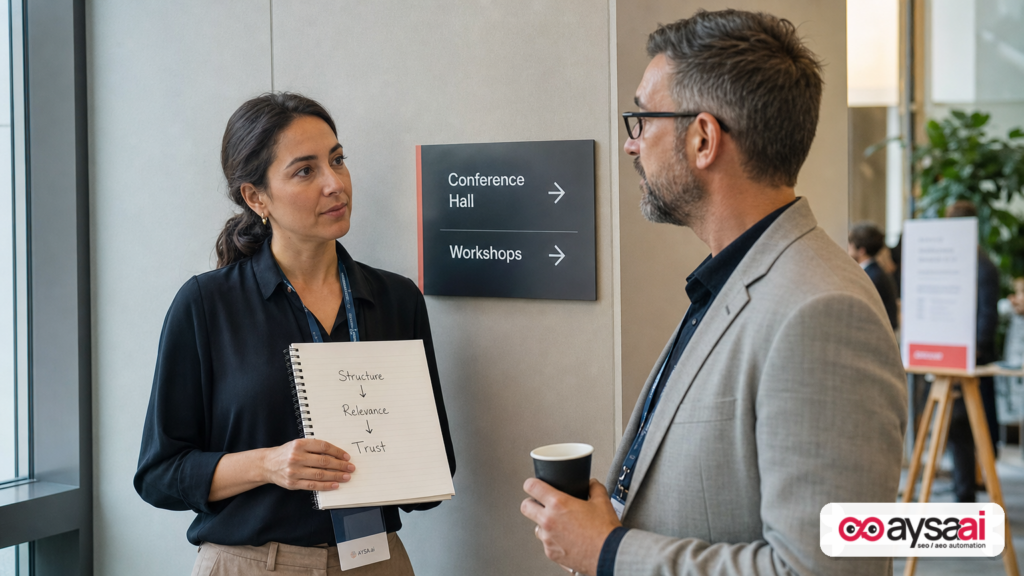
- AI search shifts the unit of competition from “ranking a page” to “being selected, summarized, and cited.”
- Foundational SEO still matters: information architecture, content structure, technical cleanliness, and authority signals.
- New acronyms (AEO/GEO/etc.) are less important than outcomes—and the ability to implement changes repeatedly.
- Traffic will be noisier. Many businesses will see fewer Clicks but equal or higher-quality leads if they become a cited source.
- The new moat is execution velocity: identifying issues is easy; consistently fixing them is rare.
Key takeaways (for busy founders)

- Stop treating “AI search” as a separate channel. Treat it as a new presentation layer sitting on top of the same underlying web ecosystem.
- Invest in “citation readiness”: clear answers, structured pages, defensible claims, and verifiable references.
- Measure what matters: qualified leads, assisted conversions, branded demand, and visibility in AI experiences—not only clicks.
- Build a repeatable improvement loop. Tools don’t implement changes; systems do.
Table of contents
- The tribute that matters to operators: why Bruce Clay’s framing still holds
- The naming problem: why AEO/GEO/AIO isn’t the point
- What changed in 2024–2026: from ranking pages to being cited by models
- Structure is strategy: content that models can parse, trust, and reuse
- Authority in the AI era: more than backlinks, less than “brand vibes”
- The new “SEO stack” is really an execution stack
- Paid media is becoming an SEO investment (yes, really)
- Measurement: when traffic drops but business performance improves
- A concrete SME scenario: the local clinic that ‘lost traffic’ but gained patients
- What agencies should rethink: deliverables, approvals, and accountability
- An action plan for SMEs: 30/60/90 days
- Where AYSA fits: an approved execution system for AI-era SEO
- What to do next
- Sources and further reading
The tribute that matters to operators: why Bruce Clay’s framing still holds
The Search Engine Land tribute isn’t just an obituary. It’s a reminder that our industry has always been built by practitioners who cared about the intersection of technology, language, and business outcomes.
In the source conversation, Bruce describes how he came from optimization work—mainframes, PCs, systems—and recognized that the web had both technical and marketing dimensions. He didn’t treat search as a hack. He treated it like engineering: learn what systems reward, build for that, and keep iterating.
That worldview is a direct antidote to what I call “AI panic marketing,” where teams react to every new SERP change by renaming their services and shuffling their tool stack without improving the underlying asset: their site and content.
Bruce also touched on something subtle but powerful: the search industry’s habit of naming things—and how names can clarify a craft, but can also distract from it. That’s exactly where we are today.
The naming problem: why AEO/GEO/AIO isn’t the point
When a market changes, language changes first. It’s how we negotiate meaning. In Bruce’s early era, “search engine positioning,” “ranking,” and “optimization” competed until SEO became the shared shorthand.
Today we’re watching a similar scramble: AEO (Answer Engine Optimization), GEO (Generative Engine Optimization), AIO (AI optimization), and more. Some of these terms may stick. Many won’t. But for operators, the naming debate is a trap if it postpones action.
Here’s the practical framing I recommend:
- SEO = making your web presence discoverable and compelling in traditional search results.
- AEO/GEO = increasing the likelihood your information is selected, summarized, and cited by AI systems.
Notice what’s missing: a radical new set of fundamentals. Most of the work still comes down to:
- Clear information architecture
- Pages that answer specific intents
- Evidence and credibility
- Technical hygiene (crawlability, speed, indexing signals)
- Iteration based on measurement
So yes, we can use newer terms when helpful. But your business won’t win because you adopt a term. You’ll win because you build a system that repeatedly improves your content and site in ways both humans and machines can use.
What changed in 2024–2026: from ranking pages to being cited by models
Traditional search trained businesses to think in a straight line:
- User searches → results list → user clicks → website converts
AI-enhanced search adds a new layer:
- User searches → AI summary/overview → user is satisfied or clicks a cited source → conversion happens on-site or off-site
This changes behavior in three ways that matter for SMEs:
1) The click is no longer the default outcome
If the AI summary answers the question, the user may never visit your site—even if your content helped generate the answer. That can feel like “traffic disappearing,” even while your brand influence grows.
(Search Engine Land has been tracking this broader shift across AI features and SERP behavior; see their ongoing coverage of AI features, including pieces like Google testing AI-generated summaries in Search ads.)
2) The unit of visibility becomes a citation (or inclusion)
In AI experiences, you compete to be included in the model’s output. That means your content needs to be easy to extract, verify, and present. “Great writing” helps, but structure often wins.
Search Engine Land also highlighted how AI modes can shift which sources are cited (e.g., ChatGPT Thinking mode changes which brands get cited). The exact mechanics vary by system, but the trend is consistent: citation patterns can change quickly, and brands must be resilient.
3) Your website becomes training data for customer decisions
Even when users don’t click, your content can influence what they believe. This creates a new kind of risk:
- Outdated pages can propagate outdated claims.
- Thin content can lead to oversimplified or incorrect summaries.
- Inconsistent positioning across pages can produce inconsistent AI outputs.
The strategic conclusion: you need to treat your site less like a brochure and more like a maintained knowledge asset.
Structure is strategy: content that models can parse, trust, and reuse
Bruce Clay’s reputation wasn’t built on “tricks.” It was built on communicating that search engines—then and now—reward understandable structure. That’s even more true in AI search, where systems must compress information into answers.
Here are the structural moves that consistently matter for SMEs (and are painfully under-implemented):
1) One page, one job
Many SMEs create pages that try to do everything:
- Explain the company
- List services
- Tell a story
- Rank for 30 keywords
That was already risky in traditional SEO. In AI search it’s worse, because models need clear, bounded answers.
Operator guidance: Make sure your key pages map to one primary intent each: “pricing,” “how it works,” “best X for Y,” “symptoms and treatment,” “shipping and returns,” “compatibility,” etc.
2) Use headings like a contract
Headings aren’t decoration. They’re a promise to both users and machines about what’s inside.
- Use a clear H1 that matches the intent.
- Use H2s as the major sub-questions a customer has.
- Use H3s for specifics, constraints, and exceptions.
If your page can’t be quickly summarized by its headings, you don’t have a content asset—you have a wall of text.
3) Add FAQ sections that answer real questions (not marketing fluff)
AI summaries often revolve around common questions. If you don’t provide crisp answers, the model will synthesize from others—often your competitors.
A strong FAQ:
- Uses the exact wording customers use
- Answers in 2–5 sentences first, then adds nuance
- Includes constraints (“depends on…,” “in these cases…”) so you’re not misquoted
4) Internal links are your “knowledge graph” on a budget
Most SMEs underuse internal linking. In an AI era, internal links do two things:
- They help crawlers and users discover your deeper expertise.
- They clarify which page is the authority for a subtopic.
If you publish a great guide but never link to it from your money pages, you’re leaving visibility on the table.
5) Freshness isn’t “new blog posts”—it’s maintaining truth
A neglected page can become an AI liability. For example:
- Old pricing
- Old features
- Old medical guidance
- Outdated policies
AI systems may surface your outdated version because it’s still indexed and still “authoritative.” That’s why maintenance is no longer optional.
AYSA’s monitoring loop is built for this reality: continuous monitoring + prepared updates + approval + execution.
Authority in the AI era: more than backlinks, less than “brand vibes”
Authority is one of the most abused words in marketing. In practice, authority is simply: why should a system trust you enough to recommend you?
In traditional SEO, backlinks and brand searches often correlated with authority. In AI search, the signals expand. Without claiming precise weighting (we shouldn’t), we can still talk about what is defensible:
Evidence beats adjectives
AI systems are more likely to reuse content that contains verifiable specifics. Replace:
- “We’re the best”
- “High quality”
- “World-class”
With:
- Clear product specs
- Process steps
- Constraints and compatibility notes
- Documented policies
- Case examples (without inventing numbers)
Be unambiguous about who you are
Many small businesses are “fuzzy” online: inconsistent names, addresses, bios, and service definitions across pages. In local contexts, that can be fatal.
If your business serves specific regions, keep location and service descriptions consistent across your main pages and your contact/about pages.
Proprietary data is defensible—if you can maintain it
Search Engine Land highlighted the strategic value of proprietary data as a citation asset (Why proprietary data is your most defensible AI citation asset). The key word is “defensible.” If anyone can publish it, you won’t own the narrative.
SMEs often think they don’t have proprietary data. Usually they do:
- Ecommerce: inventory trends, sizing notes, compatibility matrices
- Clinic: treatment protocols, patient prep checklists, aftercare guides
- Local service: time-to-complete estimates by job type, seasonal considerations
- SaaS: integration guides, migration paths, usage patterns (aggregated)
The challenge is upkeep. Publishing a matrix once isn’t enough; you need to keep it accurate.
The new “SEO stack” is really an execution stack
The industry talks constantly about tools. But the businesses that win are the ones that convert insight into changes. Search Engine Land’s broader coverage reflects that the “stack” is changing (see: The new SEO stack: What replaces your old toolset), but I want to make a sharper point:
Most SEO stacks fail not because they lack features, but because they lack execution throughput.
Here’s the execution stack that matters in 2026:
- Monitoring: detect changes in rankings, indexing, content drift, and AI visibility patterns.
- Diagnosis: turn signals into prioritized hypotheses.
- Preparation: generate specific page-level recommendations (titles, headings, internal links, schema hints, content gaps).
- Approval: keep brand, legal, and stakeholder alignment.
- Implementation: ship changes reliably and log what changed.
- Learning loop: measure outcomes and repeat.
AYSA is built to be that loop: it monitors, prepares, asks for approval, then executes accepted website changes. If you want the short version of how this maps to AI-era visibility, start here: AI search visibility and AYSA AI SEO tools.
Paid media is becoming an SEO investment (yes, really)
One of the more uncomfortable shifts: paid and organic are increasingly intertwined in AI-mediated discovery.
Search Engine Land explicitly framed this trend (Paid media is becoming an SEO investment in AI search). The point isn’t that you should “buy” your way into organic results. The point is that paid can accelerate the signals that organic and AI experiences respond to—especially when you’re building brand familiarity, demand, and engagement.
Practical examples where paid can support AI-era organic outcomes:
- Launch visibility: Promote a new guide or tool so it earns attention, links, and references faster.
- Brand demand: Drive awareness that leads to branded searches, which often correlate with trust and selection.
- Message testing: Use ads to learn what value propositions convert, then reflect that language on key pages.
Also, watch for new ad formats. If Google is testing AI-generated summaries within Search ads, as SEL reported (Read the source article on searchengineland.com), ad copy and landing page clarity may matter even more. If the summary misrepresents your offer, your conversion rate pays the price.
Measurement: when traffic drops but business performance improves
AI search breaks the simplicity of “more organic traffic = better marketing.” That was never fully true, but it was a useful proxy. Now it can mislead you.
Why clicks are less reliable
- AI answers reduce informational clicks.
- More SERP features push organic results down.
- Users may convert via calls, maps, or direct brand search later.
So what should SMEs measure instead?
KPIs that survive AI search
- Qualified leads: form fills, calls, bookings, demo requests (tracked cleanly).
- Revenue contribution: assisted conversions, not only last-click.
- Branded demand: trends in branded search and direct traffic (interpreted carefully).
- Visibility in AI experiences: whether your brand is being recommended/cited for your category (this is exactly why tools like AYSA’s visibility checks exist).
AYSA’s role here is to connect monitoring with action. If you’re only measuring and not executing, you’ll become an expert in your own decline.
A concrete SME scenario: the local clinic that ‘lost traffic’ but gained patients
Let’s make this real with a scenario I’ve seen versions of many times.
Business: a local clinic offering a high-intent service (imaging, dermatology, physical therapy—pick your niche).
Symptom: organic sessions drop 20–30% over a few months. The owner panics. “Google killed us.”
What’s actually happening:
- Top-of-funnel informational queries (“What causes X?”) now get AI summaries, reducing clicks.
- Meanwhile, the clinic’s pages are being used as sources more often because they have clear prep instructions and aftercare checklists.
- Patients still book—sometimes more—because the AI summary removes anxiety and sends only the most qualified people to the site or phone call.
The clinic’s real opportunity: stop chasing lost info-traffic, and double down on pages that convert:
- Service pages with crisp eligibility criteria
- Pricing/insurance explanation pages
- “What to expect” pages with step-by-step structure
- Location and booking pages built for action
What can go wrong: if those pages are inconsistent or outdated, the AI layer can amplify confusion (“Do they accept X insurance?” “Is fasting required?” “How long does it take?”).
This is exactly where execution matters. The winning clinic isn’t the one with the fanciest AI strategy deck. It’s the one that keeps its web knowledge accurate, structured, and continuously improved.
What agencies should rethink: deliverables, approvals, and accountability
If you run or hire an agency, AI search will pressure your model in three places:
1) Deliverables can’t be the product anymore
In a world where AI can generate audits and briefs in minutes, an agency selling “a monthly audit” will feel expensive and redundant.
Search Engine Land published a relevant perspective on this broader shift: Why AI deliverables should be judged by outcomes, not effort. I agree with the framing: effort is not value. Outcomes are.
Agencies will need to sell:
- Outcome ownership
- Execution reliability
- Cross-functional coordination (content + dev + brand)
2) The approval bottleneck is now your biggest enemy
Many SEO programs fail at the same spot: recommendations sit in a doc, waiting for approvals. AI search accelerates change, which means delays cost more.
A healthy agency-client relationship needs a documented approval workflow that answers:
- Who can approve content changes?
- Who can approve technical changes?
- What’s the turnaround SLA?
- What changes are pre-approved (templates, internal links, metadata)?
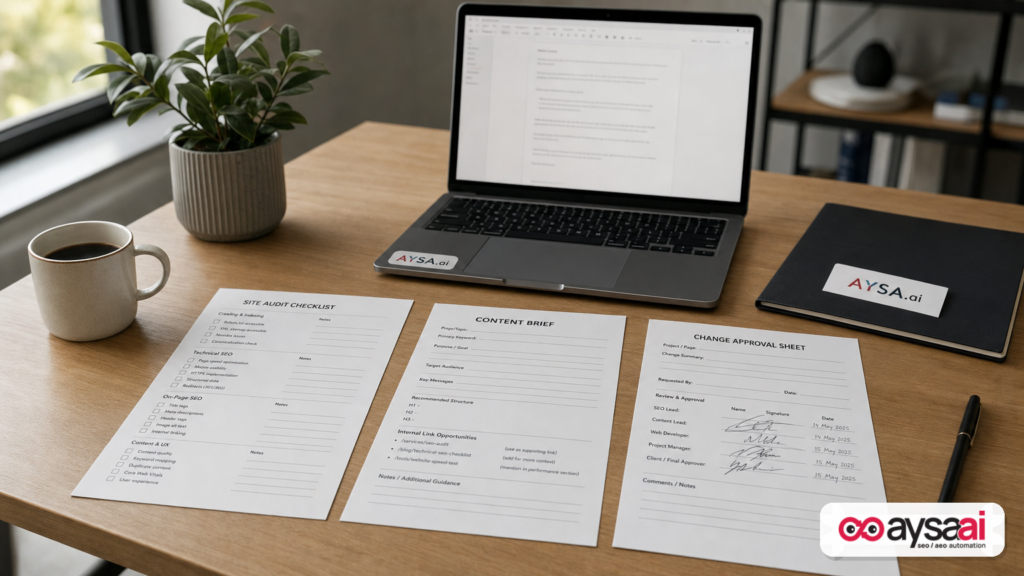
AYSA’s “prepare → approve → execute” model is designed specifically to reduce this gap between plan and production. It’s not just automation; it’s governance.
3) Reporting must evolve beyond rankings and sessions
Rankings still matter, but they don’t fully represent how AI summaries shape decisions. Agencies should add:
- Visibility in AI experiences (tracked over time)
- Content maintenance metrics (freshness, drift, coverage)
- Conversion quality metrics (lead-to-sale rate, booking rate)
Otherwise, every quarterly review becomes a debate about traffic—while the actual business might be doing fine, or the real issue might be implementation.
An action plan for SMEs: 30/60/90 days
If you’re a founder or marketing lead, you need a plan that fits real constraints: limited time, limited budget, and limited patience for jargon.
First 30 days: stabilize and clarify
- Inventory your money pages: the pages that should drive leads or sales.
- Fix obvious trust gaps: unclear pricing, missing policies, thin service descriptions, outdated statements.
- Implement structural improvements on top pages: headings, FAQs, internal links.
- Set a measurement baseline: conversions, bookings, revenue, lead quality.
Start with monitoring so you’re not flying blind: AYSA Monitoring.
Days 31–60: build citation readiness
- Create 3–5 “answer pages” for high-intent questions your customers ask before buying.
- Add comparison clarity: who your offering is for, who it’s not for, and alternatives (yes, this can increase trust).
- Strengthen internal linking from money pages to supporting guides.
If you want a practical way to think about AI visibility as a business KPI, explore: AI search visibility.
Days 61–90: scale improvements and tighten operations
- Create an ongoing maintenance cadence: monthly review of top pages, quarterly refresh of key guides.
- Identify one proprietary asset: a checklist, a matrix, a calculator, a dataset, a playbook.
- Reduce approval friction: pre-approve certain classes of changes (internal links, titles, minor copy fixes).
- Decide what you’ll automate vs. what requires human judgment.
This is also the point where most teams ask: do we hire, do we agency, or do we implement a system? If you’re evaluating options, see AYSA pricing and browse more implementation-oriented guidance on the AYSA blog.
Where AYSA fits: an approved execution system for AI-era SEO
AI is changing the discovery layer, but it’s also changing the production layer. Many teams can now generate content, audits, and recommendations faster than ever. That’s not the bottleneck.
The bottleneck is the part nobody wants to talk about:
- Actually updating the page
- Actually fixing the internal links
- Actually cleaning up duplication
- Actually maintaining accuracy over time
AYSA’s model is built for operators:
- Monitors your site and visibility signals over time (so you catch issues early)
- Prepares recommended changes (so your team isn’t stuck in analysis)
- Asks for approval (so humans stay in control and governance stays intact)
- Executes accepted changes (so the work actually ships)
If you want to see the tool layer behind this, start here: AI SEO tools.
This is not about replacing marketers or agencies. It’s about making sure good decisions become real improvements on your website, continuously. In an AI search era, that’s the difference between being a source and being forgotten.
What to do next
- Pick 10 pages that matter most (revenue pages + top informational drivers) and assess structure: headings, FAQs, internal links, freshness.
- Define your AI visibility goal: “be cited for X,” “be recommended for Y,” “own comparisons for Z.”
- Stop measuring SEO only by clicks. Add conversion quality and branded demand signals.
- Build an execution loop. If you don’t have one, you don’t have a strategy—just intentions.
- Implement monitoring so you can react before the quarter is over: AYSA Monitoring.
Sources and further reading
- Search Engine Land: In memoriam: A tribute to Bruce Clay
- Search Engine Land: The new SEO stack: What replaces your old toolset
- Search Engine Land: Google tests AI-generated summaries in Search ads
- Search Engine Land: ChatGPT Thinking mode changes which brands get cited
- Search Engine Land: Paid media is becoming an SEO investment in AI search
- Search Engine Land: Why AI deliverables should be judged by outcomes, not effort
- Search Engine Land: Why proprietary data is your most defensible AI citation asset
Related AYSA resources:
Bruce Clay helped define a discipline by insisting that words mean something—and that optimization is real work. In the AI era, that lesson becomes even more practical: you don’t win by predicting the future of search. You win by shipping improvements that make your business easier to understand, easier to trust, and easier to recommend—by humans and by machines.
Continue the AI search topic inside AYSA.
Use these pages to connect the article with AI SEO tools, AI visibility monitoring, AI Overviews and approved website execution.
Turn this topic into a website action plan.
Use these AYSA hubs to move from reading to technical fixes, AI visibility monitoring, research, glossary context and approval-first SEO execution.

