
Google’s AI-Generated Summaries Under Search Ads: What It Means for Paid Search, Brand Control, and the New “Ad Truth Layer”
Google is testing AI-generated summaries beneath Search ads—an “ad truth layer” that could change how people interpret your paid message, what gets clicked, and who owns the narrative. Here’s what changed, why it matters, and how SMEs and agencies should respond with monitoring, message hygiene, and approved execution.

Google is testing something that sounds small, but could quietly change how paid search works: AI-generated summaries that appear beneath Search ads. If this expands beyond a limited experiment, it introduces a new layer of interpretation between your ad and your customer—written by Google’s AI, not by you.
As a marketer and operator, I read this as more than a UI tweak. It’s a shift in who gets to explain your offer at the most expensive moment in the funnel: when a person is about to click an ad.
This editorial breaks down what’s changing, why it matters for SMEs and agencies, where things can go wrong, and what to do now to protect performance and brand control. I’ll also explain how AYSA fits as an execution system for the new reality: monitor, prepare, ask for approval, and execute changes that keep your messaging consistent across ads, landing pages, and the AI layer.
Concise summary
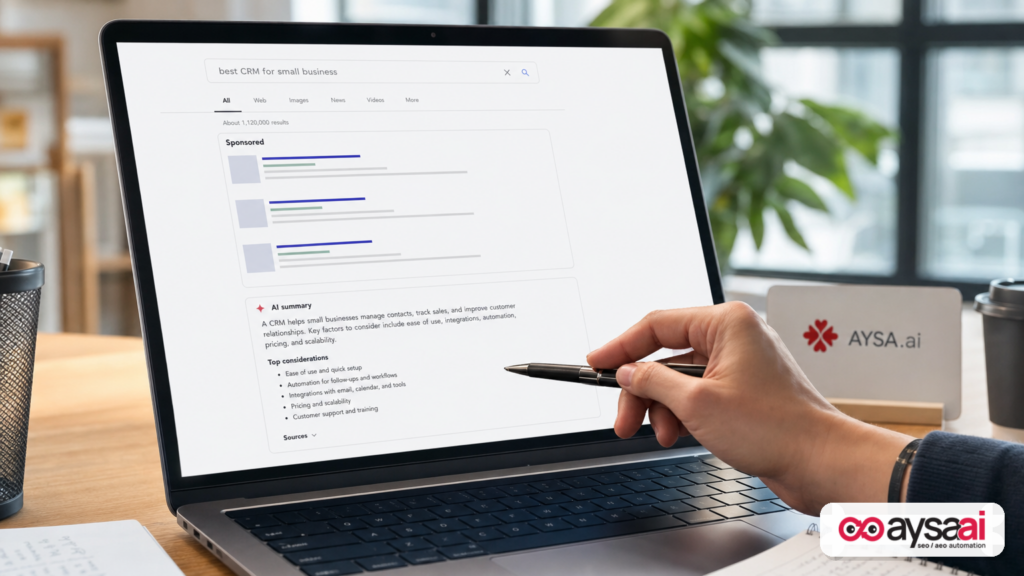
- What changed: Google is testing AI-generated summaries displayed under Search ads, with an AI disclaimer.
- Why it matters: The AI summary can steer interpretation of the ad—potentially affecting trust, CTR, lead quality, and brand control.
- What can go wrong: Inaccurate summaries, compliance risk, mis-framing (especially for complex or regulated offers), and “message drift” between ads and landing pages.
- What to do now: Treat your website as the source of truth, tighten claim language, align ad/landing content, monitor SERP changes, and build an escalation plan.
- Where AYSA fits: AYSA helps you monitor changes, spot inconsistencies, propose fixes, route them for approval, and execute approved website updates—fast and safely.
Table of contents
- What Google is testing (and what’s actually new)
- Why this is happening now: the direction of Search
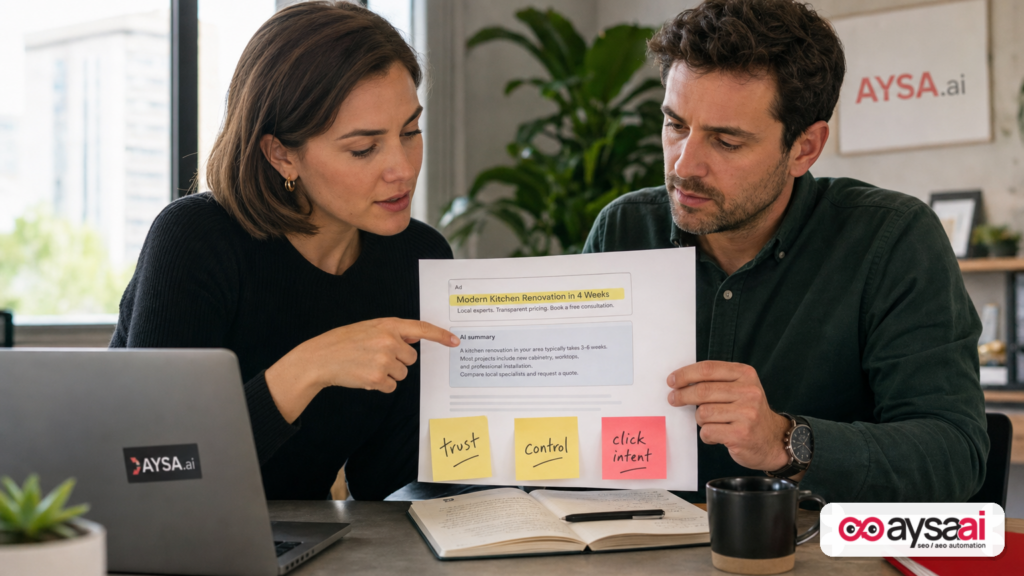
- The “ad truth layer”: why this changes paid search psychology
- Who benefits (and who gets squeezed)
- Failure modes: what can go wrong when AI summarizes your ad
- What to measure: the KPIs that will show impact first
- Message hygiene: making your ads and pages “summary-proof”
- A concrete SME scenario: a local clinic, an ecommerce brand, and a SaaS company
- What agencies should rethink: operations, approvals, and accountability
- A practical action plan (30/60/90 days)
- Where AYSA fits: monitored recommendations + approved execution
- What to do next
- Sources and further reading
What Google is testing (and what’s actually new)

According to reporting by Search Engine Land, Google is running a small experiment where some advertisers see AI-generated summaries displayed directly beneath Search ad descriptions. The summaries include a disclaimer along the lines of: AI responses are generated independently and can make mistakes, so users should double-check. Search Engine Land also noted the test was spotted by a marketer and shared publicly, and Google characterized it as a limited experiment designed to help people make more informed decisions.
The key novelty isn’t “Google uses AI.” Google has been integrating generative AI into Search for a while. The novelty is this:
- The AI text appears inside the paid unit (or at least directly attached to it), not just in organic modules.
- The AI is summarizing and framing advertiser claims—potentially highlighting what it believes is “relevant,” not what the advertiser prioritized.
- It changes what users read before clicking, which can change outcomes even if your ad copy stays the same.
In other words: you’re no longer competing only on bidding + creative + landing page. You’re also competing through an AI interpreter.
Primary source context: Search Engine Land: Google tests AI-generated summaries in Search ads.
Why this is happening now: the direction of Search
Zoom out. Google Search is evolving from “ten blue links + ads” into a multi-layer decision engine—one that increasingly provides synthesized answers, comparisons, and context before a click happens.
Search Engine Land’s broader editorial lineup (visible on the same page) is a clue to the trendline: AI Overviews, AI prompt-level visibility, paid media as an AI Search investment, and more. Even without reading every article, the thematic direction is obvious: Search is becoming answer-led, and paid media is being pulled into that gravity.
When Search becomes answer-led, two consequences follow:
- Google wants to reduce user uncertainty at the SERP. Less uncertainty can mean higher satisfaction and more trust in the platform.
- Google can standardize how information is presented—including sponsored information—so it feels consistent across the experience.
That’s likely the product logic behind “AI summaries beneath ads.” You can interpret it as Google trying to help users interpret offers more quickly. You can also interpret it as Google making the ad unit more “complete” so a user can decide with fewer Clicks.
Either way, the strategic implication for businesses is the same: you need to manage not just ad copy, but the information ecosystem the AI can draw from.
The “ad truth layer”: why this changes paid search psychology
Let’s talk about human behavior, not just marketing mechanics.
Historically, a Search ad worked like this:
- User sees a query match
- User scans headline + description + visible URL
- User decides to click (or not)
- Landing page does the persuasion and conversion
The new model introduces something like an “ad truth layer”:
- User sees your ad claim
- User immediately sees a machine-generated summary that appears to validate, clarify, or contextualize that claim
- User’s trust judgment is influenced by the AI layer
- Click happens (or doesn’t)
This matters because most people treat summaries as interpretations, not raw marketing. Even with disclaimers, the AI block may feel more “objective” than ad copy. That can:
- Increase clicks if the summary resolves doubt and emphasizes your strongest differentiator.
- Decrease clicks if it highlights caveats, missing info, pricing uncertainty, or alternatives.
- Change lead quality if it pre-qualifies users differently than your ad copy does.
From a business standpoint, the big change is accountability: you pay for the click, but you may not fully control the narrative that drives it.
Who benefits (and who gets squeezed)
Whenever Google adds a new interpretive layer, the winners tend to be the businesses that already operate with strong “information hygiene.”
Potential winners
- Brands with clear, consistent websites where pricing, availability, policies, and differentiators are explicit.
- Offers that are easy to summarize (simple product categories, straightforward service packages).
- Advertisers with strong trust signals (transparent FAQs, policies, reviews embedded on-site, clear contact info).
Potential losers
- Brands with messy or contradictory content across landing pages, FAQs, and product pages.
- Advertisers relying on clever ambiguity (“from $X”, “up to Y%”, “as low as”, “instant approval”) without clarifying conditions.
- Complex regulated categories where nuance matters (health, finance, legal), because summaries can omit crucial qualifiers.
There’s also a subtle competitive angle: if AI summaries end up being influenced by what’s commonly known or widely repeated about an offer category, then category-level narratives (including competitor positioning) might bleed into how your ad is framed.
I can’t verify how Google generates these ad summaries from the limited public context we have, so I won’t claim it’s using a specific data source. But as a strategic precaution, assume the summary could be influenced by multiple inputs and that you should treat “clarity” as a ranking factor for paid interpretation.
Failure modes: what can go wrong when AI summarizes your ad
Search Engine Land highlighted obvious concerns: accuracy, brand control, and performance impact. Let’s go deeper and translate that into operational failure modes you can actually plan for.
1) Inaccuracy and implied claims
The disclaimer matters because it implicitly admits summaries can be wrong. In paid search, even small inaccuracies can be expensive:
- A price range summarized incorrectly can spike refunds and support load.
- A shipping promise summarized too optimistically can create chargebacks and negative reviews.
- A service scope summarized too broadly can generate irrelevant leads.
2) Compliance and category sensitivity
If you operate in a category where claims are regulated or scrutinized, an AI-generated summary could create risk by:
- Removing necessary disclaimers or conditions
- Overstating outcomes
- Turning “may help” into “will help”
Even if the platform owns the summary, your brand can still carry reputational and operational fallout. If you’ve ever lived through an ad disapproval, a policy review, or a customer complaint that starts with “your ad said…”, you know how fast this can spiral.
3) Message drift between ad, summary, and landing page
Many businesses already suffer from message drift:
- Ad says “24/7 support.”
- Landing page says “support available Mon–Fri.”
- FAQ says “after-hours support for enterprise plans only.”
A summary system will tend to pick one of these statements or blend them. If it blends them, you get a new problem: a “third truth” that doesn’t exactly exist anywhere.
4) Mispositioning and the loss of nuance
Some offers win because of nuance. For example:
- A clinic that is premium, not cheap
- A SaaS that is secure and configurable, not “fast and easy”
- An ecommerce brand that is artisan-made, not mass-produced
If the AI summary compresses nuance into generic language, you can lose your differentiator—then you’re just another listing with a higher CPC.
5) Conversion rate impacts that don’t show up as “ad performance”
Paid search teams often judge success by CTR, CPC, and conversion volume. But summaries can shift:
- Conversion rate (because users arrive with different expectations)
- Refund rate / return rate
- Sales cycle length
- Support tickets per order
If you only watch ad account metrics, you may miss the real business cost.
What to measure: the KPIs that will show impact first
If Google expands this test, a lot of marketers will do what they always do: watch CTR.
CTR will matter—but it won’t be enough. You’ll want a measurement stack that detects “interpretation changes,” not just traffic changes.
1) SERP-level monitoring (presence and wording)
You need to know:
- When the AI summary appears for your queries
- What it says (at least in sampled checks)
- How often the wording changes
This is hard to do manually at scale, which is why operational Monitoring matters. AYSA’s approach starts with monitoring so you can detect meaningful shifts early: AYSA Monitoring.
2) Lead quality and downstream outcomes
Track at least one downstream indicator that reflects expectation alignment:
- Qualified lead rate (sales accepted leads vs. total)
- Return/refund rate for ecommerce
- Appointment no-show rate for local services
- Trial-to-paid conversion for SaaS
3) Brand search lift and brand sentiment signals
If summaries change perception, you might see changes in:
- Branded query volume
- “Is [brand] legit” style queries
- On-site searches and FAQ clicks
I’m not asserting you will see these changes—only that they’re plausible and worth monitoring if the experiment becomes widespread.
Message hygiene: making your ads and pages “summary-proof”
If there’s one practical concept to take away, it’s this:
AI summaries reward clarity and consistency. If your site is vague, contradictory, or missing basics, you’re inviting the AI to fill gaps. And gap-filling is where brands lose control.
Build a single source of truth on your website
Your website should answer, in plain language:
- What is it?
- Who is it for?
- What does it cost (or how is pricing determined)?
- What are the conditions and exclusions?
- What’s the process?
- What are the policies (returns, shipping, cancellations, warranties)?
This isn’t just good conversion copy. It’s defensive marketing against mis-summarization.
Tighten claim language across ads and landing pages
Do an audit of the “high-risk claims” that summaries might compress incorrectly:
- Price (“from”, “as low as”, “starting at”)
- Time (“same day”, “instant”, “24/7”)
- Outcomes (“guaranteed”, “best”, “#1”, “cures”, “approved”)
- Availability (“in stock”, “ships today”, “limited time”)
Where you must use conditional language, make the condition explicit on the landing page near the top—not buried in a footer.
Use FAQ-style clarity (even if you don’t love FAQs)
FAQs are not just for SEO. They’re a structured format that reduces ambiguity. If an AI is summarizing, it’s easier to summarize content that’s already in a question-answer shape.
For many SMEs, adding a well-written FAQ is one of the fastest ways to reduce customer confusion and improve conversion. It’s also a way to reduce “AI hallucination surface area,” because the facts are explicit.
Align ad groups with landing pages by intent, not just keyword
If you’re sending multiple intents to one generic page, you increase the odds the AI summary will grab a generic statement that doesn’t match the query intent.
Example: “emergency plumber” and “bathroom remodel estimate” should not share the same landing page. If they do, any summary system has to pick a frame—and it may pick the wrong one.
Operationalize it: approvals and change control
Most SMEs fail here—not because they don’t care, but because they don’t have a system.
You need a workflow that can:
- Detect issues
- Propose changes
- Route for approval
- Implement quickly
- Document what changed and why
This is exactly where execution systems matter more than strategy decks.
A concrete SME scenario: a local clinic, an ecommerce brand, and a SaaS company
Let’s make this real with three scenarios. These are representative examples—not based on any specific company’s private data.
Scenario 1: A local clinic advertising “same-day appointments”
Ad claim: “Same-day appointments available. Book online.”
Reality: Same-day is available only for certain services and only before 2pm.
What an AI summary might do: It could shorten this to “Offers same-day appointments,” removing the conditions. The clinic then gets calls from patients who can’t be booked same-day, creating frustration, bad reviews, and wasted ad spend.
Summary-proof fix:
- Update the landing page above the fold: “Same-day appointments available for X services when booked before 2pm.”
- Add a small eligibility FAQ.
- Align ad copy to match: “Same-day appointments for select services (book before 2pm).”
Scenario 2: An ecommerce brand advertising “free shipping”
Ad claim: “Free shipping on orders over $75.”
Reality: Excludes oversized items and remote regions.
What an AI summary might do: It might emphasize “free shipping” and omit exclusions. That increases CTR but also increases support tickets and returns when customers feel misled.
Summary-proof fix:
- Add a clear shipping policy snippet on product pages and cart.
- Use a consistent phrasing across the site (avoid three different thresholds in different places).
- Create a shipping FAQ that uses plain language about exclusions.
Scenario 3: A SaaS company advertising “SOC 2 compliant”
Ad claim: “Secure platform. SOC 2 compliant.”
Reality: They’re in progress, or only certain modules are covered.
What an AI summary might do: It could repeat the compliance claim as a definitive statement. If that’s not accurate, the summary becomes a risk multiplier: sales conversations start on a false premise.
Summary-proof fix:
- Update the security page with accurate status language (and keep it current).
- Add a “Security & Compliance” section that’s explicit about scope.
- Ensure ad claims exactly match the on-site security statement.
Notice the pattern across all three: the solution is not “write better ads.” The solution is align the entire information chain so any summarization stays accurate.
What agencies should rethink: operations, approvals, and accountability
If you’re an agency, this test should make you uncomfortable for one reason: clients hire you to control outcomes, and this introduces a new variable that’s not in your change log.
A new implicit deliverable: “interpretation management”
Agencies may need to add a new line item to their mental model:
- Not just ad copy and bidding…
- But also ensuring the brand is summarizable without distortion.
This blends PPC, CRO, SEO, and brand governance. The walls between channels get lower.
Client communication becomes more proactive
If an AI summary appears and performance shifts, clients will ask:
- “Did you change our ads?”
- “Why does Google say this?”
- “Are we liable for that wording?”
You need a prepared answer and a plan: monitoring, documentation, and remediation steps that don’t sound like excuses.
Operational excellence matters more than creative brilliance
In 2026, the agencies that win won’t be the ones that write the cleverest headline. They’ll be the ones that can:
- Spot shifts early
- Diagnose the cause across ads + site + SERP
- Ship fixes quickly with approval
That last part—shipping fixes quickly with approval—is where most teams break. It’s also where systems like AYSA are built to help.
A practical action plan (30/60/90 days)
You don’t need to panic. You do need to prepare. Here’s an action plan that’s realistic for SMEs and agencies.
Next 30 days: reduce ambiguity
- Inventory high-risk claims across your top campaigns and landing pages (price, time, outcomes, availability).
- Align top landing pages so the first screen answers the obvious questions.
- Create/refresh policy pages (shipping, returns, cancellations, warranties) and link them clearly.
- Set up monitoring for your priority queries and pages so you can detect SERP presentation changes. Start here: AYSA Monitoring.
Next 60 days: build a “summary readiness” structure
- Add intent-matched FAQs to top landing pages (not a mega FAQ nobody reads).
- Standardize language across site templates (shipping threshold, refund windows, appointment rules, etc.).
- Implement message governance: who approves claim changes? who owns compliance language? where is it stored?
- Review AI search visibility and brand recommendations as part of your broader funnel health. AYSA’s visibility tooling is designed for this direction of Search: AI Search Visibility.
Next 90 days: operationalize execution and testing
- Create a response playbook for when AI summaries appear and are inaccurate: documentation, internal escalation, client comms, page updates.
- Run controlled experiments on clarity improvements (not just button colors). Example: rewrite pricing explanation, then measure lead quality and support tickets.
- Adopt an approved execution loop so your team can ship improvements weekly, not quarterly.
Where AYSA fits: monitored recommendations + approved execution
At AYSA.ai, we’ve been building for the direction Search is heading: AI-led interpretation, multi-surface visibility, and constant change. The biggest gap in most businesses isn’t “knowing what to do.” It’s executing safely and consistently.
AYSA is designed as an execution system:
- Monitor your visibility and signals so changes don’t surprise you (Monitoring).
- Prepare recommended website updates that reduce ambiguity and improve alignment.
- Ask for approval so humans keep control of brand and compliance.
- Execute accepted changes to your site so improvements actually ship.
This matters in a world where Google can add an AI summary under your ad without you asking. If you can’t control the summary directly, you control what your brand publishes—and how consistently it’s communicated.
If you want to explore the toolset, start here: AI SEO Tools.
And if you’re evaluating whether this kind of execution loop fits your team size and budget, pricing and packaging are here: AYSA Pricing.
More context and editorial thinking is on the AYSA blog: AYSA Blog.
What to do next
- Audit your top 10 paid landing pages for clarity: pricing, conditions, policies, and definitions should be obvious above the fold.
- Remove contradictions (ad copy vs. landing page vs. FAQ vs. policy page). Pick one truth and standardize it.
- Rewrite “high-risk claims” to include conditions in plain English (especially time, pricing, and outcomes).
- Set a monitoring cadence for how your paid listings appear for priority queries; document changes over time.
- Build an escalation path for inaccurate AI framing: who reviews, who approves, who edits the site, and how fast.
- Adopt an execution system that can ship approved improvements quickly. This is where AYSA’s monitor → recommend → approve → execute workflow is built to help.
Sources and further reading
- Search Engine Land — Google tests AI-generated summaries in Search ads
- Search Engine Land — How to measure prompt-level visibility in AI search (research lead)
- Search Engine Land — Paid media is becoming an SEO investment in AI search (research lead)
- Search Engine Land — 6 SEO priorities to rethink for AI search (research lead)
- Search Engine Land — OpenAI can generate ChatGPT Ads for you (research lead)
Note: The source report describes a limited Google experiment and does not provide technical details on how summaries are generated or what controls advertisers may have. Where specifics are unknown, this article frames implications as analysis and operational risk management—not as confirmed platform behavior.
Continue the AI search topic inside AYSA.
Use these pages to connect the article with AI SEO tools, AI visibility monitoring, AI Overviews and approved website execution.
Turn this topic into a website action plan.
Use these AYSA hubs to move from reading to technical fixes, AI visibility monitoring, research, glossary context and approval-first SEO execution.

