
Bruce Clay’s Legacy: What the “Father of SEO” Still Teaches Us in the Age of AI Search (And How SMEs Should Execute Now)
Bruce Clay helped professionalize SEO long before it was a line item in marketing budgets. His passing is a moment to take stock: the fundamentals he championed—technical clarity, disciplined content, ethical strategy, and education—matter even more as AI Overviews, GEO, and automation reshape how customers discover brands. This is a practical, execution-first editorial for SMEs and agencies: what changed, why it matters, what can go wrong, and a 90‑day plan you can ship—with AYSA.ai as a monitor → prepare → approve → execute system.

Bruce Clay’s passing is more than a sad industry headline—it’s a checkpoint for everyone who depends on organic visibility. Clay is widely described as the “Father of SEO,” not because he discovered a single trick, but because he helped make SEO a profession: methodology, training, tools, and an insistence that this work should be done with discipline.
Search Engine Land reported that Bruce Clay passed away in late May and highlighted the scale of his support for the community, including his early agency work dating to the mid-1990s and decades of education and conference participation.
Source: Search Engine Land: “Bruce Clay, the Father of SEO, has passed away”.
Here’s my point of view as Marius Dosinescu at AYSA.ai: the AI era didn’t kill SEO. It made SEO more operational. The brands that win won’t be the ones with the most opinions about AI Overviews, “GEO,” or the next acronym. They’ll be the ones that build a reliable system to:
- monitor what’s changing,
- turn insights into concrete improvements,
- get the right approvals,
- and ship changes without breaking the site.
This editorial is not a tribute rewrite or a news recap. It’s a full, practical resource—built on what Clay’s legacy implies for 2026 and beyond: clarity, trust, and execution.
Table of contents
- Concise summary
- Key takeaways (concise)
- Why Bruce Clay matters (and what his legacy really is)
- What changed in search: from rankings to answers to recommendations
- What didn’t change: the three fundamentals that still govern visibility
- What can go wrong in the AI search era (even if you “do SEO”)
- Measurement reality: the KPIs that mislead (and the ones that matter)
- The execution gap: why most SEO programs fail quietly
- A concrete SME scenario: an ecommerce brand losing margin while traffic looks “fine”
- A second SME scenario: a local service business that becomes “invisible” in recommendations
- A modern visibility playbook: SEO + AEO + GEO (without the hype)
- A practical action plan (90 days) for SMEs and lean teams
- What agencies should rethink now (tool stacks, ownership, deliverables)
- Where AYSA fits: monitor → prepare → approve → execute
- What to do next (checklist)
- Sources and further reading
Concise summary

Bruce Clay helped shape SEO into a professional discipline. His passing is a reminder that fundamentals matter most during platform shifts. Search behavior is changing: users increasingly get answers and shortlists before they click, which means businesses must optimize for clarity, credibility, and being cited/recommended—not just ranking for a Keyword.
The biggest competitive advantage is not “having the right strategy.” It’s being able to execute safely and continuously. That’s why we built AYSA.ai: a system that monitors, prepares changes, asks for approval, and executes accepted updates—so visibility doesn’t depend on a quarterly audit that never gets implemented.
Key takeaways (concise)

- Clay’s legacy is operational: a repeatable craft, not a collection of hacks.
- Search is now multi-interface: classic results still exist, but AI summaries and recommendation layers shape decisions upstream.
- Visibility ≠ Clicks: your brand can lose share even if rankings “look stable.”
- Execution is the new moat: most teams can identify what to do; few can ship it consistently and safely.
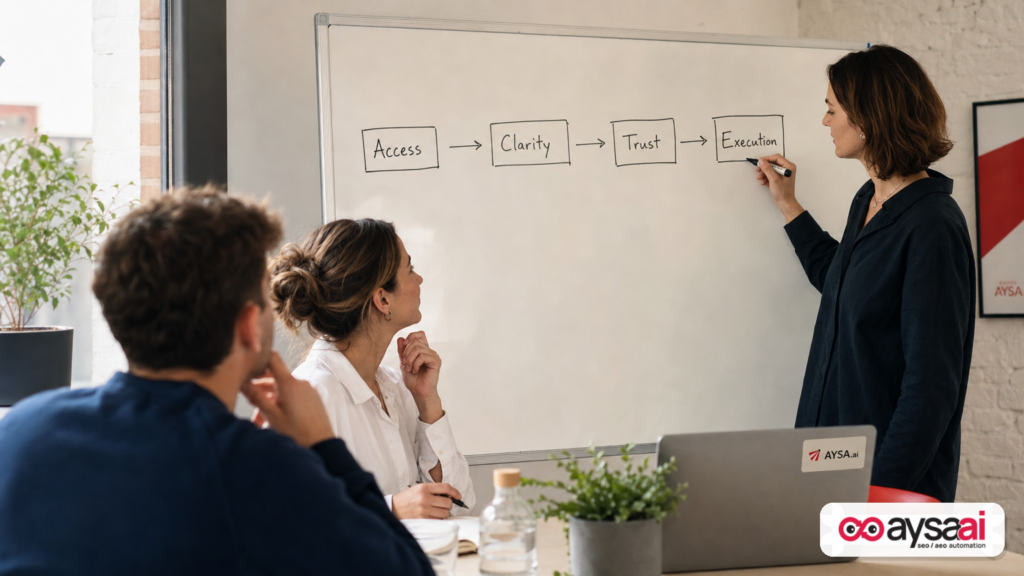
- Think in three fundamentals: access (technical), clarity (content), trust (authority/verification).
- Use a 90-day cadence: baseline → fix blockers → upgrade key pages → measure and iterate.
Why Bruce Clay matters (and what his legacy really is)
When someone is called the “Father of SEO,” the title can sound like marketing. But the Search Engine Land piece points to something real: Clay was early, consistent, and unusually generous with education and community support over decades.
That matters for a simple reason: the SEO industry has always been vulnerable to two extremes.
- Extreme #1: the gold rush. Every shift creates a new “overnight trick.”
- Extreme #2: the nihilism. Every shift triggers “SEO is dead.”
Professionals like Clay helped pull the industry toward the middle: repeatable best practices, technical rigor, and a focus on user value. In 2026, we need the same stabilizing force because AI Search is creating a new gold rush—and a new nihilism—at the same time.
My contrarian belief: the next era doesn’t belong to whoever can generate the most pages. It belongs to whoever can maintain the cleanest, most coherent, most verifiable web presence—at scale, over time, under constraints.
That’s not romantic. It’s operational.
What changed in search: from rankings to answers to recommendations
Let’s separate three layers that often get blurred:
- Ranking: “Where does my page appear?”
- Answering: “Does the platform summarize the answer before the click?”
- Recommending: “Does the system suggest a brand, product, provider, or method?”
Clay’s era was primarily about ranking. The current era includes ranking, but it increasingly uses answering and recommending to shape behavior. Search Engine Land’s broader coverage reflects that transition—especially pieces on AI search ownership and the evolving SEO tool stack.
- Why AI search is forcing global SEO teams to rethink ownership
- The new SEO stack: What replaces your old toolset
What this means for a business owner isn’t abstract. It changes where you can lose—even when you think you’re fine:
- You can rank #2 but get fewer qualified leads because the result page answers the question and filters choices.
- You can “win traffic” but lose profitability if AI recommendations send higher-intent users to competitors.
- You can publish more but be cited less if your content becomes inconsistent, duplicated, or clearly promotional.
Search Engine Land even highlighted a specific AI Overviews behavior in a separate analysis: AI Overviews may cite certain types of pages but recommend competitors in many cases, a reminder that “being present” doesn’t guarantee “being chosen.”
Context lead: Google AI Overviews cite self-serving listicles, but recommend competitors 69% of the time (useful as a directional warning, not as a universal law for every niche).
What didn’t change: the three fundamentals that still govern visibility
AI adds complexity, but it doesn’t remove the physics of visibility. If you want to be discoverable—whether via classic results, AI answers, or recommendation layers—three fundamentals still govern outcomes.
1) Access: if machines can’t reliably fetch it, evaluate it, and understand it, you don’t exist
Access is Technical SEO in plain English. Not “technical for the sake of it,” but technical as a prerequisite for being considered.
Access includes:
- Crawlability: your important pages can be discovered via internal links and aren’t blocked.
- Indexability: the pages you care about are actually eligible to appear.
- Canonical clarity: you’re not accidentally telling the engine that the wrong URL is the “main” one.
- Speed and stability: performance and UX don’t sabotage your best content.
In AI-influenced discovery, access also includes consistency. If you have three versions of the same page, mixed signals, or messy parameters, you increase the risk that systems cite the wrong information.
This is why continuous monitoring matters. Access problems rarely announce themselves with a dramatic error message. They often show up as a slow leak: fewer indexed pages, weaker internal link flow, a template change that removes headings, a plugin that adds duplicate tags.
2) Clarity: make it easy to understand what you do, who it’s for, and why it’s the best choice
In practice, “clarity” means your content answers the question behind the query. Not just the words, but the decision.
Examples of clarity improvements that don’t require a content farm:
- Explain your process step-by-step, including timelines and expectations.
- Provide pricing ranges and what drives cost (even if you can’t list exact prices).
- Create comparison pages that explain tradeoffs honestly (“X vs Y,” “DIY vs professional,” “Plan A vs Plan B”).
- Make your service areas, delivery locations, or availability explicit.
AI systems tend to reward content that’s structured, consistent, and explicit. Humans do too. If a page needs a sales call to become understandable, it’s not a great candidate for being cited or recommended.
3) Trust: prove you’re real, verifiable, and worth citing
Trust isn’t a vibe. It’s a set of verifiable signals—many of which are under your control.
For SMEs, trust looks like:
- Clear About/Company information with real names, history, and accountability.
- Real-world contact info that matches across your site and key profiles.
- Editorial standards where it matters (especially in advice content).
- Third-party references: partnerships, citations, mentions, reviews (handled ethically).
Trust is also what “protects” you from volatility. If the platform changes, the sources it prefers are usually the ones it can rely on.
What can go wrong in the AI search era (even if you “do SEO”)
The AI era doesn’t just add new opportunities; it adds new failure modes. Here are the ones that consistently hurt SMEs and agencies.
Failure mode #1: You measure the wrong thing, then optimize the wrong thing
If your only dashboard is “rankings + sessions,” you can miss real damage:
- Traffic stays flat but conversion rate drops.
- Branded search grows but non-brand demand shrinks (you’re not acquiring new customers).
- You rank for more keywords but fewer of them represent buying intent.
AI interfaces amplify this. The platform can do more “pre-click persuasion,” which changes the quality of clicks you get.
Failure mode #2: AI content inflation makes your site less coherent
AI makes it easy to publish. That’s why publishing is no longer the hard part. The hard part is maintaining a coherent knowledge base.
Content inflation creates:
- Cannibalization: pages compete against each other for the same queries.
- Index bloat: thousands of low-value URLs dilute crawl budget and site signals.
- Maintenance debt: you can’t update what you can’t even inventory.
- Trust erosion: generic, repetitive content undermines credibility.
Search Engine Land has been exploring content audit and pruning workflows as a modern necessity, not a nice-to-have.
Even if you don’t use those exact workflows, adopt the principle: consolidate before you expand.
Failure mode #3: Technical drift quietly breaks the stuff that already worked
Websites drift because teams ship changes for other reasons: new designs, new product lines, new tracking, new apps, new compliance banners, CMS updates.
Common drift problems:
- Template updates remove internal links or headings.
- Filtering and faceted navigation explode URL count.
- “Noindex” or canonical rules get applied too broadly.
- Redirect chains and soft 404s accumulate.
In the past, teams discovered this when traffic crashed. In 2026, you often discover it when you’re no longer cited or recommended—even if traffic hasn’t crashed yet.
Failure mode #4: You treat brand as separate from SEO, then wonder why recommendations favor others
Recommendation is not purely a keyword problem. It’s a brand problem, an authority problem, and a verification problem. If your competitor has clearer positioning, more third-party references, and better-defined expertise, they become the default “safe” choice.
Search Engine Land’s coverage of the “paid brand mention problem” in generative experiences is a reminder that recommendation layers can create new incentives and distortions. Even if you’re not buying mentions, you need to understand the landscape because your category’s visibility may be shaped by more than classic ranking.
Measurement reality: the KPIs that mislead (and the ones that matter)
If you’re an SME, you don’t need a PhD in analytics. You need a scoreboard that matches how customers actually buy.
KPIs that often mislead in 2026
- Average position: hides SERP feature changes and shifts in click distribution.
- Total organic sessions: can stay stable while high-intent traffic declines.
- Keyword count: incentivizes publishing noise and chasing non-commercial queries.
- “Pages indexed” as a vanity metric: more indexed pages can be a sign of bloat.
KPIs that better match modern visibility
- Revenue/lead KPI by page group: money pages vs informational vs support content.
- Brand vs non-brand query mix: are you acquiring new demand?
- Conversion rate from organic landing pages: quality over volume.
- Top query themes shifting over time: are you losing the questions that convert?
When you build a monitoring and execution cadence, these metrics become actionable: they tell you where to ship improvements, not just where to panic.
For teams explicitly prioritizing AI-era discoverability, start with AYSA’s AI Search Visibility approach and then operationalize it via Monitoring.
The execution gap: why most SEO programs fail quietly
Most organizations are not short on recommendations. They are short on shipped changes.
This is the failure pattern I see again and again:
- Audit happens (internal or external). You get a backlog of 50–200 items.
- Everyone agrees it’s important.
- Nothing ships because the work spans multiple owners: CMS, dev, design, content, brand, legal.
- Time passes. The site changes. The audit becomes stale. The same issues reappear.
In the AI era, this is more dangerous because the platform can change the “shape” of demand faster than your organization can respond. If execution lags by months, your competitor becomes the default answer.
Why this gap exists (in plain business terms)
- Ownership is unclear: SEO is “marketing’s problem” until it touches code, then it’s “engineering’s problem.”
- Risk is real: changes can break layouts, tracking, compliance, checkout flows, or medical/legal statements.
- Priorities collide: SEO rarely outranks revenue-critical product work unless you tie it to revenue.
- Tooling stops at insight: most tools detect issues; they don’t manage approvals and execution.
Bruce Clay’s legacy was about turning SEO into a repeatable practice. The next step is turning it into a repeatable delivery system.
A concrete SME scenario: an ecommerce brand losing margin while traffic looks “fine”
Let’s make the AI-era shift tangible with a scenario I’ve seen repeatedly (illustrative, not a claim about a specific business).
The business
A mid-sized ecommerce brand sells premium home goods—think cookware, specialty coffee gear, or ergonomic office accessories. They have:
- a solid category structure,
- a content team publishing guides,
- and steady organic traffic year over year.
The symptom
Traffic looks stable. Rankings for head terms look similar. But profitability declines:
- more discount-driven purchases,
- lower AOV,
- fewer purchases of premium SKUs.
What changed
The result page starts to do more decision-making before the click. Users see:
- product grids, shopping modules, and richer comparisons,
- summaries that highlight “best value” rather than “premium performance,”
- recommendations that send “serious” buyers to competitor guides that look more authoritative.
What the brand should do (practical, shippable)
- Rewrite 5–10 “money” category pages to clearly explain the premium value: materials, durability, warranty, use cases, and who it’s for (and not for).
- Consolidate buying guides so you have fewer, stronger pages that are easier to cite.
- Improve internal linking from guides to premium collections and from product pages back to decision content (“Why this model,” “How to choose”).
- Audit duplication caused by filters and variants (faceted URLs, parameters) to reduce index bloat.
The core lesson: in AI-shaped journeys, you’re not only competing on ranking—you’re competing on how the web understands your differentiation.
A second SME scenario: a local service business that becomes “invisible” in recommendations
Local and service businesses often assume AI changes won’t affect them because “people still need a provider near them.” That’s true—but the shortlist can change, and the shortlist is most of the battle.
The business
A local home services company (HVAC, roofing, pest control, or a boutique law practice) relies on organic search + referrals. They rank top 3 for several service terms and have good reviews.
The symptom
They see:
- stable or slightly down traffic,
- but a noticeable decline in call volume,
- more “price shoppers” and fewer high-quality jobs.
What changed
Search becomes more conversational and recommendation-driven. Users ask:
- “Who’s the best HVAC company for older homes?”
- “Is mini-split worth it in my climate?”
- “What should a roof replacement include?”
If your site only has thin service pages and generic blog posts, you’re not the best source to cite—even if you’re the best provider in real life.
What to ship (not what to theorize)
- Upgrade service pages into decision pages: include scope, options, timelines, warranties, and what can go wrong.
- Create “inspection” content that helps homeowners understand the process and avoids fear-based marketing.
- Make verification easy: licenses, insurance, team bios, service area, clear contact info, and consistent details.
- Build local authority via real community references and partnerships (not spam links).
AI-driven experiences reward the businesses that explain the category well—not only the businesses that sell in it.
A modern visibility playbook: SEO + AEO + GEO (without the hype)
Different people use different acronyms:
- SEO (classic search visibility)
- AEO (being the source for direct answers)
- GEO (being referenced/recommended in generative experiences)
Don’t treat these as three separate strategies. Treat them as three outputs of one system: make your site and brand the clearest, most reliable source in your niche, then ensure you can execute improvements continuously.
Layer 1: Technical foundation (access + consistency)
What to prioritize first:
- Ensure priority pages are indexable and correctly canonicalized.
- Reduce duplication from parameters, tags, and internal search pages.
- Improve internal linking so important pages aren’t orphaned.
- Prevent template regressions that remove headings or structured content blocks.
This is where most SMEs need a system, not a hero. Start with AYSA Monitoring so drift becomes a ticket—not a surprise.
Layer 2: Content designed for decisions (clarity + usefulness)
Stop thinking “keywords.” Think “decisions.” For most businesses, the content that drives conversion and citation is:
- pricing and cost drivers,
- comparisons and alternatives,
- process and timelines,
- requirements/eligibility,
- common mistakes and how to avoid them,
- maintenance/care,
- glossary-style definitions where confusion is common.
Then make it machine-friendly without writing for robots: clear headings, explicit definitions, consistent terminology, and a structure that supports scanning.
Layer 3: Authority and verification (trust + defensibility)
Authority is not “link building” as a silo. It’s the business proving it’s a legitimate, credible actor in the world.
For SMEs, the simplest authority strategy is often:
- build a strong “About” and “Team” presence,
- publish content tied to real expertise (with accountability),
- earn mentions from relevant organizations (associations, partners, local media),
- keep business details consistent across the web.
And yes: your tool stack matters. Search Engine Land has been tracking how the “new SEO stack” is evolving, which is a useful lens for teams that feel overwhelmed by point tools.
A practical action plan (90 days) for SMEs and lean teams
Most businesses don’t need a revolutionary strategy. They need a realistic plan that fits weekly constraints, ships improvements, and builds compounding advantage.
This 90-day plan is designed to be executed by:
- a founder + marketer,
- a small in-house team, or
- an agency working with limited client bandwidth.
Days 1–15: Baseline, money pages, monitoring, approvals
Goal: build the scoreboard and the execution path before you “do more SEO.”
- Define your business outcome KPI: leads, bookings, pipeline value, revenue—pick one primary.
- Identify 10–20 money pages: the pages that directly support revenue (services, categories, product families, location pages).
- Check the basics on those pages: indexability, canonical, internal links, page titles, and whether content matches the query intent.
- Set up continuous monitoring: detect technical drift and visibility decay early (AYSA Monitoring).
- Define approval rules: what can ship immediately vs what needs brand/legal/dev review.
Operational note: if you can’t answer “who approves SEO changes?” you don’t have an SEO program. You have an SEO wish list.
Days 16–45: Fix blockers, remove confusion, consolidate
Goal: stop leaks and reduce complexity before you scale content.
- Fix indexation blockers affecting money pages (noindex, canonical errors, redirect chains).
- Reduce duplication: combine overlapping pages and redirect responsibly; remove thin pages that add no unique value.
- Improve internal linking: ensure money pages receive links from navigation, relevant guides, and high-traffic posts.
- Stabilize templates: prevent the CMS from generating infinite low-value URLs.
Need a lightweight cadence to make this sustainable? Search Engine Land shared a “120-minute weekly SEO workflow” concept—useful as a model for SMEs that can’t allocate huge time blocks.
Days 46–75: Upgrade decision content that earns trust and citations
Goal: create or upgrade assets that help users decide—and that AI systems can reliably cite.
- Rewrite 1–3 core pages to be best-in-market explainers (not marketing fluff).
- Publish 3–6 support pieces that answer high-intent questions: pricing, comparisons, process, and alternatives.
- Add credibility structure where appropriate: author accountability, review notes, update dates, and clear sourcing when making claims.
Content audit workflows can help here, but don’t let “workflow” replace judgment. Your goal is coherence: fewer, stronger pages.
Days 76–90: Measure impact, lock the cadence, expand what works
Goal: make this repeatable.
- Review query theme shifts: what questions are growing or shrinking?
- Identify winners: pages that improved in visibility and conversion.
- Replicate patterns: copy the structure of winning pages into other categories/services.
- Formalize ownership: assign one person responsible for shipping improvements weekly.
At this stage, you’re not “done.” You’re running an operating system.
What agencies should rethink now (tool stacks, ownership, deliverables)
Agencies are under pressure from two sides:
- clients expect more outcomes for the same retainer,
- AI makes “content output” cheap, which commoditizes deliverables.
The agencies that win will shift from deliverables to delivery: guaranteeing that changes get implemented, verified, and measured.
1) Ownership is now the product
Search Engine Land’s point about AI search forcing teams to rethink ownership is not just for enterprises. Agencies need ownership models too:
- Who owns implementation on the client side?
- What gets approved automatically?
- How are dev and content resources allocated?
- How do you prevent the client’s other initiatives from breaking SEO gains?
Context lead: Why AI search is forcing global SEO teams to rethink ownership.
2) The “new SEO stack” is really an execution stack
Tool sprawl is a symptom of an execution gap. Teams buy tools to get answers, then still struggle to ship. That’s why the next stack is less about “more data” and more about:
- monitoring,
- prioritization,
- change management,
- approval workflows,
- verification and QA.
Context lead: The new SEO stack: What replaces your old toolset.
3) Agencies must be explicit about AI-era visibility scope
Clients now ask, “How do we show up in AI answers?” Agencies should define scope without hype:
- What you can control (site clarity, trust, technical accessibility, authority building)
- What you can influence (citations, being a recommended option)
- What you can’t guarantee (exact AI outputs for every user)
Search Engine Land’s discussions about generative experiences and brand mentions are useful for setting expectations and designing ethical strategies.
Where AYSA fits: monitor → prepare → approve → execute
Most SEO tooling excels at telling you what’s wrong. But for SMEs and agencies, “knowing” is not the constraint. Shipping is the constraint.
AYSA.ai is built as an execution system for SEO/AEO/GEO work—so your strategy becomes real changes on your website.
Monitor
Visibility decays quietly. Templates change. Indexation drifts. Competitors publish better explanations. Monitoring makes this detectable early.
Start here: AYSA Monitoring
Prepare
Preparation is the translation layer: turning signals into concrete change sets. Not “fix your titles,” but “update these 8 templates and these 12 pages; here’s the before/after; here’s risk.”
Ask for approval
Approved execution is the difference between fast and reckless. Good teams need governance: brand review, legal review, compliance review, dev review. AYSA is designed to fit that reality, not pretend it doesn’t exist.
Execute accepted changes
Execution is where compounding happens. Every shipped improvement strengthens access, clarity, or trust—and makes you more likely to be ranked, cited, and recommended.
If you’re evaluating solutions, these pages help you understand fit:
Bottom line: if Bruce Clay helped make SEO professional, the next professionalism leap is execution with governance.
What to do next (checklist)
If you want immediate traction, do this in the next 7–10 days.
- Pick your top 10 money pages (services, categories, product families, locations).
- Verify access: indexable, correct canonical, no redirect chains, not blocked by robots or noindex.
- Improve clarity on one page: add pricing drivers, comparisons, process steps, proof, FAQs—make it decision-ready.
- Consolidate before you publish: merge or redirect overlapping content; reduce cannibalization.
- Set a weekly shipping cadence: one technical fix + one content improvement every week.
- Create approval rules: define what can be shipped fast vs what needs brand/legal/dev review.
- Adopt monitoring so drift becomes visible early: AYSA Monitoring.
If you do only one thing from this article, do this: treat visibility as operations. That’s how you survive interface changes—because you can respond faster than the market.
Sources and further reading
- Search Engine Land — Bruce Clay, the Father of SEO, has passed away
- Search Engine Land — Why AI search is forcing global SEO teams to rethink ownership
- Search Engine Land — The paid brand mention problem in GEO
- Search Engine Land — The new SEO stack: What replaces your old toolset
- Search Engine Land — 6 content audit workflows to build in Claude
- Search Engine Land — How to build a 120-minute weekly SEO workflow that gets results
- Search Engine Land — Google AI Overviews cite self-serving listicles, but recommend competitors 69% of the time
Note on sourcing and claims: This editorial intentionally avoids inventing statistics or citing sources not included in the provided research context. Where AI search behaviors and measurement are evolving, the guidance above is framed as analysis and operational best practice rather than as quantified guarantees.
Continue the AI search topic inside AYSA.
Use these pages to connect the article with AI SEO tools, AI visibility monitoring, AI Overviews and approved website execution.
Turn this topic into a website action plan.
Use these AYSA hubs to move from reading to technical fixes, AI visibility monitoring, research, glossary context and approval-first SEO execution.

