
ChatGPT Is Now Mostly Non‑English: The AI Search Shift That Breaks “English-First” SEO (And What To Do About It)
OpenAI says most active ChatGPT consumer users now use non-English languages, with the fastest growth in Africa and Asia. That’s not a trivia stat—it changes how AI answers are formed, which sources get cited, and how SMEs should structure, translate, and monitor content in 2026.

OpenAI has shared consumer usage signals indicating that most active ChatGPT users now use non-English languages, with the fastest relative growth coming from Africa and Asia. That single shift changes how you should think about “search” in 2026—because discovery is no longer happening inside one language, one geography, or one set of sources.
If you run an SME, lead marketing for a multi-location business, or manage an agency, here’s the uncomfortable truth: an English-only strategy can still “work” in Google while failing in AI answers. And AI answers are increasingly where users start. You don’t need to believe that ChatGPT replaces Google tomorrow. You just need to accept that it’s becoming a parallel discovery layer—one that’s multilingual by default.
This editorial breaks down what changed, why it matters, what can go wrong, and how to build a practical multilingual AI-search playbook—without creating operational chaos. I’ll also explain where AYSA’s AI Search Visibility and Monitoring capabilities fit: monitor → prepare → ask for approval → execute accepted changes.
Concise summary

- ChatGPT consumer usage is now majority non-English, per OpenAI Signals as reported by Search Engine Journal.
- Non-English growth is fastest in Africa and Asia, and smaller languages can be growing quickly—meaning “international” no longer means only French/German/Japanese.
- AI Retrieval can still bias toward English sources even when the user asks in another language, creating citation gaps and brand misrepresentation risks.
- Winning in AI answers increasingly requires multilingual content architecture, technical correctness (Hreflang, canonicals), Entity Clarity, and Monitoring.
- Execution—not ideas—is the bottleneck. Teams need a safe system to deploy changes at scale with approval workflows.
Key takeaways (for busy operators)
- Stop assuming “English-first audience” = your market. If AI tools are your customers’ first touchpoint, you need to be understandable and cite-worthy in the languages they use.
- Translation is not a strategy. The strategy is: target tasks, map intent, localize trust signals, and structure content so AI can quote it cleanly.
- Measure AI visibility like a product. Track prompts, tasks, citations, and Brand Mentions across languages—not just Google rankings.
- Build multilingual authority inputs. That includes your site, but also references, local sources, and consistent facts across the web.
Table of contents

- What Actually Changed: ChatGPT’s Center Of Gravity Moved
- Why This Matters: AI Search Is A Different Kind Of Discovery
- The Hidden Problem: AI Retrieval Can Still Be English-Centric
- What Breaks When You Treat Non-English As “Later”
- What Users Are Really Doing In ChatGPT (And Why That Changes Your Content)
- A Practical SME Scenario: The Clinic That “Ranked” But Disappeared In AI Answers
- The 2026 Playbook: How To Build Multilingual AI Visibility Without Creating Chaos
- Technical Foundations: Hreflang, Canonicals, Indexing, And The “AI Readability” Layer
- Content Structure For AI Citations: Answerable Paragraphs, Lists, Tables, And Source Hygiene
- Measurement: What To Track When “Rankings” Aren’t The Whole Story
- Agency Reset: Packaging Multilingual AEO/GEO As A Repeatable Service
- Where AYSA Fits: Approved Execution For AI Search
- What to do next (action list)
- Sources and further reading
What Actually Changed: ChatGPT’s Center Of Gravity Moved
The headline is simple: according to consumer usage data from OpenAI, more than half of active ChatGPT users now predominantly use a language other than English. The most common non-English languages cited in reporting include Spanish, Portuguese, and Arabic, and the fastest relative growth is reported in Africa and Asia.
This matters for one reason: distribution determines strategy.
For the first two years of generative AI going mainstream, most businesses treated it like an English-speaking early adopter phenomenon—useful for writing drafts, brainstorming ads, and answering internal questions. That era is ending. The consumer AI layer is going multilingual, and that pushes three changes downstream:
- Demand shifts: more prompts about local needs, in local languages, from users outside the “typical” early adopter markets.
- Supply competition shifts: citation competition expands. You’re no longer only competing with the English web (or only your local competitors).
- Quality expectations change: people will ask follow-ups, compare options, and request step-by-step help in their language—not just accept a generic translated summary.
Important nuance: The reported data covers consumer ChatGPT plans (Free/Go/Plus/Pro) and does not represent total enterprise, education, or developer usage. So we should be careful not to claim “most ChatGPT usage globally” is non-English. But even within consumer behavior alone, the shift is big enough to change how brands should plan for AI discovery.
Why This Matters: AI Search Is A Different Kind Of Discovery
Traditional SEO conditioned businesses to think in a familiar set of questions:
- Which Keyword?
- Which page?
- Which ranking position?
AI search (AEO/GEO) introduces a different set:
- Which task is the user trying to complete?
- Which sources does the model trust and cite (when it cites)?
- Which entities are associated with the recommended answer?
- Which language and region does the model “default” to during retrieval and summarization?
When the user base is majority non-English, the AI discovery layer becomes less forgiving to businesses that rely on a single-language website and a single-country content strategy. Not because your English pages vanish from the internet, but because the user’s starting context has changed. If they ask in Arabic, they want Arabic answers, Arabic examples, Arabic disclaimers, and region-relevant pricing, availability, and regulations.
And for many SMEs, the most painful part will be this: AI answers collapse the funnel. Instead of “search → ten blue links → your homepage,” users get “here are 3 options, with reasons.” If you’re not one of the options, it’s not a ranking problem—it’s a visibility problem.
This is why we’re building AYSA’s tooling and execution workflows around AI Search Visibility rather than just “SEO tasks.” You can’t optimize what you don’t monitor, and you can’t scale changes safely without approval-driven execution.
Explore: AI Search Visibility
The Hidden Problem: AI Retrieval Can Still Be English-Centric
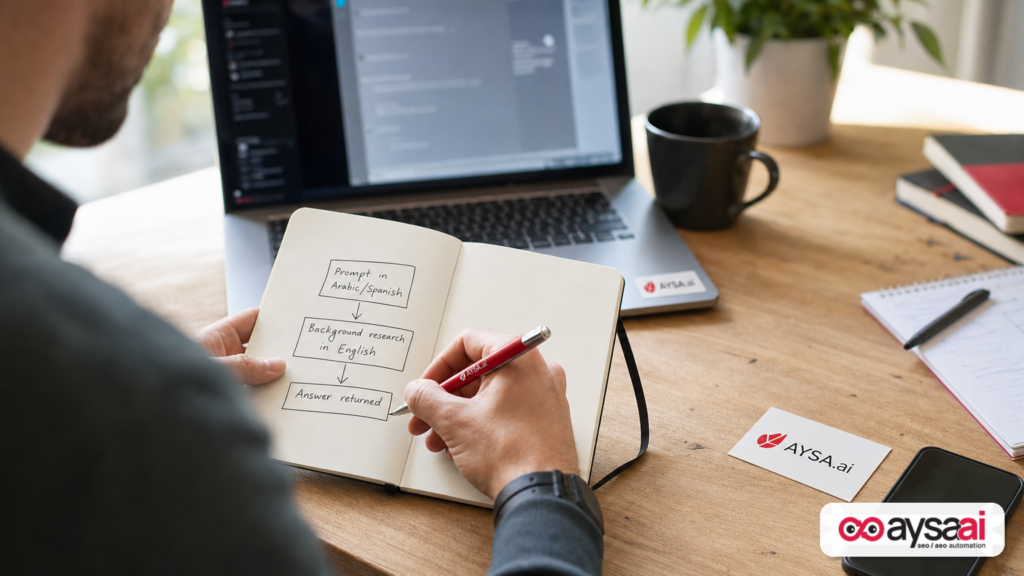
Here’s the trap: even if users are non-English, parts of the AI retrieval process can still tilt toward English. The Search Engine Journal reporting notes prior coverage that ChatGPT Search may run background “fan-out” queries in English even when the original prompt isn’t in English. That means a Spanish question can still be answered using English sources—then translated back into Spanish.
If that happens, three consequences show up in the real world:
1) Citation gap: local sources don’t get picked
If the retrieval layer is fishing in English ponds, your high-quality Spanish (or Arabic, Portuguese, etc.) content might never be in the candidate set. You can be “the best answer” in your market and still be invisible.
2) Translation drift: meaning changes across languages
When the model summarizes English content into another language, subtle details can drift: policy limits, pricing conditions, medical or legal disclaimers, measurement units, shipping thresholds. This isn’t a knock on translation quality—it’s a risk created by multi-step summarization.
3) Brand identity mismatch: you get described inaccurately
AI answers often include descriptors (e.g., “best for families,” “budget-friendly,” “premium,” “available worldwide”). If your brand facts and differentiators aren’t clear and consistent across languages, AI can fill in the gaps with generic assumptions.
Operator takeaway: Your job is to make sure the best version of your brand exists in the languages your customers use—and is technically accessible, easily quotable, and consistent enough that AI systems don’t improvise.
What Breaks When You Treat Non-English As “Later”
Most SMEs don’t ignore non-English on purpose. They ignore it because multilingual feels expensive, hard to QA, and risky. But delaying it creates a hidden tax across marketing, support, and conversion.
A) Your support load increases (and you call it “seasonality”)
If a customer’s first exposure to your product is an AI answer in their language, but your website is English-only, you create friction immediately. That customer either bounces, or contacts support with basic questions your site could have answered.
B) You attract misqualified leads
AI answers can over-broaden your audience. If your page doesn’t clearly state shipping countries, service area, licensing, eligibility, or pricing structure in multiple languages, you’ll get leads you can’t serve.
C) Your brand becomes inconsistent across the web
As users discuss you on forums, social platforms, and review sites in different languages, the “ambient description” of your brand expands. If your own site doesn’t provide a clear multilingual reference point, AI systems may rely on third-party text that isn’t accurate or updated.
D) You accidentally recommend competitors
In AI answers, the model may list alternatives. If your content doesn’t address key comparisons, use cases, and constraints in the user’s language, competitors that do will look like the better match—even if your product is stronger.
Practical note: This isn’t only about “international businesses.” Many local markets are multilingual. In the U.S., Spanish-language discovery is a daily reality. In Europe, cross-border consumption is normal. In Africa and Asia (where growth is reportedly fastest), multilingual is the default, not the exception.
What Users Are Really Doing In ChatGPT (And Why That Changes Your Content)
The reported OpenAI consumer analysis also suggests that after six months on ChatGPT, users tend to send more messages per day and try more unique tasks. Even if we treat that as directional rather than universal (it’s based on a small sample, per the reporting), the pattern is consistent with what we see operationally: users don’t ask one question anymore—they run a workflow.
That means your content needs to support multi-step journeys, not just single queries. For example:
- “What should I buy?” → “Compare these options.” → “What are the downsides?” → “How do I install it?” → “What’s the warranty?”
- “I have a symptom.” → “What could it be?” → “When should I seek care?” → “Which clinic nearby?” → “How much will it cost?”
- “I need software.” → “What integrations?” → “What’s the pricing?” → “How long to migrate?” → “Do you support my region/language?”
In AI answers, the “winner” often isn’t the page with the perfect keyword density. It’s the site that supplies the cleanest, most quotable blocks of truth across the journey: definitions, steps, comparisons, constraints, and next actions.
A Practical SME Scenario: The Clinic That “Ranked” But Disappeared In AI Answers
Let’s make this real with a scenario I see constantly (and you may recognize it).
Business: a regional dental clinic group with three locations. They rank well in Google for English terms like “emergency dentist near me” and “dental implants cost.”
What changed: Over 12–18 months, the region’s population becomes more multilingual (Spanish and Arabic). More patients start using AI assistants to ask healthcare questions privately before choosing a provider.
What the clinic sees:
- Google rankings look stable.
- Website sessions are stable.
- But calls are “weird”: more price shoppers, more eligibility questions, more no-shows.
- New patients say: “ChatGPT told me you do X,” but the clinic doesn’t actually offer X at that location.
What’s happening: AI answers are summarizing generic or outdated third-party information, possibly translating it, and presenting it with confidence. The clinic’s site has minimal structured FAQs, no Spanish/Arabic service explanations, and location pages are thin. So the AI system fills gaps using whatever it can find.
The fix isn’t “translate the homepage.” The fix is to build a multilingual truth set:
- Clear service availability by location (in each target language)
- Pricing ranges with constraints (insurance vs cash, what’s included)
- Eligibility and “when to see a professional” guidance with appropriate disclaimers
- FAQs designed for quotation (short, direct answers)
- Consistent contact and location signals
Then you monitor how AI answers change over time—because they will—and keep tightening the inputs.
This is exactly the workflow we’re aiming to operationalize with AYSA: identify gaps via monitoring, propose fixes as concrete website changes, get approval, and execute safely. Learn more: AYSA Monitoring
The 2026 Playbook: How To Build Multilingual AI Visibility Without Creating Chaos
Most businesses approach multilingual in one of two broken ways:
- Boil the ocean: translate everything, ship it fast, and hope quality is “good enough.”
- Do nothing: wait until “international” becomes a formal priority.
The practical path is a third option: prioritize tasks and truths, then build outward with quality control.
Step 1: Identify your real multilingual demand
Before you translate a single page, answer:
- Which languages are your customers using in your service area today?
- Which languages show up in inquiries, calls, chats, or support tickets?
- Which countries/regions are already hitting your key pages?
If you’re not sure, treat it like a measurement project. You can’t manage what you don’t see.
Step 2: Pick the first 10 “AI tasks” you want to win
AI search is task-driven. Build a list of the top 10 tasks (not keywords) that drive revenue or reduce cost. Examples:
- “Choose the right [product type] for [use case]”
- “Compare [your solution] vs [category alternative]”
- “Find a [service] near [location] that accepts [constraint]”
- “How much does [service] cost in [region]?”
Then map each task to a page (or a small cluster) that can become the “best cite-able source.”
Step 3: Build a multilingual content nucleus (not a library)
For most SMEs, the highest ROI nucleus is:
- Core service/category pages (what you actually sell)
- Pricing and “what’s included” explanations
- FAQ blocks that answer common objections
- Policies that affect conversion (shipping/returns, service area, warranties)
- Location pages (if you’re local/multi-location)
Translate and localize these first. Only then expand into long-tail content.
Step 4: Treat localization as conversion work, not translation work
Good localization includes:
- Units, currency, tax/shipping norms
- Trust signals and compliance language appropriate to region
- Examples and comparisons that make sense locally
- Contact methods people actually use in that market
This is where many “translate everything” projects fail: they reproduce words but not buying confidence.
Step 5: Operationalize approvals and safe execution
Multilingual work touches templates, internal linking, schema, canonical rules, and sometimes URL structure. It’s high impact—and easy to break at scale. You need a system where changes are:
- Prepared as concrete diffs (what changes, where, and why)
- Reviewed by the business owner/marketing lead
- Executed safely and consistently
This is the execution gap AYSA is designed to close. Start here: AI SEO Tools
Technical Foundations: Hreflang, Canonicals, Indexing, And The “AI Readability” Layer
If you take one technical lesson from this editorial, make it this: multilingual content without strong technical foundations often creates duplicate content, wrong indexing, and broken user journeys.
I’m not going to pretend we can cover every international SEO edge case in one article, but here are the foundations that matter for AI discovery as well as Google:
1) Correct language/region targeting (hreflang done right)
If you publish multiple language versions, you need search engines to understand which page is intended for which audience. That’s where hreflang becomes critical. The safest approach is to follow Google’s documentation and test thoroughly. (If you need a starting point, Google’s own SEO documentation is the most reliable baseline: Google Search Central documentation.)
Operational advice: Don’t ship 20 languages on day one. Ship 1–2, validate indexing and user journeys, then expand.
2) Canonicalization that matches your intent
If your Spanish page canonicals to English (or vice versa), you’re telling engines the translated page isn’t the primary version. That can kill visibility. Canonical rules must match your strategy.
3) Indexability and crawl paths that don’t isolate language versions
If your language pages exist but are hard to discover (no internal links, no sitemaps, blocked by robots, or hidden behind scripts), they won’t become reliable sources.
4) AI readability: structure that’s easy to quote
AI systems don’t “rank” your page the same way Google does, but they still need to extract meaning. If your page is:
- buried under heavy scripts,
- full of vague marketing copy,
- missing clear definitions and constraints,
- or inconsistent across languages,
…you reduce the chance that a model can confidently quote you.
This is where technical SEO, content design, and brand truth converge. It’s not glamorous, but it’s how you become “the source.”
Content Structure For AI Citations: Answerable Paragraphs, Lists, Tables, And Source Hygiene
AI answers often pull from content that is:
- Specific (not vague)
- Structured (easy to extract)
- Consistent (doesn’t contradict itself)
- Updated (not obviously outdated)
Here’s a structure I recommend for SMEs building multilingual “cite-worthy” pages.
A) Start with answer blocks
For each page, add short blocks that directly answer the likely AI questions. Example for an ecommerce category:
- What it is (1–2 sentences)
- Who it’s for (bullets)
- How to choose (3–6 criteria)
- Common mistakes
- Pricing range and what changes price
- Compatibility / constraints
Then localize those blocks properly for each language—not by literal translation, but by matching the local questions and expectations.
B) Build comparison sections that don’t fear trade-offs
AI systems love comparison prompts. Your content should include honest trade-offs. “Best” without constraints is not credible; “best for X” is.
C) Use tables for specs, inclusions, and eligibility
Tables are extractable. They also reduce ambiguity. Examples:
- Shipping times by region
- Service coverage by location
- Plan features by tier
- What’s included vs add-ons
D) Source hygiene: keep facts consistent across the site
If your return policy says 30 days in one place and 14 in another (or differs by language version without explanation), you’re training AI systems to distrust you—or to improvise. Consistency is not just legal hygiene; it’s AI visibility hygiene.
Measurement: What To Track When “Rankings” Aren’t The Whole Story
If you only measure Google rankings and organic sessions, you will miss the AI shift until revenue is impacted.
What should SMEs and agencies track instead?
1) AI visibility checks (prompts by language)
Create a controlled list of prompts (your 10 core tasks) in each target language. Run them regularly and record:
- Is your brand mentioned?
- Is your site cited (when citations appear)?
- Are competitors recommended instead?
- Are any claims incorrect?
This is tedious manually. That’s why monitoring matters—and why it should be part of your SEO stack, not an ad-hoc exercise. See: AYSA Monitoring.
2) Conversion quality by language and region
If you launch Spanish pages and see traffic rise but conversion fall, don’t celebrate. Track:
- Lead qualification rate
- Sales cycle length
- Refund rate / cancellations
- Support contacts per customer
3) Entity consistency signals
Even without pretending we can measure “entity strength” perfectly, you can audit basic consistency:
- Business name, address, phone formats
- Service area definitions
- Pricing ranges and constraints
- Feature lists and plan names
4) Use GA4 and Search Console—but interpret carefully
Google Analytics 4 and Google Search Console remain foundational. They tell you what happens on your site and in Google. They don’t fully describe AI-driven discovery. But they can reveal language growth patterns and landing page performance.
If you’re building an internal dashboard, keep it simple: language page performance, conversion metrics, and a separate AI visibility log.
Agency Reset: Packaging Multilingual AEO/GEO As A Repeatable Service
Agencies are going to feel this shift earlier than most in-house teams, because clients will ask: “Why did leads change?” and “Why am I not showing up in AI?”
The agencies that win in 2026 will do three things well:
1) Productize multilingual AI visibility
Not as “translation.” As a package:
- Language opportunity assessment
- AI task mapping
- Content nucleus build (localized, structured)
- Technical rollout (hreflang, templates, internal linking)
- Ongoing monitoring and iteration
2) Prove impact with controlled tests
AI discovery is messy. Agencies need testing discipline: prompt sets, baselines, change logs, and measurement. Even if the ecosystem evolves, the practice of controlled measurement will remain the advantage.
3) Execute safely at scale
Most agency churn happens when execution breaks something: templates, indexation, duplicate pages, wrong canonicals, inconsistent offers. An “approved execution” system reduces risk and makes delivery predictable.
This is where AYSA can be an operational layer for agencies and SMEs: monitor, prepare changes, get approvals, execute. Learn more about the system: AI SEO Tools and pricing: AYSA Pricing.
Where AYSA Fits: Approved Execution For AI Search
Here’s my opinionated take: the biggest mistake businesses make with AI search is treating it as a content brainstorming problem. It’s not. It’s an operations and execution problem.
You need to answer four questions continuously:
- What are AI systems saying about us? (by language, by location, by task)
- Where are they getting that information? (your site vs third parties)
- What should change on our site to become the better source?
- How do we ship changes safely without breaking SEO, UX, or compliance?
AYSA is built to operationalize that loop:
- Monitors AI and search visibility signals (so you don’t fly blind): Monitoring
- Prepares recommended changes (content, technical, structure)
- Asks for approval before touching your site
- Executes accepted website changes consistently, so strategy turns into outcomes
If you want to see how we frame AI visibility as a system, start here: AI Search Visibility. For ongoing thinking and implementation notes, browse: AYSA Blog.
What to do next (action list)
- List your top 10 revenue-driving customer tasks (not keywords). Write them in English and the top 1–2 non-English languages relevant to your market.
- Audit your “truth set” pages: services/categories, pricing, policies, FAQs, and location pages. Identify which facts are missing, inconsistent, or unstructured.
- Pick one language to pilot. Build a localized nucleus (not a full-site translation). Ensure technical setup supports it (indexing, internal links, intended canonicals).
- Run an AI visibility baseline using a repeatable prompt set per language. Record brand mentions, citations, competitor mentions, and inaccuracies.
- Ship structured upgrades: answer blocks, comparison sections, tables for constraints, and clear next steps.
- Set monitoring so you catch drift (new competitors recommended, wrong claims, outdated pricing) before it costs you.
- Operationalize approvals. Make sure every change is reviewable and attributable—especially across multiple languages.
Sources and further reading
- Search Engine Journal: “ChatGPT Users Are Now Mostly Non-English” (reporting on OpenAI consumer usage signals)
- Search Engine Journal – Latest news (context and ongoing coverage)
- Search Engine Journal – International search (broader background)
- Google Search Central documentation (primary reference for indexation and international SEO fundamentals)
Note on sourcing: The OpenAI Signals details are referenced via Search Engine Journal’s reporting. This editorial intentionally avoids adding unverified numbers beyond what’s described in the supplied source context.
If you want this translated into an execution plan for your business—language priorities, page templates, structured FAQ formats, and a monitoring cadence—AYSA is built for that workflow: AI SEO tools and pricing.
Continue the AI search topic inside AYSA.
Use these pages to connect the article with AI SEO tools, AI visibility monitoring, AI Overviews and approved website execution.
Turn this topic into a website action plan.
Use these AYSA hubs to move from reading to technical fixes, AI visibility monitoring, research, glossary context and approval-first SEO execution.

