
Google AI Mode Puts Recipe Links First: What This Means For SEO, Creators, And Any Business That Wants AI Citations
Google’s AI Mode is now showing prominent recipe-site links at the top of certain AI responses—complete with creator names, ratings, and ingredient counts. It’s a meaningful signal: Google is experimenting with how attribution, trust, and clicks work in AI search. Here’s what changed, why it matters, and the practical playbook to earn visibility when AI answers become the default interface.

Google just made a notable move inside AI Mode: for certain recipe queries, it’s now showing prominent recipe-site links at the very top of the AI response—along with details like creator name, rating, and ingredient count.
On the surface, this looks like a UI improvement for hungry searchers. But for creators, publishers, ecommerce brands, and agencies trying to win in AI-first search, it’s a bigger signal: Google is actively experimenting with how Attribution and Clicks work when the answer is generated by AI.
I’m writing this from the perspective of building and operating growth systems for SMEs and agencies at AYSA.ai. If your business depends on organic search—whether you publish recipes or you sell products, services, and expertise—this change is a preview of where search is heading: AI summaries will keep expanding, and the “link” will increasingly be a designed component inside a generated interface.
Concise summary
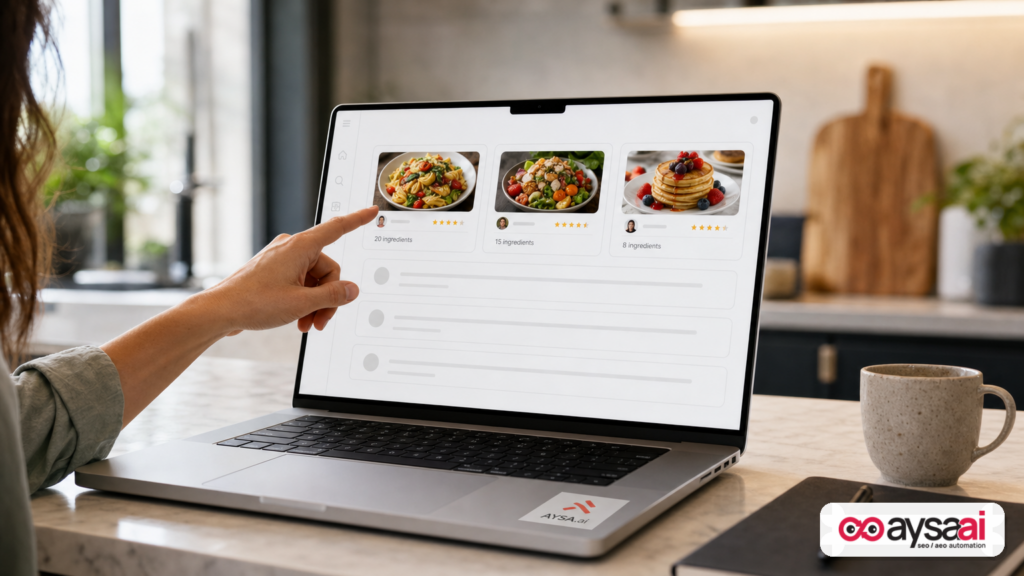
- What changed: In Google AI Mode, some recipe queries now show recipe site links at the top of the AI response with creator and recipe details.
- Why it matters: It suggests Google is trying to balance AI-generated answers with attribution and traffic back to creators—and it sets expectations for other verticals.
- What businesses should do: Tighten content structure, improve on-page clarity, validate Structured data, and measure AI visibility like a product surface—because AI search is not “rankings only.”
- Where AYSA fits: Use an execution system that monitors AI search surfaces, prepares site improvements, asks for approval, and deploys accepted changes safely (not random edits and hope).
Key takeaways (read this if you only have 2 minutes)
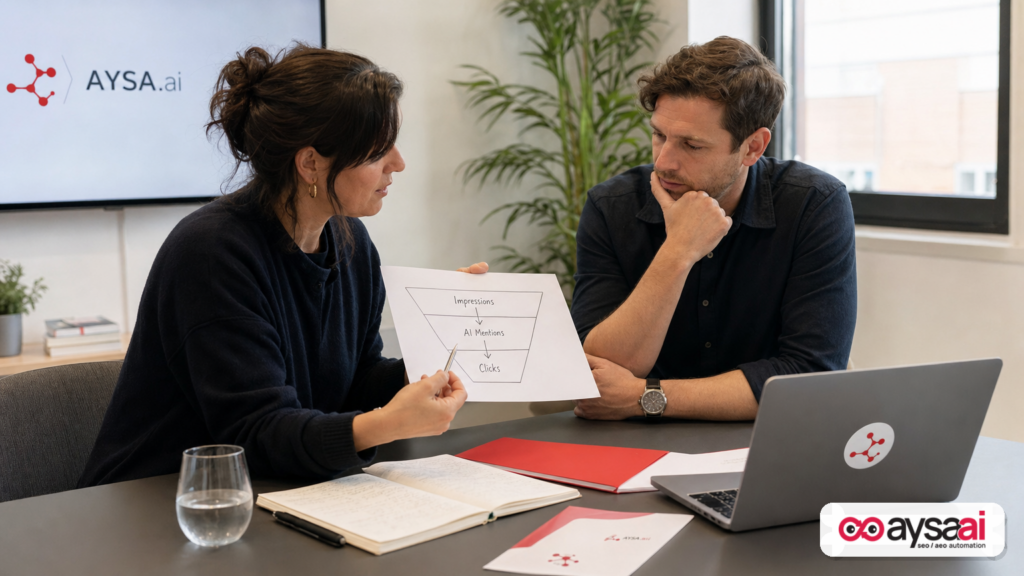
- AI Mode is turning SEO into interface placement. Being “included” isn’t enough; where you appear in the AI UI will decide whether you get clicks.
- Google is listening to creator feedback—selectively. The recipe industry has been vocal about misattribution and traffic loss. This looks like a partial response.
- Structured data is likely correlated with eligibility for these new link cards (ratings, ingredients), even if Google doesn’t explicitly require it for AI Mode.
- Expect similar patterns in other categories: local services, ecommerce product comparisons, travel/hospitality, healthcare info, B2B software explainers.
- Execution speed now matters. AI search surfaces change faster than classic rankings. The winners will run tight Monitoring + controlled website updates.
Table of contents
- What Google Changed In AI Mode (And Why It’s Not Just A UI Tweak)
- How This Fits Google’s Recent AI Search Direction
- Why This Matters Beyond Food: AI Search Is Rebuilding The Click Economy
- The Real Creator Problem: AI Summaries Can Be Wrong (And Still Confident)
- What This Signals About Ranking In AI Mode (And How It Differs From Classic SEO)
- The Practical Playbook: How Recipe Sites (And Any Publisher) Should Adapt Now
- A Concrete SME Scenario: “Meal Kit” Ecommerce Brand Competing With Recipe Publishers
- Measurement: How To Tell If AI Search Is Helping Or Cannibalizing You
- What Agencies Need To Rethink In 2026
- Where AYSA.ai Fits: Monitor, Prepare, Approve, Execute (Without Chaos)
- What to do next (Action list)
- Sources and further reading
What Google Changed In AI Mode (And Why It’s Not Just A UI Tweak)
According to reporting by Search Engine Journal, Google introduced a new visual treatment in AI Mode for relevant recipe queries: recipe links appear at the top of the AI response, displayed with helpful metadata such as creator name, ratings, and ingredient count.
This matters because AI search is not just “ten blue links with a summary.” It’s a composed interface where Google can choose:
- Which sources are visible
- How high they appear (top vs. buried in a carousel vs. cited inline)
- How much context a user gets before clicking (ratings, ingredients, creator identity)
- How strongly the UI nudges the user to leave Google (or not)
In classic search, you fought for rank. In AI Mode, you’re fighting for placement + presentation + perceived trust. The UI itself becomes part of the algorithm.
Primary reference for the change (secondary reporting): Search Engine Journal coverage of Google’s AI Mode recipe links update.
How This Fits Google’s Recent AI Search Direction
The Search Engine Journal piece notes that Google’s Robby Stein connected this update to earlier recipe-results work mentioned in March—suggesting it’s iterative and feedback-driven.
Even without re-litigating every prior launch, the direction is clear: Google is pressure-testing a new equilibrium between:
- Instant answers (the AI summary)
- Source attribution (which publishers are credited)
- Outbound clicks (whether the user visits the publisher site)
That triad is the business model tension of AI search. If the AI answer is “good enough,” clicks drop. If attribution is too hidden, creators revolt (and regulators pay attention). If the UI sends too many clicks away, Google risks reducing time-in-product and ad inventory.
Recipes are a perfect lab for this because they are:
- High volume
- Highly templated (ingredients, times, steps)
- Easy to summarize (and easy to get subtly wrong)
- Deeply tied to creator monetization (ads, affiliates, cookbooks, subscriptions)
When Google changes recipe presentation, it often foreshadows how other industries will be treated once the pattern “works.”
Why This Matters Beyond Food: AI Search Is Rebuilding The Click Economy
If you don’t run a recipe site, you might think this is irrelevant. I disagree. This is a prototype for how Google can handle any query where:
- The user wants a quick answer and
- There’s a clear set of candidate sources that deserve credit and
- The content can be expressed as a structured object (like a “recipe card”)
Translate “recipe card” into other verticals:
- Local services: “best water heater repair near me” → provider cards with rating, response time, service area
- Healthcare: “physical therapy for rotator cuff pain” → clinic/guide citations with author credentials and conservative disclaimers
- Hospitality: “3-day itinerary in Austin” → hotel and attraction sources cited as cards
- Ecommerce: “best running shoes for flat feet” → product cards with specs and review aggregate
- B2B SaaS: “how to set up SOC 2 policies” → vendor and expert guides with authorship and update dates
The real takeaway: AI search is becoming a curated interface. And curated interfaces have “sponsored slot” logic—even when the slots aren’t ads.
For SMEs, that means the future isn’t just “do SEO.” It’s “earn inclusion in AI interfaces that have limited visible slots.”
The Real Creator Problem: AI Summaries Can Be Wrong (And Still Confident)
Search Engine Journal notes that some publishers welcomed the more prominent links but still raised concerns: AI-generated recipe summaries can misrepresent the original content. That complaint is bigger than recipes.
Here’s the uncomfortable truth: in AI-first interfaces, the summary becomes the default product, and your website becomes a “source container.” If the summary is inaccurate, you get:
- Brand risk (people blame you for the wrong method or wrong ingredient)
- Support burden (emails, comments, refunds, angry reviews)
- Conversion loss (users don’t click because they think they already got the answer)
- Compliance exposure in sensitive industries (health, finance) if the AI output is interpreted as guidance
So the change—surfacing creator links more prominently—helps, but it does not solve the underlying issue: the AI layer can still distort your content while borrowing your authority.
That’s why the best response isn’t to celebrate or panic. It’s to operate your site like it’s feeding multiple “consumers”:
- Humans (readers, buyers)
- Classic crawlers (indexing, rankings)
- AI summarizers (chunking, extraction, synthesis)
- Interface renderers (cards, carousels, citations)
Different consumer, different failure mode. Same underlying asset: your content architecture.
What This Signals About Ranking In AI Mode (And How It Differs From Classic SEO)
Let’s be precise. We can’t verify every internal requirement for AI Mode inclusion because Google hasn’t published a full “AI Mode eligibility” spec in the provided context. But we can reason from what’s visible in the UI treatment described: creator name, ratings, ingredient count.
Those elements strongly imply Google is pulling from structured and semi-structured signals such as:
- Clear authorship/creator identity on the page (and/or in markup)
- Review/rating signals (where applicable and policy-compliant)
- Ingredient list structure that is easy to extract
Even if structured data isn’t “mandatory,” it tends to be a competitive advantage whenever the search engine needs to render a rich UI reliably.
Here’s the broader pattern I expect SMEs to internalize:
- Classic SEO asked: “Can Google find and rank my page?”
- AI search asks: “Can Google safely extract, summarize, and attribute my content in a way users trust?”
That shifts effort from keyword targeting alone to:
- Information design (clear, stable sections)
- Entity clarity (who wrote it, what it refers to)
- Freshness and versioning (what changed, when)
- Proof and credibility signals (especially for YMYL-like topics)
AI search isn’t one surface
One of the biggest mistakes teams make in 2026 is treating “AI search” as one thing. In reality, you’ll have multiple surfaces:
- Classic results
- AI Overviews (where present)
- AI Mode (interactive, conversational results)
- Other assistants (outside Google) that reference the open web
You don’t need to be everywhere to win. But you do need to know where you’re currently visible and where you’re losing clicks. That’s monitoring, not guessing.
The Practical Playbook: How Recipe Sites (And Any Publisher) Should Adapt Now
Below is the pragmatic, do-this-now guidance I’d give an SME publisher—or any brand that publishes educational content that can be summarized by AI.
This is not a “rank #1 in 7 days” gimmick. It’s an operations plan to improve eligibility for rich AI presentation and reduce misrepresentation risk.
1) Structure your page like an object, not a diary
Recipe sites already learned this lesson over the last decade: users want the recipe, not a life story. AI summarizers want the same thing, but for extraction reasons.
For recipes:
- Put the core recipe card (ingredients, times, steps) in a consistent location
- Use clear headings (Ingredients, Instructions, Notes, Substitutions, Storage)
- Keep units and quantities unambiguous
For non-recipe SMEs:
- Turn services into “service cards” (what it is, who it’s for, price range, timeline, deliverables)
- Turn product categories into “comparison objects” (materials, sizing, compatibility, returns)
- Turn policies into “policy objects” (effective date, scope, exceptions, steps)
AI thrives on stable structure. Stable structure reduces hallucination risk.
2) Treat authorship as a business asset
Google highlighting the creator name is not a small detail. It’s a product decision: Google is signaling that identity improves trust.
Practical steps:
- Add a visible author/creator block on content pages
- Maintain author profile pages with credentials, expertise, and other work
- For brands, consider “editorial reviewed by” where relevant
For SMEs in healthcare, legal-adjacent, or safety topics, do not bury credentials. If AI search becomes the front door, your credibility needs to be machine-readable and human-visible.
3) Assume the UI will extract your key fields
Ingredient counts, ratings, times—these are all extractable, comparable fields. The moment Google can compare you side-by-side, you’re no longer “a page.” You’re “an option.”
So ask:
- What fields would I want shown if my content becomes a card?
- Are those fields accurate, consistent, and easy to parse?
- Do they match the visible content on the page?
For a local service business, the “fields” might be:
- Service area
- Response time
- Certifications
- Insurance coverage
- Pricing model
If those are missing or inconsistent, the AI layer will fill gaps. And you may not like what it fills them with.
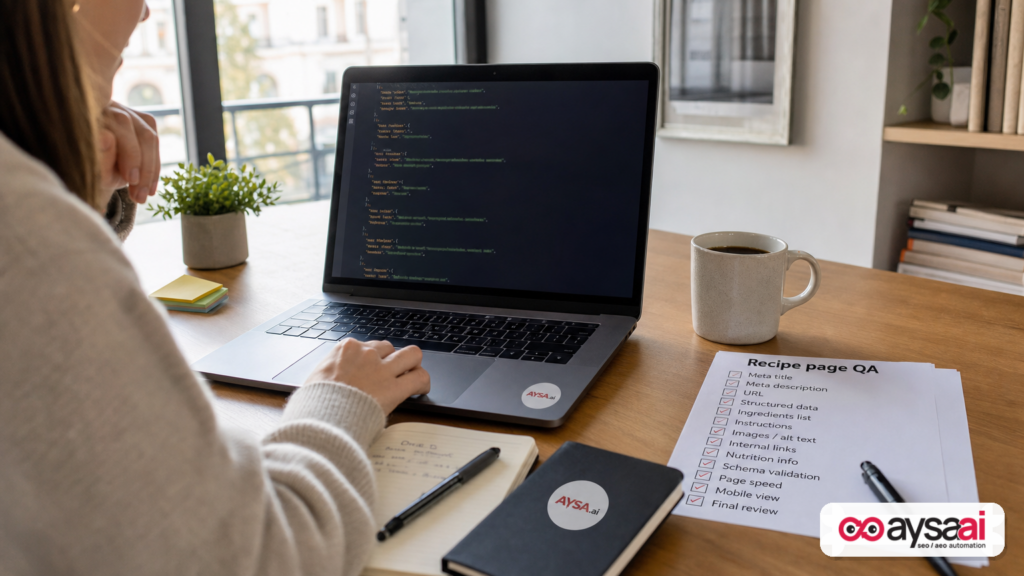
4) Do structured data QA like it’s revenue protection
The SEJ report notes the displayed fields resemble typical recipe structured data fields. Google didn’t confirm structured data is required for this AI Mode treatment, but the correlation is logical.
At minimum:
- Validate structured data output across templates
- Ensure the structured values match what users see
- Fix broken or inconsistent markup at scale
If you’re an SME without an in-house technical team, this is where systems matter. You need repeatable checks, not heroic one-off audits.
AYSA’s approach is to treat these as monitorable issues and ship changes through an approval gate rather than ad-hoc edits. See: AYSA AI SEO tools and AYSA monitoring.
5) Reduce “AI summary risk” with explicit constraints
AI systems often misrepresent content when instructions contain optional branches, substitutions, or edge cases.
Recipe example:
- If you say “swap baking soda for baking powder,” AI might flatten nuance and produce an incorrect substitution ratio.
Service example:
- If you say “usually completed in 2–4 weeks,” AI might quote “2 weeks” as a guarantee.
Mitigation tactics:
- Use “If/then” formatting for optional steps
- Put critical constraints near the top of the relevant section
- Add a short “Important” block for safety/quality constraints
- Keep a clear separation between “baseline method” and “variations”
This is content design, not keyword stuffing.
6) Optimize for click-worthiness, not just inclusion
If the AI answer gives away the core, why would someone click?
With recipes, clicks still happen for:
- Step-by-step photos
- Video
- Printable recipe
- Trusted notes (e.g., high altitude adjustments, gluten-free swaps)
For other SMEs, clicks happen for:
- Calculators and tools
- Templates (downloadable, checklists)
- Interactive booking/quote flows
- Clear product availability and shipping details
- Proof (case studies, before/after galleries, certifications)
AI search will compress commodity information. Your job is to offer utility that the summary cannot replace.
A Concrete SME Scenario: “Meal Kit” Ecommerce Brand Competing With Recipe Publishers
Let’s make this real for an SME that isn’t a media company.
Scenario: You run a regional meal kit ecommerce brand. You sell curated boxes (ingredients included), and your marketing strategy includes publishing recipes to rank for high-intent queries like “easy lemon chicken pasta” or “healthy weeknight dinners.”
Before AI Mode: You competed on classic SEO: recipe pages, internal linking, some backlinks, strong photography, and decent UX.
With AI Mode recipe links at the top: You might get one of two outcomes:
- Win: Your recipe appears as a top card with your creator/brand name. Users click through, see you offer a meal kit, and you convert.
- Lose: Google summarizes the recipe and shows competing cards. Users never click, or they click the bigger publisher with better ratings signals.
What the meal kit brand should do (practical)
- Separate “recipe content” from “product content” but interlink them intentionally (e.g., “Shop the kit” modules, substitution notes tied to available ingredients).
- Improve extractable fields: times, servings, ingredients, dietary attributes—consistent across pages.
- Build click value: printable card, shopping list, difficulty level, swap logic, and video.
- Make creator identity clear: chef profile, testing notes, kitchen methodology.
- Measure AI surface visibility: monitor whether you appear in AI Mode cards for your priority recipe set.
This is exactly where an execution system like AYSA helps: you can monitor visibility changes, generate a prioritized backlog of content/template improvements, get stakeholder approval, and push consistent updates across dozens or hundreds of pages. Start here: AYSA AI search visibility.
Measurement: How To Tell If AI Search Is Helping Or Cannibalizing You
SMEs often ask me: “Is AI search stealing my traffic?” That question is emotionally valid—but operationally incomplete.
The better questions are:
- Where am I visible inside AI experiences?
- When I’m visible, do I get clicks and conversions?
- When I’m not visible, who is being recommended instead?
Metrics to watch (without inventing new dashboards)
Without claiming any proprietary measurement magic, you can still run a disciplined approach:
- Query cohorts: define a list of valuable queries (recipes, services, comparisons).
- Visibility checks: periodically check whether your brand is cited/linked in AI experiences for those queries.
- On-site behavior: track landing page engagement and conversions from organic entry points.
- Branded demand: monitor whether brand searches rise/fall alongside AI exposure.
The point: treat AI visibility as a channel surface. If you only watch classic rank trackers, you’ll miss the new UI realities.
This is also why monitoring needs to be continuous. Google’s AI interfaces are iterating quickly. See how AYSA approaches this at AYSA Monitoring.
What Agencies Need To Rethink In 2026
This recipe-links change is small enough to ignore—until you remember what it represents: Google is productizing attribution.
Agencies that still sell “SEO as rankings” will struggle. Here’s what needs to change.
1) Deliverables must map to AI search surfaces
Clients don’t care about “AI Mode.” They care about:
- Leads
- Bookings
- Revenue
- Brand trust
So agencies need to translate AI surface shifts into concrete deliverables:
- Content structure refactors
- Authorship systems
- Structured data QA pipelines
- Conversion-focused “click value” improvements
2) Execution is now a core skill, not a handoff
In many engagements, agencies recommend changes and hope the client implements them. In AI search, that delay kills you. By the time a ticket gets prioritized, the interface may have shifted again.
This is why I believe the next generation of SEO/AEO/GEO work is execution-led. Not reckless auto-updates—controlled execution with approvals.
That’s the design philosophy behind AYSA: monitor → prepare changes → request approval → execute accepted updates. Learn the model at AI SEO Tools and explore adoption options at AYSA Pricing.
3) Stop optimizing only for Google’s classic SERP
Even if your client’s revenue is still driven by Google organic, AI discovery is multi-surface and multi-system. Agencies should build content that is:
- Readable by humans
- Extractable by machines
- Credible by design
- Useful enough to earn the click
This is AEO/GEO in practice: optimizing for answers and generative experiences, not just rankings.
Where AYSA.ai Fits: Monitor, Prepare, Approve, Execute (Without Chaos)
When Google tweaks AI Mode for recipes, the “SEO tasks” aren’t theoretical. They’re operational:
- Which pages are being surfaced?
- Are the creator/rating/ingredient signals correct?
- Are competitors being promoted instead?
- Do we need to update templates, markup, authorship blocks, or content modules?
And then the hard part: shipping changes consistently without breaking the site, without endless back-and-forth, and without turning your CMS into a patchwork of exceptions.
AYSA is built for that reality:
- Monitor search and AI visibility signals so you know what changed (not just what you hope is true): Monitoring
- Prepare recommended site changes (content structure, internal links, technical fixes, markup hygiene)
- Ask for approval so teams maintain control and brand governance
- Execute accepted changes so improvements actually reach users and crawlers
If you’re trying to compete in AI-first interfaces, speed matters—but so does safety. “Move fast and break things” is not a strategy when your pages are being summarized for millions of users.
To go deeper on our thinking, see the AYSA blog: AYSA Blog.
What to do next (Action list)
- Pick 20–50 priority queries (recipes, service questions, product comparisons) that matter to your business.
- Manually review AI visibility for those queries on a recurring cadence and log whether you are linked/cited and where.
- Audit page structure: are your key fields clearly labeled and consistently placed?
- Strengthen authorship/creator identity with visible on-page modules and robust profile pages.
- QA structured data across templates; fix inconsistencies that could distort AI-rendered fields.
- Create “click value” assets (printable versions, calculators, video, tools, templates) that AI summaries can’t replace.
- Implement through a controlled execution system: monitor → prepare → approve → execute. If you want that workflow without chaos, explore AYSA: AI search visibility and Pricing.
Sources and further reading
- Search Engine Journal: Google Puts Recipe Links At Top Of AI Mode Responses (source article referenced)
- Search Engine Journal: Latest news (ongoing coverage context)
- Search Engine Journal: SEO section (broader SEO implications)
- Search Engine Journal: Google Algorithm Updates history (context for Google iteration cycles)
Related AYSA resources
Continue the AI search topic inside AYSA.
Use these pages to connect the article with AI SEO tools, AI visibility monitoring, AI Overviews and approved website execution.
Turn this topic into a website action plan.
Use these AYSA hubs to move from reading to technical fixes, AI visibility monitoring, research, glossary context and approval-first SEO execution.

