
Google’s AI Mode is finally sending more love to recipe publishers — here’s what it means for every business fighting for clicks
Google updated recipe results in AI Mode with prominent links, creator names, ratings, and ingredient counts—small UI changes that signal a bigger shift: AI answers are becoming navigational again. Here’s what changed, why it matters to SMEs and publishers, and how to operationalize AI visibility with approved execution.

Google just made a small but meaningful change to how recipes appear inside AI Mode: richer, more obvious pathways back to the original publisher. If you run a recipe site, you should care today. If you run any business that depends on search traffic, you should care even more—because this update is a clue to where AI-powered search is headed: answers that increasingly act like navigation layers, not dead ends.
I’m Marius Dosinescu, building at AYSA.ai. I’m optimistic about AI Search—but only if businesses adapt to the new reality: you don’t just “rank” anymore. You must be selected, attributed, and clicked, often in that order.
Concise summary
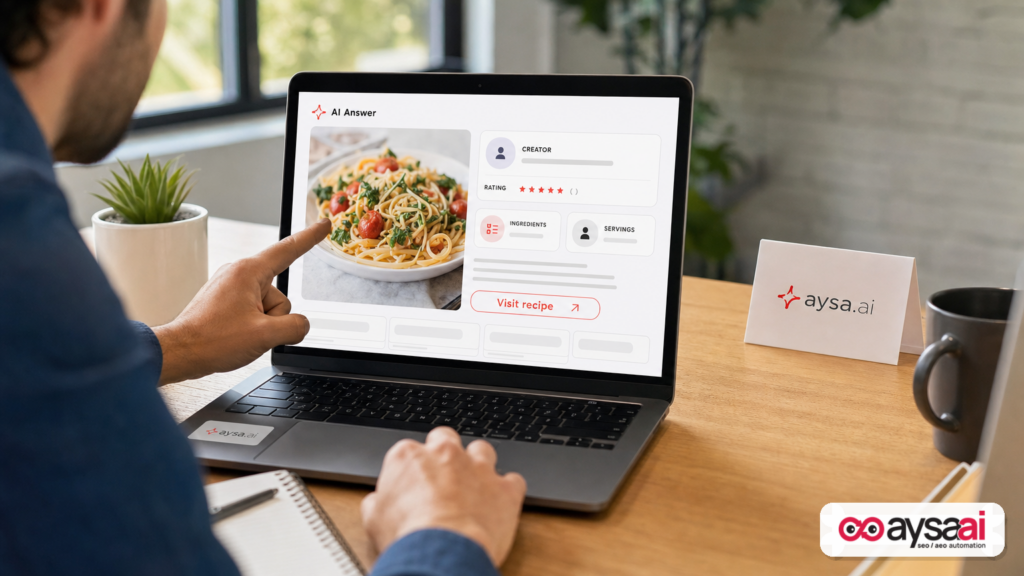
- What changed: Google added a more publisher-friendly visual treatment for recipes in AI Mode, including prominent links plus details like creator name, ratings, and ingredient count.
- Why it matters: This is Google acknowledging a core tension: AI answers reduce Clicks, and publishers (especially recipe creators) need clearer routes for discovery and traffic.
- What to do: Treat AI search as a new surface area. Improve creator Attribution, Structured data, Internal linking, and “click-worthiness” (unique value beyond the summary). Monitor AI visibility and execute changes quickly—but with approval controls.
Key takeaways (what I’d tell a busy owner)
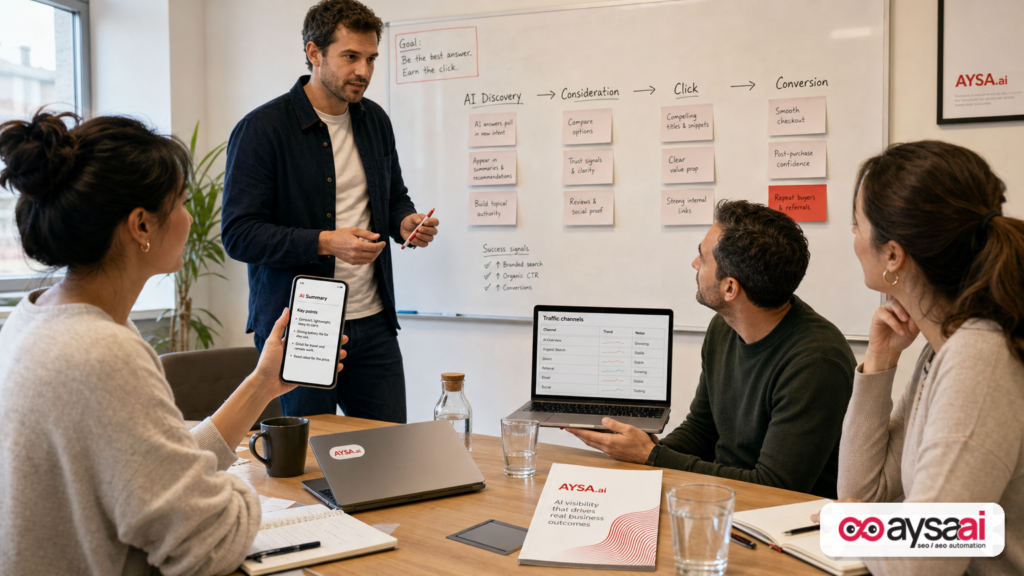
- UI changes can be strategy changes. A few extra links and trust cues can materially change click behavior in AI results.
- Attribution is the new ranking. If AI Mode shows the creator, rating, and ingredient count, then your on-page signals and markup must make that easy for Google to trust.
- Expect “search journeys” to fragment. Some users will stop at the AI answer. Others will click the most credible-looking source. Your job is to be that source.
- Execution speed is a moat. The winners will be the teams that can monitor, propose, approve, and ship site improvements weekly—not quarterly.
Table of contents

- What Google changed in AI Mode recipe results (and what it’s trying to fix)
- The bigger context: why recipes became the frontline of AI search backlash
- Why this matters beyond recipes: AI is changing the click economy
- How AI Mode likely decides what to show (without pretending we know the secret sauce)
- What “publisher-friendly” really means—and what it doesn’t
- A practical playbook for recipe sites and any content-led business
- A concrete SME scenario: a meal-prep ecommerce brand that depends on recipes
- What agencies should rethink: reporting, deliverables, and the new KPI stack
- What can go wrong (and how to de-risk AI-era optimization)
- Where AYSA fits: from monitoring to approved execution in the AI era
- What to do next (action list)
- Sources and further reading
What Google changed in AI Mode recipe results (and what it’s trying to fix)
According to reporting by Search Engine Land, Google rolled out a new recipe presentation inside AI Mode designed to make it easier for people to discover and visit recipe pages. The update adds more prominent links and useful details such as the creator name, recipe ratings, and number of ingredients for some recipes. Google’s Robby Stein described it as a “visual treatment” intended to make it “even easier to discover and visit recipe pages.”
That sounds cosmetic. It isn’t.
In AI search, the interface is policy. When Google decides where links appear, how big they are, and what trust cues are visible, it is effectively deciding who gets traffic and who gets summarized into oblivion.
From a publisher perspective, those three details (creator, ratings, ingredients) are especially telling:
- Creator name is an attribution signal. It reinforces “this came from a real person/site,” and gives users a reason to click.
- Ratings are trust shorthand. They are not just UX—they are conversion psychology.
- Ingredient count is intent-matching. It helps users decide if the recipe fits their constraints (simple vs. complex).
What is Google trying to fix? Two things at once:
- User experience: AI Mode can be useful, but recipe queries are highly “doable” tasks. People want to cook, not read a summary. The best experiences guide users to the full recipe and instructions.
- The publisher relationship: Recipe creators have been among the loudest critics of AI-generated “recipe slop” and the reduction in Referral traffic from AI experiences. This update is Google signaling, “We hear you—here are more obvious links back.”
Primary source for the update: Search Engine Land’s coverage of Google’s AI Mode recipe changes.
The bigger context: why recipes became the frontline of AI search backlash
Recipes are a special category in search for three reasons.
1) They are high-intent queries with clear “success criteria”
If I search “chicken fajitas recipe,” I’m not browsing abstract ideas. I’m trying to make dinner. That means:
- I need accurate ingredients and quantities.
- I need steps, timings, temperatures, substitutions.
- I often need photos, tips, and troubleshooting.
An AI summary can be helpful, but it can also be dangerously incomplete. Users often still want the original.
2) The recipe web monetizes on pageviews and session depth
Whether you love or hate the “life story before the recipe,” the reality is that recipe sites typically monetize through ads, affiliates, email lists, cookbooks, and brand partnerships. All of those are downstream of visits.
3) Recipes are one of the most structured-data-heavy verticals
Recipe markup, ratings, cooking time, nutrition information—this vertical has been shaped by structured data for years. That makes it an ideal testing ground for AI Mode UX because Google can pull consistent fields and display them neatly.
So when Google “fixes” recipes in AI Mode, it’s rarely just about recipes. It’s a message to every industry where creators rely on search distribution: Google is experimenting with how to keep AI answers useful without fully collapsing the referral ecosystem that funds the open web.
Why this matters beyond recipes: AI is changing the click economy
For 20 years, most search strategy has been built on a simple model:
- Rank on the SERP.
- Earn the click.
- Convert on your site.
AI search disrupts that sequence. Increasingly, the flow looks like:
- Get included in the AI synthesis (or you don’t exist).
- Get attributed clearly enough that a user trusts you.
- Earn the click only when the user needs details, credibility, or next steps.
That’s why I pay attention to “small” UI changes like this recipe update. They indicate whether the AI layer is moving toward:
- Zero-click answers as the default (publishers lose), or
- AI as a guided discovery layer (publishers can still win)
The recipe change—prominent links, creator, ratings—leans toward guided discovery.
But don’t confuse “more publisher-friendly” with “publisher-first.” Google’s incentives remain user satisfaction and retention inside Google. Your incentives remain revenue and customer growth. The overlap is real, but it’s not perfect.
How AI Mode likely decides what to show (without pretending we know the secret sauce)
We do not have a complete, official breakdown of how AI Mode selects and formats sources for every query type in the supplied research context, so I won’t invent one. But we can still reason about what’s plausible based on how search has historically worked and on what Google is now choosing to display.
If Google is confidently showing:
- Creator name
- Ratings
- Ingredient count
…then your site needs to make those facts easy to extract and verify.
What this implies for your site
- Clear authorship and creator pages that are consistent sitewide (don’t alternate between “Admin,” “Team,” and a person’s name).
- Consistent review/rating implementation (and careful avoidance of spammy patterns that could reduce trust).
- Structured content where ingredients are actually ingredients—not buried in paragraphs or images.
This is the unglamorous reality of AI search optimization: the AI can only credit you for what it can confidently parse.
What “publisher-friendly” really means—and what it doesn’t
Let’s translate Google’s publisher-friendly move into business language.
It means
- More visible outbound pathways: users are more likely to notice a link to the original recipe.
- More trust cues for the source: creator name and ratings help users decide “this is worth clicking.”
- More differentiation among sources: if ingredient counts and ratings show, the “best fit” recipe may win, not just the most generic.
It does NOT mean
- Traffic will return to pre-AI levels. Some queries will remain partially satisfied by AI summaries.
- Rankings will behave the same way. Visibility in AI answers can diverge from classic blue-link positions.
- Publishers are “safe.” This is an evolving product surface. What’s true this month may change next quarter.
The practical takeaway: treat AI visibility as its own channel that needs monitoring, testing, and operational execution—not as a footnote to SEO.
A practical playbook for recipe sites and any content-led business
This section is written for two audiences at once:
- Recipe publishers (obviously impacted)
- Any SME whose marketing relies on content (blogs, guides, FAQs, comparisons, “how-to” pages, service explainers)
1) Make creator attribution impossible to miss
Google is explicitly adding “creator name” in AI Mode recipe results. That’s a hint: authorship and brand identity are becoming first-class UI elements.
Do the basics well:
- Use a consistent author name format across your site.
- Link author names to a real author page with credentials and other recipes/content.
- Ensure your brand is obvious on-page (logo in header, about page, editorial policy if relevant).
This isn’t about gaming “E-E-A-T” as a buzzword. It’s about making it easy for an AI system—and a human—to understand who is behind the content.
2) Audit your structured data and page structure (not just for compliance, but for extractability)
Recipes are heavily schema-driven. But here’s the broader lesson: AI answer engines reward structured, extractable information.
Even if you’re not a recipe site, ask: can a machine reliably extract the key facts a user wants?
- For clinics: services, pricing ranges (if published), appointment steps, insurance, hours.
- For hotels: room types, amenities, policies, location context.
- For SaaS: features, integrations, pricing tiers, setup steps.
- For ecommerce: specs, compatibility, shipping/returns, sizing, materials.
When you improve structure, you improve your odds of being correctly summarized and correctly attributed.
3) Build “click-worthiness” into the page (assume the summary exists)
In an AI-first world, your page must offer something the AI summary doesn’t fully deliver. For recipes, that might be:
- Step-by-step photos
- Video technique notes
- Altitude adjustments
- Ingredient substitution table
- Dietary variations
- Printable format, shopping list, meal plan
For non-recipe SMEs, the equivalents are:
- Calculators, templates, and checklists
- Local proof (photos, case studies, reviews)
- Clear pricing logic and next steps
- Before/after examples
Don’t just publish content. Publish assets.
4) Treat internal linking like product design, not SEO trivia
If AI Mode sends you a click, you may get fewer clicks overall—but each click is more precious. That means your site must help users continue the journey.
On recipe pages:
- Link to variations (“spicy,” “low carb,” “air fryer version”).
- Link to complementary dishes (“what to serve with…”).
- Link to ingredient guides (sauces, spice blends).
On service pages:
- Link to FAQs, pricing, booking, and proof (reviews/case studies).
- Link to location pages if you’re local.
This isn’t only for crawling. It’s for conversions.
5) Monitor AI visibility separately from classic SEO
One of the biggest mistakes I see: teams still look only at traditional rank tracking and Search Console clicks, then wonder why leads are volatile.
AI surfaces add new questions:
- Are we being cited in AI answers for our priority topics?
- When we’re cited, are we credited correctly (brand name, creator)?
- Are the links prominent enough to earn clicks?
- Which pages are being pulled as sources—our best ones or outdated ones?
At AYSA, this is exactly why we built dedicated monitoring for AI-era search visibility: AI Search Visibility plus ongoing Monitoring so you can see changes early and respond before revenue is impacted.
A concrete SME scenario: a meal-prep ecommerce brand that depends on recipes
Let’s make this real.
Imagine a small ecommerce brand that sells meal-prep containers and spice kits. Their marketing strategy is content-led:
- They publish recipes weekly.
- Recipes internally link to the products (“Use this 3-compartment container”).
- Email signups are driven by “weekly meal plan” downloads.
Then AI Mode becomes more common for recipe queries. Users ask for “high-protein burrito bowl meal prep recipe.” The AI answer provides a workable ingredient list and steps. Clicks drop. Revenue dips.
Now Google introduces a more publisher-friendly recipe UI in AI Mode: creator name, ratings, ingredient count, prominent links.
Here’s how the brand can capitalize—without waiting for “SEO magic”:
- Creator clarity: Ensure recipes show a real creator identity (not “Admin”) and that the creator page reinforces authority and consistency.
- Ratings strategy (ethical): Encourage verified customers and subscribers to rate recipes in a legitimate way. Don’t fake it; don’t spam it.
- Ingredient structure: Make ingredients a clean list, not a story paragraph or image.
- Click-worthiness: Add a meal-prep grid (storage instructions, macros if they can support it responsibly, substitution table).
- Internal linking: From each recipe, link to the relevant products and to a “meal prep basics” hub.
- Operational cadence: Monitor AI visibility weekly, ship improvements continuously.
Notice what’s missing: “wait six months and hope rankings improve.” The new AI interface rewards clarity and trust cues now.
What agencies should rethink: reporting, deliverables, and the new KPI stack
If you’re an agency (or hiring one), AI Mode and AI Overviews change what clients will value.
Traditional deliverables:
- Keyword rankings
- Content calendars
- Backlink counts
…still matter, but they’re insufficient. Clients will ask:
- “Are we showing up in AI answers?”
- “Are we getting credited?”
- “Did traffic drop because of AI, or because we broke something?”
- “What did we execute this month that improved outcomes?”
The agency shift: from deliverables to execution systems
The best agencies will look less like writers and more like operators:
- Monitoring visibility across classic search and AI surfaces
- Identifying opportunities (content, technical, internal linking, schema)
- Shipping improvements fast
- Documenting what changed and why
This is why “approved execution” matters. Many SMEs can’t safely give an external team unlimited access to production websites. But they also can’t afford a slow ticket queue.
AYSA’s model is built around that reality: we monitor, prepare changes, ask for approval, and then execute accepted updates—so businesses can move at AI speed without losing governance.
If you want to see how we frame this operationally, start here: AYSA AI SEO Tools and our overview of Monitoring.
What can go wrong (and how to de-risk AI-era optimization)
When platforms change quickly, people overreact. Here are common pitfalls I’m watching.
Risk #1: Chasing AI inclusion while weakening the site for humans
It’s possible to over-structure content into something that reads like a database export. You might win extractability and lose persuasion.
De-risk it: Keep structure, but retain human utility—photos, examples, context, and genuine expertise.
Risk #2: Spammy ratings or “trust cues” that backfire
Ratings are powerful, which is why they attract abuse. Don’t manipulate.
De-risk it: Focus on legitimate review collection and clean implementation. If you can’t verify a tactic is safe, don’t do it.
Risk #3: Updating at scale without change control
AI-era SEO requires faster iteration. Faster iteration increases the chance of breaking templates, duplicating metadata, or introducing indexation errors.
De-risk it: Use an approval gate. Even one layer of review prevents most disasters. This is exactly what an “approved execution” workflow is designed for.
Risk #4: Measuring the wrong thing (and firing the wrong strategy)
If AI reduces top-level clicks, you might see traffic drop and assume “SEO is dead.” But conversions might hold or even improve if the remaining clicks are more qualified.
De-risk it: Track outcomes (leads, purchases, bookings) and assisted journeys, not just sessions. Pair this with AI visibility monitoring so you know whether you lost presence, lost clicks, or simply saw behavior shift.
Where AYSA fits: from monitoring to approved execution in the AI era
This Google recipe update points to a broader truth: we’re moving into an environment where interfaces change faster than most businesses can execute. By the time many SMEs notice a traffic pattern shift, a competitor has already adapted.
AYSA is built to close that execution gap.
The AYSA loop (how it maps to AI search reality)
- Monitor: Track your search presence and site health continuously, including AI-era visibility signals. (Start: Monitoring)
- Prepare: Identify opportunities and generate concrete, scoped website changes: content improvements, internal linking, technical fixes.
- Ask for approval: You stay in control. Nothing ships without a clear yes.
- Execute accepted changes: Improvements go live—fast—so you benefit while the window is open.
This is what I mean when I say: AI search will reward operators. Not just strategists. Not just writers. Operators.
If you’re evaluating whether this model fits your team, look at: Pricing, explore our thinking on the AYSA blog, and start with the practical overview of AI Search Visibility.
What to do next (action list)
Here’s a practical next-step list you can run in the next 7–14 days—whether you’re a recipe publisher or any content-driven business.
- Spot-check your AI presence: Identify 10–20 high-value queries and manually observe whether AI answers appear and which sources are credited.
- Audit attribution signals: Confirm authors/creators are consistent, linked to real pages, and visible on all key content templates.
- Verify structured content blocks: Make sure key facts are in clean lists/tables where appropriate (ingredients, steps, specs, policies, pricing logic).
- Strengthen “reason to click”: Add one unique asset to your top 10 pages (printable, checklist, calculator, comparison table, troubleshooting).
- Upgrade internal linking: Ensure every high-traffic page routes users to the next best step (product, booking, email, related guide).
- Set up continuous monitoring: Don’t wait for monthly reporting—AI surfaces change too fast. (See: AYSA Monitoring)
- Operationalize execution: Decide how changes get shipped weekly with minimal risk—ideally via an approve/reject workflow rather than ad-hoc dev tickets.
Sources and further reading
- Search Engine Land — Google makes recipes in AI Mode more publisher friendly
- Search Engine Land — Google Search Console gains reporting on social and video platforms (context on measurement changes)
- Search Engine Land — ChatGPT commands 92% of AI referral traffic (analysis of AI referrals) (useful context on AI traffic patterns; validate implications for your own site)
- Search Engine Land — Winning the AI decision layer: From AI discovery to agentic commerce (broader AI discovery framing)
- Search Engine Land — Gemini Intelligence signals a new era for search and commerce (industry context)
AYSA internal resources referenced: AI Search Visibility, Monitoring, AI SEO Tools, Pricing, Blog.
Note: The source coverage references Google statements via Robby Stein and describes the updated recipe UI elements in AI Mode. Beyond those described elements, any discussion above about selection mechanics is framed as analysis rather than verified internal Google methodology.
Continue the AI search topic inside AYSA.
Use these pages to connect the article with AI SEO tools, AI visibility monitoring, AI Overviews and approved website execution.
Turn this topic into a website action plan.
Use these AYSA hubs to move from reading to technical fixes, AI visibility monitoring, research, glossary context and approval-first SEO execution.

