
ChatGPT Recommendations Are Quietly Rewiring Your Traffic: Why “AI-Influenced” Visits Look Like Search—and How to Win Them
Similarweb data suggests ChatGPT recommendations can materially shift brand visits—and the most important twist is attribution: many of those visits show up as “search,” not “AI.” Here’s what changed, why it matters for SMEs and agencies, and the execution plan to earn (and measure) AI-driven demand.

AI didn’t just add a new traffic source. It added a new decision layer that often happens before the click—and that changes how demand is created, how Attribution breaks, and how brand winners get picked.
A recent Similarweb study (covered by Search Engine Land) found that when users see a brand recommended by ChatGPT, they’re significantly more likely to visit that brand’s website in the following week. Even more interesting: those “AI-influenced” visitors engage more deeply once they arrive—viewing more pages and staying longer.
But here’s the operational reality for most businesses: you won’t see a clean “ChatGPT” line item in your analytics that matches the impact. In Similarweb’s data, many AI-influenced visits show up later as search traffic, not AI Referral traffic. That means your team can be “winning AI” (or losing it) without realizing it—because the credit gets assigned elsewhere.
I’m Marius Dosinescu, and at AYSA.ai we’ve been building around a simple thesis: visibility is meaningless without execution. AI visibility is no different. If AI systems steer people toward (or away from) your brand, the winners won’t be the teams with the best theory. They’ll be the teams that can monitor, decide, and ship changes continuously—without breaking things or getting stuck in approval loops.
Table of contents

- Concise summary
- Key takeaways (read this if you only have 2 minutes)
- Context: why ChatGPT recommendations are different from “ranking”
- What Similarweb’s study actually tells us (and what it doesn’t)
- How AI recommendations translate into website visits (the behavior chain)
- The new attribution problem: AI creates demand, search captures the click
- Why AI-influenced visitors engage more (and what your site must do to convert them)
- From SEO to AEO/GEO: what you’re really optimizing for now
- What can go wrong: the new failure modes of AI-driven discovery
- A concrete SME scenario: the local clinic that “lost” leads in GA4 (but didn’t)
- What agencies should rethink: deliverables, reporting, and ops
- The execution plan: a 30/60/90-day playbook
- Where AYSA fits: monitor → prepare → approve → execute
- What to do next
- Sources and further reading
Concise summary
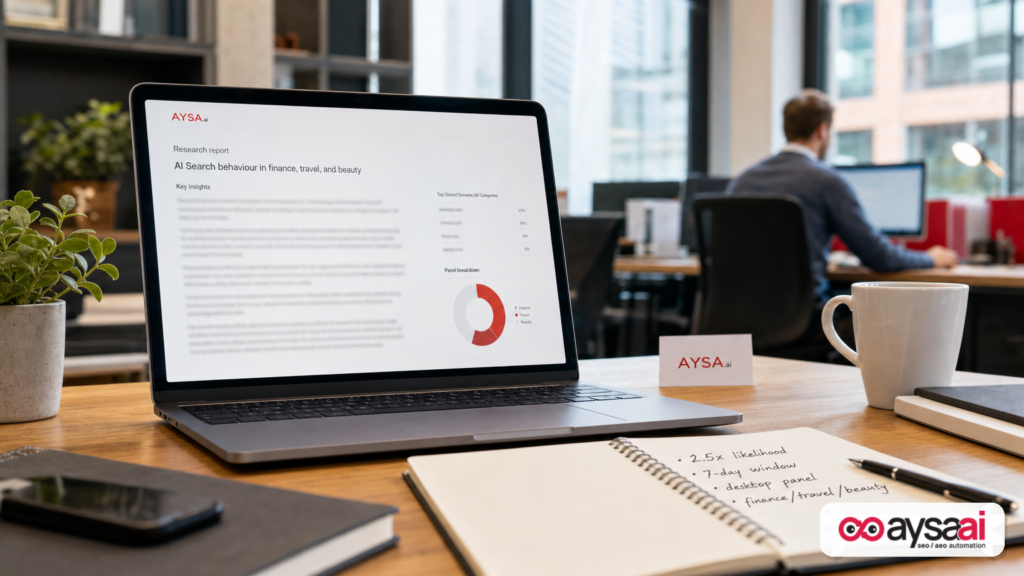
Similarweb’s analysis suggests ChatGPT recommendations can shift real consumer behavior: users who received an AI recommendation were more likely to visit the recommended brand’s website than a direct competitor. Those AI-influenced visitors also spent more time on site and viewed more pages. The big twist is attribution: many of these visits appear as search traffic in analytics, meaning AI can influence outcomes while staying invisible in your reports.
The practical implication for SMEs and agencies is straightforward: you need AI visibility monitoring and an execution system that can quickly improve what AI systems learn about your brand (entities, trust, differentiation, coverage) and what users experience after the click (clarity, proof, conversion paths). This is AEO/GEO meets real-world operations.
Key takeaways (read this if you only have 2 minutes)

- AI recommendations are upstream of the click. Users may decide in ChatGPT, then “confirm” in Google or go directly to your site. That makes AI impact hard to attribute.
- Engagement tends to be higher. Similarweb found AI-influenced visitors viewed ~12 pages and spent ~11.8 minutes on site vs. ~6.5 pages and ~5.6 minutes for others (directional, panel-based data).
- Winning AI visibility isn’t only content. It’s also brand clarity, entity consistency, evidence, UX, and conversion design.
- Measurement must evolve. Watch brand search lift, assisted conversions, changes in channel mix (search up, direct down), and landing-page behavior—not just “referrals from ChatGPT.”
- Execution is now the moat. The teams who can monitor → decide → ship site changes continuously will compound gains, while others debate definitions of “AI SEO.”
Context: why ChatGPT recommendations are different from “ranking”
Traditional search marketing trained businesses to think in rankings, Clicks, and sessions. Even when SEO was hard, it was legible: you optimized pages, you earned links, you watched positions move, you got traffic.
AI assistants change the interface—and therefore the user’s decision process.
When someone asks ChatGPT, “What’s the best travel booking site for flexible flights?” they aren’t necessarily looking for ten blue links. They’re looking for a shortlist, a recommendation, and a sense of confidence. In other words, AI systems are increasingly acting like:
- a category educator (what matters when choosing),
- a comparison engine (who is best for this situation), and
- a persuasion layer (why the answer is credible).
This is why AI visibility is not just “another SERP feature.” It’s a new gate in the funnel. And it’s why the Similarweb results matter: they suggest that being recommended isn’t a vanity mention—it can translate into measurable downstream visits.
Search Engine Land’s coverage sits among a broader wave of search changes and measurement problems—AI performance reporting in Google Search Console, spam updates, and ongoing debate about how AI systems decide what to cite or recommend. You can see that broader context in related Search Engine Land reporting, including:
- Google Search Console AI performance reports rolling out to more users
- Google releases June 2026 spam update and rollout completion coverage
- Google’s LLM patent suggests a new goal for SEO: teaching AI who you are
- Google AI Overviews citing patterns and competitive recommendations
- The paid brand mention problem in GEO
I’m not linking these to overwhelm you. I’m linking them because they point to the same truth: the discovery layer is fragmenting, and the measurement layer is lagging.
What Similarweb’s study actually tells us (and what it doesn’t)
Let’s strip the hype and focus on what the Similarweb analysis (as described by Search Engine Land) reasonably supports.
What the study design implies
Similarweb reportedly tracked opted-in U.S. desktop user behavior (July–December 2025) and focused on a clean-ish experiment:
- User asks ChatGPT an industry-relevant question.
- ChatGPT recommends a specific brand.
- Within seven days, user visits either the recommended brand or a direct competitor.
- They excluded people who had visited the brand in the prior four weeks or who named the brand in the prompt (to reduce obvious selection bias).
Within that framework, Search Engine Land reported two key findings from Similarweb:
- Traffic shift: users were ~2.5× more likely (on average) to visit the AI-recommended brand than a competitor in the studied pairs across finance, travel, and beauty.
- Deeper engagement: AI-influenced visitors viewed more pages and spent more time on site.
What we should not over-claim
This is not a universal law of marketing. It’s not proof that “ChatGPT replaces Google.” It’s not proof that every ChatGPT mention leads to revenue. And it’s not a guarantee that the same effect holds for mobile, other countries, other verticals, or other AI platforms.
It is, however, credible directional evidence that AI recommendations can influence brand choice—and that influence can show up in downstream web behavior.
The right way to use this kind of study is as a strategic wake-up call:
- If AI can steer consumers to a brand, then AI can also steer them away.
- If the influence is real, you should expect it to compound as AI usage rises.
- If attribution is messy, you need new measurement proxies and monitoring habits.
How AI recommendations translate into website visits (the behavior chain)
Most businesses still picture a linear funnel: Google → website → conversion.
AI introduces a pre-funnel: Chat → shortlist → validation → click.
In practice, the user journey often looks like one of these patterns:
Pattern A: AI shortlist → Google validation → click
- User asks ChatGPT for “best option.”
- ChatGPT recommends Brand A and explains why.
- User opens Google and searches “Brand A reviews,” “Brand A pricing,” “Brand A vs Brand B.”
- User clicks Brand A site (or a comparison page).
This pattern explains why AI influence can later appear as search traffic. The “decision” happened in AI; the “click” happened in search.
Pattern B: AI recommendation → direct navigation
- User asks ChatGPT.
- User types the brand URL or brand name directly.
This would normally look like direct traffic, but Similarweb’s summary (as covered by Search Engine Land) suggests direct is a smaller share for AI-influenced visits than for standard visits—again, consistent with the “validation via search” behavior.
Pattern C: AI recommendation → marketplace/app store → later brand site
For ecommerce and local services, users may go to marketplaces (Amazon, Booking-style platforms) or app stores first, then end up on the brand site later for details, support, or account management. Your web analytics may miss the earliest influence entirely.
Pattern D: AI recommendation → no click (decision completes in AI)
Sometimes AI answers the question so well that no click happens. This is the “zero-click” phenomenon, now supercharged. That doesn’t mean AI has no business impact. It means the impact may show up as:
- brand searches later,
- in-store actions,
- calls,
- or conversions on other platforms.
So yes, you still need SEO. But you also need to accept that SEO is now partly about earning consideration before the SERP.
The new attribution problem: AI creates demand, search captures the click
One line from the Search Engine Land summary should change how you read your reports:
Most AI-influenced visits didn’t appear as AI referral traffic.
Similarweb found that a majority of AI-influenced visits came through search, and that direct traffic was lower compared to non-AI-influenced visits. That’s the inversion most teams aren’t ready for.
Why this breaks common reporting
Most SMB dashboards ask: “Which channel drove the session?” They do not ask: “Which interaction shaped the choice?”
AI is shaping choice upstream, but the last-click channel often gets credit. This leads to predictable mistakes:
- SEO teams celebrate “search growth” without realizing the growth may be AI-assisted—and therefore vulnerable if AI sentiment shifts.
- Brand teams underinvest in AI visibility because “we’re not getting ChatGPT referrals.”
- Agencies misreport performance because the KPI stack is stuck in 2022.
What you should measure instead (practical proxies)
You don’t need perfect attribution to make good decisions. You need useful signals. Here are measurement proxies that work in the real world:
- Brand search lift: watch Google Search Console for brand queries increasing (impressions and clicks), especially after content or PR pushes. If AI is driving awareness, brand search often rises. (If you have GSC access, this is one of the cleanest signals you own.)
- Non-brand → brand pathway: in GA4, watch paths where users land on informational content then later hit pricing/contact. AI-influenced visitors may take different paths because they arrive pre-educated.
- Channel mix shifts: if search grows while direct shrinks, it can indicate more “validation searches” rather than navigational behavior.
- Engagement deltas on key landing pages: AI-influenced visitors may engage more deeply; watch time-on-site, scroll depth (if measured), and multi-page sessions on your top “consideration” pages.
- Conversion quality: not just conversion volume—look at lead quality, sales cycle length, or refund/support patterns if you can (even qualitatively through sales feedback).
Later in this article, I’ll outline what to instrument and what to change—but the mindset shift comes first: your analytics will increasingly show the click, not the influence.
Why AI-influenced visitors engage more (and what your site must do to convert them)
Similarweb’s finding that AI-influenced users view more pages and spend more time on site is intuitive if you think about what AI is doing: it’s compressing the top-of-funnel research and moving users deeper into evaluation mode.
But “more engaged” doesn’t automatically mean “more converted.” It can also mean:
- they’re verifying claims,
- they’re checking trust signals,
- they’re comparing product details,
- they’re searching for pricing clarity, cancellation policies, shipping, guarantees, or proof.
So the opportunity is real, but it comes with a requirement: your website has to be built for validation.
The new “validation stack” your site needs
If AI is sending you higher-intent visitors, your site should reduce friction in five areas:
- Clarity: Within 5 seconds, can a visitor tell what you do, who it’s for, and why you’re different?
- Proof: Reviews, case studies, certifications, transparent policies, real photos—whatever applies to your industry.
- Comparability: Simple comparison pages and FAQs that answer “Why you vs. alternatives?” without being gimmicky.
- Findability: Navigation and internal search that help people quickly confirm specifics (pricing, locations, ingredients, integrations).
- Conversion paths: Booking, checkout, call, demo—fast, mobile-friendly, with fewer dead ends.
Why this is now an SEO problem (again)
In 2026, SEO is no longer only about ranking pages. It’s about ensuring the entire brand experience supports the decision that AI helped initiate.
This is where most teams fail: they invest in “AI visibility content” and forget the landing experience. AI can send you the right visitors; your site can still lose them.
From SEO to AEO/GEO: what you’re really optimizing for now
You’ll hear a lot of labels: AEO (Answer Engine Optimization), GEO (Generative Engine Optimization), AI SEO, LLMO. The label matters less than the shift underneath:
- From keywords → entities and concepts
- From page relevance → brand understanding
- From “rank #1” → “be the recommended option for this scenario”
Search Engine Land’s ecosystem has been tracking this shift from multiple angles, including the idea that modern SEO increasingly involves “teaching AI who you are” (their coverage references a Google LLM patent discussion). Whether or not you agree with every framing, the operational takeaway is solid: you need consistent, machine-readable brand signals across your site and across the web.
What “teaching AI who you are” looks like in practice
For an SME, this isn’t mystical. It’s mostly the fundamentals done with discipline:
- Consistent positioning: Same category language across homepage, about page, product pages, and key articles.
- Clear entity signals: Who you are, where you operate, what you sell, what you specialize in—clearly stated, not implied.
- Evidence: Awards, certifications, press mentions, author bios, experience statements (where relevant), transparent policies.
- Coverage: Content that answers the real pre-purchase questions customers ask AI systems (not just what they type into Google).
In other words, AEO/GEO is largely: brand clarity + content coverage + credibility + execution velocity.
Why “paid brand mentions” are a real risk
As AI visibility becomes valuable, some players will try to buy their way into recommendations. Search Engine Land has pointed to this risk via coverage of “paid brand mention” dynamics in GEO. The business risk for legitimate brands is twofold:
- You can lose recommendations to better-funded competitors, not better products.
- The ecosystem can get noisier, making trust harder to earn.
The antidote is to build a moat of real-world proof, clear differentiation, and consistent distribution—so AI systems have more high-quality signals to learn from, and users have more reasons to validate you.
What can go wrong: the new failure modes of AI-driven discovery
AI-driven discovery doesn’t only create opportunity. It creates new ways to lose—quietly.
Failure mode 1: You get recommended for the wrong thing
If your positioning is fuzzy, AI might associate you with the wrong category, audience, or use case. That leads to mismatched traffic: high engagement, low conversion, confused leads.
Fix: tighten your category language, build explicit “who it’s for” pages, and ensure your site content doesn’t contradict itself.
Failure mode 2: Competitors get the shortlist spot
In Similarweb’s examples (finance, travel, beauty), the “winner” changed based on which brand the AI recommended. That implies a reality you need to accept: in competitive categories, AI visibility is a zero-sum battleground at the point of recommendation.
Fix: don’t just publish content—build authority signals, unique data, and clear differentiation that’s hard to replicate.
Failure mode 3: You can’t measure it, so you stop investing
If you require perfect attribution, you’ll underinvest. AI won’t wait for your reporting stack to catch up.
Fix: adopt proxy metrics and controlled tests. Ship improvements, then watch brand search, engagement, and assisted conversions.
Failure mode 4: Your website can’t close the loop
AI-influenced users may arrive with higher intent and more questions. If your site is slow, unclear, or conversion-hostile, you’ll waste the advantage.
Fix: treat your top validation pages as revenue pages: speed, structure, proof, UX, and conversion paths.
Failure mode 5: Operational bottlenecks kill momentum
AI visibility improvements are iterative. If every change takes six weeks and three departments, you’ll lose to faster competitors.
Fix: adopt an approved execution workflow: monitor issues, prepare changes, get approvals, deploy safely, and document what changed.
A concrete SME scenario: the local clinic that “lost” leads in GA4 (but didn’t)
Let’s make this real with a scenario I see variations of all the time.
The situation
A local clinic (say, dermatology or physical therapy) notices something odd:
- Direct traffic is down month-over-month.
- Organic search traffic is up.
- Calls are steady, but form fills fluctuate.
- The owner believes “Google changed something again.”
In the old world, you might assume SEO improvements or rank changes caused the shift. In the new world, another explanation becomes plausible:
- Patients ask ChatGPT: “Best dermatologist near me for acne scars” or “What’s a good clinic for sports injury rehab?”
- ChatGPT provides guidance and mentions a couple of clinics or what criteria to use.
- Patients then search Google for the clinic names, read reviews, and finally land on the clinic site to book.
In GA4, that looks like “organic search.” The AI influence is invisible.
What the clinic should do (not theory—execution)
- Audit the top validation pages: services pages, doctor bios, location pages, insurance/price FAQs, booking flow.
- Clarify specialization: not “We offer dermatology,” but explicit conditions, procedures, and who they help.
- Strengthen trust signals: credentials, real patient guidance content, policies, and clear contact/booking calls-to-action.
- Instrument better: ensure forms work, calls are tracked, and conversion paths are measurable (this sounds basic—until a broken form quietly kills leads for months; Search Engine Land recently highlighted how damaging that can be in another context: one broken form costing months of leads).
- Monitor AI visibility: not just rankings—whether AI systems mention the clinic, which services they associate with it, and what competitors are being recommended.
That’s the theme of this entire article: the winning move isn’t to argue about attribution. It’s to improve the inputs (visibility + clarity + trust) and improve the outputs (conversion experience + measurement).
What agencies should rethink: deliverables, reporting, and ops
If you’re an agency, AI-driven discovery is both a threat and an opportunity.
Threat: your reporting model can become irrelevant
Clients are already confused by:
- AI Overviews,
- shifting SERP layouts,
- spam updates and volatility,
- and now “AI influence that shows up as search.”
If your monthly report is still “rankings + sessions,” you’ll struggle to explain outcomes—especially when conversions don’t map neatly to last click.
Opportunity: become the team that owns “recommendation readiness”
Agencies can productize AI visibility work into a few durable services:
- AI visibility monitoring: track whether the brand is mentioned/recommended in common prompts and categories.
- Entity and trust optimization: site structure, author pages, policies, proof, and consistent positioning.
- Content coverage for AI questions: not keyword stuffing—clear answers and comparisons built for humans and machines.
- Conversion and validation UX: turning AI-influenced intent into leads/sales.
The operational gap: agencies need execution leverage
Most agencies are bottlenecked by client approvals and dev cycles. AI search rewards iteration speed. This is why an “approved execution” system matters: a way to propose changes, get sign-off, and ship without endless back-and-forth.
That’s exactly the gap we built AYSA to address: monitor, prepare, request approval, then execute accepted changes safely—so strategy doesn’t die in a Jira queue.
The execution plan: a 30/60/90-day playbook
You don’t need to boil the ocean. You need an execution plan that improves AI visibility and improves what happens after the click.
Days 1–30: establish your baseline and fix the obvious leaks
- Baseline AI visibility: determine whether your brand is recommended for your core category prompts and “best for” scenarios. Track competitors that appear instead.
- Baseline analytics: document current brand search trends in Google Search Console and channel mix in GA4.
- Fix critical conversion issues: broken forms, slow pages, confusing CTAs, missing contact info, unclear pricing/policies.
- Identify validation pages: the pages users must trust before buying—improve clarity and proof.
AYSA angle: this is where monitoring matters—because you can’t improve what you don’t watch, and most teams are blind to AI visibility changes until it’s too late.
Days 31–60: build “recommendation readiness” assets
- Write/refresh category-defining pages: “What we do,” “who we’re for,” and “why choose us” with specific, verifiable claims.
- Create comparison and alternatives content: “Brand vs competitor,” “best option for X,” “how to choose,” “pricing explained.”
- Strengthen trust: credentials, policies, author bios, customer proof, and transparent FAQs.
- Improve internal linking: make it easy for visitors to validate details quickly.
AYSA angle: use AI search visibility workflows to identify gaps in how AI systems understand your brand—and then translate those gaps into website updates that your team can approve and ship.
Days 61–90: operationalize and scale
- Turn monitoring into a weekly habit: track prompt categories, competitor mentions, and shifts in outcomes.
- Ship improvements continuously: treat AI visibility as ongoing, not a one-time project.
- Refine measurement: build a reporting view that includes brand search lift, engagement changes on validation pages, and assisted conversion pathways.
- Document wins: not just traffic, but lead quality and sales feedback—because AI influence often shows up in buyer readiness.
AYSA angle: this is where an execution system becomes a growth flywheel rather than a one-off sprint. Tools without execution don’t compound.
Where AYSA fits: monitor → prepare → approve → execute
Most companies don’t have an “SEO problem.” They have an implementation problem.
AI search increases the penalty for slow execution because the environment shifts faster: recommendation patterns change, competitors publish, SERP layouts evolve, and new attribution quirks emerge.
AYSA is built to operate as an execution layer for modern SEO/AEO/GEO:
- Monitors your visibility and site signals (so you can see what’s changing).
- Prepares recommended changes (content, technical, internal linking, structured improvements—depending on your workflow).
- Asks for approval so humans stay in control (especially important for regulated industries and brand voice consistency).
- Executes accepted changes so improvements actually ship.
If you want to explore how this looks in practice, start here:
One important note: AI visibility is not a magic switch. It’s an output of many inputs. Our view is practical: you improve the inputs you control (site clarity, coverage, proof, performance, conversion), you measure with the best proxies available, and you ship consistently.
What to do next
- Pick 10 real customer questions and test them in AI assistants (category “best,” “vs,” “near me,” “for beginners,” “for budget,” “for enterprise”). Note who gets recommended and why.
- Audit your validation pages: homepage, pricing, top product/service pages, about, reviews/testimonials, FAQs, contact/booking.
- Check your analytics for misreads: don’t assume “search growth” is purely Google-driven; look for brand query lift and shifts in channel mix.
- Create 3 high-impact content assets that answer decision-stage questions (comparisons, “how to choose,” pricing/policies explainers).
- Set a weekly execution cadence: monitor → propose changes → approve → deploy → measure.
- If you need an execution system, evaluate AYSA’s monitoring and AI visibility workflows and decide what you want automated vs. what must remain human-approved.
Sources and further reading
- Search Engine Land: ChatGPT recommendations drive more brand website visits: Study
- Search Engine Land: Google Search Console AI performance reports rolling out to more users
- Search Engine Land: Google’s LLM patent suggests a new goal for SEO: Teaching AI who you are
- Search Engine Land: Google releases June 2026 spam update
- Search Engine Land: Google June 2026 spam update done rolling out
- Search Engine Land: Google AI Overviews cite self-serving listicles, but recommend competitors 69% of the time
- Search Engine Land: The paid brand mention problem in GEO
- Search Engine Land: How one broken form cost an agency months of leads
AYSA internal resources: AI Search Visibility, Monitoring, AI SEO Tools, Pricing, Blog.
Continue the AI search topic inside AYSA.
Use these pages to connect the article with AI SEO tools, AI visibility monitoring, AI Overviews and approved website execution.
Turn this topic into a website action plan.
Use these AYSA hubs to move from reading to technical fixes, AI visibility monitoring, research, glossary context and approval-first SEO execution.

