
ChatGPT Ads Are Getting Harder to Ignore: What a 50% Drop in Dismissals Means for Search, Intent, and Your Next Marketing Play
OpenAI says ChatGPT ad dismissals are down 50% as relevance improves. That single metric signals a bigger shift: ads are moving from “interruptions” to “assistance.” Here’s what changes for SMEs, agencies, and anyone who depends on search demand—plus a practical action plan and how AYSA turns AEO/GEO strategy into approved execution.

OpenAI says users are dismissing ads in ChatGPT about 50% less often than when the company first launched ads earlier this year. That’s a deceptively small update with a big implication: the ad unit isn’t competing for attention the way a banner does—it’s competing for usefulness inside an active decision-making conversation.
If that trend continues, it changes how SMEs and agencies should think about paid search, landing pages, “AI Optimization” (AEO/GEO), and measurement. It also puts a spotlight on a reality many teams are still avoiding: your website and product data now have to serve two audiences at once—humans and the AI systems that mediate recommendations.
This editorial breaks down what’s changing, why it matters, what can go wrong, and what to do next—plus where AYSA fits as an execution system that monitors, prepares, asks for approval, and implements accepted website changes.
Concise summary

- Fewer ad dismissals likely means conversational ads are becoming more relevant to user intent, not merely better designed.
- AI chat environments raise the bar: anything that feels off-topic can damage trust fast.
- Paid and organic are converging inside AI answers—brands need both conversion-ready pages and “AI-readable” entity/offer clarity.
- Attribution will get harder, so teams need better measurement hygiene and narrative reporting.
- Execution is the bottleneck: Monitoring and recommendations are cheap; shipping site changes is where performance is won.
Key takeaways for business owners and marketers
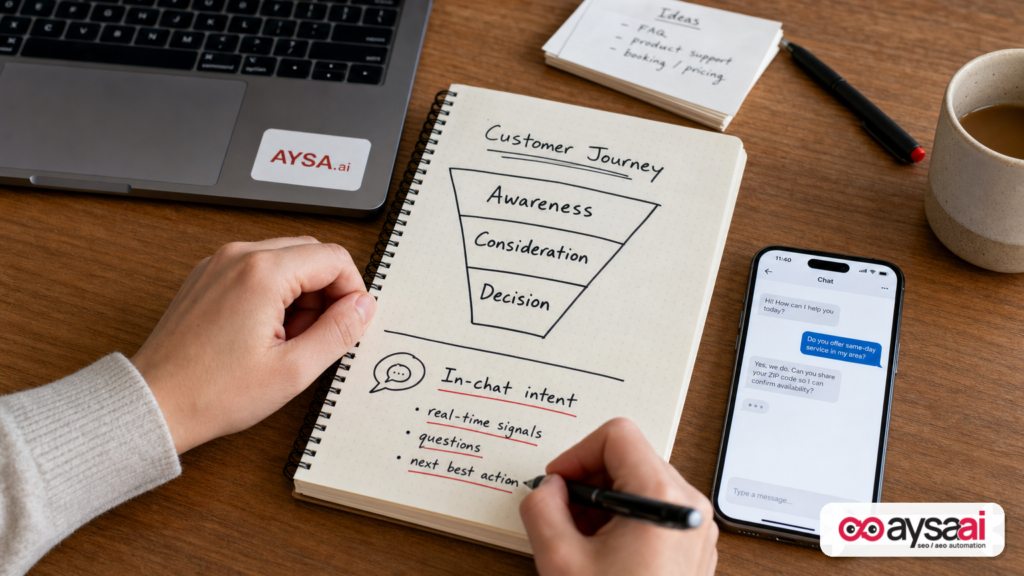
- Conversational AI ads are less about “creative” and more about matching real intent and reducing decision friction.
- Your website clarity (pricing, policies, proof, inventory/service constraints) matters more because the AI experience compresses research time.
- Expect a new category of performance problems: high-intent traffic that bounces because your page can’t close the loop the assistant started.
- SMEs should invest in AEO/GEO readiness and conversion fundamentals before chasing new ad surfaces.
Table of contents

- The real headline isn’t “ads in ChatGPT”—it’s “ads that behave like answers”
- What changed: OpenAI’s “ad dismissals” metric, and why it matters
- Why relevance is the entire game in conversational ads
- How AI chat changes search behavior (and what that does to the funnel)
- What can go wrong: trust, bias, compliance, and brand safety in an AI answer
- A practical SME scenario: the local clinic, the ecommerce brand, and the “help me decide” moment
- Landing pages in the AI era: your page must “finish the job”
- The measurement problem: what to track when clicks aren’t the whole story
- What agencies should rethink (before clients ask why leads changed)
- Where AYSA fits: monitoring → recommendations → approvals → execution
- What to do next: a 30-day action plan for SMEs
- Sources and further reading
The real headline isn’t “ads in ChatGPT”—it’s “ads that behave like answers”
When people hear “ads in ChatGPT,” they often picture the worst version of advertising: an intrusive pop-up wedged into something personal. But conversational AI advertising—if it works—feels less like a billboard and more like a contextual option inside a decision.
That’s a fundamental shift from the classic display model:
- Display/social: you’re interrupting consumption (scrolling, watching, reading).
- Search: you’re intercepting declared intent (“best running shoes for plantar fasciitis”).
- Conversational AI: you’re participating in an evolving intent (“I need shoes that reduce heel pain, under $150, available this week, and I have wide feet”).
The AI context is more fragile. Users are not “browsing content”; they’re trying to solve a problem. That’s why a metric like dismissals matters: it’s a signal of perceived friction.
OpenAI’s update (via Search Engine Land) suggests that friction is dropping. Here’s the source we’re working from: Search Engine Land: OpenAI says ChatGPT ad dismissals have dropped 50% as relevance improves.
What changed: OpenAI’s “ad dismissals” metric, and why it matters
According to OpenAI executives as reported by Search Engine Land, the rate at which users dismiss ads inside ChatGPT has fallen by about 50% since the ads business launched earlier this year. The report frames dismissals as a proxy for relevance: fewer dismissals implies ads are better aligned with what users are trying to accomplish in the conversation.
There are two important subtleties for marketers:
- This is not a typical CTR story. Dismissals are about experience quality. Someone can “not dismiss” and still not click—because the ad was useful as information, or because they’re still deciding.
- It’s a platform-leading indicator. If a conversational ad format can reduce annoyance, platforms will scale it. That means more competition and more sophisticated ranking/selection mechanisms.
OpenAI’s Chief Revenue Officer Denise Dresser is quoted in the Search Engine Land piece emphasizing usefulness and relevance. We can’t verify any additional internal metrics beyond what’s reported there, so treat the 50% figure as an early directional signal, not a mature performance benchmark.
Why relevance is the entire game in conversational ads
In classic ad environments, “relevance” often means the ad is roughly in the right neighborhood: the person read an article about mortgages, so you show a refinance offer. In an AI conversation, “relevance” needs to be situational:
- Constraints: budget, timeline, location, shipping windows, insurance, eligibility.
- Preferences: style, brand, ingredients, accessibility needs.
- Risk tolerance: warranties, returns, guarantees, safety, compliance.
- Job-to-be-done: the real outcome the user is hiring a product/service for.
This is where a lot of brands will struggle. They’re used to writing copy that sounds good. Conversational relevance is less about sounding good and more about being operationally true. If your ad implies “available tomorrow” but your logistics can’t support it, users won’t just bounce—they’ll distrust the assistant experience, and platforms will respond.
That means the performance conversation is going to get more “boring” (in the best way). Winning brands will obsess over:
- Clean product/service data
- Clear pricing and policy pages
- Accurate location/service area details
- Proof: reviews, certifications, case studies (where appropriate)
- On-page language that makes constraints explicit (so AI and humans can understand)
How AI chat changes search behavior (and what that does to the funnel)
The buyer journey isn’t disappearing, but AI compresses it. Instead of ten tabs and a dozen searches, the user tries to get the assistant to do three things:
- Clarify the problem (what do I actually need?)
- Shortlist options (what should I choose?)
- Reduce risk (how do I avoid a bad decision?)
In that environment, your brand can show up in a few different ways:
- As an organic recommendation in the assistant’s answer (AEO/GEO impact).
- As a sponsored option that fits the conversation (paid impact).
- As a citation/source the assistant trusts enough to reference.
Notice what’s missing: the SERP as the central decision interface. That doesn’t mean Google is “done.” It means interfaces are fragmenting. You have to win in multiple places.
Search Engine Land’s broader context (seen in the page’s discovered links) signals the same industry-wide shift: AI performance reporting in Google Search Console is rolling out to more users, and the SEO conversation is increasingly about teaching systems “who you are,” not just ranking a page.
Those items were listed on the source page as related/adjacent coverage. For reference:
- Google Search Console AI performance reports rolling out to more users (Search Engine Land)
- Google’s LLM patent suggests a new goal for SEO: Teaching AI who you are (Search Engine Land)
- The paid brand mention problem in GEO (Search Engine Land)
We’re not treating those as primary proof of how Google systems work, but they’re useful leads for how practitioners are thinking about AI discovery right now.
What can go wrong: trust, bias, compliance, and brand safety in an AI answer
Conversational ads only scale if users keep trusting the environment. That creates risk for platforms and advertisers.
1) The “creepy relevance” line
There’s a difference between “helpful” and “how did you know that?” If ads feel too personal, users push back. If they feel generic, users dismiss them. Platforms will keep iterating on this boundary, and advertisers should assume policies will evolve.
2) Misrepresentation risk
AI experiences summarize. Summaries can be wrong or incomplete. If your offer has complex eligibility (financing, medical services, legal services, enterprise software), any mismatch between what the assistant implies and what you actually provide can create:
- Refund and chargeback issues
- Customer support burden
- Reputation damage
For regulated categories, it can also create compliance problems. If you operate in a regulated industry, get your compliance team involved early.
3) Brand safety and adjacency
In a conversation, “adjacency” is less about the webpage and more about the topic trajectory. Your ad could appear after sensitive questions. Platforms will build controls, but advertisers should be ready to apply exclusions and guardrails where possible.
4) The assistant becomes the gatekeeper
If users rely on the assistant to decide, then being “recommended” becomes a new kind of distribution power. That’s good when you’re included; dangerous when you’re invisible. This is exactly why AEO/GEO and brand entity clarity matter: you want the assistant to have a clean, accurate model of your brand and offer.
A practical SME scenario: the local clinic, the ecommerce brand, and the “help me decide” moment
Let’s make this tangible with three realistic scenarios. No hype—just what likely happens when conversational ads and AI recommendations are integrated into shopping and decision-making.
Scenario A: A local clinic
A parent asks an AI assistant: “My kid has recurring ear pain, can I get a same-week appointment near me? What should I ask the doctor?”
The assistant might respond with general advice and then present options: nearby clinics, telehealth, or urgent care—potentially including a sponsored clinic option if relevant.
What determines whether the clinic wins?
- Does the clinic page clearly state services offered (pediatrics vs ENT referral)?
- Are appointment rules clear (walk-ins, same-day, insurance accepted)?
- Is location and hours accurate?
- Is there immediate next-step conversion (call, book, request)?
Scenario B: An ecommerce brand
A user asks: “I need a carry-on backpack that fits European airlines, has a laptop compartment, and won’t hurt my shoulders. Under $120.”
In a conversation, the assistant can narrow options quickly—sometimes faster than a user can filter a messy category page.
What determines whether your product gets recommended (paid or organic)?
- Do you publish precise dimensions and weight?
- Do you clearly explain comfort/strap design in plain language?
- Is shipping time and returns policy easy to find?
- Do you have reviews that mention the exact constraints (airline fit, comfort)?
Scenario C: A B2B SaaS company
A founder asks: “What’s the simplest tool for invoice reminders and basic cash-flow tracking for a 3-person agency?”
If your site is full of vague claims (“best-in-class platform”) but doesn’t clearly state who it’s for, what it replaces, how pricing works, and how fast setup is, you won’t convert—even if the assistant mentions you.
Across all three: conversational ads reward brands that are specific and truthful about constraints.
Landing pages in the AI era: your page must “finish the job”
Here’s the part many teams will miss: when an AI assistant frames the problem and presents options, it has already done a chunk of your sales work. That’s great—unless your landing page forces the user to start over.
In practical terms, AI-era landing pages should do five things exceptionally well:
1) Confirm relevance immediately
Mirror the user’s constraint language (without being creepy). If the user asked for “same-week appointment,” your page should make scheduling availability obvious. If the user asked “under $120,” show the product and price without hunting.
2) Reduce perceived risk
Policies become conversion drivers: returns, warranties, cancellations, delivery windows, refunds, support response times.
3) Prove the claim
Use proof that aligns to the job-to-be-done: reviews, before/after examples, certifications, comparison tables (when accurate), FAQs addressing edge cases.
4) Make the next step effortless
Chat-based intent is often high-intent. Don’t waste it with friction:
- Fast mobile performance
- Clear primary CTA
- Short forms or progressive profiling
- Obvious contact routes
5) Be AI-readable as well as human-readable
This is where AEO/GEO meets conversion. Your page should communicate “who this is for” and “what it does” in clean language, structured sections, and consistent terminology. Schema and structured data can help in some contexts, but the core is semantic clarity: the assistant can’t recommend what it can’t understand.
If you want a practical starting point, AYSA focuses on AI search visibility and execution workflows. Explore:
The measurement problem: what to track when clicks aren’t the whole story
Marketing measurement has been deteriorating for years (privacy changes, modeled conversions, walled gardens). Conversational AI adds a new twist: the assistant can influence the decision even if the user never clicks the sponsored item, or clicks later via a different path.
So what should SMEs and agencies track?
Baseline: keep the fundamentals clean
- Ensure consistent conversion tracking on forms, calls, bookings, purchases.
- Validate that lead capture forms actually work end-to-end (you’d be surprised).
- Maintain clean UTM discipline for campaigns you can control.
Search Engine Land’s broader coverage includes a cautionary theme: bad data doesn’t just create bad reports—it can hurt delivery. That’s relevant here because if platforms optimize to “good experiences,” your measurement quality may affect how systems learn. See: Bad data used to mean bad reports, now it means poor ad delivery (Search Engine Land).
Conversation-era additions
Even without perfect platform-side attribution, you can build directional visibility using:
- Branded search lift: do you see more branded queries after AI discovery pushes?
- Assisted conversions: look at conversion paths, not just last-click.
- On-site “intent alignment” metrics: bounce rate on key landing pages, scroll depth, CTA engagement, booking-start rate.
- Lead quality signals: are leads more specific (“I need X by Friday”)—a sign they came with pre-framed intent?
And you need a monitoring layer that alerts you when visibility shifts, not weeks later. AYSA’s monitoring capability is designed for that operational reality: AYSA Monitoring.
What agencies should rethink (before clients ask why leads changed)
Agencies are about to get squeezed from both sides:
- Clients want growth from “new AI channels,” but don’t want complexity.
- Platforms want relevance and user trust, which pushes advertisers toward stricter formats and constraints.
To stay ahead, agencies should rethink four areas.
1) Strategy: stop separating “SEO” and “PPC” as different planets
In AI experiences, paid and organic are interleaved inside the same answer interface. Your brand either “makes sense” as a recommended option or it doesn’t. That means landing page clarity, entity consistency, and offer structure need to be coordinated across teams.
2) Creative: shift from persuasion to fit
The best “creative” in conversational AI may be the ability to match constraints and reduce risk. That’s not just copywriting; it’s operational truth translated into clear language.
3) Ops: execution speed becomes a moat
When the environment changes quickly, the agency that can ship improvements weekly (not quarterly) wins. That’s why execution systems matter more than slide decks.
4) Reporting: narrate performance in a world where attribution is imperfect
Clients will ask: “Are we getting business from AI?” You will need a narrative backed by directional indicators: branded lift, lead quality shifts, on-site intent metrics, and visibility monitoring.
If you want more practical guidance, AYSA’s blog is where we publish operational playbooks as these interfaces evolve: AYSA Blog.
Where AYSA fits: monitoring → recommendations → approvals → execution
Most companies don’t fail because they lack ideas. They fail because execution gets stuck:
- Who owns the website changes?
- Who approves copy updates?
- Who fixes technical issues?
- How do we prioritize what actually moves the needle?
AYSA is built to solve that bottleneck with an approved execution model:
- Monitor visibility and site signals across SEO/AEO/GEO surfaces.
- Prepare specific recommended changes (content, technical, structured clarity).
- Ask for approval so humans stay in control.
- Execute the accepted changes on your site.
In the context of conversational ads and AI discovery, this matters because “relevance” isn’t only an ad-targeting problem—it’s often a website truth problem. Your site must communicate your offer so clearly that both humans and AI systems can confidently choose you.
Learn more:
What to do next: a 30-day action plan for SMEs
You don’t need to “run ChatGPT ads tomorrow” to benefit from this shift. You need to prepare for a world where more buying journeys begin inside an assistant.
Week 1: Get your “truth layer” in order
- Audit top landing pages for pricing clarity, availability, and policy visibility.
- Ensure each core service/product page answers: who it’s for, what it does, constraints, and next steps.
- Fix obvious trust gaps: missing contact info, vague guarantees, outdated hours, confusing shipping/returns.
Week 2: Upgrade conversion paths
- Test the purchase/booking flow on mobile end-to-end.
- Reduce form friction; confirm you’re capturing the right lead details.
- Add FAQ sections focused on real objections and edge cases.
Week 3: Build AI-ready semantics (AEO/GEO basics)
- Standardize your naming: brand, products, categories, service areas.
- Create “explainers” that map to user questions (not internal jargon).
- Ensure your site content reflects operational realities (inventory, lead times, eligibility).
Week 4: Instrument, monitor, and iterate
- Validate analytics and conversions are firing reliably.
- Set up monitoring so you can spot visibility or performance shifts early.
- Establish a weekly cadence: review, approve changes, ship updates.
If you need a system that turns that cadence into reality—without endless tickets and stalled backlogs—that’s exactly the execution gap AYSA is designed to close.
What to watch over the next 6–12 months
Based on the directional signal of declining dismissals and the broader industry push toward AI-mediated discovery, here’s what I expect smart teams to pay attention to—without pretending we can see inside any platform’s roadmap:
- More ad formats that look like recommendations, with stronger labeling requirements.
- Higher standards for landing page accuracy (availability, pricing, claims).
- New reporting surfaces that try to bridge AI impressions to outcomes (still imperfect).
- More competition for “trusted brand” status as assistants select fewer options than a SERP.
For businesses, the defensive move is clear: become the most understandable, most trustworthy option in your niche—so whether the mention is organic or sponsored, it converts.
Sources and further reading
- OpenAI says ChatGPT ad dismissals have dropped 50% as relevance improves (Search Engine Land)
- Google Search Console AI performance reports rolling out to more users (Search Engine Land)
- Google’s LLM patent suggests a new goal for SEO: Teaching AI who you are (Search Engine Land)
- The paid brand mention problem in GEO (Search Engine Land)
- Bad data used to mean bad reports, now it means poor ad delivery (Search Engine Land)
Related AYSA resources:
Continue the AI search topic inside AYSA.
Use these pages to connect the article with AI SEO tools, AI visibility monitoring, AI Overviews and approved website execution.
Turn this topic into a website action plan.
Use these AYSA hubs to move from reading to technical fixes, AI visibility monitoring, research, glossary context and approval-first SEO execution.

