
Claude Sonnet 5 Goes “Near-Opus” for Everyone: What This Means for AI Search, Agentic SEO, and Practical Business Execution
Anthropic made Claude Sonnet 5 the default model for all plans—including free—while highlighting stronger agentic performance and more economical token usage. Here’s the real business impact: faster “good enough” AI at scale changes how brands get discovered, cited, and chosen—and why execution (not prompting) becomes the competitive advantage.
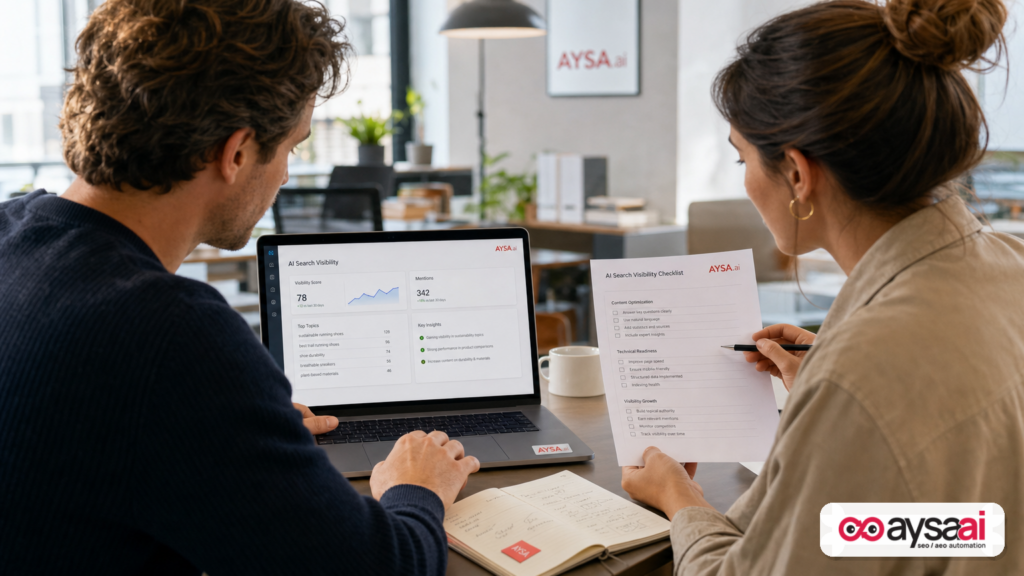
Anthropic’s decision to ship Claude Sonnet 5 as the default model across all plans—including free—looks like a product update. But for business owners and marketers, it’s a market signal: capable AI is becoming baseline infrastructure, not a premium add-on.
When “pretty good” AI gets cheaper and more available, two things happen fast:
- More people use AI to decide what to buy (not just to research).
- More companies use AI to produce and change things (not just draft ideas).
This editorial breaks down what Sonnet 5 changes, why “agentic performance” matters for AI Search, and what you should do next if your growth depends on organic discovery. I’ll also show where AYSA fits: Monitoring what AI systems say about you, preparing improvements, asking for approval, and executing accepted changes—so AI visibility turns into measurable outcomes.
Concise summary

- Sonnet 5 is now the default across Anthropic plans, including free, and Anthropic highlighted improved coding + agentic performance and more economical token usage.
- Agentic performance matters because AI systems increasingly do multi-step work: browse, compare, decide, and recommend—often without a human controlling every step.
- AI Search is shifting from “ranking pages” to “recommending vendors.” That changes what “SEO” means for SMEs: structured facts, trust signals, and operational execution become the moat.
- The winning move in 2026 isn’t more AI content volume. It’s improving the inputs AI systems rely on: site structure, Entity Clarity, location accuracy, policies, and proof.
- AYSA’s role: continuously monitor AI search visibility, recommend changes, route them for approval, and execute improvements safely on your website.
Table of contents
- What changed: Sonnet 5 becomes the default model across plans (including free)
- “Near-Opus intelligence” is a pricing/packaging story (and that matters)
- Why “agentic performance” matters more than raw model IQ
- Benchmarks: what they suggest (and what they don’t)
- The hidden SEO impact: better agents change how AI systems “decide” what to cite
- A concrete SME scenario: a local clinic competing in AI answers
- What can go wrong: where businesses get burned by faster, cheaper AI
- A practical 2026 playbook: from “rankings” to “recommendation readiness”
- Proving it: measurement approaches that survive the AI search era
- What agencies should rethink: deliver execution, not deliverables
- Where AYSA fits: monitor, prepare, approve, execute
- What to do next (action list)
- Sources and further reading
What changed: Sonnet 5 becomes the default model across plans (including free)

According to coverage in Search Engine Journal, Anthropic released Claude Sonnet 5 as the latest Sonnet-class model and made it the default model for all plans, including the free tier. The same coverage notes Anthropic’s emphasis on improved capabilities for coding, agentic performance (multi-step autonomous work), and token efficiency, plus introductory pricing for tokens through a defined period.
For most SMEs, the headline isn’t “new model.” It’s distribution. When a model becomes the default, usage spikes—especially among casual users who don’t pick models at all. That changes the baseline of what customers, employees, and competitors can do with AI on a random Tuesday.
Translation: the average quality of AI-generated research, comparisons, and recommendations improves. That raises the bar for your website’s clarity, credibility, and machine-readability—because AI systems are increasingly the interface between a customer and your business.
“Near-Opus intelligence” is a pricing/packaging story (and that matters)
The phrase “near-Opus intelligence” (as reported by SEJ) is a strategic message: Anthropic is telling the market that you can get close to their higher-tier performance at a Sonnet price point. Whether you’re a founder, an in-house marketer, or an agency owner, this matters for one reason:
Cost determines behavior.
- Cheaper tokens mean more experimentation, more automation, more “let’s just try it.”
- More experimentation means more AI-generated pages, more AI-assisted site changes, more AI-written Outreach, and more AI-driven competitive analysis.
- That increased activity feeds back into search ecosystems: more content, more noise, more duplication—and more pressure on platforms to answer directly instead of sending Clicks.
In other words: model upgrades don’t just improve outputs. They accelerate the operational adoption curve across the entire market. The competitive gap won’t be “who has AI.” It will be who executes correctly and who measures reality.
Why “agentic performance” matters more than raw model IQ
“Agentic” is one of those words that can become buzz fast. Here’s the plain-English version:
- A normal chat model answers a question.
- An agent can take a goal (“find the best option”) and run a multi-step process: plan, browse, extract facts, compare, and produce a decision-ready output.
SEJ’s coverage states that Anthropic emphasized the model’s ability to make plans, use tools like browsers and terminals, and operate more autonomously—reducing the amount of direct human guidance required.
From an AI Search perspective, this is the real shift: the AI isn’t just a writing tool. It becomes a researcher, a procurement assistant, a travel planner, or a referral engine. And it will only recommend you if it can confidently understand:
- What you are (entity clarity)
- What you offer (service/product specificity)
- Where you offer it (location accuracy)
- Why you’re credible (proof)
- How to choose you (clear next steps)
If your website is vague, inconsistent, or missing structured facts, an agentic model is less likely to “take the risk” of recommending you—especially when it can easily find competitors with cleaner signals.
Benchmarks: what they suggest (and what they don’t)
SEJ lists several benchmark results highlighting Sonnet 5 performance improvements versus prior Sonnet and select competitor models, including tests like BrowseComp, Terminal-Bench, SWE-bench Pro, and FrontierCode (as described in Anthropic’s system card). Those details support a reasonable business conclusion:
Sonnet 5 appears positioned as a strong “workhorse” model—good enough for real tasks, especially coding and tool-using workflows, without always needing the highest-cost frontier tier.
But here’s the caution I want SMEs to internalize: benchmarks don’t directly equal business outcomes.
- A model can score well in terminal tasks and still produce risky brand copy.
- A model can browse well and still misinterpret a policy page or miss nuances like service boundaries, licensing, or availability.
- A model can be fast and cheap, leading teams to automate changes prematurely.
The “win” is not picking the best benchmark model. The win is building a system where AI outputs are constrained by facts, reviewed, and executed with accountability.
The hidden SEO impact: better agents change how AI systems “decide” what to cite
Historically, SEO mostly meant: earn rankings, get clicks, convert on-site.
AI Search changes the middle step. Increasingly, the user’s journey looks like:
- User asks an AI tool for the best option.
- The tool synthesizes, recommends, and sometimes cites sources.
- User chooses from a short list (often without visiting many sites).
So the SEO question evolves from “How do I rank?” to:
“How do I become the business an AI feels safe recommending?”
This is where AEO (Answer Engine Optimization) and GEO (Generative Engine Optimization) become operational, not theoretical. It’s less about clever phrasing and more about:
- Consistent business facts across your site (and across locations)
- Clear service definitions (what you do, what you don’t do)
- Pricing/estimates policies (when applicable)
- Trust assets: credentials, warranties, return policies, editorial standards
- Structured data where it fits and is supported by visible content
If you’ve ever wondered why a competitor with a “worse” website gets mentioned more often in AI answers, it’s usually because their information is more extractable and more verifiable, not because they have more blog posts.
A concrete SME scenario: a local clinic competing in AI answers
Let’s make this tangible.
Imagine a local physical therapy clinic with two locations. They rely on:
- Organic search
- Local discovery
- Referrals
- Insurance-related service pages
A potential patient asks an AI assistant: “Who’s the best physical therapist near me for runner’s knee? I need someone who takes my insurance and has early appointments.”
In a world of better agentic performance, the AI might:
- Search the web for clinics nearby.
- Cross-check hours and appointment availability cues.
- Look for insurance signals (without making legal promises).
- Assess credibility signals: licensure, staff bios, clinical focus, reviews (where accessible), and clear service descriptions.
- Recommend 2–3 options with reasons.
Now the clinic’s real risk: if their site has thin service pages, missing clinician credentials, inconsistent hours across pages, or vague “we help with pain” copy, the AI may recommend a competitor who has:
- Clean location pages
- Specific condition pages with medically careful language
- Clear next steps (call, book, what to bring)
- Policies that reduce uncertainty
That competitor might not outrank on every keyword—but they become the AI’s “safe choice.”
The clinic doesn’t need 200 AI-written articles. They need a small set of high-trust pages, accurate location/entity information, and a process to keep it current.
What can go wrong: where businesses get burned by faster, cheaper AI
As models get cheaper and more autonomous, the failure modes become more operational than technical. Here are the most common ones I see in the market (and what to do instead):
1) Automating content or site changes without a truth layer
If you let AI “fill in” details, it will. That’s the point. But unless it’s constrained by your real business facts (services, terms, locations, inventory rules, compliance limits), it can produce:
- Incorrect claims
- Overbroad promises
- Confusing location/service coverage
Fix: create a “source of truth” set of pages and structured facts, then let AI expand only within those constraints.
2) Treating AI volume as a growth strategy
Publishing more pages faster is not the same as increasing demand or trust. AI Search systems are increasingly selective about what they cite and recommend, especially for “your money or your life” categories and high-stakes decisions.
Fix: prioritize depth, proof, and clarity over page count. Build pages that answer selection questions: “Who is this for?”, “What does it cost?”, “What’s the process?”, “What’s included?”, “What’s the risk?”
3) Measuring only rankings while the market shifts to answers
If your dashboard is still “top 10 keywords,” you’ll miss what’s happening: AI can reduce clicks while increasing brand selection. You need measurement that captures visibility in AI answers and downstream conversions.
Fix: add AI visibility monitoring and controlled tests. (More on measurement below.)
4) Letting AI agents change production sites without approvals
Agentic performance is exciting until your pricing page changes, your legal copy gets rewritten, or a critical template breaks. Faster models make this easier to do accidentally.
Fix: enforce an approval-first workflow. AI prepares changes; humans approve; execution is logged and reversible.
A practical 2026 playbook: from “rankings” to “recommendation readiness”
Here’s the framework I recommend to SMEs and agencies who want to win the next two years of organic growth. It’s not trendy. It’s operational.
1) Clean up the entity: make it easy to understand who you are
Your business should be unambiguous to both humans and machines:
- Exact business name, consistent across the site
- Clear description of what you do (one sentence, not marketing fog)
- Service area (especially for local services)
- Location pages with consistent hours, address, phone, directions, parking notes
This is foundational for AI search visibility because models cite and recommend what they can confidently identify.
2) Build “decision pages,” not just “information pages”
Most SME websites explain. Very few help customers decide.
Add or improve pages that reduce uncertainty:
- Pricing philosophy (even if you can’t list exact prices)
- What to expect (timeline, steps, onboarding)
- Comparisons (when appropriate and honest)
- Refund/returns/warranty policies
- Licenses, certifications, compliance statements where needed
These pages become the “evidence” an AI agent can use when it synthesizes options.
3) Structure the site so agents can extract facts fast
Agentic browsing is improved when your site is structured:
- Clear headings
- Scannable sections
- FAQ blocks that reflect real pre-sales questions
- Consistent templates across locations/services
If you’re thinking, “That’s just good UX,” you’re right. AI Search rewards good UX because it makes content easier to interpret and verify.
4) Make trust visible (not implied)
AI systems—and customers—look for concrete trust signals:
- Real team bios with credentials where relevant
- Case studies with verifiable detail (without inventing numbers)
- Editorial standards for advice content
- Clear contact and support pathways
Trust isn’t a vibe. It’s an artifact.
5) Treat every location as its own “AI surface”
If you operate multiple locations, AI systems may describe them differently. Inconsistent details lead to inconsistent recommendations. Standardize:
- Location attributes (hours, services, accessibility)
- Unique content (not duplicated boilerplate)
- Local proof (photos, staff, local policies)
This aligns with the broader industry push to win AI citations across locations—an issue frequently raised in AI search discussions (including in SEJ’s broader context navigation elements on AI testing and location accuracy).
6) Operationalize execution: small, approved changes shipped weekly
This is where most teams fail. They know what to do but can’t ship consistently:
- Ideas live in docs.
- Audits become PDFs.
- Tickets sit in backlog.
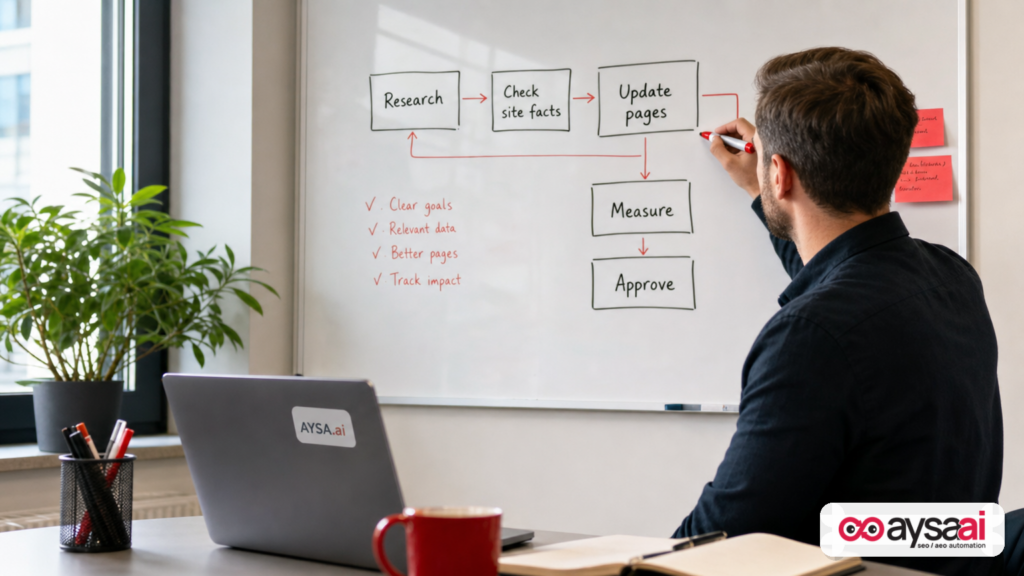
AI advantages compound when you can execute. The winning cadence is: monitor → identify opportunities → prepare changes → approve → ship → measure → repeat.
That’s exactly how AYSA is designed to work: monitoring + preparation + approval gates + execution.
Proving it: measurement approaches that survive the AI search era
If you can’t prove what’s happening, budgets get cut and strategy turns into opinions. Here’s a measurement stack that stays useful even as click patterns change.
Measure what AI says about you (not just what Google ranks)
You need to track how your brand and products/services appear in AI answers. That includes:
- Whether you’re cited or recommended
- What claims are made about your business
- Which competitors are mentioned instead
AYSA’s AI SEO tools and AI Search visibility focus on making those signals observable—so you can act, not guess.
Run controlled changes and annotate outcomes
AI search environments are noisy. If you change 30 things at once, you learn nothing. Instead:
- Ship improvements in small batches
- Annotate release dates
- Monitor conversion-rate changes, lead quality, and assisted conversions
This isn’t glamorous, but it’s how you build a repeatable growth system.
Tie AI visibility to business KPIs
Ultimately, your scorecard is:
- Qualified leads
- Bookings
- Revenue
- Retention (for subscriptions)
If AI visibility rises but pipeline doesn’t, the issue is usually one of these:
- The AI is mentioning you for the wrong intent
- Your pages don’t convert once users arrive
- Your offer isn’t differentiated or credible enough
What agencies should rethink: deliver execution, not deliverables
Agencies are entering a squeeze: clients expect faster output because “AI can do it,” while results are harder to attribute because AI answers reduce clicks.
In this environment, the agency advantage isn’t writing more content. It’s:
- Running a tighter operating system for visibility and iteration
- Owning measurement that maps to revenue
- Shipping improvements with governance, not chaos
That’s why I believe “approved execution” becomes the defining agency differentiator. Clients don’t want a 40-page audit. They want outcomes with a change log.
AYSA supports this posture by combining monitoring with controlled, approval-based execution—so agencies can scale implementation without taking on unmanaged risk. If you’re evaluating this, start at AYSA pricing and browse use cases on our blog.
Where AYSA fits: monitor, prepare, approve, execute
Models like Sonnet 5 make “doing” cheaper: drafting, researching, planning, and coding. But businesses still lose when execution is messy.
AYSA is built for the part that actually compounds: turning insights into approved website changes that improve AI Search performance over time.
1) Monitor what matters in AI Search
Start with visibility, not assumptions. Use monitoring to track how your brand and pages show up and where gaps exist—especially across locations, services, and high-intent topics.
2) Prepare improvements tied to business outcomes
Instead of “write more blogs,” the work becomes:
- Clarify service pages
- Fix internal consistency (facts, policies, coverage)
- Improve structured information and page templates
- Add trust assets and decision content
AYSA helps prepare the change set so it’s ready for review.
3) Require approval (because your website is a business asset)
Agentic workflows are powerful. They also create risk. AYSA’s model is simple: we propose; you approve. That keeps you in control of brand, compliance, and accuracy.
4) Execute accepted changes consistently
Execution is where most strategies die. AYSA’s value is operational: accepted improvements get implemented. Over time, that produces compounding gains in clarity, crawlability, and AI recommendability.
What to do next (action list)
- Audit your “AI readiness” pages: homepage, core service/product pages, location pages, about/team, policies, contact/support.
- Fix factual inconsistencies: hours, addresses, phone numbers, service area boundaries, pricing language, and policies.
- Create 3–5 decision assets: “What to expect,” “Pricing approach,” “Who it’s for,” “FAQs,” “Credentials/standards.”
- Choose a measurement plan: track AI visibility + conversions; annotate every meaningful website change.
- Adopt an approval-first workflow: AI can draft and propose, but humans approve and changes are logged.
- Implement a weekly shipping cadence: small improvements every week beat big redesigns twice a year.
- If you want a system for this: start with AI Search Visibility and Monitoring, then evaluate pricing.
Sources and further reading
- Search Engine Journal: Anthropic’s Claude Sonnet 5 Is “Near-Opus Intelligence” For All Plans
- Search Engine Journal: Latest News
- Search Engine Journal: SEO
- Search Engine Journal: Webinars (AI search testing and measurement context)
Note: The SEJ coverage references Anthropic’s announcement and system card details. In this editorial, I’ve limited claims to what was provided in the supplied source context and focused on business implications and execution best practices rather than adding unverified product specifics.
Deep dive: why this matters even if you don’t use Claude
One last point that matters: you don’t have to be an Anthropic customer for this to affect you.
When any major lab increases baseline capability at a lower price, the downstream effects show up everywhere:
- Competitors produce more—and test more—because the unit cost dropped.
- Agencies change deliverables and timelines because clients expect faster outputs.
- AI search experiences improve because models browse and reason more effectively.
- Users ask more complex questions and expect better, more actionable answers.
So the strategic response isn’t “pick the best model.” It’s “build the best operational loop.” That’s how you win in AI Search: by making your business easy to understand, safe to recommend, and consistently improved through approved execution.
If you want more practical frameworks like this, explore the AYSA blog and the AI SEO tools hub.
Continue the AI search topic inside AYSA.
Use these pages to connect the article with AI SEO tools, AI visibility monitoring, AI Overviews and approved website execution.
Turn this topic into a website action plan.
Use these AYSA hubs to move from reading to technical fixes, AI visibility monitoring, research, glossary context and approval-first SEO execution.

