
Europe’s DMA vs. Privacy & Security: What Businesses Should Watch in Search, Android, and the AI Assistant Era
The EU’s DMA is reshaping how platforms share data and open access—but the latest rulings also raise a real risk: security and privacy guardrails could be weakened right as AI assistants become more capable. Here’s what changed, why it matters for SMEs and agencies, what to monitor, and how to execute safe, approved SEO/AEO updates with AYSA.

By Marius Dosinescu (AYSA.ai)
Europe’s Digital Markets Act (DMA) is designed to open up competition in digital markets. That’s a goal most business operators can understand and support—more choice, less lock-in, fewer “you must use the platform’s tools” constraints.
But the newest tension is unavoidable: when regulators push for more interoperability and data access, the practical implementation can collide with security and privacy fundamentals—especially now that AI assistants are becoming the default interface for many tasks on phones and across search journeys.
Google’s recent public position is that some DMA decisions risk weakening privacy and security safeguards for Europeans—specifically around Android app permissions and exposure of private searches to unfamiliar companies without adequate anonymization or consent. You can read the source commentary here: Google Search Blog: “The DMA should not undercut security & privacy for Europeans”.
This article is not a rewrite of that post. It’s a practical business editorial for SMEs and agencies: what changed, why it matters for search and AI-driven discovery, what could go wrong operationally, and how to adapt your SEO/AEO/GEO execution so you don’t get blindsided by a “policy fight” you assumed wouldn’t touch your revenue.
Table of contents

- The concise summary (for busy operators)
- Context: what the DMA is trying to do (in plain English)
- What changed: the DMA is colliding with “security fundamentals”
- Why this matters for search visibility (and not just “policy people”)
- Android, AI assistants, and permissions: where the real risk lives
- Search data exposure: why “private queries” are uniquely sensitive
- Business risk map: what can go wrong for SMEs and agencies
- What to monitor now: a practical checklist
- Content strategy for AI discovery under privacy constraints
- Measurement reality: attribution gets worse before it gets better
- An SME scenario: the clinic, the ecommerce shop, and the “helpful assistant”
- What agencies should rethink (packages, reporting, and responsibility)
- Where AYSA fits: monitoring → preparation → approval → execution
- What to do next (action list)
- Sources and further reading
The concise summary (for busy operators)
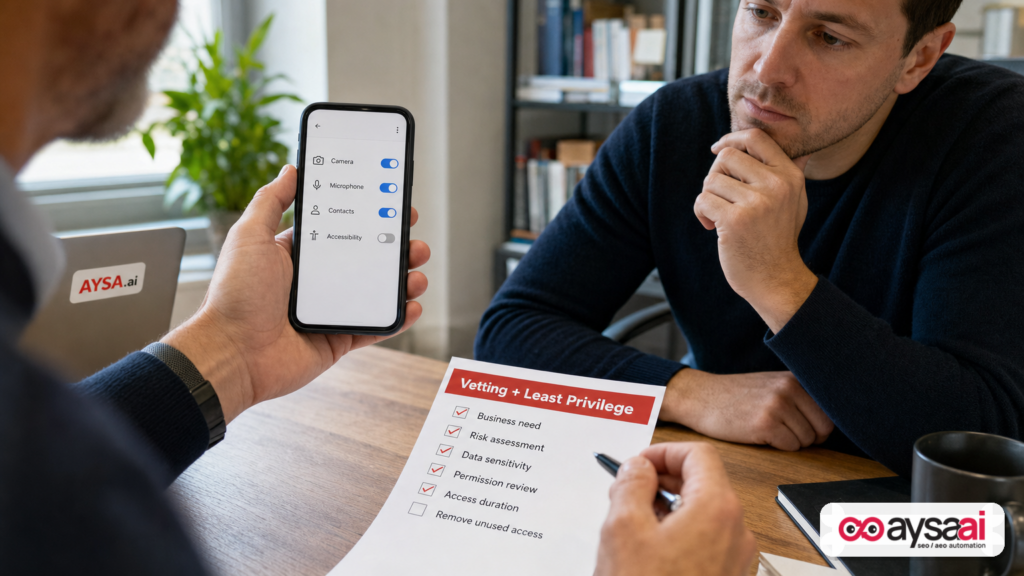
- DMA enforcement is pushing more openness—but implementation details can weaken privacy/security guardrails if “access” is mandated without strong consent, anonymization, and permission controls.
- AI assistants raise the stakes: assistants aren’t just “apps.” They can request powerful device capabilities and can become a primary interface for search, purchasing, and customer support.
- Search visibility risk isn’t only rankings. It’s: fragmented journeys across assistants, reduced Attribution clarity, more surfaces where your brand must be accurately represented, and higher downside from data leakage.
- SMEs should focus on operational hygiene: first‑party data discipline, security/privacy reviews, structured content that’s assistant-readable, and Monitoring that catches changes before revenue drops.
- AYSA’s value in this environment is execution you can trust: monitor what changes, prepare safe SEO/AEO updates, ask for approval, then execute accepted changes—reducing the risk of “quick fixes” that create compliance or security issues.
Context: what the DMA is trying to do (in plain English)

The DMA is an EU framework aimed at ensuring large digital “gatekeepers” don’t use their position to block competition. For a non-SEO operator, this often translates to expectations like:
- More interoperability between services
- Less friction switching defaults
- Less bundling that forces one product choice
- More data access for business users and competing services
In principle, those are pro-market goals. Many SMEs are frustrated by opaque platform rules and shifting ad costs. If you’re a retailer, you want fair access to customers. If you’re a SaaS company, you want a chance to compete on product quality, not just distribution deals.
But DMA-style openness runs into a hard truth: the easiest way to “open up” an ecosystem is to move or share data and permissions. And in 2026, the most sensitive data isn’t just your contacts list or your location—it’s often your intent: what you search, what you ask assistants, what you try to buy, what medical or financial questions you explore privately.
That’s why the debate matters for SEO leaders, CMOs, founders, and agency owners. If you touch digital acquisition, you touch the downstream effects of privacy and security decisions—even if you never read policy memos.
What changed: the DMA is colliding with “security fundamentals”
Google’s post argues that recent decisions risk weakening privacy and security protections for Europeans in two main ways:
- Android / device access: expanding access to capabilities and permissions for external apps without the safeguards device makers use when they vet assistants and system-level integrations.
- Search data exposure: exposing Europeans’ private searches to unfamiliar companies without adequate anonymization and without user knowledge or consent.
Whether you agree with Google’s framing or not, the operational warning is worth taking seriously: “Open access” implemented poorly can become “open season.”
And this is where many businesses miss the point. They hear “DMA compliance” and assume it’s a fight between regulators and trillion-dollar companies. In reality, any change that affects:
- How assistants interact with your device, your accounts, or your data
- How Search intent signals move between entities
- How defaults or discovery surfaces behave
…will cascade into how customers find you, how they trust you, and how reliably you can measure your growth.
Why this matters for search visibility (and not just “policy people”)
Search is no longer a single box on a single page. It’s an ecosystem of surfaces:
- Classic search results
- Answer-like interfaces and AI summaries
- Assistant experiences on mobile devices
- Maps-like local discovery
- Browser-driven suggestions and shortcuts
When regulation changes the rules around data access or interoperability, it can change:
- Which surfaces customers use (default flows, assistant-first experiences, new intermediaries)
- How much “signal” platforms can use to personalize, secure, or filter abuse
- Who gets visibility into queries and intents
- How attribution works (what gets hidden, aggregated, or split across systems)
For SMEs, the immediate question isn’t “Who’s right?” The question is: What do I need to do so my brand is correctly represented across assistants and search surfaces, without taking on privacy/security risk?
That’s why the modern SEO stack isn’t just Keyword research and content briefs. It’s an execution system that can safely implement technical changes (schema, Internal linking, content structure, performance, canonical hygiene) while respecting privacy and consent.
AYSA’s mission is built for that reality: AI SEO tools are not helpful if they only generate recommendations. The value is in a loop that monitors, prepares, asks for approval, and executes.
Android, AI assistants, and permissions: where the real risk lives
On Android (and mobile platforms generally), security is often enforced through:
- Permission models (camera, mic, location, contacts, accessibility)
- OS-level restrictions on background activity and sensitive APIs
- Store policies and review processes
- Device maker controls for system integrations
When you hear “AI assistant,” think beyond chat. Assistants can be layered into workflows that touch everything: reading messages, controlling apps, autofilling forms, initiating purchases, summarizing emails, interacting with sensitive information on screen.
So Google’s warning—summarized in their post as concern about granting external apps powerful permissions without the usual safeguards—maps to a broader risk category: capability concentration. An assistant that can “do things for you” is valuable. It’s also a higher-value target for abuse and a higher-risk integration point when governance is unclear.
For businesses, this matters because customer journeys increasingly involve mobile assistants, including steps like:
- “Find a dentist near me that accepts my insurance”
- “Reorder the same protein powder as last month”
- “Book a hotel in Barcelona, quiet neighborhood, late check-in”
- “Summarize this product page and tell me if it’s compatible”
If the environment becomes more fragmented—multiple assistant providers, multiple data intermediaries—your SEO strategy must account for two realities:
- You need stronger on-site clarity so assistants can extract correct answers (AEO/GEO).
- You need stronger risk controls so you aren’t accidentally exposing customer data or business-sensitive information through sloppy implementations.
Google also references the EU’s own cybersecurity agency warning that “security fundamentals matter more than ever in the age of AI.” The source post doesn’t provide the ENISA link, so I won’t cite a specific document here—but the principle is consistent with mainstream security guidance: as AI expands capabilities, the impact of compromised permissions increases.
Search data exposure: why “private queries” are uniquely sensitive
The Google post flags a particularly sharp issue: private searches could be exposed to unfamiliar companies without adequate anonymization and without user knowledge or consent.
Even if you ignore the platform politics, this is the part every operator should understand. Search queries are a direct feed of:
- Health concerns
- Financial stress signals
- Legal anxieties
- Relationship issues
- Business intent and trade secrets (e.g., “supplier for X,” “competitor pricing,” “tender requirements”)
If those intents are shared more widely than users expect, several downstream effects appear:
- Trust erosion: people become less willing to search freely, which changes query behavior and reduces the quality of intent signals.
- More “dark journeys”: users move to closed communities, apps, or non-indexable environments, reducing organic discoverability.
- More compliance risk for businesses that handle sensitive categories (health, finance) when data flows are unclear.
For SEO specifically, privacy constraints often push platforms to: aggregate data, reduce query reporting granularity, or change how performance can be measured. That tends to hit SMEs hardest because they have less redundancy in channels and less engineering capacity to rebuild measurement systems quickly.
So yes, the debate is about citizens’ rights. It’s also about market predictability—the stability of the intent ecosystem your business depends on.
Business risk map: what can go wrong for SMEs and agencies
When privacy/security guardrails weaken (or even when they’re simply reconfigured), SMEs face a mix of direct and indirect risks. Here’s the practical map.
1) Misrepresentation risk across assistants
If assistants pull summaries from your site (or from third-party sources about your site), mistakes become costly:
- Wrong pricing
- Outdated opening hours
- Incorrect product compatibility
- Wrong refund policies
In classic SEO, a wrong snippet is annoying. In assistant-first journeys, a wrong answer can be the entire decision.
2) Data leakage and “competitive intelligence by accident”
Many businesses assume trade secrets live in spreadsheets, not websites. But a lot of sensitive business info is exposed through:
- Unprotected staging sites
- Indexable internal search pages
- PDF contracts left public
- Careless parameter indexing
- Overly verbose schema markup or embedded data
When ecosystems encourage broader data access and interoperability, you should assume that whatever is technically accessible may become practically accessible to more parties than before.
3) Fraud and abuse adaptation
Attackers follow capability. If assistants can trigger actions, attackers will attempt to manipulate those actions (prompt injection-style patterns, social engineering flows, permission abuse). SMEs don’t need to become security researchers—but they do need baseline hygiene and a clear escalation path.
4) Attribution fog (and bad decisions)
When journeys fragment, attribution gets harder. Businesses then do one of two bad things:
- Over-credit the channels that still measure well (usually paid), starving organic and brand investments.
- Chase noise (random content production, frantic technical changes) without an execution system.
5) Compliance-by-rumor
This is the quiet killer: teams make changes because “someone on LinkedIn said” a policy requires it. They deploy sitewide template changes, consent banners, or data-sharing toggles without proper review—creating more liability than before.
In 2026, the winning posture is: monitor, validate, execute with approvals and auditability.
What to monitor now: a practical checklist
If you operate in Europe (or serve European customers), you should treat the DMA privacy/security debate as a risk signal—meaning your monitoring maturity matters.
Here’s a pragmatic checklist that doesn’t require a legal team.
Technical and visibility signals
- Indexation stability: sudden drops or spikes in indexed pages can indicate parameter leaks, canonical issues, or template regressions.
- Snippet/answer integrity: watch for changes in how your brand appears in search summaries: name, pricing, availability, policies.
- Structured data drift: schema markup can quietly break during design updates or CMS changes, harming assistant-readability.
- Internal linking changes: navigation and related-content modules often change during “privacy banner” or “consent management” updates and can accidentally reduce crawl paths.
- Performance regressions: new scripts (including consent and tracking) can slow pages and reduce conversion.
Privacy/security-adjacent web signals
- Public exposure checks: ensure staging subdomains, internal search, and sensitive PDFs aren’t indexable.
- Consent and cookie governance: avoid “set and forget.” Changes in tooling can change what fires when—and on which regions.
- Referrer and query leakage awareness: be careful with URL parameters that might store sensitive on-site searches or personal info.
This is exactly where an execution platform matters. With AYSA Monitoring, you can set a baseline and detect anomalies early. Then, instead of an ad-hoc scramble, you use an approval loop to implement fixes safely and consistently.
Content strategy for AI discovery under privacy constraints
When privacy constraints tighten (or when ecosystems fragment), many marketers respond by producing more content. That’s not automatically wrong—but it’s often inefficient.
The smarter move is content structure: making your existing content unambiguous, extractable, and resilient across assistant-driven interfaces.
What “assistant-readable” content looks like
- Clear entity definitions: who you are, what you do, where you operate, what you sell.
- Plain-language policies: shipping, returns, cancellation, warranty, booking rules.
- Explicit constraints: “Works with X, not with Y,” “Available in these regions,” “Requires prescription,” etc.
- FAQ blocks that match real intent: not fluffy, but the questions people ask right before conversion.
- Structured data where appropriate: not as a trick, but as a clarity layer.
This is AEO/GEO work: optimizing not only for ranking, but for correct answers and correct representation across AI systems.
If you want a starting point, explore AYSA’s AI Search Visibility approach—then pair it with ongoing execution from AYSA AI SEO tools so changes actually make it to production after review.
Measurement reality: attribution gets worse before it gets better
Operators want a clean answer: “Will this help or hurt organic?” The honest answer is: expect more variance.
As platforms and regulators adjust rules, you may see:
- More “zero-click” behavior (answers given without a visit)
- More assistant-mediated conversions (a user decides without browsing 10 tabs)
- Less query-level reporting clarity
- More noisy fluctuations as experiments roll out by region
That doesn’t mean SEO becomes less valuable. It means SEO becomes less like a weekly report and more like a product discipline: visibility, representation, and execution quality.
For SMEs, the playbook is:
- Prioritize leading indicators: impressions, coverage, index health, snippet correctness, conversion rate.
- Harden your content + technical foundation so you don’t rely on fragile loopholes.
- Reduce time-to-fix when the ecosystem shifts.
This is why AYSA is built around continuous monitoring and approved execution. Read more on the model in the AYSA blog, and if you’re evaluating fit, see pricing to understand how it scales for SMEs and agencies.
An SME scenario: the clinic, the ecommerce shop, and the “helpful assistant”
Let’s make this real with two common businesses.
Scenario A: A local clinic in France
A patient searches (or asks an assistant): “Do you offer same-day appointments for skin rash? Is it covered?”
Risks introduced by ecosystem changes:
- Privacy expectation mismatch: the user assumes the query stays within a trusted context. If query data flows more broadly, trust erodes.
- Answer correctness: if the assistant pulls outdated policy info, the clinic gets angry calls and reputational damage.
- Consent complexity: the clinic’s site adds more scripts to comply with shifting requirements, slowing the booking page and reducing conversions.
Practical fixes:
- Publish clear, structured service and booking pages (hours, coverage disclaimers, appointment types).
- Maintain clean technical signals: canonical URLs, fast pages, minimal script bloat.
- Monitor representation: do assistants and search snippets show the right opening hours and booking links?
Scenario B: A mid-sized ecommerce brand in Germany
A buyer asks: “Find me a quiet mechanical keyboard, ISO-DE layout, under €150.”
Risks introduced by ecosystem changes:
- Fragmented discovery: assistants shortlist products without sending traffic, so ranking reports alone don’t reflect reality.
- Competitive leakage: product and intent data may inform other intermediaries if governance is unclear.
- Wrong summaries: assistant misstates compatibility, causing returns.
Practical fixes:
- Standardize product specs and compatibility language across pages.
- Use structured product data where appropriate; ensure it stays accurate when inventory/pricing changes.
- Track anomalies and fix quickly with an approved execution process.
This is the new baseline: it’s not enough to “rank.” You must be accurate, fast, and resilient as discovery moves into assistants.
What agencies should rethink (packages, reporting, and responsibility)
If you run an agency, DMA-driven shifts amplify three pressures already building in the market:
1) The deliverable is shifting from “content volume” to “system integrity”
Clients still ask for blog posts. But the bigger retention driver will be whether you can maintain:
- Technical cleanliness
- Structured clarity
- Snippet and brand representation accuracy
- Rapid response to ecosystem changes
2) “Recommendations-only” work is losing value
Every tool can produce audits. The bottleneck is implementation—especially in regulated or privacy-sensitive contexts where changes require review and approval.
3) Responsibility is expanding
When clients ask, “Will this break privacy compliance?” they may ask the SEO agency first. Agencies need a disciplined answer:
- What you can validate (technical facts)
- What requires legal input
- What you will implement only after approval
AYSA is designed to support this reality: you can use it to monitor, prepare changes, and execute only after the client approves. That’s not just convenient—it’s risk management.
Where AYSA fits: monitoring → preparation → approval → execution
In a world where policy changes can reshape discovery surfaces and data flows, the competitive advantage isn’t having opinions. It’s having an operating system for execution.
Here’s the AYSA workflow—how we think modern SEO/AEO/GEO should run:
1) Monitor what matters continuously
Set baselines and alerts so you see issues before revenue drops. Start here: AYSA Monitoring
2) Prepare safe changes (technical + content)
Recommendations are translated into specific, implementable actions: schema fixes, internal linking improvements, content structure updates, page hygiene, and other items that improve assistant-readability and reduce ambiguity.
3) Ask for approval (the missing layer in most stacks)
In privacy/security-sensitive environments, “just push it” is a bad habit. Approval creates accountability, reduces mistakes, and keeps stakeholders aligned.
4) Execute accepted changes on the website
Execution is where strategies become outcomes. If you want a deeper look at our approach to AI-driven visibility, start here: AI Search Visibility
If you’re evaluating whether AYSA fits your org size and needs, review AYSA Pricing.
And if you want more operational editorials like this, visit AYSA Blog.
What to do next (action list)
- Assume fragmentation: plan for multiple assistant/search surfaces representing your business—some with less transparent attribution.
- Harden representation: make your key pages unambiguous (pricing, availability, policies, hours, compatibility, service constraints).
- Audit exposure: check for indexable sensitive assets (staging, internal search, PDFs, parameter pages).
- Reduce script bloat: privacy tooling should not silently destroy performance and conversion.
- Implement monitoring: catch schema drift, indexation anomalies, and snippet changes early.
- Move to approved execution: stop making sitewide changes from rumors; require review and approval before deployment.
- Upgrade your SEO definition: rankings matter, but accurate assistant answers and resilient technical foundations matter more.
Sources and further reading
- Google Search Blog (Google in Europe): “The DMA should not undercut security & privacy for Europeans”
- Google Security Blog (useful background source referenced from the same Google Blog navigation context)
- Google Developers Blog (for platform/implementation context; linked from the same source page)
- Google Research Blog (for AI systems context; linked from the same source page)
- Google DeepMind Blog (for AI capability context; linked from the same source page)
- Google Cloud Blog (for security/architecture background; linked from the same source page)
- Google Ads & Commerce Blog (for measurement/commerce ecosystem context; linked from the same source page)
Note: The original Google post references an EU cybersecurity agency warning about “security fundamentals” in the age of AI, but the specific document link is not included in the supplied source context. For accuracy, this editorial does not cite a particular ENISA publication by name.
Continue the AI search topic inside AYSA.
Use these pages to connect the article with AI SEO tools, AI visibility monitoring, AI Overviews and approved website execution.
Turn this topic into a website action plan.
Use these AYSA hubs to move from reading to technical fixes, AI visibility monitoring, research, glossary context and approval-first SEO execution.

