GEO vs SEO: Why Clients Are Asking for “AI Search” Visibility—and How to Win Without Abandoning Google
More search freelancers report rising GEO (generative engine optimization) requests than classic “rank on Google” requests—but they still believe SEO is the stronger long-term bet. Here’s what changed, why pricing pressure is real, and the practical operating system SMEs and agencies need to measure and improve visibility in both Google and AI answer engines.

Search is going through a buyer-behavior shift that feels subtle until you’re the one fielding the requests.
For years, the default client ask was simple: “Help me rank on Google.” Now, more business owners are asking a different question: “How do I show up in AI answers?” That’s Generative Engine Optimization (GEO) and Answer Engine Optimization (AEO) entering the mainstream—first as curiosity, then as budget, and now as a real scope of work.
A recent Search Engine Journal report on a Fiverr survey captured the moment well: more Fiverr search freelancers said GEO requests are rising than classic Google-ranking requests, even though most still believe SEO is the stronger long-term investment. If you run a business, manage marketing, or sell SEO services, that tension is the story: demand is shifting faster than measurement, and expectations are changing faster than outcomes.
This editorial is my practical take (as Marius Dosinescu, AYSA.ai) on what changed, why it matters, and what to do next—without falling for hype or giving up the fundamentals that still drive revenue.
Concise summary

- Client demand is expanding from “rank on Google” to “be mentioned in AI answers,” which creates new deliverables, new expectations, and new pricing dynamics.
- The hardest part of GEO right now isn’t tactics—it’s measurement and Attribution. If you can’t measure it, you can’t manage it.
- SEO isn’t dying. It’s becoming the foundation layer that powers both Google visibility and AI-answer visibility.
- Winning teams build an operating system: monitor → prepare → approve → execute → verify, with governance and documentation.
- AYSA fits as an Approved Execution system: it monitors, prepares changes, asks for approval, and executes accepted website changes—so you can move faster without losing control.
Table of contents
- The Fiverr signal: clients are buying “AI answers” now (even if SEO still wins long-term)
- What GEO actually is (and how it differs from SEO and AEO)
- Why this is happening now: product shifts, behavior shifts, and budget shifts
- The pricing trap: why “AI = cheaper” is spreading—and how to respond
- The measurement problem: why GEO feels “hand-wavy” (and how to make it accountable)
- What to optimize for AI answers without guessing
- Content that earns citations vs content that only ranks
- Technical fundamentals that still matter (more than people think)
- Authority and brand signals: the part most GEO conversations skip
- Local and ecommerce: where GEO changes the purchase journey fastest
- SME scenario: a local clinic that needs Google rankings and AI answers
- A practical GEO + SEO operating system (what to do weekly, monthly, quarterly)
- Where AYSA fits: approved execution for SEO/AEO/GEO
- What to do next (action list)
- Sources and further reading
The Fiverr signal: clients are buying “AI answers” now (even if SEO still wins long-term)

Fiverr’s survey of search freelancers—covered by Search Engine Journal—reported a telling split: more freelancers said they’ve seen an increase in GEO requests than an increase in requests to improve Google rankings. Yet those same freelancers still leaned toward classic SEO as the strongest long-term investment.
That combination is not contradictory. It’s exactly what a market transition looks like:
- Demand shifts first: buyers ask for the new thing before it’s fully measurable, standardized, or even well-defined.
- Capabilities catch up later: tools, reporting, and best practices mature after enough money flows.
- Foundations remain: most “new things” are layers on top of what already worked.
Another detail from the same SEJ report matters for anyone selling services: Fiverr respondents said clients often expect lower prices when AI is involved. That’s a signal that buyers are confusing “AI-assisted execution” with “no expertise required.” If you don’t set boundaries and educate, the market will commoditize the wrong part of the work.
Also important: the SEJ write-up notes the survey is self-reported and that the report (as published) omitted some methodological details (sample size, question wording, etc.). Treat it as directional, not as a universal law. The trend is still useful: it matches what many of us are seeing in the field.
What GEO actually is (and how it differs from SEO and AEO)
Let’s de-confuse the acronyms, in plain business terms.
SEO (Search Engine Optimization)
SEO is optimizing your site and brand presence to earn visibility in traditional search results—especially Google. It includes technical health, content, Internal linking, authority, and user experience.
AEO (Answer Engine Optimization)
AEO focuses on being the best answer—often in formats like featured snippets, “People also ask,” knowledge panels, or assistant-style responses. Historically, AEO lived inside SEO.
GEO (Generative Engine Optimization)
GEO is about increasing the likelihood your brand and your content are used, referenced, or cited in generative responses—AI-generated answers that synthesize information, sometimes with citations, sometimes without.
In practice, GEO includes:
- Creating content that is easy to summarize accurately.
- Structuring information so it can be extracted reliably (definitions, steps, comparisons, constraints).
- Strengthening entity and brand signals so models “trust” and recall you.
- Ensuring your pages are technically accessible and semantically clear.
- Tracking visibility and business outcomes with imperfect but improving measurement.
My take: GEO isn’t a replacement for SEO. It’s the next interface layer. If the web is your inventory of answers, SEO is still how you keep that inventory clean, credible, and discoverable.
Why this is happening now: product shifts, behavior shifts, and budget shifts
GEO didn’t appear because the acronym is trendy. It appeared because search behavior is fragmenting.
1) Search is becoming a conversation
Users increasingly expect a single synthesized answer, not ten blue links. When that becomes the default experience, the question shifts from “Do I rank?” to “Am I included?”
2) “Visibility” is moving up the funnel
Traditional SEO often wins at the moment of intent (“buy,” “book,” “price,” “near me”). AI answers often influence earlier: research, comparison, narrowing options. If your brand is missing at that stage, you may never get the click later.
3) Budget follows executive fear and executive curiosity
When decision-makers hear that AI answers might reduce clicks, they do what they always do: fund a hedge. That hedge is “Let’s do GEO.” Sometimes that’s wise. Sometimes it’s a reaction. Your job (as a business or agency) is to make it operational and measurable.
4) The industry is signaling investment
Search Engine Journal’s State of Search 2027 report (referenced in the SEJ coverage) indicated many search professionals plan to prioritize GEO. That doesn’t prove ROI by itself, but it confirms the direction of attention and resourcing.
The pricing trap: why “AI = cheaper” is spreading—and how to respond
According to the SEJ coverage of Fiverr’s survey, many search specialists reported clients expect lower prices simply because AI is involved. This is one of the most important second-order effects of AI in marketing services.
Here’s what’s happening psychologically:
- Buyers see AI as automation → automation implies less labor → less labor implies lower cost.
- But the labor they’re “removing” is often the least valuable part (drafting, formatting, minor edits).
- The valuable part—strategy, prioritization, risk control, measurement, and iteration—didn’t get easier. It got harder because the surface area expanded (Google + AI engines + multiple interfaces).
To respond without sounding defensive, you need to reframe what clients are buying:
Sell outcomes and risk management, not keystrokes
- “You’re not paying for writing. You’re paying for revenue-impacting visibility and the system to maintain it.”
- “AI helps produce drafts faster. It doesn’t validate claims, align with your brand, or ensure the site implements changes safely.”
Separate “execution” from “accountability” in your pricing
If you’re an agency or consultant, consider structuring retainers with clear line items:
- Monitoring & diagnostics (what changed, what broke, what moved)
- Strategy & prioritization (what we do next and why)
- Approved execution (changes deployed after review)
- Measurement & reporting (what improved and how we know)
This is where an execution system like AYSA helps: it makes the work visible, reviewable, and repeatable—so the value isn’t “mystery work,” and the client sees governance.
The measurement problem: why GEO feels “hand-wavy” (and how to make it accountable)
The fastest way GEO becomes a scam is when it becomes unmeasurable.
Traditional SEO has a mature measurement culture: rankings, impressions, clicks, conversions, revenue. Not perfect, but operational.
GEO measurement is still emerging, and that creates two risks:
- Over-promising: “We’ll get you into AI answers” without defining what success looks like.
- Under-measuring: treating GEO as “content vibes” rather than performance work.
Start with what you can measure today
Even without perfect “AI citations” reporting, you can build accountability using:
- Search Console trends for branded and non-branded queries (directional evidence that demand and visibility are moving).
- On-site conversion tracking (forms, purchases, calls) to tie any visibility work to outcomes.
- Referral analysis to detect traffic from known AI sources when they do pass referrers (inconsistent, but still useful when present).
- Structured qualitative checks: defined prompts, defined engines, defined cadence, documented results (screenshots are fine internally, but don’t pretend they’re statistically valid).
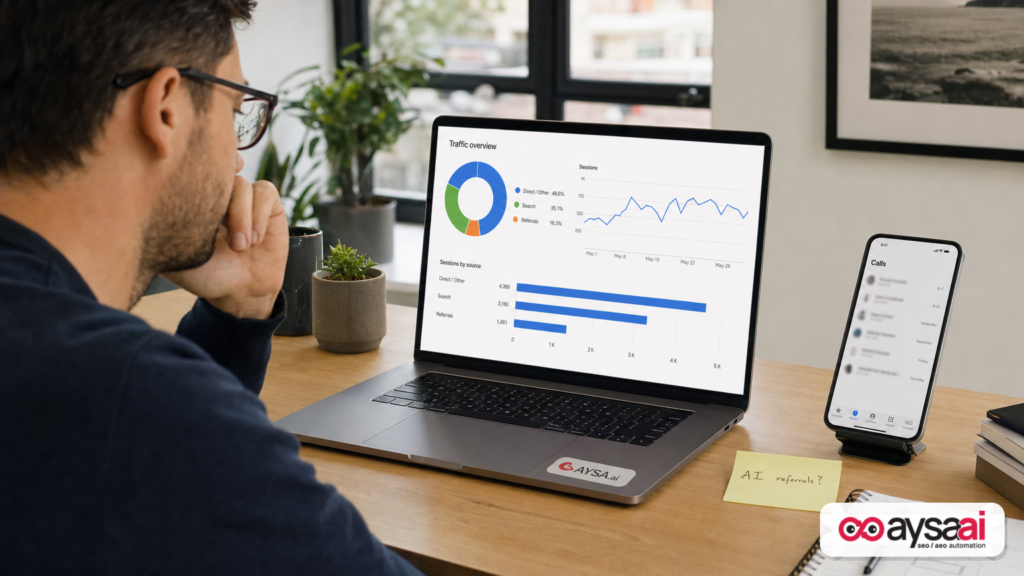
SEJ has also highlighted the attribution issue in AI contexts—for example, how some AI-driven calls and visits can land in ambiguous analytics buckets. If your acquisition data lumps everything into “Direct/Other,” you will struggle to justify GEO investment, even if it’s working.
Make GEO reporting honest: leading vs lagging indicators
For SMEs, a practical model is:
- Leading indicators: content coverage (topics answered), technical accessibility, internal linking improvements, schema deployment, brand mention growth (where measurable).
- Lagging indicators: organic revenue, qualified leads, assisted conversions, branded demand, retention.
Leading indicators are not “vanity.” They are the controllable inputs. The key is not to confuse them with outcomes.
What to optimize for AI answers without guessing
If you want your content to be used in AI answers, you need to optimize for three things at the same time:
- Extractability: can a system accurately pull the right information?
- Verifiability: can the claim be supported by a credible source (including your own first-party evidence)?
- Authority: is your brand a reasonable entity to cite for this topic?
Notice what’s not on that list: “tricks.” GEO is not a hacks game; it’s a clarity + credibility game.
Write like you expect to be quoted
AI responses often paraphrase. Paraphrase goes wrong when your page is vague. So you want:
- Clear definitions early in the page.
- Constraints and caveats (“this applies when…”, “avoid if…”).
- Step-by-step procedures with explicit inputs/outputs.
- Comparison tables that reduce ambiguity.
Build “answer modules” inside your pages
Instead of writing one long narrative, include modular sections that can stand alone:
- Short “What it is”
- “When to use it”
- “Common mistakes”
- “Pricing / timelines” (if relevant)
- “Checklist”
This also improves classic SEO. Good GEO writing is often just good explanatory writing.
Content that earns citations vs content that only ranks
Ranking content and citation-worthy content overlap, but they’re not identical.
What “citation-worthy” tends to look like
- Unique point of view based on real-world experience (clear assumptions, clear context).
- Primary explanations that simplify complexity without flattening it.
- Original frameworks (operating models, checklists, decision trees).
- First-party evidence (even if it’s small-scale): screenshots of your process, anonymized examples, documented steps.
You don’t need to invent data. In fact, you must not. But you can document reality: what you did, why you did it, what changed, and what you learned.
Content types that work well for SMEs
- “Best for” pages: “Best X for Y use case” (not thin affiliate lists—real decision support).
- Alternatives and comparisons: “Option A vs Option B” with tradeoffs.
- How-to + pitfalls: procedural content that prevents mistakes.
- Local explainers: “How to choose a [service] in [city]” with compliance and expectations.
AYSA supports this kind of execution by monitoring what’s working, proposing updates and internal linking improvements, and then implementing changes only after approval. See: AI search visibility and AI SEO tools.
Technical fundamentals that still matter (more than people think)
When people talk about AI search, technical SEO can sound “old world.” That’s a mistake. AI systems can only use content they can access, parse, and interpret.
At minimum, keep these fundamentals clean:
Crawlability and indexation hygiene
- Important pages should be discoverable via internal links.
- Canonicalization should not accidentally hide the page you want referenced.
- Thin duplicates should be consolidated to avoid confusing signals.
Information architecture that matches intent
If your site structure is a maze, both humans and machines will struggle. Build clear hubs (category pages, service pages) and supporting articles that answer sub-questions.
Structured data where it clarifies meaning
Structured data doesn’t guarantee inclusion anywhere, but it can reduce ambiguity about entities, products, reviews, organizations, and FAQs (used responsibly). The goal is not “schema spam.” The goal is machine clarity.
Page experience basics
Speed and usability still matter because they influence engagement and conversions. Even if AI reduces clicks in some queries, the clicks you do get must convert—especially for SMEs.
AYSA’s monitoring workflow can help keep these basics from drifting. Start here: Monitoring.
Authority and brand signals: the part most GEO conversations skip
One uncomfortable truth: for many competitive topics, you won’t “GEO” your way into visibility purely by formatting content better.
AI systems (and the web ecosystem they draw from) rely on signals of authority and credibility. That includes traditional SEO signals (links, mentions) and broader brand signals (consistency, expertise, third-party references).
Practical authority building for SMEs (without chasing vanity PR)
- Get cited by relevant industry organizations (associations, accredited directories, local chambers).
- Publish expert content tied to real operations (processes, standards, compliance checklists).
- Earn mentions through partnerships and integrations (real relationships, not link schemes).
- Make authorship and company credibility obvious: clear about page, credentials, policies, contact, and editorial standards.
This is also where many “AI content farms” will fail. They can produce volume, but they can’t manufacture trust sustainably.
Local and ecommerce: where GEO changes the purchase journey fastest
Not every business feels GEO the same way. Two categories tend to experience the shift earlier:
Local services
People ask assistants questions like:
- “What’s the best urgent care near me for X?”
- “How much does a roof repair cost in my area?”
- “Which dentist is good with anxious patients?”
These are high-intent questions with high trust requirements. If AI answers summarize options, your brand needs to be one of the options worth summarizing. Local SEO fundamentals still apply (service pages, reviews, consistency), but you also need content that answers pre-visit questions clearly.
Ecommerce
Ecommerce buyers ask comparison and fit questions:
- “Best running shoes for flat feet under $150”
- “What size should I get in brand X vs brand Y?”
- “Is product A worth it compared to product B?”
If your site has weak category copy, thin product pages, and no real buying guidance, you’re leaving the “AI-assisted consideration” stage to marketplaces and publishers.
Execution matters here because ecommerce sites change constantly—inventory, pricing, seasonal categories. GEO can’t be a one-time project. It must be operational.
SME scenario: a local clinic that needs Google rankings and AI answers
Let’s make this real with a scenario you can picture.
Business: A mid-sized local clinic offering primary care and urgent care appointments.
The old SEO request: “We need to rank for ‘urgent care near me’ and ‘primary care [city].’”
The new GEO-flavored request: “Patients keep telling us they ‘asked ChatGPT’ where to go. How do we show up there?”
What can go wrong if you chase GEO without fundamentals
- You publish generic blog posts about symptoms that compete with major medical publishers (and lose).
- You forget the pages that matter most: location, insurance accepted, appointment booking, hours, and what to expect.
- You can’t measure outcomes, so the clinic loses confidence and cuts budget.
What a practical plan looks like
- SEO foundation: fix technical issues, consolidate duplicate service pages, improve internal linking from top navigation to appointment pages.
- Answer modules: create clear pages for “insurance accepted,” “when to choose urgent care vs ER,” “walk-in vs appointment,” and “pricing expectations.”
- Local clarity: ensure each location page contains the details patients ask assistants (hours, parking, wait times policy, phone, booking steps).
- Measurement: track appointment conversions, call volume, branded search growth, and query trends in Search Console.
This is exactly where a systemized approach wins: the clinic doesn’t need a one-off “AI visibility” project. It needs a repeatable workflow that keeps pages accurate and improves visibility over time.
A practical GEO + SEO operating system (what to do weekly, monthly, quarterly)
If you want to win across Google and AI answers, you need to stop thinking in campaigns and start thinking in an operating system.
Here’s a practical cadence for SMEs and agencies.
Weekly (lightweight, consistency beats intensity)
- Monitor site health changes and indexing anomalies.
- Review top pages losing clicks/conversions and identify quick fixes.
- Capture 5–10 real customer questions from sales/support and add them to a content backlog.
Monthly (performance + execution)
- Refresh 2–6 key pages (service, category, high-converting blog posts) with clearer answer modules.
- Improve internal linking from high-traffic pages to revenue pages.
- Publish 1–4 high-quality pieces that reduce pre-purchase uncertainty (comparisons, “best for,” setup guides).
Quarterly (strategy + authority)
- Re-map topics to the customer journey: awareness → consideration → purchase → retention.
- Review brand/entity signals: about page, author credibility, policies, citations, partner mentions.
- Run a technical audit focused on crawl paths, duplication, canonicals, and structured data accuracy.
The key is governance: changes must be reviewed, approved, and tracked. This reduces risk and keeps stakeholders aligned.
Where AYSA fits: approved execution for SEO/AEO/GEO
Most teams don’t lose at strategy—they lose at execution.
They know they need to update the service pages. They know their internal linking is weak. They know they should clarify FAQs and add comparison content. But the backlog grows, engineering bandwidth is limited, and changes ship inconsistently.
AYSA is designed to close that gap as an execution system for modern search visibility:
- Monitors your site and visibility signals to detect what’s changing and what needs attention. (Monitoring)
- Prepares recommended website changes (technical, content, internal linking) based on the opportunities detected.
- Asks for approval so stakeholders keep control—no surprise deployments.
- Executes accepted changes so improvements don’t die in a doc.
That “approved execution” model matters more as GEO demand grows, because GEO expands scope. The moment you’re optimizing for both traditional search and AI answers, you need operational speed and operational safety.
If you want the broader picture, start with:
What to do next (action list)
If you’re an SME owner, a marketer, or an agency lead, here’s the practical next step list.
1) Define what “GEO success” means for your business
- Is it more qualified leads? More bookings? Higher conversion rate? More branded demand?
- Write it down. If it’s not written, you can’t measure it.
2) Fix the measurement basics before you buy more tactics
- Ensure conversion tracking is correct (forms, calls, purchases).
- Make sure your reporting can separate brand vs non-brand performance in Search Console.
3) Upgrade 10 pages that already matter
- Pick your top converting pages and add answer modules, clearer definitions, and internal links.
- Do not start with 50 new blog posts.
4) Build one “citation-worthy” asset per month
- A comparison guide, a checklist, a decision tree, a “best for” page with real tradeoffs.
5) Operationalize execution
- Set a cadence: monthly updates, quarterly audits.
- Use an approved execution workflow so changes ship and risk stays controlled.
Sources and further reading
- Search Engine Journal: “GEO Requests Rise Among More Search Freelancers Than Google SEO”
- Search Engine Journal: AI Search category
- Search Engine Journal: SEO category
- Search Engine Journal: State of Search 2027 report (as referenced in the SEJ coverage)
- AYSA: AI Search Visibility
- AYSA: AI SEO Tools
- AYSA: Monitoring
- AYSA: Pricing
- AYSA: Blog
Continue the AI search topic inside AYSA.
Use these pages to connect the article with AI SEO tools, AI visibility monitoring, AI Overviews and approved website execution.
Turn this topic into a website action plan.
Use these AYSA hubs to move from reading to technical fixes, AI visibility monitoring, research, glossary context and approval-first SEO execution.