ChatGPT Ads + GEO: A Practical Playbook For Paid Placements And Earned AI Visibility (And How To Measure What You Can’t See)
ChatGPT ads and earned AI mentions serve different jobs—and you can’t manage what you can’t measure. Here’s a practical, SME-friendly playbook to build on-site evidence, track GEO patterns, test paid placements against clear outcomes, and use AYSA to monitor, propose, approve, and execute the site changes that improve AI visibility over time.

Search is no longer a single lane called “Google.” For buyers, the journey increasingly starts (and sometimes ends) inside AI conversations. That changes how visibility works, how influence gets attributed, and how marketers should plan budgets across paid and earned.
This editorial builds on a key idea from an OpenAI + Go Fish Digital discussion recapped by Search Engine Journal: ChatGPT ads and earned AI answers are separate systems. They can appear in the same conversation, but they do different jobs and must be measured differently.
I’ll add the part most teams are missing: a practical, repeatable operating model for GEO (Generative Engine Optimization) that doesn’t collapse into “vibes,” plus a way to execute the unglamorous fixes—service clarity, crawl access, structured content, consistency—without turning your roadmap into a six-month committee meeting.
Concise Summary

- Paid placements (ChatGPT ads) do not buy inclusion in AI answers; earned mentions are not ad Impressions.
- GEO isn’t a ranking. Treat it as a pattern you measure repeatedly across a representative set of buyer questions.
- Fix first-party evidence first. If your site doesn’t clearly state what you do (and for whom), AI systems won’t reliably represent you.
- Expect Attribution gaps. AI influence can show up as Branded Search, direct traffic, or “direct/other.” Measure outcomes and trends, not just referrers.
- Execution is the advantage. Monitoring plus approved, fast implementation beats endless analysis. That’s where AYSA fits: monitor → propose → request approval → execute.
Table of Contents

- What Changed: AI Conversations Became A Shopping Surface
- The New Reality: A Buyer Can Go From Research To Purchase Without Leaving A Chat Conversation
- ChatGPT Ads Vs. Earned Answers: Two Channels, Two Jobs, One Conversation
- How AI Changes “Consideration” (And Why Your Site Copy Suddenly Matters More)
- Measuring GEO The Right Way: Patterns Over Rankings
- Fix Your Evidence Before Chasing Mentions
- Technical Gates That Quietly Kill AI Visibility
- Analytics Reality: AI Influence Will Be Undercounted
- How To Test ChatGPT Ads Without Confusing Yourself (Or Your CFO)
- A Concrete SME Scenario: The Local Clinic That Keeps Getting Misrepresented By AI
- What Agencies Should Rethink: From Rankings To Evidence And Outcomes
- Where AYSA Fits: Monitoring + Approved Execution For AI Search
- What To Do Next (Action List)
- Sources And Further Reading
What Changed: AI Conversations Became A Shopping Surface
For 20+ years, search marketing was built around a stable mental model:
- A user searches.
- A search engine returns a list of pages.
- Brands compete for Clicks through SEO and ads.
- Analytics capture referrers and conversions.
AI assistants and “answer engines” change the geometry. Users can ask follow-up questions, compare options, refine constraints, and receive a synthesized recommendation—all without ever clicking a traditional search result.
The Search Engine Journal recap of the OpenAI + Go Fish Digital webinar frames this shift clearly: the same buyer can encounter a paid placement and an earned recommendation in a single ChatGPT conversation, but those are distinct mechanisms with different rules and different measurement realities.
As marketers, we have to stop treating “AI visibility” as a single KPI. It’s not. It’s a stack:
- Paid visibility: ads served in eligible contexts, measured like advertising.
- Earned AI visibility: mentions/citations/recommendations in answers, shaped by the evidence available about your brand.
- On-site conversion effectiveness: what happens when someone finally lands on your site—often after several invisible steps.
This is the core of a modern AI search strategy: build the evidence (so you can be represented correctly), measure the pattern (so you can prioritize), and execute quickly (so the system has updated facts to work with).
If you want a foundational overview of how we approach this at AYSA, start here: AI Search Visibility.
The New Reality: A Buyer Can Go From Research To Purchase Without Leaving A Chat Conversation
The most important behavioral shift isn’t “people use AI.” It’s how they use it.
In classic search, the buyer journey was fragmented:
- Search → read one page → back → refine query → read another page
- Separate steps for “learn,” “compare,” and “buy”
In AI conversation journeys, those steps compress. A buyer can:
- Explain their situation
- Ask for options
- Request a recommendation
- Ask for objections, pros/cons, and pricing expectations
- Decide on a shortlist
And if an ad is eligible, it can show up alongside that conversation context, while earned recommendations reflect what the model can support based on available information.
This has a practical consequence: you can’t assume the click is the start of the journey anymore. Often, the click is the end of a long decision-making sequence you don’t fully observe.
That’s why AYSA emphasizes continuous monitoring, not occasional audits. See the monitoring layer here: AYSA Monitoring.
ChatGPT Ads Vs. Earned Answers: Two Channels, Two Jobs, One Conversation
One of the most useful clarifications from the SEJ recap is the separation between:
- Earned answers: what the assistant recommends or mentions organically
- Paid placements: labeled ads that can appear in the conversation
According to the recap, OpenAI’s representative emphasized that ads do not inform the organic answer. That distinction matters because it prevents a common planning error: expecting paid spend to “buy” an earned mention.
Here’s the business translation:
- Paid is for controlled exposure: reach, traffic, conversion—depending on your objective and targeting eligibility.
- Earned is for trust and consideration: being recommended, described accurately, and compared fairly when the buyer asks.
If you treat them as the same thing, you’ll either:
- overspend on ads trying to fix representation problems, or
- over-celebrate earned mentions that never drive measurable outcomes.
When you do run paid tests, treat them like paid media. Search Engine Journal’s recap notes that OpenAI pointed advertisers toward its ads manager and advised choosing an outcome (reach/traffic/conversions) and connecting measurement where possible. We can’t verify every current availability detail from the recap alone, so treat platform access as “check current eligibility.”
If your organization needs to align SEO, GEO, and paid experimentation in one operating system, that’s the point of AYSA’s AI SEO tools.
How AI Changes “Consideration” (And Why Your Site Copy Suddenly Matters More)
In the old model, your website competed for a click. In the new model, your website competes to become the evidence behind the AI’s narrative about you.
That’s a different kind of competition.
From Keywords To Claims
Traditional SEO often encouraged broad pages aimed at many keywords. But AI answers tend to respond to specific buyer claims:
- “Do they serve my area?”
- “Can they handle my edge case?”
- “Are they appropriate for my budget?”
- “What’s their process and what’s included?”
If those claims are missing or vague on your site, you haven’t given any system—human or machine—solid ground.
Consistency Wins More Than Cleverness
Marketers love clever messaging. Buyers love clarity. AI systems, by nature, prefer information that is:
- explicit (not implied)
- consistent across pages
- supported by corroborating sources (reviews, press, directory listings, etc.)
So the path to better GEO is often not “write 50 blog posts.” It’s:
- make your service pages unambiguous
- remove contradictions
- answer the real objections and constraints
AYSA’s approach is built around this kind of practical execution: monitor what matters, prepare specific changes, request approval, then implement accepted updates. That model is why teams can move faster without losing control. Learn more: AYSA Pricing.
Measuring GEO The Right Way: Patterns Over Rankings
One prompt is not a ranking.
That might be the single most important mindset reset in AI search measurement.
In the webinar recap, Go Fish Digital’s framework for GEO measurement breaks into three dimensions:
- Presence: are you mentioned/cited for relevant buyer questions?
- Representation: is what’s said about you accurate and current?
- Competitiveness: do you appear as often as (or more often than) relevant alternatives?
This is far more actionable than chasing a mythical “rank #3 in ChatGPT.” You want to identify recurring gaps you can fix.
A Simple GEO Testing Protocol (That SMEs Can Actually Run)
Here’s a pragmatic protocol inspired by the SEJ recap, adapted for real operations:
- Pick a buyer job-to-be-done. Example: “Emergency HVAC repair in Phoenix” or “best project management tool for agencies.”
- Build 20–40 real questions. Use customer emails, sales calls, chat logs, and support tickets. (If you only use SEO keyword tools, you’ll miss nuance.)
- Lock your testing conditions. Same model, similar settings, same geography where applicable. Document what you used.
- Run the set repeatedly. Don’t do a single run. Repeat across a week or two to see stability vs variance.
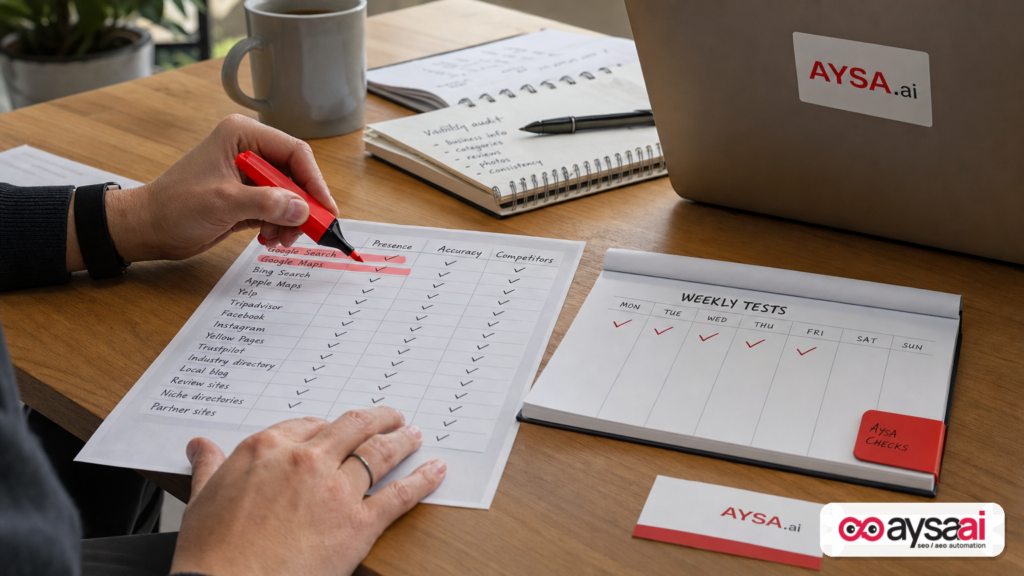
- Score Presence / Accuracy / Competitive share. You’re not trying to “win a prompt.” You’re trying to detect patterns.
- Turn gaps into tickets. Every pattern you find should map to a specific fix: page update, clarification, technical access, or external corroboration.
This is where most teams stall: they can diagnose, but they can’t implement quickly. GEO requires iteration. Iteration requires execution.
AYSA is designed for that loop: monitoring plus execution tooling so improvements don’t sit in spreadsheets.
Fix Your Evidence Before Chasing Mentions
A recurring theme in the webinar recap: start with your website because you control it.
I’ll push this further: your site is the only source you can systematically repair.
PR, reviews, directory listings, and third-party coverage matter, but they’re slower to change and harder to govern. If your own pages are unclear or contradictory, you’re asking AI systems to guess.
What “Evidence” Actually Means In Practice
For GEO, “evidence” isn’t a philosophical concept. It’s concrete information a system can use to answer buyer questions:
- Clear service definitions: what you do and do not do
- Eligibility constraints: regions served, hours, age limits, industries supported
- Process and outcomes: what a customer can expect step-by-step
- Updated pricing signals: ranges, minimums, what affects cost (when appropriate)
- Differentiators: what makes you meaningfully different, not generic “quality service” claims
- Proof: policies, certifications, case studies (without inventing claims)
The Danger Of Implied Services
One example referenced in the recap: a moving company that offers cross-country moves but doesn’t explicitly state it on the site. The risk is obvious: if you don’t say it, you can’t expect accurate representation.
This is incredibly common with SMEs. Owners “know” what they do, so they write vague copy. But customers—and AI systems—need explicit clarity.
If you’re trying to improve your AI search visibility, these are the kinds of pages AYSA will surface for improvement and help you update with an approval-first workflow. For more context, see: AI Search Visibility.
Technical Gates That Quietly Kill AI Visibility
Before you obsess over prompts, check your fundamentals. In the recap, Go Fish Digital highlighted a “technical first check”: ensure relevant pages are accessible to crawlers and not blocked by robots rules or a CDN configuration.
That’s not glamorous. It’s also where a shocking number of businesses lose.
Common Blockers To Audit
- Robots.txt blocks on important directories (sometimes left over from staging)
- Noindex tags applied too broadly
- Login walls around key content that should be public
- Over-aggressive bot protection via CDN/firewall rules that block legitimate crawlers
- Broken internal linking that strands your service pages
- Inconsistent canonical tags causing the wrong version of a page to be treated as primary
Even if an AI model can “know” about your brand from elsewhere, your own site is still your most reliable source of truth for what you offer. Make it accessible and coherent.
AYSA’s monitoring is designed to surface these issues continuously rather than once per quarter. Start with the overview here: AYSA Monitoring.
Analytics Reality: AI Influence Will Be Undercounted
Marketing leaders love dashboards. AI journeys break dashboards.
The webinar recap points to a real attribution challenge: a buyer might discover you in an AI assistant, then later:
- search your brand name on Google
- type your URL directly
- click a saved link
- ask a different assistant and then navigate manually
When that happens, your analytics may not show “AI referral” at all. It may show up as:
- direct traffic
- branded search traffic
- “other” or ambiguous sources
So what do you do?
Stop Demanding Perfect Attribution; Start Designing For Decision Confidence
Most teams handle uncertainty by pretending it doesn’t exist. They either ignore AI or over-claim AI. Neither is management. Management is building a measurement approach that can guide decisions even with incomplete data.
Practical tactics (consistent with the recap’s direction):
- Keep AI assistant traffic separated in reporting where you can identify it.
- Track branded search trends alongside AI visibility work (not as proof, but as a signal).
- Track direct traffic trends for the same reason.
- Add self-reported attribution at key moments (lead forms, checkout surveys, onboarding calls): “How did you first hear about us?” Include “ChatGPT / AI assistant” as an option.
- Document changes so later performance shifts have context: “We updated service pages on X date,” “We launched a paid test on Y date.”
If you want to build a more modern reporting mindset, a helpful place to start is to align on what you’re trying to improve: awareness, consideration, conversion, or retention. Then choose indicators that are good enough to guide actions.
AYSA’s role is not to magically fix attribution. It’s to help you run more disciplined iterations: monitor changes, propose improvements, and implement approved updates quickly—so you can run cleaner tests over time. More: AI SEO Tools.
How To Test ChatGPT Ads Without Confusing Yourself (Or Your CFO)
Paid placements inside AI conversations will be attractive because they feel close to intent. But “close to intent” is not a strategy. Testing is a strategy.
From the recap, OpenAI’s guidance (as described at the time of the webinar) was to start by choosing an objective (reach, traffic, or conversions) and to connect conversion measurement where possible.
Here’s how to make that operational, without over-promising:
Step 1: Pick One Business Outcome
- Reach if you’re validating audience availability and message resonance.
- Traffic if you’re validating landing page fit and top-of-funnel demand.
- Conversions if you have a stable funnel and can track outcomes reliably.
Don’t mix these on day one. Mixed objectives create mixed interpretations.
Step 2: Design A Fair Test
- Define a budget you’re willing to “pay for learning.”
- Use a landing page that matches the conversation intent (not your homepage).
- Run long enough to reduce noise (not just a two-day burst).
Step 3: Compare Against A Baseline You Trust
The biggest mistake is comparing a new channel to nothing. You need a baseline, such as:
- existing paid search campaigns
- organic conversion rate on the same landing page
- historical lead volume for the same offer
Step 4: Don’t Let Paid Mask Evidence Problems
If your brand is misrepresented in earned answers, paid traffic won’t fix that. It may even make it worse by driving users to a site that doesn’t confirm what they thought they learned in the assistant.
That’s why the correct sequence is usually:
- Fix your evidence (website clarity + accessibility).
- Measure GEO patterns and identify gaps.
- Then test paid placements with clean objectives.
A Concrete SME Scenario: The Local Clinic That Keeps Getting Misrepresented By AI
Let’s make this real with a scenario I see constantly across local services and healthcare-adjacent businesses.
The business: a local clinic with two locations. They provide urgent care services, but they do not do certain specialty procedures. They also have specific insurance constraints.
The problem: patients arrive expecting services the clinic doesn’t provide—because “the internet said so.” The clinic notices that some of those misunderstandings start with AI assistants that summarize “nearby clinics that do X.”
Why it happens:
- The clinic’s website has a generic “Services” page with broad claims.
- Location pages aren’t specific about differences between locations.
- Third-party listings are inconsistent.
- FAQs don’t address constraints (insurance, age limits, appointment rules).
What to do (earned visibility path):
- Rewrite service pages around “what we do / what we don’t.” Not as legal disclaimers—just clear buyer language.
- Add a “When to choose us” section. Help the assistant and the human understand the right fit.
- Create location-specific clarity. Hours, services, insurance notes per location.
- Add FAQs that reflect real call scripts. The questions your front desk answers 20 times per day are GEO gold.
- Validate crawlability and internal links. Make sure these clarifications are accessible and connected.
How to measure improvement (pattern path):
- Build a question set like: “Does [Clinic] do X?”, “Best clinic for Y near [Neighborhood]”, “What insurance does [Clinic] accept?”
- Run repeated checks over 1–2 weeks under consistent conditions.
- Score accuracy, not just presence. A wrong mention is worse than no mention.
Where paid fits (if eligible): If the clinic wants to promote flu shots seasonally, that’s a clean paid objective. But paid campaigns should point to a landing page that confirms exactly what’s offered, who it’s for, and what to bring—otherwise you create friction and mistrust.
Where AYSA fits: This is the kind of work that dies in meetings. AYSA can monitor the pages and issues, prepare specific changes (FAQs, service copy, internal linking, technical checks), request approval from the clinic owner/manager, and then execute the accepted updates quickly—so the next measurement cycle is based on real improvements, not a backlog. Start here: AI Search Visibility.
What Agencies Should Rethink: From Rankings To Evidence And Outcomes
If you run an agency, GEO will punish your old operating model if it’s built on:
- monthly ranking reports
- “publish more content” without proof of buyer relevance
- one-off audits that never get implemented
GEO demands a different product:
- Question-based research tied to revenue moments
- Representation accuracy as a first-class KPI
- Iteration velocity (how quickly you can ship improvements)
- Governance (approval workflows so clients don’t fear changes)
New Deliverables That Clients Will Actually Value
- AI Visibility Scorecards built on repeatable prompts, not one-time screenshots
- Evidence maps: which pages support which buyer questions
- Accuracy fixes: remove contradictions, add constraints, update outdated claims
- Experiment logs: a record of what changed, when, and what moved
This is why automation matters—but not “set it and forget it” automation. The winning model is approved execution: faster shipping without losing client control.
AYSA was built for exactly this reality. Agencies can use it as the execution system behind a GEO service: AI SEO Tools and AYSA Pricing.
Where AYSA Fits: Monitoring + Approved Execution For AI Search
Most teams don’t have an ideas problem. They have an execution problem.
You can read 50 threads about GEO. You can collect 200 “AI optimization tips.” None of it matters if your site remains:
- unclear about what you offer
- contradictory across key pages
- blocked from crawlers
- slow to update because every change requires five meetings
AYSA’s model is designed for the messy middle between strategy and implementation:
- Monitor your site and search visibility signals continuously.
- Prepare recommended updates tied to specific goals (clarity, content completeness, technical accessibility).
- Ask for approval so stakeholders stay in control.
- Execute accepted changes so iteration actually happens.
This matters more in AI search than in classic SEO because GEO measurement is inherently iterative. You don’t “optimize once.” You run cycles.
- Explore the product approach: AI SEO Tools
- Understand AI visibility strategy: AI Search Visibility
- See monitoring: AYSA Monitoring
- Pricing and packaging (SME + agency-friendly): AYSA Pricing
- More editorials and updates: AYSA Blog
What To Do Next (Action List)
If you only do one thing after reading this, do this: pick one buyer problem and run a focused improvement cycle. Don’t chase everything.
Week 1: Build Your GEO Baseline
- Choose one product/service line that matters to revenue.
- Collect 20–40 real buyer questions from your sales/support team.
- Run your first measurement pass and score: Presence / Accuracy / Competitor share.
- Document conditions (model/settings) so you can repeat later.
Week 2: Fix First-Party Evidence
- Update the pages that should answer those questions (service pages, location pages, product pages, FAQ hubs).
- Clarify constraints: what you do, don’t do, where you serve, who you’re for.
- Check crawl accessibility (robots/noindex/CDN blocks).
- Remove contradictions across pages (especially templates and old blog posts).
Week 3: Run A Second Measurement Cycle
- Repeat the same question set across multiple runs.
- Look for improved accuracy and presence patterns—don’t overreact to one response.
- Turn remaining gaps into a prioritized list of fixes.
Optional: Run A Paid Test (Only If It Matches The Objective)
- Confirm current platform eligibility in the relevant ads manager (availability can change).
- Choose one objective (reach, traffic, or conversions).
- Use a landing page designed to confirm what the conversation promised.
- Measure with clean baselines; don’t claim credit you can’t prove.
Operationalize With AYSA
- Use AYSA monitoring to keep issues visible: AYSA Monitoring
- Use approved execution so changes ship quickly but safely: AI SEO Tools
Sources And Further Reading
- Search Engine Journal: ChatGPT Ads And GEO: Where Paid And Earned AI Visibility Fit Together (primary source for the webinar recap and key concepts referenced)
- SEJ: AI Search category (additional context and ongoing coverage)
- SEJ: Paid Media category (paid testing mindset and measurement framing)
- SEJ: Technical SEO category (crawlability and access considerations relevant to GEO fundamentals)
- SEJ: Local SEO category (useful for local businesses adapting to AI-driven discovery)
Note on verification: Availability, eligibility, and implementation details for any ad product can change quickly. The discussion referenced above reflects what was described in the webinar recap at the time. For any paid experiment, confirm current capabilities directly in the relevant platform tooling before committing spend.
Continue the AI search topic inside AYSA.
Use these pages to connect the article with AI SEO tools, AI visibility monitoring, AI Overviews and approved website execution.
Turn this topic into a website action plan.
Use these AYSA hubs to move from reading to technical fixes, AI visibility monitoring, research, glossary context and approval-first SEO execution.