AI Mode Ads Are the New Toll Booth: What Google’s 30% Ad Penetration Means for SEO, PPC, and SME Growth in 2026
A new study suggests Google AI Mode shows text ads on nearly 30% of commercial queries—and high-CPC terms trigger ads far more often. Here’s the practical playbook for SMEs and agencies: treat AI ads, citations, and organic rankings as separate channels, rebuild measurement, and use execution systems like AYSA to ship the site changes that actually improve AI search visibility.
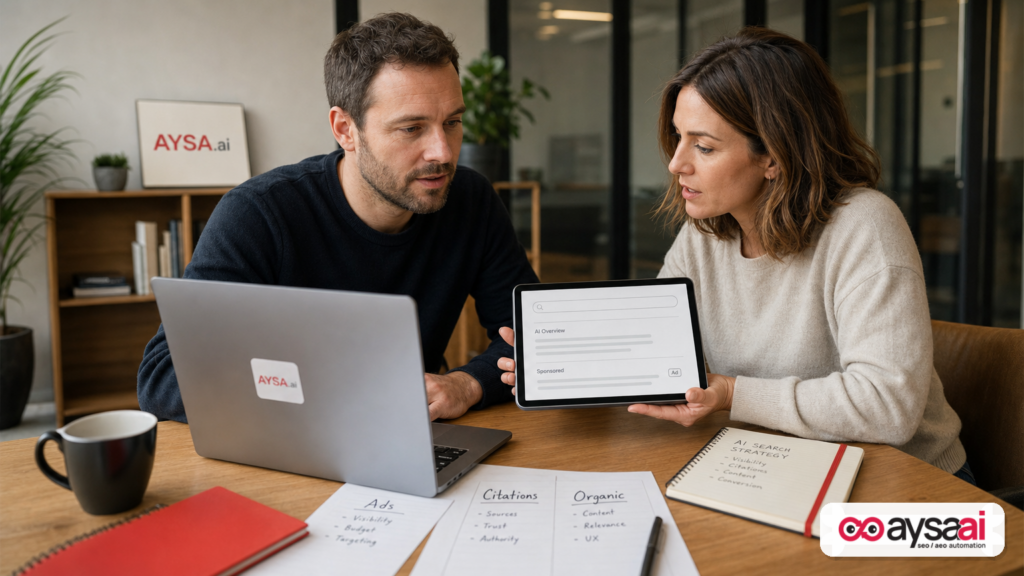
Google is turning AI Search into a bigger business—fast. And if you run marketing for a small or mid-sized company, the uncomfortable truth is this: you may be doing “good SEO,” you may even be spending on “good PPC,” and still lose the moment that matters most—the moment a customer asks Google an intent-heavy question and Google answers it with an AI response that includes ads, citations, and links you don’t control.
A recent SE Ranking study, covered by Search Engine Land, found that Google AI Mode showed text ads on 29.45% of commercial queries they analyzed. Even more important than the topline percentage: high-CPC keywords were dramatically more likely to trigger AI text ads, while advertisers rarely appeared as cited sources and often didn’t rank organically for the same queries where their ads showed.
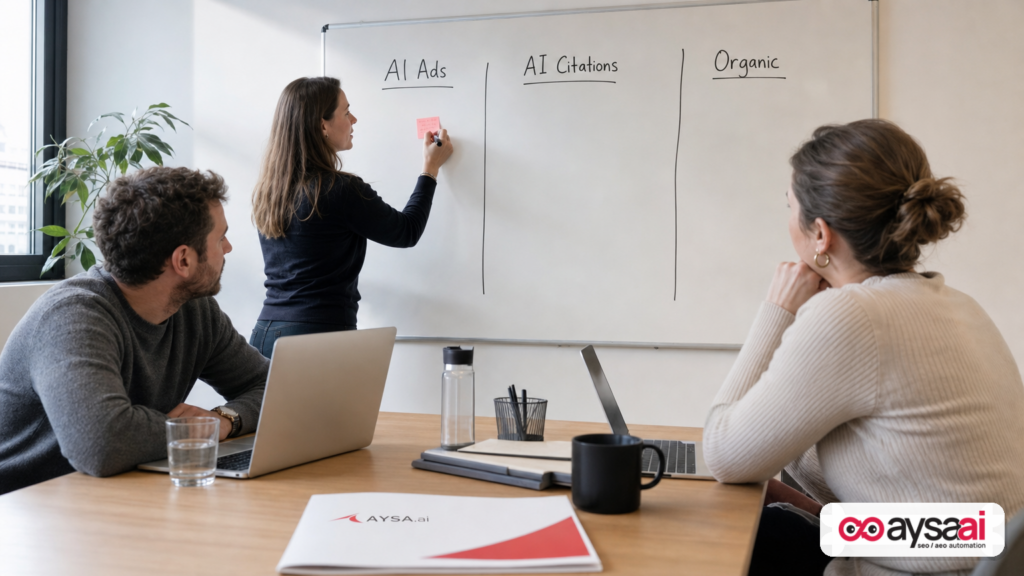
That combination creates a strategic trap for businesses: it’s easy to assume “if I pay, I’ll show up everywhere,” or “if I rank, I’ll be safe.” AI Mode is pushing us toward a reality where AI ads, AI citations, and classic organic rankings behave like three different visibility channels with different rules, different measurement, and different optimization levers.
I’m writing this from the perspective of building AYSA.ai as an execution system for modern search: we monitor what’s happening, prepare changes, ask for approval, and then execute accepted improvements to your website. In the AI era, the limiting factor isn’t ideas. It’s shipping the right changes safely, consistently, and with proof.
Table of contents
- Concise summary
- Key takeaways (read this first)
- What changed: AI search is becoming a monetized answer engine
- What the SE Ranking study actually tells us (and what it doesn’t)
- The new reality: “commercial intent” now has a third layer
- Why high-CPC keywords attract AI Mode ads (and what that signals)
- Why ads don’t translate into citations (and why that’s logical)
- Why advertisers often don’t rank organically for the same queries
- A concrete SME scenario: the local clinic vs. the lead-gen keywords
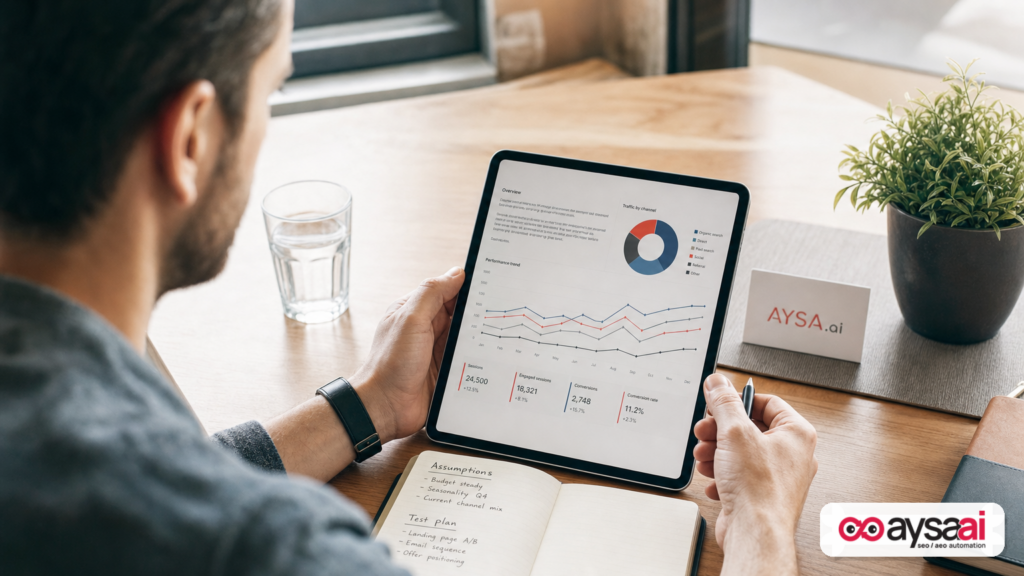
- What to measure now: new KPIs for AI visibility
- A practical playbook: how to win across AI ads, AI citations, and organic
- What agencies must change: org chart, reporting, and execution
- Where AYSA fits: monitoring + approved execution for AI-era search
- What to do next (action list)
- Sources and further reading
Concise summary
Google AI Mode is increasingly showing text ads inside AI-generated answers—nearly 30% of commercial queries in one U.S. dataset. The same research indicates that buying ads rarely increases your chances of being cited as a source, and many advertisers don’t rank organically for the same keywords. The strategic implication: treat AI ads, AI citations, and organic rankings as separate visibility channels. SMEs and agencies need new measurement, new content/entity discipline, and a faster Website Execution loop. AYSA helps by Monitoring AI search visibility and safely executing approved site changes that improve eligibility for citations and organic discovery.
Key takeaways (read this first)

- AI Mode ads are not “just another placement.” They show up inside the answer experience, which changes user behavior and attention.
- High-CPC queries are the canary in the coal mine. If your niche has expensive Clicks, assume AI Mode ad penetration will be aggressive.
- Paid does not equal “trusted.” The study suggests advertisers are rarely cited as sources within AI answers.
- Ranking does not equal “included.” Classic organic rankings don’t guarantee you’ll be used as an AI citation.
- You need three strategies and one shared measurement layer. Plan for AI ads (capture demand), AI citations (become a referenced source), and organic rankings (own durable discovery).
- Execution speed is now a moat. The winners will be the teams that can monitor change and ship improvements weekly without breaking the site.
What changed: AI search is becoming a monetized answer engine
For two decades, the basic bargain of search was simple: Google sends traffic; publishers and businesses earn that traffic with relevance and authority; advertisers buy the high-intent clicks they can’t win organically (or don’t want to wait for). Yes, Google added SERP Features that reduced clicks, but the architecture still looked like a list of links with ads around it.
AI Mode shifts that architecture. The “default experience” becomes: ask a question → get an answer. If Google can answer the question directly, fewer users will click out. At the same time, commercial queries are exactly where monetization pressure is highest. So it shouldn’t surprise anyone that Google introduced ads inside AI answers—and, per the study covered by Search Engine Land, expanded them quickly.
This matters because when the answer becomes the product, distribution changes:
- Your brand can be present as a paid placement even if Google doesn’t “trust” your site as a source.
- Your brand can be present as a citation/source even if you’re not the #1 organic result.
- Your brand can still rank organically and yet be invisible in the AI answer layer.
That’s the new competitive reality: three surfaces, three rulebooks, one user.
What the SE Ranking study actually tells us (and what it doesn’t)
Let’s stick to what’s actually in the reporting. Search Engine Land’s write-up summarizes an SE Ranking analysis of 50,032 U.S. commercial keywords across 20 niches, measured on June 30, focused on queries where text ads could appear (excluding product carousels). In that dataset:
- 29.45% of the analyzed commercial queries showed AI Mode text ads.
- When ads appeared, two advertisers showed together most of the time (reported as 71.1% of ad-triggering queries showing two ads).
- CPC was the strongest predictor of ad visibility: higher-cost keywords were much more likely to trigger AI Mode ads.
- Paid placements rarely boosted citations or organic rankings for those same queries.
Two important caveats were also noted:
- AI Mode results can be inconsistent across sessions. That means any single-snapshot measurement may undercount or overcount what a typical user sees over time.
- The ad behavior may change as Google expands AI-specific formats.
So what can we responsibly conclude without overreaching?
- The ad rollout in AI answers is not experimental anymore. It’s scaling.
- Google is more willing to place ads inside AI answers when there’s clear commercial value (CPC proxy).
- There’s no evidence in this dataset that “buying the ad” increases your chance of being cited as a source or ranking organically for the same Keyword.
What we cannot conclude from this alone:
- We cannot conclude user CTR behavior, conversion rate, or lift compared to classic SERPs. The study summary doesn’t include click or conversion data.
- We cannot conclude causality on why citations behave the way they do—only that overlap is limited in this dataset.
That distinction matters for business decisions. Treat this as a strategic signal and then build your own tests.
The new reality: “commercial intent” now has a third layer
Most SMEs already understand two lanes:
- Paid Search (Google Ads): you buy visibility for high-intent queries.
- Organic Search (SEO): you earn visibility through content, technical performance, and authority.
AI search adds a third lane that many companies still misunderstand:
- AI citations / AI inclusion (AEO/GEO): you earn visibility by being a credible source the model chooses to reference, summarize, or use as evidence.
Call it AEO (answer engine optimization), GEO (generative engine optimization), AI SEO—labels are less important than mechanics. The mechanics are:
- AI answers compress multiple sources into one output.
- Inclusion is selective; the model doesn’t need ten results—it needs enough evidence to answer.
- Google can monetize the answer view with ads, without changing which sources it cites.
If you’re a founder or operator, here’s the mental model to adopt:
- AI ads capture attention when Google decides the query is worth monetizing.
- AI citations influence trust because they’re framed as evidence behind the answer.
- Organic rankings remain the infrastructure that feeds discovery, long-tail demand, and brand credibility over time.
Your job is to build a plan that works even when these lanes don’t overlap.
Why high-CPC keywords attract AI Mode ads (and what that signals)
The study summary says CPC predicted ad visibility far better than search volume or keyword difficulty. That aligns with incentives: CPC is a market signal that advertisers are willing to pay to acquire that click because the downstream economics work (margin, LTV, conversion rate, lead value).
In the SE Ranking dataset (as reported by Search Engine Land):
- Keywords with CPCs below $2 showed AI Mode ads about 24.33% of the time.
- CPC $2–$10: about 32.45%.
- CPC $10+: about 53.56%.
You don’t need to obsess over the exact thresholds; you need to internalize the direction: the more valuable the click, the more likely Google is to place ads inside the AI answer.
For SMEs, that has three practical implications:
1) “We’ll just rank #1” is no longer a complete plan
Even if you’re winning classic SEO, the AI answer can reduce clicks—or shift them to the ad block—especially on high-intent queries where ads become standard.
2) You may have to defend your own brand demand
If AI Mode ads expand, competitors can show up earlier in the answer flow. That can force uncomfortable decisions like bidding on competitor terms or defending branded terms more aggressively—depending on your category and legal constraints.
3) Lead-gen niches should assume faster ad evolution
Search Engine Land’s summary notes big variance by category, with lead-gen markets more likely to show ads and informational/YMYL categories less likely. That suggests rollout intensity tracks revenue opportunity and risk tolerance. If you sell appointments, quotes, financing, insurance, home services, legal services, B2B demos—assume you’re on the front line.
Why ads don’t translate into citations (and why that’s logical)
One of the most important points in the Search Engine Land coverage is also the most counterintuitive for business owners: buying an ad in AI Mode didn’t make a domain more likely to be cited as a source in that same AI response, with only limited overlap reported.
At first glance, some marketers will call that “unfair.” But from a product integrity perspective, it’s exactly what you’d expect Google to do.
Here’s why:
- Citations are a trust signal. They imply evidence behind the answer. If citations were “for sale,” the AI answer would be less credible.
- Ads are a disclosure-based unit. They’re monetization, clearly labeled (at least in principle).
- Separating the systems reduces regulatory and reputational risk. A system that commingles paid placements with “sources” would attract scrutiny and user distrust.
So if you want citations, treat it like earning editorial references—not buying shelf space.
What “citation readiness” looks like in practice
Without inventing new study data, we can still outline what typically makes a page more eligible to be used as a source in AI summaries:
- Clear authorship and accountability (who wrote it, who reviewed it, how to contact the organization).
- Entity clarity (the business, product, location, and offering are unambiguous).
- Structured information (so systems can extract facts reliably).
- Policies and trust pages (refunds, shipping, privacy, editorial standards where relevant).
- Topical depth (content that answers related questions thoroughly, not thinly).
This is the kind of work that’s tedious, unsexy, and high leverage—especially when executed consistently across a site. It’s also exactly the kind of work that breaks down when teams can’t get changes shipped.
Why advertisers often don’t rank organically for the same queries
The Search Engine Land summary indicates that many advertisers in AI Mode didn’t rank organically for the same queries where their ads appeared, and overlap at the URL level was particularly low.
Again, that’s not shocking. Businesses use PPC specifically to buy visibility where SEO is weak, slow, or too competitive. But AI Mode changes what that means tactically because the ad is now inside the answer experience, not adjacent to a list of links.
If you’re relying heavily on PPC for high-intent keywords, ask yourself:
- What happens if CPCs rise because AI Mode expands ads and more advertisers compete for fewer clicks?
- What happens if conversion rates drop because AI answers satisfy some users without a click?
- What happens if competitors appear in the AI answer while you appear only as an ad?
Those are not reasons to abandon paid search. They’re reasons to build resilience: a durable organic footprint plus citation eligibility so you aren’t only renting attention.
A concrete SME scenario: the local clinic vs. the lead-gen keywords
Let’s make this real with a scenario I’ve seen variations of repeatedly.
Business: a local physical therapy clinic with two locations.
Acquisition today: Google Business Profile discovery, a few blog posts, and Google Ads targeting “physical therapy near me,” “sports injury rehab,” and “back pain treatment.”
Now add the AI Mode layer:
- A user searches: “best physical therapy for runners knee pain” or “how many sessions for rotator cuff rehab.”
- AI Mode produces a summary with general guidance, then offers next steps, and sometimes shows a text ad.
- The AI answer cites a couple medical associations, a big hospital system, and a general health site.
- The clinic’s ad appears—but the clinic is not cited and does not appear in organic results for that exact query.
The clinic owner asks: “We’re paying—why aren’t we in the sources?”
Here’s the operational answer:
- The ad is demand capture. It can generate appointments today.
- Citations are evidence. They are earned through publish-quality information, trust signals, and clarity—not spend.
- Organic ranking is competitive infrastructure. It requires time, content strategy, and technical foundations.
So what should the clinic do?
A pragmatic plan for the clinic (no heroics)
- Keep PPC—but tighten it. Focus on calls/appointments, add negative keywords aggressively, and ensure landing pages match intent.
- Build citation eligibility for “treatment + condition” queries. Publish clinician-reviewed pages explaining protocols, session expectations, and local service details with strong accountability signals.
- Strengthen local entities. Make sure each location is unambiguous (NAP consistency, service areas, staff, insurance accepted, contact points). If AI can’t verify you, it won’t recommend you.
- Measure separately. Track ad-driven conversions, organic rankings, and AI visibility as distinct metrics.
This is not theory. It’s how you protect growth in a world where the results page is no longer “ten blue links.”
What to measure now: new KPIs for AI visibility
If AI ads, AI citations, and organic rankings are separate channels, your reporting must reflect that. Most teams are still stuck in a 2018 reporting model: keyword rankings + sessions + conversions. That’s necessary, but no longer sufficient.
Here’s a modern measurement model that SMEs can actually run (and agencies can sell without smoke and mirrors).
Channel 1: AI ads / paid visibility KPIs
- Share of impression in high-intent clusters (not just single keywords).
- Cost per qualified lead / order segmented by intent theme.
- Landing page congruence score (do visitors find exactly what the query implies?).
- Incrementality checks where possible (brand vs non-brand, geo experiments, time-based tests). If you can’t run experiments, at least annotate spend changes and watch downstream metrics.
Channel 2: AI citations / AI inclusion KPIs
- AI visibility share for your category questions (how often you’re referenced or recommended when users ask relevant questions).
- Entity coverage: do you have authoritative pages for your products/services, locations, and policies?
- Source page quality: clarity, freshness, authorship, structured data, and topical completeness.
AYSA is built for this direction: monitoring and visibility tracking are foundational. Start here if you want a practical system: AI Search Visibility and AYSA Monitoring.
Channel 3: Organic search KPIs (still vital)
- Non-brand organic growth in revenue-driving pages, not just total sessions.
- Long-tail coverage (new queries you show up for, new pages gaining traction).
- Technical health: indexation, internal linking, content decay remediation, and site speed fundamentals.
- Authority and relevance signals (earned links/mentions, topical depth).
The unifying layer: one “search visibility P&L”
Most businesses separate SEO and PPC budgets, separate tools, separate teams, separate reporting. AI search punishes that separation.
Create a single view that answers:
- Which intent themes drive revenue?
- Where are we buying visibility?
- Where are we earning visibility?
- Where are we missing entirely (no ads, no citations, no organic presence)?
That last bucket—missing entirely—is where growth lives.
A practical playbook: how to win across AI ads, AI citations, and organic
This is the part most editorials skip: the operational plan. Here’s a framework that doesn’t require a 20-person marketing team.
Step 1: Map your money keywords into intent themes
Stop managing SEO and PPC as lists of keywords. Start managing them as themes tied to real buying journeys.
- Problem/solution themes: “fix leaking roof,” “treat back pain,” “ship flowers same day.”
- Comparison themes: “best,” “top,” “vs,” “reviews,” “alternatives.”
- Urgency themes: “near me,” “open now,” “same day,” “emergency.”
- Price themes: “cost,” “pricing,” “quote,” “estimate.”
Then ask: where do AI answers appear? Where do AI ads appear? Where do citations appear? The study suggests high-CPC themes are most likely to show AI ads—use that as your starting hypothesis.
Step 2: Build “citation landing pages,” not just blog posts
Many businesses respond to AI by publishing more content. That’s usually the wrong reflex. The right approach is to publish fewer, stronger, clearer pages that can be used as sources.
A citation-ready page typically has:
- A precise scope: one service/product/condition/location intent cluster.
- Answer-first structure: definitions, steps, timelines, costs, risks, FAQs.
- Accountability: who is responsible for the information.
- Evidence and clarity: concrete details, not marketing fluff.
- Internal links to supporting pages and policies.
If you’re a local service business, this often means upgrading service pages that were written like brochures into pages written like customer decision tools.
Step 3: Close entity gaps and structure what matters
AI systems struggle with ambiguity. If your site is unclear about who you are, what you offer, where you operate, and how customers transact with you, you’ll lose citations even if your content is “good.”
Entity basics to get right:
- Consistent business name, locations, service areas.
- Unique pages for each location (if applicable) with real differentiators.
- Clear product/service taxonomy.
- Up-to-date policies and trust signals.
- Structured data where appropriate (without spam).
This is where tools and execution matter. It’s easy to identify gaps; it’s hard to implement changes safely across dozens or hundreds of pages. AYSA’s model is designed around that reality: identify improvements, prepare changes, get approval, and execute. Explore the tooling approach: AI SEO Tools.
Step 4: Treat paid as a performance channel, not an “AI inclusion” strategy
The study’s summary strongly suggests ads don’t buy citations. So treat paid search for what it is: a performance channel that can scale quickly, with clear economics.
What to do in paid search as AI Mode expands:
- Strengthen post-click experience. AI answers can pre-educate users; your landing page must move them to the next step without repeating generic info.
- Align ad groups to intent themes. Don’t dump everything into one campaign and hope smart bidding saves you.
- Protect your conversion tracking quality. If user journeys get more complex, attribution gets worse. Clean measurement becomes a competitive edge.
If you’re an agency, this is where client education is critical: paid is not a substitute for citation readiness and organic infrastructure.
Step 5: Build feedback loops (monitor → learn → ship)
AI search changes quickly. The only stable strategy is iteration. But iteration requires an operating system.
At a minimum, you want weekly loops:
- Which queries/themes showed AI answers and/or AI ads?
- Where did we appear (ad, citation, organic, none)?
- What pages are closest to being citation-worthy but missing clarity?
- What changes can we ship this week that improve eligibility?
This is the gap AYSA is built to close: not “more ideas,” but faster, safer shipping with approval gates. Start with monitoring and visibility: AYSA Monitoring.
What agencies must change: org chart, reporting, and execution
One of the biggest silent failures in search marketing right now is organizational, not technical: SEO and PPC teams run on different cadences, use different language, and optimize for different metrics. AI search makes that separation expensive.
The org chart problem
If one person owns “SEO,” another owns “Google Ads,” and nobody owns “AI visibility,” you’ll default to chaos:
- PPC will demand landing pages fast, and SEO will resist risky changes.
- SEO will publish content, and PPC won’t use it for conversion alignment.
- Reporting will contradict itself, and the client will lose trust.
Fix: create a single “search growth” function with shared goals—then assign channel specialists inside it.
Reporting must separate channels but unify outcomes
Remember the three channels. Your client report should clearly show:
- Paid performance outcomes (leads/sales, CPA/ROAS).
- Organic performance outcomes (non-brand growth, revenue pages, long-tail wins).
- AI visibility outcomes (citation/recommendation presence for priority themes).
But it should also unify on business outcomes: pipeline, revenue, bookings—whatever the business actually cares about.
Execution is where agencies win or lose in 2026
Most agencies can diagnose. Far fewer can execute changes on the client’s site reliably, because of approvals, dev bottlenecks, and fear of breaking something.
An “execution system” becomes a service differentiator: monitor, propose changes, get approvals, implement, measure, repeat. That’s the mindset behind AYSA’s approved execution approach, and it’s why this moment is an opportunity for agencies who operationalize it.
If you’re evaluating what this could look like in your stack, start here: AYSA Pricing.
Where AYSA fits: monitoring + approved execution for AI-era search
Let’s be direct about what most businesses need right now. You don’t need more “AI tips.” You need a system that:
- Monitors how your brand appears (or doesn’t) across AI-driven search experiences.
- Identifies concrete site-level gaps that block inclusion: missing pages, unclear entities, weak internal linking, thin explanations, outdated copy.
- Prepares fixes in a way that a business owner can review (not a 40-page audit PDF).
- Asks for approval so changes are governed and safe.
- Executes the approved changes consistently.
That’s the philosophy behind AYSA. We’re not trying to replace your strategy. We’re trying to make strategy shippable—because in AI search, shipping beats theorizing.
Explore the parts of AYSA most relevant to this AI Mode moment:
- AI search visibility tracking: AI Search Visibility
- Monitoring: AYSA Monitoring
- AI SEO tools: AI SEO Tools
- Product and editorial updates: AYSA Blog
What to do next (action list)
If you’re an SME owner, marketing lead, or agency, here’s a practical next-step list you can run over the next 30 days.
In the next 7 days
- List your top 25 “money queries” (or themes) that drive leads/sales.
- Classify them by CPC pressure (high/medium/low) using your own account data if you have it.
- Audit your presence across three channels: do you have ads, citations, organic rankings, or none?
In the next 14 days
- Pick 3 themes where you are “missing entirely.” Build a plan to add one strong page per theme.
- Upgrade one existing high-intent landing page into an answer-first page (clear scope, FAQs, process, pricing guidance, trust signals).
- Fix entity basics: location clarity, service taxonomy, contact/policies pages.
In the next 30 days
- Run a reporting reset: separate AI ads, AI citations, and organic in your dashboards, but unify business outcomes.
- Create a weekly shipping cadence for site improvements (even if it’s small).
- Decide what you will automate and what requires explicit approval to reduce risk.
If you want a structured system to support those steps—monitoring, recommendations, approvals, and execution—start with AYSA’s monitoring and AI visibility capabilities: AYSA Monitoring and AI Search Visibility.
Sources and further reading
- Search Engine Land: Google AI Mode ads reach nearly 30% of queries: Study
- Search Engine Land: SEO and PPC alignment starts with your org chart
- Search Engine Land: Google says AI Max unlocks billions of new monetizable searches
- Search Engine Land: How to audit your AI entity footprint
- Search Engine Land: 7 feedback loops for self-improving AI content workflows
- Search Engine Land: Schema for AI search: How to identify and prioritize entity gaps
- Search Engine Land: The new SEO rules for bloggers in 2026: Why clarity matters in AI search
Note: The editorial analysis above is based on the study details summarized in Search Engine Land’s coverage and the broader operational realities businesses face when search surfaces change. Where additional primary documentation from Google would further verify mechanics or future behavior, it is not included in the provided research context—so recommendations are framed as strategy and best-practice operations rather than hard claims about platform internals.
Continue the AI search topic inside AYSA.
Use these pages to connect the article with AI SEO tools, AI visibility monitoring, AI Overviews and approved website execution.
Turn this topic into a website action plan.
Use these AYSA hubs to move from reading to technical fixes, AI visibility monitoring, research, glossary context and approval-first SEO execution.