Google AI Mode Ads Are Decoupling Paid, Organic, and “Cited” Visibility—Here’s How SMEs Should Respond
Early analysis suggests Google AI Mode shows text ads on a meaningful slice of commercial queries—yet the advertisers rarely appear as cited sources. That separation changes how businesses should measure success, budget PPC, and build AI-ready content. This editorial breaks down what’s changing, why it matters, and an action plan SMEs and agencies can execute with AYSA’s monitoring and approved SEO/AEO/GEO execution workflow.

Google is turning search into a multi-layered marketplace: you can buy visibility, you can earn organic rankings, and now you can also be selected as a cited source inside AI-generated answers. Those three outcomes look similar to a user—but they’re increasingly driven by different systems.
A recent analysis reported by Search Engine Journal (based on a SE Ranking study) suggests Google AI Mode showed text ads on a meaningful share of commercial queries tested, but the advertiser rarely appeared as a cited source in the AI response. If that holds broadly as AI Mode expands, it has a blunt implication for SMEs and agencies: you can’t treat PPC performance, organic SEO, and AI answer visibility as one blended KPI anymore.
This editorial explains what’s changed, why it matters, what can go wrong if you measure the old way, and exactly what to do next—especially if you’re an owner, CMO, or agency lead trying to make budget decisions with incomplete information.
Concise summary
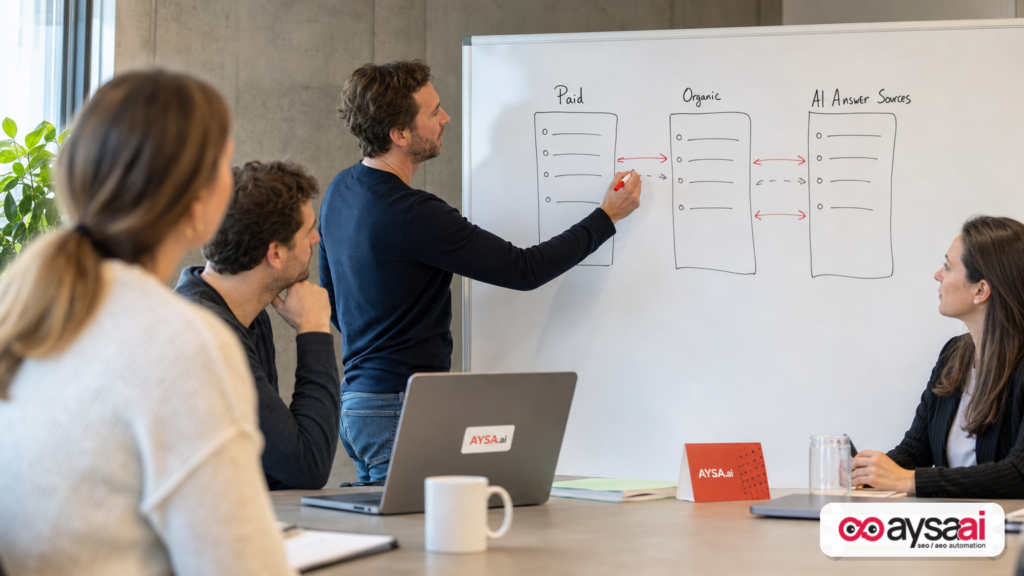
- AI Mode introduces a third visibility layer beyond paid ads and organic rankings: being cited/linked as a source in the AI answer.
- Early analysis suggests ad presence in AI Mode correlates more with CPC than with Search volume, and advertisers often aren’t cited sources for the same query.
- For many businesses, “buying the slot” and “being the source” are separate strategies with separate budgets, tactics, and reporting.
- As Google tests formats that embed ads inside AI responses, the line between content and ads may blur, raising new brand, compliance, and measurement challenges.
- Winning in 2026 search will require Monitoring + Approved Execution: track AI visibility and ad visibility separately, then ship the website changes that earn citations and conversions.
Table of contents

- What changed: AI Mode adds ads—and decouples visibility signals
- The big change: AI answers introduce a third visibility layer
- What SE Ranking’s AI Mode ad analysis suggests (and what it doesn’t)
- Why Google is building an “ad layer” inside AI experiences
- How this may change user behavior (and what we should not assume yet)
- What can go wrong: measurement traps, brand risk, and wasted spend
- A concrete SME scenario: local clinic vs. ecommerce brand
- The new measurement stack: KPIs for paid, organic, and AI visibility
- Action plan: what to do in the next 30–90 days
- Agency playbook: how to re-scope retainers for AI visibility
- Where AYSA fits: monitoring + preparation + approved execution
- What to do next (checklist)
- Sources and further reading
What changed: AI Mode adds ads—and decouples visibility signals

For most of Google’s history, “search visibility” was a two-lane road:
- Paid search (PPC): you bid, you get a spot, you pay per click.
- Organic search (SEO): you earn rankings, you get Clicks, you “pay” with effort and time.
AI Mode (and related AI answer experiences, including AI Overviews) adds a third lane: AI-selected sources. Your content may appear as a cited source (sometimes linked) inside the AI-generated response. That’s neither a standard ad placement nor a conventional blue-link ranking.
The SEJ-reported analysis (based on a SE Ranking review of AI Mode text ads) points to a key reality: ads can show up without the advertiser being cited, and citations can occur without a brand buying ads. In other words, paid and “AI answer visibility” can be independent. That’s new operational complexity—and it demands new reporting and decision-making.
The Big Change: AI Answers Introduce a Third Visibility Layer
Let’s name the three layers clearly, because most reporting dashboards still mash them together:
1) Paid placement visibility
This is the classic Google Ads outcome: your ad shows, you might get a click. You’re buying exposure and traffic. In AI Mode, the ad may appear adjacent to the AI answer or, in emerging formats, potentially inside the conversational flow.
2) Organic ranking visibility
This is where SEO teams historically lived: rank for “best running shoes,” earn top 3 positions, win clicks.
3) AI answer “source” visibility (AEO/GEO)
This is the new one. Your brand can be referenced as a source for claims, comparisons, definitions, steps, pricing guidance, pros/cons, and recommendations. In AI answer experiences, being cited can matter even when you don’t rank #1. Conversely, ranking well doesn’t guarantee being selected as a source.
Operationally, this means:
- Your PPC team can “win” without your SEO team winning.
- Your SEO team can “win” without your PPC team winning.
- Your content can be used to answer questions without you getting the click you expected.
If you run an SME, this is not theoretical. It affects budget allocation, creative decisions, landing page strategy, and what your agency should report to you each month.
What SE Ranking’s AI Mode Ad Analysis Actually Suggests (And What It Doesn’t)
According to the coverage by Search Engine Journal of the SE Ranking analysis, AI Mode returned a text ad on 29% of the commercial keywords tested in their dataset. The Keyword set was chosen to trigger text ads and sampled across niches, which matters: it’s not a universal prevalence rate for all searches, and it’s a snapshot in time.
The more strategic insight is not “29%.” It’s the relationship between paid ads and citations:
- The advertiser domain appeared among AI Mode’s listed sources only some of the time (SEJ reports 11% at the domain level, and ~1.95% at the exact URL level in the analysis they describe).
- Advertiser landing pages also rarely ranked organically for the same keyword (SEJ reports low overlap in the analysis).
- Ad presence appeared to correlate more with higher CPC bands than with search volume or keyword difficulty (again as described in the analysis coverage).
What this suggests: Google can show AI answers and still monetize the moment—without needing the advertiser to be a source in the AI response. Paid placement and source selection can be separate auctions/algorithms with different incentives.
What this does not prove:
- That 29% is a stable number across time, industries, or geographies.
- That CPC causes ad presence in AI Mode; it’s a correlation in the observed data.
- That citations will never favor advertisers. Google may change selection logic, formats, or policies.
In other words: you should act on this as a planning signal. The safe conclusion is: measure paid visibility and AI citation visibility separately, because they may not overlap.
Why Google Is Building an “Ad Layer” Inside AI Experiences
Google has always been a monetization machine built around user intent. When a user types “best payroll software for small business,” there’s money on the table. AI answers don’t remove that; if anything, they concentrate it.
Search Engine Journal’s report notes Google has been gradually adding ads to AI Mode and introduced new AI-mode ad formats at Google Marketing Live (including formats described as embedded within AI responses). Those formats are still in testing, per SEJ’s reporting, but the direction is clear: Google wants to ensure AI-driven search remains commercially viable.
From a business perspective, that’s rational. But for advertisers and publishers, it creates a shifting incentive map:
- For Google: maximize user satisfaction while preserving ad revenue.
- For advertisers: maintain qualified lead volume and control CAC as interfaces change.
- For content owners: get credited, cited, and clicked—without being commoditized into “training data” or unattributed summaries.
Even if you never touch SEO, you should understand that AI answers are not a “feature.” They’re a new interface for intent—and where intent flows, ad products follow.
How This May Change User Behavior (And What We Should Not Assume Yet)
One of the most dangerous mistakes I see in marketing is treating interface changes as automatically good or bad. AI answers can change user behavior in conflicting ways depending on intent:
Informational intent: fewer clicks, more brand impression
When people want a quick explanation, an AI answer can satisfy them without a click. That can reduce traffic to publishers and “top-of-funnel” SME content. But it may increase brand impression for cited sources—even if clicks decline.
Commercial intent: fewer comparisons, faster decisions
For commercial queries, AI answers can reduce the need to open 10 tabs. That can compress the comparison journey. In that world, the brands surfaced (as ads, as citations, as recommended providers) can win disproportionately.
High-risk intent (YMYL): more caution, more verification
For health, finance, legal, and safety-related decisions, users may verify more. SEJ’s report notes large swings by niche in ad presence (for example, very low in healthcare in the dataset). It’s reasonable to expect stricter standards and more conservative monetization in sensitive categories—but we should not assume that stays fixed.
What we should not assume:
- That ads will always be “outside” the AI answer.
- That citations guarantee clicks.
- That ranking #1 guarantees citations or AI mentions.
The practical response is not panic. It’s instrumentation: measure each layer, then adapt.
What Can Go Wrong: Measurement Traps, Brand Risk, and Wasted Spend
When visibility splits into layers, teams accidentally optimize the wrong thing. Here are the big failure modes I expect to see more often in 2026.
Trap #1: reporting “search visibility” as one number
Old dashboards often blend impressions and clicks from multiple channels into one trend line. That becomes misleading when:
- AI answers reduce clicks but increase impressions.
- Ads appear in AI Mode for high-CPC queries regardless of organic position.
- Your content is cited but not clicked.
Fix: break reporting into three lanes: paid presence, organic rank/traffic, AI citations/mentions (where measurable). AYSA’s philosophy here is simple: monitor separately, then optimize intentionally.
Trap #2: assuming PPC spend will “buy” trust or citations
SEJ’s report highlights a low overlap between advertisers and cited sources in the analysis. Even if that changes later, it’s unsafe to assume the ad account buys you credibility in the AI answer.
Fix: PPC is for demand capture; AI citation visibility is about being the best source. Different work, different owners, different timelines.
Trap #3: landing pages optimized for conversion but invisible to AI systems
Many PPC landing pages are intentionally thin: minimal navigation, minimal external links, minimal context. Great for conversion testing. Not always great for being recognized as an authoritative source for an AI system.
Fix: you likely need a two-layer content strategy:
- Conversion pages designed to convert the click.
- Source pages designed to be cited: definitions, comparisons, methodology, policies, FAQs, specs, and evidence.
Trap #4: brand safety and compliance in “embedded” ad formats
As ad formats move closer to the AI answer itself (as SEJ reports Google is testing), there’s more risk of:
- Users misunderstanding what’s sponsored.
- Brands appearing next to or within sensitive topics.
- Compliance teams being surprised by new placements.
Fix: require placement visibility and a review cadence. Don’t let “AI mode placements” become a black box inside your paid account.
A Concrete SME Scenario: Local Clinic vs. Ecommerce Brand
To make this real, here are two plausible businesses facing AI Mode changes—without assuming any specific performance numbers.
Scenario A: Local clinic (high trust, high scrutiny)
A local clinic runs Google Ads for “sports injury clinic near me” and publishes educational pages like “how to treat a sprained ankle.”
- Paid goal: appointment requests from local intent queries.
- Organic goal: local SEO presence + informational traffic that builds trust.
- AI visibility goal: being referenced for medically safe, well-sourced guidance.
If AI Mode shows fewer ads in healthcare-like niches (as the SEJ-reported dataset implies), the clinic’s paid opportunities might be narrower, while the reputational stakes are higher. The clinic should invest in content that is accurate, reviewed, clearly authored, and locally relevant—because being cited incorrectly can be as damaging as not being cited.
Scenario B: Ecommerce brand (comparisons and purchase intent)
An ecommerce brand selling pet supplies bids on “best dog food for sensitive stomach” and publishes buyer guides and product comparisons.
- Paid goal: capture high-intent shoppers before they choose a competitor.
- Organic goal: rank for category terms and long-tail comparisons.
- AI visibility goal: have the brand’s guides cited in AI answers and be present as an ad for the same query when CPC justifies it.
In the SEJ-reported analysis, niches like Pets showed much higher ad presence than others. If that directionally reflects reality, ecommerce brands should assume AI Mode may be a heavily monetized environment for commercial queries. That makes it even more important to:
- Differentiate on evidence, clarity, and product data.
- Build “source-worthy” pages that AI systems can rely on.
- Measure whether ads show up in AI Mode specifically—not just “Search” broadly.
The New Measurement Stack: KPIs For Paid, Organic, And AI Visibility
If your reporting stays the same, your decisions will get worse. Here’s a measurement stack that matches the new reality.
Paid visibility KPIs (PPC)
- Impression share / top impression share (where applicable) for your core commercial terms.
- CPA / CAC by intent segment (brand, non-brand, competitor, category).
- Conversion rate by landing page type (thin conversion page vs. content-assisted).
- Placement notes: when and where AI Mode placements appear (even if manual sampling at first).
Organic visibility KPIs (SEO)
- Rank distribution for your commercial + informational clusters.
- Non-brand organic traffic split by page type (category, product, guide, FAQ, local landing page).
- Organic conversions assisted (not just last-click), if you can measure it responsibly.
AI visibility KPIs (AEO/GEO)
AI visibility is harder to standardize, and tools vary. But the concept is consistent:
- Mentions/citations presence for priority queries (are you cited at all?).
- Query coverage: how many of your high-value topics produce a mention/citation?
- Source page mapping: which URLs get cited, and are they the pages you want users to see?
- Competitive gap: where competitors are cited and you aren’t.
If you want a starting point for AI-search visibility as a practice (not hype), see: AI Search Visibility.
The overlap KPI (the “bonus” metric)
Overlap is valuable, but it should be treated as upside—not the core objective.
- Overlap rate: % of priority queries where you have (a) paid presence and (b) AI citation and/or (c) top organic ranking.
Why this matters: if you chase overlap as the main KPI, you’ll make the wrong trade-offs. Sometimes you should bid even if you’re not cited. Sometimes you should build source content even if you won’t bid. Keep the levers independent.
Action Plan: What To Do In The Next 30–90 Days
This is the practical core. You don’t need a data science team. You need disciplined monitoring and a pipeline of approved changes.
In the next 30 days: establish baselines
- Pick 25–50 priority queries that represent revenue (not vanity). Include a mix of brand, category, comparison, and “best” queries.
- Record three snapshots per query:
- Does an ad show (and whose)?
- Who ranks organically in the top 10?
- Who is cited as sources in the AI answer (if present)?
- Label the intent (informational vs commercial vs local vs support) and the niche sensitivity (YMYL-like or not).
- Identify your “source-worthy” URLs: pages you would be happy to have cited and clicked.
If you want a structured monitoring workflow, start here: AYSA Monitoring.
In the next 60 days: build “source pages” that deserve citation
Most SMEs don’t need more content volume. They need better content architecture.
Prioritize pages that AI systems can reliably use:
- Comparison pages (what to choose, trade-offs, use cases).
- Methodology pages (how you test, how you price, what “best” means to you).
- Policies and trust pages (shipping, returns, warranty, licensing, safety).
- Structured FAQs that answer real pre-sales objections.
- Local proof for local businesses: service areas, credentials, reviews/testimonials policy, appointment expectations.
Then connect them to conversion: ensure your conversion pages have clean paths to these trust assets, and vice versa.
If you’re building an AI-ready SEO toolkit, start with: AI SEO Tools.
In the next 90 days: separate budgets, separate experiments
Run PPC and AI-visibility work as parallel tracks with shared learning:
- PPC track: test whether AI Mode placements change CTR, CPA, or lead quality for your top CPC terms; audit landing pages for conversion and compliance.
- AI citation track: test content restructuring (not just new articles), improve internal linking, clarify entities (products/services/locations), and ensure pages reflect up-to-date info.
Most importantly: implement a release discipline. Don’t ship “SEO changes” ad hoc. Make changes, request approval, then execute and monitor impact. That’s how you avoid the classic SME failure mode—lots of activity, little compounding.
Agency Playbook: How To Re-Scope Retainers For AI Visibility
If you’re an agency, AI Mode forces an uncomfortable conversation with clients: the definition of “SEO success” is splitting.
Stop bundling three different outcomes into one promise
Many retainers implicitly promise: rankings + traffic + leads. Now clients will also ask: “Are we showing up in AI answers?”
Those are different deliverables with different workflows:
- Paid search management (creative testing, bidding, feeds, landing pages, conversion tracking)
- Organic SEO (technical health, internal linking, content strategy, authority)
- AEO/GEO (source-worthy content, structured answers, entity clarity, monitoring AI mentions/citations)
Package them separately, then offer a “visibility integration” layer that reports overlap. This protects your margins and your credibility.
Make execution explicit, not implied
Agencies lose time and trust when recommendations sit in a Google Doc for 90 days. In AI search, that lag is fatal because the interface is evolving quickly.
Agencies should adopt an execution system where:
- Changes are prepared as specific tasks (titles, headings, FAQs, internal links, schema, page updates).
- Client approvals are captured.
- Accepted changes are executed consistently and tracked.
This is where an “approved execution” workflow matters more than another keyword report.
Where AYSA Fits: Monitoring + Preparation + Approved Execution
At AYSA.ai, our point of view is simple: in a world where search surfaces change faster than most teams can ship updates, execution is the moat.
AI Mode ads changing the landscape is not just a PPC story. It’s an operational story:
- You need to monitor what Google is showing for your money terms and trust terms.
- You need to prepare website improvements that make you the best source and the best option.
- You need to get approval (because brand/compliance matters).
- You need to execute accepted changes consistently—then measure again.
That’s the model behind AYSA’s approach: monitors what matters, proposes improvements, asks for approval, then executes the accepted website changes. If you’re building a 2026-ready workflow, explore:
Important: AYSA isn’t a magic “rank me in AI Mode” button. No credible system can promise that. The goal is to consistently ship the improvements that make your site more understandable, more trustworthy, and more useful—then verify outcomes across paid, organic, and AI surfaces.
What to do next (checklist)
- Pick your 25–50 priority queries and classify them by intent and revenue impact.
- Track three lanes weekly: paid ad presence, organic rankings, AI citations/mentions (where visible).
- Audit your landing pages: separate conversion pages from “source pages,” and connect them with internal links.
- Build or upgrade 5–10 source-worthy pages (comparisons, methodology, FAQs, policies, specs).
- Create a monthly overlap report (paid + organic + AI source presence) as a bonus metric, not the main KPI.
- Adopt an approved execution workflow so improvements actually ship, get QA’d, and get measured.
Sources and further reading
- Search Engine Journal: Google AI Mode Shows Ads On 1 In 3 Commercial Keywords
- Search Engine Journal: Latest news (useful for tracking ongoing AI Mode and ads coverage)
- Search Engine Journal: SEO section
- Search Engine Journal: PPC news
- AYSA.ai: AI search visibility
- AYSA.ai: Monitoring
- AYSA.ai: AI SEO tools
- AYSA.ai Blog
Continue the AI search topic inside AYSA.
Use these pages to connect the article with AI SEO tools, AI visibility monitoring, AI Overviews and approved website execution.
Turn this topic into a website action plan.
Use these AYSA hubs to move from reading to technical fixes, AI visibility monitoring, research, glossary context and approval-first SEO execution.