AI Overviews Visibility: Why Spot-Checks Fail (And The Monitoring System SMEs Need)
Manual prompts and occasional “is my brand in AI Overviews?” checks don’t create a baseline, don’t explain why you appear, and don’t catch silent citation loss. Here’s a practical monitoring and execution framework SMEs and agencies can use to measure AI search presence, brand sentiment, and citations over time—and fix what’s actually driving visibility.

AI Overviews changed the practical question from “Do we rank?” to “Do we still exist in the answer?” If your team is still relying on occasional manual prompts to see whether your brand appears, you’re not tracking visibility—you’re taking a screenshot of a moving target.
AI engines regenerate responses constantly. The same query can produce a different summary, different cited sources, and different Brand Mentions tomorrow. That means a brand can quietly lose AI citations (and the downstream trust + Clicks that come with them) without any obvious warning in traditional SEO reports.
This article is a hands-on framework for SMEs and agencies that want a reliable way to (1) measure brand presence in AI Overviews over time, (2) diagnose why it’s improving or slipping, and (3) execute the changes that restore citations and sentiment—without turning AEO into another monthly “spot-check ritual.”
Concise summary
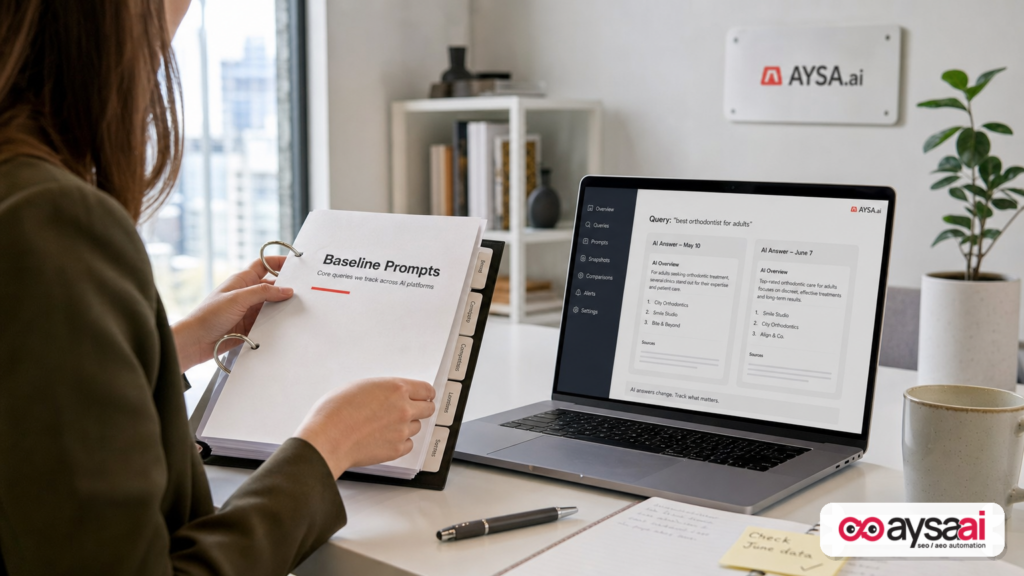
- Spot-checking AI answers is not measurement. It creates no baseline, doesn’t detect citation loss, and can’t explain what to fix.
- You need a tracked prompt set mapped to your revenue intents (comparison, alternatives, price, local service, “best for,” etc.).
- Measure four outcomes: mentions, citations, Share of Voice, and sentiment—over time.
- Fixes fall into four pillars: content that AI can extract, technical accessibility, authority/credibility, and a measurement system that triggers action.
- Execution is the bottleneck. Monitoring without a workflow to implement approved changes is just a prettier dashboard.
Table of contents

- What changed: AI Overviews made visibility dynamic
- Why spot-checks fail (even when they feel “good enough”)
- How AI Overviews reshape the search funnel for SMEs
- What to measure: the AI visibility scorecard
- Build your monitoring set: prompts, intents, and entities
- The four pillars of AI visibility (and what each one actually means)
- Content AI engines can use: formatting, answers, and structure
- Technical readiness: make your best pages “retrievable”
- Authority: earning citations when AI is choosing sources
- A concrete SME scenario: a local clinic loses citations without losing rankings
- What agencies must rethink: deliverables, reporting, and accountability
- Where AYSA fits: monitoring → recommended changes → approved execution
- 90-day action plan for SMEs (practical and realistic)
- What to do next
- Sources and further reading
The new reality: AI answers are regenerated, so visibility is never “done”
Classic SEO trained us to think in relatively stable artifacts: a ranking position for a Keyword, a URL that’s “the” result, a set of blue links that stay mostly consistent day-to-day. AI Overviews (and broader AI-driven results) shift that model. The output is assembled each time a user asks, influenced by query phrasing, context, location, freshness, and what the model chooses to cite in that moment.
Search Engine Journal recently made the point clearly: manual prompting is a point-in-time snapshot, not a baseline, and it won’t tell you why you’re visible or why you disappeared. The remedy is continuous monitoring against a defined prompt set, tracking citations and sentiment over time rather than relying on ad hoc checks. (Source: Search Engine Journal.)
That’s the core shift: AI visibility is not a yes/no question. It’s a living trend line.
For SMEs, this matters because a single lost citation can have an outsized effect. When an AI Overview summarizes options, users may never scroll to the traditional results where you “still rank.” Your brand can be “ranked” but not “chosen” by the answer.
Why spot-checks fail (even when they feel “good enough”)
Let’s be honest: spot-checks are seductive. They’re fast, they’re visual, and they create a sense of certainty—especially when a founder sees their business name appear in an AI answer one day.
The problem is that spot-checks answer the least useful question: “Did I show up right now?” They don’t answer the questions that actually drive decisions:
- Baseline: Are we improving or declining across the prompts that matter?
- Coverage: Are we visible for top-of-funnel research prompts or only for branded ones?
- Drivers: Are we being cited because of one strong page, one strong publication mention, or broad site-wide clarity?
- Risk: If we lose one page or one citation source, do we collapse?
- Next action: What should we do this week that will plausibly move visibility next month?
Spot-checks fail because they’re not a system. A system has: scope (prompt set), cadence (how often), metrics (what you track), and response (what you do when it changes).
How AI Overviews reshape the search funnel for SMEs
In a traditional funnel, you could often “win” by ranking a few category pages and publishing a cluster of blog posts. AI Overviews shift the user journey in three important ways:
1) Funnel compression
Users can go from “I’m exploring options” to “I’m ready to contact someone” within a single AI answer. If your brand isn’t present, you may not be considered—even if you have great service and reviews.
2) Source selection becomes the gate
It’s not only “are we relevant?” It’s “are we a source worth citing?” AI Overviews often reference pages that are clear, structured, and credible. That elevates fundamentals like page purpose, headings, internal linking, and trust signals.
3) Brand sentiment can become part of the answer
Even when you’re mentioned, the framing matters: are you described as premium, affordable, reliable, risky, niche, or “an alternative”? SMEs can’t ignore this. AI answers can become a reputational layer that influences conversion.
Net: Your SEO program must evolve into Search + AI visibility management, not just rankings management.
What to measure (beyond “Did we show up?”): the AI visibility scorecard
If you want something reliable, you need a scorecard. Not a vanity score—an operational one that triggers work. Here’s what we recommend tracking for AI Overviews and adjacent AI search surfaces.
Metric 1: Brand mentions
Your brand name (and common variants) appearing in AI-generated answers for monitored prompts. Mentions are not the same as citations. A mention without a link can still influence trust, but it’s also more fragile.
Metric 2: Citations / linked sources
When the AI answer includes a link to your site (or to a third-party page that strongly features your brand). Citations matter because they represent traceable, defensible visibility. They’re also closer to something you can optimize for: pages, structure, authority.
Metric 3: Share of voice across your prompt set
Not market share in general—share of visibility across the prompts you care about. For example: in “best [service] near me” prompts, how often are you included relative to your top competitors?
Metric 4: Brand sentiment / framing
How the AI describes you when you’re mentioned. This is not a perfect science and should be treated as directional, but it’s still operationally useful. If your brand repeatedly appears with qualifiers like “expensive” or “limited,” that’s a content and reputation opportunity.
Metric 5: Prompt coverage and intent mix
Are you tracking enough prompts to represent your real demand? Many teams accidentally track only obvious head terms and branded prompts. That can create a false sense of dominance.
Metric 6: Change over time (the “delta”)
The most important metric is movement: week-over-week or month-over-month trends for citations, mentions, and sentiment. A single data point is not strategy.
Search Engine Journal frames this as the difference between “teams running AEO” and “teams running ad hoc prompt testing.” It’s a measurement layer that supports decisions. (Source: SEJ webinar announcement.)
Build your monitoring set: prompts, intents, and entities (the part everyone skips)
The monitoring set is where most teams fail—not because they’re lazy, but because they don’t have a framework.
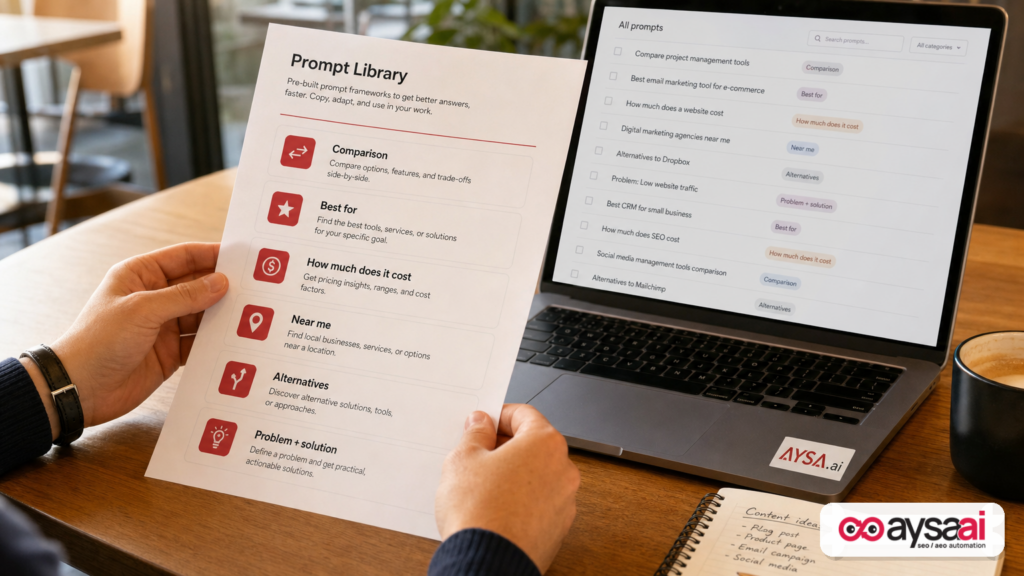
Here’s a practical way to build a prompt library that maps to revenue and customer decision-making. You can do this in an afternoon, and then refine it monthly.
Step 1: List your “money offers” and primary entities
- Core products/services
- Primary categories and subcategories
- Brands you sell (ecommerce) or treat (clinics)
- Locations served (local)
- Audience segments (B2B roles, patient types, etc.)
Step 2: Map intents to prompt patterns
Use a mix like the following (adapt to your industry):
- Best / top: “best [service] in [city]”
- Comparison: “[brand] vs [competitor]”
- Alternatives: “alternatives to [brand]”
- Price / cost: “how much does [service] cost in [city]”
- Problem → solution: “why does [problem] happen and how to fix it”
- Fit / use case: “best [product] for [persona/use case]”
- Trust / safety: “is [treatment/product] safe”
- Local intent: “near me” prompts and neighborhood modifiers
Step 3: Create controlled variants (so you’re not chasing randomness)
Don’t create 2,000 prompts. Create a controlled set that represents variation:
- 2–3 query phrasings per intent
- 2–3 locations (if local)
- 2–3 audience segments (if B2B)
Step 4: Define your competitor set per prompt group
Competitors in AI answers may differ from your classic SERP competitors. For example, an AI Overview might cite an industry association or a marketplace (directory) that outranks everyone by trust. You should track those sources too.
Step 5: Review monthly, not daily
Prompts should evolve with your business—new services, new SKUs, new geographies, seasonal demand. But don’t rebuild constantly. The value of monitoring is consistency.
The four pillars of AI visibility (and what each one actually means)
SEJ highlights four pillars that shape whether AI engines understand and cite you: content, technical health, authority, and measurement. That’s a useful model because it’s broad enough to be true and specific enough to guide work. (Source: Search Engine Journal.)
I’ll translate those pillars into an SME-usable checklist:
Pillar A: Content clarity (can the AI extract a correct answer?)
- Does each key page answer a real question directly?
- Are the headings structured so a machine can summarize?
- Do you define terms and remove ambiguity?
- Do you show constraints (who it’s for / not for)?
Pillar B: Technical accessibility (can the AI retrieve and trust the page?)
- Is the content indexable and crawlable?
- Are canonicals correct?
- Do you have strong internal linking so important pages are discoverable?
- Is structured data used where appropriate?
Pillar C: Authority signals (why should the AI cite you?)
- Do reputable sites mention you in relevant context?
- Do you have evidence of expertise (bios, policies, references)?
- Do you have a recognizable brand entity footprint?
Pillar D: Measurement & response (do you know what’s changing and act on it?)
- Do you have a tracked prompt set?
- Do you record citations and sentiment over time?
- Do drops trigger an investigation workflow?
- Can you implement fixes quickly?
Most businesses have some of A–C. Almost nobody has D in a real, continuous way. That’s why “we asked ChatGPT and saw our name” turns into disappointment three months later.
Content AI engines can use: formatting, answers, and structure
“Write great content” is not a strategy. What matters for AI Overviews is extractability and answer quality.
1) Put the answer first (then expand)
On key pages, lead with a direct, concise answer to the primary question that the page is meant to solve. Then expand with nuance, steps, examples, and FAQs. This helps both humans and systems that summarize.
2) Use headings like an outline, not like design elements
Heading hierarchy should reflect logic:
- H2: main section topics
- H3: sub-questions
- Bullets and numbered steps where appropriate
This isn’t “for Google.” It’s for any system trying to compress your page into a few sentences while staying accurate.
3) Define terms and avoid internal jargon
SMEs often write like insiders. AI answers tend to favor clarity. Define your unique process, your package names, your treatment options, your warranty terms—without marketing fluff.
4) Use FAQs where they truly match real questions
Not a 40-question FAQ stuffed with variations. A tight set of real questions that match the prompt categories you monitor: cost, timeline, safety, comparisons, who it’s for, what to expect.
5) Add structured data where it makes sense
We won’t pretend structured data is a magic lever for AI Overviews. But schema can reduce ambiguity about what a page is, who the organization is, what products exist, and what FAQs apply—especially for ecommerce and local entities.
If your team needs official guidance on schema vocabulary and implementation, start with Schema.org. If you’re focusing on Google-supported structured data types, use Google’s official documentation for structured data in Search.
6) Cite your own sources (where appropriate)
Especially in YMYL-adjacent categories (health, finance, safety), adding citations to primary references can improve perceived trust. Don’t overdo it; do it where it strengthens credibility.
Technical readiness: make your best pages “retrievable”
AI Overviews still depend on the web. If your content is difficult to crawl, blocked, duplicated, or poorly canonicalized, you may not be consistently cited—even if the writing is great.
1) Indexation hygiene
- Important pages should be indexable (no accidental noindex)
- Avoid thin duplicate pages that confuse canonical selection
- Keep sitemaps clean and current
For foundational best practices, Google’s SEO Starter Guide is still the most reliable primary reference.
2) Internal linking that reflects business priorities
Many SMEs unintentionally bury their best pages. Internal links are a signal of importance and a discovery mechanism. If you want to be cited for “pricing,” your pricing page can’t be a footer link nobody references.
3) One page, one job
A common failure: a single page tries to rank for everything—service description, pricing, FAQs, blog, testimonials, and a contact form. That can work for humans, but AI summarizers tend to prefer pages with a clean purpose and structure.
4) Performance and UX still matter (indirectly)
We should be careful about over-claiming direct causal impact between speed and AI citations. But poor UX is correlated with poor outcomes: thin engagement, higher bounce, weaker link earning, and less trust. Technical excellence is still a competitive advantage.
Authority: earning citations when AI is choosing sources
When AI Overviews cite sources, they’re effectively making a judgment call: “Which pages are safe, representative, and trustworthy to reference?” Your job is to make your site the obvious choice.
1) Build a clear brand/entity footprint
This isn’t about gaming knowledge panels. It’s about consistency: your organization name, services, locations, and expert bios should match across your site and reputable third-party profiles.
2) Earn relevant mentions and links (not just volume)
The old “more links is better” mentality is outdated. What matters is relevance and legitimacy: local news, industry publications, associations, partners, suppliers, and meaningful community involvement—things that are real and verifiable.
3) Put proof on the page
- Real policies (returns, warranties, privacy)
- Real team bios (who is responsible)
- Real service area details (local)
- Real product specs and constraints (ecommerce)
Authority is often a content project more than a PR project: making the site feel like the “source of truth” for your niche.
A concrete SME scenario: a local clinic loses citations without losing rankings
Imagine a local physical therapy clinic. They’ve invested in SEO for years and rank on page one for “physical therapy [city]” and a few condition pages. They’re busy, they’re stable, and they don’t want to “chase AI.”
Then AI Overviews expand in their market. Prospective patients search “best PT for runner’s knee [city]” or “how to choose a physical therapist for sciatica.” The AI answer provides a short checklist and cites a couple of sources: a medical association article, a large national clinic chain’s guide, and a local directory page. The clinic is not cited, even though their condition page is well-written.
In Google Search Console, rankings look fine. In calls and form submissions, the clinic sees a slow decline in “new patient” leads over 6–10 weeks. The owner blames seasonality.
What’s actually happening is citation displacement:
- The clinic still “ranks,” but the AI Overview captures attention first.
- The AI Overview cites sources that are structured, broad, and authoritative.
- The clinic’s page lacks clear headings (it reads like a brochure), doesn’t answer “how to choose,” and doesn’t present credentials clearly.
- No one is monitoring AI prompts, so the decline has no early warning.
A monitoring system would flag: “Citations down for 12 prompts related to runner’s knee, sciatica, and ‘best PT’ comparisons.” That triggers a workflow: restructure the condition pages, add a “How to choose a PT” guide, improve internal linking, add provider bios and references, and pursue a few relevant local mentions.
Whether citations return is not guaranteed. But without measurement, you can’t even run the experiment.
What agencies must rethink: deliverables, reporting, and accountability
AI Overviews expose a painful truth about agency work: many deliverables were built for a world where rankings were the headline metric. In the AI era, clients will ask questions like:
- “Why did we stop showing up in the answer?”
- “Why is our competitor mentioned even when we outrank them?”
- “Are we being framed negatively?”
Those questions require new operational habits.
1) Reporting must include AI visibility metrics
Not as a novelty, but as a stable section of the monthly report: prompt coverage, citations, mentions, and sentiment trendlines.
2) Agencies need a tighter loop between insight and execution
The biggest gap isn’t “not knowing.” It’s “knowing and waiting.” When a brand loses citations, you need to deploy fixes quickly. If your workflow takes 6 weeks to approve a title tag change or publish a page update, your client will lose the AI conversation.
3) Strategy moves from keywords to prompt sets and entities
Keywords still matter. But your planning unit becomes: “Which prompts represent revenue intent, and what pages/sources will the AI use to answer them?” That’s closer to AEO/GEO than traditional SEO, and it needs new playbooks.
Search Engine Journal’s positioning of this topic as “tracking what spot-checks miss” is, in my view, the most important agency takeaway. Your competitive edge becomes measurement + response speed, not just content output volume. (Source: SEJ.)
Where AYSA fits: monitoring → recommended changes → approved execution
At AYSA.ai, our thesis is simple: visibility work fails when execution fails. Businesses don’t lose because they lacked ideas; they lose because the loop from “we noticed a problem” to “we fixed the site” is too slow and too manual.
That’s why AYSA is designed as an execution system—not just a reporting layer.
1) Monitor AI search visibility continuously
Start with visibility: tracked prompts, brand presence, citations, and trendlines. This is the foundation described in the SEJ context: continuous monitoring beats manual snapshots.
Learn more about the monitoring layer here: AYSA Monitoring and AI visibility tracking here: AI Search Visibility.
2) Translate signals into a prioritized backlog
When citations drop for a prompt cluster, you need a checklist of likely drivers:
- Is the target page structured for extractable answers?
- Is it indexable and canonicalized correctly?
- Is there a stronger competitor page being cited?
- Do we lack an authoritative “chooser” guide?
AYSA’s job is to turn monitoring into recommended changes, ranked by impact and effort—so SMEs aren’t drowning in SEO noise.
3) Ask for approval, then execute accepted website changes
SMEs need control. Agencies need accountability. Our model emphasizes “approved execution”: AYSA prepares changes, you approve, and then the system can implement accepted updates—reducing the lag between decision and deployment.
To explore the toolset that supports this workflow: AI SEO Tools. For plans and packaging: AYSA Pricing. For more playbooks: AYSA Blog.
A 90-day action plan for SMEs (practical and realistic)
If you’re an owner or operator, you don’t need a 12-month transformation roadmap. You need a 90-day plan that produces clarity and momentum.
Days 1–15: Establish a baseline
- Create a prompt library of 30–80 prompts covering your top intents
- Define brand variants and competitor set
- Record current mentions/citations for each prompt group
- Tag prompts by intent (comparison, cost, local, alternatives)
Days 16–45: Fix obvious “extractability” issues
- Restructure top 10 revenue pages with clearer headings and direct answers
- Add or refine 3–6 FAQs that match monitored prompts
- Improve internal linking so key pages are discoverable from nav and related content
- Confirm indexation, canonicals, and basic technical hygiene
- Add structured data where appropriate (Organization, Product, FAQ where valid)
Days 46–75: Build one “chooser” asset and one authority asset
- Create a “How to choose” guide that matches your highest-value prompt cluster
- Create a comparison page or “alternatives” page (honest, useful, not a smear)
- Publish one proof-heavy page: credentials, process, policies, case constraints
Days 76–90: Review trends and iterate
- Check prompt-level trendlines: where did citations improve or decline?
- Identify one cluster to double down on
- Identify one cluster where competitors are being cited and you’re not—analyze why
- Turn findings into the next month’s content + technical backlog
The point is not to “win AI Overviews” in 90 days. The point is to build a repeatable loop: measure → diagnose → execute → re-measure.
What to do next
- Stop relying on spot-checks. Choose a fixed set of prompts tied to revenue intents.
- Track four essentials: mentions, citations, share of voice, sentiment—over time.
- Audit your top pages for extractability: answer-first structure, headings, FAQs, clarity.
- Verify technical basics: indexation, internal linking, canonicals, structured data where valid.
- Create one chooser guide that helps customers decide (and makes you cite-worthy).
- Adopt an execution workflow so fixes don’t sit in a backlog for months.
- If you want a system: explore AYSA’s monitoring and AI search visibility workflow at aysa.ai/monitoring and aysa.ai/ai-search-visibility.
Sources and further reading
- Search Engine Journal: AI Overviews Visibility: A Reliable Way To Track What Spot-Checks Miss
- Search Engine Journal webinars (context and ongoing updates)
- Google Search Central: SEO Starter Guide
- Google Search Central: Introduction to structured data
- Schema.org (structured data vocabulary)
Note on sourcing: The SEJ source provided is a webinar announcement and strategy framing, not a data study. Where this article discusses tactics and measurement frameworks, it is presented as analysis and practical operations guidance rather than as verified statistical outcomes.
Continue the AI search topic inside AYSA.
Use these pages to connect the article with AI SEO tools, AI visibility monitoring, AI Overviews and approved website execution.
Turn this topic into a website action plan.
Use these AYSA hubs to move from reading to technical fixes, AI visibility monitoring, research, glossary context and approval-first SEO execution.