
Google’s AI Mode Information Agents: The New “Always-On” Search — And What SMEs Must Do To Get Chosen
Google’s AI Mode information agents shift discovery from one-off searches to background monitoring and push updates. That changes when (and whether) your content gets seen, cited, and clicked. Here’s the practical playbook for SMEs and agencies to earn inclusion—plus how AYSA helps you monitor, prepare changes, approve, and execute updates that make you more “agent-ready.”

Google is pushing search toward an “always-on” model: instead of people repeatedly running the same query, they can ask an AI agent to monitor a topic in the background and send updates with links when something changes. Google has begun rolling these information agents out to Google AI Ultra subscribers across AI Mode languages and markets, with broader access expected to expand this summer.
This isn’t a small UI tweak. For businesses, it changes:
- When searchers discover content (push updates vs. pull queries),
- How sources get selected (inclusion vs. blue-link rank), and
- What “winning search” looks like (being the cited link in an update, not merely sitting on page one).
In this editorial, I’ll translate what’s changed, why it matters for SMEs and agencies, what can go wrong, and what to do next—especially if your team doesn’t have the time to manually “keep up” with AI Search shifts. I’ll also show where AYSA fits as an execution system: we monitor, prepare changes, ask for approval, and execute accepted website updates so you can move fast without surrendering control.
Concise Summary

- What changed: Google’s AI Mode now includes information agents for AI Ultra subscribers that monitor topics continuously and send updates with links to sources.
- Why it matters: Repeated “check back” searches can become background Monitoring. The new competition is: Will your site be included in the update?
- What to do: Strengthen citation-readiness (clear claims + evidence, freshness, structured internal architecture, and brand/Entity Clarity), monitor how you appear in AI answers, and build an operational loop for continuous improvements.
- Where AYSA fits: Use AYSA to monitor visibility changes, prepare improvements, route them for approval, and execute changes quickly—without turning your website into an experiment.
Table of Contents
- What Happened: Google Rolls Out AI Mode Information Agents
- What Google’s Information Agents Change (In Plain English)
- Why This Changes Search Behavior (And Your Traffic Mix)
- The New Optimization Target: From Rankings To Inclusion
- What Might Influence Which Sources Agents Include
- Content Strategy For Agent-Driven Search: Less “More Content,” More “More Useful”
- Technical & Site Architecture: Make Your Pages Easy To Extract And Cite
- Local & Multi-Location: When “Updates” Become the New Map Pack Moment
- A Concrete SME Scenario: A Local Clinic Competing In “Agent Updates”
- What Agencies Must Rethink (Reporting, Deliverables, and Incentives)
- What Can Go Wrong: Misinformation, Brand Risk, and Attribution Blind Spots
- What SMEs Should Monitor Weekly
- How AYSA Helps: Monitor → Prepare → Approve → Execute
- What To Do Next: The 30–60 Day Action Plan
- Sources and Further Reading
What Happened: Google Rolls Out AI Mode Information Agents

According to reporting by Search Engine Journal, Google has started making AI Mode information agents available to Google AI Ultra subscribers across all AI Mode languages and markets. These agents are designed to monitor topics “around the clock” and send updates when new information becomes available, including links back to the web.
The key capability is not just summarization—it’s persistent monitoring. Users can ask AI Mode to keep them updated on a topic; the agent then watches the web (and Google’s own real-time datasets in areas like finance, shopping, and sports, as described in the same report) and pushes new updates.
Google previously described these agents as part of its AI search roadmap (the SEJ report notes the announcement occurred about three weeks earlier at Google I/O). The rollout is currently limited to Ultra subscribers, with expansion to “more people” expected this summer.
What Google’s Information Agents Change (In Plain English)
Most businesses still think search works like this:
- Someone types a query.
- They scan results.
- They click a link.
Information agents change the habit loop:
- Someone says: “Keep me updated on topic X.”
- The agent does the searching for them, continuously.
- When something changes, the user gets a notification/update with links.
This is the “always-on” version of search. And it has a huge implication: you’re not only competing in a moment of intent (“I need this now”). You’re competing to become part of a recurring information feed (“tell me when something new happens”).
In business terms, it’s the difference between:
- Search as a destination (a place people visit to research), and
- Search as a service (a background worker that brings the research to them).
Why This Changes Search Behavior (And Your Traffic Mix)
For years, recurring queries have been a quiet driver of steady Organic traffic. Think of:
- “best accounting software updates”
- “mortgage rates this week”
- “iPhone price drop”
- “new restaurant openings near me”
- “{your competitor} reviews”
These are the queries people repeat because they’re tracking change. Information agents are explicitly built to replace that repetitive behavior.
If the user no longer runs the query every week, what happens to your traffic?
- Some Clicks move earlier (you get traffic when an update drops).
- Some clicks disappear (the user is satisfied by the update summary).
- Some clicks concentrate (only a handful of cited links get the attention).
That last point is critical. If updates cite, say, a small set of sources (Google hasn’t published a full selection methodology in the provided research context), then the “winner-takes-more” dynamic intensifies: fewer publishers and businesses receive a larger share of attention. That’s why SMEs must stop treating AI search as a vague future concept and start building operational readiness now.
The New Optimization Target: From Rankings To Inclusion
Classic SEO asks: Where do we rank?
Agent-era optimization asks: Are we included?
Inclusion is not a poetic rebrand. It’s a structural difference in how value flows:
- Ranking is a list order. Even if you’re #6, you may still get clicks.
- Inclusion is binary in many AI surfaces. If your brand/page isn’t referenced, you may effectively not exist for that interaction.
This is where AEO (Answer Engine Optimization) and GEO (Generative Engine Optimization) become practical, not buzzwords. The goal is to make your pages easy and safe for AI systems to cite when they are constructing answers or updates.
AYSA’s own framing of AI search visibility is built around this: ensuring your site is structured and maintained so that AI systems can extract accurate, attributable information. If you want the overview of that approach, start here: AI Search Visibility.
What Might Influence Which Sources Agents Include
Google has not (in the research provided here) published a full “agent source selection” rubric. So we should avoid pretending there’s a definitive checklist.
But we can reason from how AI answer systems typically behave and from what Google has signaled in the SEJ report: agents look across the web (blogs, news, social posts) and also use real-time datasets in verticals like finance, shopping, and sports. That implies three pressures:
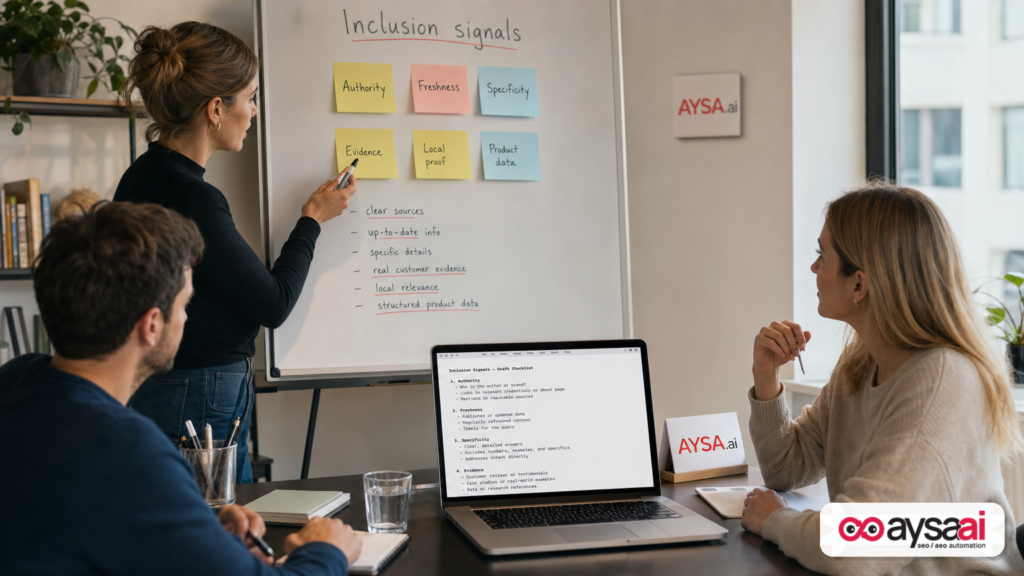
1) Freshness becomes a first-class signal for monitored topics
If a user asks to be updated on a topic, the agent needs to detect what’s new. That doesn’t necessarily mean “new URL.” It can mean:
- Existing pages updated with new information
- New product availability or pricing changes
- New FAQs based on shifting customer questions
SMEs that publish once and forget will be outpaced by competitors who maintain a living knowledge base.
2) Evidence and specificity likely win over generic content
AI systems prefer sources that can be quoted, referenced, and triangulated. Vague marketing copy is hard to cite. Clear claims with supporting details are easier to cite.
Practically: “We offer fast shipping” is weak. “Orders placed before 2pm ship same day from Austin, TX; delivery estimates by ZIP code at checkout” is cite-worthy (and also customer-friendly).
3) Entity clarity matters: who are you, and why should you be trusted?
When AI systems pull from many sources, they need to resolve identity and authority. That means:
- Consistent brand naming across your site
- Clear “About” and editorial ownership
- Author attribution where it matters
- Contact, location, and policies that demonstrate legitimacy
You don’t need to turn your site into a compliance document. But you do need to look like a real business with real accountability—because AI systems are increasingly cautious about citing low-trust sources.
Content Strategy For Agent-Driven Search: Less “More Content,” More “More Useful”
Here’s the uncomfortable truth: publishing more content is not a strategy. It’s a tactic. In agent-driven search, the tactic can backfire if it creates:
- Duplicate thin pages that confuse source selection
- Conflicting answers across your own site
- Outdated pages that make your brand look unreliable
Instead, build a content system that’s optimized for monitoring topics—because that’s what users are delegating to agents.
Build “update magnets”: pages that deserve recurring citations
Ask: what topics do customers track over time?
- Ecommerce: restocks, price drops, new versions, compatibility changes
- Local services: seasonal availability, new service areas, licensing updates
- SaaS: feature releases, integrations, security notes, pricing changes
- Healthcare/clinics (careful with claims): appointment availability, insurance updates, treatment options overview pages with citations to reputable medical sources
For each tracked topic, create or improve a primary page that becomes the canonical reference. Then update it consistently.
Write for extraction: make your key answers impossible to miss
AI systems extract. Humans skim. The overlap is your friend.
- Use short sections with descriptive headings
- Put the direct answer near the top
- Follow with supporting detail, caveats, and next steps
- Add a clear “last updated” context when appropriate (don’t fake it)
Reduce internal contradiction (a silent citation killer)
Nothing undermines inclusion faster than two pages from the same domain disagreeing. If one page says shipping is free over $50 and another says $75, which does an agent cite?
SMEs should run a quarterly “consistency audit” across high-intent pages: pricing, shipping, returns, service areas, hours, guarantees, and product specs.
This is exactly the kind of ongoing maintenance loop that should be systematized—not handled with sporadic bursts of effort.
Technical & Site Architecture: Make Your Pages Easy To Extract And Cite
Agentic search does not erase technical SEO; it raises the bar for clarity.
Ensure every important page has one job
If your “Services” page tries to rank for 12 unrelated services with vague copy, you’re making it harder for an agent to cite you. Split complex pages into focused hubs and subpages where it helps users.
Use internal linking like you mean it
Agents will follow links—directly or indirectly through indexing and retrieval—when they build an understanding of your site. Make it obvious which page is the source of truth.
- Link from blog posts back to the canonical service/product page
- Use consistent anchor text
- Maintain clean navigation and breadcrumbs
Fix “retrieval friction”
Common SME issues that reduce extractability:
- Critical info locked behind interactive elements that don’t render well
- Overloaded pages that bury the answer beneath huge carousels
- Unclear page titles and headings
- Thin templated pages for every city/product variation with little differentiation
The goal is not “to please Google.” It’s to reduce friction for both humans and machines trying to understand your offering quickly.
Monitoring becomes part of technical SEO
In a world of background agents, your SEO isn’t “done” when a page is published. You need monitoring: what changed, what broke, and where visibility slipped.
AYSA was built around that operational reality. Start with monitoring here: AYSA Monitoring.
Local & Multi-Location: When “Updates” Become the New Map Pack Moment
Local search has always been competitive because intent is immediate. But information agents can create a different local dynamic: customers may subscribe to updates like:
- “Keep me updated on the best urgent care near me with short wait times”
- “Tell me when hotel prices drop in Denver”
- “Update me on new restaurants in my neighborhood”
If those updates include links, your brand presence becomes a recurring contest. And for multi-location brands, inconsistency across locations (hours, services, policies) can turn into brand-level risk if an agent cites the wrong detail.
Local businesses should focus on:
- Location pages that contain complete, current, and consistent info
- Service definitions that match what is actually offered at that location
- Clear policy statements that reduce ambiguity
This is where “approved execution” matters. Automated changes across 50 locations without oversight can create serious errors. But moving too slowly means you lose inclusion opportunities. The solution is a controlled system that prepares changes and routes them for approval—then executes quickly once approved.
A Concrete SME Scenario: A Local Clinic Competing In “Agent Updates”
Let’s make this real with a scenario you can picture.
Business: A local clinic with two locations. They’re not trying to “go viral.” They want consistent new patient appointments.
What people search today:
- “walk-in clinic near me open now”
- “urgent care wait times”
- “does {clinic} accept {insurance}”
- “strep test cost”
What agents enable: A user might say: “Keep me updated on clinics near me with short wait times and that accept my insurance.”
Now, ask yourself: what does an agent need to choose sources?
- Clear and consistent insurance information
- Accurate hours and location details
- Transparent service descriptions (what they do and don’t do)
- Policies and next steps that reduce uncertainty
Where SMEs lose: Many clinics have outdated pages, missing insurance lists, vague service copy, and inconsistent details across location pages. Even if they “rank,” an agent might avoid citing them because the information is incomplete or contradictory.
What to do:
- Consolidate insurance and service info into canonical pages and link to them from location pages.
- Update location pages monthly (or whenever a policy changes).
- Add plain-language FAQs that answer the actual questions patients ask.
- Monitor how the clinic appears in AI answers and adjust inputs.
How AYSA fits: AYSA can monitor visibility and content changes, propose structured updates to key pages, ask for approval, and execute accepted changes—so the clinic stays accurate without relying on ad hoc website edits. (More on this in the AYSA section.)
What Agencies Must Rethink (Reporting, Deliverables, and Incentives)
Agencies built for a “ranking era” often sell:
- Monthly keyword movements
- Content volume
- Backlink counts
Those can still matter, but they don’t fully map to the new objective: being chosen as a cited source in AI-driven experiences and agent updates.
Reporting must shift from “positions” to “presence”
Clients will increasingly ask:
- “Are we showing up in AI answers?”
- “When we are cited, which page is used?”
- “Are competitors being cited instead?”
This requires monitoring that doesn’t depend on a single SERP screenshot. It’s longitudinal and topic-driven.
Deliverables must become operational
In an agentic world, the best agency isn’t the one that writes the most blogs. It’s the one that can:
- Detect shifts quickly
- Update key pages fast
- Maintain consistency across dozens/hundreds of URLs
- Control risk with approvals and QA
Execution is the bottleneck. Which brings us to automation done right: not “set it and forget it,” but “monitor, propose, approve, execute.”
If you’re an agency, AYSA’s approach is designed for exactly this: systematic improvements with human approval gates. Explore the toolset here: AI SEO Tools.
What Can Go Wrong: Misinformation, Brand Risk, and Attribution Blind Spots
Any push-style update system introduces new risks for brands.
Risk #1: Wrong information spreads faster
If your site has outdated policy text, old pricing, or a discontinued product description, an agent can pick it up at the worst time—precisely because it’s monitoring for changes and surfacing them quickly.
This is not theoretical. Many SMEs have legacy pages that “no one visits” (so they think). Agents change that. Old pages can become sources again.
Risk #2: You lose the context around your brand
When a user gets an update, they may see a summary and one or two links. If your brand’s message relies on a carefully crafted funnel, the agent interface compresses it. That means your pages must deliver clarity fast. Above-the-fold matters again—just in a new way.
Risk #3: Attribution becomes harder
Even if updates include links, not every user will click. Some will act based on the summary alone, then search your brand directly later, or walk in, or convert via a different channel. Your analytics will undercount search’s influence.
The practical response is to improve measurement discipline: align your content updates with observable business outcomes (leads, calls, bookings, sales) and track branded demand trends over time, not just last-click traffic.
What SMEs Should Monitor Weekly
If you’re a founder or operator, you don’t need an enterprise SEO war room. But you do need a weekly rhythm. Here’s what to monitor as AI Mode agents roll out more broadly:
1) Brand presence in AI surfaces (where you can observe it)
Track whether your brand is mentioned or cited in AI-driven results for your core topics. If you can’t verify something directly, treat it as directional. The point is to spot patterns: are you showing up more or less often?
2) Your “update magnet” pages
Pick 10–20 pages that should be authoritative and current. Review them for:
- Accuracy
- Freshness
- Clarity
- Internal contradictions
3) Competitor citations and content patterns
When a competitor is consistently referenced, don’t obsess—analyze. What do they have that you don’t?
- More specific product data?
- Clearer pricing pages?
- Better FAQs?
- More consistent location info?
4) Operational speed
How long does it take your business to fix a wrong page? If the answer is “weeks,” you’re not ready for always-on search.
This is where systems matter more than heroics.
How AYSA Helps: Monitor → Prepare → Approve → Execute
Most SEO advice fails at the same point: execution. Businesses either don’t have time, don’t have the technical help, or don’t want to risk publishing changes that might break conversions or compliance requirements.
AYSA is built to solve that bottleneck with a controlled loop:
1) Monitor what matters
AI search visibility isn’t static. AYSA helps you set up monitoring so you can detect issues and opportunities early, before they become revenue problems.
Start here: AYSA Monitoring.
2) Prepare improvements (without instantly changing your site)
Instead of pushing edits live automatically, AYSA prepares recommended updates—content improvements, structural fixes, internal linking suggestions, and other SEO/AEO/GEO-oriented changes—based on what’s holding your pages back from being cited and trusted.
Explore the broader toolkit: AI SEO Tools.
3) Ask for approval (control and governance)
SMEs and agencies need guardrails. Especially in regulated industries, franchising, and multi-location operations, you can’t let automation publish unchecked.
AYSA’s model routes changes for approval so humans stay accountable.
4) Execute accepted changes quickly
Once approved, execution should be fast. Agent-driven search rewards timeliness. If you can update the right pages quickly, you increase your chance of being included in future updates—and reduce the risk of outdated pages being cited.
If you want to understand how AYSA frames AI search visibility strategically, read: AI Search Visibility.
Where to start if you’re new
If you’re still building your internal capability, our blog is where we publish playbooks and operational guidance: AYSA Blog.
And if you need to understand packaging and costs, pricing is here: AYSA Pricing.
What To Do Next: The 30–60 Day Action Plan
If you’re an SME, you don’t need to “boil the ocean.” You need a focused plan that makes your site more citeable and reduces operational lag.
Days 1–7: Pick your monitored topics and canonical pages
- List 10–20 topics customers repeatedly research (prices, comparisons, availability, regulations, releases).
- Identify the single best page on your site for each topic.
- If you have multiple competing pages, decide which one becomes canonical and update internal links accordingly.
Days 8–21: Upgrade pages for citation-readiness
- Add clear definitions and direct answers near the top.
- Remove or rewrite vague claims that can’t be supported.
- Fix contradictions across policies, hours, pricing, and specs.
- Improve internal linking so the “source of truth” is obvious.
Days 22–45: Create your “update cadence” and governance
- Assign an owner for each “update magnet” page.
- Set a review cadence (monthly minimum, faster for fast-moving topics).
- Define an approval process so changes don’t stall (or go live dangerously).
Days 46–60: Operationalize monitoring and execution with AYSA
- Enable monitoring for visibility and page-level drift: AYSA Monitoring.
- Use AYSA to prepare recommended changes and route approvals.
- Execute improvements and keep the loop running weekly.
What to do next (Checklist)
- Choose 10 monitored topics your customers care about repeatedly.
- Make one page the source of truth for each topic.
- Update for clarity + evidence so AI systems can cite you confidently.
- Eliminate contradictions across shipping, pricing, hours, and policies.
- Set a monthly refresh cadence (weekly for fast-moving topics).
- Implement monitoring so you notice changes before your customers do.
- Adopt approved execution so you can move fast without risky automation.
Sources and Further Reading
- Search Engine Journal: Google Rolls Out AI Mode Information Agents To Ultra Subscribers
- Search Engine Journal: Latest News (ongoing coverage and context)
- Search Engine Journal: SEO section (broader SEO implications)
- AYSA: AI Search Visibility
- AYSA: AI SEO Tools
- AYSA: Monitoring
- AYSA Blog
- AYSA Pricing
Note on sourcing: The information agent rollout details in this editorial are based on the SEJ report linked above. Google’s precise criteria for how information agents select which sources to cite was not provided in the supplied research context, so the guidance above frames selection factors as practical analysis rather than confirmed rules.
Continue the AI search topic inside AYSA.
Use these pages to connect the article with AI SEO tools, AI visibility monitoring, AI Overviews and approved website execution.
Turn this topic into a website action plan.
Use these AYSA hubs to move from reading to technical fixes, AI visibility monitoring, research, glossary context and approval-first SEO execution.

