
Google’s expanded limited ad serving on Search: The new “trust tax” on PPC—and how to protect your reach
Google is expanding when it can quietly limit Search ad impressions based on perceived user risk—putting clearer branding, stronger landing-page UX, and real-world trust signals at the center of paid reach. Here’s what changed, why it matters for SMEs and agencies, and the practical fixes to protect performance.

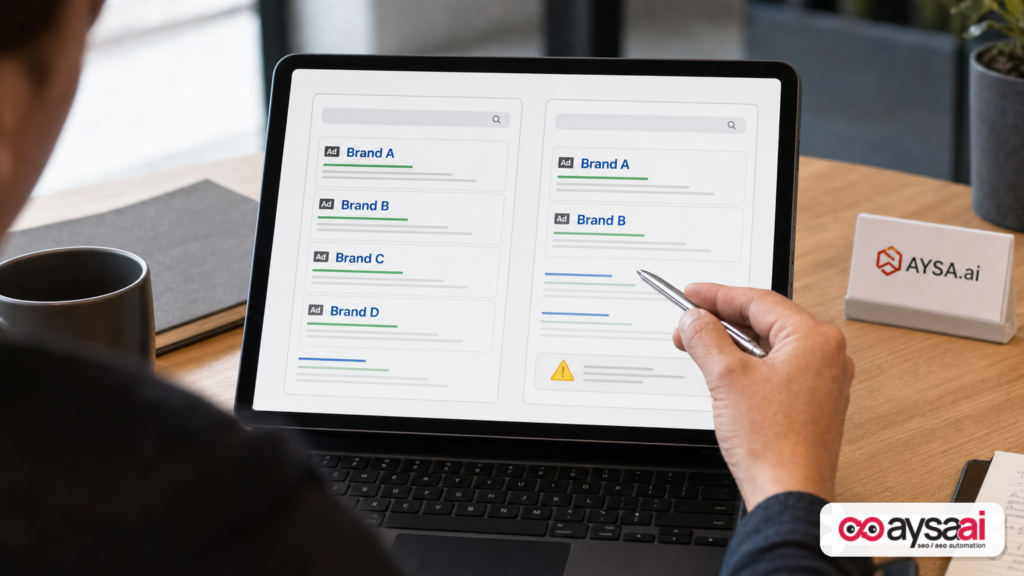
Google is expanding when it can quietly limit how often your Search ads show—based not only on policy violations, but on whether Google believes your ads create confusion or risk a negative user experience. This is a meaningful shift: it turns “trust” and “clarity” into delivery levers, not just conversion-rate levers.
In plain English: you can be compliant, willing to pay, and still get less reach on certain searches if Google’s systems decide users can’t tell who you are, what you’re selling, or whether the experience behind the click is likely to disappoint.
This editorial breaks down what changed, what to watch for, and how to protect ad reach—especially if you’re an SME or an agency running performance programs at scale. I’ll also explain how AYSA helps operationalize the “trust work” that PPC teams often know they should do, but struggle to execute consistently.
Concise summary
- What changed: Google expanded its Limited ad serving policy for Search to cover more scenarios, rolling out gradually through 2028, increasing Google’s discretion to restrict Impressions when it believes the user-risk is higher.
- What drives limits: Persistent negative user feedback (e.g., misleading content/products/business practices) and unclear advertiser identity (users can’t easily tell who is behind the ad).
- Why it matters: This can create invisible throttling—performance drops that look like bidding or competition issues, but are actually delivery constraints.
- What to do: Tighten brand clarity in ads and landing pages, reduce “generic” copy, ensure domain/affiliation transparency, and invest in user experience signals that reduce complaints.
- How AYSA fits: AYSA monitors visibility and trust-related risks, proposes specific fixes, asks for approval, and executes accepted changes on your website—helping you move faster than manual processes allow.
Table of contents

- What changed: Google is widening when it can limit Search impressions
- Why this is happening now (and why it’s not just “more policy”)
- How Google decides: feedback, identity, and higher-risk searches
- The practical risk: “invisible throttling” that looks like a performance problem
- Who’s most exposed: SMEs, newer advertisers, and ambiguous brands
- Brand clarity is now a delivery lever (not just a conversion lever)
- Landing page experience is the new front line for paid reach
- Ads that look interchangeable will be punished (even if they convert)
- Affiliations, resellers, and “who are you?” confusion
- How to diagnose limited serving vs. normal volatility
- A concrete SME scenario: the local clinic whose ads suddenly stopped showing
- What agencies should rethink: governance, creative, and QA at scale
- How AYSA helps: monitor, prepare changes, ask for approval, execute safely
- What to do next: a practical action list
- Sources and further reading
What changed: Google is widening when it can limit Search impressions
Google announced it is broadening its Limited ad serving policy on Search, giving itself more authority to restrict impressions for advertisers it considers unqualified or potentially confusing to users. The rollout starts now and continues gradually through 2028.
The core idea isn’t new—Google has always limited certain ads and advertisers based on policy and quality systems. What’s new is the explicit emphasis on:
- User feedback as a stronger qualification signal
- Advertiser identity clarity (users should easily recognize who’s behind an ad)
- Search scenarios Google considers higher-risk for negative user experiences
This update was covered by Search Engine Land, which framed it clearly: branding and positive user experiences may play a larger role in maintaining Google Search ad reach going forward.
Source: Search Engine Land – Google expands limited ad serving policy on Search
Why this is happening now (and why it’s not just “more policy”)
When people hear “policy,” they think of hard approvals/disapprovals: ads rejected, accounts suspended, words you can’t use. Limited ad serving is different: it’s a delivery constraint. Your ads may still be eligible, but they show less often in some contexts.
From a business standpoint, Google is making a straightforward trade:
- Search monetization depends on user trust.
- If users click ads and feel misled, they click fewer ads over time.
- So Google is shifting from purely reactive enforcement to risk-based prevention.
This is consistent with where Search is headed overall: more emphasis on brand trust, experience, and “who is the source?” signals across both organic and paid surfaces. Search Engine Land has been covering adjacent themes around AI-era visibility and trust (even though those stories aren’t the same policy):
- What new AI search data reveals about visibility and trust
- Google zero-click searches hit 68% in early 2026: Study
I’m not claiming those pieces prove the limited-serving change. But the direction is clear: if fewer Clicks are available (because of zero-click behavior, AI surfaces, and crowded SERPs), then the clicks that remain are more valuable—and platforms become more selective about what they show.
How Google decides: feedback, identity, and higher-risk searches
According to the policy expansion described by Search Engine Land, Google will weigh:
- User feedback more heavily, especially if reports are persistent and disproportionate for misleading content/products/business practices.
- Advertiser identity clarity: Google may limit ads that make it difficult for users to identify who the advertiser is.
- Contextual risk: impressions may be limited on searches Google believes have higher risk of negative user experiences.
There are two implications here that most advertisers will underestimate:
- It’s not only about your ad. It’s about your end-to-end user experience: the landing page, the clarity of your offer, the transparency of your business, and the mismatch between expectations and reality.
- It’s not only about compliance. Being “allowed” is no longer enough. You must be recognizable and trusted in the moment the user scans the SERP.
Google also offered a tactical suggestion: pin a domain headline in the first position of a Responsive Search Ad (RSA) to make advertiser identity more obvious. That one tip reveals the intent: reduce ambiguity on the SERP itself.
The practical risk: “invisible throttling” that looks like a performance problem
Most PPC teams are built to solve visible problems:
- CPA went up → adjust bids / tighten targeting
- Conversion rate dropped → test landing page
- CTR declined → test new headlines
Limited ad serving creates a nastier situation because the symptom is often lower impressions and lower reach, which can be misdiagnosed as:
- More competition
- Seasonality
- Smart Bidding “learning” issues
- Budget caps
- Match type expansion catching bad queries
And you can burn weeks “optimizing” the wrong thing. In my experience, this is where SMEs get hurt most: they don’t have the time or instrumentation to separate delivery constraints from auction constraints.
Limited ad serving also changes how you should interpret common PPC metrics:
- Impression share can drop for reasons unrelated to bids and budget.
- CTR can shift because only certain queries still show your ads.
- Search terms quality can drift if some auctions stop serving.
- Conversion rate might increase (because only “safer” queries remain), which can mask the underlying reach problem.
Who’s most exposed: SMEs, newer advertisers, and ambiguous brands
Search Engine Land noted the update could particularly affect:
- Newer advertisers
- Brands with poor user feedback
- Advertisers whose identity is not clearly communicated in ads
Let’s translate that into real-world patterns.
1) Newer advertisers (the “trust gap” problem)
New advertisers often lack:
- Brand Search volume
- Clear reputation signals
- Consistent on-site messaging
- Established complaint history (good or bad)
That doesn’t mean they’re untrustworthy—it means they’re unknown. In a risk-based system, unknown can be treated closer to risky, especially on sensitive or high-stakes queries.
2) Ambiguous brands (the “who are you?” problem)
If your ad looks like it could be from anyone—generic “Best Prices,” “Official Site,” “Top Rated,” “Same Day Service”—Google is signaling that this is now a delivery risk.
3) Feedback-heavy businesses (the “expectation mismatch” problem)
Some business models naturally produce more complaints because expectations are easy to mis-set:
- Lead-gen middlemen
- Resellers and affiliates
- Subscription trials with confusing terms
- Services with heavy fine print (cancellation, shipping, fees)
I’m not saying these are “bad.” I’m saying they can create disproportionate user reports if the ad and landing page aren’t extremely clear.
Brand clarity is now a delivery lever (not just a conversion lever)
PPC people have always cared about branding, but usually for secondary reasons:
- Brand recall
- Higher CTR
- Lower CPC via better Quality signals
- Trust boosting conversion rate
Now branding is also about eligibility for reach.
What “brand clarity” actually means in Search ads
Brand clarity isn’t a logo. It’s whether a user can answer, in one second:
- Who is advertising?
- What are they offering?
- Are they the provider, a marketplace, or a reseller?
- Is this the brand I think it is?
Practical ad-level moves:
- Use your brand name early in headline variants.
- Pin a domain headline in position 1 (as Google suggested) to reduce identity ambiguity.
- Match ad message to landing page above-the-fold so users don’t feel tricked.
- Avoid “official” language unless you truly are the official brand/site.
The hidden risk of “generic” copy
Generic copy works in one narrow sense: it casts a wide net, and it’s easy to scale across many ad groups. But it also creates:
- Identity confusion
- Expectation mismatch
- Higher chance of user disappointment
In a limited-serving world, “generic at scale” may stop being an optimization advantage and start becoming a distribution penalty.
Landing page experience is the new front line for paid reach
Google’s emphasis on user feedback and negative experiences pushes landing pages into the center of paid reach decisions. A landing page isn’t just where you convert; it’s where users decide whether they feel misled.
The landing-page trust stack (what users look for fast)
For SMEs, you don’t need a redesign. You need clarity blocks that reduce complaints:
- Business identity: legal/brand name, physical address (if relevant), contact phone/email, “About” information.
- Offer clarity: what is included, what is not included, key constraints (availability, eligibility, coverage area).
- Policies: shipping/returns/cancellation, fees, timelines, warranties.
- Proof: real reviews/testimonials (where you can substantiate them), certifications, team photos, case studies (without exaggeration).
- Friction reduction: Page speed, mobile UX, readable layout, accessible forms.
If a user clicks an ad and can’t tell who you are within a few seconds, you’re inviting the very feedback loops Google is now using to limit delivery.
Don’t hide what you are
Many businesses are legitimate intermediaries: marketplaces, comparison sites, lead aggregators, franchise networks, resellers. The mistake is not being an intermediary—the mistake is not saying it clearly.
Google explicitly called out affiliation clarity in the Search Engine Land coverage: advertisers should clearly communicate affiliation with other brands. That’s a hint that “user confusion” is a specific trigger Google wants to reduce.
Ads that look interchangeable will be punished (even if they convert)
Responsive Search Ads (RSAs) encouraged a kind of industrial-scale ad production: feed Google 10–15 headlines and 4 descriptions, let the system mix and match.
That approach can still work—but the expansion of limited serving changes the design constraints.
Design RSAs for recognition, not just variation
Instead of “15 headlines = 15 different ways to say generic benefits,” use variation to reinforce identity and clarity:
- Headline set A (identity): Brand name, location, category (“Acme Dental – Chicago”).
- Headline set B (offer): Clear service/product (“Same-week cleaning appointments”).
- Headline set C (qualification): Who it’s for (“Serving Lincoln Park & Loop”).
- Headline set D (trust cue): Transparent terms (“Upfront pricing • No hidden fees”).
The goal is that no matter which combo renders, users still understand who you are and what you do.
Pinning is back (strategically)
For years, pinning was treated as something you do only when absolutely necessary, because it restricts machine learning. Google’s suggestion to pin a domain headline in position 1 is a reminder: there are moments where human clarity beats algorithmic flexibility.
If you’re in a category where trust matters, pinning key identity elements can be worth the trade.
Affiliations, resellers, and “who are you?” confusion
One of the most common “trust accidents” in Search happens when a user thinks they’re clicking a brand’s official site—but they’re landing on:
- a reseller
- a marketplace listing
- an affiliate page
- a lead form that sells the lead to multiple providers
Again: these models aren’t inherently wrong. But the user’s mental model matters. If the ad and landing page don’t match that mental model, the user feels misled—and that’s exactly the kind of feedback loop Google highlighted.
Simple language that reduces confusion
Consider adding clear statements like:
- “We’re an independent retailer of [brand] products.”
- “Compare quotes from multiple providers—your request may be shared.”
- “[Brand] is a trademark of its owners; we are not affiliated.”
This is not legal advice, but it’s a practical clarity technique. When in doubt, work with counsel for exact wording—especially in regulated categories.
How to diagnose limited serving vs. normal volatility
Because Google’s change increases discretion, it’s likely many advertisers will suspect limited serving without being sure. You should build a diagnostic routine that separates four buckets:
- Budget-limited: you’re capped by spend.
- Rank-limited: bids/quality aren’t competitive.
- Targeting-limited: match types, audiences, geos, schedules restrict volume.
- Trust/eligibility-limited: your ads are being served less often due to perceived risk.
Tell-tale patterns worth investigating
These patterns can indicate delivery restriction, but they’re not proof:
- Impressions fall sharply while budgets remain unspent and bids are unchanged.
- Non-brand impressions drop but brand remains stable (or vice versa).
- Search term mix shifts toward safer, more navigational queries.
- CTR changes abruptly without a creative change—because the auctions you appear in changed.
- GEO pockets collapse while others remain stable (contextual risk can vary by query set and intent).
To avoid guesswork, use systematic monitoring. This is exactly where operational tooling matters more than strategy memos.
AYSA’s monitoring capabilities are designed to catch visibility anomalies early and turn them into a fix list that teams can actually execute: AYSA Monitoring
A concrete SME scenario: the local clinic whose ads suddenly stopped showing
Let’s make this real with a plausible scenario (not a client claim, just a realistic composite).
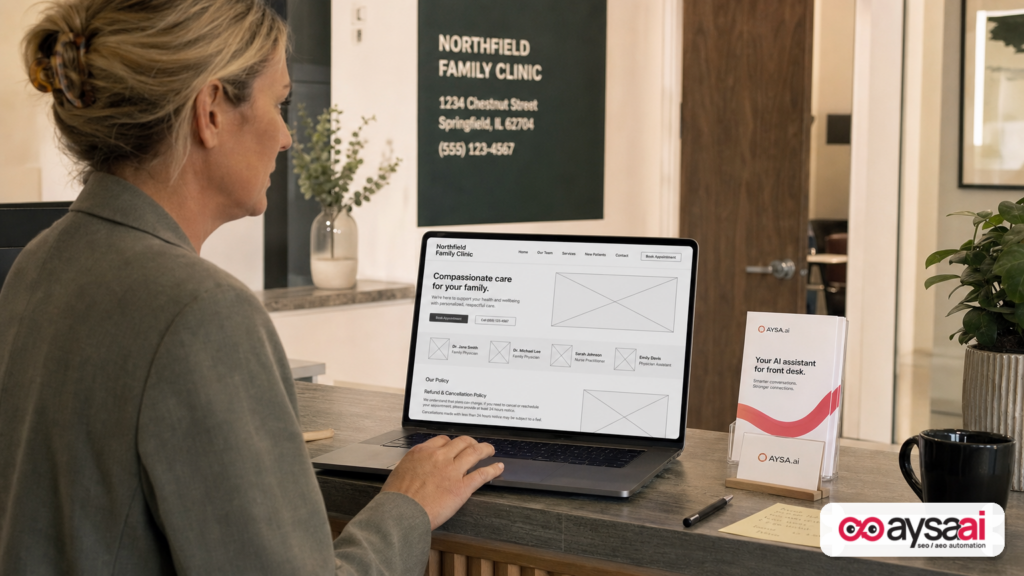
Business: a local dental clinic running Google Search ads for “teeth whitening,” “emergency dentist,” and “invisalign consultation.”
What they see:
- Last month: steady impressions and a predictable cost per lead.
- This month: impressions down ~30–50% on non-brand queries, despite the same budget and similar bids.
- Brand queries still show, but growth stalls.
What they do first (typical):
- Raise bids
- Broaden match types
- Add more “discount” language
What goes wrong: the clinic gets more low-intent clicks, a higher bounce rate, and some frustrated callers—because the landing page is thin and unclear.
Where limited ad serving can enter: If users report misleading pricing (“starting at” offers that don’t apply), or if the ad doesn’t make it clear whether this is a local clinic vs. a directory, Google’s systems may reduce delivery on higher-risk searches where user disappointment is common.
The fix path (practical, not fancy):
- Ad identity: include clinic name and neighborhood in pinned headlines.
- Landing clarity: above-the-fold shows clinic name, address, phone, and what the consultation includes.
- Pricing language: remove bait-y “from $X” if it’s rarely applicable; add clear ranges and conditions.
- Policies: publish cancellation/financing terms clearly.
- UX: improve mobile load time and simplify booking.
This is the “trust tax” in action. It’s not about being perfect; it’s about being unmistakable and transparent.
What agencies should rethink: governance, creative, and QA at scale
Agencies are going to feel this expansion differently than in-house teams because of scale. When you manage dozens of accounts, it’s easy for “clarity debt” to accumulate:
- Templated ad copy reused across clients
- Landing pages built by different vendors
- Inconsistent About/Contact/policy structures
- Franchise and reseller edge cases everywhere
The new agency skill: trust ops
The differentiator won’t just be bidding and keywords. It will be:
- Trust-oriented QA checklists for ads and landing pages
- Governance around brand identity and disclaimers
- Monitoring that flags visibility constraints early
- Execution speed on the website side (where many agencies have limited control)
This is also where “SEO vs PPC” silos get expensive. If paid reach depends on landing page clarity and user experience, then the teams that control the website have to be part of the paid growth loop.
AYSA’s approach is built for this reality: it bridges monitoring → recommendations → approved execution so the work doesn’t die in a ticket queue. Learn more: AI SEO Tools
How AYSA helps: monitor, prepare changes, ask for approval, execute safely
Google’s expansion effectively increases the number of things that can reduce paid reach—many of which live on your website, not in your ad account. That’s a governance and execution problem.
AYSA is designed as an execution system for modern search (SEO/AEO/GEO), and it naturally supports this new paid-search reality because it helps you:
- Monitor for visibility and performance anomalies that suggest delivery risk.
- Prepare concrete, page-level improvements that increase clarity and user trust (not vague “improve UX”).
- Ask for approval before making changes, so teams keep control and compliance.
- Execute accepted changes consistently, without waiting weeks for engineering cycles.
Start with visibility monitoring: AI Search Visibility
Then operationalize improvements through ongoing monitoring workflows: AYSA Monitoring
Where AYSA directly supports PPC resilience
Even though this Google change is a paid-search policy update, the remediation often touches things AYSA can help coordinate:
- On-site brand clarity: consistent naming, About page completeness, contact info, footer identity.
- Policy clarity pages: shipping/returns, cancellations, refund terms.
- Landing page message match: alignment between ad promise and on-page reality.
- Technical UX: speed, mobile usability, broken elements that trigger dissatisfaction.
- Content clarity: removing ambiguous or overstated claims that create complaints.
If you want to understand how AYSA is positioned and what plans look like: AYSA Pricing
And for ongoing editorials and playbooks like this one: AYSA Blog
What to do next: a practical action list
If you run Google Search ads (or manage them for clients), treat this as a quarterly hardening project. Here’s a pragmatic sequence that works for SMEs and agencies.
1) Audit ad identity in the SERP (15 minutes per campaign)
- Do your top ads clearly state your brand name?
- Could a user confuse you with a competitor or a marketplace?
- Are you implying official affiliation you don’t have?
- For RSAs: do you have at least one pinned identity headline option?
2) Audit landing-page identity above the fold (per top landing page)
- Can a user identify the business within 3 seconds?
- Is there an obvious way to contact you?
- Do the offer details match what the ad implies?
3) Reduce expectation mismatch (the #1 complaint generator)
- Remove overly broad “best” claims that set unrealistic expectations.
- Clarify eligibility, limitations, fees, availability, and timelines.
- If you’re a reseller/aggregator, say so clearly.
4) Improve UX basics that amplify dissatisfaction
- Fix slow mobile load times on paid landing pages.
- Eliminate intrusive popups that block content immediately after click.
- Ensure forms work reliably, confirmation messages are clear, and contact details are correct.
5) Build a monitoring loop so you catch issues early
- Track impressions and impression share alongside spend, not separately.
- Segment brand vs non-brand performance trends.
- Watch for sudden query-mix changes.
- Document landing page changes so you can correlate shifts with delivery changes.
6) Operationalize execution (don’t rely on “someone will fix it”)
This is where most teams fail: they know what to change, but it takes months to ship. If Google is rolling this out over years, the teams that win will be the ones that can ship trust improvements continuously.
AYSA’s model—monitor → propose → approve → execute—is built for that operating reality. Explore the toolset: AI SEO Tools
Sources and further reading
- Search Engine Land: Google expands limited ad serving policy on Search
- Search Engine Land: What new AI search data reveals about visibility and trust
- Search Engine Land: Google zero-click searches hit 68% in early 2026: Study
- Search Engine Land: Google expands Smart Bidding Exploration, adds Promotion Mode
Related AYSA resources:
Note: Google’s detailed public documentation for this specific expanded policy was not included in the provided research context. Where implementation details aren’t verifiable from primary documentation here, I’ve framed guidance as practical risk reduction rather than definitive “Google will do X” statements.
Continue the AI search topic inside AYSA.
Use these pages to connect the article with AI SEO tools, AI visibility monitoring, AI Overviews and approved website execution.
Turn this topic into a website action plan.
Use these AYSA hubs to move from reading to technical fixes, AI visibility monitoring, research, glossary context and approval-first SEO execution.

