
Google’s May 2026 Core Update Is Done. Here’s What SMEs Should Do Next (And Why Execution Matters More Than Ever)
Google’s May 2026 core update is complete after a volatile rollout. If rankings or leads shifted, the fix isn’t a quick trick—it’s systematic: diagnose by page type, intent, and quality signals, then execute improvements fast. This editorial breaks down what likely changed, how to audit impact, and how AYSA helps teams monitor, prepare, approve, and deploy SEO/AEO changes safely.

Google confirmed the May 2026 core update rollout is complete—and if you felt your rankings (and leads) swinging hard over the last couple of weeks, you weren’t imagining it. According to Search Engine Land, this was the second core update of 2026, launched May 21 and completed June 2, and it drove notable volatility across many verticals.
Here’s my take as Marius Dosinescu at AYSA.ai: the update ending is not the finish line. It’s the starting gun for a better, more disciplined operating rhythm—because the sites that win after a core update aren’t the ones with the best hot take. They’re the ones that can measure impact correctly, prioritize fixes, and ship improvements safely.
Concise summary (for busy operators)
- Core updates aren’t penalties—they’re broad relevance and satisfaction recalibrations. Recovery usually comes from improving pages, not “appealing” anything.
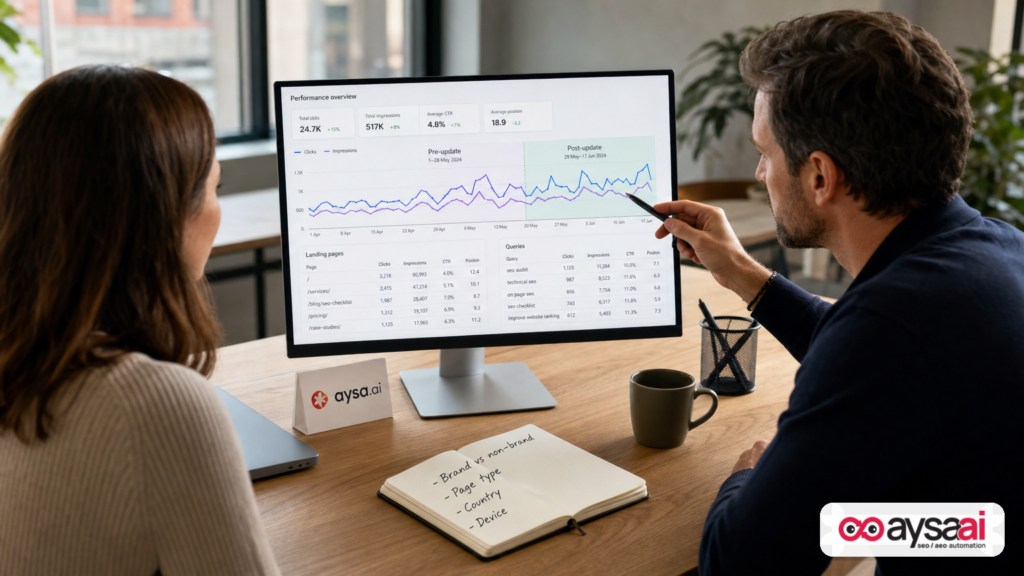
- Volatility is the clue: diagnose by segment (page type, query intent, brand vs non-brand, device, country), not by overall traffic totals.
- AI Overviews and AI Mode continue to change click behavior. Rankings matter, but what Google chooses to show matters just as much.
- Execution speed is now a competitive advantage. It’s not enough to audit—teams must implement changes without breaking the site.
- AYSA fits as an execution system: it monitors, prepares recommended changes, asks for approval, and executes accepted updates—so you can respond to updates with operational consistency instead of chaos.
Table of contents
- What happened: May 2026 core update, in plain English
- Why this rollout felt so volatile
- What the May 2026 Core Update likely changed (without guessing the algorithm)
- The SERP reality: AI Overviews, AI Mode, and fewer clicks
- The only reliable way to diagnose a core update impact: segment, don’t panic
- What to measure now: beyond “traffic went down”
- The most common reasons SMEs lose after core updates
- Quick wins vs. real fixes (and how to choose)
- A concrete SME scenario: when a “helpful” blog stops producing leads
- What agencies should rethink after May 2026
- Where AYSA fits: monitoring + approved execution (the part most teams fail at)
- A 30-day action plan after the May 2026 core update
- What to do next
- Sources and further reading
What happened: May 2026 core update, in plain English

Search Engine Land reports that Google’s May 2026 core update began on May 21 and finished rolling out on June 2 (about 12 days). It also notes meaningful volatility early in the rollout and additional spikes around May 30 and just before completion. Google described it as a “regular update designed to better surface relevant, satisfying content for searchers from all types of sites.”
That line matters. In my experience, when Google says “relevant” and “satisfying,” they’re pointing to a simple truth: Google is trying to reward the pages that best complete the user’s task—not the pages that best match an SEO checklist.
Primary takeaway: if you were hit, it doesn’t automatically mean something is “wrong” in the technical sense. It can mean your pages are no longer the best answer compared to what Google now believes satisfies the query.
External source: Search Engine Land: Google May 2026 core update rollout is now complete
Why this rollout felt so volatile
Core updates can feel different from “normal” ranking fluctuations for two reasons:
1) They touch many systems at once
Core updates aren’t typically single-issue tweaks (like “we changed how we treat one type of spam”). They’re broad. That means multiple categories of queries and multiple types of sites can move at the same time. The outcome: the SERPs can look like someone shook the table.
2) They often reorder the entire candidate set
In competitive spaces—health, finance, ecommerce, local services—Google may reconsider which “class” of page should rank: category pages vs. guides, local pages vs. national directories, brand pages vs. affiliates, etc. If Google changes its mind about the best format for a query, you can lose rankings even with “good content.”
3) The click environment is changing, too
Even if your rank stays similar, AI-generated experiences (like AI Overviews) can change whether you get the click. So some businesses experience “update pain” as a Traffic Drop even when they didn’t lose positions.
Search Engine Land explicitly flagged that Google Search is sending “less and less traffic to sites” as SERPs evolve. Whether you agree with that framing or not, the operational reality is clear: you must work harder to earn fewer Clicks. Which makes the value of each click—and the conversion path after the click—more important.
What the May 2026 Core Update likely changed (without guessing the algorithm)
Google did not publish new, update-specific instructions for May 2026 (per the Search Engine Land coverage). So we shouldn’t pretend there’s a secret rubric. But we can still make disciplined, non-hallucinatory analysis based on how core updates tend to behave and on Google’s standing guidance.
Core updates typically re-evaluate “helpfulness” and satisfaction signals
When Google says it wants to surface “relevant, satisfying content,” that implies a few practical questions you can ask about your pages:
- Does the page quickly confirm it’s the right result for the query?
- Does it answer the question fully (not just partially)?
- Is it easy to act on (buy, book, compare, contact, learn)?
- Is the information trustworthy and current?
- Does the page demonstrate real-world expertise or experience?
Core updates can change what “good” looks like for a query
For the same Keyword, Google might decide a different content type is more satisfying. Example: “best running shoes for flat feet” could tilt toward ecommerce category pages (with filters and inventory) or toward editorial reviews (with testing and comparisons). If the SERP’s preferred format changes, your page can drop even if your content is accurate.
There’s no “one fix,” but there is a reliable process
Search Engine Land reiterated Google’s long-standing messaging: there may not be a specific action to “recover,” and some recovery can occur only after future core updates. That’s true—but it’s often misread as “do nothing.” The better translation is:
- Don’t chase hacks.
- Do improve the assets that are underperforming.
- Do run a consistent quality program.
Google’s standing advice also points creators to “helpful, reliable, people-first content.” Search Engine Land references Google’s documentation and guidance pages; when you’re uncertain, anchor your plan to those principles rather than rumor.
Reference lead: Search Engine Land’s coverage (which cites Google’s Search Status Dashboard and prior guidance).
The SERP reality: AI Overviews, AI Mode, and fewer clicks
There’s an uncomfortable truth many businesses are now forced to accept:
Even when you “win” SEO, you may not “win” the click.
Search Engine Land’s article explicitly connects core updates to the broader shift: Google is changing search results with AI Overviews and AI Mode. The practical effect for SMEs is that you’re competing in a new environment where:
- Some informational queries are partially answered directly in the SERP.
- Users may browse fewer results because the SERP provides a summary.
- Brand trust can matter more: if users don’t click, your brand still needs to be recognized and selected when they do.
What this means for your strategy
- Lean into bottom-of-funnel content (service pages, category pages, pricing, comparisons) where users still need to take action.
- Make top-of-funnel content “conversion-capable”—clear next steps, internal links to solutions, proof, and differentiators.
- Invest in being the cited source where possible (clean structure, clear claims, strong entity signals), while accepting that clicks may be lower.
If you’re thinking, “So SEO is dead,” it’s not. But it is more operational. You need Monitoring, iteration, and execution—because your search visibility now spans traditional rankings and AI-influenced surfaces.
Related reading lead from the same Search Engine Land page context: Google Search Console AI performance reports and controls to block your content in AI responses (useful as a research lead on how measurement and control may evolve; note: this is a separate article link in the source page context).
The only reliable way to diagnose a core update impact: segment, don’t panic
If you only remember one thing from this editorial, make it this:
“Traffic down” is not a diagnosis.
Core update analysis fails when teams look at one chart and declare victory or disaster. The right approach is segmentation—because different parts of your site can be affected in opposite directions.
Step 1: Confirm the timeline (and avoid false positives)
- Mark May 21 to June 2 on your internal performance timeline.
- Note site releases, migrations, CMS updates, theme changes, tracking changes.
- Check major seasonality patterns in your niche (holidays, weather, promotions).
Step 2: Break performance into “buckets”
At minimum, segment by:
- Brand vs non-brand queries (brand often behaves differently)
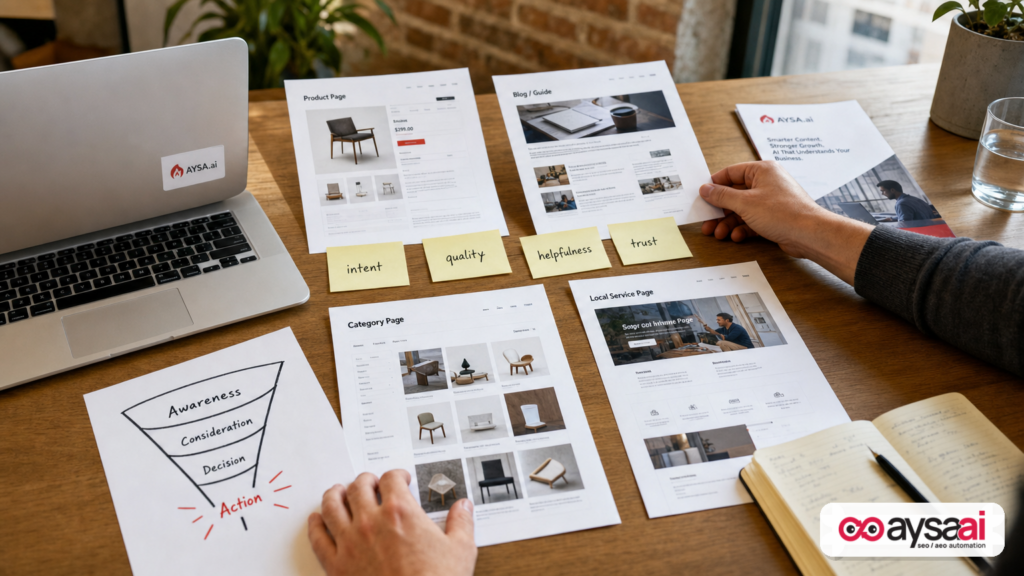
- Page type (product, category, blog, location, comparison, docs)
- Intent (informational, commercial investigation, transactional, local)
- Device (mobile vs desktop)
- Country/region (if relevant)
Step 3: Identify winners and losers—by query group
Don’t start with the pages you “like.” Start with the pages that:
- Lost Impressions (visibility loss)
- Lost clicks disproportionately (CTR issue)
- Stayed visible but lost conversions (on-page issue)
Step 4: Compare the new SERP composition
For each major query group, manually review what Google now ranks. Ask:
- Did page types change (guides replaced by categories, forums replaced by brands, etc.)?
- Did Google add more SERP features (AI answers, local pack, shopping modules)?
- Are the winners clearly more helpful, or simply more authoritative brands?
That last question is important. Sometimes you lose because competitors improved; sometimes you lose because the SERP shifted toward bigger brands. Your response differs depending on which is happening.
Step 5: Decide whether the fix is content, technical, or positioning
- Content fix: expand/clarify, add missing comparisons, update for freshness, improve structure.
- Technical fix: speed/UX, indexing issues, canonical problems, internal linking architecture, structured data.
- Positioning fix: create the page type Google now prefers; shift keyword targeting; build topical authority clusters; improve brand signals.
If you want a systemized way to stay ahead of these changes, AYSA’s monitoring layer is designed for this rhythm: AYSA Monitoring.
What to measure now: beyond “traffic went down”
SMEs often over-focus on one number: sessions. Sessions matter, but they’re lagging indicators. After a core update, measure a portfolio of indicators so you can tell what kind of problem you have.
Visibility indicators
- Impressions by query group and page type
- Average position distribution (not just the mean)
- Number of ranking pages for key categories
Click indicators
- CTR shifts (especially if AI features increased)
- Brand query click share (are you still “chosen”?)
Business indicators (the ones that pay salaries)
- Leads, bookings, purchases originating from organic landing pages
- Revenue per organic session (or lead rate per session)
- Assisted conversions where organic appears early in the journey
Quality indicators (proxy signals)
- Engagement on key pages (scroll depth, time, interaction)
- Conversion path friction (drop-offs, form errors, slow pages)
One of the biggest mistakes I see: teams treat a ranking loss like a pure SEO problem, when it’s actually a product + content + UX problem. Core updates tend to magnify weak experiences.
The most common reasons SMEs lose after core updates
Let’s get practical. Here are patterns that frequently show up when an SME loses visibility after a broad core update. These are not “guaranteed causes,” but they’re reliable places to investigate.
1) Thin differentiation (content that could be on any site)
If your page reads like it was written to “cover the topic” rather than to help a buyer decide or help a customer complete a task, it becomes replaceable. Core updates can be brutal to replaceable content.
2) Mismatch between query intent and page format
You can have a great article that ranks for a keyword that now prefers a tool, a category page, a local provider list, or a comparison page. When intent shifts, your format can become the wrong answer.
3) Content debt: old pages that haven’t been maintained
Many sites accumulate years of posts and pages that are “technically live” but not maintained. Over time, that can dilute topical focus and trust. If you haven’t updated core content, competitors might look fresher and more reliable.
4) Internal linking that doesn’t reflect your priorities
SMEs often have the right content but the wrong architecture. Important pages aren’t reinforced. New posts don’t link to money pages. Or the site has navigation bloat that confuses hierarchy.
5) UX and performance issues that reduce satisfaction
Slow pages, intrusive interstitials, confusing layouts, weak “above the fold” clarity—these can suppress performance even when content is fine. Core updates can amplify satisfaction-related signals.
6) Weak trust signals for YMYL-adjacent topics
If you operate in areas that touch health, finance, safety, or major life decisions, trust expectations rise. Clear authorship, credentials, citations, and up-to-date policies matter more.
Quick wins vs. real fixes (and how to choose)
After an update, everyone wants quick wins. Some are legitimate. Others waste time. Here’s how I separate them.
Quick wins (often worth doing)
- Rewrite intros to match intent immediately (what it is, who it’s for, what problem it solves).
- Add a “decision block”: comparisons, pros/cons, pricing ranges, FAQs, next steps.
- Strengthen internal links from high-traffic informational pages to core service/product pages.
- Update titles and meta descriptions to be accurate and compelling (especially if CTR fell).
- Fix obvious technical errors: indexing anomalies, broken canonicals, redirect loops.
Real fixes (slower, but often decisive)
- Consolidate overlapping content that competes with itself; create one authoritative page per topic.
- Rebuild key commercial pages into the format Google now prefers (e.g., from blog post to category hub).
- Upgrade proof and trust: case studies, policies, editorial standards, author bios, real photos.
- Improve site architecture so importance is clear and crawling/indexing is efficient.
What not to do
- Don’t mass-edit hundreds of pages blindly.
- Don’t disavow links because you panicked (unless you have a clear reason tied to spam issues).
- Don’t “keyword stuff” your way back. That’s how you lose twice.
A concrete SME scenario: when a “helpful” blog stops producing leads
Let’s make this real with a scenario I see constantly.
The business
A local service business (say, an HVAC company or a dental clinic) invested in content marketing for years. They built dozens of blog posts answering common questions, and those posts generated steady organic traffic that turned into calls and bookings.
What happens after a core update
- Several “how much does X cost” and “is X worth it” posts lose rankings.
- Google begins ranking bigger publishers, forums, or aggregator pages for those informational queries.
- The business sees a 25–40% drop in organic sessions (hypothetical example range; your numbers will vary), and the owner concludes SEO “stopped working.”
What’s actually going on
The business may be facing a combination of:
- SERP feature displacement (AI summaries reduce clicks)
- Intent shift (Google favors deeper comparisons and stronger proof)
- Format mismatch (blog posts no longer satisfy; service pages or local landing pages might)
A pragmatic response
- Turn the top 5 blog posts into lead pathways: add local proof, FAQs, clear service CTAs, and internal links to the booking/service page.
- Create one “definitive” local guide (with pricing ranges, process, timelines, local constraints) instead of 10 overlapping articles.
- Upgrade the service page with transparency: what’s included, who it’s for, what to expect, common objections, guarantees.
- Track conversions by landing page, not just overall traffic.
This is exactly where an execution platform matters. Many SMEs can identify what to do; they fail at doing it consistently. AYSA is designed to close that loop: monitor performance, generate proposed improvements, get owner approval, and deploy changes safely.
Explore: AI Search Visibility
What agencies should rethink after May 2026
If you run an agency (or manage one), May 2026 is another reminder that the SEO deliverable stack must evolve.
Reporting is not value
Core update decks aren’t outcomes. They’re context. Clients don’t pay for “we observed volatility.” They pay for:
- Earlier detection of impact
- Clear prioritization of fixes
- Fast implementation without breaking things
- Revenue and lead stabilization
The agency competitive edge is execution bandwidth
In the old model, the best agencies were the best “keyword and content strategy” shops. In the current model, the best agencies also have a system for:
- Continuous technical hygiene
- Structured content updates
- On-page CRO alignment
- Fast approvals and safe deployments
This is why automation that respects approvals—not automation that “runs wild”—is the next layer of agency leverage.
For broader industry context, Search Engine Land also surfaced related discussions like: Why so much SEO work no longer drives growth. It’s a different article, but it aligns with what many teams are feeling: the old checklist doesn’t automatically translate to growth.
Where AYSA fits: monitoring + approved execution (the part most teams fail at)
Most businesses don’t fail at SEO because they don’t know what to do. They fail because they don’t have an operating system for doing it reliably.
At AYSA.ai, we position ourselves as an approved execution system for SEO/AEO/GEO work:
- Monitors your visibility and site health over time
- Prepares recommended website changes and content improvements
- Asks for approval before making changes (so humans stay in control)
- Executes accepted changes efficiently and safely
This model matters after a core update because the winners typically do three things better than everyone else:
- They see the problem earlier (monitoring)
- They choose the right fixes (prioritization)
- They ship the fixes (execution)
If you want to understand how we think about AI-driven search visibility (including the shift toward AI surfaces), start here: AI SEO Tools and AI Search Visibility.
What “approved execution” prevents
- Mass changes that accidentally tank conversions
- Random experimentation without baselines
- Never-ending audits that never become releases
- Teams being stuck waiting on dev cycles for weeks
What it enables
- A consistent content refresh cadence
- Faster fixes to internal links and on-page structure
- Standardized page templates that match intent
- Clear accountability: what we changed, when, and why
If you’re evaluating whether AYSA fits your current workflow, you can review options here: AYSA Pricing.
A 30-day action plan after the May 2026 core update
Core updates create urgency, but the response should be calm and structured. Here’s a realistic 30-day plan for SMEs and lean teams.
Days 1–3: Stabilize and measure
- Confirm tracking and annotate timeline (update window, site releases, campaigns).
- Identify top 20 affected pages (by lost impressions/clicks AND by lost revenue/leads).
- Separate “ranking loss” vs “CTR loss.”
Days 4–7: SERP and competitor review
- For each key query group, review the new top results and note format patterns.
- Document what winners do better: structure, depth, proof, UX, price clarity, media.
- Create a short hypothesis per page group (e.g., “intent shifted to comparisons” or “needs stronger trust”).
Days 8–14: Fix the “money pages” first
- Upgrade service/category/product pages: clearer value prop, FAQs, proof, internal links.
- Ensure each money page has a matching “supporting content cluster.”
- Remove friction: speed issues, confusing navigation, weak CTAs.
Days 15–21: Refresh and consolidate content
- Update top guides that have fallen behind or become generic.
- Consolidate overlapping articles into one definitive resource when appropriate.
- Add unique experience: real examples, process photos, step-by-step walkthroughs.
Days 22–30: Build a repeatable operating cadence
- Set a monthly “search quality sprint”: monitor → prioritize → approve → deploy.
- Define templates for the pages you create repeatedly (service pages, guides, comparisons).
- Track business outcomes by landing page, not just keywords.
If you need ongoing structure for this cadence, AYSA’s monitoring is built for continuous detection and iteration: AYSA Monitoring.
What to do next
- Stop looking at one traffic chart. Segment impact by page type and intent.
- Pick five pages that matter most to revenue/leads. Improve those before touching anything else.
- Compare your pages to the new SERP winners and write down what’s missing (format, proof, clarity, UX).
- Ship changes in controlled batches so you can measure what helped.
- Adopt an execution system—whether internal or with AYSA—so updates don’t derail your roadmap.
To see how AYSA approaches AI-era search visibility and execution, start with: AYSA Blog.
Sources and further reading
- Search Engine Land: Google May 2026 core update rollout is now complete
- Search Engine Land (research lead): Google Search Console AI performance reports and controls to block your content in AI responses
- Search Engine Land (context): Why so much SEO work no longer drives growth
- Search Engine Land (context): Delegation search: Why users outsource decisions to AI
- Search Engine Land (context): Beyond RAG: Why every AI search platform is now agentic and what that means for your content
Internal AYSA resources
Note on sourcing: This editorial uses Search Engine Land’s coverage as the primary research input and treats any additional links listed on that source page as context and research leads. Where Google’s original dashboard or documentation is referenced but not included directly in the provided research context, I’ve avoided quoting or asserting specifics beyond what the source article states.
Continue the AI search topic inside AYSA.
Use these pages to connect the article with AI SEO tools, AI visibility monitoring, AI Overviews and approved website execution.
Turn this topic into a website action plan.
Use these AYSA hubs to move from reading to technical fixes, AI visibility monitoring, research, glossary context and approval-first SEO execution.

