Google Can Report Search Revenue to the Decimal—But Can’t (or Won’t) Prove the Clicks You Depend On
Alphabet’s Q2 filings make Search revenue feel perfectly measurable. Google’s public statements about traffic to the open web are the opposite: broad, rounded, and impossible to audit. Here’s what changed, why it matters, and how SMEs and agencies should rebuild measurement and execution for AI Search.
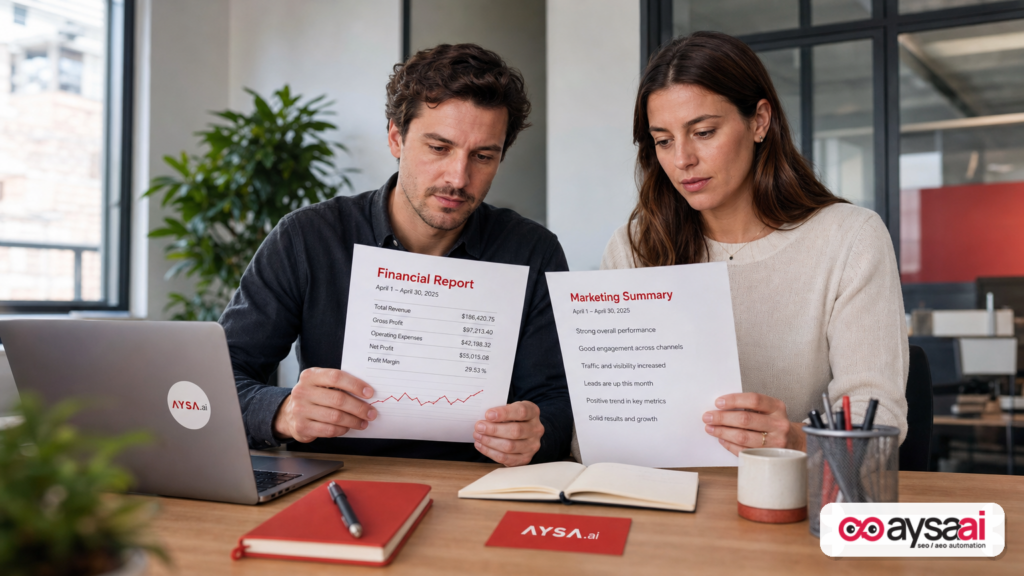
Alphabet’s Q2 reporting can tell you, to the decimal, how much money Google Search generated. But when the conversation turns to the metric that most businesses actually live and die by—Clicks to websites—we’re largely asked to accept broad assurances that can’t be independently checked.
This is not a niche SEO complaint. It’s a boardroom-level measurement problem that affects how you forecast pipeline, justify content budgets, and decide whether to invest in organic search versus paid, partnerships, email, or marketplaces.
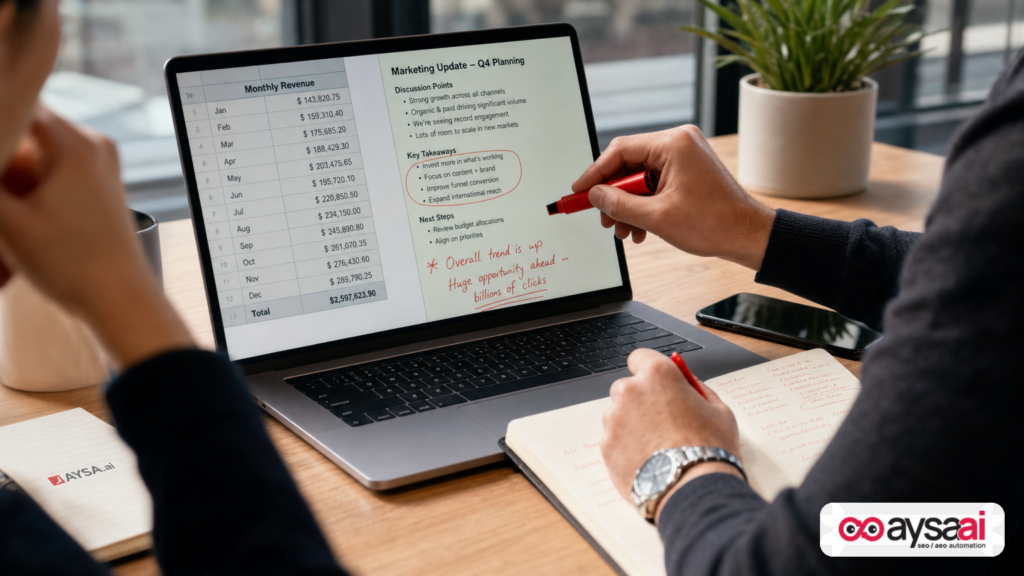
As AI Overviews and AI Mode reshape search behavior, the transparency gap matters more each quarter: revenue is concrete, but the outbound traffic story is narrated in rounded phrases like “billions of clicks,” without definitions, baselines, or consistent breakouts by surface.
Below is how I’m thinking about this as Marius Dosinescu at AYSA.ai: what changed, what’s knowable, what’s not, and what an SME or agency should do now—especially if you can’t rely on platform-level click reporting to explain performance.
Concise summary
- Alphabet’s Q2 Search revenue is precise and auditable; Google’s claims about outbound clicks are broad and hard to verify.
- AI search experiences change click distribution (who gets the click, whether a click happens at all, and whether users return to results quickly).
- No single third-party dataset can recreate Google-wide outbound click totals; external studies can only measure slices of behavior (certain query sets, panels, devices, or referral sources).
- The winning move for SMEs is measurement + execution discipline: monitor leading indicators, link them to outcomes, and ship improvements quickly—without guessing what Google “must be” doing.
- AYSA fits here as an Approved Execution system: monitor signals, propose changes, get approval, and implement accepted updates to improve AI Search visibility and conversion outcomes.
Table of contents
- What sparked this: Q2 numbers you can audit vs. click claims you can’t
- The transparency gap: decimals for revenue, vibes for clicks
- What actually changed in AI Search (and why you feel it in your traffic)
- The three kinds of unverifiable click claims (and how to translate them into business risk)
- What outside measurement can—and cannot—tell you
- The KPI reset: what to measure when “organic clicks” stops explaining outcomes
- A concrete SME scenario: the local clinic that ‘lost traffic’ but gained patients
- Agency implications: your reporting model is now a product
- Execution beats speculation: the site improvements that still move the needle
- Where AYSA.ai fits: monitoring + approved execution for AI Search visibility
- What to do next (a practical action list)
- Sources and further reading
What sparked this: Q2 numbers you can audit vs. click claims you can’t
Search Engine Journal highlighted a contrast that should make any operator pause: Alphabet’s Q2 filings provide a clean, consistent breakdown of Search revenue—numbers that are stable across quarters, comparable year over year, and designed for scrutiny—while public statements about traffic flowing back to the web show up as broad, rounded, hard-to-test claims.
That contrast is the story, not any single quarter’s growth rate. It’s about two standards of disclosure inside the same ecosystem:
- Investor-grade precision for revenue and costs.
- PR-grade aggregation for the outcome publishers and businesses depend on: outbound clicks.
Reference: Search Engine Journal’s coverage of Google’s Q2 revenue precision vs. unverifiable click claims.
The transparency gap: decimals for revenue, vibes for clicks
Let’s be blunt: Google can measure clicks. It measures everything. The issue is not capability. The issue is what is being disclosed, with what definitions, at what granularity.
Alphabet’s earnings reporting tells a coherent, checkable narrative. If a number changes quarter to quarter, analysts can ask why, compare it to prior periods, and build models around it. That’s how capital markets work.
Now compare that to traffic statements aimed at the web ecosystem:
- “Queries are at an all-time high.”
- “We send billions of clicks…”
- “Click quality is up; AI removes bounce clicks.”
Those may be true in some form. But from an operator’s standpoint, they’re not decision-grade because they don’t answer the questions that matter:
- How many clicks, exactly?
- To what types of sites (publishers, local businesses, ecommerce, SaaS)?
- From which surfaces (traditional results, AI Overviews, AI Mode, other AI placements)?
- How is a “click” defined (what counts as a click, what’s excluded)?
- How is “quality” defined, and what’s the baseline?
In the AI era, the click is no longer the only outcome that matters—but it’s still the core unit of distribution for most SMEs. If you run a clinic, a hotel, a software product, a law firm, or a local service business, you don’t get paid in “query growth.” You get paid in booked appointments, calls, leads, and orders—most of which still begin with a visit.
What actually changed in AI Search (and why you feel it in your traffic)
If you’re a business owner reading this, you may not care whether a result is labeled “AI Overview” or “AI Mode.” You care about the symptom: Impressions feel up, clicks feel inconsistent, and the “why” is hard to explain.
Here’s what changed at a behavioral level:
1) Search results pages became answer pages
Historically, Google’s results page was primarily a routing layer: it helped users choose a destination. AI answers tilt the page toward being a destination itself.
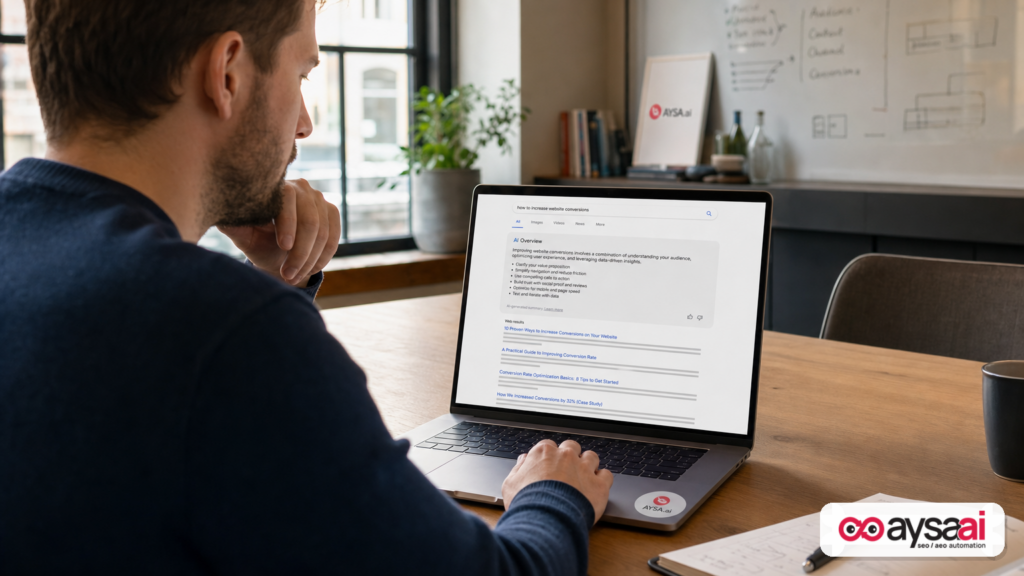
When a user gets a full synthesized explanation, fewer users need to click for basic information. That’s not inherently “good” or “bad”—it depends on your category. But it does change distribution, especially for informational content.
2) The journey becomes multi-step and indirect
Even when AI reduces direct clicks, it can increase the chance that a user later searches for a brand by name (Branded Search), or asks a follow-up question that surfaces different sources. This is one reason many businesses report: “traffic down, leads stable” or “referrals down, branded searches up.”
This aligns with the idea (mentioned in SEJ’s source context) that some AI-driven exposure may result in downstream behaviors rather than direct referral clicks.
3) Your competition is no longer just the top 10 links
In AI-assisted experiences, you’re competing with:
- the AI’s synthesized answer (which can satisfy the query),
- the set of cited sources (if citations are present),
- ads placed around or inside AI experiences (a separate monetization track),
- and the user’s willingness to keep exploring.
The business impact: ranking alone is a weaker proxy for outcomes. You can “rank” and still lose share of attention if an AI panel absorbs demand.
The three kinds of unverifiable click claims (and how to translate them into business risk)
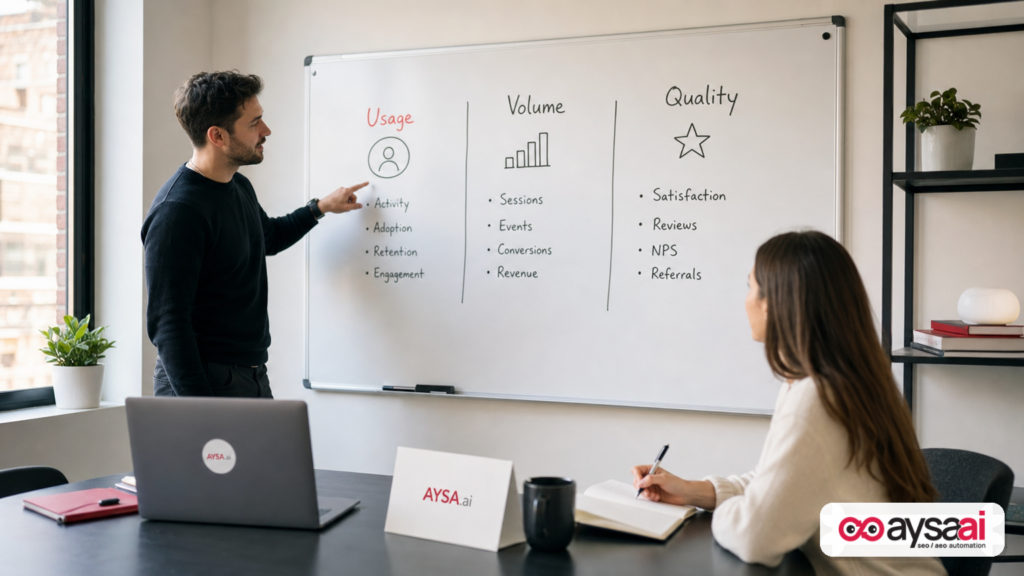
One of the most useful parts of the SEJ analysis is how it groups Google’s public traffic statements into three types. That structure helps you decide what to believe, what to test, and what to treat as non-actionable.
Claim type #1: Usage claims (queries are up)
“Queries are at an all-time high” may be true. But it doesn’t automatically mean:
- your category gets more clicks,
- your pages get more visits, or
- your conversions increase.
Business translation: This is a top-of-funnel platform metric. Useful context, not a KPI you can manage to.
Claim type #2: Volume claims (billions of clicks)
“Billions of clicks” is directionally meaningful, but not operational. Without exact counts and definitions, you can’t use it to reconcile why your traffic dropped 18% in a quarter while Google says it’s sending “billions.” Both can be true at the same time.
Business translation: Aggregate volume claims do not de-risk your business. They do not provide an assurance that your acquisition channel is stable.
Claim type #3: Quality claims (better clicks, fewer bounce clicks)
Quality claims are the most tempting because they imply that losing clicks is fine—those clicks were “bad” anyway. The issue is that “quality” is a definition problem:
- Is quality defined by pogo-sticking (returning to results quickly)?
- By time on site?
- By conversion propensity?
- By user satisfaction surveys?
Without a published methodology, “quality” can’t be audited. Also, a bounce is not always bad: a user who checks your opening hours, verifies you take their insurance, or confirms inventory might bounce quickly and still convert offline. SMEs live in these “fast confirmation” moments.
Business translation: Treat quality claims as hypotheses. Validate them using your own conversion and lead quality data, not by assuming they’re universally true.
What outside measurement can—and cannot—tell you
The SEJ source context points to a key reality: independent datasets can illuminate slices of behavior, but none can fully reproduce Google’s aggregate click claims. That’s not because third parties are incompetent. It’s because they don’t have:
- Google-wide query logs,
- all device and geography coverage,
- full visibility into which surfaces showed (and to whom),
- or consistent definitions.
So what can you use third-party analyses for?
1) CTR studies: good for direction, not for totals
Click-through-rate studies that compare pages with and without AI panels can be useful in diagnosing a pattern: “When AI appears, organic CTR tends to compress.” The SEJ article references analyses like Seer Interactive and Pew Research Center in this context.
How to use this: If your GSC data shows impressions rising while clicks fall on informational queries, you don’t need to panic—but you do need to adapt. The likely problem is distribution, not necessarily ranking.
What it won’t do: Tell you how many clicks Google sent overall, or whether your site is “entitled” to more traffic.
2) Position-level CTR benchmarks: useful, but can hide AI effects
Position CTR curves (desktop vs mobile) can help you understand whether declines are likely due to SERP changes versus ranking movement. But if the dataset doesn’t isolate AI panels, it can’t cleanly attribute cause.
3) Assistant referral traffic: a different channel
Referral traffic from assistants (like Gemini) can increase while Google Search referrals fall, and vice versa. These are distinct surfaces with distinct user intent. Don’t assume assistant referrals “make up for” search changes unless your lead and revenue attribution says they do.
4) Downstream behavior: brand lift can be real, but indirect
Some analyses suggest AI recommendations can correlate with later site visits, often via branded search. For SMEs, this matters because branded search is one of the most defensible acquisition mechanics in the AI era. If AI makes people remember you, that’s valuable—even if the click didn’t happen immediately.
Operator takeaway: External datasets are best used as diagnostic lenses, not as court evidence. Your strategy should be built primarily on your first-party analytics and conversion data.
The KPI reset: what to measure when “organic clicks” stops explaining outcomes
When a platform changes the way it answers questions, you need to evolve what you count. Not because clicks “don’t matter,” but because clicks alone can become a misleading scoreboard.
Here’s a practical KPI reset I recommend for SMEs and agencies.
Leading indicators (early warning signals)
- GSC impressions by query intent (informational vs commercial vs navigational). You can do this with tagging/grouping even if it’s imperfect.
- GSC clicks and CTR by page type (blog, category, product/service, location pages, help center).
- Share of branded vs non-branded queries in Search Console.
- SERP feature exposure notes (when you suspect AI panels are appearing). Even a manual sampled log helps when combined with traffic patterns.
Mid-funnel indicators (are visits still meaningful?)
- Engaged sessions in GA4, segmented by landing page type.
- Micro-conversions: add-to-cart, quote-start, booking widget opens, call clicks, email clicks.
- New vs returning users from organic search.
Outcome metrics (what you actually run the business on)
- Leads/orders by channel with a consistent attribution model.
- Revenue per session (ecommerce) or lead-to-close rate (services/SaaS).
- Call tracking + appointment booking conversions for local businesses.
- Customer acquisition cost blended across paid + organic, because AI surfaces may shift the balance.
If you’re an SME, this may feel like “more analytics.” But the point is the opposite: fewer metrics, better tied to outcomes, so you can act without needing Google to publish better click breakdowns.
A concrete SME scenario: the local clinic that ‘lost traffic’ but gained patients
Let’s make this real with a scenario I see constantly.
Business: A multi-location dental clinic.
Old model: Publish educational blog posts (“How much does a crown cost?”, “Does whitening hurt?”) to earn traffic, then funnel users to booking pages.
What changes: AI Overviews start answering the basic questions directly. The clinic sees:
- Blog impressions rising (they’re still visible),
- Blog clicks down (fewer people need to click),
- Service page traffic flat,
- Bookings slightly up.
The wrong conclusion: “SEO stopped working.”
The right diagnosis: Top-of-funnel informational clicks compressed, but high-intent users still click (or come back later via branded search). If the clinic improved conversion on service pages, updated insurance coverage details, strengthened local proof (reviews, credentials, before/after galleries where appropriate), and made booking frictionless, they can win even with fewer blog clicks.
What to do in this scenario:
- Double down on pages that close: services, locations, doctor bios, pricing/financing, FAQs tied to booking intent.
- Restructure informational content to route users to a next step—without being spammy.
- Improve on-page clarity so the business is easy for AI systems to understand and cite (AEO/GEO readiness).
This is the heart of the AI Search transition: you can lose low-intent clicks and still grow the business—but only if you measure and execute in the right places.
Agency implications: your reporting model is now a product
If you run an agency, AI Search is forcing an uncomfortable shift: clients won’t accept “Google changed” as an explanation for a quarter of volatility. They also won’t accept traffic-only reporting when the SERP itself is stealing attention.
Stop overpromising on what you can’t measure
If Google doesn’t provide AI surface click data in a way that’s auditable, don’t build a promise around it. Build a promise around what you control:
- technical health and crawlability,
- information architecture,
- content clarity and coverage,
- entity-level brand signals,
- conversion performance.
Client education must move from “rankings” to “distribution”
Clients understand distribution. They already live it on social media. The same concept is now true in search:
- Some queries turn into zero-click answers.
- Some clicks shift to a smaller set of sources.
- Some value shifts into brand recall and later branded searches.
Your new deliverable is the system, not the spreadsheet
In AI Search, a monthly report is not enough. What clients need is a continuous operating loop:
- monitor changes weekly,
- identify page clusters losing CTR,
- ship improvements fast,
- validate with outcomes,
- repeat.
This is exactly why we built AYSA around monitoring + approved execution rather than static audits.
Execution beats speculation: the site improvements that still move the needle
You can’t control whether an AI panel appears. You can control whether your site becomes the obvious “best next click” when it does—or whether you become one of the sources AI systems are comfortable referencing.
Here are the execution areas that remain durable across AI shifts.
1) Clarity wins: tighten your answers and your page purpose
AI systems reward clarity because clarity reduces ambiguity. For humans, clarity increases conversion.
- Make the primary question a page answers unmistakable (headline + first screen).
- Use scannable sections and FAQs that reflect real buyer questions.
- Remove content bloat that exists only to “rank.”
2) Information architecture: build clusters that mirror intent
If your content is a pile of disconnected posts, AI-era search will expose that weakness. Build clusters:
- one hub page for the category (service, product line, condition),
- supporting pages for subtopics,
- internal links that guide users to decisions.
3) Strengthen your entity signals (brand, expertise, proof)
AEO/GEO is not just “write for AI.” It’s: make it easy for systems to understand who you are, what you do, where you operate, and why you’re credible.
- Clear About pages, author/doctor bios where relevant, credentials.
- Consistent NAP (name/address/phone) for local.
- Policies, guarantees, shipping/returns, pricing/estimates where possible.
- Original media where appropriate (photos, demos, examples).
4) Technical fundamentals: remove friction for crawlers and users
When distribution tightens, small technical issues hurt more. Prioritize:
- indexation and canonical hygiene,
- site speed and Core Web Vitals improvements,
- structured data where it genuinely reflects page content (no spam),
- clean internal linking and navigation.
5) Conversion is the hedge against click volatility
If you can’t guarantee click volume, you need to increase value per click:
- clear CTAs, fewer steps to purchase/book,
- better comparison and trust content,
- answers to objections on the landing page,
- faster lead response.
Where AYSA.ai fits: monitoring + approved execution for AI Search visibility
Most businesses don’t fail at search because they lack ideas. They fail because execution is slow, scattered, and risky. AI Search increases the pace of change, which means the old workflow—quarterly audits, monthly backlogs, and “someday” fixes—breaks.
AYSA is designed as an execution system for SEO/AEO/GEO:
- Monitor your visibility and performance signals continuously: AYSA Monitoring
- Prepare recommended site changes with context (what, why, expected impact).
- Ask for approval so changes don’t create brand, legal, or compliance risk.
- Execute accepted changes to ship improvements without endless tickets.
In practical terms, this is how an SME uses AYSA in an AI Search world:
The AYSA operating loop (simple and repeatable)
- Detect early patterns (e.g., impressions up / CTR down on informational pages).
- Diagnose by page cluster and intent (not by vanity keywords).
- Improve pages that drive outcomes: service pages, categories, product pages, location pages, conversion paths.
- Validate with outcomes in analytics and CRM—not with platform statements you can’t verify.
If you’re evaluating how to prepare for AI Search, start here:
- AI SEO tooling overview: AI SEO Tools
- AI Search visibility approach: AI Search Visibility
- Pricing and packaging (for SMEs and agencies): AYSA Pricing
- More operator-focused editorials: AYSA Blog
The point is not that AYSA “solves” the transparency gap. The point is that you can run a disciplined growth system even when platform-level reporting is incomplete.
What to do next (a practical action list)
If you’re an SME owner or marketing lead, here’s the most practical next-week plan I’d follow.
In the next 7 days
- Segment your Search Console data by page type (informational vs money pages). Don’t treat “organic” as one bucket.
- Record a baseline: last 28 days vs prior 28 days for impressions, clicks, CTR by page cluster.
- Pick one cluster with CTR decline and review the top landing pages for clarity, intent match, and conversion path.
- Check branded vs non-branded trends. If branded is rising while referrals fall, your “loss” may be redistribution.
In the next 30 days
- Upgrade the pages that close: improve service/category/product/location pages with clearer positioning, proof, FAQs, and CTAs.
- Build or repair topic clusters so informational content routes to commercial intent naturally.
- Harden your measurement: ensure GA4 key events are configured; add call tracking if calls matter; connect leads to outcomes.
- Separate paid vs organic learning. Paid expansion in AI experiences is monetization; don’t treat it as evidence about organic clicks.
Ongoing cadence
- Weekly monitoring for early anomalies (CTR shifts, page cluster drops, branded share changes).
- Monthly execution sprint: ship fixes, not decks.
- Quarterly strategy reset based on outcomes: pipeline, revenue, lead quality.
If you want that cadence to be systematic, that’s where AYSA’s monitoring and approved execution workflow can help: AYSA Monitoring.
Sources and further reading
- Search Engine Journal — Google’s Q2: Precise Revenue Figures, Click Claims You Can’t Check
- Search Engine Journal — Latest news (research lead)
- Search Engine Journal — SEO section (research lead)
- Search Engine Journal — Webinars (research lead)
Note on citations: The source context references third-party analyses (e.g., Seer Interactive, Pew Research Center, Advanced Web Ranking, SE Ranking, Similarweb) but those primary URLs are not included in the provided research context. Rather than guess or fabricate links, I’ve treated them as directional research leads. If you want, we can update this section with primary links once you provide them.
Final word: run your own numbers, build your own leverage
When a platform reports revenue with decimal precision but discusses outbound clicks in rounded, unverifiable terms, you should assume one thing: you are responsible for your own measurement and resilience.
That doesn’t mean search is “dead.” It means search has become a more complex distribution system where the winners are the businesses that:
- monitor changes early,
- optimize for outcomes, not nostalgia,
- ship improvements fast,
- and build brand signals that persist across AI surfaces.
That’s the operating model we’re building at AYSA.ai—so SMEs and agencies can keep growing even when the most important platform metrics aren’t fully disclosed.
Continue the AI search topic inside AYSA.
Use these pages to connect the article with AI SEO tools, AI visibility monitoring, AI Overviews and approved website execution.
Turn this topic into a website action plan.
Use these AYSA hubs to move from reading to technical fixes, AI visibility monitoring, research, glossary context and approval-first SEO execution.