
Google Admits Search Console Can’t Measure AI Search Properly: What SMEs Should Track Now (And How To Act Without Perfect Data)
Google has acknowledged that Search Console’s AI search reporting—especially “position”—doesn’t reflect how links are actually surfaced inside AI Overviews and AI Mode. Here’s what changed, why it breaks old SEO reporting, and a practical measurement + execution plan for SMEs and agencies using AYSA’s approved-change workflow.

Google just said the quiet part out loud: Search Console isn’t currently able to report AI Search visibility in a way that matches how AI results actually work. And if you’re a founder, marketer, or agency using Google Search Console (GSC) as your primary SEO truth source, this matters more than most people want to admit.
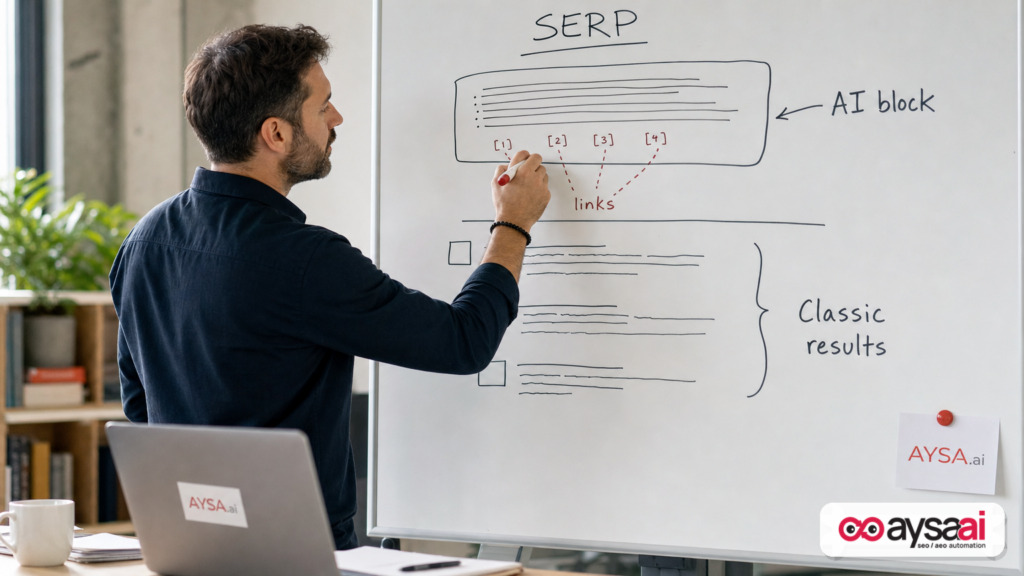
In September 2026, Google’s John Mueller acknowledged that the new generative AI performance reporting in Search Console—built to surface data for AI Overviews and AI Mode—is inadequate for what SEOs actually need, particularly around position reporting. The core issue: AI search results are not “ten blue links,” and the old mental model doesn’t map cleanly onto citation-based, block-based, expandable AI experiences. Google is tracking AI results “as a block,” not as individual Link Placement inside that block. In other words: the number you’re looking at might describe where the AI module appeared, not where your brand sat within it. Source: Search Engine Journal.
This editorial isn’t a news rewrite. It’s a business operating manual for what to do next: how to measure what you can, how to avoid the wrong conclusions, and how to build an execution system that improves AI visibility even when the reporting is blurry.
Concise Summary (For Busy Operators)
- Google admits GSC AI reporting is hard to make useful, especially the “position” metric for AI Overviews and AI Mode.
- Impressions can overstate visibility (counted when served, not necessarily seen), while “Show more” can undercount exposure until expanded.
- Position is tracked at the AI feature/block level, not your link’s placement among citations—making “Average position” a weak KPI for AI surfaces.
- SMEs and agencies should shift from “rank tracking” to intent coverage + citation readiness + conversion measurement.
- Execution matters more now: you need a system that monitors, proposes improvements, gets approval, and deploys safely.
If you want to get ahead of this without betting your business on a half-formed metric stack, AYSA’s model is straightforward: monitor AI visibility signals, prepare changes, get human approval, then execute accepted website updates. That’s what turns uncertainty into momentum.
Table of Contents
- What Google Admitted (And What It Really Means In Practice)
- Why Search Console Struggles With AI Search Reporting
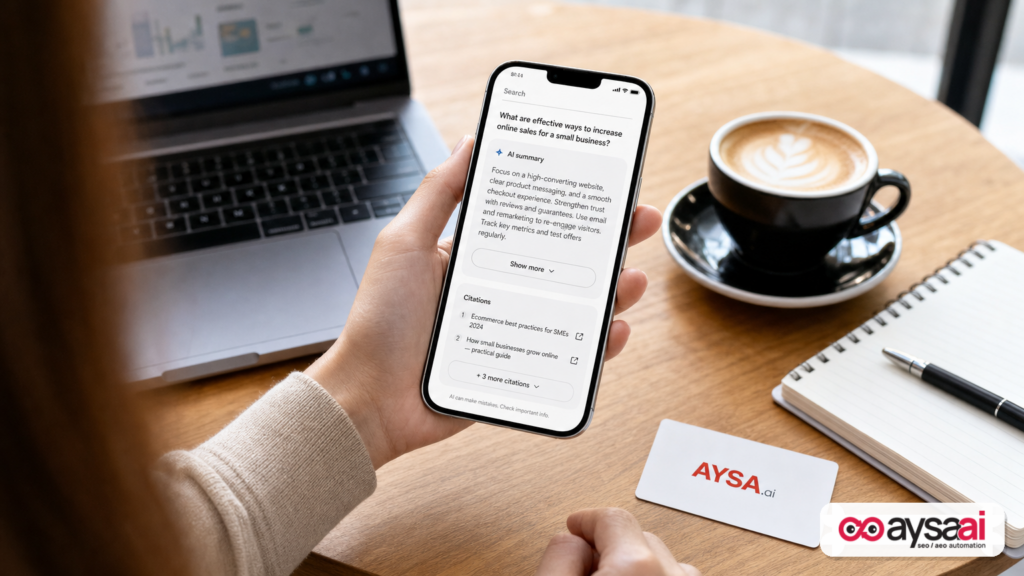
- The Two Reporting Traps: “Impressions Without Being Seen” And “Show More” Blind Spots
- Why “Position” Is Now A Block, Not A Ranking
- Stop Thinking In Ten Links: What Modern Search Is Optimizing For
- What To Measure Instead: Practical KPIs For AI Search
- A Better Measurement Stack For AI Search (Even If Google Won’t Give You One Yet)
- A Concrete SME Scenario: Local Clinic Losing Calls While “SEO Looks Fine”
- What Can Go Wrong If You Trust The Wrong Metrics
- What Agencies Should Rethink: Reporting, Retainers, And Proof
- A 90-Day Action Plan For SMEs (Designed For Imperfect Data)
- Where AYSA Fits: Monitor → Prepare Changes → Get Approval → Execute
- What To Do Next (Checklist)
- Sources And Further Reading
What Google Admitted (And What It Really Means In Practice)
Google launched a dedicated Search Console report for generative AI search performance in 2026. The intent was good: give site owners visibility into how their pages show up in AI surfaces like AI Overviews and AI Mode.
But when practitioners started comparing what they saw in the SERP with what they saw in Search Console, the mismatch became obvious—and public. A Reddit discussion laid out the key problems (as reported by Search Engine Journal): impressions and positions in AI modules don’t behave like classic results, and in some cases they can mislead teams into thinking they have more (or less) visibility than users actually experienced.
John Mueller’s response, as cited by Search Engine Journal, essentially confirmed:
- AI reporting is complex, and Google is currently tracking “position” like it does for other search features—as a block.
- That means link-level placement inside the AI module is not represented by the reported position metric.
- The Gen-AI report is a filtered view of data already included in the standard performance report—not a separate layer to add on top.
Here’s the practical meaning for operators: if your CMO asks, “Are we ranking in AI Overviews?” the honest answer is often: we can see partial signals, but we cannot reliably quantify our exact placement and exposure from GSC alone.
That’s uncomfortable—because businesses like certainty. But it’s also an opportunity: teams that build a better operating system will win.
Why Search Console Struggles With AI Search Reporting
Search Console was born in an era where:
- Results were mostly a list
- “Position” meant something like “you’re #3”
- A click had a clearer connection to a visible result
Even years ago that model started to degrade with featured snippets, local packs, image blocks, shopping modules, “People also ask,” and everything else. AI Overviews and AI Mode take that fragmentation to the next level. They’re not just “a feature”—they can be the primary interface between the user and information, with citations that may be visible, collapsible, swapped, or personalized.
When Google says it’s hard to report “position” usefully, I believe them. But I also believe this is the wrong business question.
The business question isn’t “What position am I?” It’s:
- Do I show up when customers ask the questions that lead to revenue?
- Do customers trust what they see enough to contact/buy?
- Is the AI answer accurate about my offering, pricing, availability, and location?
- When traffic does arrive, does it convert?
Those are measurable—just not with a single metric called “average position.”
The Two Reporting Traps: “Impressions Without Being Seen” And “Show More” Blind Spots
Based on the discussion summarized in the Search Engine Journal source, two mechanics matter most for how you interpret AI visibility in GSC.
1) Impressions can count even when users never see your citation
Search Console impressions traditionally count when a result is served on the page, not necessarily scrolled into view. In AI contexts, that can be even more misleading because the AI block may render with citations while the user never engages with that section, never scrolls, or abandons quickly.
Operational risk: teams celebrate rising impressions as “AI visibility wins,” while pipeline stays flat. Meanwhile, competitors might be getting the visible citations and the clicks.
2) “Show more” can hide your link—and the impression may not count until expansion
The “Show more” mechanic is a reporting exception: items behind expansions may not count until the user expands. That can undercount your presence in the AI module, even if you’re consistently included among deeper citations.
Operational risk: teams assume they are not present in AI answers, stop investing in content that actually supports AI inclusion, and lose longer-term defensibility.
What makes this tricky is that both can be true at once: impressions may overstate “served presence” and understate “expand-and-see presence.” That’s why a single KPI is not enough.
Why “Position” Is Now A Block, Not A Ranking
Mueller’s confirmation that Google is tracking AI features “as a block” is a major reporting break for SEO workflows.
In practical terms, consider an AI Overview that appears at the top of a result. Inside that AI block there might be multiple citations. Your site might be:
- the first visible citation
- a mid-list citation
- hidden behind expansion
- or not present
If GSC assigns every citation the same “position” (the AI block’s position), then your “average position” becomes a blended number that can’t answer the question that matters: were we the citation users were most likely to click?
This is not just an analytics problem. It’s a budgeting problem. Because CFOs fund what can be measured. If AI surfaces create value but reporting can’t show it, the organizations that win will be the ones that can connect signals to outcomes in a disciplined way.
Stop Thinking In Ten Links: What Modern Search Is Optimizing For
Google’s comment that “position 1–10” is hard to map is a reminder that search is now a set of interaction choices, not just a list. The user can:
- read the AI answer and never click
- click a citation
- ask a follow-up in AI Mode
- open a local pack
- call directly from the SERP
For SMEs, this changes the definition of SEO success. You’re not optimizing for “rank.” You’re optimizing for:
- Being included when the AI system composes answers
- Being trusted as a source worth citing
- Being chosen when a user wants to take action
This is why the industry has started using terms like AEO (Answer Engine Optimization) and GEO (Generative Engine Optimization). Whether those acronyms stick is less important than the underlying operating change: the unit of value is becoming “the answer” and “the citation,” not “the blue link.”
AYSA’s stance is simple: don’t chase vocabulary—chase outcomes. Use the labels if they help your team align. But build a system that improves customer-facing truth and converts demand.
What To Measure Instead: Practical KPIs For AI Search
If GSC’s AI reporting is incomplete, that doesn’t mean you can’t measure AI search impact. It means you need multiple KPIs that triangulate truth.
1) Query coverage by intent (not by head terms)
AI answers tend to show up heavily for informational and comparative queries (the ones people ask before buying). SMEs should track whether they have strong pages for:
- “best” / “top” / “alternatives”
- “how much does X cost”
- “X vs Y”
- “is X worth it”
- “near me” with constraints (open now, same day, emergency)
This is not about producing more content. It’s about producing the content that resolves purchase anxiety.
2) Citation readiness (source quality signals you control)
You can’t force AI Overviews to cite you, but you can become easier to cite:
- Clear definitions and direct answers near the top
- Unique expertise and first-party explanations
- Transparent policies (returns, insurance, shipping, guarantees)
- Up-to-date pages that don’t contradict each other
3) Assisted conversions and lead quality
If AI impressions rise but revenue doesn’t, your business might be getting informational visibility without commercial traction. Track:
- form submissions by landing page cluster
- calls (with call tracking, if applicable)
- bookings / checkouts by content category
- sales cycle velocity changes (for services/SaaS)
I’m not adding tool-specific instructions here because your stack varies. But the principle is consistent: tie content presence to downstream actions.
4) Brand demand lift (directional, not perfect)
When AI answers do their job, they often shift behavior from “search generic” to “search brand.” Watch for directional changes in:
- branded queries in Search Console
- direct traffic trends (imperfect, but useful in context)
- CRM attribution notes (“found you through Google summary”)
Don’t treat any one of these as gospel. Treat them as a pattern.
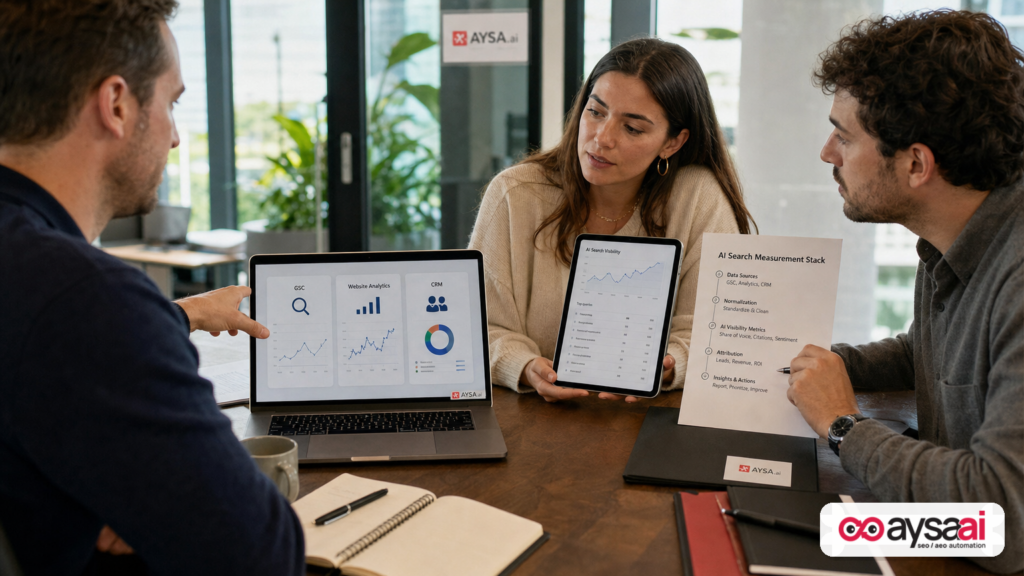
A Better Measurement Stack For AI Search (Even If Google Won’t Give You One Yet)
One of the most important lines in the source story is that the Gen-AI performance report is a filtered view. That means:
- you must avoid double-counting
- you must compare apples-to-apples time ranges
- you must accept that GSC alone will not answer every AI question
Here’s a practical stack I recommend for SMEs and agencies who want to manage AI search like a business channel, not like a vanity metric.
Layer 1: Search Console (directional visibility)
Use GSC to track queries and landing pages that appear in AI surfaces, but interpret the data as:
- inclusion signal, not placement precision
- trend detector, not a truth machine
Google’s own position here—per Mueller, as covered by Search Engine Journal—is that reporting is hard and currently block-based. Take them at their word and adjust expectations accordingly.
Layer 2: On-site analytics (engagement + conversion)
When AI citations send visitors, those visitors have behaviors. You can learn:
- what pages convert
- what pages confuse
- which FAQs reduce support contacts
If you’re using GA4, use it for outcomes (leads, purchases, calls), not as an argument about where the user “came from” in a philosophical sense.
Layer 3: CRM and call outcomes (business truth)
For service businesses and B2B, the real KPI is pipeline quality. Track:
- lead source notes
- sales-qualified rate by landing page themes
- common questions asked on calls (these become content)
Layer 4: Content operations (execution velocity with safety)
AI search rewards brands that stay accurate, consistent, and up to date. That’s not just a content task; it’s a production system task.
This is where execution platforms matter—because the biggest AI-search failure mode I see is not “we didn’t know the metric.” It’s “we knew what to fix, but didn’t ship.”
AYSA was built for this operational reality: monitor, prepare, approve, execute. Learn more about our tooling and approach here:
A Concrete SME Scenario: Local Clinic Losing Calls While “SEO Looks Fine”
Let’s make this real with a scenario I see frequently.
Business: a mid-sized dental clinic with two locations.
What the owner sees:
- Search Console clicks are steady
- Average position looks stable
- Marketing spend hasn’t changed
What the owner feels:
- fewer inbound calls for high-margin services (implants, Invisalign)
- more price-shopping leads
- front desk reporting “people keep asking the same questions”
What’s happening in AI search:
- AI Overviews answer “how much do dental implants cost” with general guidance
- citations include a national health publisher, a forum, and a competitor’s pricing page
- the clinic is sometimes cited but behind “Show more,” or not the most visible citation
Why GSC may not help enough:
- impressions can rise without visibility (“served but not seen”)
- position may reflect the AI block location, not the clinic’s citation prominence
What fixes it: not obsessing over position—but building the pages AI wants to cite and patients want to trust:
- a clear implants pricing explainer with ranges, financing, and what changes cost
- location-specific pages that answer “cost in [city]” with real operational detail
- FAQ sections written in patient language (not just SEO language)
- consistent information across service pages (no contradictions)
Then you measure success through outcomes: calls, bookings, consult requests, and the quality of those leads—while using GSC as a directional signal for AI inclusion.
What Can Go Wrong If You Trust The Wrong Metrics
When a reporting system becomes partially decoupled from real user experience, predictable mistakes happen.
1) You optimize for impressions, not business outcomes
Impressions are easy to inflate by covering broad topics. That’s how you create traffic that doesn’t convert.
2) You “report your way out of” a performance problem
Agencies (and internal teams) can unintentionally hide behind metrics when visibility becomes abstract. That’s not malicious; it’s human. The fix is to move reporting closer to business outcomes.
3) You ship risky changes because you’re chasing the new thing
AI search hype pushes teams toward fast, unreviewed edits: mass rewriting, thin FAQs, or pages that look good to a model but bad to a customer. Without a controlled execution process, the site becomes inconsistent—exactly what reduces trust and citation-worthiness.
4) You miss the opportunity to build defensible authority
AI systems cite sources they can lean on. The businesses that win will be the ones that build durable informational assets and keep them accurate over time.
What Agencies Should Rethink: Reporting, Retainers, And Proof
If you run an agency, AI reporting gaps aren’t just a technical nuisance. They’re a client-retention risk. Clients don’t pay for “we think we’re visible.” They pay for momentum they can feel.
Here’s what I recommend agencies do now:
1) Update your reporting narrative
Stop promising precision you can’t deliver. Instead, define three layers:
- Inclusion signals (GSC AI filters, query/landing page patterns)
- On-site outcomes (leads, sales, bookings)
- Operational delivery (what you shipped, what changed, what improved)
2) Sell execution, not dashboards
Dashboards are commodities. Execution is rare. A controlled system that proposes changes, gets approvals, and deploys safely is a competitive advantage—especially for clients who don’t have the staff to do it.
3) Build “citation-grade” content programs
Not content calendars. Programs. A program has:
- prioritized topics tied to revenue
- structured pages designed for direct answers
- maintenance cadence
- clear ownership and approvals
If you want a system that supports this operational style, see how AYSA approaches AI visibility and SEO execution:
A 90-Day Action Plan For SMEs (Designed For Imperfect Data)
This is the plan I’d use if I were responsible for growth at an SME and I didn’t want to wait for Google to fix reporting.
Days 1–15: Establish AI visibility baselines without pretending they’re perfect
- Identify top revenue-driving services/products and the top 20–50 customer questions around them.
- In Search Console, review performance at the page and query level to understand which content clusters already pull demand.
- Document what you think your “money questions” are (pricing, comparisons, near-me, availability).
- Align internally: GSC AI metrics are directional signals, not precise rankings.
Days 16–45: Build citation-worthy, conversion-worthy pages
- Create or upgrade “answer pages” that resolve buying anxiety: cost, timelines, who it’s for, risks, alternatives.
- Add clear summaries and direct answers near the top (without making the page thin).
- Remove contradictions across pages (the silent killer for trust).
- Improve internal linking so the site presents a coherent knowledge structure.
Days 46–75: Instrument and connect outcomes
- Ensure you can track conversions by landing page theme (not just by channel).
- For service businesses, ensure calls and bookings have a way to connect back to web behavior (even if imperfect).
- Train staff to capture “how did you hear about us” when AI is involved (simple, consistent scripting).
Days 76–90: Turn improvements into an operating cadence
- Monthly content maintenance: refresh pricing, availability, policies, and key FAQs.
- Quarterly consolidation: merge thin overlapping pages, strengthen the best one.
- Create a change management workflow so updates are proposed, reviewed, approved, and deployed safely.
That last point is where most SMEs fail—not because they don’t know what to do, but because they lack a process to ship reliably.
Where AYSA Fits: Monitor → Prepare Changes → Get Approval → Execute
AI search makes two things true at the same time:
- Measurement is less precise than the “rank tracking era” led us to expect.
- Execution speed and consistency matter more than ever.
That’s exactly the environment AYSA is designed for.
AYSA functions as an SEO/AEO/GEO execution system:
- Monitors site signals and visibility patterns (Monitoring)
- Prepares specific website changes (content, internal linking, structured improvements) tied to real pages and intents
- Asks for approval before changes go live (critical for brand, legal, and operational accuracy)
- Executes accepted changes so improvements ship, not just get discussed
This matters because AI visibility is often earned through disciplined site quality: consistency, clarity, freshness, and authority. A tool that only reports won’t fix that. A system that helps you operate the site will.
If you want to explore whether AYSA fits your team’s workflow, start here:
What To Do Next (Checklist)
- Reset expectations: treat GSC AI “position” as feature/block placement, not link ranking.
- Audit money questions: list the questions that drive buying decisions for your business.
- Build answer pages: create pages that answer those questions clearly, accurately, and with conversion paths.
- Fix contradictions: pricing, policies, availability, and service descriptions must match across the site.
- Measure outcomes: leads, calls, bookings, and sales-qualified rate by content theme.
- Adopt approved execution: stop letting changes drift; propose, approve, deploy, and QA on a cadence.
- Use AYSA to operationalize: monitoring + change proposals + approvals + execution (AYSA Monitoring).
Sources And Further Reading
- Search Engine Journal: Google Admits Search Console Reporting For AI Search Is Inadequate
- Search Engine Journal: AI Search coverage (research lead)
- Search Engine Journal: SEO coverage (research lead)
- Search Engine Journal: Technical SEO (research lead)
Note: Google’s help-center documentation and official product notes about Search Console impression/click definitions are referenced in the source article context, but were not included directly in the provided research extract. Where this editorial discusses impression mechanics and block-based position, it is grounded in the Search Engine Journal summary of Mueller’s comments and the described reporting rules, and framed as operational interpretation rather than a claim of complete measurement accuracy.
Continue the AI search topic inside AYSA.
Use these pages to connect the article with AI SEO tools, AI visibility monitoring, AI Overviews and approved website execution.
Turn this topic into a website action plan.
Use these AYSA hubs to move from reading to technical fixes, AI visibility monitoring, research, glossary context and approval-first SEO execution.

