
Google’s “AI Contribution” Payments: What It Really Means For Publishers, SMEs, And The Future Of SEO
Google is testing an “AI contribution” pilot inside Search Console that pays publishers when their content meaningfully shapes AI answers in Gemini, AI Overviews, and AI Mode. Here’s what changed, why it matters beyond media, and how SMEs and agencies should adapt their SEO/AEO/GEO execution to win visibility—and revenue—in an AI-first search world.

Google is testing something that could redefine the relationship between search platforms and the open web: direct payments to publishers when their content meaningfully contributes to AI answers. The pilot appears inside Google Search Console and reportedly applies when content shapes answers in the Gemini app, AI Overviews, and AI Mode.
If you’re a publisher, this sounds like the beginning of a new revenue line—maybe even a long-overdue “answer economy” payout. If you’re an SMB, ecommerce operator, clinic, hotel, or SaaS team, you might think: does this matter to me if I’m not getting paid? Yes—because the payment pilot is a signal of where Google believes value is shifting: from “who got the click” to “who influenced the answer.”
Below is the practical breakdown: what changed, what’s still unknown, why the incentives matter, and what businesses should do right now to earn AI visibility and protect demand. I’ll also explain how AYSA fits—not as a dashboard, but as an execution system that monitors, prepares changes, requests approval, and ships improvements that make your site more usable by AI systems and better for customers.
Concise summary
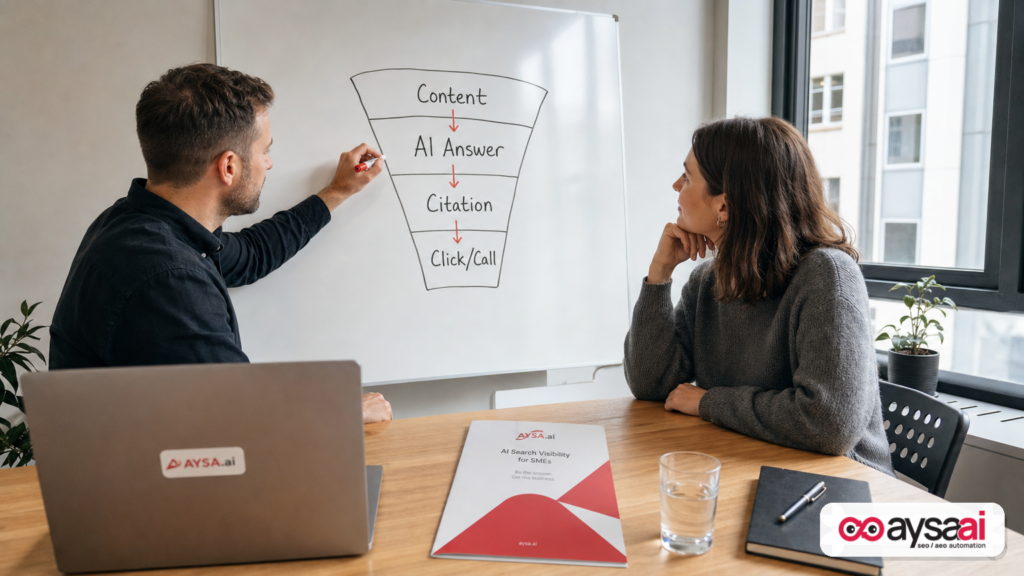
- Google is testing an “AI contribution” pilot inside Search Console that pays publishers when their content significantly contributes to AI answers (Gemini, AI Overviews, AI Mode).
- The reported qualification line is “generation,” not “citation.” In other words: shaping the answer may qualify; merely being linked after the answer is generated may not.
- The panel reportedly shows earnings, but not the Attribution logic. That lack of transparency is a big operational and negotiation issue for publishers and agencies.
- SMEs may not be paid (at least not in this pilot), but they should still treat AI answer visibility as a new primary channel for discovery and trust.
- Execution speed with controls wins. AI Search rewards sites that are structured, current, and explicit—then consistently maintained.
Key takeaways (what to remember if you read nothing else)
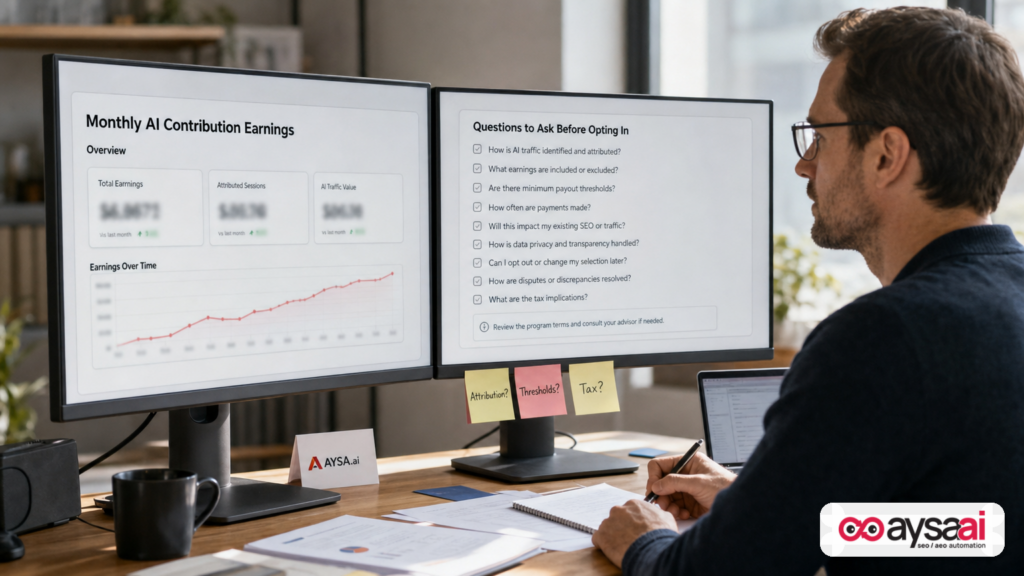
- AI search is shifting incentives from traffic to contribution. That changes what “SEO success” looks like.
- Visibility will be measured in more than Clicks. Impressions, citations, mention frequency, and “answer inclusion” become operational KPIs.
- Publishers should treat payments as a pilot, not a business model—yet. Don’t trade long-term leverage for short-term “peanuts.”
- SMEs should build “answer-ready” pages. Policies, FAQs, pricing logic, comparisons, and process pages are becoming as important as blog posts.
- Monitoring + approved execution is the new baseline. The winners will be the teams that can detect opportunities and deploy changes safely and repeatedly.
Table of contents

- What Actually Changed: From “Ranking For Clicks” To “Contributing To Answers”
- Context: Why Payments Are Even On The Table
- What We Know About The Search Console “AI Contribution” Pilot
- How Google’s Pilot Likely Works (And What We Still Don’t Know)
- Why This Matters Beyond Publishers: Incentives Shape The Web
- The SME Reality: You Probably Won’t Get Paid—But You Can Still Win
- What Can Go Wrong: Black Boxes, Bad Incentives, And Brand Risk
- The New Measurement Stack: From Rankings To AI Visibility
- What “AI-Contribution-Ready” Content Looks Like (Without Becoming Spam)
- Technical Readiness: The Unsexy Stuff That Makes You Usable In AI Answers
- What Agencies Should Rethink (Packaging, Reporting, And Execution)
- Where AYSA Fits: Monitoring → Preparation → Approval → Execution
- A Practical 90-Day Action Plan (With AEO/GEO Execution Built In)
- What to do next
- Sources and further reading
What Actually Changed: From “Ranking For Clicks” To “Contributing To Answers”
For 20+ years, the basic deal of SEO was understandable:
- You publish information.
- Google ranks it.
- Users click through.
- You monetize the visit (ads, leads, purchases).
AI answers compress that journey. When Google provides an answer directly in the search experience—through AI Overviews or AI Mode—fewer users need to click to get the basics. That doesn’t mean your site becomes irrelevant; it means your site can be used earlier in the chain: as source material.
The reported pilot moves the conversation from “we might send you traffic” to “we might pay you when you shape the answer.” That’s a meaningful philosophical shift: it acknowledges that the value your content provides isn’t only realized when a user lands on your page.
But it also introduces a new competitive reality: you may need to optimize for answer inclusion—being understandable, extractable, and trustworthy enough to be used—rather than optimizing only for the click.
This is where AEO (Answer Engine Optimization) and GEO (Generative Engine Optimization) become practical—not buzzwords. Your goal expands from “rank” to “be selected as an ingredient.”
Context: Why Payments Are Even On The Table
It’s easy to view this pilot as a simple revenue-sharing experiment. It’s bigger than that.
Generative AI answers put pressure on the long-standing web value exchange. Publishers and creators have argued for years that platforms benefit from their work while pushing visibility and revenue downstream. In that environment, payments can serve multiple purposes at once:
- Incentive alignment: motivate creation of high-quality, current, factual content that improves AI answers.
- Risk management: reduce legal and reputational risk around “using the web” to generate responses.
- Supply chain stability: keep the open web healthy enough that there’s still fresh information to use.
Google already has systems that send traffic and provide tools (Search Console is one of the most important). The reported pilot suggests a new lever: direct compensation for contribution. That’s a big statement about how Google thinks AI answers will persist long-term.
Our job as operators—publishers, SMEs, agencies—is to respond pragmatically, not emotionally. Payments may help some sites. But the larger business shift is that AI answers create new “winners” and “losers” based on clarity, credibility, structure, and freshness.
What We Know About The Search Console “AI Contribution” Pilot
Based on reporting from Search Engine Journal (covering a Digiday report) and what was described in the extracted text:
- Google is testing a Search Console pilot that pays publishers when their content contributes to AI answers.
- The covered products include the Gemini app, AI Overviews, and AI Mode.
- The help text reportedly emphasizes that payment applies when content “contributes significantly” during answer generation—not merely being linked afterward.
- After agreeing to terms, publishers reportedly see an earnings panel in Search Console with monthly earnings and some historical data.
- Publishers can reportedly opt out anytime in Search Console settings.
- The panel reportedly does not show how earnings were calculated (a “black box”).
SEJ also notes that Google rolled out generative AI performance reporting broadly on Aug. 31 (impressions from AI features) and that it does not include clicks.
Additionally, SEJ references a June 18 Google post describing a pilot partnering with websites whose content contributes to “freshness and factuality” of generative AI responses through grounding (the extracted text does not include the URL; I’m not linking it as a verified primary source from the supplied context). If you have that official link, add it to your internal documentation.
How Google’s Pilot Likely Works (And What We Still Don’t Know)
We don’t have full technical documentation for the pilot in the provided source text, so anything beyond the reported behavior is analysis. Still, we can outline the plausible mechanics and, more importantly, the questions you should ask.
A plausible attribution model (analysis)
If Google is paying for “significant contribution” at generation time, they likely need to estimate something like:
- Which URLs were retrieved/used (“grounded”) for a response.
- How strongly a given source influenced the final output (weighting).
- Whether the response met quality thresholds (to avoid paying for low-value inclusions).
- Potentially: geography, language, topic sensitivity, or user intent categories.
This would be similar in spirit to how ad platforms attribute value to interactions—but applied to content contribution rather than clicks.
What’s still unknown (and why it matters)
From the reporting, the panel is “black box.” That raises operational questions:
- Attribution transparency: Which queries or topics triggered contribution?
- Content scope: Which URLs contributed and how often?
- Decay and freshness: Does updated content earn more? How quickly do outdated pages stop contributing?
- Quality gates: Are there penalties for misinformation, thin content, or “SEO-first” writing?
- Payment calculation: Is it per inclusion, per unique user, per query class, or a pooled distribution?
- Regional rules: Are there payment thresholds or local restrictions?
Without this visibility, publishers can’t reliably optimize. And if they can’t optimize, the payment becomes less of an incentive and more of a lottery ticket.
Why This Matters Beyond Publishers: Incentives Shape The Web
You might think: “This is a publisher problem.” But incentives change behavior, and behavior changes the web you’re competing in.
If payments scale, some publishers will shift resources toward content types that are more likely to be used in AI answers—think:
- Definitions and explainers
- How-to guides with clear steps
- Comparisons and decision trees
- Fresh updates and factual corrections
- Structured FAQs and policy pages
That will raise the bar for everyone else. AI answers will increasingly be built on content that’s cleanly written, structured, and frequently refreshed. SMEs that treat content as “marketing fluff” will be competing against an ecosystem that has been trained—and potentially paid—to create machine-usable clarity.
This is why I believe the right response for SMEs and agencies isn’t “do more blog posts.” It’s “make the business legible.” Explain what you do, how you do it, what it costs (or what affects cost), what you don’t do, where you operate, and what outcomes customers can expect.
The SME Reality: You Probably Won’t Get Paid—But You Can Still Win
Most SMEs aren’t going to get an invitation to a publisher-focused payment pilot in the near term. But that’s not the point.
The point is that AI answers are rapidly becoming the first point of contact for many discovery journeys. Even when users do click, it might be later in the journey—after they’ve formed an opinion based on what the AI answer summarized.
A concrete SME scenario (realistic)
Imagine a local clinic (or a dental practice, physical therapy office, or urgent care) trying to attract new patients. Historically, the clinic relied on ranking for “dentist near me” and a few service keywords.
In AI Mode / AI Overviews, the user might ask:
- “What’s the difference between a crown and a veneer?”
- “How long does a root canal recovery take?”
- “Does insurance usually cover X?”
- “What questions should I ask before booking?”
If the clinic has well-structured, compliant, plain-English pages that answer these questions—plus clear next steps (book, call, insurance info)—it can be cited, mentioned, or implicitly relied on. Even without payment, the clinic can win:
- Brand trust: the AI answer aligns with the clinic’s expertise and messaging.
- Higher-intent visits: fewer clicks, but better clicks.
- More calls: users search the brand name or navigate directly after reading the AI summary.
This is why “AI visibility” should be treated as a demand channel, not a vanity metric. If you’re only measuring SEO by sessions, you’ll under-invest in what’s becoming the top-of-funnel experience.
What Can Go Wrong: Black Boxes, Bad Incentives, And Brand Risk
Whenever platforms introduce payments, three risks show up fast.
1) The black box risk
If you can’t see why you earned what you earned, you can’t scale it. For publishers, that makes forecasting hard. For agencies, it makes reporting risky. For SMEs, it makes “AI optimization” feel like superstition.
Operational response: build a measurement model that doesn’t depend on a single platform’s self-reported number. Track visibility across multiple surfaces (Search Console impressions, brand search lift, conversions, call tracking, and qualitative feedback from customers about “where they heard about you”).
2) Perverse incentives (content designed for payout, not users)
If money is attached to “contribution,” some sites will try to reverse-engineer the system and publish content that’s optimized to be ingested rather than understood. This is how we get the next wave of thin “definition farms,” just with a new coat of paint.
Google will likely respond with stricter quality filters, which can create volatility. SMEs that chase loopholes will lose. Teams that build genuinely helpful, well-structured pages will be more resilient.
3) Brand risk: being used incorrectly
Even if your content is accurate, AI answers can summarize it in a way that’s incomplete or mismatched to context. That can create customer confusion or even compliance issues in regulated spaces.
Operational response: publish content that’s explicit about conditions and exceptions. Add clear “who this is for / not for” sections. Keep policy pages updated. And monitor how your brand is being represented in AI answers (more on monitoring below).
The New Measurement Stack: From Rankings To AI Visibility
SEJ’s reporting highlights an important gap: Google’s generative AI performance reporting in Search Console shows impressions from AI features but not clicks (per the extracted text). Even if clicks are missing, impressions are still a directional signal.
But in an AI-first environment, you need a broader measurement stack. Here’s what I recommend teams track, in plain business terms:
1) Visibility metrics
- AI feature impressions (from Search Console where available)
- Branded search demand (are more people searching your brand after AI exposure?)
- Share of “answer space” (how often your brand/site is cited or mentioned in AI answers for your topic set)
2) Business metrics (still the point)
- Leads, calls, bookings, purchases
- Conversion rate changes on AI-affected landing pages
- Assisted conversions (where SEO content supports later brand or paid conversion)
3) Content operations metrics
- Time-to-update critical pages (pricing, policies, availability)
- Coverage of top customer questions (sales/support input)
- Consistency of entities: names, addresses, offerings, and definitions across the site
This is exactly where many SMEs and agencies struggle: they can see “stuff happening,” but they can’t execute improvements consistently. That’s why AYSA focuses on monitoring plus approved execution (more later).
What “AI-Contribution-Ready” Content Looks Like (Without Becoming Spam)
To be included in AI answers, content needs to be easy to interpret and safe to use. That doesn’t mean writing for robots. It means writing like a great operator: clear, complete, and current.
Content types that tend to perform well in AI answer environments
- Customer-question FAQs that reflect real language (sales calls, support tickets, chat logs).
- Policies (returns, shipping, cancellations, warranties, eligibility) written plainly.
- Process pages: “How it works,” “What to expect,” “Timeline,” “Aftercare.”
- Comparisons: A vs B, “best for,” trade-offs, and decision criteria.
- Pricing logic: not always a price, but what drives cost and how quotes are built.
- Location/service area clarity for local businesses: where you actually serve and what’s in/out of scope.
Editorial standards that increase “answer usability”
- Define terms once and use them consistently.
- Put the direct answer first, then add nuance (conditions, exceptions).
- Use structured headings that match questions people ask.
- Keep facts current and show update signals where appropriate.
- Remove ambiguity: specify timeframes, locations, eligibility, and assumptions.
Notice what’s missing: “publish 50 AI-generated blogs per week.” In my view, this era punishes volume without clarity. If your site is a mess, more content just adds more mess.
Technical Readiness: The Unsexy Stuff That Makes You Usable In AI Answers
AI systems rely on retrieval and grounding. If your content is hard to parse, inconsistent, or blocked, you reduce your odds of being used—regardless of how good it is.
Even without referencing undocumented specifics, the practical technical baseline for AI-era search looks like this:
1) Indexability and crawl hygiene
- Important pages should be indexable (no accidental noindex, no blocked resources that break rendering).
- Canonicalization should be consistent (avoid duplicates that confuse which page is “the source”).
2) Structure and semantics
- Use clear H2/H3 hierarchies for questions and answers.
- Ensure pages have a single purpose (don’t mix unrelated topics on one URL).
3) Entity consistency (especially for SMEs)
- Business name, address, phone, service descriptions, and location coverage should match across the site.
- Product/service attributes should be consistent (sizes, materials, coverage, warranty).
4) Trust and maintenance signals
- Maintain accurate contact info and policy pages.
- Show author/editor info where it makes sense for expertise-heavy topics.
None of this is new—what’s new is that AI answers raise the stakes. Technical sloppiness doesn’t just cost rankings; it can cost inclusion.
What Agencies Should Rethink (Packaging, Reporting, And Execution)
Agencies are being forced to evolve from “ranking reports” to “visibility and outcomes” reports. The reported Search Console changes reinforce that: the platform itself is moving toward AI-centric reporting and experiments.
1) Packaging: sell “AI visibility readiness,” not “AI hacks”
If an agency sells tricks, clients will churn when tricks stop working. If an agency sells a system—monitoring, content operations, technical hygiene, and controlled iteration—clients stay.
2) Reporting: build explainable KPIs
When clicks become less reliable, agencies need a KPI set that executives understand:
- AI impressions (directional)
- Branded demand lift
- Lead quality improvements
- Conversion lift on key pages
3) Execution: speed matters, but so does governance
The teams that win will update more often—pricing, inventory, policies, FAQs, comparisons, and “what’s changed” pages. But uncontrolled speed creates brand risk.
This is exactly why I’m bullish on “approved execution” as a model: changes get prepared and proposed, stakeholders approve, then they ship. You move fast without breaking trust.
Where AYSA Fits: Monitoring → Preparation → Approval → Execution
AI search is operational. It’s not one audit, one keyword set, or one content sprint. It’s a continuous cycle:
- Monitor what AI search surfaces are doing to your visibility.
- Identify where you’re missing answers, entities, and clarity.
- Prepare specific on-site improvements (content, structure, technical fixes).
- Get approval from the business (brand, legal, medical, pricing, leadership).
- Execute accepted changes safely and measure impact.
AYSA is built to run that loop with less friction. If you want the product overview paths relevant to this topic:
- AI SEO tools: AI SEO Tools
- AI search visibility: AI Search Visibility
- Monitoring: AYSA Monitoring
- Pricing: AYSA Pricing
- More editorial context: AYSA Blog
In practical terms, this matters because AI-era SEO is full of “should we update this?” decisions that involve multiple stakeholders. AYSA’s model is designed for that reality: proposed changes are reviewed and approved before they go live.
A Practical 90-Day Action Plan (With AEO/GEO Execution Built In)
If you’re an SME, publisher, or agency, the best response to “AI is changing search” is not a rebrand. It’s a 90-day operational plan.
Days 1–15: Establish your AI visibility baseline
- Inventory your money pages: services, categories, products, pricing logic, policies, booking/contact.
- Review Search Console for AI feature impressions where available (AI Overviews / AI Mode reporting is referenced in the SEJ piece).
- Collect real questions from sales/support: top 50 objections, comparisons, “what does it include,” “how long,” “does it work for me.”
- Decide your KPI set: not just traffic—include leads, calls, bookings, conversion rate, branded search.
Days 16–45: Build answer-ready coverage on the site
- Create or upgrade FAQ hubs for each core service/product category.
- Write comparison pages (A vs B, “best for,” “not for”).
- Improve policy clarity (returns, cancellations, warranties, eligibility).
- Update process pages (“how it works,” timeline, aftercare/maintenance).
Days 46–75: Fix structure, reduce ambiguity, improve trust
- Standardize naming and definitions across pages (entity consistency).
- Clean up duplication and outdated pages.
- Add update discipline: assign owners and review cadence for “facts that change.”
Days 76–90: Build the ongoing operating system
- Set a monthly “AI visibility review” meeting: what questions are trending, what pages need clarity.
- Keep an approvals workflow so stakeholders can sign off quickly.
- Measure outcomes and adjust: which updates correlate with leads, calls, bookings, and assisted conversions.
AYSA’s role in this plan is simple: keep monitoring on, prepare improvements continuously, request approvals, and execute the accepted changes—so you don’t lose momentum after the first sprint.
What to do next
- If you’re a publisher invited to the pilot: treat it as an experiment; review terms carefully; document baseline revenue and traffic; don’t let a new payout reduce your negotiation leverage.
- If you’re an SME: pick one revenue-driving service or category and build the best “answer-ready” page cluster on the internet for it (FAQs, process, comparisons, policies, pricing logic).
- If you’re an agency: update your reporting to include AI visibility and business outcomes, and productize execution governance so you can ship improvements faster without brand risk.
- If you need an execution system: start with AYSA’s monitoring and AI visibility capabilities and connect them to an approval workflow: AYSA Monitoring and AI Search Visibility.
Sources and further reading
- Search Engine Journal — Google Tests Paying Publishers For AI Answers Via Search Console
- Search Engine Journal — AI Search section (context)
- Search Engine Journal — SEO section (context)
- Search Engine Journal — SEO News (context)
- Search Engine Journal — Technical SEO (context)
Note: The SEJ piece references a June 18 Google post about a pilot partnering with websites whose content contributes to the freshness and factuality of generative AI responses through grounding. The official URL is not included in the supplied research context, so it’s not linked here. If you have it, add it to this section as a primary source.
Continue the AI search topic inside AYSA.
Use these pages to connect the article with AI SEO tools, AI visibility monitoring, AI Overviews and approved website execution.
Turn this topic into a website action plan.
Use these AYSA hubs to move from reading to technical fixes, AI visibility monitoring, research, glossary context and approval-first SEO execution.

