
Google Search Revenue Slowed—Here’s What That Signals For AI Search, Ads, And Your 2026 Visibility Plan
Alphabet’s Q2 Search revenue still grew strongly, but the growth rate eased for the first time after a year of acceleration. That matters because it hints at a new phase: AI-driven search experiences expanding, ad monetization adapting, and businesses needing measurement and execution systems that go beyond “rankings.”

Google Search is still growing. But the rate of that growth just slowed for the first time after a year of acceleration.
That combination—strong revenue, easing growth, and heavy emphasis on AI—should change how you think about visibility in 2026. Not because you need to panic about SEO being “dead,” but because the mechanics of discovery are being rebuilt in public: answer-first results, AI layers, new ad tooling, and new measurement gaps.
In this editorial, I’ll translate the business signal into a practical operating plan for small and mid-sized businesses (SMEs) and agencies: what likely changed, what it means for your pipeline, what to measure, and what to do next. I’ll also explain where AYSA.ai fits as an execution system that monitors, prepares changes, asks for approval, and then implements accepted updates on your site—because strategy without shipping is just a meeting.
Concise summary

- Alphabet reported Q2 Search revenue up year-over-year, but growth slowed versus the prior quarter. The headline isn’t “decline,” it’s “deceleration.”
- Google continues to frame AI as a driver of query growth and ad performance, including deeper integration of Gemini and tools like AI Max for Search campaigns.
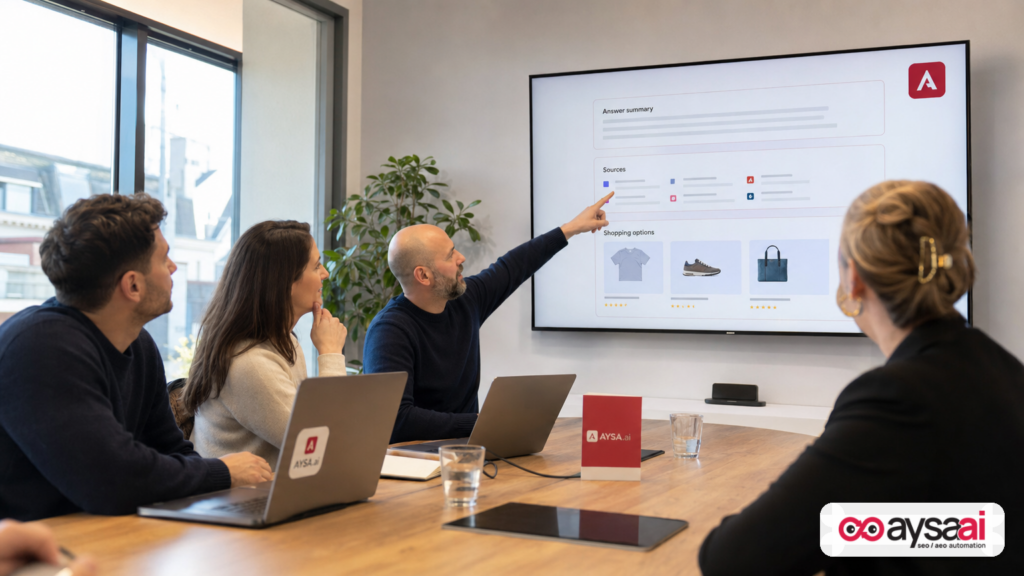
- For businesses, this is a signal that search behavior is moving faster than measurement. Visibility can increase while click outcomes change, especially in AI Overviews/AI Mode and shopping-heavy layouts.
- The winning play is not “publish more content.” The winning play is: clean technical foundations, entity-led content, conversion measurement, and fast, governed execution.
Key takeaways (read this if you’re busy)
- Decelerating growth is a business signal, not an SEO signal. It can mean monetization is adjusting to new behavior—not that demand vanished.
- AI features can grow queries while changing click distribution. Expect more “visibility without traffic” moments and manage them with better measurement and content structure.
- Ads and organic are converging. When AI-driven ad tools expand what’s monetizable, paid search will keep evolving around new intent patterns.
- Track outcomes, not nostalgia. Rankings still matter, but they don’t explain revenue. Conversions, assisted conversions, and lead quality do.
- Execution speed is now a competitive advantage. If your team can’t implement fixes and content improvements quickly, you’ll lose to businesses that can.
Table of contents
- What happened: the revenue headline and why it matters
- The signal behind the headline: monetization is catching up to behavior
- Context: a year of acceleration, then a step down
- What changed in search: from “ten blue links” to answer-first discovery
- AI in ads: why AI Max matters even if you never touch Google Ads
- Visibility vs. traffic vs. revenue: the three-number mistake
- A practical measurement stack for 2026 (what SMEs can actually run)
- A concrete SME scenario: the local clinic that “kept rankings” but lost leads
- What can go wrong (and how to avoid self-inflicted losses)
- Agency reset: what to stop selling and what to start delivering
- The action plan: a 30/60/90-day visibility operating system
- Where AYSA fits: monitor → prepare → approve → execute
- What to do next (checklist)
- Sources and further reading
What happened: the revenue headline and why it matters
Alphabet’s latest quarterly report showed Google Search revenue still growing year-over-year, but at a slower pace than the previous quarter—ending a streak where growth had accelerated for four straight quarters.
This isn’t a prediction of doom. It’s a directional cue:
- Search demand is still large and growing—but the rate of growth is no longer climbing every quarter.
- Google is publicly tying Search momentum to AI features and Gemini integration, and also tying AI to ad monetization improvements.
- The market is normalizing around AI-shaped search behavior—and that normalization will show up in where Clicks go, how queries are phrased, and what types of pages get surfaced or cited.
My take: when a platform the size of Google talks about AI as both (1) increasing query growth and (2) improving monetization, you should assume the interface will keep changing—and your visibility program must be built to adapt without reinvention every quarter.
Primary research input for this editorial: Search Engine Journal’s coverage of Alphabet’s Q2 report.
The signal behind the headline: monetization is catching up to behavior
When revenue growth decelerates while a company emphasizes product expansion (AI features, integrations, new ad tooling), it often means one or more of these are happening:
- User behavior is shifting faster than the ad model can fully capture. If people get answers sooner, refine fewer times, or click differently, monetization has to catch up.
- Growth is moving from “easy” to “hard.” The first phase is harvesting existing demand. The next phase is monetizing edge cases and new query classes—exactly the kind of thing Google referenced with AI-driven ad tools reaching searches that were previously harder to monetize.
- The platform is rebalancing product experience and ad load. Google can’t simply cram more ads into every surface without risking user satisfaction and long-term usage.
If you run a business, your question should not be “is Google making more money?” Your question should be:
- Where does my brand show up now when customers ask questions in AI-shaped search?
- What content gets cited or referenced?
- What pages still win clicks?
- What queries are becoming “no-click” or “low-click” because the answer is visible on the results page?
That’s the operational shift: treat search as a distribution environment, not a list of rankings.
Context: a year of acceleration, then a step down
The SEJ report lays out a clear progression: Search revenue growth accelerated for multiple quarters and then eased in Q2. The key nuance is that the number is still strongly positive—just not accelerating.
Here’s why this context matters to your SEO/AEO/GEO planning:
- Acceleration phases create false certainty. Businesses start to assume the next quarter looks like the last quarter. Agencies bake assumptions into retainers. Forecasts get lazy.
- Deceleration exposes weak measurement. When the platform’s growth rate changes, you finally see which channels and which pages were actually producing revenue—versus just producing “traffic.”
- AI narratives can hide distribution changes. “AI is driving query growth” can be true while the click opportunity for publishers and SMEs becomes more fragmented.
So the question isn’t whether AI is “good” or “bad.” The question is: what new behaviors are forming, and how do you align your site, content, and campaigns to be discoverable inside them?
What changed in search: from “ten blue links” to answer-first discovery
Traditional SEO was built around a simple mental model:
- User searches a Keyword.
- Google shows links.
- You rank higher → you get more clicks → you get more business.
AI search breaks that simplicity—not because links vanish, but because the interface now often answers first and routes second. That has several practical consequences for SMEs:
1) “Being the answer” can beat “being #1”
If a user sees a summarized answer (with or without citations), the click may go to:
- a cited source,
- a brand named in the summary,
- a product module or local pack,
- or nowhere at all (the user is satisfied).
That’s why modern visibility must include AEO/GEO—answer engine optimization and generative engine optimization—alongside classic SEO.
At AYSA.ai, we treat this as a practical checklist, not a buzzword. Start here if you want the framework: AI search visibility.
2) Intent is fragmenting into micro-moments
AI makes it easier for users to ask longer, more specific queries. That means your “keyword list” becomes less important than:
- your topical coverage,
- your product/service clarity,
- your structured data and on-page semantics,
- and your authority signals.
In other words: you win by being the most reliable source on a topic, not by stuffing exact-match phrases.
3) Search is becoming distribution, not just navigation
For years, the implicit deal was: “publish content, rank, get traffic.” Now the deal is shifting toward: “publish content, get referenced, get visibility, earn trust—and sometimes get traffic.”
This is uncomfortable for businesses that rely on top-of-funnel content to fuel retargeting and email capture. But it’s manageable if you plan for it by:
- designing content to be citable (clear claims, definitions, steps, comparisons),
- building stronger brand and entity signals,
- improving conversion rates on the traffic you do get.
AI in ads: why AI Max matters even if you never touch Google Ads
SEJ’s coverage notes Google highlighting AI-driven ad tooling (including AI Max for Search campaigns) as part of the monetization story. Even if you don’t run paid search, this should change how you think about the SERP:
- More queries become monetizable. That often means more ad presence in places that used to be “organic-first.”
- Creative and targeting become more automated. Your competitor’s ability to test messaging quickly can improve—even with a small team.
- Paid and organic alignment matters more. If Google can better match ads to nuanced intent, you can’t afford to have your organic messaging contradict your paid messaging (or vice versa).
Practical implication: your SEO and paid search teams can’t operate like separate agencies that never speak. They’re competing for the same attention in a more dynamic interface.
Also note: Google’s official guidance and tooling for advertisers evolves constantly; if you need baseline orientation on how Google frames Search advertising, start from Google’s own Ads documentation (primary source): Google Ads Help Center. (This link is provided as a reputable primary reference; it’s not from the SEJ page itself.)
Visibility vs. traffic vs. revenue: the three-number mistake
Most businesses accidentally run SEO using three numbers that don’t agree:
- Rankings (a proxy for potential visibility)
- Traffic (a proxy for realized visits)
- Revenue/leads (the only number that actually pays salaries)
In classic search, these were more correlated. In AI search, correlation weakens because the interface absorbs more of the “answer” layer.
This creates a common failure pattern:
- Your rankings “look fine.”
- Your traffic dips or flattens.
- Your revenue dips.
- You blame content volume, publish more, and the gap remains.
The better diagnosis path is:
- Which queries changed? (long-tail? local intent? comparison queries?)
- Which SERP layouts changed? (more shopping modules? more local packs? more AI answer coverage?)
- Which landing pages lost click share?
- Did conversion rate change? (sometimes you get fewer visits but better-qualified ones)
If you want a system that’s built for that workflow—monitoring first, then preparing actions, then executing with approval—start here: AYSA Monitoring.
A practical measurement stack for 2026 (what SMEs can actually run)
You don’t need an enterprise data team to manage AI search change. You need a repeatable stack that separates visibility signals from business outcomes.
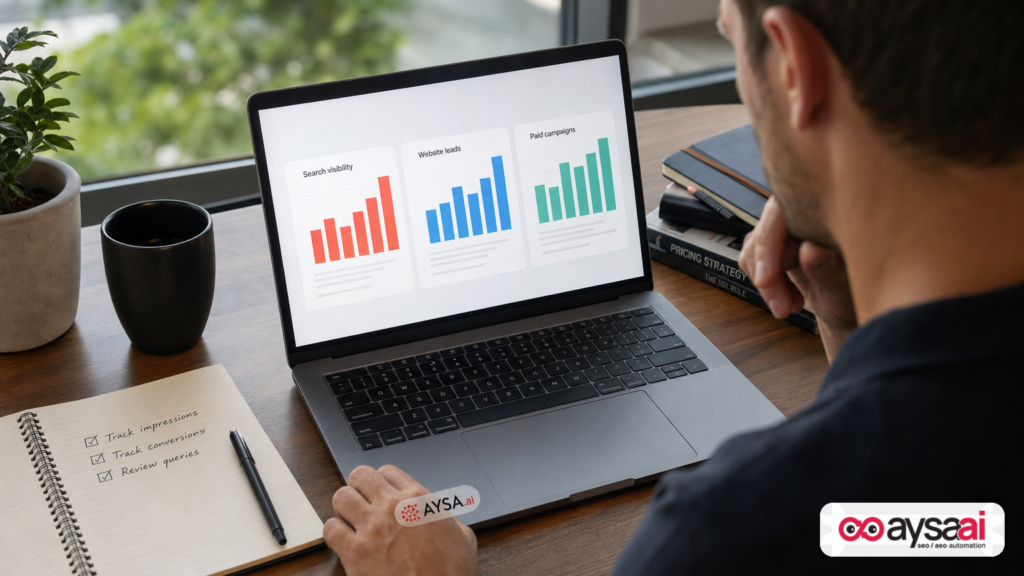
1) Google Search Console: your baseline truth for search visibility
Search Console remains the best free source for understanding what Google is showing and where impressions are coming from. SEJ notes Google added reporting for generative AI features, but with important limitations (notably around click data in those surfaces).
Start from the official product: Google Search Console.
What to do weekly:
- Review queries and pages for major impression shifts.
- Spot new query patterns (more conversational, more specific).
- Track branded vs. non-branded trends.
What not to do: obsess over average position as if it guarantees clicks.
2) GA4 (or your analytics): outcomes, not just sessions
Analytics is where you validate whether visibility becomes value:
- Leads, purchases, calls, booked appointments
- Assisted conversions (organic may start the journey, paid may close)
- Landing page conversion rate changes
Official reference: Google Analytics Help.
3) Paid search reporting: the “market price” of intent
Even if you spend modestly, paid search data can help you understand:
- which intent segments are getting more competitive,
- which messages convert,
- which queries you can’t reliably win organically anymore.
4) Content inventory: what you have, what it’s for, what it earns
Most SMEs don’t have “a content strategy.” They have content accumulation. In AI search, that’s dangerous because messy content:
- confuses topical authority,
- splits internal link equity,
- and increases the chance AI summaries pull inconsistent claims.
Build a simple inventory:
- Pages that drive conversions
- Pages that drive awareness
- Pages that are redundant/outdated
- Pages that should be consolidated
If you’re trying to modernize this with AI safely, use tools that keep humans in control. That’s the philosophy behind AYSA’s approach: AI SEO tools.
A concrete SME scenario: the local clinic that “kept rankings” but lost leads
Let’s make this real with a scenario I see constantly.
The business
A regional clinic offers dermatology appointments and cosmetic services. They’ve invested in SEO for years. They rank well for a handful of “money” terms like “dermatologist near me,” plus service pages like “acne scar treatment” and “mole removal.”
The symptom
- Rankings look stable.
- Organic traffic is slightly down.
- Call volume and booked appointments dip noticeably.
What actually happened (plausible causes in AI-era SERPs)
- Local packs and review-driven surfaces take more attention for “near me” terms.
- Answer-first summaries reduce clicks on informational pages (“what causes adult acne?”).
- Users arrive more qualified but expect immediate proof: credentials, pricing ranges, insurance accepted, before/after galleries, and fast booking.
The fix: not “more blogs,” but a conversion-ready, AI-citable presence
- Clarify service pages: add clear sections that answer the top questions in plain language.
- Strengthen entity trust: clinician bios, credentials, policies, location consistency.
- Improve internal linking: guide users from symptoms → treatments → booking.
- Optimize conversion flow: fewer steps to book; clear phone CTA; insurance/payment info.
- Measure lead quality: track booked appointments, not just form submissions.
The lesson: AI search doesn’t just change traffic quantity; it changes expectation. If your pages aren’t built to satisfy that expectation, your “rankings” won’t save your revenue.
What can go wrong (and how to avoid self-inflicted losses)
AI-era visibility programs fail in predictable ways. Here are the biggest ones I’d warn an SME owner about.
1) Chasing impressions as the new vanity metric
When clicks are harder to attribute (especially in AI surfaces), teams may over-celebrate impressions. Don’t. Use impressions as a visibility diagnostic, not a success metric.
Guardrail: tie every major content or technical initiative to one of these:
- conversion rate improvement
- lead quality improvement
- pipeline volume improvement
- brand demand growth (branded searches)
2) Publishing “AI content” at scale without editorial control
More pages can make you less coherent. When your site becomes internally contradictory, you weaken trust with users and risk confusion in how your content is summarized or referenced.
Guardrail: consolidate and improve before you expand. Make cornerstone pages stronger, clearer, and easier to cite.
3) Treating schema like magic dust
Structured data helps machines interpret your page, but it doesn’t fix a weak offer, weak authority, or confusing copy. Use schema as a clarity tool, not a trick.
4) Measuring change but not shipping change
This is the most expensive failure: you see the problem, you create a ticket list, and nothing gets implemented for weeks or months.
In 2026, execution speed is a moat. If your competitor updates key pages monthly and you update quarterly, they’ll win more of the “answer layer” and the conversions that follow.
Agency reset: what to stop selling and what to start delivering
If you run an agency or you hire one, the AI-era shift demands a reset in deliverables.
Stop selling these as the main value
- “We’ll get you to #1” (for a handful of terms)
- Monthly blog quotas without conversion intent
- Reporting that is 80% rankings and 20% outcomes
Start delivering these instead
- Visibility coverage: where you appear across classic results, local surfaces, and AI answer layers
- Entity-led content systems: topical maps, content consolidation, and citation-ready pages
- Conversion readiness: landing pages that earn trust fast, especially for high-intent queries
- Execution governance: monitoring → recommendations → approvals → implementation → validation
AYSA is designed to make that last part real. Agencies and in-house teams don’t need more PDFs; they need a reliable way to ship improvements safely. If you want to see how we think about that operational model, start with: AYSA.ai blog.
The action plan: a 30/60/90-day visibility operating system
Below is a practical plan that fits most SMEs. It doesn’t require hiring a new team. It requires deciding that visibility is an operating system, not a one-time project.
Days 1–30: stabilize measurement and identify where you’re vulnerable
- Audit Search Console: top queries, top pages, branded vs. non-branded trends.
- Map pages to outcomes: which pages lead to leads/sales?
- Identify “answer-risk” pages: pages that can be fully summarized (definitions, simple how-tos) and may lose clicks.
- Identify “conversion-hero” pages: pages that must be perfect (service/product pages, pricing, booking, demo).
- Create a change backlog with effort vs. impact scoring.
Days 31–60: upgrade your highest-intent pages to be citable and conversion-ready
- Rewrite top service/product pages for clarity: who it’s for, outcomes, process, pricing signals, FAQs.
- Improve internal linking to funnel users from questions → solutions → conversion.
- Fix technical friction: indexation issues, duplicate pages, broken canonicals, slow templates (prioritize what blocks conversion pages).
- Add trust assets: policies, reviews/testimonials where appropriate, credentials, case studies (where permissible and true).
Days 61–90: build a sustainable content and visibility loop
- Consolidate thin content into fewer, stronger pages.
- Publish citation-friendly assets: comparison guides, checklists, glossaries, buyer guides—content that AI can reference cleanly.
- Align paid and organic messaging: ensure the same promise, same positioning, same landing page logic.
- Review outcomes monthly: not just traffic, but leads/sales and conversion rate by landing page.
Where AYSA fits: monitor → prepare → approve → execute
The hardest part of SEO in 2026 isn’t “knowing what to do.” The hardest part is getting it done—without breaking your site, without waiting on overloaded dev teams, and without turning your content into AI-generated mush.
AYSA.ai is built around a simple, business-safe execution loop:
- Monitor your site and search visibility for changes and opportunities.
- Prepare recommended updates (technical fixes, content improvements, internal links, structured data opportunities) in a controlled way.
- Ask for approval so humans stay accountable and brand risk stays managed.
- Execute accepted changes on the website.
- Validate impact through the measurement stack.
This matters because AI search pushes faster iteration cycles. If it takes you 90 days to update five pages, you’re effectively choosing to lose.
Explore the core pieces here:
- Monitoring (see what changed and what needs attention)
- AI Search Visibility (framework for AI-era discovery)
- AI SEO Tools (practical, controlled assistance—not content spam)
- Pricing (to evaluate fit vs. DIY or agency-only models)
- Blog (ongoing playbooks and updates)
What to do next (checklist)
- Open Search Console and identify your top 20 converting landing pages. If you don’t know which pages convert, fix tracking first.
- For each page, answer: Is this page clear enough to be summarized correctly? Is it trustworthy enough to be cited? Is it conversion-ready?
- Create 10 “citation-ready” upgrades (FAQs, definitions, steps, comparisons, pricing context) on your top pages.
- Consolidate or retire redundant content that splits authority and confuses users.
- Align paid + organic on your highest-intent offers: messaging, landing pages, and conversion flow.
- Set a monthly shipping goal: a fixed number of meaningful changes implemented (not just “audited”).
- If execution is your bottleneck, adopt an approved-execution system so improvements don’t die in a spreadsheet.
Sources and further reading
- Search Engine Journal: Google Search Revenue Growth Eases After A Year Of Acceleration (research input)
- Google Search Console (official)
- Google Analytics Help (official)
- Google Ads Help Center (official)
- AYSA.ai: AI Search Visibility
- AYSA.ai: Monitoring
- AYSA.ai: AI SEO Tools
- AYSA.ai: Pricing
Editorial note on certainty: The revenue figures and narrative about AI integration are drawn from the cited SEJ coverage of Alphabet’s quarter. Where the industry lacks verifiable, page-level click attribution in AI surfaces, I’ve framed guidance as practical analysis and operational best practice rather than claiming precise causal numbers.
Continue the AI search topic inside AYSA.
Use these pages to connect the article with AI SEO tools, AI visibility monitoring, AI Overviews and approved website execution.
Turn this topic into a website action plan.
Use these AYSA hubs to move from reading to technical fixes, AI visibility monitoring, research, glossary context and approval-first SEO execution.

