Google vs. SerpApi: What the DMCA Scraping Ruling Really Means for SEO Tools, AI Visibility, and Your Business
A federal judge dismissed key parts of Google’s DMCA claims against SerpApi and paused discovery, giving Google 21 days to amend. This isn’t just courtroom drama: it’s a signal about how fragile the data layer is beneath rank tracking, AI visibility monitoring, and modern SEO automation—and what businesses should do now to stay resilient.

Search is in the middle of a structural shift: AI answers are changing how people discover businesses, and the “data plumbing” underneath SEO tools is being stress-tested by stronger anti-scraping measures and legal pressure.
That’s why a recent federal court decision involving Google and SerpApi matters even if you never plan to read a single legal filing. According to Search Engine Land, the U.S. District Court for the Northern District of California dismissed key parts of Google’s DMCA claims against SerpApi and gave Google 21 days to amend part of its complaint. Discovery was stayed in the meantime.
This isn’t a victory lap for “scraping” and it isn’t proof that “Google can’t stop bots.” It’s a reminder that the marketing industry has built a lot of critical workflows—Rank tracking, competitive Monitoring, AI visibility checks—on top of access to public search results, and that access is neither guaranteed nor stable.
I’m writing this as Marius Dosinescu from AYSA.ai, and I’ll be direct: businesses that treat monitoring and execution as ad-hoc tasks are going to feel this kind of uncertainty first—and hardest. The answer is not panic. The answer is resilience: diversify your signals, tighten your governance, and make execution faster (without making it reckless).
Concise summary
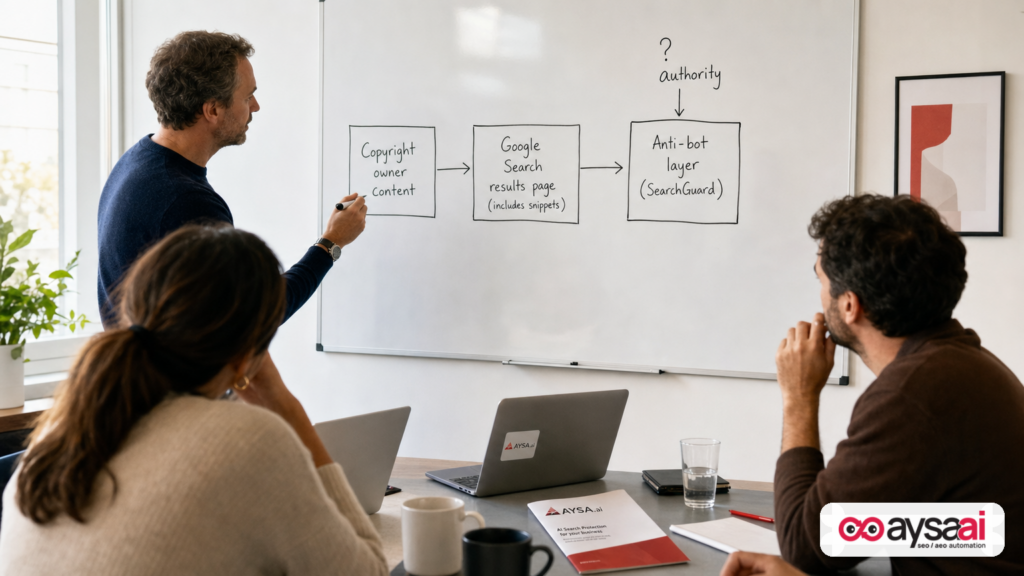
- A judge dismissed Google’s two DMCA claims against SerpApi as pleaded, permanently for non-copyrighted-result scenarios and with leave to amend for scenarios involving copyrighted content.
- The court focused on whether Google sufficiently alleged that its anti-scraping system (SearchGuard) operated “with the authority of the copyright owner” for the relevant copyrighted material.
- Discovery is paused until Google amends (or doesn’t) and any renewed motion to dismiss is resolved.
- This matters because many SEO and analytics workflows depend on automated access to public SERPs—especially for monitoring AI-era visibility.
- Practical response: build a “search resilience stack” that combines first-party data (GSC/GA4), controlled monitoring, and an Approved Execution process so you can adapt quickly and safely.
Key takeaways (what to do if you only have 2 minutes)

- Assume SERP-based metrics can get noisier. Build reporting that can tolerate missing/partial data.
- Don’t manage SEO from a single tool’s chart. Cross-check with first-party signals and server-side evidence.
- Focus on what you can control: crawlability, indexation, entity clarity, schema, Internal linking, and content maintenance.
- Create a governance loop: monitor → prepare changes → get approval → execute → measure. This is exactly how AYSA operates.
Table of contents

- What happened: the DMCA claims, the SearchGuard question, and the 21-day clock
- Why this matters beyond one lawsuit: SERP data is the plumbing of modern marketing
- A practical DMCA primer for marketers (no law degree required)
- Why “copyrighted content in results” changes the analysis
- Practical risks if SERP access tightens: what breaks first (and how to notice)
- A concrete SME scenario: the local clinic that loses signal before it loses revenue
- What agencies should change now: reporting, QA, and vendor risk
- What could happen next in the case—and what not to assume
- Build a “search resilience stack”: signals, redundancy, and governance
- 90-day action plan: stabilize monitoring, strengthen pages, improve AI-era clarity
- The AYSA perspective: stop treating monitoring as “nice to have” and start treating it as governance
- What to do next
- Sources and further reading
What happened: the DMCA claims, the SearchGuard question, and the 21-day clock
Here’s the non-hype version of what the court did, based on reporting from Search Engine Land (source):
- The court granted SerpApi’s motion to dismiss Google’s two claims under the Digital Millennium Copyright Act (DMCA) as pleaded.
- Some parts were dismissed permanently—specifically, portions tied to search results that did not include copyrighted content.
- Other parts were dismissed with leave to amend—portions involving search results that did include copyrighted content, where Google could potentially re-plead with better factual support.
- The court stayed discovery until Google either amends and any renewed motion to dismiss is resolved, or chooses not to amend.
- The court found Google had not sufficiently alleged facts showing that SearchGuard (Google’s anti-scraping system) was implemented and functioned “with the authority of the copyright owner” for the relevant copyrighted content.
SerpApi framed the ruling as a win for an open internet and argued the court rejected an attempt to expand the DMCA to control access to public pages, again per Search Engine Land’s coverage. Google still has a path forward if it can strengthen allegations around authorization for copyrighted materials.
What should you, as an operator, take from this? Not that “scraping is legal” or “Google lost.” Take this instead: the legal perimeter around automated SERP access is under active negotiation, and the technical perimeter (anti-bot systems) is already tight. If your business depends on SERP-derived metrics, you need operational backups.
Why this matters beyond one lawsuit: SERP data is the plumbing of modern marketing
Most businesses don’t buy “SERP data.” They buy outcomes: leads, sales, pipeline, bookings. But modern SEO tooling—especially in AI-era search—leans heavily on third-party collection of public results to answer practical questions like:
- Did we move up for our top queries?
- Which competitors are outranking us today?
- Did our local pack presence change?
- Are we being mentioned or cited in AI-style answers?
Even if you don’t “scrape,” you probably use a product that does some form of automated retrieval—directly or indirectly—to assemble insights at scale. Many SEO tools, agency dashboards, and internal reports are built on that assumption.
So when anti-scraping systems harden and lawsuits proliferate, the risk is not theoretical. The risk shows up as:
- Gaps in rank tracking (sudden missing keywords, regions, devices)
- Delayed reporting (data arrives later, more sampling)
- Inconsistent SERP features detection (AI answers, local packs, knowledge panels)
- Vendor-to-vendor disagreement (two tools show different “truth”)
In 2026, that’s not just an SEO problem. It’s a budgeting problem. A forecasting problem. A “do we hire or freeze?” problem. That’s why this case matters beyond the parties involved.
A practical DMCA primer for marketers (no law degree required)
The DMCA is a U.S. law that, among other things, addresses circumvention of technological measures that control access to copyrighted works. You don’t need to memorize the statute to understand the business implication: if a court agrees a measure is protecting access to copyrighted content, and someone is accused of bypassing it, that can create legal exposure.
But this case, as reported, highlights a key friction point for search:
- Search results pages are publicly viewable.
- They can contain a mix of content types: original elements created by the search engine, plus snippets or media that might be protected by someone else’s copyright.
- Google uses anti-automation systems (SearchGuard is the term referenced in the reporting) to deter large-scale extraction.
The court’s emphasis—again, per Search Engine Land’s summary—was that Google didn’t sufficiently allege that SearchGuard operated with the authority of the relevant copyright owner when used to protect licensed or copyrighted content in results.
From a marketer’s perspective, the “authority” question matters because it draws a line between:
- General anti-bot protection (protecting infrastructure, abuse prevention, rate limiting)
- Copyright access control (a technological measure tied to copyrighted works and rights-holder authorization)
That line influences how far DMCA claims can be stretched in disputes about collecting public-facing information.
Why “copyrighted content in results” changes the analysis
One of the most important practical nuances from the reporting is that the court split claims by whether the search results at issue included copyrighted content.
Here’s why that matters in operations terms:
- If the results page is treated primarily as a collection of public facts and links (titles, URLs, positions), the argument that a copyright access-control measure was circumvented may be harder to sustain.
- If the results page includes copyrighted material (for example, protected images or content excerpts licensed from a rights holder), the access-control argument can look different—depending on what exactly is displayed and what authorization exists.
Notice what this implies for the SEO industry: the more Google (and others) blend results pages with richer, more content-like elements, the more complex the “what is being accessed” question becomes. That complexity isn’t just legal; it’s product architecture. Tools that collect “rank positions” may attempt to avoid collecting more than needed. Others that analyze SERP features might need more page context, increasing exposure to disputes.
As an SME or agency, you don’t control that legal boundary. But you do control whether your decision-making depends on a single fragile source of SERP-derived truth.
Practical risks if SERP access tightens: what breaks first (and how to notice)
When access gets tighter—whether due to legal pressure, bot defenses, or platform changes—the industry tends to feel it in predictable ways. Here are the failure modes I want you to watch for, because they show up months before revenue declines:
1) “Rankings are stable” becomes a false comfort
If your tracker can’t collect reliably, it may show flat lines, “no change,” or fewer updates. That can look like stability. It might actually be missing data.
What to monitor instead: first-party impressions/clicks trends in Google Search Console (GSC), branded query volume patterns, and conversions by landing page.
2) You start fighting phantom competitors
Partial SERP collection can over-represent certain domains (that load faster, geo-match, or trigger fewer bot defenses). You’ll “see” competitors that aren’t consistently beating you in real user contexts.
What to do: validate with manual spot checks for a small sample of revenue-driving queries and locations, and track outcomes (leads/sales) alongside visibility.
3) AI visibility gets mis-measured
AI-era results are not just “rank #3 vs #5.” They’re presence/absence in answer modules, citations, and recommendation contexts. If collection is limited, your AI visibility report can swing wildly.
What to do: treat AI visibility as a portfolio of signals, not a single score. You want repeatable checks and trend direction, not absolute certainty from one vendor.
4) Local becomes a mess first
Local results vary dramatically by location, device, and user context. Tightened collection can make local tracking particularly unreliable—yet local businesses are the ones who depend on it most.
What to do: anchor local reporting around actions you can verify: calls, direction requests, bookings, and GSC landing page performance for local service pages.
5) Your organization mistakes “data access” for “strategy”
When the data stream is threatened, teams often respond by trying to out-engineer the blockade rather than improving fundamentals. That’s a trap. You can’t “growth hack” your way out of a platform’s incentives.
What to do: build resilience: technical health, clear entities, strong pages, and disciplined execution.
A concrete SME scenario: the local clinic that loses signal before it loses revenue
Let’s make this real.
Imagine a multi-location dental clinic group in two suburbs. The owner doesn’t care about “scraping.” They care about booked appointments. Their marketing manager cares about local pack presence, reviews, and whether competitors are running aggressive campaigns.
Today, they use a rank tracker to monitor:
- “dentist near me”
- “emergency dentist [city]”
- “invisalign [city]”
Now imagine SERP collection becomes less reliable for local pack layouts. The tool starts reporting fewer data points and smoother trends. The marketing manager concludes: “All good. Stable.”
But in reality, two things are happening:
- A competitor is gaining local pack visibility for high-intent queries during business hours (when real users search).
- The clinic’s Google Business Profile (GBP) listing got a subtle attribute conflict after an address-related update, and visibility dropped in a specific zip code cluster.
If the clinic waits for revenue to dip, they’re late. The earlier warning would have been:
- GSC impressions falling for location pages
- Call tracking volume shifting by location
- GBP actions changing (calls, direction requests) even if rankings look “stable”
The point: brittle SERP monitoring doesn’t just reduce precision; it delays awareness. And delayed awareness is what turns fixable issues into expensive ones.
What agencies should change now: reporting, QA, and vendor risk
Agencies are in the blast radius of SERP data uncertainty because clients expect answers like: “Why did we drop?” or “Are we winning?” If SERP collection becomes constrained, agencies face a trust problem.
Here’s how I think agencies should adapt immediately.
1) Redesign KPIs around outcomes + first-party signals
Rankings still matter, but don’t build your entire monthly narrative on them. The moment collection becomes patchy, you’ll look incompetent even if the work is solid.
Shift the spine of reporting to:
- GSC query groups and landing page cohorts
- Conversions and assisted conversions by page type
- Indexation and coverage stability
- Content maintenance velocity (updates, consolidation, pruning)
Use rankings as supporting evidence, not the core truth.
2) Build a vendor risk register (yes, really)
If your reporting pipeline depends on any single provider for SERP data, you have vendor concentration risk. Document it. Plan contingencies. It’s basic operations.
At minimum, define:
- What happens if tracking updates slow down?
- What happens if local pack detection becomes unreliable?
- What happens if AI visibility snapshots can’t be collected for certain geos?
3) Make execution auditable
When data is noisy, clients will ask: “What did you change?” If your changes are scattered across email threads, freelancers, and untracked CMS edits, you can’t defend performance.
This is where an approved execution system shines: monitor → propose changes → client approves → execute → log → measure.
That governance model is a major reason AYSA exists.
What could happen next in the case—and what not to assume
The court gave Google 21 days to amend part of its complaint, per the reporting. That means several plausible paths forward, and none of them justify complacency:
- Google amends and attempts to address the “authority of the copyright owner” issue with additional allegations.
- SerpApi challenges again via another motion to dismiss.
- The case narrows to fewer issues, or proceeds with more limited scope.
- Settlement is possible in many disputes, though there’s no claim here that it will happen.
What you should not assume:
- That the ruling means “scraping is safe” broadly.
- That the ruling prevents platforms from tightening technical defenses.
- That your tool vendor’s collection methods will remain constant.
As operators, the right response is not to become armchair litigators. It’s to design marketing systems that don’t break when one data feed degrades.
Build a “search resilience stack”: signals, redundancy, and governance
If you want a durable approach to SEO and AI search visibility in 2026, build your stack around three layers:
Layer 1: First-party truth (your baseline)
First-party doesn’t mean perfect, but it’s the most defensible. Your baseline should include:
- Google Search Console performance trends by query groups and pages
- Analytics outcomes (leads, sales, bookings) by landing page and channel
- Server logs or edge analytics for crawl patterns (where available)
These signals won’t answer every competitive question, but they tell you what’s actually happening to your business.
Layer 2: Controlled monitoring (your context)
This is where SERP-based tooling still matters—but you treat it as context, not gospel:
- Spot checks for revenue queries
- Segmented keyword sets (not 50,000 vanity terms)
- Local monitoring based on real service areas
- AI visibility checks treated as trend signals
Layer 3: Execution governance (your advantage)
This is the part most businesses lack. Data is only useful if it drives correct action. Governance means:
- Monitoring detects an issue/opportunity
- A change is proposed with a clear rationale
- The business approves (or rejects) the change
- The change is executed safely and documented
- Impact is measured and folded back into the system
This is the operational model we built into AYSA: it monitors, prepares, asks for approval, and executes accepted website changes.
90-day action plan: stabilize monitoring, strengthen pages, improve AI-era clarity
Below is a practical 90-day plan you can run whether you’re an SME, an in-house team, or an agency. The goal is simple: make your search program less dependent on any single fragile data stream.
Days 1–15: Audit your dependence on SERP-derived metrics
- Inventory reports: which dashboards and KPIs depend on SERP scraping/collection?
- Classify risk: what breaks if that feed becomes partial or delayed?
- Define minimum viable monitoring: which 50–200 queries actually map to revenue?
- Set a “data confidence” note in leadership reporting (high/medium/low) so you don’t oversell precision.
If you want a structured approach, start with AYSA’s monitoring perspective and tooling philosophy: AYSA Monitoring.
Days 16–45: Strengthen the fundamentals that survive platform turbulence
Regardless of what happens in courts or bot defenses, the following fundamentals remain your best hedge:
- Technical SEO hygiene: indexation issues, canonical mistakes, thin duplicates, redirect chains.
- Entity clarity: make it easy for systems to understand who you are, what you do, where you operate.
- Information architecture: pages aligned to user intent, not internal org politics.
- Structured data where appropriate and accurate (don’t spam it; treat it as clarity tooling).
- Content maintenance: update, consolidate, and prune. (If you publish endlessly without upkeep, you accumulate risk.)
AYSA’s toolset is designed to help you execute this consistently without turning your CMS into a free-for-all: AI SEO Tools.
Days 46–75: Build AI-era visibility without chasing hype
AI search visibility is not a single trick. It’s the result of being:
- understandable (clear entities, consistent facts)
- credible (authoritative pages, reputation signals, references)
- useful (content that answers real questions with specificity)
Start here if you want a dedicated lens on AI visibility: AI Search Visibility.
Days 76–90: Operationalize an “approved execution” workflow
This is where most teams fail: they know what to do, but execution is slow, political, or risky.
Implement a simple system:
- Weekly monitoring review (30–60 minutes)
- Priority list of proposed changes (technical + content + internal linking)
- Approval step (so changes don’t surprise stakeholders)
- Execution window (with logging)
- Impact review (so you learn, not just ship)
AYSA is built around this governance loop—especially for SMEs who need speed and safety. If you’re evaluating fit, pricing and packaging are here: AYSA Pricing.
The AYSA perspective: stop treating monitoring as “nice to have” and start treating it as governance
When people hear “SEO automation,” they often imagine risky bots pushing changes to production. That’s not what serious businesses need—especially when the data environment is volatile.
In my view, the winning model for the next wave of SEO/AEO/GEO is:
- Monitoring that detects meaningful changes (not vanity noise)
- Preparation of recommended updates (technical fixes, content improvements, schema opportunities)
- Approval by a human who owns the business risk
- Execution that’s controlled, logged, and reversible
This is the model we’re building at AYSA. The SerpApi case is one more reason the industry should move away from brittle, single-source “SERP truth” and toward operational systems that can adapt when data access shifts.
If you want more of our thinking on where search is heading and how to operationalize it, the AYSA blog is the best place to follow: AYSA Blog.
What to do next
- Decide what you’re optimizing for: rankings as a proxy, or outcomes (leads/sales/bookings) with visibility as a leading indicator.
- Reduce measurement fragility: stop relying on a single SERP dataset; cross-check with GSC/analytics.
- Rewrite your SEO operating system: implement monitor → propose → approve → execute → learn.
- Focus on fundamentals that survive any legal/technical shifts: crawlability, clarity, authority, maintenance.
- If you’re an agency: update client reporting now so a vendor data disruption doesn’t look like your failure.
Sources and further reading
- Search Engine Land: Google loses key DMCA claims against SerpApi in scraping lawsuit
- Search Engine Land (related context lead): How to audit your AI entity footprint
- Search Engine Land (related context lead): AI search can’t verify your business — here’s how to fix it
- Search Engine Land (related context lead): Schema for AI search: How to identify and prioritize entity gaps
- Search Engine Land (related context lead): The new SEO rules for bloggers in 2026: Why clarity matters in AI search
- AYSA: AI search visibility
- AYSA: Monitoring
- AYSA: AI SEO tools
- AYSA: Pricing
- AYSA: Blog
Note: This editorial relies on the supplied reporting context from Search Engine Land and does not claim to reproduce court documents or additional filings beyond what’s included in that context.
Continue the AI search topic inside AYSA.
Use these pages to connect the article with AI SEO tools, AI visibility monitoring, AI Overviews and approved website execution.
Turn this topic into a website action plan.
Use these AYSA hubs to move from reading to technical fixes, AI visibility monitoring, research, glossary context and approval-first SEO execution.