
Google Ads Video Campaign Groups: The Practical Guide to Reach, Frequency, and Not Wasting Your YouTube Budget
Google Ads has rolled out video campaign groups globally, letting advertisers optimize YouTube reach and frequency across multiple campaigns with unified reporting. Here’s what changed, why it matters for SMEs and agencies, what can go wrong, and a step-by-step playbook—plus how AYSA helps you connect paid learning back to SEO/AEO execution.

Google Ads has quietly made a meaningful upgrade for YouTube advertisers: video campaign groups for YouTube reach and frequency campaigns are now available globally. That sounds like platform plumbing. In practice, it changes how you plan, manage, and measure awareness spend—especially if you run multiple video campaigns at the same time.
This is bigger than a new toggle in Google Ads. It’s part of a broader trend: Google is pushing advertisers toward cross-campaign optimization—tools that let you manage the audience outcome (unique reach, controlled repetition) rather than babysitting each campaign in isolation.
Below is the playbook I’d want on my desk if I were running YouTube awareness for an SMB, a multi-location brand, or an agency with many accounts: what changed, why it matters, what can go wrong, and what to do next. I’ll also make the connection many teams miss: how better YouTube reach/frequency management should feed your SEO/AEO work—and how AYSA Monitoring helps you turn paid learning into approved, measurable Website Execution.
Concise summary
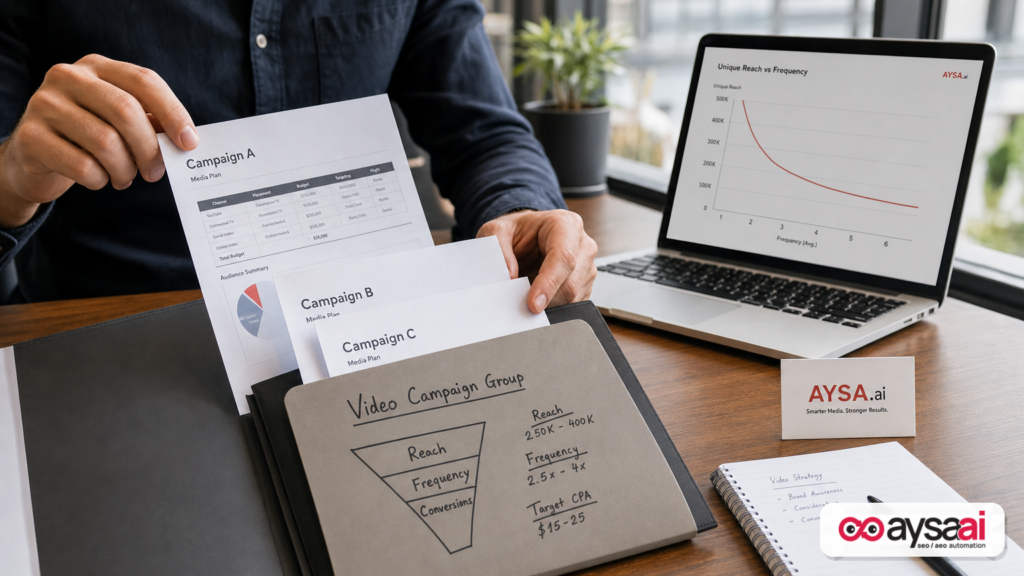
- What changed: Google Ads now lets you group multiple YouTube reach & frequency campaigns under a single reach or frequency objective, with unified reporting across the group.
- Why it matters: It’s easier to avoid audience overexposure, reduce overlap across campaigns, and manage awareness like a portfolio—without giving up campaign-level controls.
- What to do: Rebuild your YouTube planning around a group-level goal, define guardrails (frequency, creative rotation, GEO, audience), and monitor downstream outcomes (brand search, direct traffic, conversion assist) with discipline.
- How AYSA fits: Use YouTube campaigns to reveal objections, terminology, and intent—then let AYSA monitor, propose, and execute the website/AEO changes (with approval) that convert that new demand.
Table of contents

- What changed: video campaign groups are now global
- Why reach & frequency still matter in 2026 (even with AI everywhere)
- What you actually get: control stays at campaign level
- The measurement shift: unified reporting is the real win
- How this changes YouTube strategy for SMEs
- What agencies should rethink (and what to productize)
- What can go wrong: the 10 most common failure modes
- A step-by-step setup playbook (SMEs and agencies)
- Concrete SME scenario: a local clinic running two YouTube offers
- The bridge most teams miss: YouTube reach → SEO/AEO demand capture
- Where AYSA.ai fits: monitored insights → approved execution
- What to do next (action list)
- Sources and further reading
What changed: video campaign groups are now global
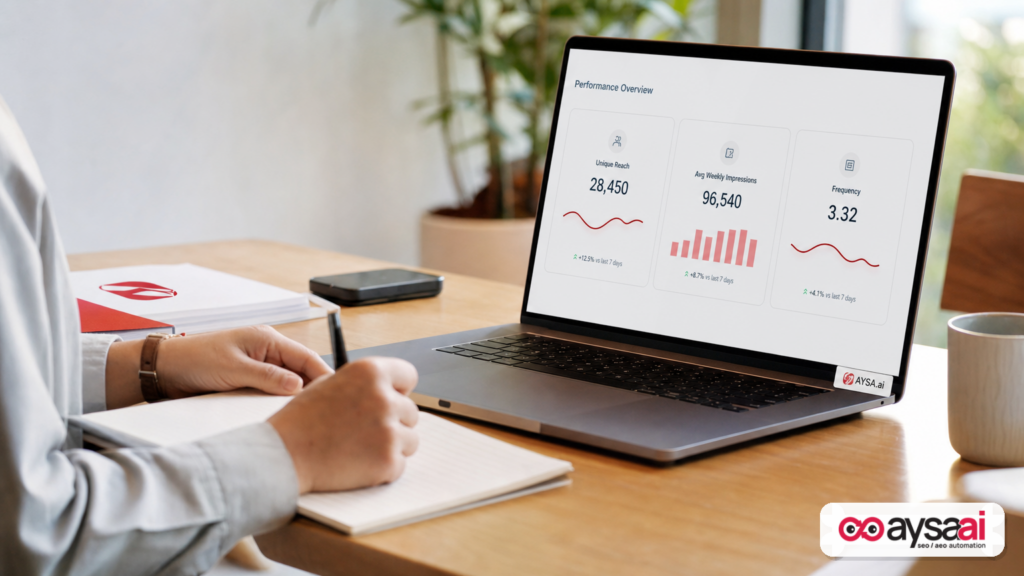
Google Ads has rolled out video campaign groups globally for YouTube reach and frequency campaigns. The core idea is simple: instead of trying to manage reach and frequency across several campaigns manually, you can now group multiple campaigns under a shared reach or frequency objective—while keeping campaign-level settings like budgets and creative distinct.
This update was reported by Search Engine Land in: Google Ads rolls out video campaign groups globally.
Google’s framing is also important: this is meant to simplify management and improve media efficiency by avoiding unnecessary overexposure—meaning you can aim for broader unique reach while controlling how often people see your ads.
A quick note on where this goes next
Search Engine Land also notes Google intends to expand this capability into Display & Video 360 (DV360) so advertisers can coordinate reach and frequency across multiple YouTube line items. I’m not going to over-claim timelines or specifics beyond what was reported, but directionally this signals something: audience-level planning is becoming the default, even for teams that used to plan at the campaign or ad set level.
Why reach & frequency still matter in 2026 (even with AI everywhere)
AI has changed how ads are created, targeted, and optimized. But it hasn’t changed the basic physics of attention.
When you run YouTube for awareness, you’re buying two scarce resources:
- Unique reach: how many distinct people in your target audience you can expose to your message.
- Frequency: how often those people see the message.
The tension between those is eternal: push frequency too high and you burn budget repeating the same message to the same people. Push frequency too low and you risk creating “forgettable awareness”—the user saw you once, but it never stuck, and it never translates into action.
The practical business cost of overexposure
For an SME, wasted frequency shows up as:
- CPM drift: you pay more to keep serving Impressions to the same exhausted audience segments.
- Creative fatigue: performance decays, but you keep spending because the campaign still delivers.
- Opportunity cost: budget that could have reached new prospects is stuck repeating impressions.
- Brand annoyance: you become “that company” that follows people everywhere.
Search Engine Land referenced a Meridian marketing mix modeling (MMM) study from Google indicating an “optimal frequency” point (2.7 impressions per week) associated with improved ROI. I’m not going to treat one number as a universal law—different categories, creatives, and purchase cycles will vary—but the principle is what matters: there is a point where more impressions stop helping and start hurting efficiency.
AI optimization is not the same as business optimization
Even if automated systems get better at “optimizing,” they typically optimize toward what you asked for—delivery, reach, frequency, viewability, completion, or some proxy. They do not automatically optimize toward what you meant: profitable growth, fewer wasted impressions, or less cannibalization with other campaigns.
That’s why tooling that lets you manage cross-campaign audience exposure matters. It narrows the gap between platform optimization and business optimization.
What you actually get: control stays at campaign level
One reason teams hesitate to adopt new “grouping” features is fear of losing control. The good news (as described in the Search Engine Land report) is that video campaign groups let you align toward a shared reach or frequency goal while still keeping campaign-level levers such as:
- Budgets per campaign
- Creative assets per campaign (different videos for different messages)
- Other campaign settings (without turning everything into one blended bucket)
In other words: you can run distinct strategies inside one coordinated reach/frequency “portfolio.”
Who benefits most
- Brands running multiple creatives concurrently (e.g., product-led + brand story + seasonal offer)
- Multi-location businesses that need separate campaigns for geography, but want unified exposure control
- Agencies managing many campaigns where reporting and overlap are constant headaches
- Fast-growing SMEs that have outgrown “one campaign at a time” thinking
The measurement shift: unified reporting is the real win
Most advertisers don’t suffer from a lack of metrics. They suffer from fragmented reality.
When you run two, three, or ten YouTube campaigns at once, you can easily end up with these classic questions:
- “Are these campaigns reaching new people—or the same people?”
- “Are we over-serving impressions to a small slice of the audience?”
- “Which creative is driving incremental reach vs. redundant frequency?”
- “How do I explain performance to the owner/CFO without a 40-tab spreadsheet?”
Unified reporting across a campaign group is the difference between campaign management and audience management. According to Search Engine Land’s reporting, the group-level reporting can include:
- Unique reach
- Average weekly impressions
- Reach and frequency performance across the group
Why this changes behavior, not just dashboards
When reporting is unified, teams tend to:
- Plan at the group level (“How many people do we want to reach?”) instead of per-campaign (“How much can we spend here?”)
- Rotate creative intentionally to manage fatigue
- Stop duplicating audiences across multiple campaigns that accidentally compete
- Make cleaner weekly decisions (what to scale, what to pause, what to swap)
This is how awareness becomes manageable for SMEs: not by adding complexity, but by reducing coordination cost.
How this changes YouTube strategy for SMEs
SMEs usually approach YouTube in one of three ways:
- One-and-done brand campaign (run for a month, hope for the best)
- Retargeting-only (YouTube as cheap frequency on warm audiences)
- Performance-YouTube (try to force last-click conversions from video)
Video campaign groups are an invitation to do something more mature without becoming enterprise-level complicated: run multiple messages at once, aimed at the same market, while maintaining sensible exposure.
Move from “campaign thinking” to “portfolio thinking”
Instead of asking, “What will this campaign do?”, you ask:
- How many people in our serviceable audience do we want to reach this month?
- What is the acceptable frequency band before fatigue?
- Which message should a prospect see first, second, third?
- What landing experience will capture the demand we create?
That last bullet is where most SMEs lose the plot. You can’t spend your way out of a weak website narrative. You have to connect awareness to clarity and conversion—fast.
Creative rotation stops being “nice” and becomes mandatory
When frequency is managed across multiple campaigns, you can:
- Run a brand story video and a proof video concurrently
- Test two hooks for the same offer (price-led vs. outcome-led)
- Segment creatives by funnel stage while still managing total exposure
But you must plan for it. If you group campaigns yet keep repeating the same creative concept, you’ll still create fatigue—just more elegantly reported.
What agencies should rethink (and what to productize)
If you run an agency, campaign groups can be more than a feature—you can turn them into a client deliverable: “Reach & Frequency Governance.”
Most clients don’t care about your campaign naming convention. They care about:
- How many people you reached
- Whether you annoyed them
- Whether awareness turned into pipeline
- Whether spend was disciplined
A better operating model for agencies
Instead of weekly reports by campaign, consider:
- One group-level narrative: reach achieved, frequency band, creative mix, geo mix
- One testing plan: what creative hypothesis is next
- One website/action plan: what needs to change on the site to capture demand
This is also where SEO and PPC alignment becomes real. Search Engine Land has covered the organizational side of this idea in a separate piece (useful as a concept lead): SEO and PPC alignment starts with your org chart. The point isn’t the org chart itself—it’s that measurement, messaging, and execution must share a feedback loop.
What can go wrong: the 10 most common failure modes
New tooling doesn’t eliminate mistakes; it changes where mistakes happen. Here are the failure modes I’d watch for with video campaign groups.
1) You group campaigns that should not share a goal
If campaigns target meaningfully different audiences (e.g., consumers vs. B2B decision makers) or different geographies with different realities, one shared reach/frequency objective can blur accountability. Grouping should reflect one coherent audience strategy.
2) You chase reach and ignore message quality
Unique reach is only valuable if the message lands. If your creative is generic, broad reach just means broad wasted impressions.
3) You under-rotate creative and create fatigue anyway
Even with perfect frequency governance, the same creative repeated will decay. Your plan should include creative variation designed for repetition.
4) You treat frequency as a vanity metric
There’s no universal “best frequency.” Different purchase cycles require different repetition. For a florist, 1–2 exposures near an event could work. For a B2B SaaS, repetition across weeks may be required. Use frequency as a constraint tied to outcomes, not as a badge.
5) You measure only platform metrics
View rates and impressions matter, but awareness must connect to business signals: brand search lift, direct traffic, assisted conversions, calls, form fills—measured carefully and without magical thinking.
6) You don’t control landing page relevance
A classic SME trap: the video says one thing, the landing page says another, and the user bounces. Your website must match the promise, explain the offer, and answer objections.
7) You forget that YouTube creates demand you must capture elsewhere
If awareness works, people won’t always click the ad. They’ll search your brand, your category, or your product names. If your SEO/AEO footprint is weak, you leak the value you paid to create.
8) You confuse overlap control with incrementality
Reducing overlap across campaigns helps efficiency, but it doesn’t prove incrementality. Be careful with claims. Treat this feature as operational improvement, not proof of causal lift.
9) You centralize optimization but decentralize accountability
When multiple campaigns roll up into one group, teams can start blaming “the group” for performance. Keep ownership: who owns creative, who owns targeting, who owns landing pages, who owns reporting?
10) You don’t document decisions
If you change frequency targets or add/remove campaigns from a group without documenting the rationale, you’ll lose learning. SMEs especially need a lightweight log: what changed, why, what we expect, what happened.
A step-by-step setup playbook (SMEs and agencies)
Below is a practical, business-first workflow you can adapt. I’m deliberately keeping it platform-agnostic and outcome-driven; the exact Clicks inside Google Ads will evolve.
Step 1: Define the business objective in one sentence
Examples:
- “Reach 70% of homeowners in our service area with our emergency plumbing message over 4 weeks without exceeding an average of X exposures per person per week.”
- “Reach new parents within 10 miles to promote our pediatric clinic’s back-to-school visits, prioritizing new unique reach.”
- “Reach IT managers in the U.S. with a product narrative and a proof narrative, controlling repetition to avoid fatigue.”
Step 2: Choose your group strategy: reach-led or frequency-led
- Reach-led if you need market penetration (new brand, new location, new category entry).
- Frequency-led if you need reinforcement (competitive market, long consideration cycle, seasonal return customers).
Don’t overcomplicate it. Pick the primary constraint you’re solving first.
Step 3: Design campaign roles inside the group
Think like a TV planner, but with digital feedback loops:
- Campaign 1 (Hook): quick value proposition, broad audience
- Campaign 2 (Proof): testimonials, guarantees, differentiation
- Campaign 3 (Offer): limited-time or specific service line
Each campaign keeps its own budget/creative, but the group governs the audience exposure goal.
Step 4: Create a creative rotation map (and commit to swapping)
Write down:
- What is the primary message per creative?
- What objection does it answer?
- What should the viewer do next (search brand, visit page, call, book)?
- When will you replace or refresh it?
Step 5: Build measurement outside Google Ads
At minimum, track:
- Brand search trend in Google Search Console (directional)
- Direct traffic trend in GA4 (directional)
- Assisted conversions where possible (interpret cautiously)
- Lead quality signals (call recordings, form fields, sales notes)
If you’re not already disciplined on analytics, start here. Google’s own analytics product is GA4: Google Analytics 4 (GA4) overview.
Step 6: Align the website to capture demand
This is the “hidden” step, and it’s where awareness becomes revenue. Check:
- Does the landing page match the video promise in the first 5 seconds?
- Do you answer the top 3 objections clearly?
- Is the CTA obvious and frictionless on mobile?
- Do you have a dedicated page for the service/product mentioned?
- Do you have content that supports comparison and trust?
For many SMEs, the biggest ROI isn’t in “more targeting.” It’s in better clarity on-site.
Concrete SME scenario: a local clinic running two YouTube offers
Let’s make this real.
Business: A local clinic (multi-provider practice) in a metro area.
Goal: Grow new patient appointments for two services: (1) primary care new patients, (2) sports physicals for teens.
The old way (common reality)
- Campaign A promotes new patient visits
- Campaign B promotes sports physicals
- Each campaign is monitored independently
- Frequency is “whatever happens”
Two weeks in, the clinic’s marketing manager sees Campaign B has a great view rate but calls are flat. Campaign A has higher CPM but slightly more website sessions. Nobody can tell whether the same families are seeing both campaigns repeatedly, or whether they’re reaching new parents at all.
With video campaign groups
Now, imagine both campaigns sit inside one clinic awareness campaign group with a shared reach/frequency objective.
- You still keep separate creative and budgets per campaign (so each service line has accountability)
- You get a unified view of how many unique people you’re reaching and what the average weekly impressions look like
- You can adjust creative rotation to avoid showing the same message too often
Then you do the step most clinics skip: you update the website so that people who search the clinic name after seeing the ad land on a page that immediately matches the message (sports physical booking flow, new patient instructions, insurance details, and a clean “book now” CTA).
This is the difference between “running YouTube” and “building demand capture.”
The bridge most teams miss: YouTube reach → SEO/AEO demand capture
Here’s the non-obvious truth: when YouTube awareness works, a meaningful portion of the audience will not click.
They will:
- Search your brand name later
- Search “Brand + reviews”
- Search “service near me” after remembering your message
- Ask an AI assistant for “best [service] in [city]”
If your organic presence is weak, you pay to create demand—then you hand it to competitors.
Why this is also an AEO/GEO issue
Awareness creates new language around your business. Your creative hooks become the phrases people search and ask.
So, your job is to ensure your site and entity footprint reflect:
- What you do (clear services/products)
- Where you do it (service area clarity)
- Why you’re credible (proof, reviews, credentials)
- What the next step is (conversion path)
If you want a deeper exploration of how clarity is becoming the new SEO baseline in AI-driven discovery, Search Engine Land has also covered this theme: The new SEO rules for bloggers in 2026: Why clarity matters in AI search. Different context, same lesson: clarity converts, whether the user arrives via paid video, traditional search, or AI summaries.
What to monitor when you run reach/frequency flights
If you’re an SME owner, these are practical signals that your YouTube awareness is creating real demand:
- Brand search impressions rising (Search Console)
- More direct visits (GA4)
- More “how much does X cost” questions from leads
- More calls mentioning the video (train staff to ask “How did you hear about us?”)
- More comparison traffic to pages like “pricing,” “reviews,” “about,” “locations,” “shipping/returns”
Then you translate those into site improvements, not just more ad spend.
Where AYSA.ai fits: monitored insights → approved execution
Most marketing teams don’t fail because they lack ideas. They fail because execution is slow, scattered, or risky. A YouTube reach/frequency flight creates learning quickly—new questions, objections, and intent signals. If it takes you 6–8 weeks to update the website, you lose momentum.
AYSA is built for this moment: monitor, prepare, ask for approval, execute accepted website changes. That’s the bridge between paid demand creation and organic demand capture.
A practical AYSA workflow after launching a video campaign group
- Monitor: Use AYSA Monitoring to keep an eye on organic visibility signals, page performance, and the pages users are actually landing on after they search.
- Identify demand-capture gaps: Are people searching “brand + pricing” but your pricing page is thin? Are they searching for a service you mention in video but you only have a generic category page?
- Prepare changes: AYSA can help structure updates (new service pages, improved headings, FAQs, internal links, on-page clarity) using your real business context.
- Ask for approval: You stay in control—changes aren’t pushed blindly. This matters for SMEs where brand voice, compliance, and risk are real.
- Execute: Once approved, changes ship. Faster shipping means you capture the demand you’re paying to create.
Where to explore AYSA capabilities
- AI search visibility (how your brand shows up as discovery shifts)
- AI SEO tools (execution-oriented tooling, not just reports)
- Pricing (so you can evaluate fit quickly)
- AYSA blog (additional playbooks and operational guidance)
My point of view: “Efficiency” is no longer only a media problem
Google’s new campaign groups are clearly designed to improve media efficiency—less waste, less overlap, better coordination. But the bigger efficiency unlock for most SMEs isn’t only in ad delivery.
It’s in what happens after the ad:
- Do you show up when people search?
- Does your page answer what the video promised?
- Does your site convert that attention into calls, bookings, orders, demos?
The teams that win in 2026 will be the teams that treat paid and organic as one system: paid creates demand, organic captures it, and the website gets better every week.
What to do next (action list)
Use this as a checklist for the next 14 days.
1) Audit your current YouTube structure
- List all active YouTube campaigns
- Identify where audiences overlap
- Note which campaigns share the same awareness objective
2) Decide your first campaign group scope
- Pick one coherent audience and one time period (e.g., 4 weeks)
- Define whether the group is reach-led or frequency-led
3) Build a creative rotation plan
- Minimum: two distinct hooks and one proof asset
- Document the swap schedule (weekly is a good start for many SMEs)
4) Put “demand capture” on the same calendar as the ads
- Update or create the landing page(s) tied to each message
- Add an FAQ section that matches the top objections
- Ensure calls-to-action are fast and mobile-friendly
5) Start a simple measurement log
- Weekly: unique reach & frequency (group-level), creative rotation, spend
- Weekly: brand search trend, direct traffic trend, lead volume/quality notes
6) Use AYSA to ship improvements faster (with approval)
- Set up Monitoring
- Review your AI search visibility baseline
- Prepare and approve a first batch of high-impact site changes
Sources and further reading
- Search Engine Land: Google Ads rolls out video campaign groups globally
- Search Engine Land: SEO and PPC alignment starts with your org chart
- Search Engine Land: The new SEO rules for bloggers in 2026: Why clarity matters in AI search
- Google Analytics Help: Google Analytics 4 overview
- Google Ads Help Center (for up-to-date product documentation and feature availability)
Disclosure note: I’m basing the product change description on the reporting and context provided in the Search Engine Land source above. For the latest UI details and eligibility, confirm inside your Google Ads account or the Google Ads Help Center.
Continue the AI search topic inside AYSA.
Use these pages to connect the article with AI SEO tools, AI visibility monitoring, AI Overviews and approved website execution.
Turn this topic into a website action plan.
Use these AYSA hubs to move from reading to technical fixes, AI visibility monitoring, research, glossary context and approval-first SEO execution.

