
Topical Authority Still Wins in AI Search: How SMEs Can Earn Category Ownership (and Keep It)
AI answers are reshaping how buyers discover brands, but the underlying rule hasn’t changed: the brands that build real topical authority tend to get mentioned more—and those mentions compound over time. Here’s how to pick the right categories, close entity gaps, and operationalize “approved execution” with AYSA.ai.

By Marius Dosinescu (AYSA.ai)
AI answers are changing how customers discover brands. But if you zoom out, the winners don’t look random: the brands that consistently cover a category with clarity, depth, and credibility tend to get named more often—and once they’re named often, they tend to stay named.
That’s the core takeaway from a recent Search Engine Land analysis of new Semrush data on topical authority in AI search. The dataset focuses on how often brands are mentioned in ChatGPT answers across categories and prompts, and it suggests something important for SMEs: AI visibility is less about winning one Keyword and more about owning a topic cluster over time.
This article is not a rewrite of the source. It’s a practical editorial guide for business owners, marketers, and agencies who need to turn “topical authority” into an Execution Plan—especially in a world where AI answers can reduce Clicks, shorten buyer research, and elevate the first brand in the shortlist.
Concise summary

- AI Search rewards durable topic ownership. In the Semrush/ChatGPT dataset covered by Search Engine Land, many categories still have no clear “owner,” which creates a window for challengers.
- Mentions matter more than citations for buyer choice. Being named in the answer often influences consideration even when users don’t click.
- Topical authority isn’t “publish more.” It’s closing coverage gaps across the prompts buyers actually use (definitions, comparisons, alternatives, use cases, buying questions) with strong Entity Clarity and proof.
- Operationalizing this is the hard part. Monitoring, prioritization, and Approved Execution (changes you can review and approve) are what turn strategy into compounding visibility.
Key takeaways (for busy operators)
- Pick categories like you pick products: a small portfolio where you can realistically win.
- Track prompts, not just keywords: AI answers respond to intent patterns, not only query strings.
- Build a “proof stack”: clear positioning, comparisons, documentation, FAQs, policies, third-party references, and schema.
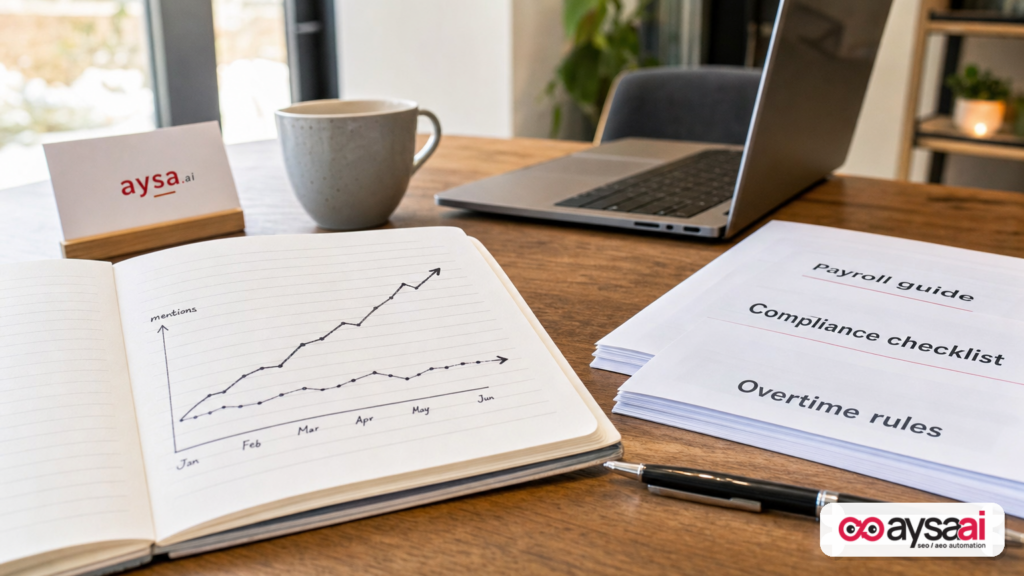
- Measure three layers: mentions (AEO/GEO), citations (source trust), and business outcomes (leads/revenue).
- Move from advice to action: use a system that monitors, prepares changes, asks for approval, and executes—so improvements don’t die in a backlog.
Table of contents
- What changed: from ranking pages to earning mentions
- Why topical authority still matters in AI search
- The durable advantage: why topical authority compounds in AI answers
- A practical model: the “category ownership” scoreboard
- How to pick the right categories (and avoid the expensive ones)
- Mentions vs. citations: what to optimize for (and what not to)
- Entity clarity: the non-negotiable foundation for AI visibility
- What “topical authority content” looks like in 2026 (without publishing 200 posts)
- Local businesses: topical authority is also local clarity
- The SME scenario: a local clinic competing in AI answers
- What agencies should rethink: deliver ownership, not output
- Where AYSA.ai fits: monitoring + approved execution
- What to do next
- Sources and further reading
What changed: from ranking pages to earning mentions
For 20 years, most SEO programs could be summarized as: rank pages → earn clicks → convert traffic.
AI answers compress that funnel. Users ask a question and get:
- a synthesized explanation,
- a short list of recommended options,
- sometimes citations,
- often enough information to decide without clicking.
The Search Engine Land piece (based on Semrush AI visibility data in ChatGPT) highlights the key implication: AI answers develop “topic owners.” Brands that achieve an outsized share of mentions in a category frequently keep it over time.
That’s a different battleground. You’re not only competing for the blue link. You’re competing to be named as the answer set for a topic—and to stay there as AI systems update sources and interpret prompts.
If you’re an SME, that can feel intimidating. The good news is the dataset described in the source suggests many high-demand categories may not yet be “owned” by a single dominant brand in AI answers, which creates opportunity for challengers.
Why topical authority still matters in AI search
Topical authority gets abused as an SEO buzzword. People use it to justify “publish more content” without a plan. That’s not what we mean here.
In plain English, topical authority is:
- Coverage: you reliably answer the important questions in your category.
- Consistency: your answers don’t contradict each other and remain updated.
- Clarity: the web can identify what you sell, who you serve, where you operate, and why you’re credible.
- Proof: you demonstrate legitimacy via policies, documentation, examples, customer language, and reputable references.
Those traits map well to how AI systems choose and summarize sources. Even when users don’t click, the AI still needs reliable inputs. And when it generates a shortlist, it tends to reuse entities (brands) that fit the category and the prompt consistently.
The Search Engine Land article also connects topical authority to a strategic outcome: durability. If your goal is “category ownership” (being mentioned across many prompt types), the compounding effect matters more than one-off spikes.
The durable advantage: why topical authority compounds in AI answers
Here’s the mental model I use with founders: AI search rewards portfolios, not lottery tickets.
In classic SEO, you could sometimes win by discovering a few under-competitive keywords, publishing targeted pages, and building links. That still exists, but AI answers have a tendency to:
- collapse multiple queries into one “topic conversation,”
- reuse a small set of trusted sources across variations of prompts,
- push buyers toward a shortlist instead of a broad results page.
That means small improvements in how well your site represents a topic can have outsized effects on how often you’re named. And once you’re named repeatedly, you become “easy” for the model to pick again because you’re already aligned with the prompt pattern.
This is why topical authority is a defensive moat. It’s not just about getting in; it’s about becoming hard to replace.
The source study also suggests challengers can win when the leading brand’s margin is narrow, but owners with wider leads are harder to dethrone. Translation: don’t waste your best months attacking a category that is already fully consolidated unless you have a real wedge.
A practical model: the “category ownership” scoreboard
Most SMEs don’t need a sophisticated AI lab. They need a scoreboard that turns this into weekly work.
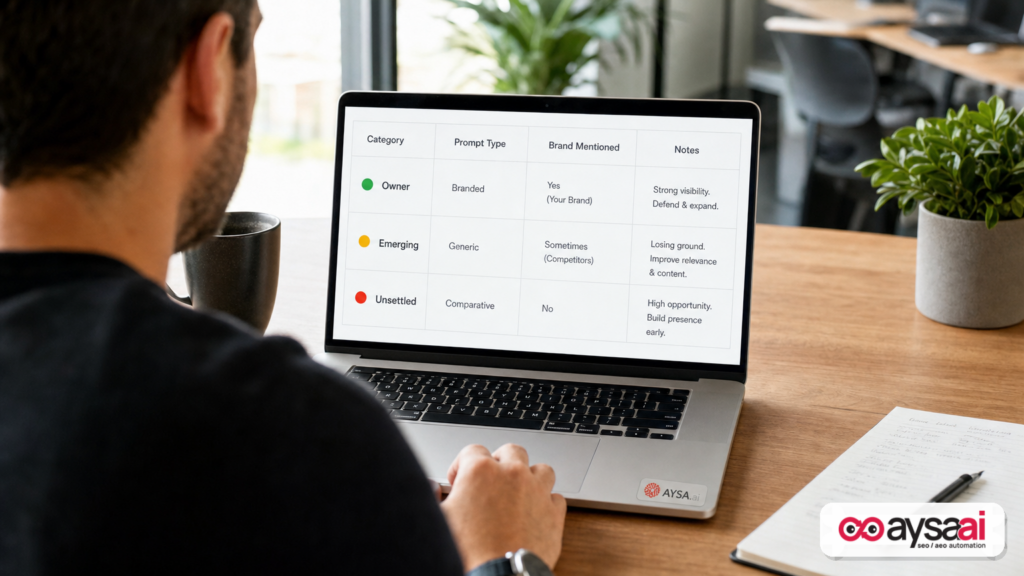
Build a simple “category ownership” sheet with:
- Category (the commercial topic you want to be known for)
- Prompt type (definition, comparison, alternatives, use case, buying question)
- Brands mentioned (who shows up in the AI answer)
- Citations (which sites are referenced when available)
- Your gap (what’s missing on your site or off-site footprint)
- Next action (content, schema/entity, product positioning, third-party proof)
Then classify categories into three buckets, similar to the research framing in the Search Engine Land piece:
- Owned: one brand consistently dominates mentions across prompt types.
- Emerging leader: a brand leads but not decisively; volatility is higher.
- Unsettled: no consistent leader; opportunity is high.
The purpose isn’t to obsess over labels. It’s to decide where to invest so your work compounds instead of scattering across semi-related topics.
How to pick the right categories (and avoid the expensive ones)
The most common strategic error I see: businesses “pick categories” based on search volume alone.
In AI search, you should pick categories using three filters:
Filter 1: commercial proximity
If the topic doesn’t naturally lead to your product/service being considered, it’s not a category—it’s a content distraction. The source article uses a payroll software example: you can chase broad finance topics, or you can build deep payroll coverage that eventually makes “Which payroll software should I use?” prompts more likely to include your brand.
SME translation:
- A local dentist shouldn’t try to “own wellness.”
- A boutique hotel shouldn’t try to “own travel.”
- An ecommerce brand shouldn’t try to “own lifestyle.”
win-ability (is the category already locked?)
If one brand appears in almost every prompt variation, the cost to displace them is usually high. The Semrush/ChatGPT study described in Search Engine Land suggests ownership is sticky when the lead is wide.
Your best play is often to:
- defend what you already lead,
- attack unsettled categories,
- or pick a narrower subcategory where you have unique proof.
proof advantage
Ask: what can we prove that others can’t?
- certifications,
- clear inventory depth,
- documented process,
- local footprint,
- unique expertise,
- original research,
- credible third-party coverage.
AI systems (and buyers) respond to proof. If you can’t outspend incumbents, you can often out-clarify and out-document them in a focused lane.
Mentions vs. citations: what to optimize for (and what not to)
The Search Engine Land analysis makes a distinction that matters operationally:
- Mentions = the brand is named in the answer.
- Citations = the AI points to sources/URLs (when it does).
Why you should care: user behavior in AI interfaces often skews toward reading the answer and selecting from the shortlist, not clicking around. The Search Engine Land piece references related research from the author about how users build (or don’t build) shortlists in AI mode, reinforcing the idea that being named is powerful.
From an SME perspective, here’s the practical implication:
- Optimize for “being included,” not just “being cited.” A cited URL is useful, but brand inclusion is what moves consideration.
- Don’t treat citations as a KPI you can game. Citations are a signal of source trust; they’re not always the lever that increases mentions directly.
So what do you actually do?
- Build category-level clarity (what you are, what you do, who you serve).
- Build prompt-level coverage (answer each intent type cleanly).
- Build proof and reputation (on-site and off-site).
Entity clarity: the non-negotiable foundation for AI visibility
If topical authority is the strategy, entity clarity is the plumbing.
AI systems don’t just read pages; they try to understand entities: brands, products, services, locations, people, and their relationships. If your website is confusing about what entity you are, your “topical authority” work leaks value.
Here are the entity clarity basics most SMEs need to get right:
1) About + who-it’s-for + proof
- A real About page that matches your market positioning.
- Clear service/product pages with constraints (who you serve, where you serve, what you don’t do).
- Proof elements: policies, certifications, team bios, case studies where appropriate.
2) Structured data (schema) and entity gaps
Structured data helps search systems interpret your pages. The source context includes a related Search Engine Land piece on schema and entity gaps: Schema for AI search: How to identify and prioritize entity gaps. You don’t need to implement every schema type under the sun; you need to implement the right ones correctly and consistently.
Typical starting points:
- Organization schema (with consistent name, logo, sameAs links where appropriate)
- Product/Service schema (depending on the business)
- FAQ schema where it genuinely fits
- LocalBusiness schema for local operators
Important: schema won’t magically make you a category owner. But bad schema (or inconsistent identity) can prevent you from being understood and included.
3) Audit your AI entity footprint
The source context also points to a related item: How to audit your AI entity footprint. Even without copying their methodology, the directional guidance is sound: you need to understand where your entity is represented, missing, or inconsistent across the web.
If AI can’t confidently reconcile your brand identity (name variants, addresses, service area, product names), you’ll see inconsistent visibility even with good content.
What “topical authority content” looks like in 2026 (without publishing 200 posts)
SMEs don’t lose because they don’t publish enough. They lose because they publish the wrong things—or publish without connecting content to a clear conversion path.
Use the “prompt types” framework and build a minimum viable topical cluster per category:
1) Definition / basics
One strong page that explains the concept in plain language, who it’s for, and what decisions it influences. This is where clarity matters. The source context includes another relevant Search Engine Land article: The new SEO rules for bloggers in 2026: Why clarity matters in AI search.
2) Comparison page
“X vs Y” or “Best for [use case]” style pages that help buyers decide. These are hard because they require fairness and specificity. Done well, they’re often where brands earn mentions for commercial prompts.
3) Alternatives page
Yes, including competitors can be uncomfortable. But buyers ask for alternatives in AI prompts constantly. If you don’t have a thoughtful alternatives page, you’re opting out of a major prompt class.
4) Use case / job-to-be-done page
“How to solve [problem]” content that maps to your offering without becoming a generic blog post. Practical templates, checklists, and decision criteria help here.
5) Buying question page
“How much does it cost?”, “What should I choose?”, “What are the risks?”, “What should I ask vendors?” If you answer these with specificity, you’re building the same decision scaffolding the AI tries to provide.
6) Documentation / policies / proof library
For services: process, timelines, guarantees, what’s included, aftercare, refund policies. For ecommerce: shipping, returns, sizing, materials, sourcing. For SaaS: security, implementation, integrations, SLAs. These are trust accelerators for both humans and AI summarization.
Note: This is not “publish endlessly.” It’s cover the prompt set completely, then maintain it. The Search Engine Land source also hints at the risk of going too broad (examples of large sites that were demoted after expanding beyond core topics). The lesson for SMEs is simple: don’t dilute the signal you’re trying to send.
Local businesses: topical authority is also local clarity
Local businesses often assume AI search is only a problem for SaaS or publishers. That’s a mistake.
AI answers routinely include local-intent suggestions (“best near me,” “best for families,” “same-day,” “takes insurance,” etc.). To compete, local brands need both topical authority and clean local signals.
The source context includes a relevant local angle: How semantics and topical authority improve local SEO and another operational warning about Google Business Profile address changes: Why Google Business Profile address changes can disrupt local rankings.
You don’t need to over-engineer local SEO to benefit from AI visibility. You do need to:
- Keep your location and service area consistent across your site and profiles.
- Describe services in the language customers use (symptoms, needs, constraints).
- Maintain clear pages for each primary service line.
- Make it easy to verify legitimacy (address, phone, hours, licensing where applicable).
The SME scenario: a local clinic competing in AI answers
Let’s make this concrete with a realistic scenario.
Business: a regional dermatology clinic with two locations.
Problem: organic traffic is flat, referrals are slowing, and staff hears patients say, “I asked ChatGPT and it recommended…” but the clinic rarely gets named.
Wrong approach: publish 50 generic blog posts about “skincare tips” and “what is acne” without a strategy. You might get some impressions, but you won’t own the decision prompts that drive bookings.
Right approach (category ownership):
Step 1: choose 3 categories that map to revenue
- Acne treatment (medical)
- Skin cancer screening (medical)
- Laser hair removal (cosmetic)
Step 2: define prompt types to monitor monthly
- Definition: “What is a skin cancer screening?”
- Comparison: “Dermatologist vs med spa for laser hair removal”
- Alternatives: “Alternatives to isotretinoin” (with careful medical framing)
- Use case: “How to treat adult acne when topical products fail”
- Buying/local: “Best dermatologist for acne in [city]”
Step 3: close gaps with clarity + proof
- Create a clean “Acne care” hub with treatment pathways, what qualifies, what to expect, cost ranges where appropriate, and aftercare.
- Build comparison pages that explain safety and supervision differences (no fear tactics, just factual criteria).
- Add doctor bios and credentials near relevant services.
- Implement LocalBusiness/Organization schema correctly and maintain consistent location pages.
Step 4: measure what matters
- Mentions: does the clinic’s name appear more often for the monitored prompts?
- Citations: is the clinic’s site referenced as a source?
- Business outcomes: call volume, form fills, booked consults, “how did you hear about us?” responses.
This is topical authority as an operating system: fewer pages, higher intent, clearer entity signals, and measurable progress.
What agencies should rethink: deliver ownership, not output
Agencies are under pressure because AI content made output cheap. If an agency’s value proposition is “we publish X posts per month,” that’s a race to the bottom.
AI search forces a different deliverable:
- Category selection: where we can win and why.
- Prompt coverage: how we cover the intent set completely.
- Entity integrity: schema, on-site identity, off-site consistency.
- Proof acquisition: credible third-party mentions and references (earned, not invented).
- Measurement: mentions + citations + business outcomes.
There’s also a workflow implication. The source context includes an article on creating feedback loops for self-improving AI content workflows: 7 feedback loops for self-improving AI content workflows. Whether you follow that exact framework or not, the principle is right: you need feedback loops. AI search changes monthly. Your process can’t be “publish and pray.”
Where AYSA.ai fits: monitoring + approved execution
Strategy fails at execution. That’s not a slogan—it’s the daily reality for SMEs and lean marketing teams.
Topical authority in AI search requires:
- monitoring prompt sets and categories over time,
- finding gaps (content + entity + proof),
- prioritizing what to fix next,
- actually implementing changes on the website,
- and repeating monthly.
AYSA.ai is built to make that operational. Our model is simple:
- Monitor what’s happening (visibility, coverage, site signals) using monitoring.
- Prepare recommended website improvements (content updates, internal linking, structured data, page clarity, technical fixes).
- Ask for approval before changes go live (so business owners stay in control).
- Execute the accepted changes reliably—so progress isn’t stuck in tickets and backlogs.
If your goal is AI search visibility and category ownership, AYSA supports the practical work behind it:
- AI search visibility focus: see what visibility means and how we frame it at AYSA AI Search Visibility.
- Tooling and workflows: explore our approach at AYSA AI SEO Tools.
- Learning and examples: more editorials and playbooks at AYSA Blog.
- Implementation reality: if you’re evaluating cost and scope, start at Pricing.
In other words: we’re not here to tell you “topical authority matters.” We’re here to help you earn it—and keep it—through a repeatable, approved execution loop.
What to do next
If you want a practical starting plan you can run in the next 30 days, do this:
1) Choose 5–10 commercial categories you want to own
Be honest. If it’s not connected to revenue, it’s a distraction.
2) Write 5 prompt types per category
- Definition
- Comparison
- Alternatives
- Use case
- Buying question
3) Track mentions monthly
Don’t overreact to one week. Look for trends. Investigate when leaders change.
4) Identify your “gap set”
- Which prompt types are you missing pages for?
- Which pages exist but are vague, outdated, or thin?
- Where is your entity unclear (brand/service/location)?
5) Build a minimum viable topical cluster
Focus on completeness and quality, not volume. Build the pages that match the prompt types.
6) Operationalize execution
If you struggle to ship changes consistently, use an approved execution system. Start with monitoring and a clear cadence (monthly AI visibility review + weekly implementation).
Sources and further reading
- Search Engine Land: Does topical authority matter in AI search?
- Search Engine Land: The new SEO rules for bloggers in 2026: Why clarity matters in AI search
- Search Engine Land: How semantics and topical authority improve local SEO
- Search Engine Land: Schema for AI search: How to identify and prioritize entity gaps
- Search Engine Land: How to audit your AI entity footprint
- Search Engine Land: 7 feedback loops for self-improving AI content workflows
- Search Engine Land: Why Google Business Profile address changes can disrupt local rankings
AYSA.ai related: AI Search Visibility • AI SEO Tools • Monitoring • Pricing • Blog
Continue the AI search topic inside AYSA.
Use these pages to connect the article with AI SEO tools, AI visibility monitoring, AI Overviews and approved website execution.
Turn this topic into a website action plan.
Use these AYSA hubs to move from reading to technical fixes, AI visibility monitoring, research, glossary context and approval-first SEO execution.

